The 4Ps of marketing (Product, Price, Place, Promotion) is the classic “marketing mix” framework most teams reach for when they need an actionable go‑to‑market plan. And yet, teams still waste hours rebuilding the same grid in different docs. In a Jeda.ai AI Workspace, you can generate the 4Ps matrix, keep it editable, and collaborate on it like a living board on an AI Whiteboard—the same one used by 150,000+ users.
What are the 4Ps of Marketing?
The 4Ps of marketing is a managerial framework that organizes controllable marketing decisions into four categories: Product, Price, Place, and Promotion. The modern 4Ps model is commonly attributed to E. Jerome McCarthy (1960), building on earlier “marketing mix” thinking discussed by Neil Borden (1964).
Conceptually, the 4Ps helps you move from “we should market this better” to a structured set of decisions: what you offer, what you charge, where customers get it, and how you communicate value. It’s widely taught because it is simple, memorable, and operational.
But simplicity has a cost. In service-heavy or relationship-driven markets, many scholars have argued the 4Ps is incomplete, which is why extensions like the 7Ps (adding People, Process, Physical Evidence) became popular in services marketing.
Why use the 4Ps marketing mix with AI?
Using AI doesn’t replace the framework; it changes the workflow around the framework. In practice, teams struggle with three bottlenecks: collecting inputs, drafting coherent options, and revising quickly when assumptions change. A visual-first AI tool reduces those bottlenecks while keeping the structure intact.
Evidence-in, editable visuals-out
A big weakness in many 4Ps templates is that they start as blank boxes and end as vague slogans. In a Jeda.ai AI Workspace, you can bring in materials (briefs, notes, research summaries, positioning docs), then generate an editable matrix on an AI Whiteboard. The output is not a static paragraph; it is a board your team can edit, comment on, and reuse.
And yes—this is where Visual AI matters: you can keep the reasoning and the deliverable in the same visual artifact.
Faster iteration without losing rigor
Marketing strategy is rarely “one and done.” Pricing changes, distribution shifts, promotion channels saturate, and product scope expands. The value of AI is iteration speed: you can generate a first pass, test internal consistency, and revise. The academic standard still applies: assumptions should be explicit, sources should be traceable, and decisions should be justified.
- Evidence-in workflows
Start from briefs, research notes, and product docs so the 4Ps is grounded in actual inputs, not generic filler.
- Editable marketing mix
Treat the 4Ps as a living artifact. Update a quadrant, annotate assumptions, and keep decision context on the board.
- Collaboration that stays visual
Review and revise on an AI Whiteboard with stakeholders. Less copy-paste. Fewer “which version is current?” debates.
The 4Ps matrix: Product, Price, Place, Promotion
A useful 4Ps matrix is specific enough that a team could execute it without “translating” it into five more documents. Below are the typical decision variables for each quadrant.
Product decisions
Product answers: What are we selling, and why should the customer care? That includes the core offering, the feature set, packaging, differentiation, and the supporting service model.
Price decisions
Price answers: What do we charge, and how do we justify it? Price is never a number alone. It’s also the logic of value, discounting, terms, and willingness-to-pay constraints.
Place decisions
Place answers: Where and how does the customer obtain the offering? This includes channels, distribution partners, marketplaces, direct sales, and the end-to-end purchasing path.
Promotion decisions
Promotion answers: How do we communicate value and trigger action? Promotion includes messaging, media mix, content strategy, sales enablement, and timing.
How to create a 4Ps of Marketing matrix in Jeda.ai
You can build a 4Ps of marketing matrix in Jeda.ai in two ways. The output is the same: an editable Matrix on an AI Whiteboard inside your AI Workspace.
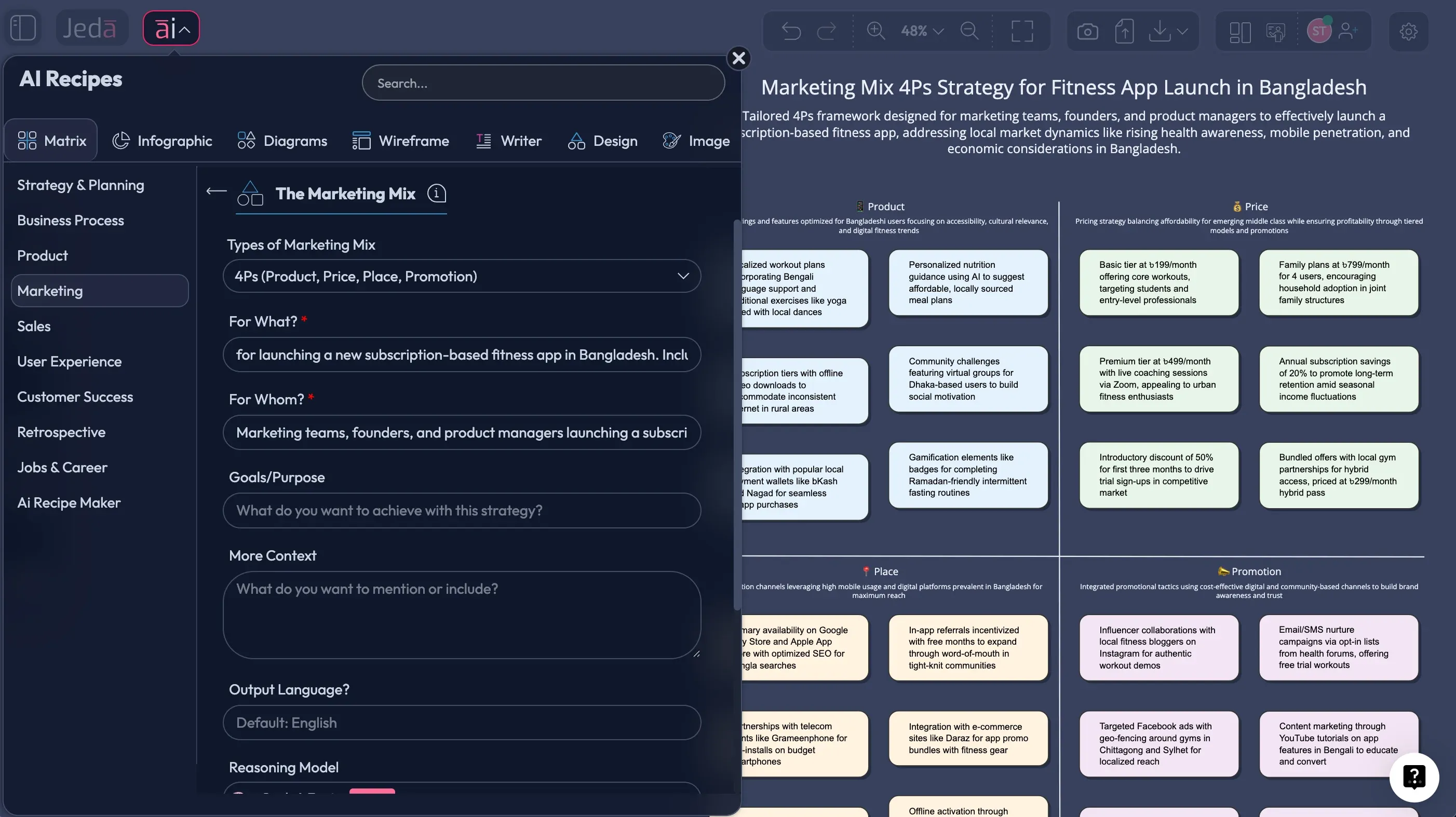
Method 1: Recipe Matrix (AI Menu)
Use this when you want a structured starting point and consistent formatting.
- Open the AI Menu (top-left).
- Choose Matrix Recipes.
- Select the "4Ps of Marketing" template.
- Add brief context: offer, target segment, market, constraints, and timeframe.
- Click Generate, then edit the outputs on the canvas.
Method 2: Prompt Bar (Matrix command)
Use this when you want maximum control over your inputs.
- Open the Prompt Bar at the bottom of the canvas.
- Select the Matrix command.
- Paste a prompt that specifies the product, audience, goals, constraints, and desired level of detail.
- Press Enter to generate.
- Edit the matrix text, add icons, and rearrange for your team’s workflow.
Prompt template (copy/paste):
“Create a 4Ps of marketing matrix (Product, Price, Place, Promotion) for: [product/service]. Target segment: [segment]. Market: [region]. Positioning: [premium/value]. Constraints: [budget, timing, channels]. Include 5–7 bullets per quadrant with practical decisions, not generic statements.”
AI+ button deep dive (extend without re-writing)
Once your matrix exists, you will usually want depth in one quadrant (pricing details, channel rollout, or promotion plan). That’s when the AI+ button is useful.
- Select a quadrant (or a specific sticky note inside it).
- Tap AI+ to extend the content.
- Review and edit what gets added. Keep what is supported. Remove what is speculative.
This keeps your 4Ps board coherent because you are extending inside the same structure, instead of generating disconnected paragraphs elsewhere.
Convert the matrix into an execution workflow (optional)
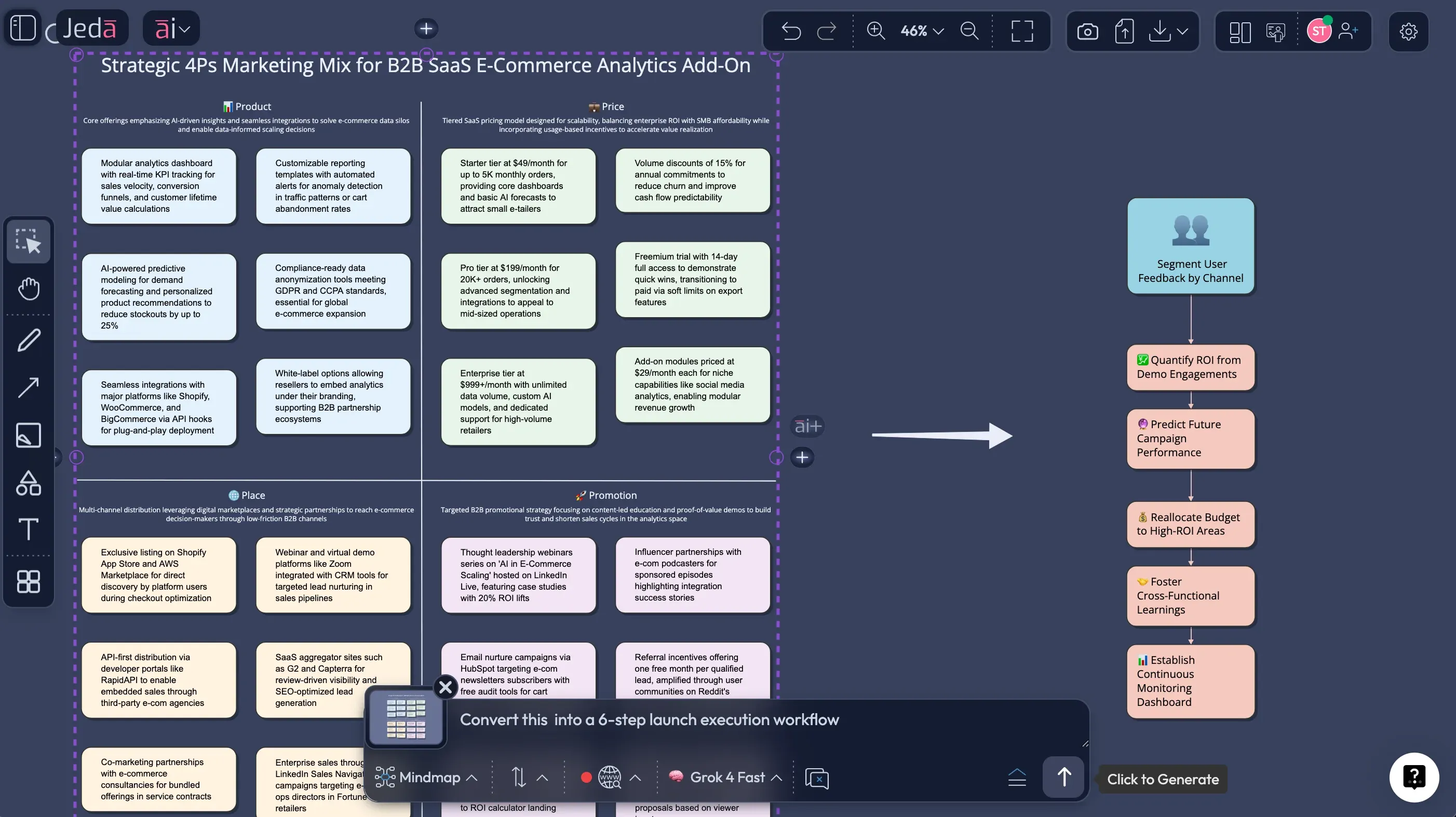
If you want to move from “strategy” to “who does what next,” use Vision Transform to convert the Matrix into a Flowchart (launch steps), a Mindmap (campaign ideation), or a Diagram (customer journey map). The board remains editable.
And when you need to ship it, export as PNG, SVG, or PDF (those are the supported export formats).
- Collect inputs
Gather product notes, target segment definition, constraints, and any existing market research you want reflected in the marketing mix.
- Choose a matrix path
Use Method 1 (AI Menu → Matrix Recipes) for a structured template, or Method 2 (Prompt Bar → Matrix) for full control over instructions.
- Generate the 4Ps grid
Create a 4-cell matrix and label the quadrants Product, Price, Place, and Promotion.
- Make it decision-grade
Replace vague bullets with concrete choices: tiers, channels, rollout sequencing, creative formats, and measurable goals.
- Extend selectively with AI+
Use the AI+ button to expand one quadrant at a time, then prune items that are not supported by evidence or constraints.
- Convert to execution views
Use Vision Transform to convert the matrix into a Flowchart (plan), Mindmap (ideas), or Diagram (journey) without rebuilding the content.
- Export and share
Export the board as PNG, SVG, or PDF and share it with stakeholders or attach it to your launch documentation.
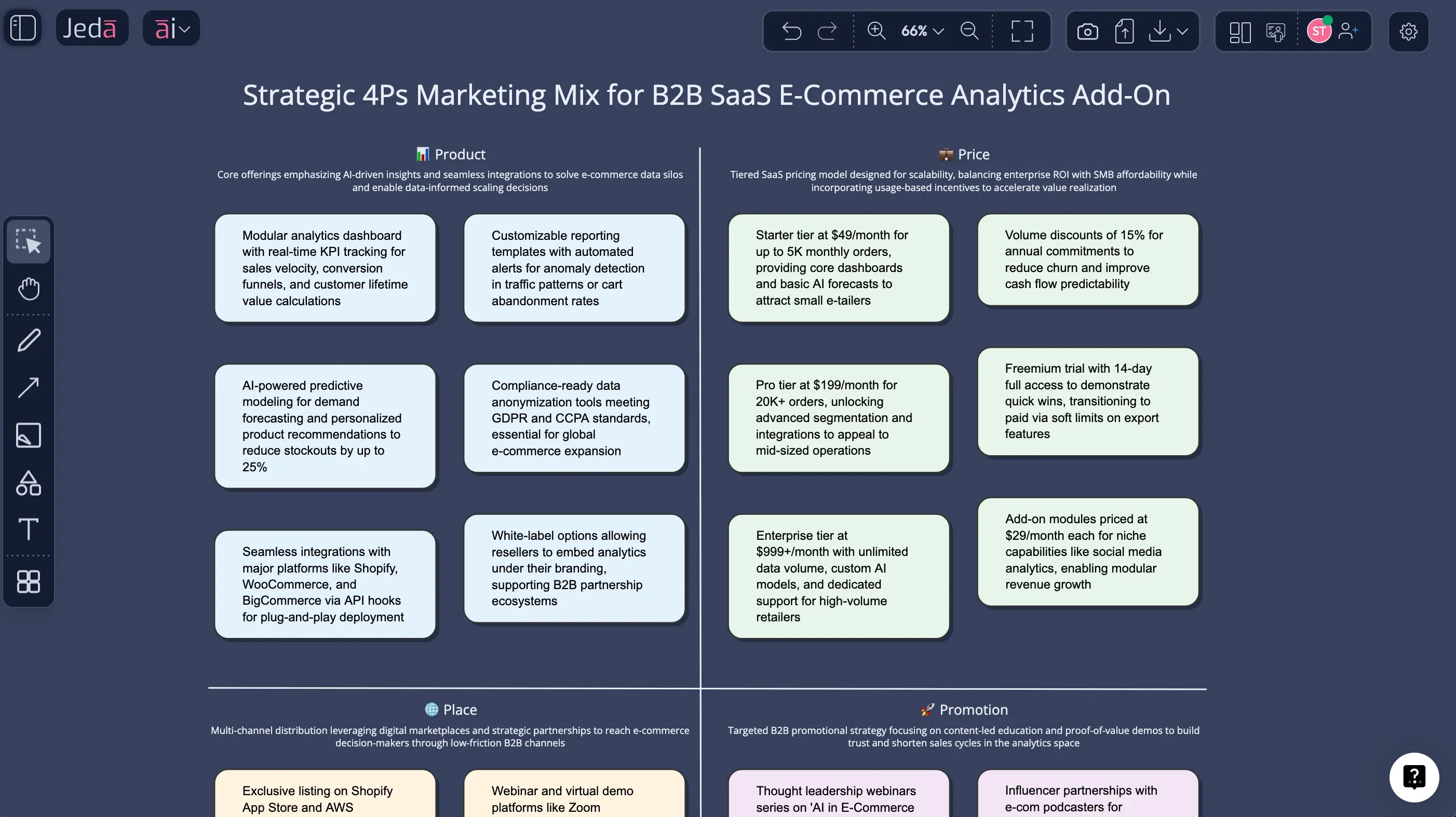
Example 4Ps marketing mix (worked example)
To keep this concrete, consider a hypothetical B2B SaaS: an analytics add‑on for e‑commerce teams.
Best practices and common mistakes
Good 4Ps work is mostly about internal consistency.
Common mistakes:
- Writing slogans instead of decisions (“best quality”, “great service”)
- Treating “Place” as a single channel (“online”) rather than an acquisition + fulfillment path
- Picking promotion tactics without a measurement plan
- Forgetting the framework’s limitations (services or relationship contexts may need 7Ps)
- Updating one quadrant and ignoring the ripple effect across the other three
Frequently Asked Questions
- What are the 4Ps of marketing?
- The 4Ps of marketing are Product, Price, Place, and Promotion. They are a structured way to organize the controllable decisions you make to bring a product or service to market and communicate its value.
- Who created the 4Ps model and when?
- The 4Ps framework is commonly attributed to E. Jerome McCarthy, who presented it in 1960 in Basic Marketing: A Managerial Approach. The broader marketing mix concept was discussed earlier by Neil Borden (1964).
- When should I use the 4Ps instead of STP?
- Use STP (segmentation, targeting, positioning) to decide who you are serving and how you will position. Use the 4Ps after that to translate positioning into executable decisions about the offer, pricing, channels, and promotion.
- Does the 4Ps model work for services and SaaS?
- It often works as a baseline, but service-heavy offerings may need an expanded view such as the 7Ps (adding People, Process, Physical Evidence). Many services marketing scholars adopted extensions because the 4Ps can under-specify delivery and experience variables.
- Can AI generate a marketing mix matrix that is actually usable?
- Yes, if you provide grounded inputs. AI can draft structured options quickly, but the output becomes usable only when you add constraints (budget, channel limits, timelines) and then edit to ensure the four quadrants are internally consistent.
- How does Jeda.ai help with the 4Ps specifically?
- Jeda.ai generates an editable 4Ps matrix as a visual artifact in an AI Workspace. You can collaborate on an AI Whiteboard, extend a quadrant with the AI+ button, and convert the matrix into other views (like a launch flowchart) without rebuilding.
- How do I export a 4Ps board from Jeda.ai?
- You can export Jeda.ai boards as PNG, SVG, or PDF. Choose the export format based on your use case: PNG for quick sharing, SVG for design editing, and PDF for documentation and sign-off packages.
- How much does Jeda.ai cost?
- Jeda.ai offers Whitebelt (Free), Blackbelt ($10/month), and Shifu ($39/month). The free tier includes all 11 commands with limited daily usage; paid plans increase usage and collaboration, and Shifu adds multi-model intelligence with an aggregator.
- How often should we update our 4Ps matrix?
- Update it whenever a core assumption changes (pricing, channel access, product scope, or positioning). In practice, many teams revisit the 4Ps monthly during active launches and quarterly for steady-state products.
Sources & Further Reading
- [1]
McCarthy, E. Jerome (1960) . “Basic Marketing: A Managerial Approach” R.D. Irwin (Book).
View Source ↗ - [2]
Borden, Neil H. (1964) . “The Concept of the Marketing Mix” Journal of Advertising Research.
View Source ↗ - [3]
American Marketing Association (2022) . “The Four Ps of Marketing” AMA.org.
View Source ↗ - [4]
Grönroos, Christian (1994) . “From Marketing Mix to Relationship Marketing: Towards a Paradigm Shift in Marketing” Management Decision / Asia-Australia Marketing Journal.
View Source ↗ - [5]
Rafiq, Mohammed; Ahmed, Pervaiz K. (1995) . “Using the 7Ps as a Generic Marketing Mix: An Exploratory Survey of UK and European Marketing Academics” Marketing Intelligence & Planning.
View Source ↗ - [6]
O’Sullivan, Helen; Ngugi, Isaac (2022) . “Marketing Mix (teaching note citing Kotler & Armstrong, 2016 definition)” Bournemouth University (PDF).
View Source ↗
Start Your 4Ps Marketing Mix in Jeda.ai
Join over 150,000+ users who use Jeda.ai as an AI Workspace for editable, decision-ready visuals.
Try Free Template