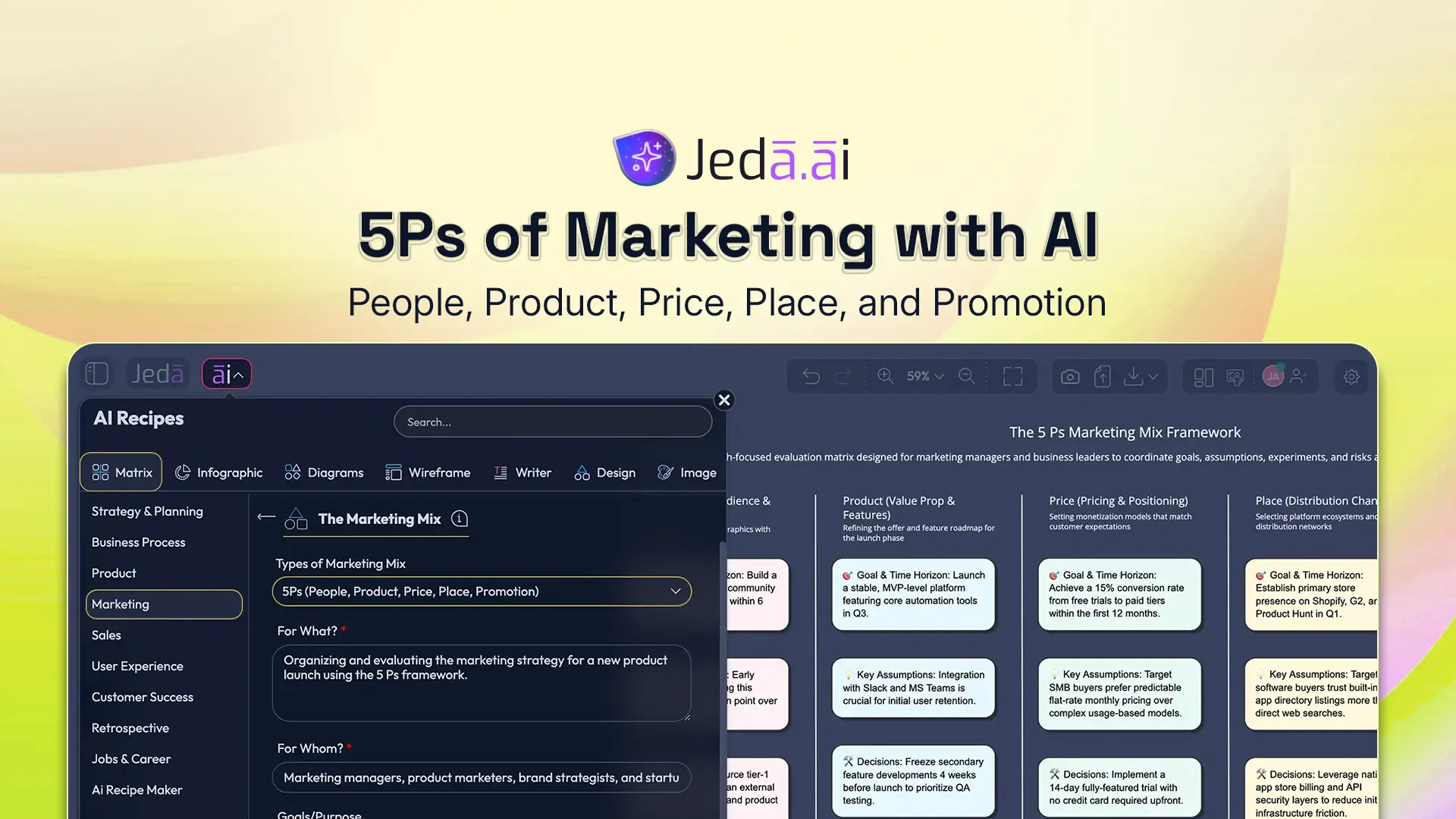
The 5 Ps of marketing turn “we should do more marketing” into decisions you can actually ship. You lay out People, Product, Price, Place, and Promotion in one matrix, then force the team to answer the annoying (but profitable) questions: Who exactly are we for? What are we selling? What will it cost? Where will it be available? How will people hear about it?
Now add AI. In a good AI Workspace and AI Whiteboard, you can pull context from your notes, summarize research, and draft options fast—without turning your marketing plan into a 37-page PDF nobody reads. Jeda.ai does this kind of “visual thinking with outputs you can edit” really well, which is why 150,000+ users use it for strategy work and planning boards.
What are the 5 Ps of marketing
The 5 Ps of marketing are a marketing mix framework: People, Product, Price, Place, and Promotion. It expands the classic 4Ps (Product, Price, Place, Promotion) commonly associated with E. Jerome McCarthy’s 1960 model, by adding People to reflect customer experience and the humans who deliver the promise.
If you’ve seen “7Ps” (adding People, Process, Physical Evidence), that comes from services marketing discussions in the early 1980s; People shows up there as a core extension.
Here’s the practical version:
- People: Who you serve, and who serves them (customers + team + support).
- Product: What you sell (and what problem it solves).
- Price: What customers pay, and why it feels fair.
- Place: Where and how customers buy (channels, distribution, availability).
- Promotion: How you drive awareness, trust, and conversion (messages + tactics).
Why use the 5 Ps of marketing with AI
Using the 5Ps with AI is less about “automation” and more about decision compression. Instead of debating each “P” in separate meetings, you generate options, test assumptions, and document the logic in one place.
A strong AI-assisted 5P workflow helps you:
- Start from evidence, not vibes. Bring in docs, competitive notes, spreadsheets, interview transcripts, or campaign results and synthesize them into the matrix.
- Generate multiple options per P quickly. Useful when you’re choosing between two price points, two channels, or three positioning angles.
- Keep decisions editable and collaborative. AI drafts; humans decide; the board stays current.
- Create one source of truth. Your 5P matrix becomes the artifact you revisit, not a slide that dies after Monday.
Research on AI in marketing consistently frames the big value as improving decision quality and speed—especially when teams can translate insight into action.
- Faster option sets
Generate 2–4 viable options for each P (price tiers, channels, offer bundles) without starting from a blank page.
- Evidence-in workflows
Summarize research notes, customer interviews, or campaign data into the matrix so the team can see the “why,” not just the “what.”
- Aligned execution
When the 5Ps live on an AI Whiteboard, teams can comment, refine, and update the plan in real time—no spreadsheet archaeology required.
The 5Ps marketing mix matrix template
This is a matrix page because the goal is not “explain the 5Ps.” The goal is make the 5Ps usable.
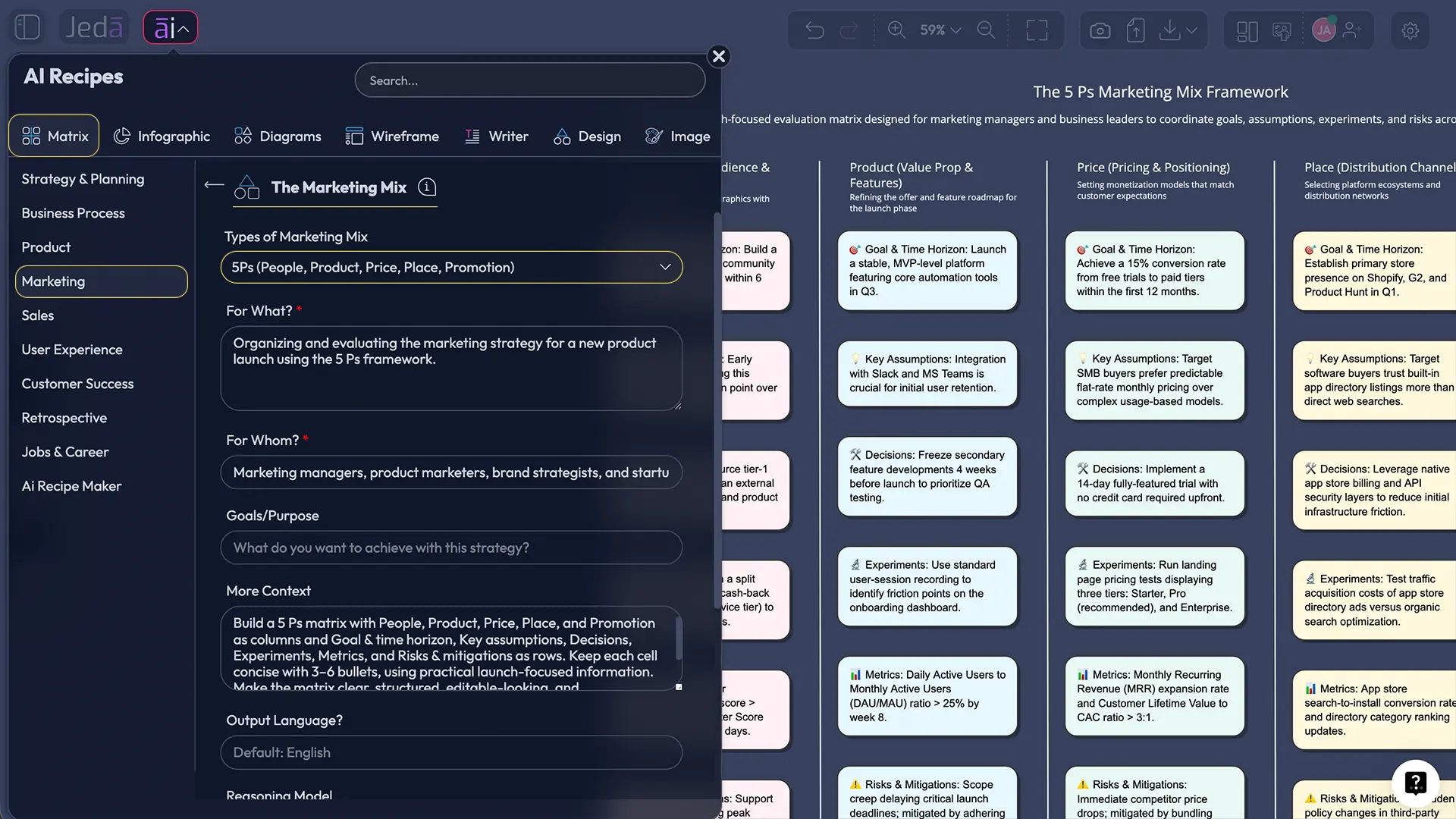
Use columns = the 5Ps, and rows = the decisions you must lock.
Recommended 6-row structure (simple, sharp, reusable):
- Goal & time horizon (what success looks like, and by when)
- Key assumptions (what you believe today)
- Decisions to make (what you must commit to)
- Experiments (how you’ll test assumptions fast)
- Metrics (what you’ll track weekly)
- Risks & mitigations (what could break, and how you’ll respond)
How to create a 5 Ps of marketing matrix in Jeda.ai
You’ll build the same 5P matrix two ways:
- Method 1: Recipe Matrix (AI Menu)
- Method 2: Prompt Bar (Matrix command)
After that, you can use the AI+ button to extend parts of the board (more on that below), and Vision Transform if you want to convert the matrix into a flowchart or mind map.
Method 1: Recipe Matrix (AI Menu)
This method is best when you want a structured starting point and consistent formatting across teams.
- Open a new board in Jeda.ai
Create a fresh canvas for your 5Ps marketing mix. You’re building a single source of truth, not a one-off doc.
- Open the AI Menu
Click AI Menu in the top-left to browse recipes (templates) built for structured visuals.
- Choose a Matrix recipe
Select the 5Ps of Marketing template.
- Generate, then edit together
Click Generate. Refine wording, add links, adjust layout, and assign owners directly on the AI Whiteboard.
Method 2: Prompt Bar (Matrix command)
Use this when you want full control over the prompt, or when you’re building a very specific 5P structure.
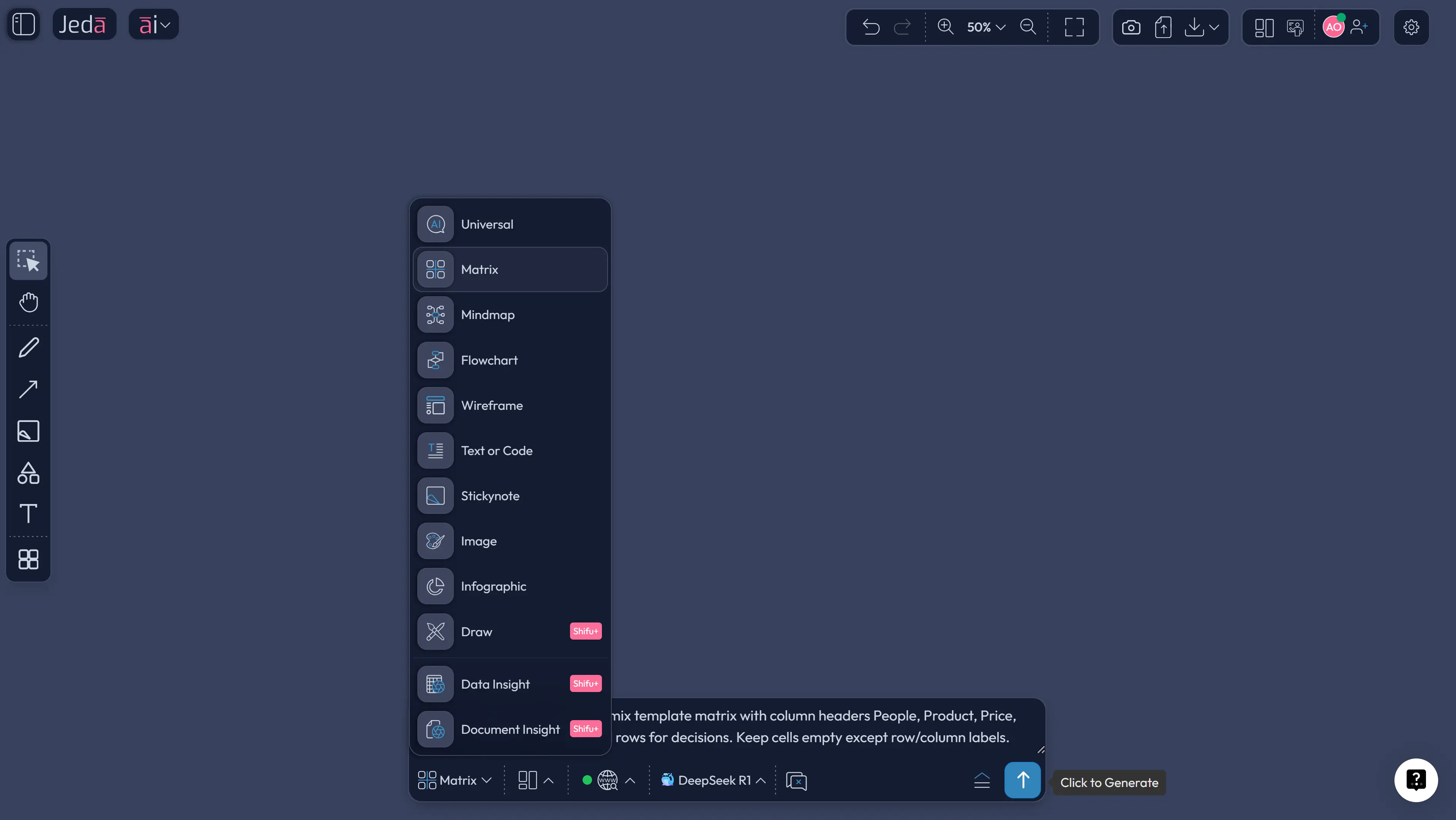
- Open the Prompt Bar at the bottom of the canvas.
- Select the Matrix command.
- Paste a prompt like the one below.
- Press Enter to generate.
Prompt (copy/paste):
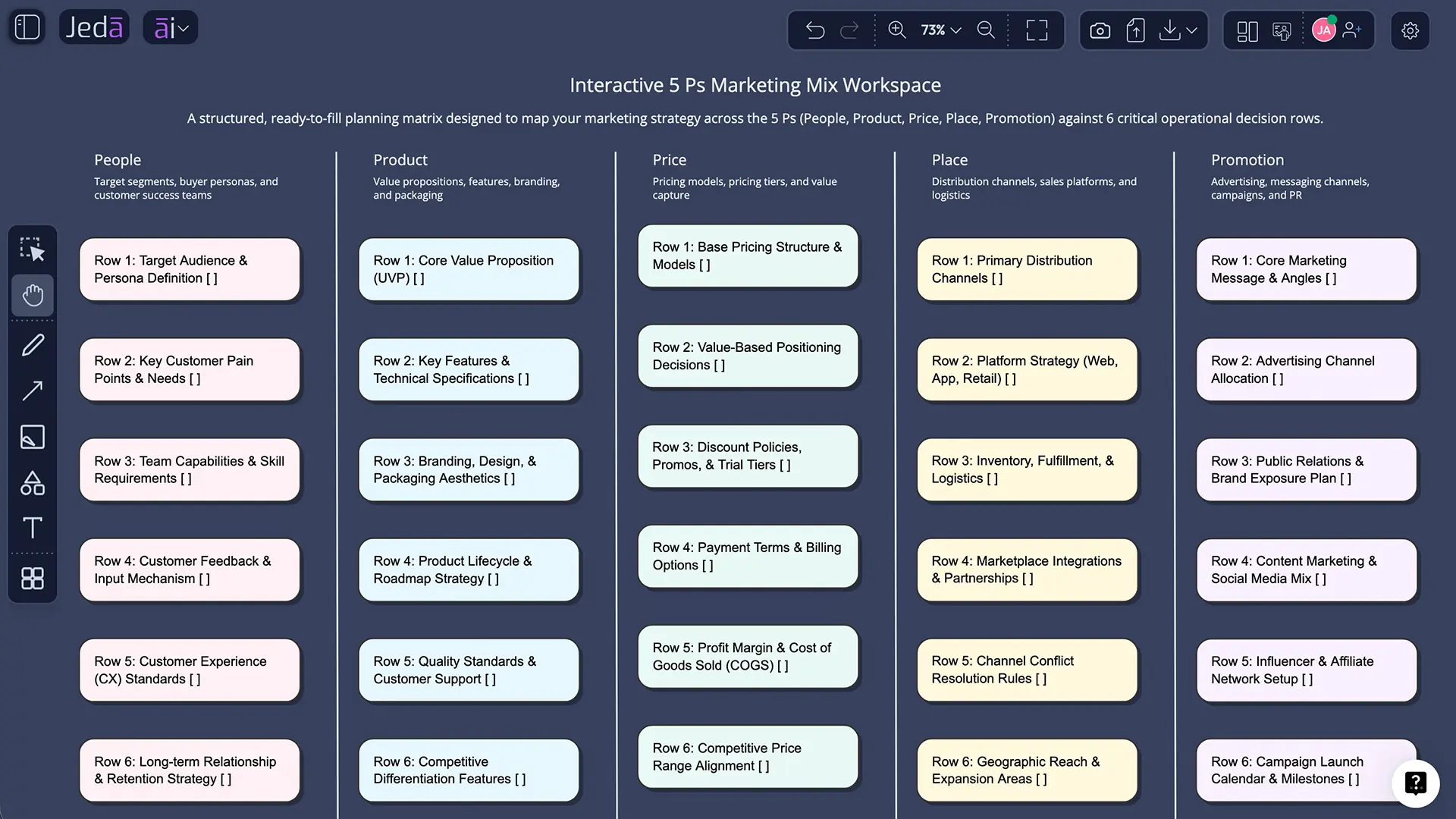
Create a 5 Ps of marketing matrix with 5 columns: People, Product, Price, Place, Promotion. Create 6 rows: Goal & time horizon, Key assumptions, Decisions, Experiments, Metrics, Risks & mitigations. Context:
- Company / offer:
- Target market:
- Launch region:
- Budget range: Rules:
- Keep each cell 3–6 bullets.
- Use specific numbers when possible.
- Include 1–2 practical experiments per column. Output as an editable matrix.
Use the AI+ button for a deeper dive
Once your 5P matrix exists, you’ll notice something: some cells are “good enough,” and some are thin.
That’s where AI Extend (the AI+ button) helps. Select any part of the matrix (a cell, a column, or a cluster of notes), then tap AI+ to extend it with AI. Keep it general: you’re asking for expansion and additional depth, not dictating a rigid output format.
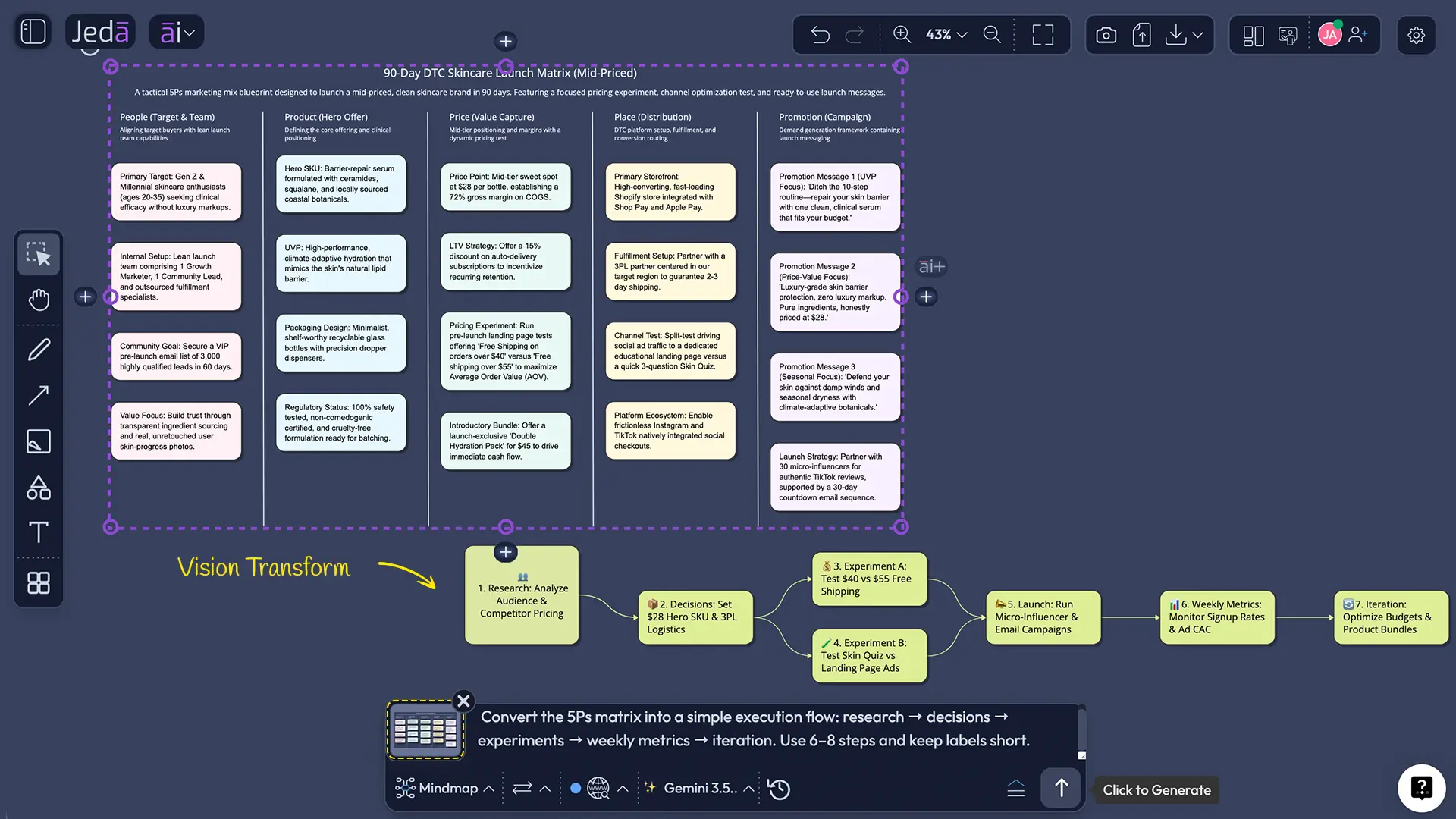
And when the matrix is solid, you can convert it:
- Use Vision Transform to turn the matrix into a Flowchart (execution steps) or a Mindmap (message and audience expansion).
- Export your final board as PNG, SVG, or PDF for stakeholders. (No PowerPoint export here—keep it honest.)
The 5 Ps, explained like you have deadlines
Below is a “working definition + decision checklist” for each P. Use these to evaluate whether your matrix is complete.
People
People covers your target segments and the humans delivering the experience. If you don’t get People right, the rest of the Ps become guesswork.
What to decide in your People column:
- Primary segment and secondary segment (be explicit).
- Jobs-to-be-done: what they’re trying to accomplish.
- Buying triggers and objections.
- Support model (self-serve, live chat, sales-assisted).
- Trust builders (social proof, guarantees, community, onboarding).
AI moves that help:
- Summarize customer research into 3 concrete segment profiles.
- List likely objections and the “proof” required to overcome each.
- Map customer questions to a simple FAQ structure.
Product
Product is the offer, the packaging, and the experience. Features matter, but the perceived outcome matters more.
What to decide in your Product column:
- Core promise (one sentence).
- Must-have features vs. nice-to-have.
- Differentiator: what’s actually unique.
- Onboarding and first value moment.
- Bundle structure (plans, tiers, add-ons).
AI moves that help:
- Turn messy feature lists into a clear “value ladder” (basic → premium).
- Draft positioning angles and test them against segment pain points.
- Generate 3 product bundles with different trade-offs.
Price
Price is the value exchange and the signal you send. It’s also the fastest way to ruin a good product if you guess.
What to decide in your Price column:
- Pricing model (subscription, usage, one-time, freemium).
- Anchors (what you compare against in the customer’s mind).
- Discount rules (when, why, and for whom).
- Payment friction (trial, deposits, minimums).
- Margin constraints and cost drivers.
AI moves that help:
- Generate 3 pricing options with pros/cons and the segment fit.
- Draft a simple willingness-to-pay experiment plan.
- Write a “price justification” message that doesn’t sound defensive.
Place
Place is your distribution and availability strategy. Where customers find you and where they buy are often two different things.
What to decide in your Place column:
- Primary channel (direct web, marketplaces, retail, partners).
- Fulfillment model (shipping, digital delivery, onboarding delivery).
- Geographic scope (where you can reliably win first).
- Channel conflicts (direct vs partner rules).
- Channel metrics (CAC by channel, conversion rate, time-to-close).
AI moves that help:
- Produce a channel shortlist based on segment behavior.
- Compare channel trade-offs (speed vs margin vs control).
- Draft a partner pitch outline if you need resellers.
Promotion
Promotion is how you earn attention and convert it into action. Messaging consistency is your friend. Random tactics are not.
What to decide in your Promotion column:
- Positioning statement and top 3 proof points.
- Messaging by funnel stage (awareness → consideration → decision).
- Creative themes and content formats (not just “run ads”).
- Campaign calendar (launch, sustain, seasonal spikes).
- Measurement plan (what “good” looks like weekly).
AI moves that help:
- Draft multiple message variants for each stage.
- Turn the 5P decisions into a content calendar.
- Create a promotion experiment backlog (ads, email, landing pages, partnerships).
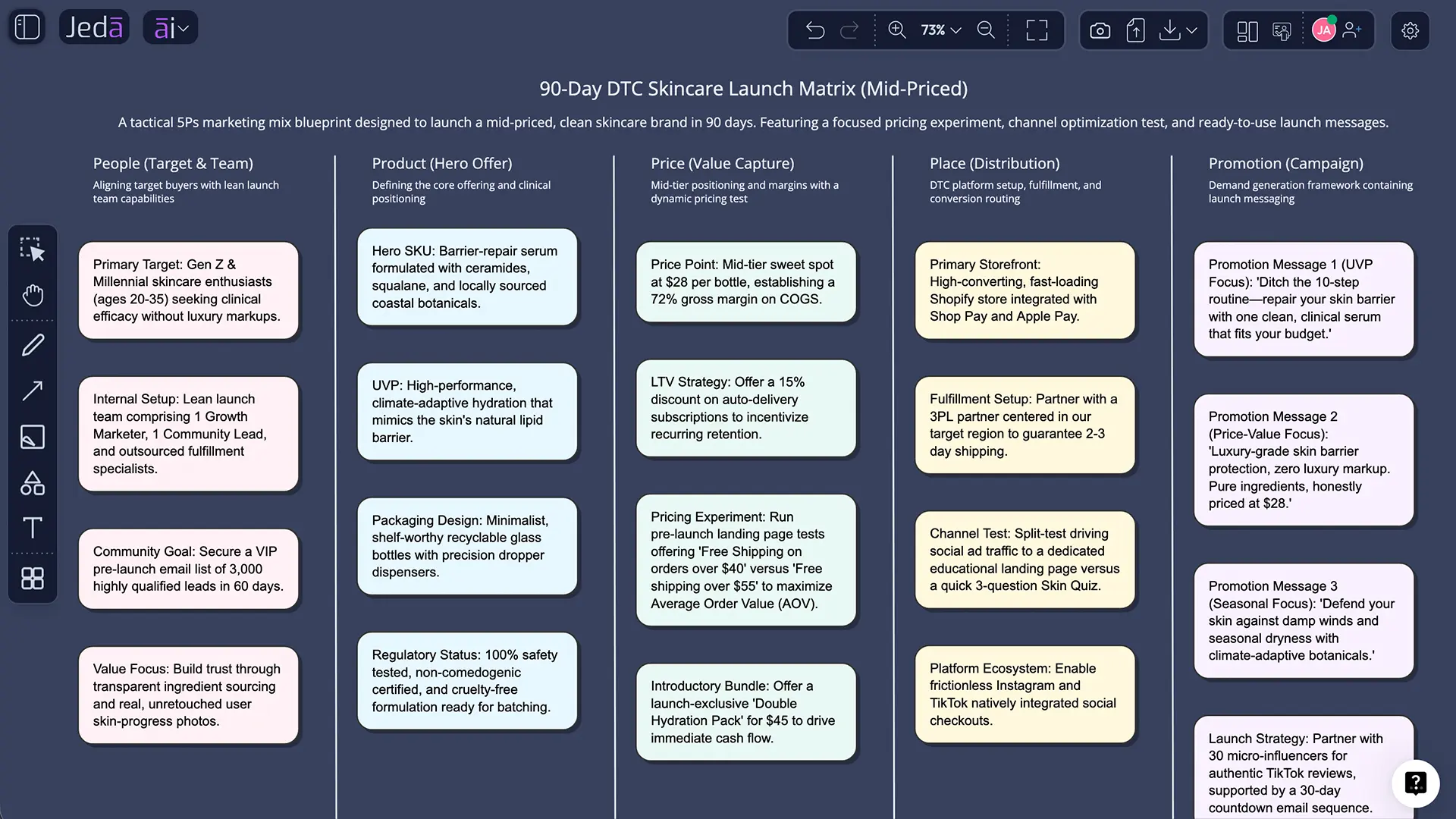
Example: a 5Ps matrix for a B2C skincare launch
Let’s make this concrete. Imagine a mid-priced DTC skincare brand launching in one region for the first 90 days.
What the matrix looks like when it’s “filled enough”:
- People: clear segment, clear objections, clear trust builders.
- Product: the promise is obvious, and bundles are named like a human wrote them.
- Price: there’s a test plan, not a single magic number.
- Place: one main channel is prioritized, not “everywhere.”
- Promotion: messaging is tied to proof, and proof is tied to assets.
Best practices for running the 5Ps as a team
- Set a timebox. 45–90 minutes is enough for a first pass.
- Force trade-offs. If you choose “premium price,” your People + Promotion must justify it.
- Keep cells short. Link to details; don’t paste the whole internet.
- Assign owners. One owner per P beats “everyone owns everything.”
- Revisit monthly. The 5Ps should change as you learn. That’s the point.
Common mistakes to avoid
Mistake 1: Writing slogans instead of decisions.
“Premium brand” isn’t a decision. “$49 starter kit, $129 bundle, 7-day shipping, two hero claims” is.
Mistake 2: Treating Place as an afterthought.
If distribution is weak, Promotion becomes expensive. Channel-first thinking is often cheaper.
Mistake 3: Pricing by ego.
Your price should match value and willingness to pay. Test it. Don’t guess.
Mistake 4: People is just a persona slide.
People is behavior + constraints + context. Make it actionable.
Mistake 5: Promotion is a list of tactics.
Tactics without a message and proof points is just noise with a budget.
Frequently asked questions
- What are the 5 Ps of marketing?
- The 5 Ps of marketing are People, Product, Price, Place, and Promotion. They are a marketing mix framework used to structure decisions about who you serve, what you offer, how you price it, where customers buy, and how you communicate value.
- What is the difference between the 4Ps and the 5Ps of marketing?
- The 4Ps focus on Product, Price, Place, and Promotion. The 5Ps keep those four and add People, which covers customer segments and the humans delivering the experience. Teams often use 5Ps when customer experience and service quality strongly affect results.
- When should I use a 5Ps matrix instead of a marketing plan document?
- Use a 5Ps matrix when you need fast alignment on core marketing decisions. A matrix makes trade-offs visible and keeps discussion focused. You can still create a longer plan later, but the matrix is better for workshops, launches, and quarterly resets.
- How do you create a 5 Ps of marketing template in Jeda.ai?
- Create a 5-column matrix labeled People, Product, Price, Place, and Promotion. In Jeda.ai, you can do this via the AI Menu using a Matrix recipe, or via the Prompt Bar by selecting the Matrix command and prompting for the 5 columns and decision rows.
- How long does a 5Ps of marketing exercise take?
- A first-pass 5Ps exercise typically takes 45–90 minutes with the right stakeholders. If you include research synthesis and option generation, plan 2–3 hours. The best practice is to timebox the first version and iterate weekly as you learn.
- Can AI replace marketing strategy work in the 5Ps framework?
- AI can speed up research synthesis, option generation, and drafting. But marketing strategy still needs human judgment, context, and accountability. The strongest workflow is AI drafts multiple options, your team selects trade-offs, and the board documents the reasoning.
- How do I use the AI+ button without overcomplicating the board?
- Use AI+ to extend a small area at a time. Expand one cell or one column, review, then trim back to the essentials. The goal is clarity, not volume. If a section becomes too long, link to a separate note or a follow-up board.
- What should be in the People section of a 5Ps matrix?
- The People section should include your primary customer segment, key behaviors and triggers, top objections, required trust signals, and the delivery/support model. If you can’t explain why the segment buys and how you’ll support them, the rest of the Ps will drift.
- What’s the best way to export and share a 5Ps matrix from Jeda.ai?
- Export your final board as PNG, SVG, or PDF depending on how it will be used. PDF is best for stakeholder review, PNG is best for quick sharing in chat tools, and SVG is best if you need to edit the graphic in design tools.
- Is the 5Ps framework only for services businesses?
- No. The 5Ps framework is used for products and services. It’s especially helpful when customer experience, onboarding, support, or human delivery affects outcomes—because the People element forces you to plan for the real experience, not just the offer.
Sources & further reading
- [1]
Australian Government (business.gov.au) (2026) . “The 5 Ps of marketing” business.gov.au.
View Source ↗ - [2]
Corporate Finance Institute (2020) . “5 P's of Marketing - Learn More About the Marketing Mix” Corporate Finance Institute.
View Source ↗ - [3]
Booms, B. H., & Bitner, M. J. (1981) . “Marketing Strategies and Organizational Structures for Service Firms” In: Marketing of Services (Semantic Scholar record).
View Source ↗ - [4]
Davenport, T., Guha, A., Grewal, D., & Bressgott, T. (2020) . “How artificial intelligence will change the future of marketing” Journal of the Academy of Marketing Science.
View Source ↗
Start Your 5Ps Marketing Mix Today
Join over 150,000+ users who trust Jeda.ai as an AI Workspace and AI Whiteboard for strategy planning and decision-ready marketing matrices.
Try Free Template