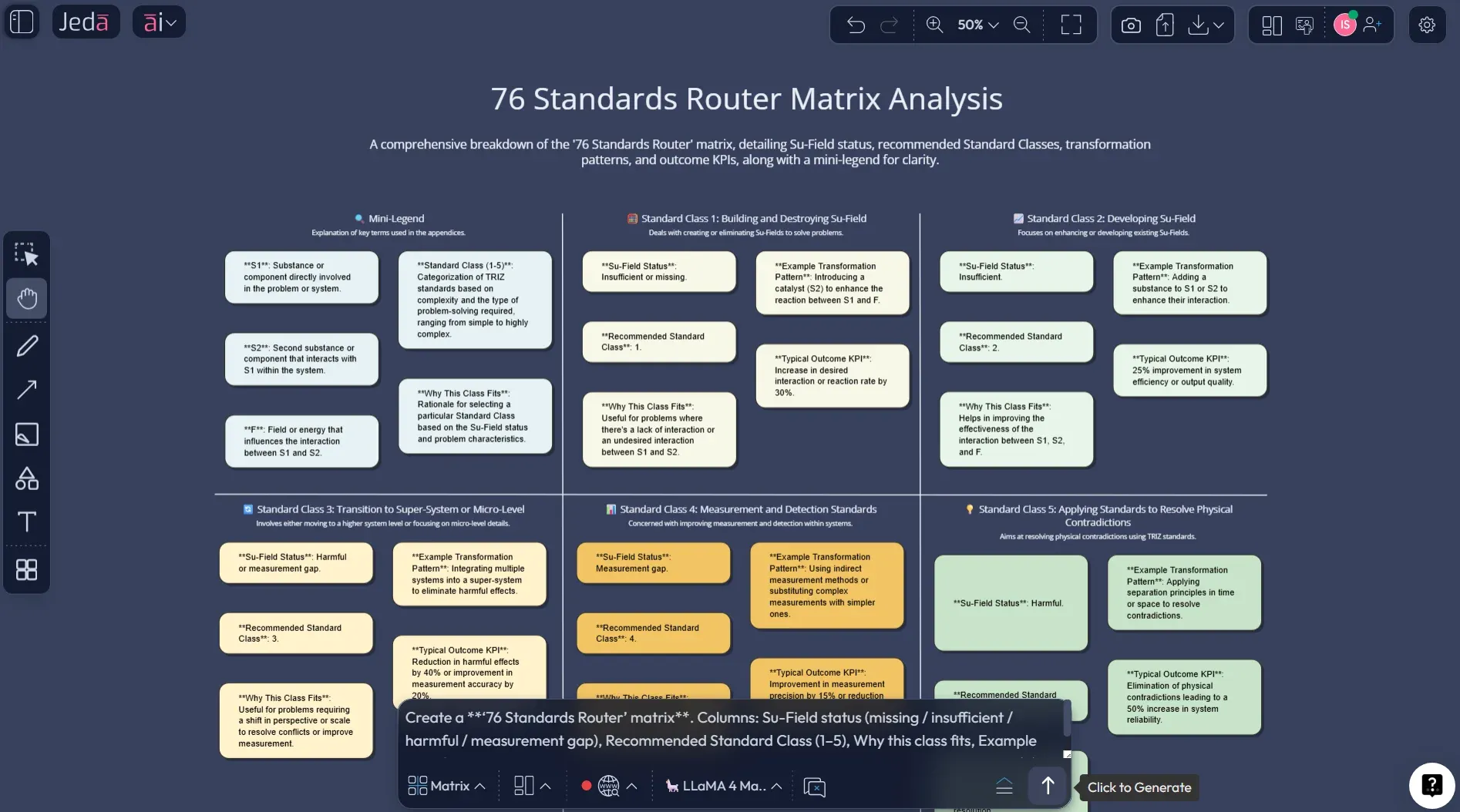
If the 40 Inventive Principles are TRIZ’s “idea patterns,” the 76 Standard Inventive Solutions (SIS) are TRIZ’s “mechanism patterns.”
They’re designed for Su‑Field (substance‑field) models—where you’ve already defined:
- S1 (the thing being acted on),
- S2 (the thing acting),
- F (the field/energy),
- and whether the interaction is missing, weak, harmful, or needs measurement.
MATRIZ describes the SIS set as 76 typical technical solutions, built as Su‑Field transformations, organized into five classes.
What are the 76 Standard Solutions (in plain English)?
Think of them as a routing system:
- Model the problem as a Su‑Field interaction.
- Decide what kind of “badness” you have (missing / insufficient / harmful / measurement).
- Use the matching Standard class to pick transformation patterns.
- Translate the abstract transformation into a mechanism that fits your constraints.
- Test it fast.
TRIZ Journal material on the 76 standards explains they are typically used after a Su‑Field model is built (often within ARIZ) and that constraints guide selection of class and specific solution.
Why use AI for Standard Solutions?
Because applying standards is mostly structured work:
- creating the matrix,
- mapping your Su‑Field to the right class,
- generating candidate standards,
- translating standards into context-specific mechanisms,
- attaching risks and tests.
AI accelerates the structure. You still validate feasibility and physics.
The Standards Matrix you should build (core deliverable)
Use this as your on-canvas matrix.
Columns
- Su‑Field status (missing / insufficient / harmful / measurement gap)
- Standard class (1–5)
- Candidate standard ID (if available)
- Transformation pattern (one line)
- Mechanism direction (in your system)
- Existing resources used
- Risk / new harm
- Fastest falsifiable test + KPI
- Decision (Keep / Kill / Needs data)
This matrix is what turns “TRIZ theory” into “TRIZ output.”
The 5 classes (routing logic)
Different publications phrase them slightly differently, but the common structure is:
- Class 1: Build/complete a Su‑Field model (when interaction is missing or weak)
- Class 2: Improve the Su‑Field model (strengthen/optimize an insufficient interaction)
- Class 3: Eliminate harmful interactions (remove harm, add protection, redirect fields)
- Class 4: Measurement & detection (add sensing/measurement when the issue is observability)
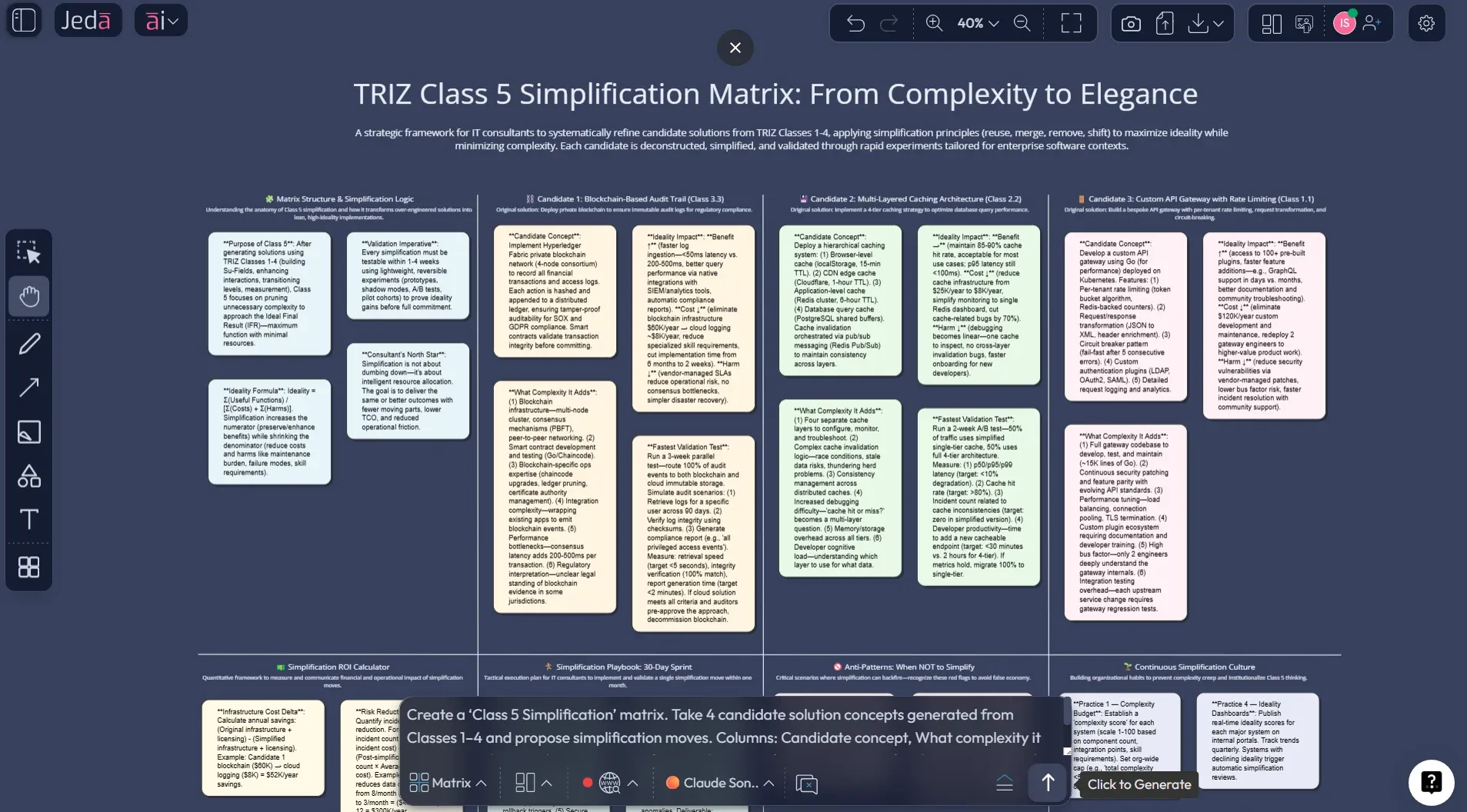
- Class 5: Simplify & increase ideality (reduce complexity added by solutions from Classes 1–4)
TRIZ Journal case material explicitly notes the “classes 1–3 for performance problems, class 4 for measurement/detection, then class 5 to simplify.”
How to run 76 Standard Solutions with AI in Jeda.ai (Matrix)
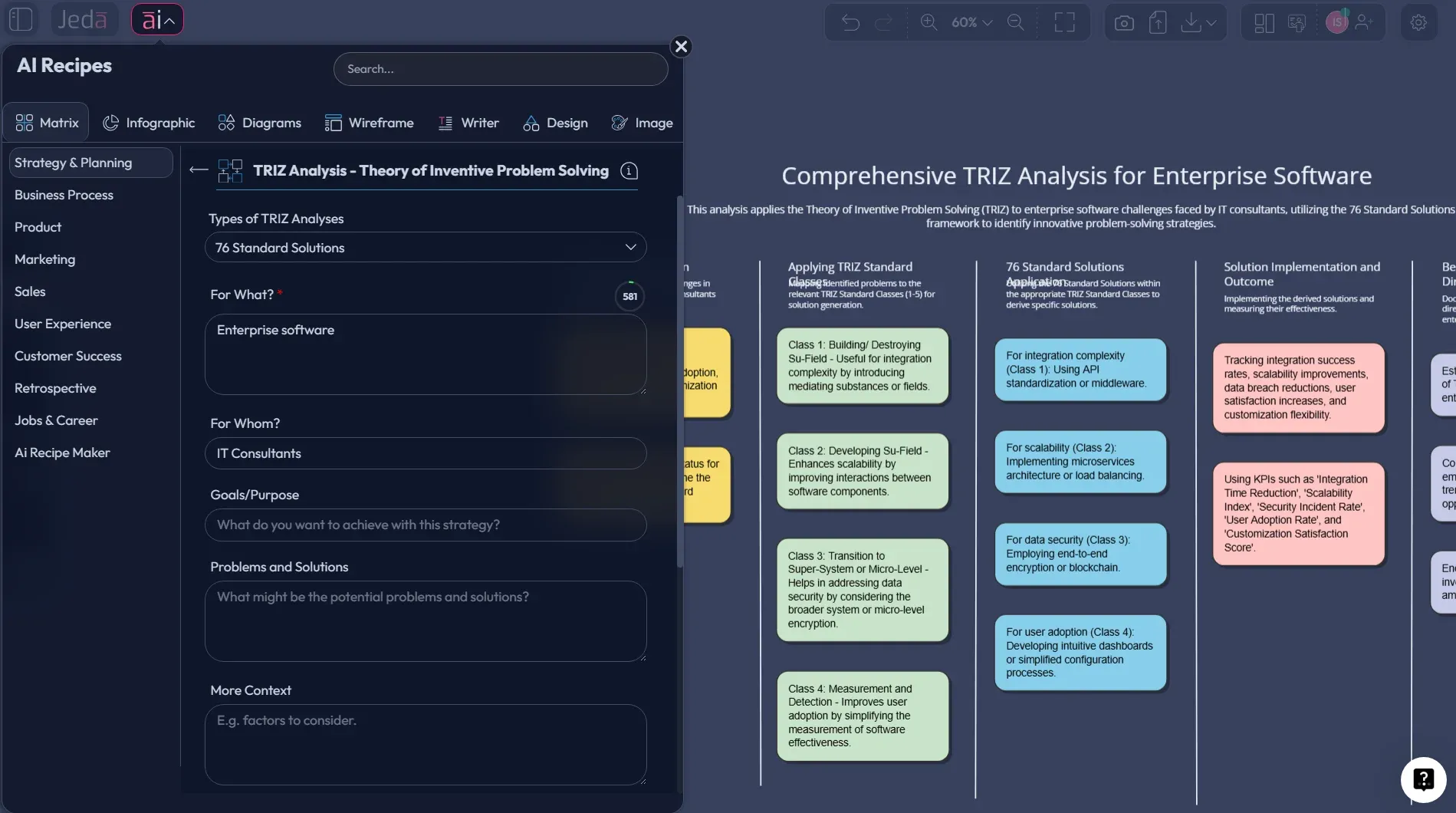
Method 1 — AI Recipe Templates (AI Menu)
- Open your board → AI Menu / AI Recipes.
- Go to TRIZ → select 76 Standard Solutions.
- Provide:
- S1, S2, Field (F)
- Interaction type: missing / insufficient / harmful / measurement gap
- Constraints (must-not-change)
- Click Generate → a Standards Router + Shortlist matrix.
- Shortlist 3–5 candidates, then expand the best 1–2 into prototypes/tests.
Method 2 — Prompt Bar (Matrix command)
- Open the AI Prompt/Command Bar.
- Select Matrix.
- Paste:
- System: …
- Su‑Field model: S1 = …, S2 = …, Field F = …
- Interaction type: missing / insufficient / harmful / measurement gap
- Constraints: …
- Deliverable: “Create a matrix that routes to Standard classes (1–5). Propose 8–12 candidate standards (with IDs if available). For each: transformation pattern, mechanism direction, risk, and fastest falsifiable test + KPI.”
- Generate → delete any row that doesn’t actually change the Su‑Field model.
- Build the Su‑Field model
Define S1, S2, and Field (F). Label the interaction: missing, insufficient, harmful, or measurement gap.
- Route to a standard class
Missing/weak → Class 1–2. Harmful → Class 3. Measurement gap → Class 4. Then apply Class 5 to simplify.
- Generate a shortlist matrix
Use AI to propose candidate standards and translate each into a mechanism direction for your system.
- Attach risks + tests
Each candidate gets a risk and a falsifiable test with a KPI threshold.
- Select and prototype
Pick 1–2 candidates that fit constraints and test them quickly. Export the matrix as the decision trail.
Quick example (so this doesn’t stay abstract)
Problem: A sliding interface wears too fast. Adding lubricant reduces wear but contaminates downstream.
Su‑Field model
- S1: surface A
- S2: surface B
- F: mechanical contact
- Interaction: harmful (wear) + side effect (contamination)
Likely routing
- Harmful interaction → Class 3 candidates (remove/neutralize harm)
- If solution adds complexity → apply Class 5 to simplify
AI should output candidate transformations like:
- introduce a mediator substance (coating / sacrificial layer),
- change the field (reduce direct contact),
- add control/measurement (detect wear and adjust conditions).
Then you pick the ones you can actually test this week.
Visual Content Prompts (for your media creator)
Command: Matrix
Prompt: “Create a ‘Standards Router’ matrix: Su‑Field status (missing/insufficient/harmful/measurement) → recommended Standard class (1–5) → why → example transformation pattern. Keep it clean and scannable.”Command: Matrix
Prompt: “Create a ‘Standards Shortlist’ matrix with 10 rows. Columns: Standard class, Standard ID (if known), transformation pattern, mechanism direction, resources used, risk, fastest test + KPI, decision.”Command: Matrix
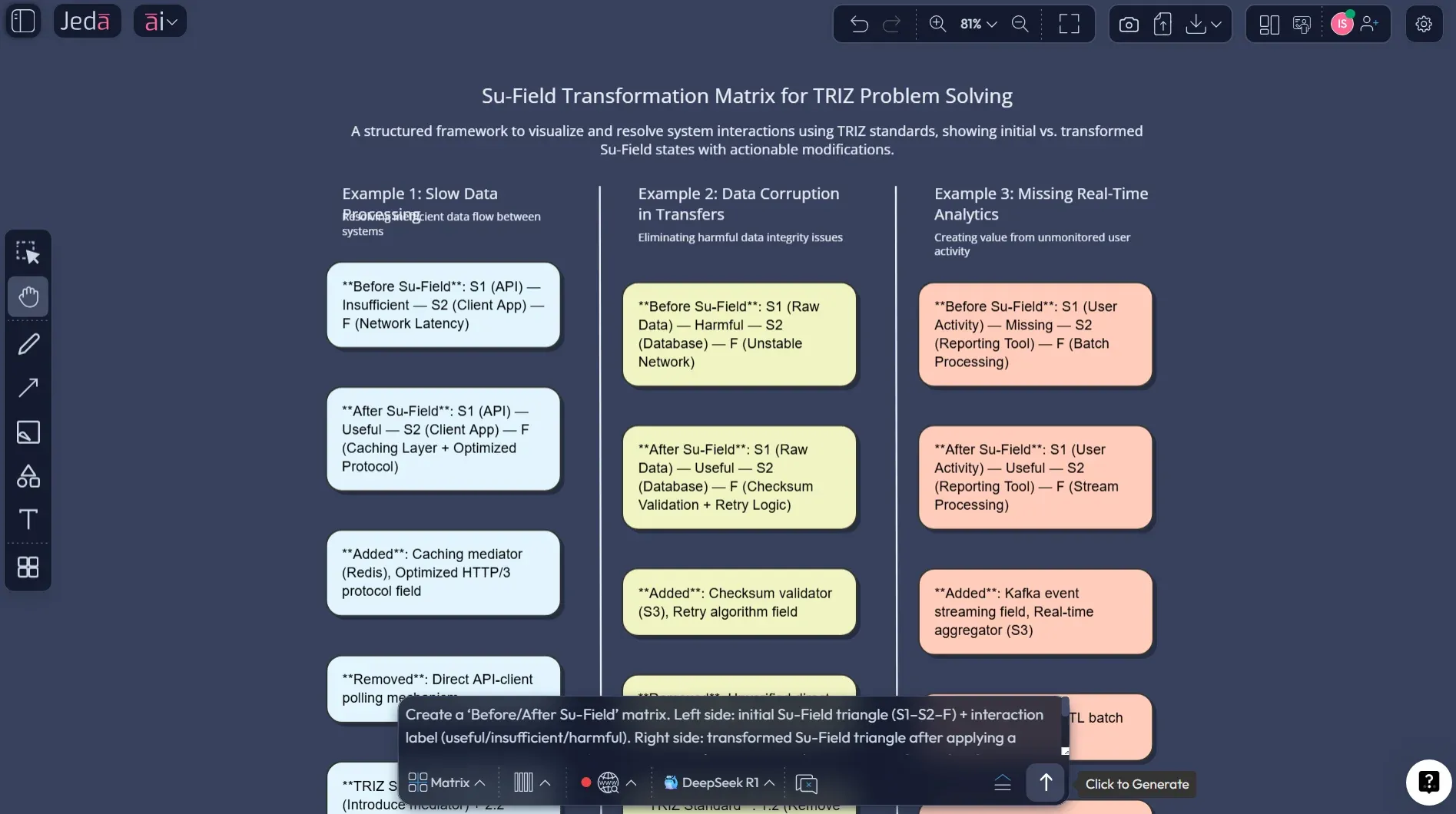
Prompt: “Create a ‘Before/After Su‑Field’ matrix: left side shows initial Su‑Field model + interaction label; right side shows transformed model after applying a standard, plus the measurable KPI change.”Command: Matrix
Prompt: “Create a ‘Class 5 Simplification’ matrix: for 4 candidate solutions from Classes 1–4, propose simplification moves (reduce parts, reuse resources, combine functions). Add a ‘ideality impact’ column.”
FAQ
- What are the 76 Standard Solutions in TRIZ?
- The 76 Standard Solutions (Standard Inventive Solutions) are a set of typical solution patterns expressed as Su‑Field transformations. They are used after building a Su‑Field model to generate structured mechanism-level solution directions.
- How are the 76 standards organized?
- MATRIZ describes the 76 standards as organized into five classes. In practice, classes route you based on whether the interaction is missing, insufficient, harmful, or requires measurement, with a final class used to simplify solutions.
- Do I need to memorize all 76 standards?
- No. You need the routing logic (class selection) and a shortlist workflow. AI can generate candidate rows; you validate feasibility and constraints.
- How does this relate to Su‑Field analysis?
- Su‑Field analysis is the modeling step; the 76 standards are the transformation library you consult after you label the interaction type in your Su‑Field model.
Citations
- [1]
Matriz TRIZ Wiki (2025) . “Standard inventive solutions (SIS) — 76 solutions in five classes” wiki.matriz.org.
View Source ↗ - [2]
J. Terninko (2000) . “The Seventy-six Standard Solutions, with Examples” TRIZ Journal Archives (PDF).
View Source ↗ - [3]
The TRIZ Journal (n.d.) . “Su-Field Analysis (step includes considering the 76 standards)” The TRIZ Journal.
View Source ↗ - [4]
The TRIZ Journal (2001) . “Using the 76 Standard Solutions (case study + class routing + simplification)” The TRIZ Journal.
View Source ↗ - [5]
D. Russo (2015) . “From Altshuller’s 76 Standard Solutions to a New Set of Standards” Procedia Engineering (ScienceDirect).
View Source ↗ - [6]
P. R. Apte (IIT Bombay) (n.d.) . “Introduction to TRIZ – Innovative Problem Solving (five classes of standard solutions)” IIT Bombay.
View Source ↗