If your marketing plan currently lives across three docs, two spreadsheets, and a Slack thread named “final_v7_really_final”… congrats, you’ve built the world’s least fun escape room.
This guide shows you how to build a 7Ps marketing mix in a single Matrix—then expand it into a launch plan using Jeda.ai as your AI Workspace and AI Whiteboard. And yes, it’s designed so you can re-use it next quarter without rewriting your entire life.
What is the 7Ps marketing mix?
The 7Ps marketing mix is a planning framework that helps you align how you bring a product or service to market—across Product, Price, Place, Promotion, People, Process, and Physical Evidence. It builds on the classic marketing mix (popularized by Borden and later simplified into the 4Ps by McCarthy) and extends it to better fit service and experience-heavy businesses.
In plain English: it’s a sanity check. Your product promise, pricing logic, distribution, messaging, customer experience, and proof signals should all agree with each other. If they don’t, customers feel it. Fast.
Why use the 7Ps marketing mix with AI?
Because the 7Ps marketing mix is simple to list, but annoying to execute. Most teams either:
- keep it vague (“Price: competitive”), or
- overbuild it (“72-slide deck about our packaging texture strategy”).
An AI-first workflow helps you stay specific without getting buried.
With Jeda.ai, you can:
- build the 7Ps marketing mix as a Matrix you can actually edit,
- pull inputs from documents (briefs, research, decks) using Document Insight,
- pull inputs from spreadsheets (pricing tables, channel performance) using Data Insight,
- and keep it all visible in one AI Workspace instead of tool-hopping.
- One source of truth
Your 7Ps marketing mix lives as an editable Matrix on a single AI Whiteboard, not scattered across docs and tabs.
- Evidence-in planning
Bring real inputs—research notes, customer interviews, pricing sheets—then build the mix around what’s true, not what feels true.
- Faster iteration
Adjust one P and immediately see what else breaks. That’s the point of the marketing mix: alignment, not decoration.
The 7Ps Recipe Matrix
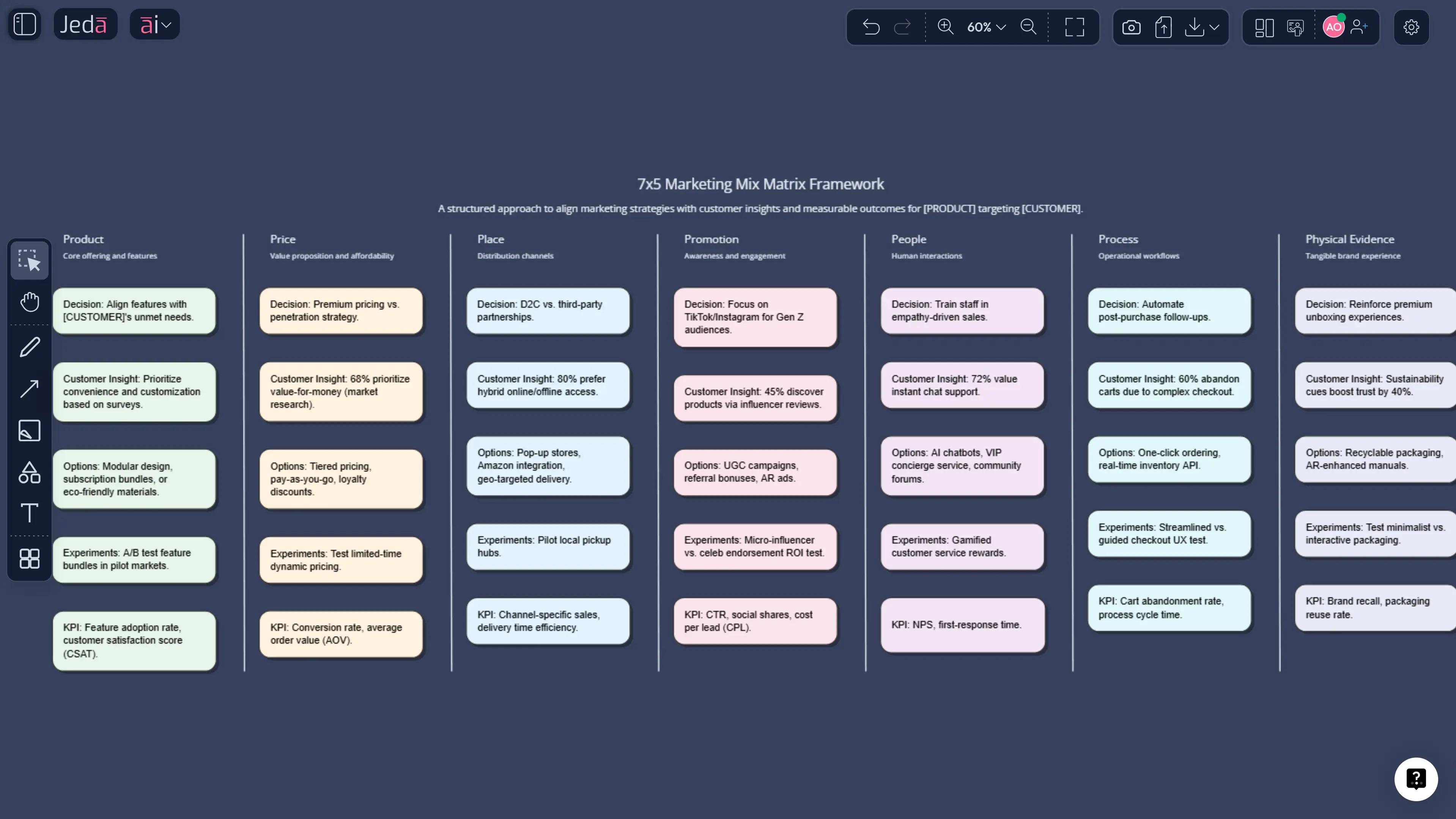
Below is a practical 7Ps marketing mix matrix you can generate in minutes, then refine. The structure is intentionally “decision-first” so it doesn’t become a cute poster and nothing else.
Matrix layout (recommended)
Rows: Product, Price, Place, Promotion, People, Process, Physical Evidence
Columns: Decision, Customer insight, Options, Experiments, KPI
7Ps marketing mix matrix (ready-to-build)
| 7P | Decision (what we choose) | Customer insight (what we know) | Options (what we could do) | Experiments (what we’ll test) | KPI (what we measure) |
|---|---|---|---|---|---|
| Product | Offer, packaging, positioning, differentiation | Top jobs-to-be-done, pain points, “must-have” features | 2–4 variants of bundle/feature set | Landing page test, demo script test | Conversion rate, activation rate |
| Price | Price point, tiers, discount rules | Willingness-to-pay signals, competitor anchors | 2–3 tier designs, trial vs freemium | Price sensitivity test, cohort pricing | ARPA, churn, win rate |
| Place | Where customers buy/try | Where they already shop or research | DTC, marketplaces, partners, retail | Channel A/B, partner pilot | CAC by channel, time-to-close |
| Promotion | Message + channel mix | What language they use to describe the problem | 3 message angles, 3 channels | Ad creative test, email subject test | CTR, CAC, pipeline created |
| People | Who delivers the experience | What customers expect from support/sales | Role definitions, training plans | Script iteration, onboarding calls | CSAT, response time, close rate |
| Process | Steps from discovery → purchase → success | Where they drop off or get confused | Shorter flow, fewer steps, better handoffs | Funnel step test, onboarding revision | Drop-off rate, time-to-value |
| Physical Evidence | Proof: reviews, demos, assets, visuals | What reduces perceived risk | Case studies, demo videos, guarantees | Social proof placement test | Trust CTR, demo-to-close |
How to create a 7Ps marketing mix in Jeda.ai
This is the “do it, don’t just read it” section. Two ways, exactly as requested.
Method 1: Recipe Matrix (AI Menu)
Use this when you want a structured starting point fast.
- Open your Jeda.ai AI Whiteboard inside the AI Workspace.
- Click AI Menu (top-left).
- Go to Matrix Recipes.
- Search for a marketing mix / 7Ps-style template.
- Generate the Matrix, then edit the sticky notes like a normal board.
Best use: workshops, team planning sessions, fast drafts.
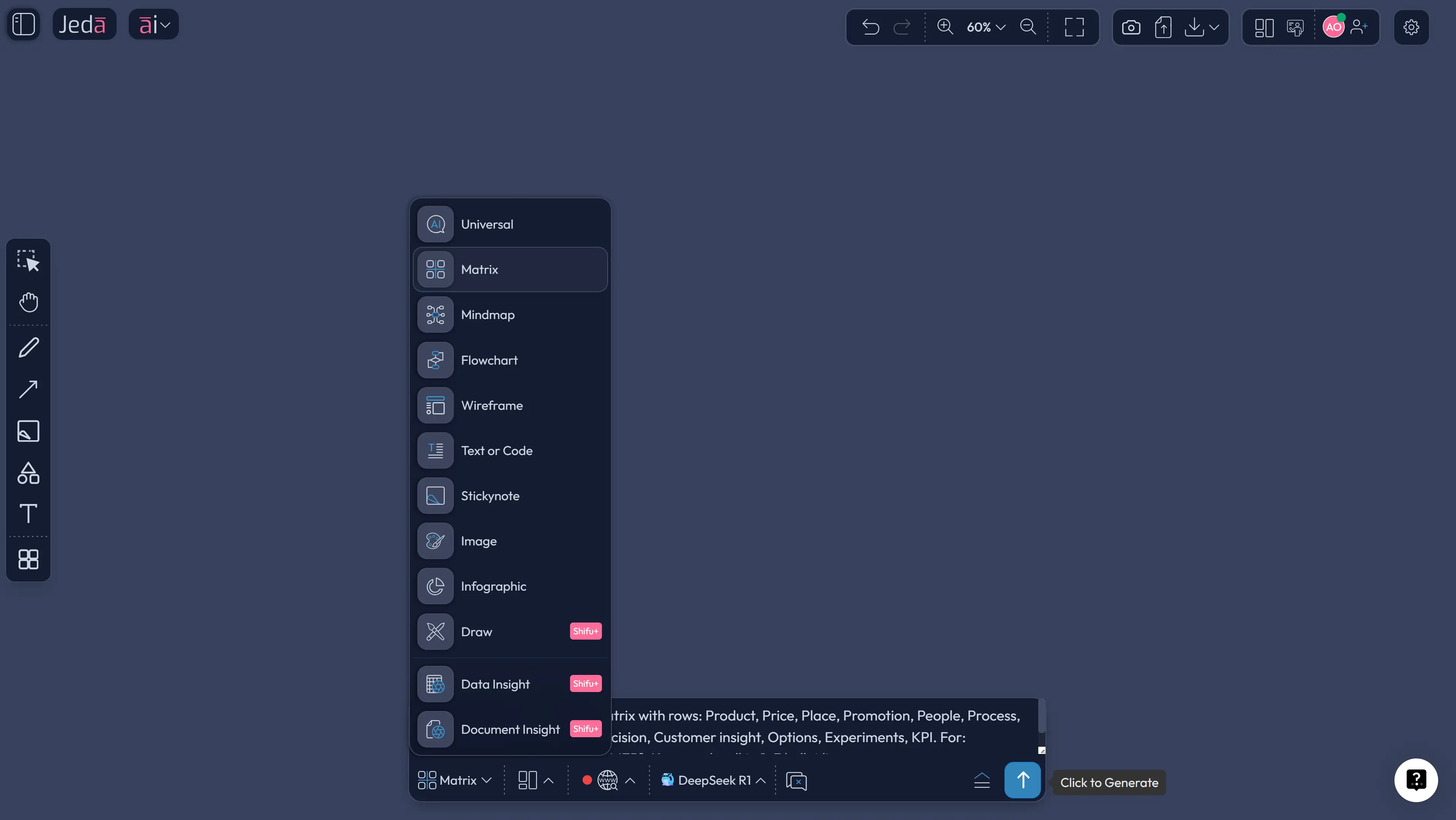
Method 2: Prompt Bar (Matrix command)
Use this when you want full control over the structure and the wording.
- Open the Prompt Bar (bottom).
- Select the Matrix command.
- Paste this prompt:
Prompt (copy/paste):
“Create a 7x5 marketing mix Matrix. Rows are Product, Price, Place, Promotion, People, Process, Physical Evidence. Columns are Decision, Customer insight, Options, Experiments, KPI. Keep each cell to 1–3 bullet lines. Use plain language. Assume we are launching: [YOUR PRODUCT] for [YOUR TARGET CUSTOMER]. Include one concrete experiment per row.”
- Press Enter to generate.
- Edit the output with your team.
AI+ button generated deep dive (general only)
Once your 7Ps marketing mix Matrix exists, you’ll want depth… but only where it helps.
- Click a sticky note (or select a section of the Matrix).
- Tap the AI+ button to extend it with AI.
- Keep the output aligned to the same cell so the Matrix stays readable.
That’s it. No elaborate ritual. Just “expand this, keep it consistent.”
Convert it with Vision Transform (optional)
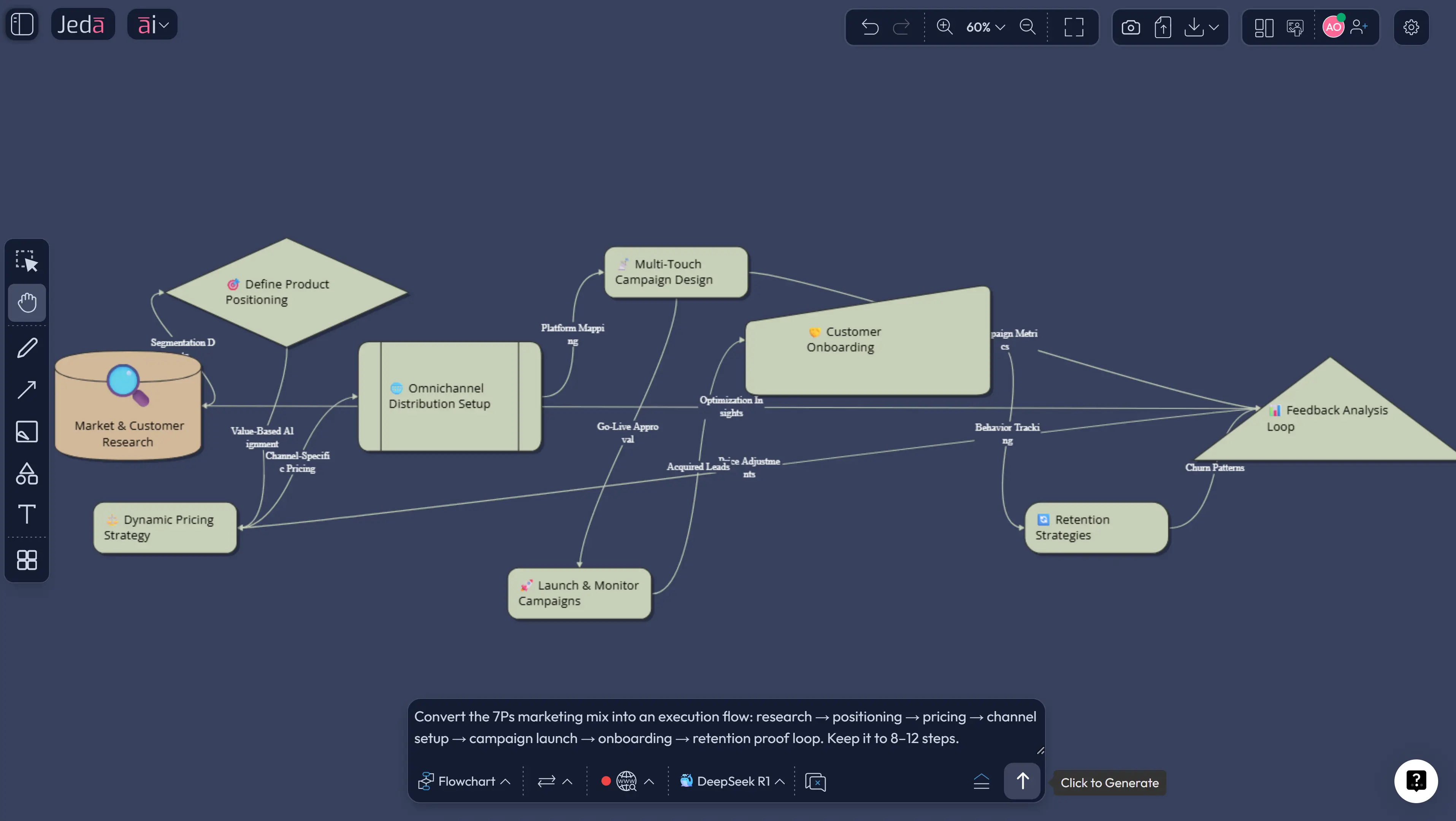
Sometimes you start with a Matrix and end with a process map. That’s normal.
- Use Vision Transform to convert your Matrix into a Flowchart (for execution steps) or Mindmap (for brainstorming variations).
Example: a 7Ps marketing mix for a simple launch
Let’s make it real. Imagine you’re launching a subscription meal kit for busy professionals who want “healthy, fast, no thinking.”
Here’s how the 7Ps marketing mix gets specific:
Now look at the alignment:
- If promotion promises “no thinking,” your process can’t be complex.
- If price is premium, physical evidence must scream trust.
Best practices for using the 7Ps marketing mix (without turning it into a poster)
Start with the customer reality, not internal opinions.
If you have a research doc, upload it and use Document Insight → Matrix output to extract usable insights into the 7Ps structure.Write decisions as commitments.
“Price: affordable” is vibes. “$29/week entry tier, no discounting for first 60 days” is a decision.Add experiments early.
Every P should have at least one test. Otherwise you’re planning a belief system.Make KPIs boring and measurable.
Use numbers. Use time. Use rate. Your future self will thank you.Keep the Matrix editable.
This is why a visual AI workspace matters. A static PDF doesn’t help when the market changes on Thursday.
Common mistakes to avoid
Mistake 1: Treating the 7Ps marketing mix like a checklist
If you fill every box with generic text, you end up with a very organized document… that doesn’t change a single outcome.
Mistake 2: Ignoring People, Process, and Physical Evidence
Services, SaaS, marketplaces, and premium brands live or die on these. If you skip them, you’re basically marketing a promise with no delivery plan.
Mistake 3: Forgetting alignment
Your promotion says “premium,” but your place is a bargain marketplace. Your product says “simple,” but your onboarding is 9 steps. Customers notice.
Mistake 4: No experiments
If you aren’t testing, you aren’t marketing. You’re journaling.
Frequently Asked Questions
- What are the 7Ps of marketing?
- The 7Ps of marketing are Product, Price, Place, Promotion, People, Process, and Physical Evidence. Together they form the extended marketing mix, helping you plan not just what you sell and how you promote it, but also how the customer experience is delivered and proven.
- What is the difference between the 4Ps and the 7Ps marketing mix?
- The 4Ps cover Product, Price, Place, and Promotion. The 7Ps marketing mix adds People, Process, and Physical Evidence, which matter most for services and experience-driven brands. Those extra Ps help you plan delivery, consistency, and trust—not just demand generation.
- When should I use the 7Ps marketing mix instead of the 4Ps?
- Use the 7Ps marketing mix when customer experience and delivery strongly influence purchase or retention—services, SaaS, subscriptions, healthcare, hospitality, education, and premium retail. If People and Process shape outcomes, the 7Ps is usually the better planning lens.
- How do I create a 7Ps marketing mix matrix in Jeda.ai?
- Open Jeda.ai, choose the Matrix command in the Prompt Bar, and generate a grid with rows for each P and columns for decisions, insights, options, experiments, and KPIs. Then edit the sticky notes with your team to make each P specific and testable.
- Can AI replace marketing strategy if I use a 7Ps marketing mix template?
- No. AI can help you draft, structure, and stress-test your 7Ps marketing mix faster, but you still need real inputs—customer research, constraints, and business goals. The best use of AI is to speed up iteration and improve alignment, not to guess reality.
- What should I put in the “Physical Evidence” part of the 7Ps marketing mix?
- Physical Evidence is anything that reduces perceived risk and makes your promise feel real—reviews, case studies, demos, guarantees, packaging, environment, certifications, and visual proof. For digital products, it often includes screenshots, walkthroughs, and testimonials placed at key funnel steps.
- How do I measure if my 7Ps marketing mix is working?
- Tie each P to at least one KPI: conversion rate (Promotion), CAC by channel (Place), churn or retention (Product/Process), win rate (Price), and support metrics like CSAT or response time (People). Then run a few experiments so changes are measurable, not hypothetical.
- How often should I update my 7Ps marketing mix?
- Quarterly is a good default for most teams. Update sooner if you change pricing, launch a new channel, shift positioning, or see major changes in conversion or retention. The 7Ps marketing mix works best as a living board you revise, not a one-time exercise.
- Can I export my 7Ps marketing mix from Jeda.ai?
- Yes. You can export your board as PNG, SVG, or PDF. Exporting helps you share the 7Ps marketing mix with stakeholders, but keep the editable version in your AI Workspace so you can update it as experiments and results come in.
- What’s the fastest way to build a 7Ps marketing mix with a team?
- Run a 45–60 minute working session: generate the matrix first, assign one P per person, fill decisions and experiments, then regroup to check alignment across rows. If you’re using Jeda.ai, collaboration is real-time, so the matrix updates live during discussion.
Sources & Further Reading
- [1]
Neil H. Borden (1964) . “The Concept of the Marketing Mix” Journal of Advertising Research (reprint).
View Source ↗ - [2]
Neil H. Borden (1964) . “The Concept of the Marketing Mix” TandF Online (DOI record).
View Source ↗ - [3]
E. Jerome McCarthy (1960) . “Basic Marketing: A Managerial Approach” R.D. Irwin.
View Source ↗ - [4]
B. H. Booms & Mary Jo Bitner (1981) . “Marketing Strategies and Organization Structures for Service Firms” Marketing of Services (AMA Conference Proceedings).
View Source ↗ - [5]
EBSCO Research Starters (n.d.) . “Marketing mix” EBSCO.
View Source ↗ - [6]
Chartered Institute of Marketing (CIM) (2025) . “The 7Ps of marketing” CIM Content Insights.
View Source ↗ - [7]
Annmarie Hanlon (2023) . “How to use the 7Ps Marketing Mix strategy model” Smart Insights.
View Source ↗
Start Your 7Ps Marketing Mix in Jeda.ai
Join over 150,000+ users who build editable, decision-ready marketing plans inside a Visual AI workspace.
Try Free Template