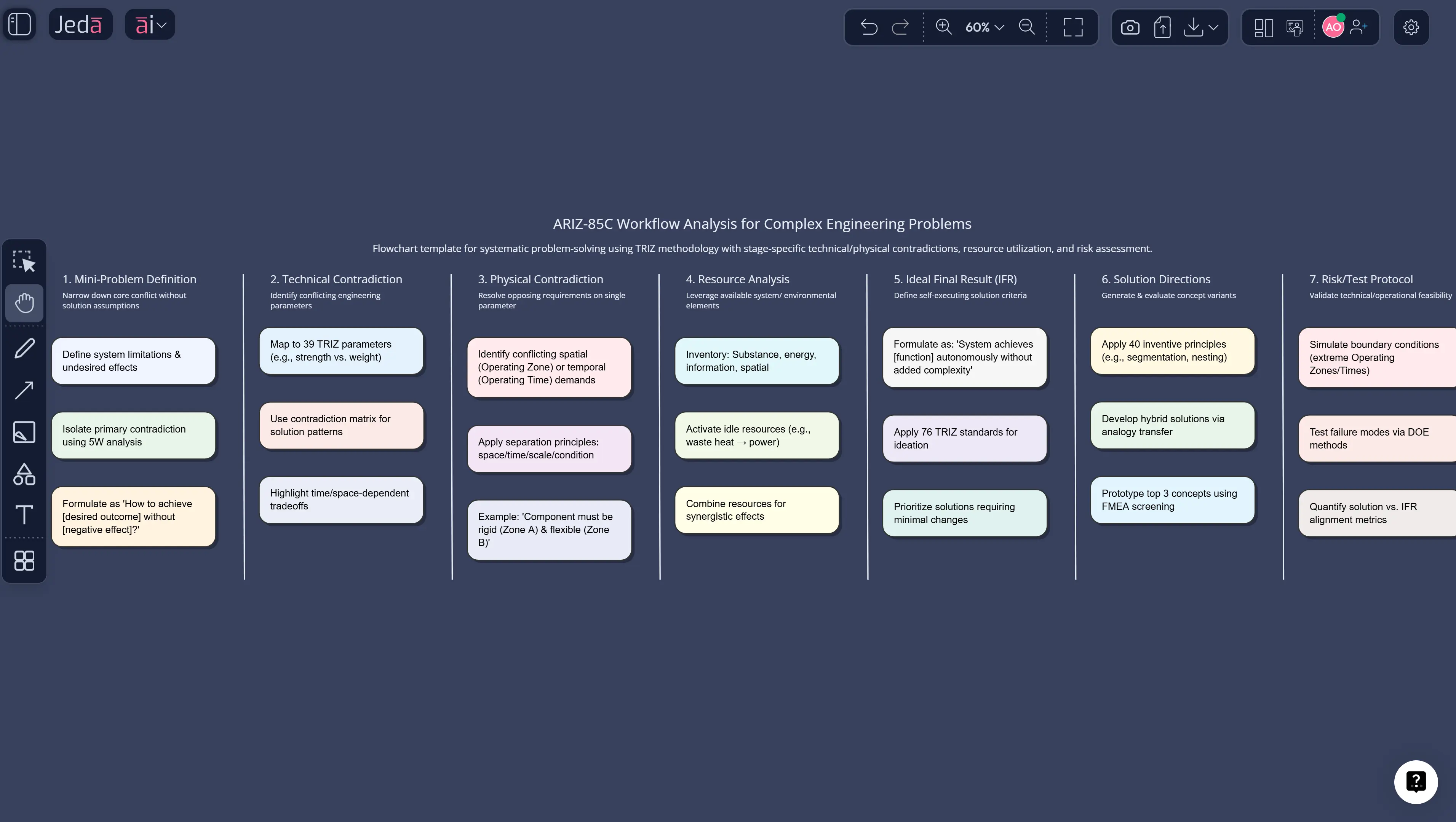
ARIZ (Algorithm for Inventive Problem Solving) is TRIZ’s “deep end.” When a problem has stubborn contradictions, unclear resources, and multiple interacting constraints, the contradiction matrix alone can feel like a polite suggestion—useful, but not decisive. ARIZ exists for those cases.
This page explains ARIZ-85C at a practical academic level: what it is, how it works, and how an AI Workspace can accelerate the analysis and documentation steps while keeping the reasoning disciplined.
Jeda.ai is an AI Whiteboard that helps you run structured frameworks as editable visuals—matrices, diagrams, and decision flows—so ARIZ doesn’t stay trapped in a notebook.
What is ARIZ?
ARIZ is a formal problem-solving algorithm within TRIZ that guides you from an initial problem statement to an inventive solution concept through disciplined modeling. Unlike lighter TRIZ tools, ARIZ emphasizes:
- refinement to a mini-problem (a sharply scoped formulation),
- identification of the main contradiction (often a physical contradiction),
- explicit use of resources within the system and environment,
- construction of an Ideal Final Result (IFR),
- transformation of the problem model into solution concepts using TRIZ operators and knowledge bases.
In TRIZ literature, ARIZ-85C is a well-known mature form of the algorithm, structured into major parts with substeps.
When ARIZ is the right tool
Use ARIZ when any of these are true:
- The problem repeats despite “good engineering.” You have tried optimization cycles and keep returning to the same trade-off.
- Multiple contradictions stack up. Fixing one issue worsens another in a different subsystem.
- You can’t choose a direction. Multiple solution paths exist, but none satisfy constraints.
- You need a defendable logic trail. The solution must be explainable, reviewable, and auditable (R&D, safety, compliance).
- The contradiction matrix gives generic output. Principles feel too broad unless you deepen the model.
If your problem is straightforward, ARIZ is overkill. But if the problem is “inventive,” ARIZ is built for it.
Why use AI for ARIZ (and what NOT to do)
ARIZ is structured. That’s good news for AI—because AI performs best when structure is explicit.
AI helps most with:
- Refactoring messy notes into a clean mini-problem formulation.
- Extracting constraints and resources from specs, test reports, or failure analyses.
- Generating candidate contradictions (technical and physical) and checking clarity.
- Producing multiple alternative IFR statements and ranking them against constraints.
- Documenting the ARIZ trail as a visual artifact your team can review.
What AI should not do alone:
- deciding which contradiction is “main” without domain validation,
- inventing physics/mechanics without evidence,
- skipping steps to jump to “cool ideas.”
You’re not outsourcing thinking. You’re outsourcing the paperwork and the first drafts.
ARIZ-85C, simplified into 9 “parts” for implementation
Different sources describe ARIZ structure slightly differently, but ARIZ-85C is commonly presented as a multi-part sequence with disciplined transitions from problem model to solution model.
Here is a practical academic breakdown you can execute on a whiteboard.
Part 1 — Problem analysis and mini-problem
Goal: Convert an ambiguous problem into a minimal statement that preserves the difficulty.
Outputs:
- system boundary and key function,
- the undesired effect,
- conditions of occurrence,
- what must not change.
AI use: paste your engineering notes + test observations; ask AI to propose 2–3 mini-problem candidates and highlight assumptions.
Part 2 — Model the conflict and intensify it
Goal: Identify the key interaction where improvement causes deterioration.
Outputs:
- technical contradiction (improving parameter vs worsening parameter),
- initial “conflict zone” or place/time where the issue happens,
- why common fixes fail.
AI use: generate contradiction candidates and ensure they’re measurable.
Part 3 — Formulate the physical contradiction
A physical contradiction is often: the same parameter must be both high and low (or present and absent) under different conditions.
Example forms:
- “The surface must be hot to enable process X, but cold to prevent damage.”
- “The part must be rigid for accuracy, but flexible for shock absorption.”
AI use: propose physical contradiction formulations in (time separation, space separation, condition separation) formats for comparison.
Part 4 — Resources analysis
Resources are underused “assets” already available in or around the system: materials, fields, geometry, time, information, waste heat, vibration, idle cycles, user actions, etc.
Output: a resource table:
- resource name,
- where it exists,
- when it exists,
- how it could be redirected.
AI use: extract resources from documentation and generate a structured inventory quickly.
Part 5 — Ideal Final Result (IFR)
IFR is not a fantasy. It’s a constraint-driven target state where the function is achieved with minimal new complexity.
A common TRIZ framing: systems evolve toward increasing ideality; IFR is a way to explicitly aim there.
AI use: create multiple IFR statements, then test each against constraints (“introduces new harm?” “adds new cost?” “requires new component?”).
Part 6 — Transformation operators and solution directions
This is where ARIZ becomes inventive. You use TRIZ tools (separation principles, field/substance transformations, standard solutions, etc.) to remove the physical contradiction.
AI use: generate several candidate solution directions anchored to the physical contradiction and resources list, not generic brainstorming.
Part 7 — Evaluate feasibility and secondary problems
ARIZ anticipates that solutions may introduce side effects.
Output:
- risk list (new harms),
- constraints re-check,
- experiments and prototypes.
AI use: structured risk brainstorming (FMEA-style) and test plan suggestions.
Part 8 — Strengthen the solution concept
Output:
- simplified mechanism,
- implementation steps,
- validation criteria.
AI use: generate an implementation outline and check alignment to IFR and physical contradiction.
Part 9 — Reflection and knowledge capture
Output:
- what contradiction patterns were resolved,
- reusable template,
- what to monitor in operation.
AI use: summarize and convert to a reusable “ARIZ board template.”
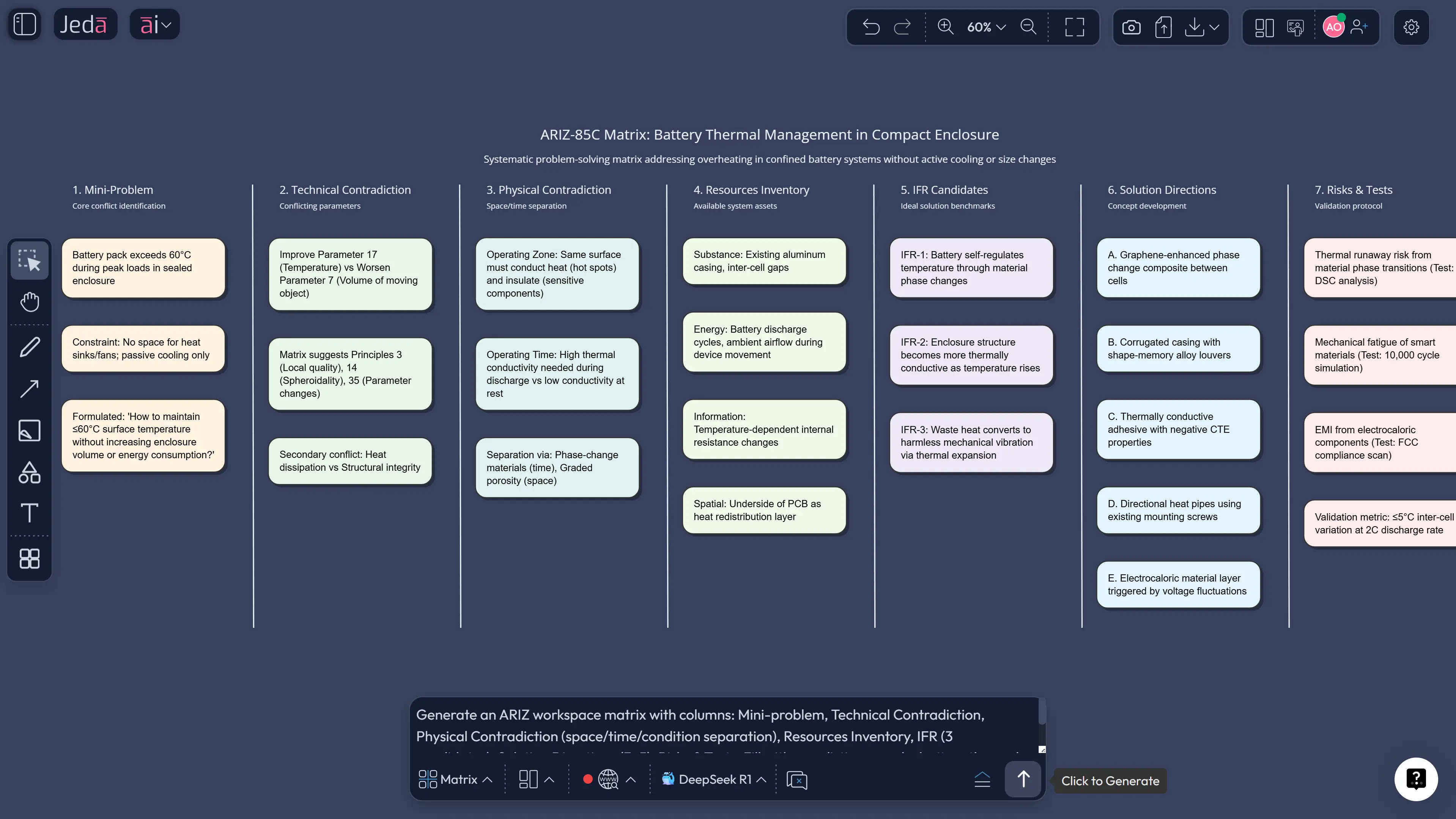
How to run ARIZ with AI in Jeda.ai (step-by-step)
- Open AI Menu → TRIZ / Innovation recipes (or create a custom board).
- Choose Matrix to build an ARIZ workspace with columns:
- Mini-problem
- Technical contradiction
- Physical contradiction
- Resources
- IFR
- Solution directions
- Risks/tests
- Import your spec/test report (Document Insight) and extract:
- constraints (must-not-change),
- failure mode descriptions,
- measurable targets.
- Run Multi‑LLM to generate alternative formulations:
- one model drafts the mini-problem,
- one proposes contradictions,
- one drafts IFR statements.
- Use the Aggregator model to produce a single “best combined” ARIZ board.
- Convert the board into a Flowchart for stakeholder review.
- Export PNG/SVG/PDF for design review or reporting.
- Data in
Import your spec, logs, or failure analysis. Extract constraints and the undesired effect.
- Mini-problem
Generate 2–3 candidate mini-problems. Select the one that preserves the contradiction.
- Contradictions
State the technical contradiction, then refine it into a physical contradiction using separation logic.
- Resources
Build a resource inventory: materials, fields, time, information, byproducts.
- IFR
Write a strict IFR. Reject IFRs that sneak in new components or hidden costs.
- Solution directions
Generate 3–5 solution directions anchored to resources + separation, then prototype the top 1–2.
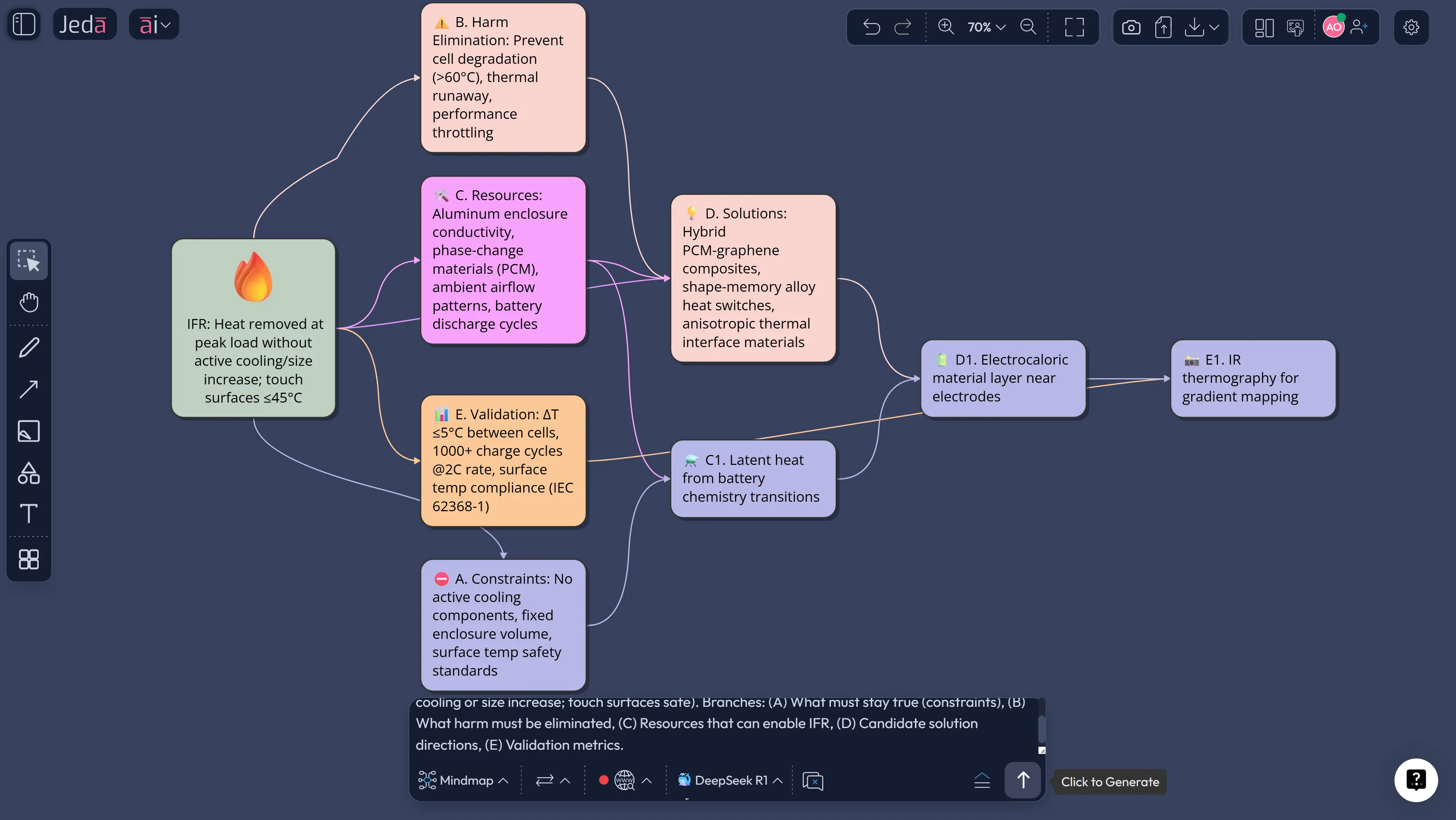
A worked micro-example (academic style)
System: battery thermal management in a compact enclosure
Undesired effect: temperature spikes under peak load
Constraint: cannot increase enclosure size; cannot add active cooling (noise/power)
Technical contradiction: improve heat removal → worsens size/complexity
Physical contradiction: the enclosure surface must be thermally conductive (to remove heat) and thermally insulating (to protect user and adjacent components)
Resources (excerpt):
- existing metal frame,
- transient airflow during user motion,
- phase change potential in materials,
- unused surface area on internal ribs.
IFR candidate: “Heat is removed at peak load without adding active cooling and without increasing enclosure size; user-touch surfaces remain safe.”
Solution directions (sketches):
- Time separation: store heat during peak load (phase change material) and release it afterward.
- Space separation: high conductivity path inward, insulating layer outward (local quality gradient).
- Condition separation: thermal switch material that changes conductivity with temperature.
The point: ARIZ makes the trade-offs explicit, then uses resources + separation to remove the conflict.
Common ARIZ failure modes (and fixes)
Failure: ARIZ becomes a checklist without insight
Fix: treat contradictions and resources as the “core variables,” not the steps.Failure: AI outputs generic “principles”
Fix: require AI to cite which resource enables each solution direction.Failure: IFR becomes wishful thinking
Fix: add a column “new costs/new harms” and reject IFRs that cheat.
FAQ
- What is ARIZ in TRIZ?
- ARIZ is the Algorithm for Inventive Problem Solving within TRIZ. ARIZ is used for complex problems where you must model contradictions, resources, and an Ideal Final Result (IFR) to generate inventive solution directions.
- What is ARIZ-85C?
- ARIZ-85C is a mature version of ARIZ formalized in the 1980s and commonly described as a multi-part algorithm that moves from problem analysis to contradiction modeling, resources, IFR, and solution synthesis.
- How is ARIZ different from the contradiction matrix?
- The contradiction matrix helps shortlist inventive principles for a defined technical contradiction. ARIZ is a deeper algorithm that refines the problem into a mini-problem, formulates a physical contradiction, uses resources, and drives to a stronger solution concept.
- Can AI run ARIZ end-to-end?
- AI can accelerate ARIZ by drafting formulations, extracting constraints from docs, generating structured alternatives, and documenting the workflow. Human validation is required for the main contradiction, feasibility, and physics/mechanism correctness.
- What is a mini-problem in ARIZ?
- A mini-problem is a sharply scoped problem statement that preserves the contradiction but removes unnecessary context. It enables more precise contradiction modeling and resource analysis.
- What is the Ideal Final Result (IFR) used for in ARIZ?
- IFR defines the target state where the function is achieved with minimal added complexity. It guides solution synthesis and acts as a filter against solutions that add hidden costs or new harms.