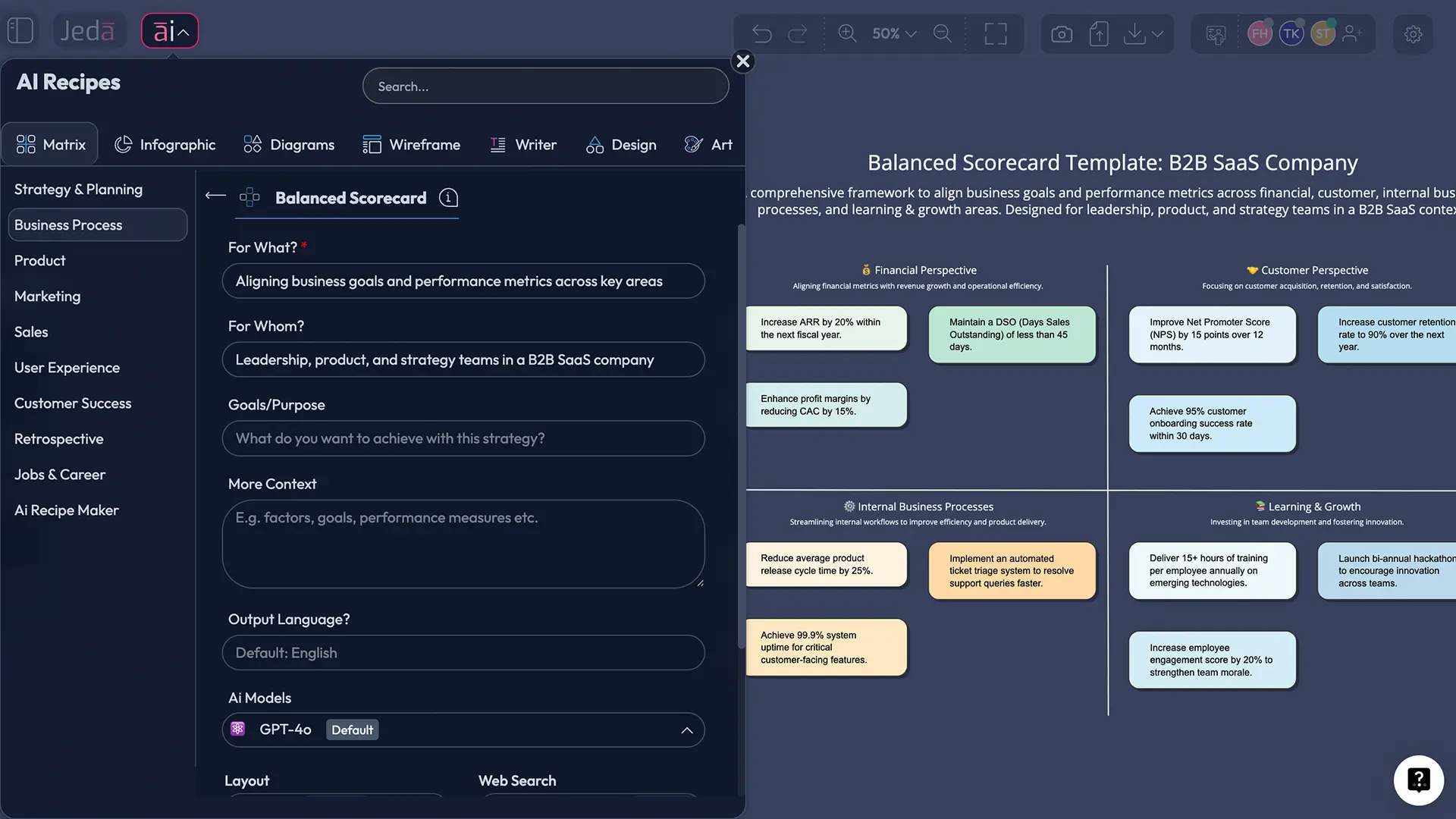
A balanced scorecard is a 2×2 matrix that makes strategy measurable. It forces you to pick the outcomes you care about, the KPIs that actually signal progress, and the initiatives you’re willing to fund (or at least staff). In Jeda.ai, you build that matrix inside an AI Workspace, review it live on an AI Whiteboard, and keep everything visible instead of scattered across slides, spreadsheets, and “final_final_v7.xlsx”.
If you’re new to the platform, start here: AI Workspace and AI Whiteboard.
Look—this is a matrix. If your “scorecard” doesn’t fit cleanly into four perspectives, it isn’t balanced. It’s just long.
What is a balanced scorecard?
A balanced scorecardis a practical layout for the Balanced Scorecard (BSC): a strategy management framework that tracks performance across four perspectives—Financial, Customer, Internal Processes, and Learning & Growth—so leaders don’t manage the business using only lagging financial results.
Robert S. Kaplan and David P. Norton introduced the Balanced Scorecard in 1992 as a way to combine financial measures with the operational measures that drive future performance. In other words: results plus drivers of results. The format matters because it keeps your scorecard readable in meetings. A solid balanced scorecard includes four things in each perspective:
- Objective: what you want to achieve
- KPI / Measure: how you’ll measure progress
- Target: what “good” looks like, by when
- Initiative: what you’ll do to move the KPI
Why use a balanced scorecard with AI?
The Balanced Scorecard is not the hard part. The hard part is the first draft that doesn’t make everyone groan. AI helps with speed and structure, but you still make the calls.
In Jeda.ai, the difference is how quickly you can turn a messy strategy conversation into a visual, editable scorecard inside an AI Workspace—then review it with your team on an AI Whiteboard without losing the thread.
Here’s what AI helps you do (without pretending it’s magic):
- Draft faster, argue better
Generate a first-pass scorecard in minutes, then spend the meeting debating targets, ownership, and trade-offs—where the real value is.
- Keep objectives tied to initiatives
AI can propose initiatives for each KPI, which is the fastest way to spot gaps like: “We want retention up, but we’re doing nothing to improve onboarding.”
- Run it as a living artifact
Scorecards fail when they’re static. Build, review, and revise the same matrix over time in one shared workspace instead of rebuilding decks monthly.
How to create a balanced scorecard in Jeda.ai
Method 1: Recipe Matrix (AI Menu)
Use this when Jeda.ai has an AI Recipe that fits the Balanced Scorecard format (or a close scorecard/strategy matrix recipe you can rename).
- Click the AI Menu on the canvas
- Choose the recipe category that produces a matrix (Matrix Recipes)
- Select the Balanced Scorecard recipe
- Enter your context (industry, business model, horizon, constraints)
- Click Generate
- Review, edit, and assign owners
Method 2: Prompt Bar (Matrix command)
Use this when you want full control, department-specific wording, or a custom KPI set.
- Open the Prompt Bar at the bottom of the canvas
- Select the Matrix command
- Type your prompt
- Press Enter to generate
Here’s a clean prompt you can paste:
Prompt (copy/paste)
Create a balanced scorecard as a 2×2 matrix with Financial, Customer, Internal Processes, and Learning & Growth.
For each quadrant: include 3 objectives. Under each objective: add 2 KPIs, a time-bound target format (number + timeframe), and 1 initiative.
Context: [industry], [business model], [top 3 priorities], [constraints], [time horizon].
- Open AI Menu or Prompt Bar
Choose AI Menu for Recipe Matrix speed, or Prompt Bar if you want to control the wording and structure.
- Generate the 2×2 scorecard
Select the Balanced Scorecard recipe.
- Replace weak KPIs
Swap vanity metrics for actionable measures you can actually influence (and explain). If you can’t defend it in one sentence, it’s probably not the KPI.
- Set targets with dates
Every KPI needs a target and a timeframe. “Improve” is not a target. “≤ 2.5% churn by Q4” is.
- Attach initiatives and owners
Add at least one initiative per objective and assign a real owner. Shared ownership usually means nobody owns it.
- Extend with AI+ (broadly)
After the matrix exists, select a quadrant or objective and use the AI+ button to extend it with deeper KPI options, clearer targets, or initiative ideas.
- Optional: convert to a strategy map
Use Vision Transform to convert the matrix into a diagram and draw cause-and-effect links across the four perspectives.
- Export and share
Export the finished scorecard as PNG, SVG, or PDF for leadership reviews or documentation.
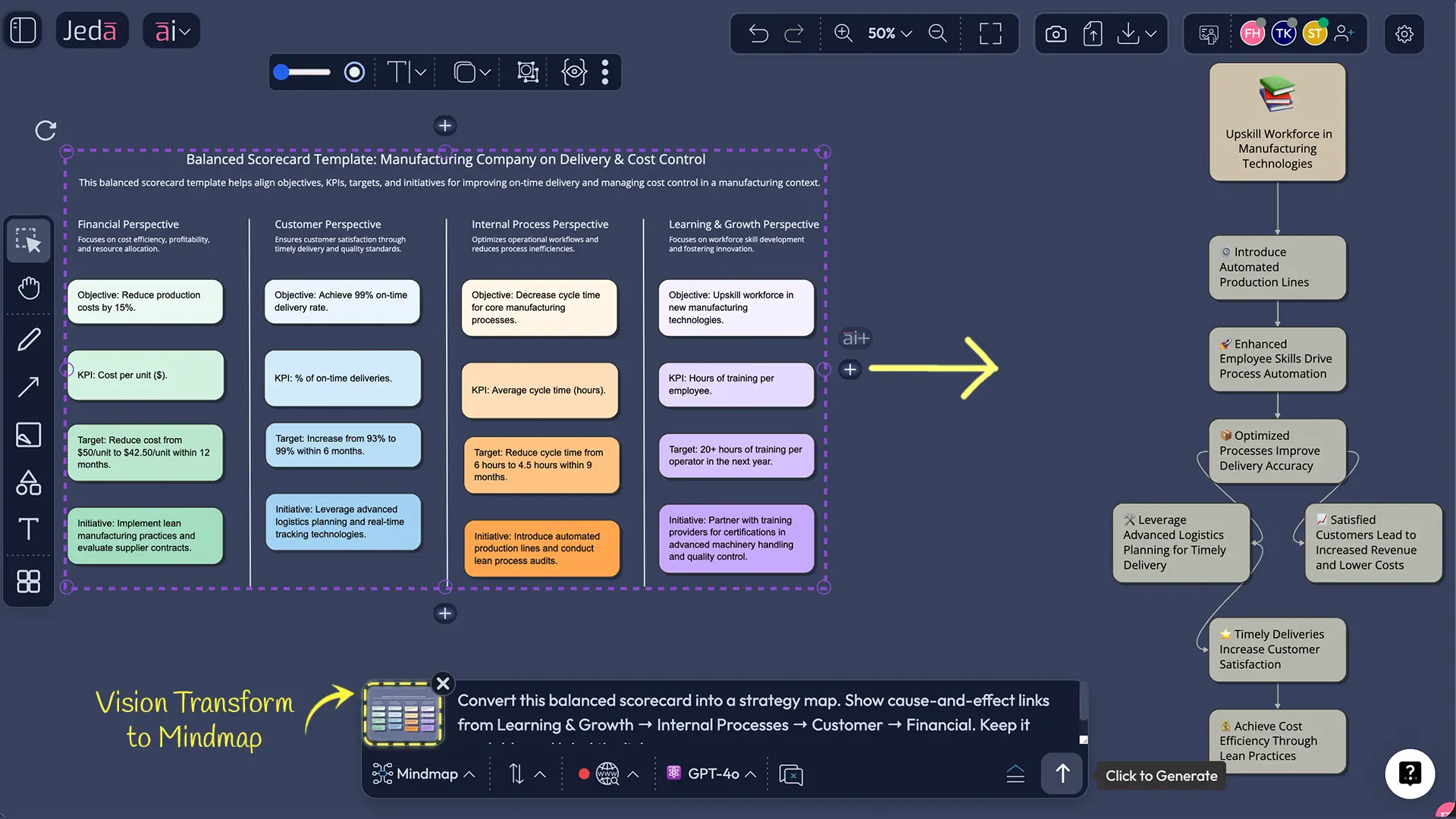
AI+ deep dive (extend what you already generated)
Once the matrix exists, AI+ is for expansion. Keep it general: “add more KPI options,” “clarify targets,” “suggest initiatives,” “tighten wording.” Avoid over-instructing; the goal is to refine, not to micromanage.
Balanced scorecard and example (worked case)
Here’s a worked example for a mid-market B2B SaaS team that wants profitable growth while lowering churn. The structure is the point—use your own metrics.
Financial quadrant (sample)
Objective: Improve net revenue retention (NRR)
- KPIs: NRR %, Expansion ARR
- Target: NRR ≥ 115% by Q4
- Initiative: Packaging refresh + expansion playbooks
Objective: Improve gross margin
- KPIs: Gross margin %, Infra cost per active customer
- Target: +4 points by Q4
- Initiative: Cloud cost optimization program
Customer quadrant (sample)
Objective: Reduce churn in the first 90 days
- KPIs: 90-day churn %, Activation rate
- Target: 90-day churn ≤ 3% by Q3
- Initiative: Guided onboarding + milestone-based setup
Objective: Improve support experience
- KPIs: First response time, CSAT
- Target: First response ≤ 2 hours; CSAT ≥ 4.6/5 by Q4
- Initiative: Triage rules + escalation playbook
Internal Processes quadrant (sample)
Objective: Reduce production incidents
- KPIs: Sev-1 count, MTTR
- Target: Sev-1 ≤ 2/month; MTTR ≤ 60 minutes by Q4
- Initiative: Postmortem system + reliability backlog
Objective: Increase release predictability
- KPIs: % on-time releases, Cycle time
- Target: 90% on-time; cycle time down 20% by Q4
- Initiative: Release train + CI stability work
Learning & Growth quadrant (sample)
Objective: Improve customer success capability
- KPIs: CSM ramp time, Playbook adoption
- Target: Ramp time down 25% by Q4
- Initiative: Training + certification track
Objective: Strengthen engineering practices
- KPIs: Test coverage (critical services), Incident recurrence
- Target: Coverage ≥ 80% on critical services; recurrence down 30% by Q4
- Initiative: Quality standards + reliability training
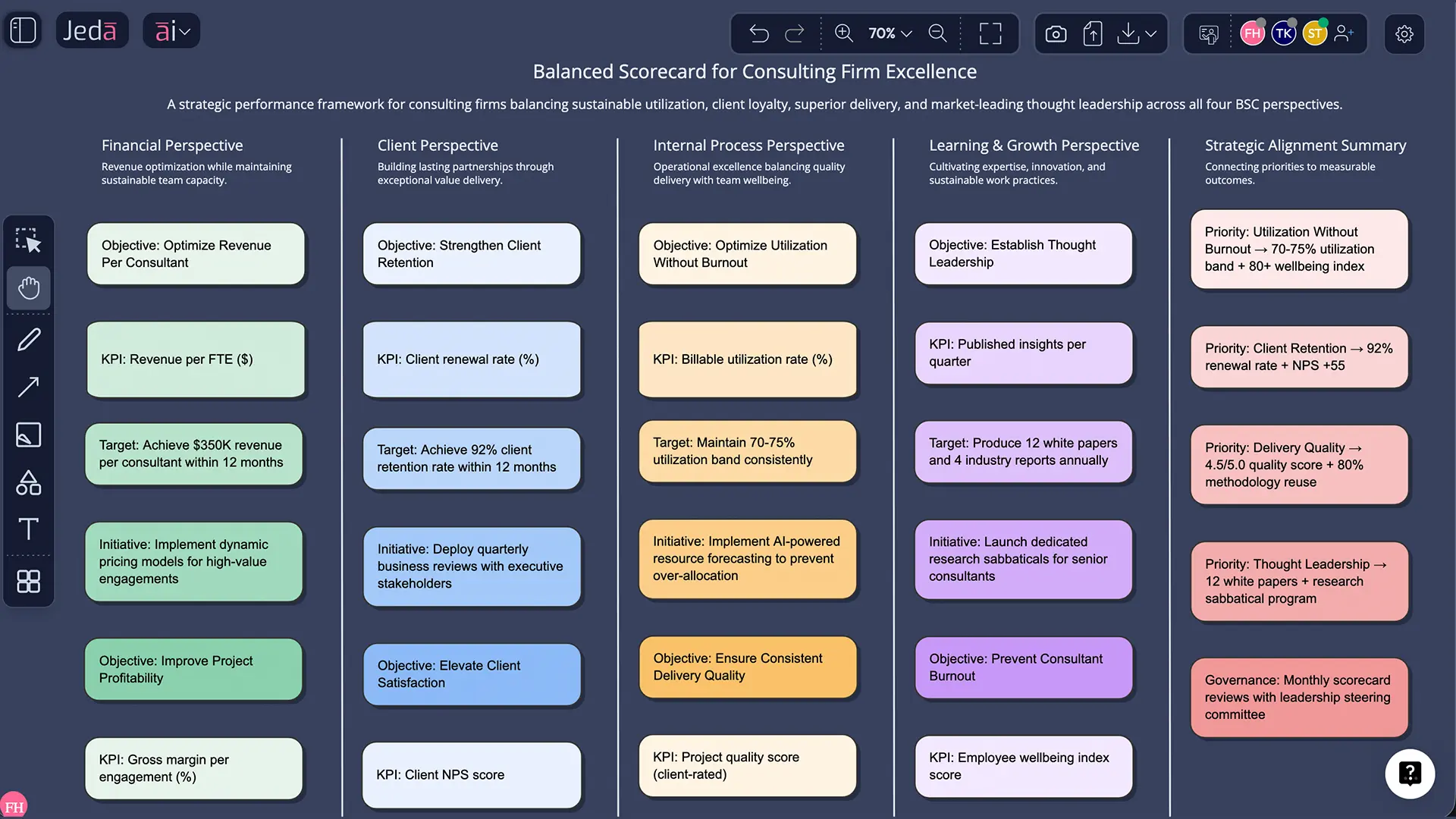
Best practices and tips (so your scorecard doesn’t become wall art)
The Balanced Scorecard works when it becomes a management cadence, not a one-time deliverable. Monthly review. Quarterly revision. Repeat.
If you want a formal explanation of strategy maps and why the cause-and-effect links matter, Kaplan and Norton’s work on strategy mapping is still the classic reference.
Common mistakes to avoid
Treating the scorecard as a dashboard
Dashboards report. Scorecards manage. If you don’t have initiatives and owners, you’re only reporting.Using vanity metrics
“Website visits” rarely belongs on a balanced scorecard unless your business model literally depends on traffic conversion and you can tie it to a specific initiative.Targets that are vague or unrealistic
“Improve customer satisfaction” isn’t a target. “Increase CSAT to 4.6/5 by Q4” is. Targets should create focus, not comedy.No causal story
A balanced scorecard should explain how Learning & Growth improvements enable better Internal Processes, which improve Customer outcomes, which deliver Financial results. If you can’t explain that chain, you can’t prioritize.Review cadence = never
If it’s not reviewed, it’s not a system. It’s a document.
Frequently Asked Questions
- What is a balanced scorecard?
- A balanced scorecard is a structured 2×2 matrix that organizes strategy into four perspectives: Financial, Customer, Internal Processes, and Learning & Growth. Each quadrant includes objectives, KPIs, targets, and initiatives so teams can manage execution, not just report performance.
- What are the four perspectives of the Balanced Scorecard?
- The four perspectives are Financial, Customer, Internal Processes, and Learning & Growth. They balance outcome measures (financial results) with the drivers of future outcomes (customer value, process quality, and organizational capability).
- How many KPIs should a balanced scorecard have?
- Most teams start with 6–12 KPIs total across all four perspectives. Too many KPIs makes review meetings noisy and dilutes accountability. Start small, assign owners, and expand only when initiatives and targets are clear.
- How do you create a balanced scorecard with AI in Jeda.ai?
- You can create a balanced scorecard in Jeda.ai using Method 1 (AI Menu → Recipe Matrix) or Method 2 (Prompt Bar → Matrix command). Both produce a 2×2 scorecard you can edit in an AI Workspace and review live on an AI Whiteboard.
- What should go inside each quadrant?
- Each quadrant should include objectives, KPIs, targets, and initiatives. Objectives define outcomes, KPIs measure progress, targets define success with a timeframe, and initiatives are the actions that move KPIs. This structure ties measurement to execution.
- What is the difference between a Balanced Scorecard and OKRs?
- Balanced scorecards organize strategy across four perspectives and connect objectives to KPIs, targets, and initiatives. OKRs focus on objectives and measurable key results for a cycle. Many teams use both: the scorecard for strategy structure, OKRs for execution rhythm.
- Can I turn a balanced scorecard into a strategy map?
- Yes. A strategy map shows cause-and-effect links across the four perspectives, typically from Learning & Growth → Internal Processes → Customer → Financial. Kaplan and Norton popularized strategy maps as a way to make the logic of strategy explicit.
- How often should a balanced scorecard be reviewed?
- A practical cadence is monthly review and quarterly revision. Monthly reviews keep initiatives accountable. Quarterly revisions keep objectives and targets aligned with market changes and operating reality.
- What formats can I export from Jeda.ai?
- Jeda.ai exports PNG, SVG, and PDF. These formats work for leadership reviews, documentation, and sharing outside the workspace while keeping the editable scorecard in your AI Workspace.
- What Jeda.ai plan is best for balanced scorecard work?
- Whitebelt (Free) works for trying the recipe with limited daily usage. Blackbelt ($10/month) adds expanded limits and full collaboration. Shifu ($39/month) adds Multi-LLM intelligence plus an Aggregator model for advanced use cases.
Sources and further reading
- [1]
Kaplan, Robert S.; Norton, David P. (1992) . “The Balanced Scorecard—Measures that Drive Performance” Harvard Business Review.
View Source ↗ - [2]
Kaplan, Robert S.; Norton, David P. (1993) . “Putting the Balanced Scorecard to Work” Harvard Business Review.
View Source ↗ - [3]
Kaplan, Robert S.; Norton, David P. (2000) . “Having Trouble with Your Strategy? Then Map It” Harvard Business Review (OnPoint).
View Source ↗ - [4]
ACCA Global (n.d.) . “Balanced scorecard (technical article)” ACCA Global.
View Source ↗ - [5]
Balanced Scorecard (UK) (n.d.) . “Perspectives” balancedscorecard.org.uk.
View Source ↗ - [6]
Weller, Joe (2024) . “Free Balanced Scorecard Templates and Examples” Smartsheet.
View Source ↗
Build your Balanced Scorecard in Jeda.ai
Join 150K+ users who use Jeda.ai as an AI Workspace and AI Whiteboard to turn strategy into editable, shareable visuals.
Try Free Recipes