What is a brand moat?
A brand moat is a durable advantage built from what people believe about you—and the habits that belief creates. It shows up as pricing power, preference under pressure, and a weird kind of patience: customers wait, forgive, and come back.
Investors call the broader version an economic moat, popularized by Warren Buffett. The brand moat is one source of that moat, alongside switching costs, scale, IP, and network effects. Put simply: brand is the part you can’t fully copy by reverse-engineering features.
Brand moat vs economic moat: what’s the difference?
Economic moat is the umbrella term. Brand moat is one type under it.
Here’s a quick way to keep your team sane:
- Economic moat answers: “Why can this business stay profitable when competitors attack?”
- Brand moat answers: “Why do customers pick this name even when cheaper options exist?”
And here’s the trap: brand often starts the advantage, but it rarely stands alone. Apple is a good example. The brand gets attention. The ecosystem creates switching costs. Together, the moat holds.
Why do brand moats get weaker in the AI era?
Because imitation got cheaper. Fast.
When everyone can generate “nice” brand assets in minutes, aesthetics stop being a differentiator. What survives is the stuff that’s hard to fake:
- Proof that you deliver (outcomes, case studies, receipts).
- Consistency across time and channels.
- Trust built through decisions that cost you something (guarantees, refunds, saying no to bad-fit customers).
- Community and identity (“people like me choose this”).
AI doesn’t kill brand. It kills generic brand. Good riddance.
This is where a visual approach matters. Your team needs to see the moat as a system, not a slogan. That’s why a shared AI Workspace beats a 32-slide brand deck that nobody reads after Monday.
The Brand Moat Analysis framework (a practical model)
A strong brand moat is not one thing. It’s a stack.
Here’s a framework we’ve found useful for teams that want clarity without the MBA fog:
The 6 Moat Builders (Brand Edition)
- Meaning — the “one sentence” you own in the buyer’s head
- Proof — evidence that backs the promise (and survives scrutiny)
- Distinctiveness — assets people recognize fast (not just a logo)
- Habit — repeat usage patterns and rituals (weekly, daily, seasonal)
- Community — identity, belonging, status, and shared language
- Staying Power — resilience under pressure (price hikes, mistakes, copycats)
Brand moat analysis is the process of scoring these, finding leaks, and deciding what to build next.
- Meaning
A sharp claim people can repeat. If your audience can’t summarize you, you don’t own a position.
- Proof
Outcomes, testimonials, third-party validation, and product truth that supports the promise.
- Distinctiveness
Recognizable cues and patterns that feel like you. Not trendy. Not generic.
- Habit
Usage patterns and rituals that make the brand part of life or workflow.
- Community
Identity and belonging that competitors can’t buy with ads.
- Staying Power
You hold preference even after a mistake, a price move, or a copycat launch.
How AI improves brand moat analysis
AI helps when the job is messy: too many inputs, too many opinions, not enough synthesis.
In Jeda.ai, you can pull evidence into one place and turn it into visuals your team can debate:
- Drop customer interview notes or positioning docs into Document Insight, then output a Matrix.
- Bring NPS, win/loss notes, or review exports into Data Insight and generate a scorecard.
- Turn competitor messaging into a Diagram that shows “where everyone sounds the same.”
- Run the same prompt with multiple models (up to three) and let the Aggregator pick the best response.
That’s not “AI magic.” It’s Visual AI applied to the unglamorous work: sorting, structuring, and getting to decisions.
How to create a Brand Moat Analysis in Jeda.ai
You can do this two ways: with the AI Menu recipe (fastest) or with the Prompt Bar (most flexible). Either way, you’re working on an AI Whiteboard inside an AI Workspace, so your team can edit the output live.
- Collect your evidence
Bring inputs: customer interviews, reviews, positioning doc, competitor pages, win/loss notes, and a quick metric snapshot (NPS, retention, branded search trend if you have it).
- Open Jeda.ai and pick your method
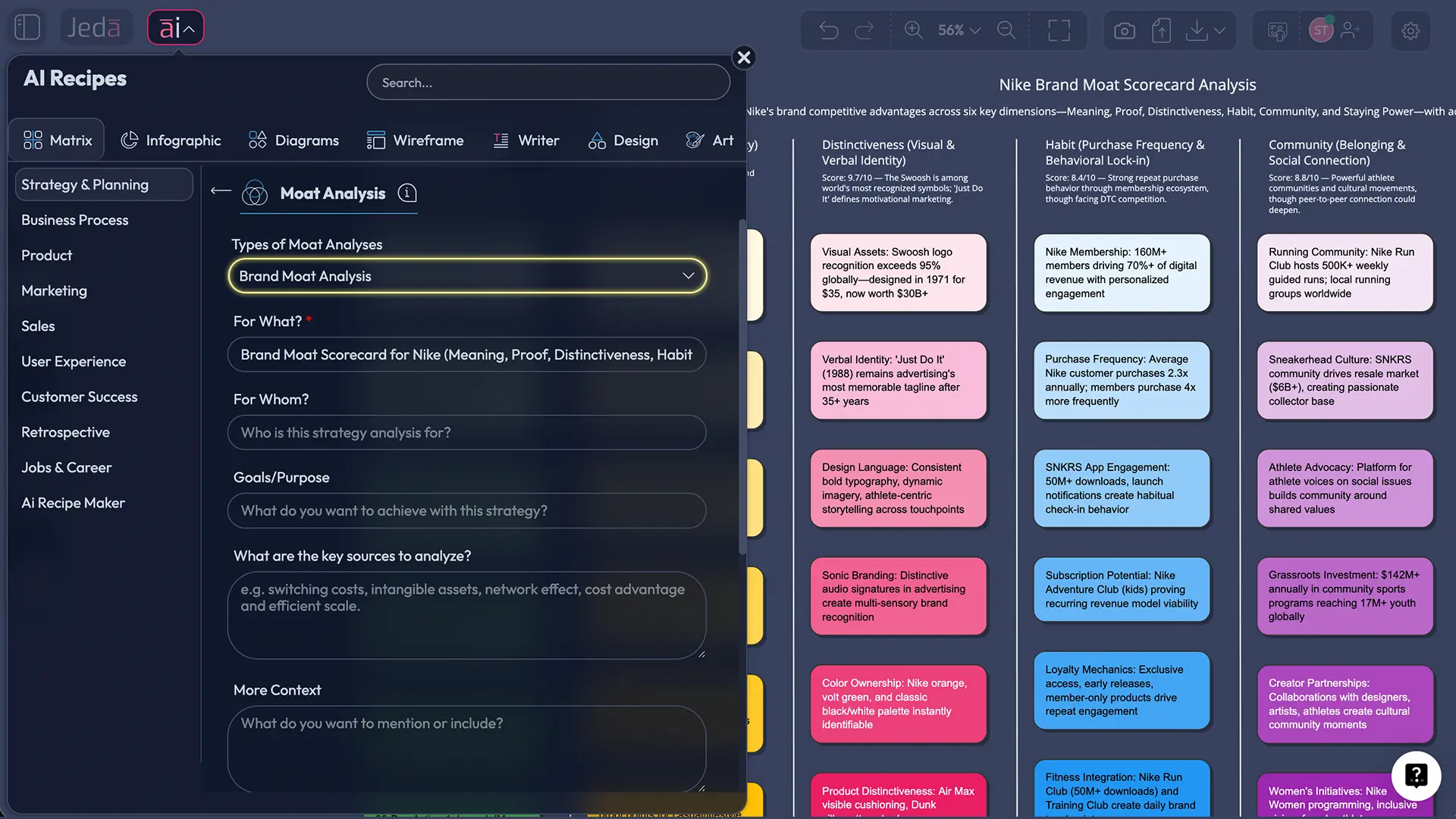
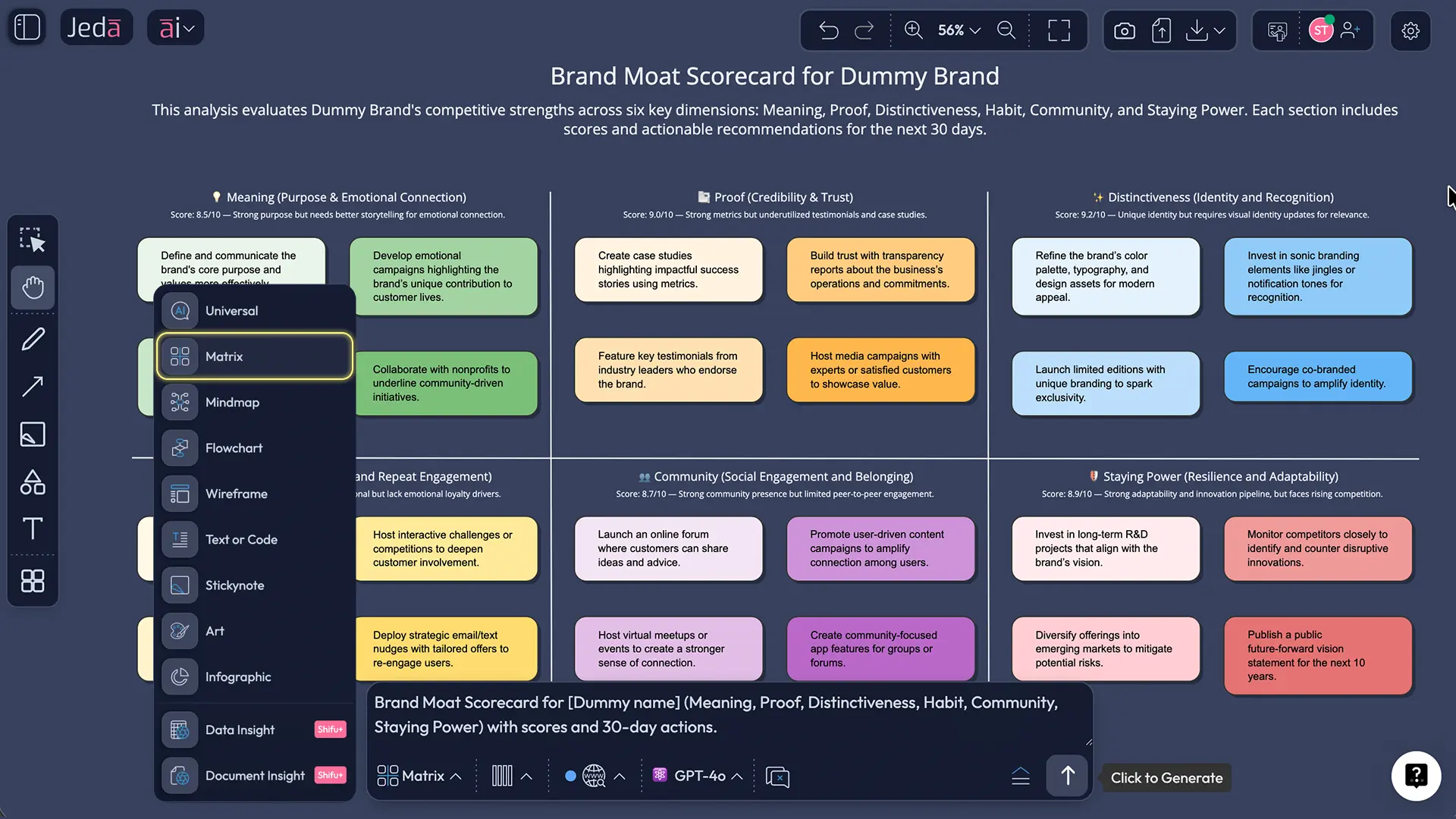
Method A: open AI Menu and search for “Moat Analysis”, then choose the Brand Moat sub-template. Method B: open the Prompt Bar and select the Matrix command.
- Generate the Brand Moat Scorecard
Ask for a 6-part scorecard (Meaning, Proof, Distinctiveness, Habit, Community, Staying Power) with scores, evidence, and a 30-day action plan.
- Stress test with a second pass
Run the same prompt again with different assumptions (new competitor, new segment). If you’re on Shifu, use Multi-LLM and compare outputs.
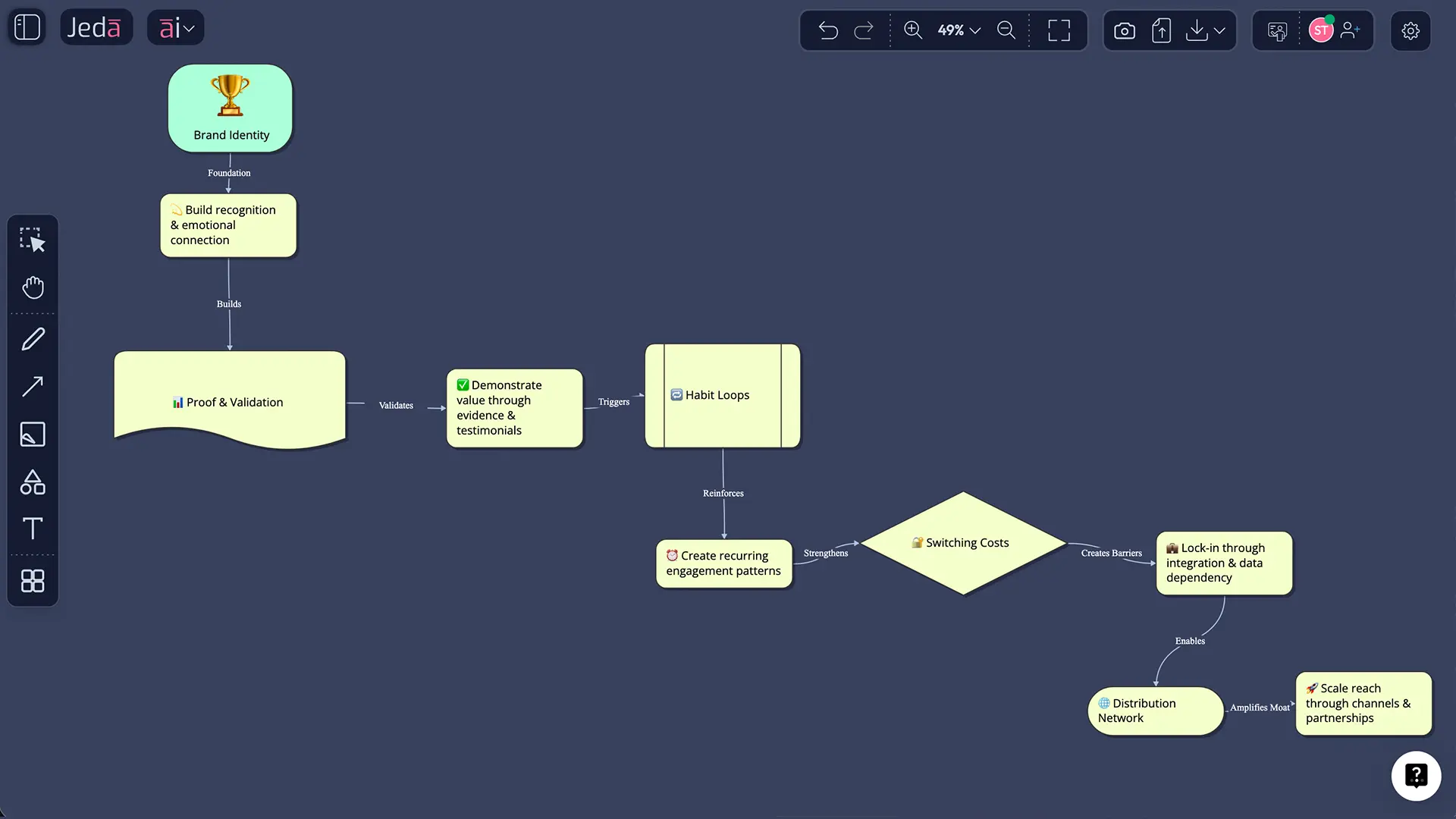
- Turn findings into a Moat Map
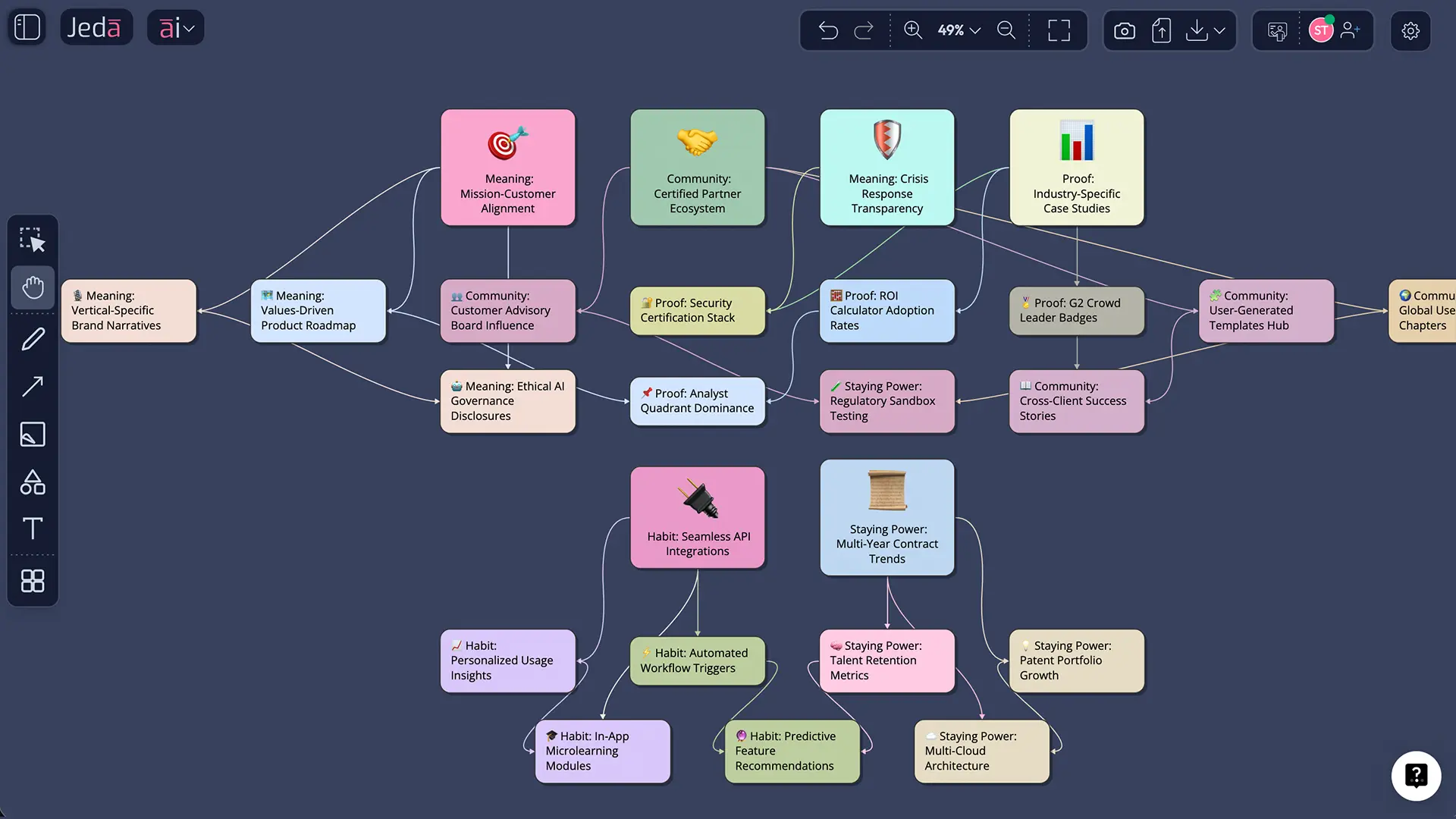
Use the Diagram command to draw the moat stack: brand on top, then switching costs, distribution, ecosystem, and proof loops.
- Extend and refine
Select any section and tap the AI+ button to expand it with more examples, evidence requests, or messaging experiments.
- Export for sharing
Export the board as PNG, SVG, or PDF for stakeholders and workshops.
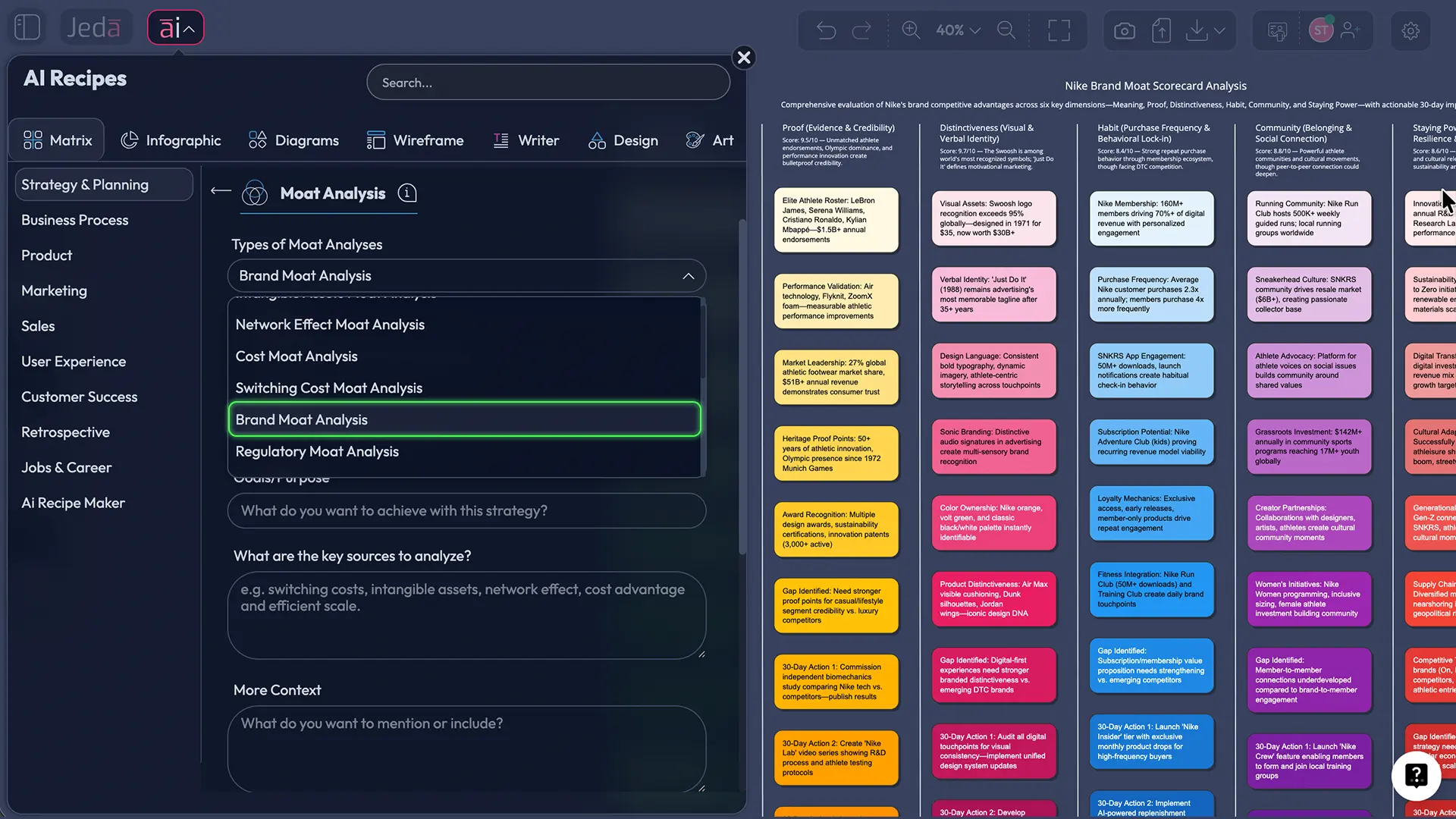
Copy-paste prompt: Brand Moat Analysis Scorecard
Use this with Matrix in the Prompt Bar:
Prompt:
“Create a Brand Moat Analysis scorecard for [Brand] in [Category].
Provide a 6-row matrix: Meaning, Proof, Distinctiveness, Habit, Community, Staying Power.
For each row include: Score (1–10), Evidence we already have, Evidence we need, Biggest risk, and 3 actions we can do in 30 days.
Add a final section: ‘If competitors copy us tomorrow, what still holds?’
Keep it specific. No vague branding advice.”
Brand moat template + example (worked through)
Let’s do a fast, honest example. Imagine a premium coffee brand (or a coffee chain) in a crowded city market.
The easy version of the brand story is “we have better beans.” Everyone says that. The moat rarely lives there.
A good analysis might find:
- Meaning: “the third place” (work + home + this)
- Habit: weekly rituals (same order, same barista, same routine)
- Community: status and belonging (especially if the brand is a cultural signal)
- Proof: consistent experience (not perfect, but predictable)
Then you look for leaks:
- The product is copied.
- Prices rise.
- Competitors open next door.
What holds? The rituals and the identity often outlive the copycat menu.
Best practices (so your moat analysis doesn’t become theatre)
Common mistakes to avoid
- Confusing vibes with defensibility. A pretty brand is not a moat. It’s a costume.
- Treating brand as the only moat. If your product has zero switching costs, brand must carry everything. That’s expensive and risky.
- Skipping the “evidence we need” column. Without it, you’re not doing analysis—you’re doing opinions.
- Ignoring new substitutes. Your competitor might not be another brand. It might be “doing nothing” or “using a spreadsheet.”
- Not making a decision. A moat map is only useful if it changes priorities.
Frequently Asked Questions
- What is a brand moat?
- A brand moat is a durable advantage created by meaning, trust, and preference that competitors can’t easily copy. It shows up as pricing power, loyalty, and customers choosing you even when alternatives are cheaper or similar.
- What is an economic moat in business?
- An economic moat is a long-term competitive advantage that protects a company’s profits and market share. Brand strength can be one source of an economic moat, along with switching costs, scale, network effects, and legal or IP barriers.
- Brand moat vs competitive advantage: are they the same?
- Not exactly. Competitive advantage is any edge that helps you win. A brand moat is a specific kind of advantage rooted in customer perception and trust, and it’s considered a ‘moat’ only when it persists over time under competitive pressure.
- How do you identify a brand moat?
- Identify a brand moat by looking for evidence of preference under pressure: customers pay more, wait longer, forgive mistakes, and still choose the brand. Then confirm it with proof like retention behavior, referrals, and consistent brand-led demand.
- What are examples of companies with strong brand moats?
- Examples often cited include Nike and Starbucks, where the brand stands for a lifestyle or identity that creates loyalty and premium pricing. The point isn’t the logo—it’s the meaning, trust, and habit loop behind the logo.
- How does AI help with brand moat analysis?
- AI helps by structuring messy inputs—reviews, interviews, competitor messaging, and metrics—into a scorecard and action plan. In Jeda.ai, you can convert evidence into visual matrices and diagrams your team can edit and challenge together.
- Can a startup build a brand moat early?
- Yes, but it starts narrow. Early brand moats usually come from sharp positioning, consistent proof, and a small community that feels ‘seen.’ Startups often widen the moat later by adding switching costs, ecosystem hooks, or distribution advantages.
- What’s the difference between brand moat and switching costs?
- Brand moat is preference-driven: people want you. Switching costs are friction-driven: it’s hard to leave. Strong companies often have both—brand opens the door, switching costs keep the relationship stable once customers are in.
- How do you measure brand equity in a practical way?
- Measure brand equity using signals you can track: branded search demand trends, repeat purchase rates, referral share, price sensitivity, and survey-based awareness/preference. Pair the numbers with qualitative evidence from interviews and reviews.
- How often should you update a moat analysis?
- Update it quarterly for fast-moving categories and at least twice per year for slower ones. Competitive pressure, new substitutes, and changes in distribution can weaken a moat quietly, so you want a regular review cadence.
- Can I export a brand moat analysis from Jeda.ai?
- Yes. After you build the scorecard and moat map in the AI Workspace, you can export the board as PNG, SVG, or PDF for sharing with stakeholders and for workshop documentation.
Sources & Further Reading
- [1]
Michael E. Porter (1985) . “The Competitive Advantage: Creating and Sustaining Superior Performance” Harvard Business School / Free Press.
View Source ↗ - [2]
Jay Barney (1991) . “Firm Resources and Sustained Competitive Advantage” Journal of Management.
View Source ↗ - [3]
David A. Aaker (1991) . “Managing Brand Equity” Free Press.
View Source ↗ - [4]
Kevin Lane Keller (1993) . “Conceptualizing, Measuring, and Managing Customer-Based Brand Equity” Journal of Marketing.
View Source ↗ - [5]
Investopedia Staff (2025) . “How an Economic Moat Provides a Competitive Advantage” Investopedia.
View Source ↗ - [6]
Morningstar (2026) . “Economic Moat” Morningstar Indexes.
View Source ↗
Build a Brand Moat That Competitors Can’t Screenshot
Join 150,000+ users who use Jeda.ai as an AI Workspace for decision-grade strategy work—visual, editable, and built for real-time collaboration.
Try Jeda.ai Free