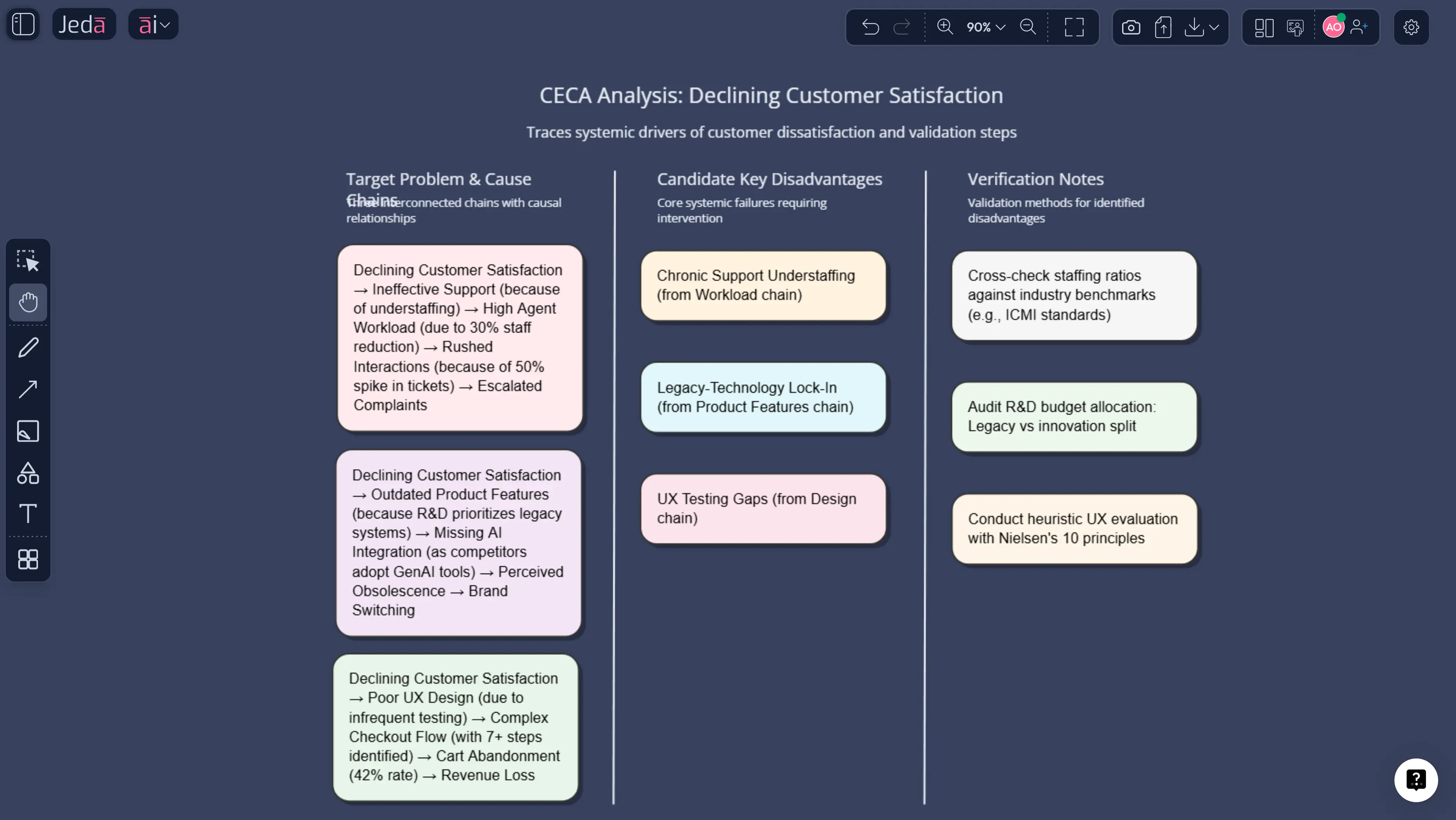
Root cause analysis is everywhere. CECA is what happens when you make it more disciplined and more TRIZ‑friendly.
In modern TRIZ, Cause‑Effect Chains Analysis (CECA) is used to identify underlying key disadvantages and key problems to address. Some TRIZ literature explicitly compares CECA with traditional RCA and explains how the methods differ.
This guide shows how to run CECA with AI inside Jeda.ai so you get:
- a verified cause‑effect chain (not just assumptions),
- a shortlist of key disadvantages,
- and a clean “what to solve next” output.
What is Cause‑Effect Chains Analysis (CECA)?
CECA is a structured analysis tool that builds a causal chain from a target problem back to deeper causes. Unlike casual RCA, CECA is often framed around identifying and prioritizing key disadvantages—causal factors that are promising to eliminate and lead to meaningful improvement.
Many CECA variants emphasize:
- building and verifying cause-effect chains,
- prioritizing key disadvantages,
- and then generating solution direction chains or idea chains (in extended approaches).
CECA vs RCA (professional distinction)
CECA and RCA both use causal logic, but TRIZ-oriented CECA literature argues they differ in execution and outcomes.
In professional practice:
- RCA often stops when a “root cause” seems plausible or politically acceptable.
- CECA pushes for deeper, structured chains and then ranks disadvantages (target, intermediate, key, insignificant, hard-to-eliminate) in some methodologies.
The result is less “we think it’s this” and more “here is the verified chain and the highest-leverage disadvantage to eliminate.”
Why use AI for CECA?
CECA is not hard because the logic is complicated. It’s hard because it’s memory-intensive and documentation-heavy:
- you need to keep hypotheses, evidence, and chain structure coherent,
- you need to avoid circular causes,
- you need to track verification status.
AI helps by:
- converting incident reports/logs into candidate causes,
- drafting multiple chain variants quickly,
- forcing consistent phrasing (“X causes Y under condition Z”),
- and producing a clean diagram you can review as a team.
Human validation remains mandatory. Otherwise CECA becomes “hallucination chains analysis.”
How to run Cause‑Effect Chains Analysis with AI in Jeda.ai
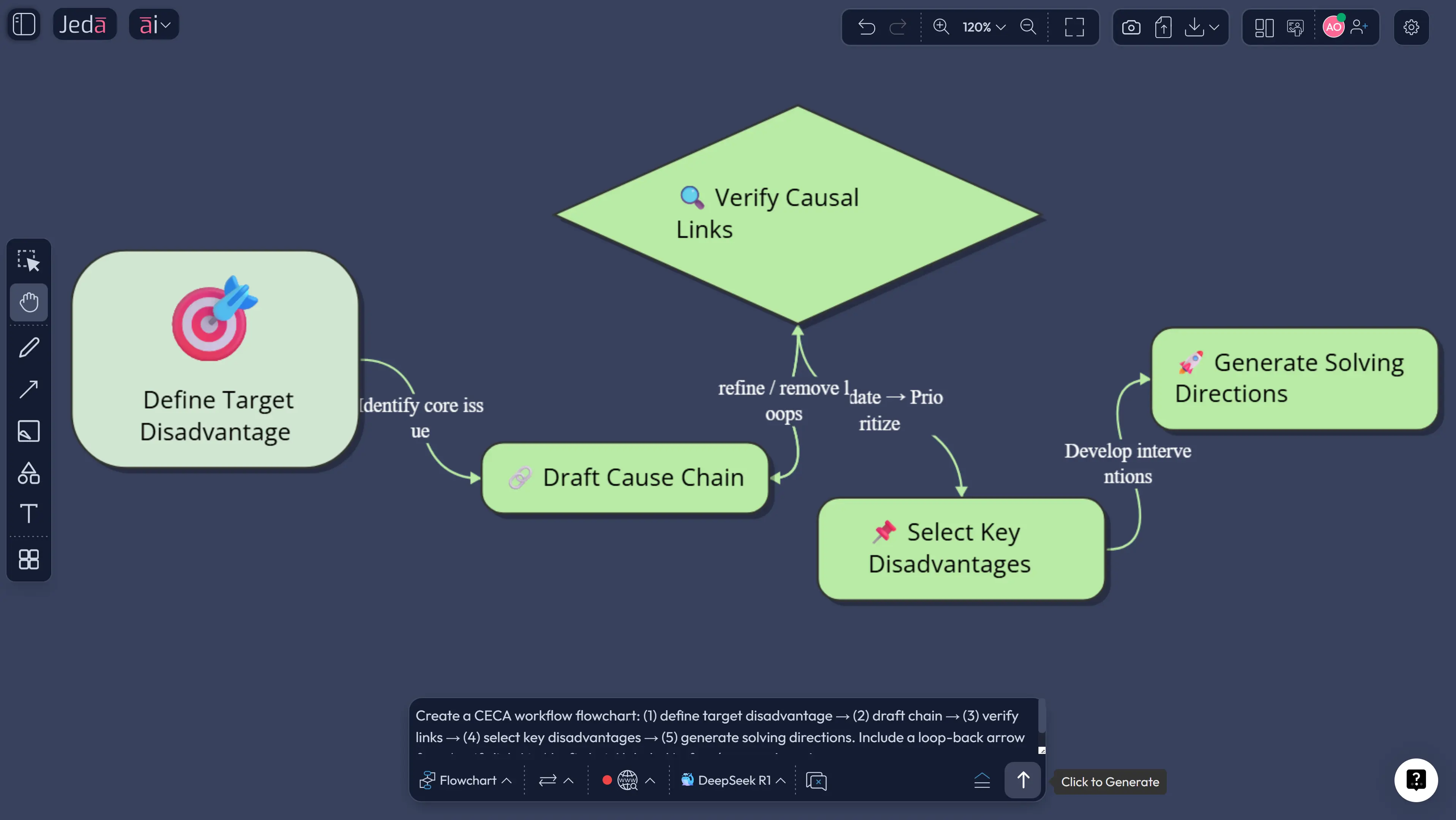
Step 1: Define the target disadvantage precisely
Use a measurable statement:
- “Defect rate increases from 0.8% to 3.1% on Line B after tool change.”
- “Checkout drop-off increases by 12% after enabling MFA step.”
Step 2: Build the first causal chain (draft)
Create a chain: Target disadvantage → immediate cause → deeper cause → candidate key disadvantage.
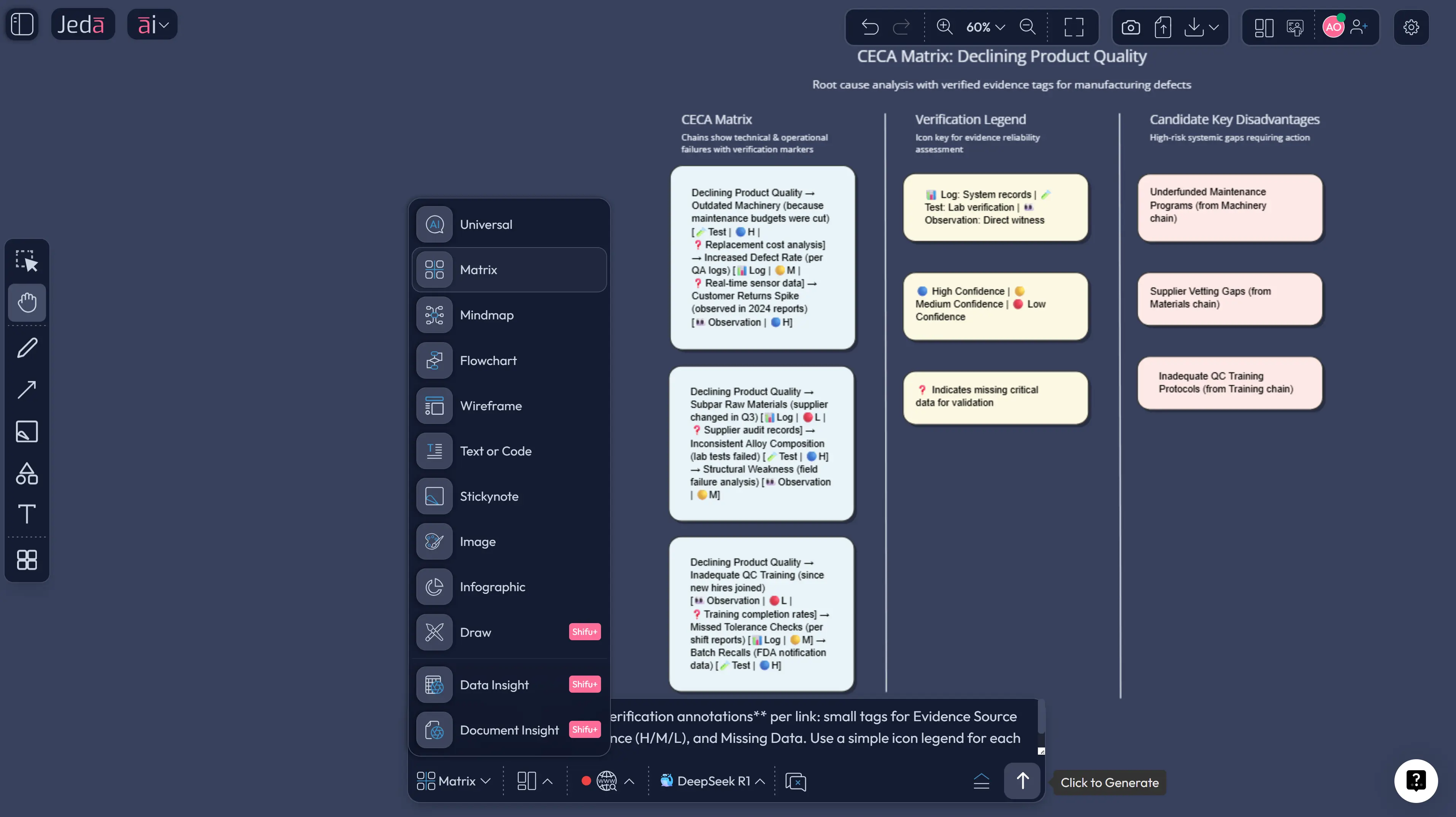
Step 3: Verify each link
For each arrow, add:
- evidence source (log, test, observation),
- confidence (High/Medium/Low),
- missing data needed.
Step 4: Identify key disadvantages
Look for nodes that:
- appear in multiple branches,
- are feasible to eliminate,
- would remove multiple downstream issues.
Step 5: Generate solving directions
Extended CECA approaches explicitly include generating solving direction chains and idea chains. In Jeda.ai, convert key disadvantages into:
- contradictions to resolve,
- function model targets,
- or Su‑Field transformations.
- Define target disadvantage
Write a measurable problem statement with context and time window (avoid vague ‘too slow’ phrasing).
- Draft the CECA chain
Generate the first-pass cause → effect chain using AI (Matrix) or an AI Recipe template.
- Verify each link
Attach evidence per arrow (log/test/observation) and mark confidence (High/Medium/Low).
- Select key disadvantages
Choose 2–3 leverage nodes that remove the most downstream disadvantages and are feasible to change.
- Generate solving directions
For each key disadvantage, generate 3–5 testable fixing directions with risks and fastest validation tests.
How to run Cause-Effect Chains Analysis (CECA) with AI in Jeda.ai (2 ways)
Method 1 — AI Recipe Templates (AI Menu)
Open your board and click AI Menu / AI Recipes.
Navigate to the relevant category (e.g., TRIZ / Problem Solving) and select Cause-Effect Chains Analysis (CECA).
Fill the recipe inputs
Click Generate to produce the editable CECA chain diagram.
Mark each link with confidence + evidence note, then highlight 2–3 key disadvantages for solving directions.
Method 2 — Prompt Bar (Diagram command)
Open the AI Prompt Bar / AI Command Bar at the bottom of the workspace.
Select Matrix as the command.
Paste a CECA prompt: Deliverable: “Build a CECA Matrix from target disadvantage → cause-effect chains. Add verification note + confidence (H/M/L) per link. Highlight 2–3 candidate key disadvantages.”
Generate → edit the canvas (remove loops, merge duplicates, tighten wording).
(Optional) Run a second prompt to generate solving directions for the selected key disadvantage(s).
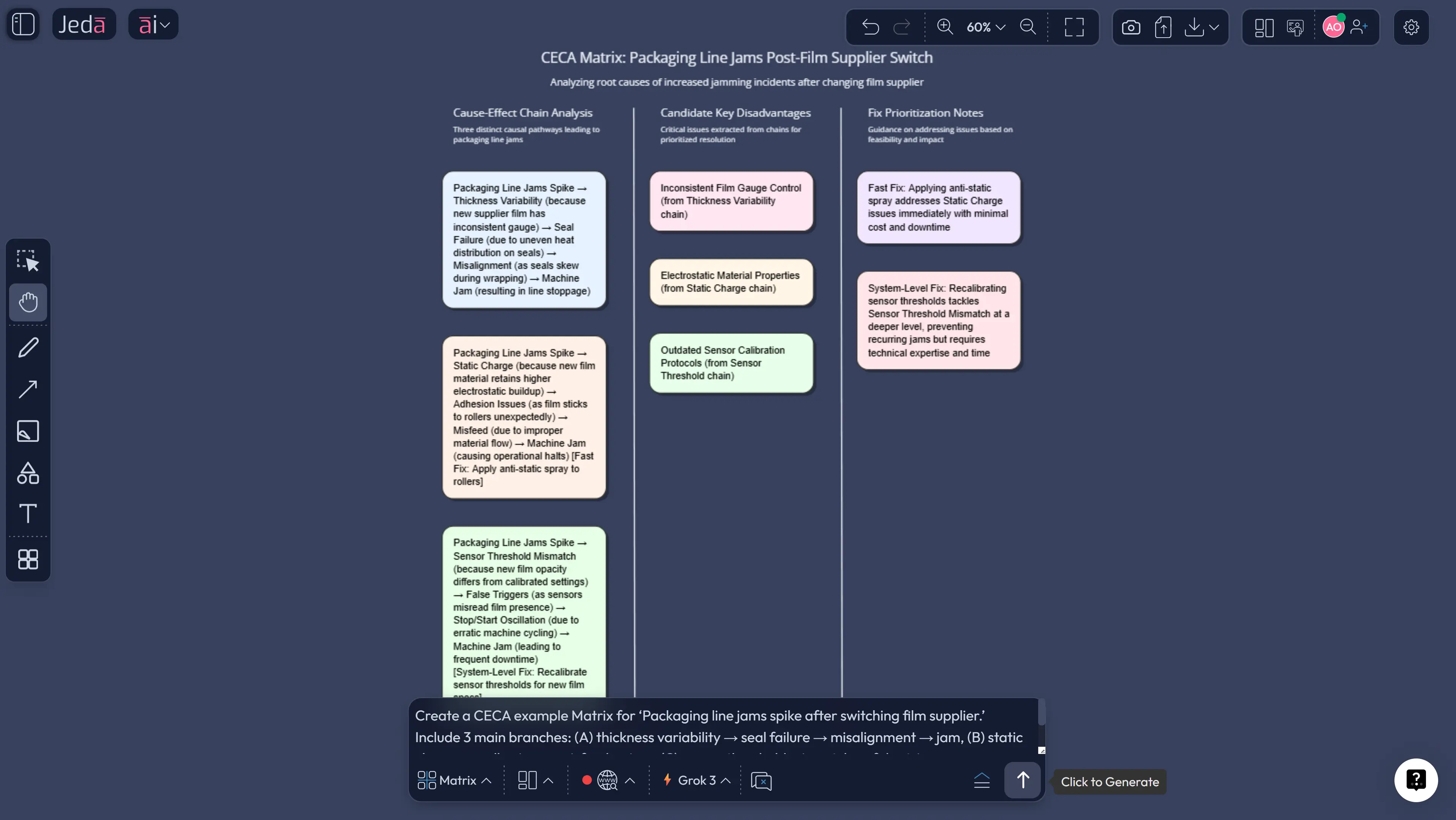
Mini example: packaging line jam spikes
Target disadvantage: jams spike after switching packaging film supplier.
CECA quickly reveals candidate causes:
- film thickness variability → seal failure → misalignment → jam
- static charge increase → adhesion → misfeed → jam
- sensor threshold tuned for old film → false triggers → stop/start oscillation → jam
Key disadvantages might be:
- “sensor threshold mismatch” (fast fix),
- “static charge management missing” (system-level fix).
CECA doesn’t just point to a “root cause.” It produces a ranked set of leverage points.
FAQ
- What is Cause-Effect Chains Analysis (CECA) in TRIZ?
- Cause-Effect Chains Analysis (CECA) is a TRIZ tool for building and verifying causal chains from a target problem back to deeper causes. It is used to identify and prioritize key disadvantages to eliminate.
- How is CECA different from root cause analysis (RCA)?
- CECA and RCA both use cause-effect logic, but CECA emphasizes structured chains, verification, and selecting key disadvantages that provide high leverage. TRIZ literature discusses differences in how CECA and RCA are performed and how they stop the analysis.
- What are key disadvantages in CECA?
- Key disadvantages are causal factors in the chain that are promising to eliminate and can remove multiple downstream disadvantages. Some CECA methods classify disadvantages into types to support selection.
- How can AI help with CECA?
- AI can draft chain variants, normalize wording, and generate clean diagrams. Humans must verify each causal link using data and domain knowledge.
Citations
- [1]
O. Y. Abramov (2015) . “TRIZ‑Based Cause and Effect Chains Analysis vs Root Cause Analysis” TRIZfest 2015 Paper (PDF).
View Source ↗ - [2]
The TRIZ Journal (2016) . “TRIZ‑Based Cause and Effect Chains Analysis vs Root Cause Analysis” The TRIZ Journal.
View Source ↗ - [3]
M. G. Lee et al. (2018) . “Introduction to cause-effect chain analysis plus with an application to an automotive part” The International Journal of Advanced Manufacturing Technology.
View Source ↗ - [4]
J. Chrząszcz (2022) . “Advanced Cause‑Effect Chains Analysis” Matriz (PDF).
View Source ↗ - [5]
C. Dobrusskin (2016) . “On the Identification of Contradictions Using Cause Effect Chains” Procedia CIRP.
View Source ↗