If you’ve ever lost a deal and thought, “Wait… we don’t even compete with them,” you’ve already met the real reason teams need a competition identification matrix. Competition isn’t only the companies in your category. It’s anything that wins the buyer’s money, attention, or internal political support. And yes, that includes the boring “status quo” that never updates its pricing page.
This resource walks you through a clean, academically grounded way to identify competitors using a matrix, then shows how to generate and iterate that matrix inside a visual AI workspace.
What is Competition Identification?
Competition identification is the step where you define who you’re actually competing against and why. Michael Porter’s work is a useful anchor here: strategy is about coping with competition, and competition is broader than “industry rivals.” It includes substitutes and other forces that shape profitability. Porter (1979) makes this point bluntly, and he repeats it later (Porter, 2008).
So, competitor identification is not a list. It’s a classification problem.
The goal is to avoid two expensive errors:
- Competitive myopia: you only track lookalikes and miss substitutes.
- Competitive paranoia: you track everyone and end up doing nothing.
The Competition Identification Matrix (3 Buckets)
You asked for three buckets and you’re right to insist on them. They make the exercise actionable.
1) Direct competitors
Same buyer. Same core job-to-be-done. Similar solution category.
Think: “If we disappear, they pick that vendor next.”
2) Different solution competitors (substitutes and alternatives)
Same buyer. Same job-to-be-done. Different way of solving it.
This is where pricing power quietly dies. Substitutes can cap what buyers are willing to pay even if they never call themselves your category. Porter (2008) highlights substitutes as a force that constrains industry profits.
3) Different customer competitors (adjacent expansion threats)
Different primary buyer or segment today, but they have a capability that can expand into your lane.
These threats often arrive via bundling, platform moves, or “we already sell to your finance team” cross-sell.
A practical, modern definition that aligns with how market intelligence teams work is: direct competitors offer similar products, and indirect competitors provide alternatives or substitutes. NielsenIQ explains this distinction clearly in its competitive strategy guidance.

Why Use Competition Identification with AI?
Academic frameworks are only useful if teams can repeat them fast. That’s where AI helps.
- Faster competitor discovery
Use the Matrix command to generate an initial competitor set from your category, customer, and job-to-be-done, then refine it with real-world evidence.
- Bucket competitors correctly
AI helps you separate direct rivals from substitutes and adjacent threats so you don't overreact to the wrong players.
- Turn messy inputs into structure
Paste notes from calls, reviews, and demos, and have AI convert them into a clean competition identification matrix you can actually use.
- Expand with AI+ when new info appears
When a new competitor pops up, select the matrix and tap AI+ to extend the watch list or refresh the threat signals.
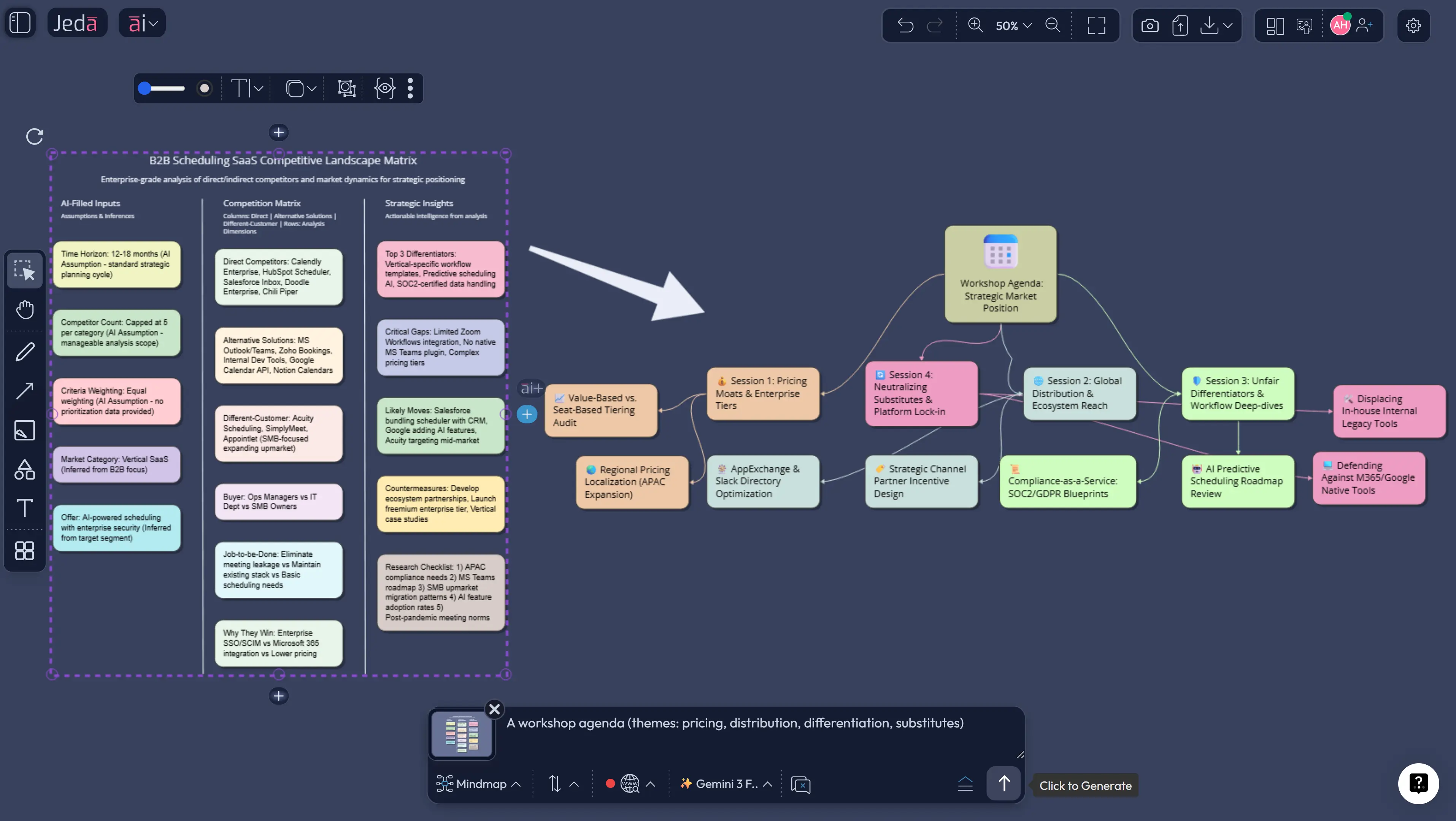
- Convert formats with Vision Transform
Turn the matrix into a mind map or flowchart when you want a storyline for a deck or a workshop.
Two quick benefits you’ll feel immediately:
- Speed: you can draft the first pass in minutes instead of days.
- Structure: you stop mixing substitutes with direct rivals, which is the strategic equivalent of putting salt in your coffee.
How to Create a Competition Identification Matrix in Jeda.ai
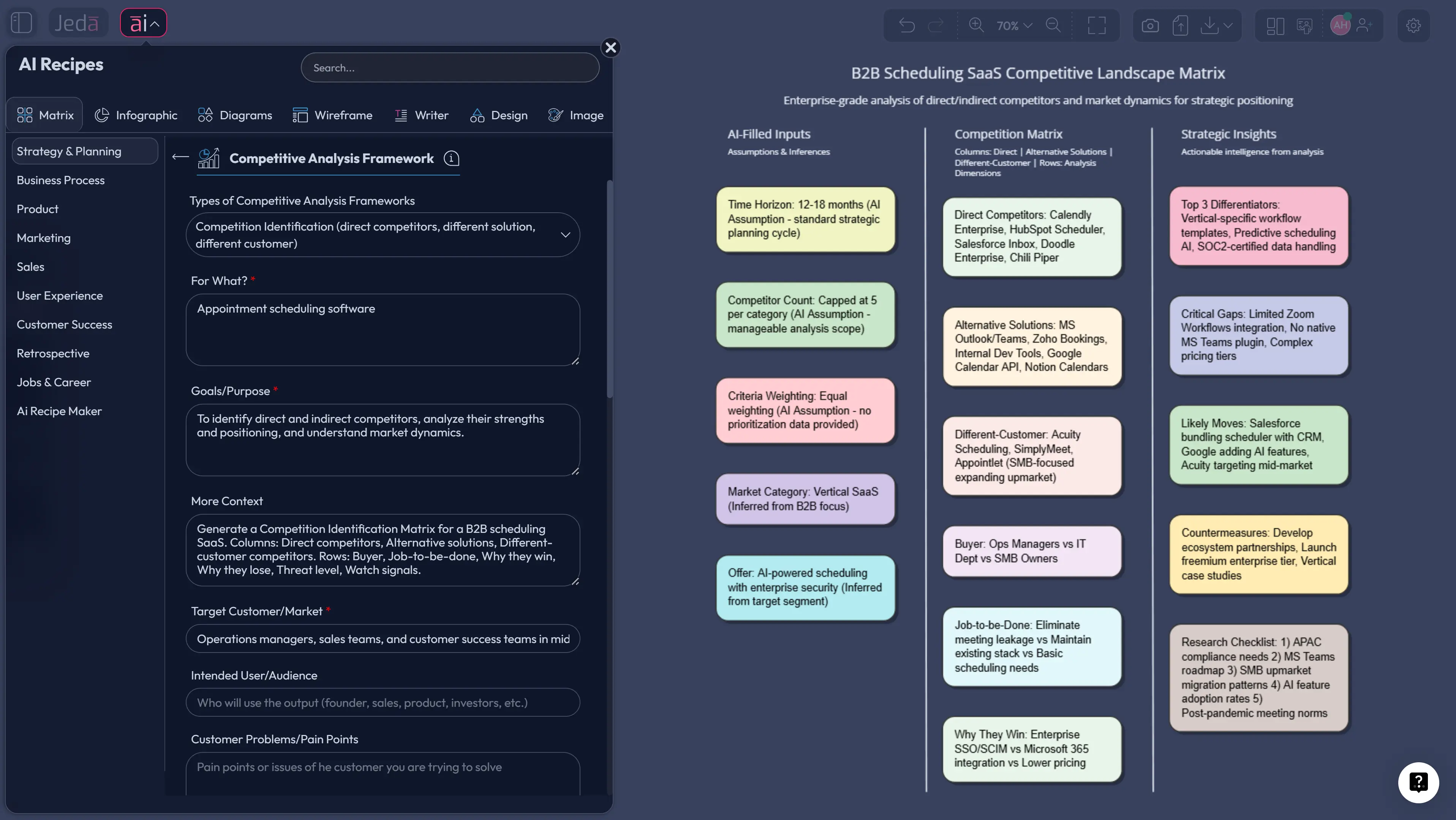
You’ll use the Matrix command (Prompt Bar) and then iterate on-canvas. If you prefer templates, you can also open the AI Menu (top-left) and search within Matrix Recipes.
Method A — Matrix Recipe Template (AI Menu → Matrix Recipes)
Open the AI Menu (top-left) → go to Matrix Recipes and search for a competitor/competition identification template (if it exists in your workspace, it will show up there).
Enter your context: market/category, your product, primary buyer, and the job-to-be-done (one line).
Generate the matrix with 3 buckets:
- Direct competitors = same buyer, same job, similar solution category
- Different solution competitors = same buyer, same job, different way to solve it (substitutes/alternatives)
- Different customer competitors = different buyer today, but can expand into your lane
Add evidence per competitor (one proof point is enough to start): pricing link, review snippet, feature screenshot, sales loss reason, or a customer quote.
Score threat + watch signals (Low/Med/High + 1–2 signals like new tier, hiring spree, partnerships, region expansion).
Decide what you’ll do next (reposition, differentiate, partner, ignore, copy) — because strategy is choice, not documentation.
Use AI+ to extend.
Use Vision Transform to convert the matrix into a mind map or flowchart for workshops/decks.
Export as PNG/SVG/PDF when you need to share.
Method B — Prompt Bar (Matrix command)
- Open a board → open the Prompt Bar → select Matrix.
- Paste a prompt like this (copy/paste): Create a Competition Identification Matrix for [market + product]. Columns: Direct competitors, Different-solution competitors (substitutes), Different-customer competitors. Rows: Buyer, Job-to-be-done, Why they win, Why they lose, Threat level, Watch signals. Keep each cell under 30–35 words. Mark assumptions with (verify).
This maps to the exact matrix structure you already use in the article’s visual caption.
- Generate → then edit on canvas (replace guesses with your real evidence).
- Click AI+ on the matrix to add a thorough dive.
- Export as PNG/SVG/PDF for stakeholder sharing.
- Start with the decision (not the list)
Write the decision at the top: pricing change, entering a region, launching a feature, or choosing a target segment. Competitor lists are useless unless they serve a decision.
- Define your buyer and job-to-be-done
State the job in one line and pick the primary buyer (the person who signs, not just the user). This prevents chasing irrelevant lookalikes.
- Fill the 3 competition buckets
Populate: (1) Direct competitors (same buyer, similar solution), (2) Different-solution competitors (same buyer, different way to solve the job), (3) Different-customer competitors (adjacent players who may expand into you).
- Add evidence, not vibes
For each competitor, attach one proof point: pricing link, review snippet, feature screenshot, customer quote, or a win/loss note. One proof point per name is enough to start.
- Score threat level and watch signals
Assign a simple threat score (Low/Medium/High) and add 1–2 watch signals (new tier, hiring spree, partnerships, region expansion).
- Decide what you’ll do next
Pick one action: reposition, differentiate, partner, ignore, or copy. Strategy is choice, not documentation.
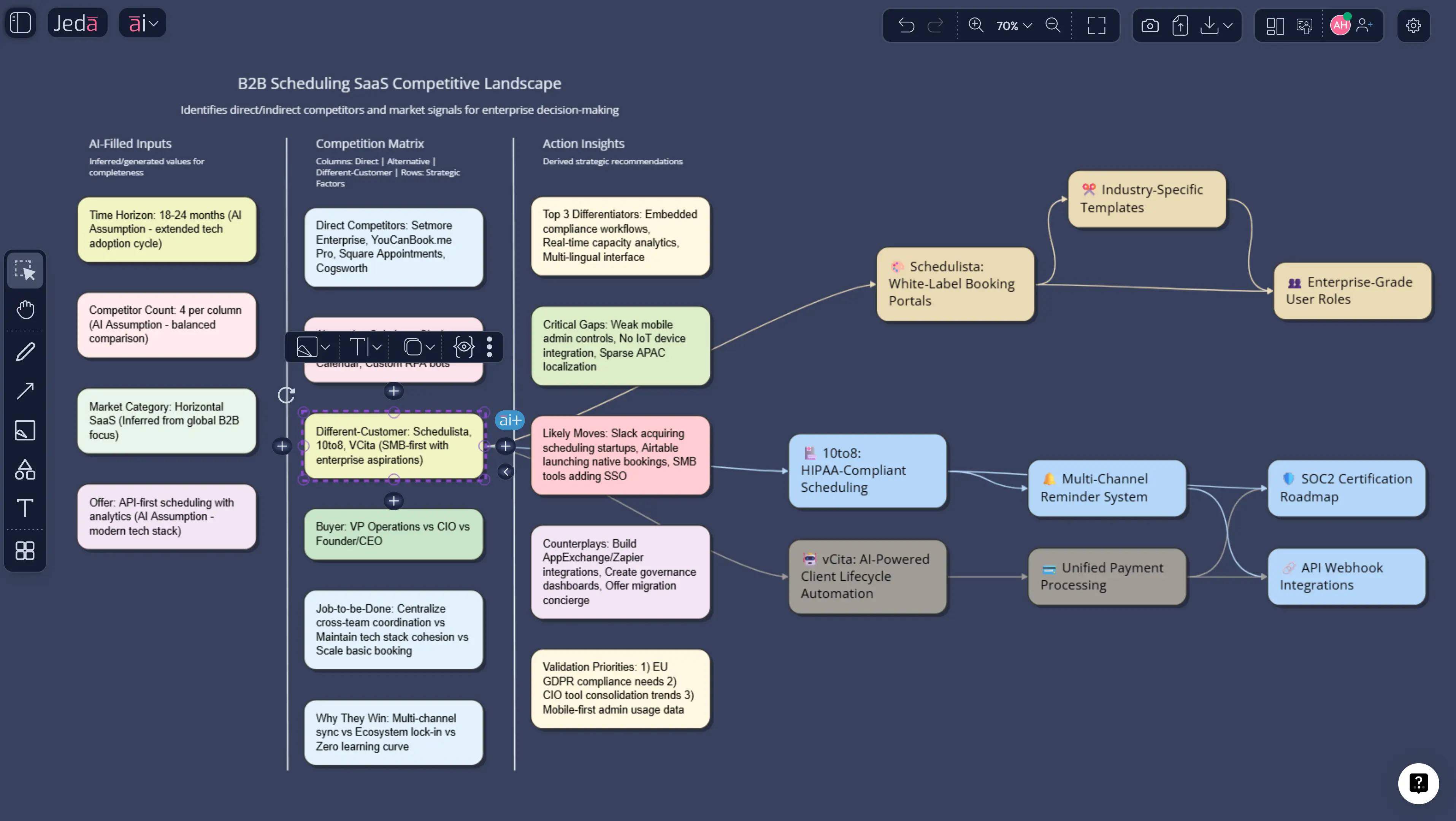
Competition Identification Template & Worked Example
Let’s use a concrete scenario: a B2B scheduling product designed for revenue teams, where the buyer is Sales Ops and the job is “reduce back-and-forth while controlling routing and compliance.”
Here’s how the matrix fills out:
- Direct: scheduling products built for the same buyer, with routing and controls.
- Different solution: email + calendar defaults, CRM scheduling, or “my assistant handles it” workflows.
- Different customer: HR scheduling tools or customer success platforms that could move into revenue ops.
Best Practices & Tips
Common Mistakes to Avoid
- Only tracking category peers. If you ignore substitutes, you misread the economic pressure in your market.
- Mixing segments. A competitor in SMB can be irrelevant in enterprise, and vice versa.
- Confusing features with jobs. Buyers don’t purchase “features.” They purchase outcomes.
- Skipping proof. A competitor list without evidence is basically fan fiction.
- Never updating the matrix. Markets move. Your competitor model should, too.
Frequently Asked Questions
- What’s the difference between direct competitors and substitutes?
- Direct competitors sell a similar solution to the same customer group. Substitutes solve the same job in a different way, which can quietly cap your pricing power even if they don’t “look” like your category.
- How many competitors should I include in a competition identification matrix?
- Start with 6 to 12: 2–4 direct rivals, 2–4 alternatives/substitutes, and 2–4 adjacent players. If you list 30, you’ll end up learning nothing because you won’t go deep on any of them.
- Should I include future entrants in competitor identification?
- Yes. Add at least two “watch list” slots for likely entrants: platforms adjacent to your space, well-funded startups, or incumbents that can bundle your feature into their suite.
- What sources are best for discovering competitors fast?
- Customer interviews, sales call notes, and search results beat fancy tools. Then triangulate with review sites, app stores, job postings, and public pricing pages to validate who’s actually active.
- How often should I refresh my competitor list?
- Quarterly for most markets. Monthly if you’re in fast-moving categories like AI tooling, fintech, or consumer apps where pricing and packaging changes happen constantly.
- What’s a common mistake in competitor identification?
- Defining competition as “companies that look like us.” That’s competitive myopia. Real competition is anything that wins the buyer’s budget or time, including substitutes and internal status quo.
- Can AI replace real competitive research?
- No. AI accelerates discovery and synthesis, but you still need ground truth: customer conversations, actual product trials, and evidence that a competitor is winning deals you care about.
- How do I handle competitors in multi-sided markets?
- Split the matrix by audience. For example: buyers vs sellers, developers vs users. Competition can be different on each side, and mixing them creates bad strategy.
Sources & Further Reading
- [1]
Porter, Michael E. (1980) . “Competitive Strategy: Techniques for Analyzing Industries and Competitors” Free Press (Harvard Business School faculty listing).
View Source ↗ - [2]
Porter, Michael E. (1979) . “How Competitive Forces Shape Strategy” Harvard Business Review.
View Source ↗ - [3]
Porter, Michael E. (2008) . “The Five Competitive Forces That Shape Strategy” Harvard Business Review.
View Source ↗ - [4]
NielsenIQ (2026) . “Competitive strategy analysis” NielsenIQ.
View Source ↗
Build a cleaner competitive landscape in minutes
Join over 150,000 professionals who keep competitive work visual inside Jeda.ai.
Try Jeda.ai