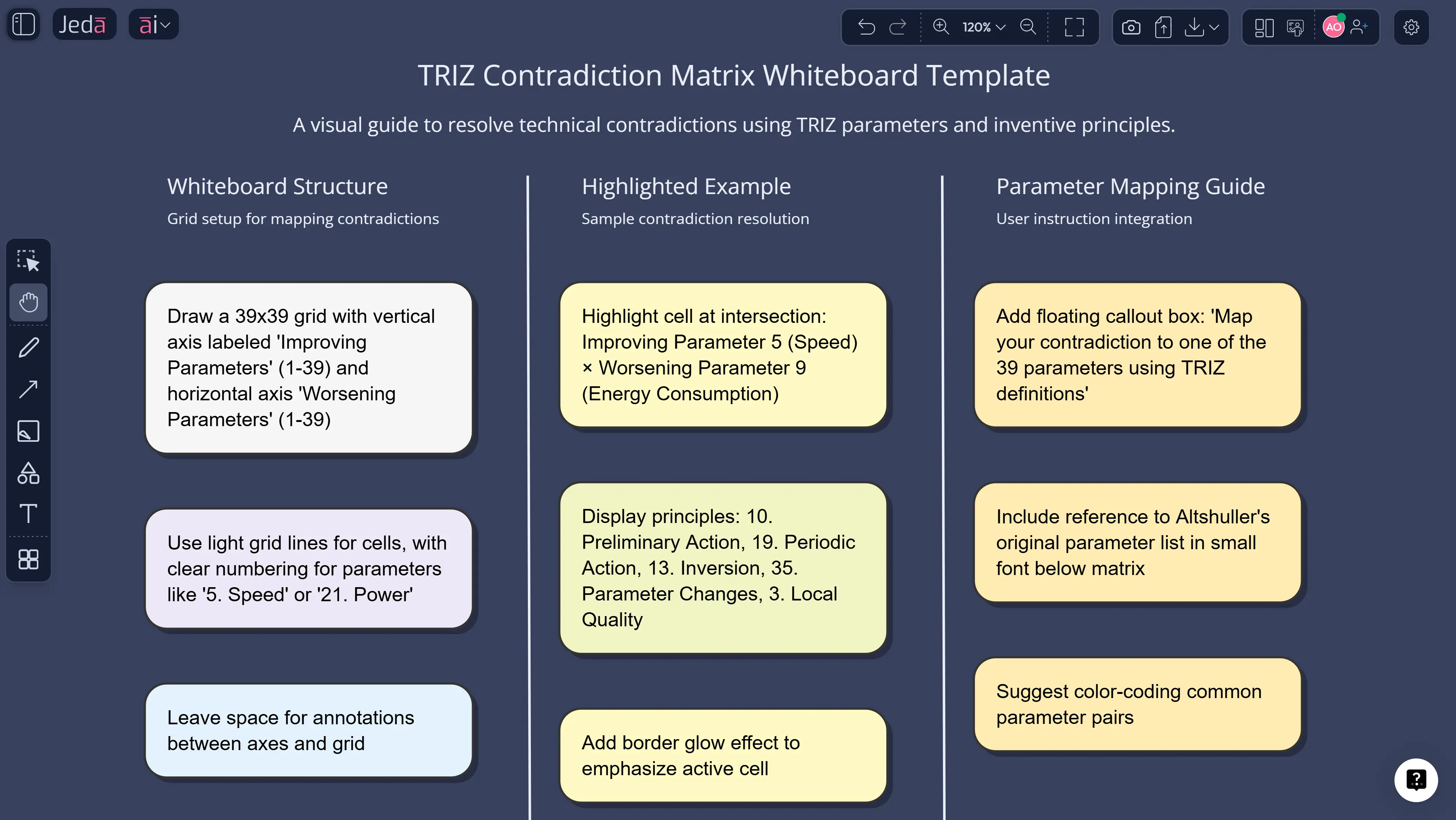
Most teams “solve” trade-offs by negotiating them: lighter but weaker, faster but riskier, cheaper but uglier. The TRIZ contradiction matrix is the alternative: remove the trade-off by using patterns that have repeatedly resolved similar contradictions.
This guide is intentionally practical. You’ll learn how to:
- write a usable technical contradiction,
- map it into a contradiction matrix (39 parameters),
- shortlist inventive principles (40 principles),
- and convert those principles into solution directions using an AI Workspace.
What is a TRIZ contradiction matrix?
A TRIZ contradiction matrix is a table that links a technical contradiction (improving one engineering parameter while another worsens) to a shortlist of inventive principles that have historically resolved similar contradictions.
Classic TRIZ descriptions commonly reference 39 engineering parameters and 40 inventive principles as the basis for matrix use.
The matrix is not a magic answer key. It’s a structured way to avoid starting from zero.
When to use the contradiction matrix (and when not to)
Use it when:
- your contradiction is clear and measurable,
- you need solution directions quickly,
- you want a shared method for innovation workshops.
Avoid it when:
- the contradiction is ambiguous or multi-layered,
- the system is heavily constrained and you need deep modeling,
- you keep getting generic ideas (that’s when ARIZ or Su-Field may help).
Step 1: Write the technical contradiction correctly
Bad contradiction:
- “Our product is too heavy.”
Good contradiction:
- “If we reduce mass, structural strength decreases.”
- “If we increase speed, accuracy decreases.”
- “If we increase security, onboarding time increases.”
The trick: write it as improve X → worsens Y.
In Jeda.ai, you can store this as a sticky note next to the matrix so the team doesn’t drift into vague language.
Step 2: Choose parameters (without turning it into a debate club)
The classic matrix uses parameter labels like “weight of moving object,” “strength,” “speed,” “loss of energy,” etc. You don’t need perfection. You need consistency.
A professional approach:
- Choose the closest improving parameter.
- Choose the closest worsening parameter.
- Record your mapping choice in a note (“we used ‘strength’ to represent drop-test survivability”).
This makes the work reviewable later.
Step 3: Use AI to generate the matrix cell output (principle shortlist)
In a manual TRIZ session, you’d look up the intersection and read principle numbers. With AI, you can generate an equivalent shortlist—then validate it against your domain constraints.
A good AI output should include:
- principle name,
- one‑sentence explanation,
- and a translation into your system context.
How to create a contradiction matrix with AI in Jeda.ai
Method A: Use the TRIZ template (fastest)
- Open AI Menu.
- Go to Matrix Recipes → TRIZ.
- Choose Contradiction Matrix.
- Enter:
- improving parameter,
- worsening parameter,
- system context,
- constraints.
- Click Generate.
Method B: Use Prompt Bar (more control)
- Select Matrix in the Prompt Bar.
- Paste the prompt below.
- (Optional) enable Multi‑LLM for alternative principle shortlists.
- Generate.
Prompt template:
- System: [what is being designed/improved]
- Improving parameter: [TRIZ parameter name + plain English]
- Worsening parameter: [TRIZ parameter name + plain English]
- Context: [where/when contradiction happens]
- Constraints: [cost, materials, regulatory, size, time]
- Deliverable: Build a contradiction matrix output: 6 inventive principles (name + short explanation), then 3 solution directions derived from the principles.

Turning inventive principles into real solution directions
This is where teams often faceplant: they list principles and stop.
Professional TRIZ work converts principles into mechanism-level directions. Use this 3-step conversion:
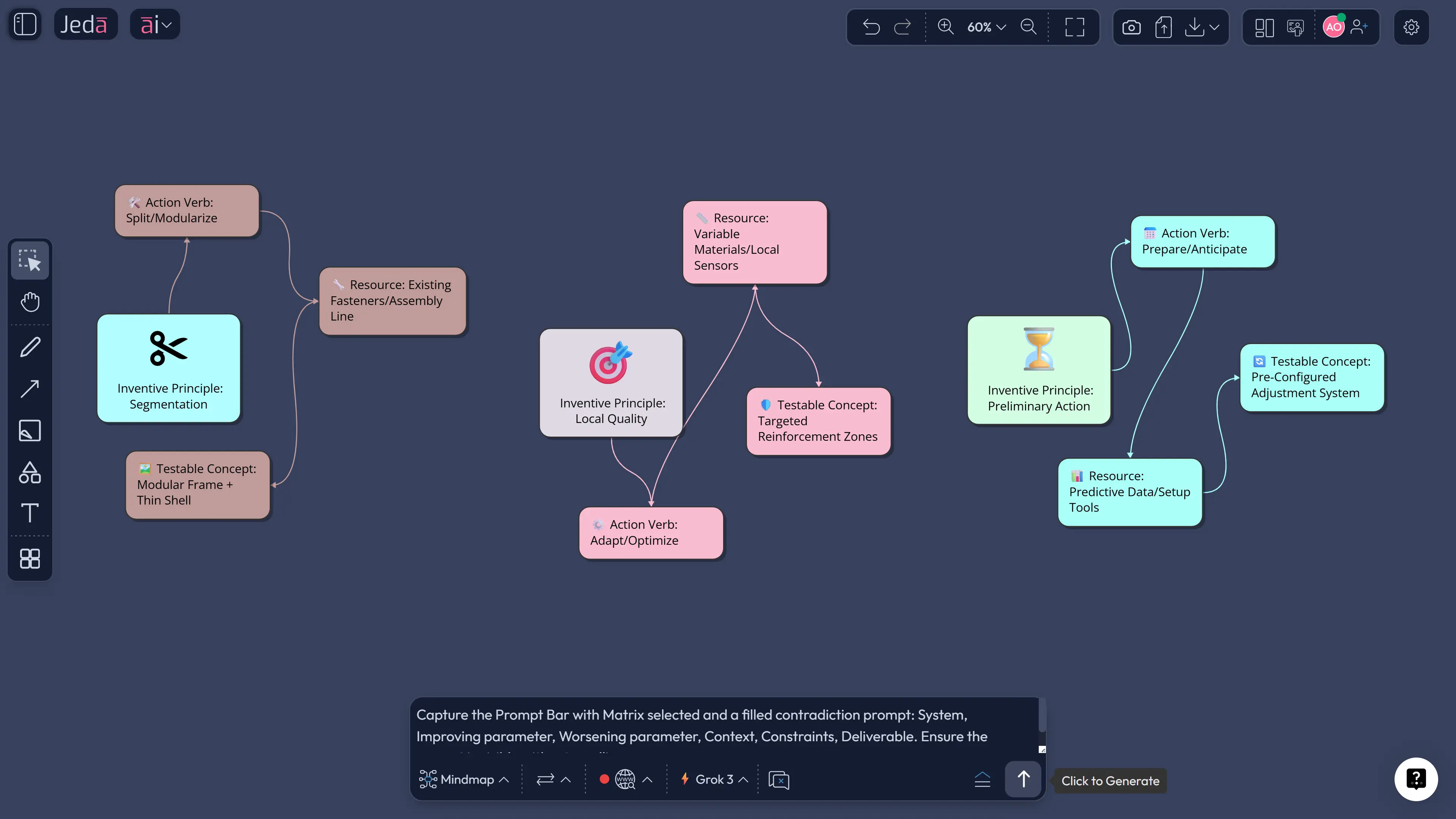
- Translate the principle into an action verb.
- Attach it to a resource (existing materials, geometry, process capability).
- Write a testable concept.
Example:
- Principle: Segmentation
Translation: “split into modules”
Resource: existing assembly line + modular fasteners
Concept: “Create a modular internal frame that carries load; thin outer shell becomes cosmetic.”
Now you have something you can prototype or simulate.
Example you can reuse: cycle time vs defect rate
Scenario: A production line wants faster throughput, but defects rise.
Contradiction:
- Improve speed → worsens accuracy/defects.
A matrix output might suggest principles like:
- Feedback (close the loop),
- Preliminary action (prepare parts earlier),
- Dynamics (adaptive process),
- Local quality (apply precision only where needed).
Then solution directions could be:
- Add in-line feedback measurement for critical steps (not the whole line).
- Shift quality gates earlier to prevent defect propagation.
- Make the line adaptive: slow down only when variance spikes.
The contradiction matrix gets you out of “let’s try harder” and into “change the system.”
Best practices for matrix sessions with AI
- Force measurability. If you can’t measure X and Y, you can’t know if you removed the trade-off.
- Limit the principle shortlist. 4–8 principles max. More creates noise.
- Keep a “rejected principles” note. Explain why a principle doesn’t fit constraints.
- Use Diagram next. Convert your top 3 concepts into a mechanism diagram.
FAQ
- What is a TRIZ contradiction matrix?
- A TRIZ contradiction matrix is a tool that maps an engineering contradiction (improve one parameter while another worsens) to inventive principles that have historically resolved similar contradictions.
- How many parameters and principles are in the classic contradiction matrix?
- Common TRIZ references describe a contradiction matrix built around 39 engineering parameters and 40 inventive principles, which are used to shortlist solution patterns for a given contradiction.
- Is the contradiction matrix enough to solve complex problems?
- For many problems, the matrix provides strong solution directions quickly. For deeply constrained or multi-layer contradictions, TRIZ practitioners often use deeper tools such as ARIZ or Su-Field modeling.
- How can AI help with a contradiction matrix?
- AI can generate a clean matrix template, translate abstract principles into system-specific interpretations, and draft solution directions. Human judgment is still required to validate feasibility and constraints.