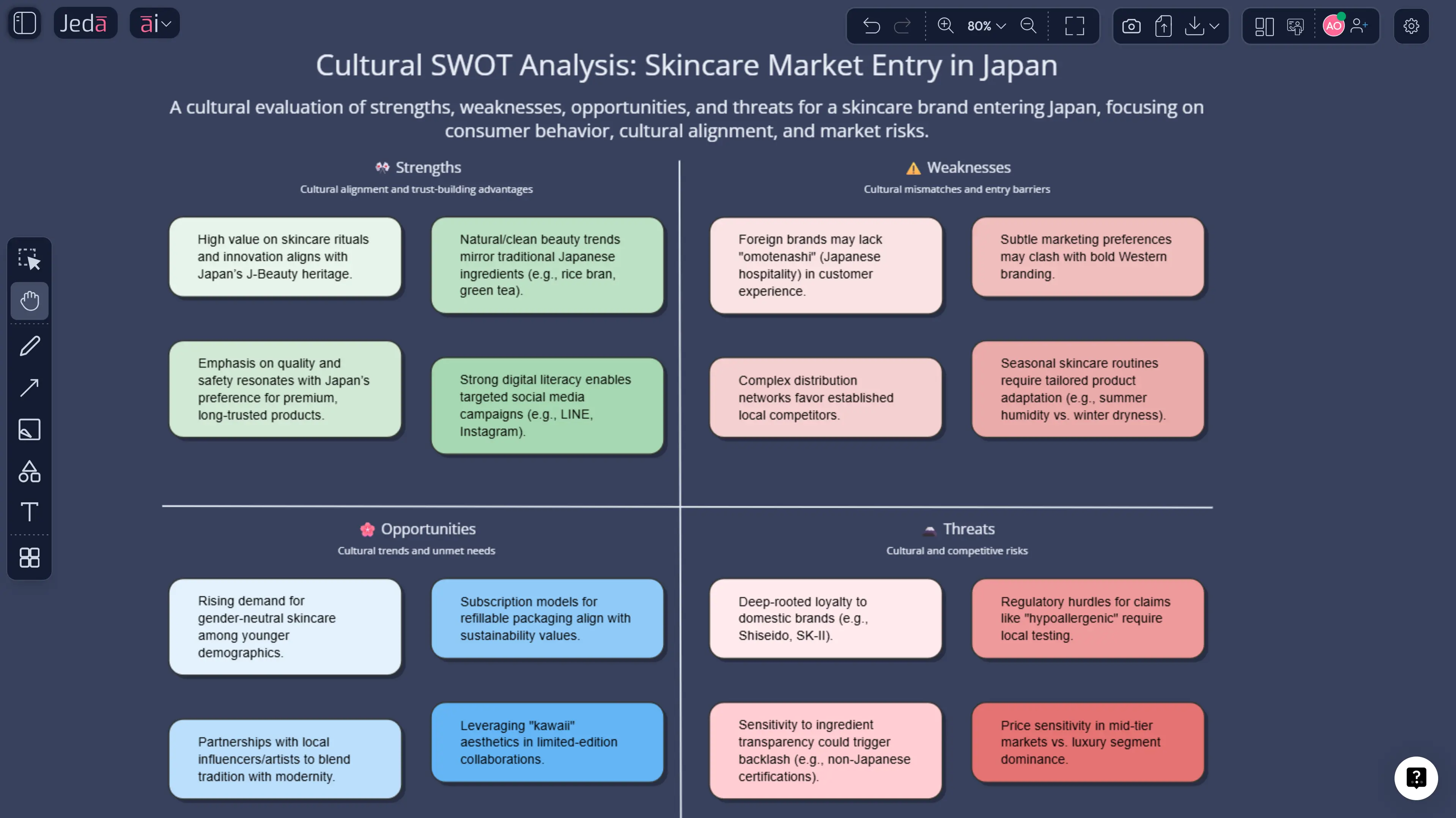
Culture gets ignored right up until it wrecks an otherwise smart strategy. A product looks strong, the pricing works, the category is growing, and then the launch stalls because the message feels off, the trust signals are wrong, or the local behavior pattern was badly misunderstood. That is exactly where Cultural SWOT Analysis with AI earns its keep.
Inside Jeda.ai’s AI Workspace, you can map cultural strengths, weaknesses, opportunities, and threats faster than a normal workshop ever does, then turn the result into an editable strategy visual on the same AI Whiteboard. No scattered notes. No “we’ll clean this up later” fiction. Just a decision-ready matrix you can extend, refine, and share.
More than 150,000+ users already use Jeda.ai to turn messy strategic thinking into clearer visuals. And for teams working across markets, audiences, or subcultures, this matters a lot. Culture is not fluff. It changes adoption, trust, positioning, partnership fit, and even execution speed.
What Is Cultural SWOT Analysis?
Cultural SWOT Analysis is a specialized SWOT used to evaluate how cultural factors affect strategy. It keeps the classic four-quadrant logic—strengths, weaknesses, opportunities, and threats—but applies it to cultural fit, social norms, communication patterns, consumer expectations, identity signals, and local behavior.
That makes it useful when your plan depends on how people interpret, trust, adopt, or talk about what you offer. Think market entry. Brand localization. International product launches. Cross-border campaigns. Even post-merger integration, when two cultures look aligned on slides and deeply misaligned in real life.
The underlying SWOT logic is well established, though its early history is more complicated than the tidy textbook version. Recent scholarship traces SWOT back to the SOFT method used in strategic planning work in the 1960s, while modern references still note that attribution remains debated. For this page, the practical point is what matters: SWOT helps teams separate internal realities from external forces, and a cultural variant helps them do that without pretending culture is just “brand tone.”
In practice, a strong cultural SWOT asks questions like these:
- What cultural traits or behaviors already help our offer resonate?
- Where are we culturally tone-deaf, inconsistent, or slow to adapt?
- What shifts in values, identity, lifestyle, or norms create openings?
- What cultural friction could block trust, adoption, or partnership success?
Why Use Cultural SWOT Analysis with AI?
Here’s the blunt version: most teams do this badly by relying on assumptions, stereotypes, or one loud person in the room.
AI does not magically solve that. But in the right AI Workspace, it does something extremely useful: it speeds up the first draft, exposes blind spots, helps structure evidence, and gives you an editable matrix you can challenge instead of a vague discussion you forget by Friday.
Jeda.ai is especially strong here because the analysis does not end as a blob of text. It becomes a living visual on the AI Whiteboard. You can move ideas around, rewrite claims, add evidence, extend one quadrant with the AI+ button, and turn the matrix into a mind map or diagram with Vision Transform. That is a much saner workflow for strategy teams, consultants, brand managers, and product leads.
And because Jeda.ai is a Visual AI platform, the output is made for thinking with other people, not just reading alone.
- Faster first draft
Generate a structured cultural analysis in minutes, so your team starts with substance instead of a blank board and good intentions.
- Better market sensitivity
Surface cultural cues tied to language, trust, consumption habits, and local expectations before they turn into expensive surprises.
- Sharper evidence review
Use the matrix to test assumptions against customer interviews, reports, survey findings, social signals, and regional context.
- Editable strategy output
Unlike a dead document, the result stays editable inside Jeda.ai, so teams can expand, refine, and reuse it across planning sessions.
If your team already works with frameworks, this also fits naturally into Jeda.ai’s library of 300+ strategic frameworks. You are not hacking a generic prompt into shape. You are using a structure that already knows what kind of thinking it should produce.
How to Create Cultural SWOT Analysis with AI in Jeda.ai
Jeda.ai gives you two clean ways to build this analysis. Method 1 is the recommended route because the Matrix recipe already knows the structure. Method 2 is better when you want more freedom from the first prompt.
Method 1: Recipe Matrix (Recommended)
Use the AI Menu when you want the fastest path and the least setup friction.
- Open the AI Menu
Inside Jeda.ai, open your AI Workspace and click the AI Menu in the top-left corner of the canvas.
- Choose the Matrix recipe category
Select Matrix, then go to the Strategy & Planning section where SWOT Analysis lives.
- Select the Cultural SWOT Analysis sub-recipe
Open SWOT Analysis and choose the Cultural SWOT Analysis sub-recipe so the framework starts with the right cultural lens.
- Fill in the guided fields
Add the product, market, audience, business goal, and any useful context such as customer behavior, localization issues, or expansion plans.
- Pick layout and model, then generate
Choose Auto, Column, or Grid layout, select your preferred reasoning model, and generate the matrix on the canvas.
- Review the quadrants for evidence gaps
Check whether each point is grounded in real observations, not stereotypes, generic market clichés, or internal wishful thinking.
- Use AI+ to deepen one quadrant
Click a quadrant or node and use the AI+ button to extend it. AI+ works best as a broad deep dive into what already exists.
- Transform or share the result
If needed, use Vision Transform to convert the matrix into a mind map or diagram, then keep refining it on the AI Whiteboard.
Strategy & Planning > SWOT Analysis, and choose the Cultural SWOT Analysis sub-recipe]" />
Method 2: Prompt Bar
Use the Prompt Bar when you want more control over tone, scope, or the exact framing of the analysis.
- Open the Prompt Bar at the bottom of the workspace.
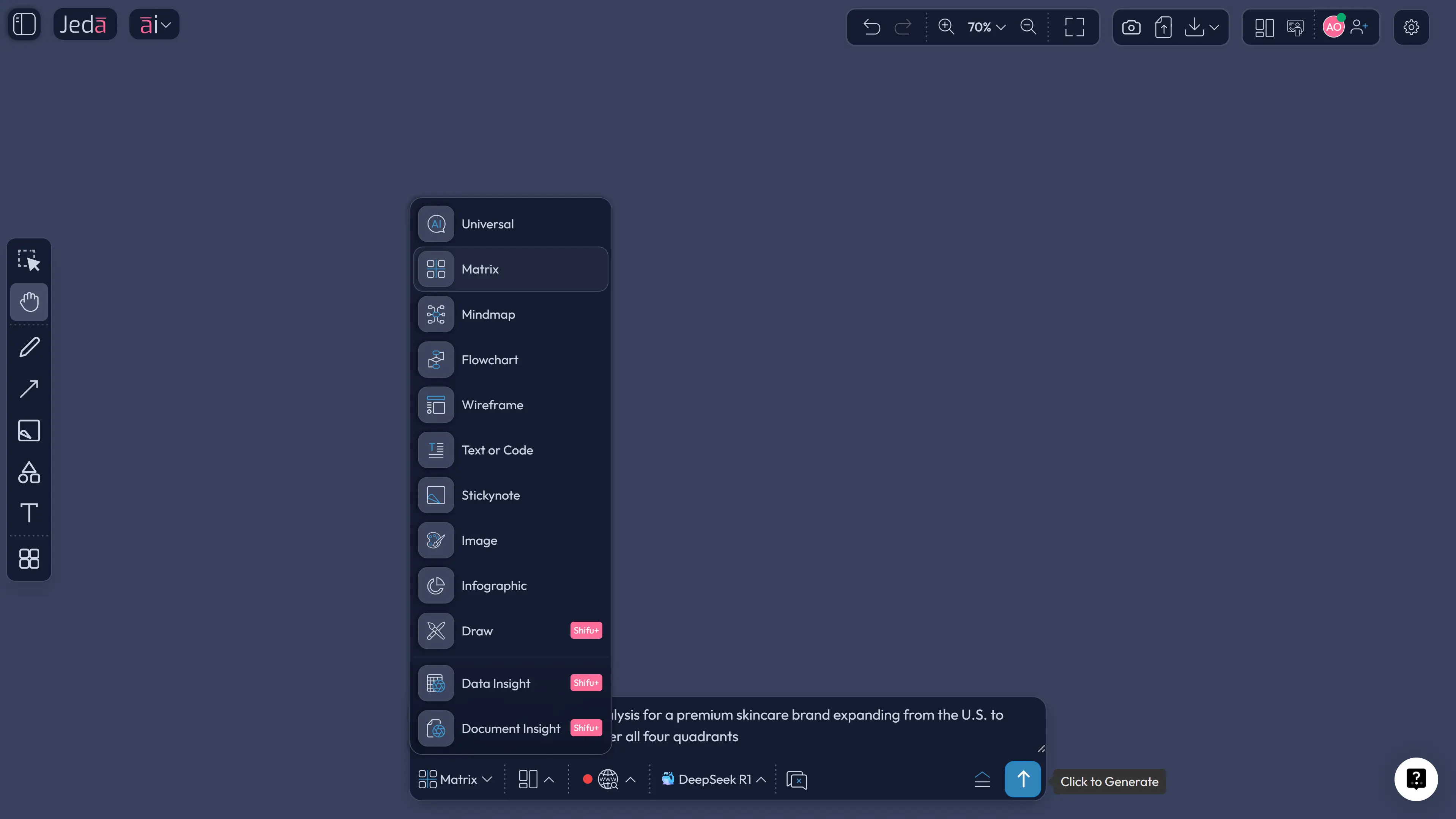
- Select the Matrix command.
- Write a prompt that names the market, audience, goal, and cultural question clearly.
- Press Enter to generate the matrix.
A solid prompt looks like this:
Create a Cultural SWOT Analysis for a premium skincare brand entering Japan. Focus on local trust signals, packaging expectations, ingredient transparency, retail behavior, and communication style. Make the points specific and decision-oriented.
Another one:
Generate a Cultural SWOT Analysis for an edtech platform expanding into the Gulf region. Evaluate learning norms, parent expectations, authority dynamics, digital trust, partnership risks, and adoption barriers.
If you need real-time context, turn on Web Search in the Prompt Bar. If you already have research reports, interview notes, or survey summaries, you can also analyze those in Jeda.ai first and then generate the final matrix in the same AI Workspace.
Cultural SWOT Analysis with AI Template & Example
Let’s make this concrete.
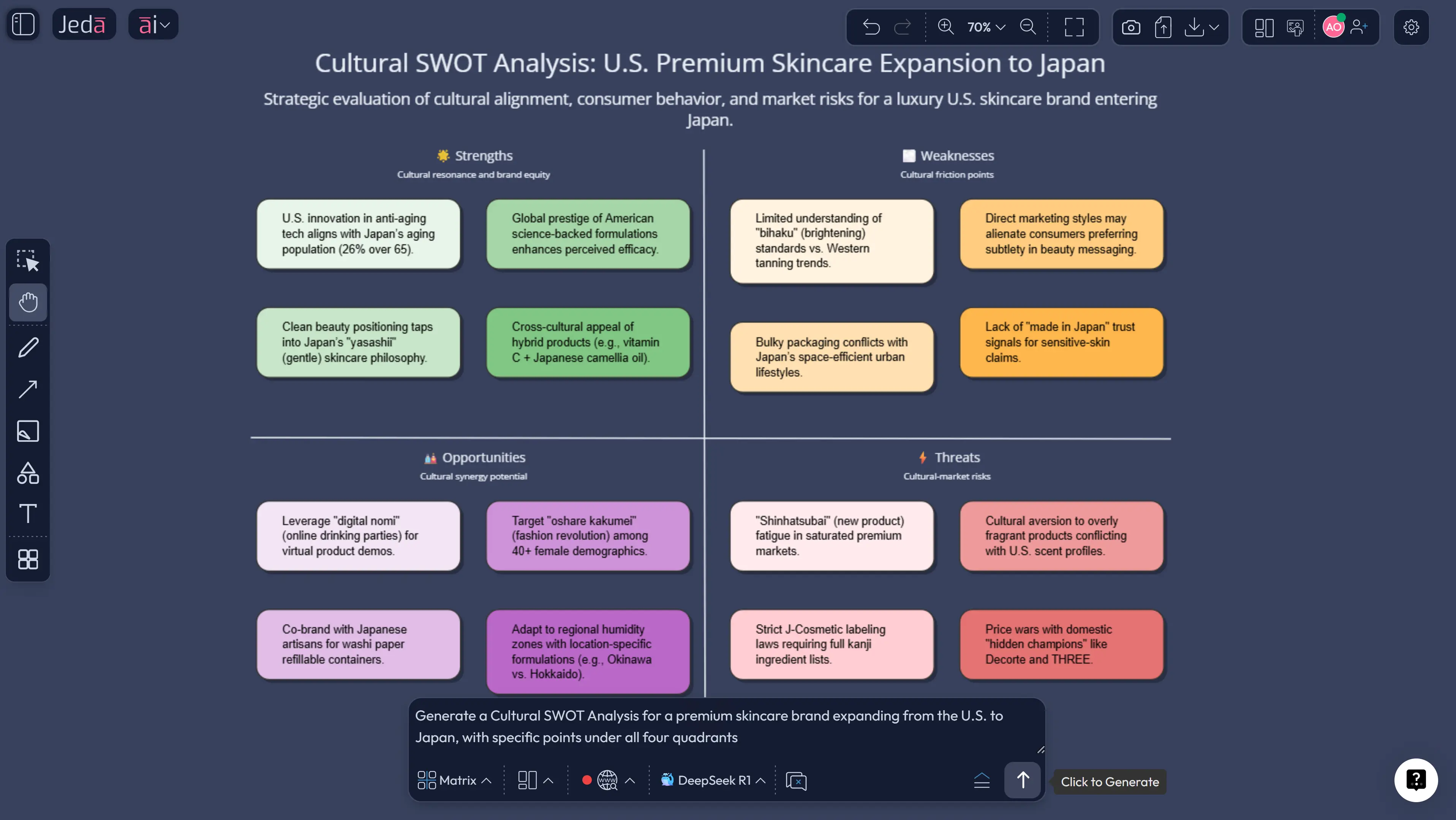
Imagine a U.S. skincare brand entering Japan with a premium but minimalist positioning. The product quality is strong. The ingredients are genuinely differentiated. The brand story is clean and modern. So far, so good.
But culture changes the board.
A cultural SWOT might reveal strengths such as ingredient transparency, disciplined formulation, and visual restraint that match local preference for credibility over hype. Weaknesses might include copy that feels too casual, oversized packaging, or influencer messaging that overstates individuality where trust is built more cautiously. Opportunities could include demand for sensitive-skin solutions, gifting rituals, and social proof through expert endorsement. Threats may include established domestic trust, strict labeling expectations, and subtle consumer skepticism toward outsider brands that misread tone.
That is the point of the framework: it forces the strategy team to stop pretending “good product” is enough.
The same logic works for:
- brand launches in unfamiliar regions
- multicultural campaign planning
- product localization strategy
- merger and acquisition integration planning
- cross-border partnership decisions
- international hiring or employer-brand adaptation
What to Put in Each Quadrant
A lot of cultural SWOTs fail because teams dump random observations into four boxes and call it strategy. Don’t do that.
Strengths
List cultural advantages you already have. These might include brand credibility, local language capability, community trust, distribution partners with cultural fluency, or product design that already fits local norms.
Weaknesses
Be honest here. Weaknesses often show up as translation issues, leadership blind spots, outsider assumptions, weak local hiring, poor social listening, or brand behaviors that feel normal at home and awkward elsewhere.
Opportunities
Look for value shifts, demographic change, consumer frustrations, new communities, under-served identity groups, evolving work habits, or rising interest in localized versions of your offer.
Threats
Threats usually come from misinterpretation, backlash, low trust, policy or compliance friction, local incumbents with stronger cultural fit, and cultural signals you do not yet understand well enough to act on confidently.
The quality of your matrix depends on the inputs. Good evidence sources include customer interviews, social listening, search behavior, partner feedback, community moderators, market-entry research, internal survey findings, and on-the-ground commercial teams.
Best Practices for a Useful Cultural SWOT
A useful matrix is specific, evidence-aware, and a little uncomfortable. That last part matters. If every quadrant sounds flattering, you are not doing analysis. You are doing morale management.
Common Mistakes to Avoid
Mistaking stereotypes for insight.
“People in that market prefer tradition” is not analysis. It is usually a shortcut covering for thin evidence.
Mixing internal failures with external conditions.
If your team lacks local language support, that is a weakness. If the market has strong local incumbents, that is a threat. Keep the line clean.
Writing soft, non-actionable points.
A quadrant filled with vague language gives nobody a decision. Be specific enough that a team could actually change something.
Ignoring subcultures.
National culture is not one block. Urban and rural segments, age groups, income bands, and online communities can behave very differently.
Stopping at the matrix.
A SWOT that never gets translated into action is just decorative strategy. Use it to guide positioning, hiring, partnerships, campaign testing, or entry sequencing.
When Cultural SWOT Is the Right Tool
Use this framework when strategy depends on cultural fit, social acceptance, local expectations, or behavior patterns—not just price or product specs.
It is especially useful before entering a new country, adapting a brand for a new audience, testing cross-border product messaging, building partnerships in unfamiliar regions, or pressure-testing whether your internal assumptions match what the market will actually reward.
And yes, it is also handy when two teams keep arguing about “what the market wants” with exactly zero shared evidence.
Frequently Asked Questions
- What is Cultural SWOT Analysis with AI?
- Cultural SWOT Analysis with AI is a structured way to evaluate how cultural factors affect strategy, using AI to draft, organize, and deepen the four SWOT quadrants. In Jeda.ai, the result becomes an editable matrix on the canvas rather than a static block of text.
- How is cultural SWOT different from a regular SWOT?
- A regular SWOT can cover anything strategic. A cultural SWOT focuses specifically on values, norms, communication patterns, identity signals, local behavior, and trust dynamics. It is the better choice when adoption depends on culture, not just product-market logic.
- Is this framework for internal company culture or external market culture?
- It can be used for both, but this Jeda.ai workflow is strongest for external market culture, localization, audience fit, and cross-cultural strategy. If your main question is internal employee culture, use the same logic but ground it in survey and team evidence.
- When should I use the recipe instead of the Prompt Bar?
- Use the recipe when you want speed, structure, and the least setup work. Use the Prompt Bar when you need tighter control over framing, geography, audience, or the exact decision context behind the analysis.
- Can AI do a Cultural SWOT accurately by itself?
- Not by itself. AI is excellent at structuring possibilities and surfacing blind spots, but the quality depends on the evidence you feed it and the human review that follows. Treat the first version as a strategic draft, not a verdict.
- What inputs make the output stronger?
- The best inputs are customer interviews, market-entry reports, local partner feedback, community observations, survey findings, search trends, and internal notes from people close to the market. Specific context beats generic prompting every time.
- How do I use AI+ on this framework?
- Generate the matrix first, select a node or quadrant, and then use the AI+ button to extend it. AI+ is best for deepening existing ideas, adding branches, or expanding one area—not for replacing the whole workflow with a brand-new instruction.
- Can I turn the matrix into another visual?
- Yes. In Jeda.ai, you can use Vision Transform to convert the matrix into a mind map or diagram when you need a different discussion format. That is useful when the team wants to move from analysis into action planning.
- Who should be in the room for a cultural SWOT?
- Bring people with different evidence, not just different titles. A strong session usually includes strategy, brand or product, a local market voice, customer insight or research, and someone close to execution so the matrix does not drift into theory.
- Can I export the final result from Jeda.ai?
- Yes. Jeda.ai supports export to PNG, SVG, and PDF. That makes it easy to share the matrix, bring it into a presentation workflow, or keep it as a visual reference for later strategy reviews.
Sources & Further Reading
- [1]
Puyt, Richard W., Lie, Finn Birger, and Wilderom, Celeste P.M. (2023) . “The origins of SWOT analysis” Long Range Planning.
View Source ↗ - [2]
Community Tool Box, University of Kansas (2026) . “SWOT Analysis: Strengths, Weaknesses, Opportunities, and Threats” Community Tool Box.
View Source ↗ - [3]
Lenartowicz, Tomasz and Roth, Kendall (1999) . “A Framework for Culture Assessment” Journal of International Business Studies.
View Source ↗ - [4]
Groysberg, Boris, Lee, Jeremiah, Price, Jesse, and Cheng, J. Yo-Jud (2018) . “The Leader's Guide to Corporate Culture” Harvard Business Review.
View Source ↗ - [5]
Jackson, Joshua Conrad (2024) . “A Model for Expanding Your Business into Foreign Markets” Harvard Business Review.
View Source ↗ - [6]
Camp, Alex, Gast, Arne, Goldstein, Drew, and Weddle, Brooke (2024) . “Organizational health is (still) the key to long-term performance” McKinsey & Company.
View Source ↗
Start Your Cultural SWOT Analysis with AI Today
Join over 150,000+ users who use Jeda.ai to turn strategy questions into clear, editable visuals.
Try Free Template