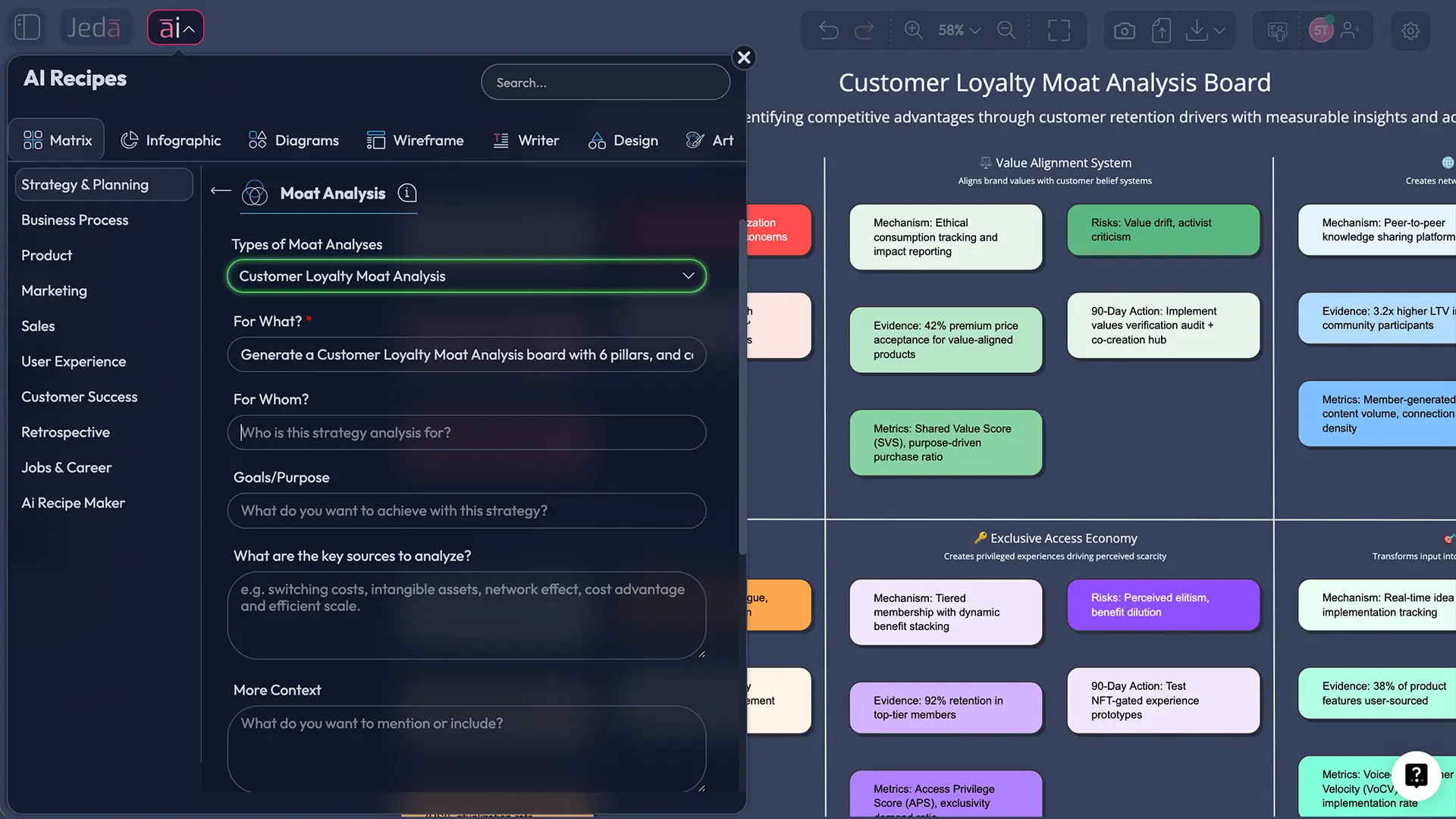
Customer loyalty is not a trophy. It’s a barrier—or it’s nothing. A Customer Loyalty Moat Analysis with AI helps you separate “people like us” from “people stay with us even when alternatives exist.” And when you do it inside an AI Workspace (on an AI Whiteboard), you can map the full loyalty system—drivers, evidence, metrics, and action—without bouncing between docs, spreadsheets, and slides.
Jeda.ai’s AI Workspace is built for this exact kind of decision work. It’s a Visual AI approach: you bring the context (data, docs, competitive notes), and you get editable visuals-out your team can debate, revise, and ship. Over 150,000+ users already use Jeda.ai to turn messy strategy conversations into clean, decision-ready boards.
What is a Customer Loyalty Moat Analysis?
A Customer Loyalty Moat Analysis is a structured way to test whether your loyalty is durable competitive advantage (a moat) rather than a temporary bump from discounts, novelty, or hype. In moat terms, loyalty becomes defensible when it creates switching friction (economic or psychological), compounding advantages (like network effects), or brand trust that’s hard to replicate.
This analysis usually answers four questions:
- What creates loyalty here? (Value, habit, identity, switching costs, community, ecosystem)
- How does it change behavior? (repurchase, renewal, usage depth, referrals, price tolerance)
- What evidence supports it? (cohorts, churn, repeat rate, NPS verbatims, qualitative research)
- How hard is it to copy? (time, money, data, brand trust, partnerships, infrastructure)
If you can’t explain the mechanism, you don’t have a moat—you have a story.
Why use AI for Customer Loyalty Moat Analysis?
Doing a loyalty moat analysis by hand is slow because loyalty is multi-causal. It’s not “one metric.” It’s a system—attitude + behavior + situation. The classic marketing research view describes loyalty as the relationship between relative attitude and repeat patronage, shaped by social norms and situational factors.
AI helps because it can:
- Synthesize messy inputs (survey verbatims, reviews, call transcripts) into loyalty drivers
- Stress-test your claims (“Is this really loyalty, or just switching cost?”)
- Generate a structured board you can edit collaboratively in minutes
- Keep the logic visible—so decisions don’t disappear into a paragraph
And in Jeda.ai’s AI Workspace, you can run the same prompt with multiple models (or the Aggregator) to compare reasoning styles, then pick the cleanest outcome for your board.
- Work on one shared loyalty truth
Build the moat analysis on an AI Whiteboard so every claim has a place: driver, evidence, metric, owner, next step.
- Bring evidence in
Use Document Insight for surveys, research, and interview notes. Use Data Insight for cohort tables, retention, and repeat purchase patterns.
- Generate, then refine
Start with AI, then edit the board like a real strategy artifact—add nuance, fix assumptions, and assign actions.
The Customer Loyalty Moat Framework
Use this 6-part framework to evaluate loyalty as a moat. Each “pillar” is a different mechanism. Some businesses have one strong pillar. The scary ones have three.
1) Value Lock-In
Signal: Customers stay because you deliver outcomes they can’t reliably get elsewhere.
- Questions: What job gets done better with you? Which benefits are uniquely hard to match?
- Evidence: win/loss notes, renewal reasons, reviews, support tickets
- Metrics: retention by segment, expansion revenue, repeat purchase rate
2) Switching Costs
Signal: Leaving is annoying, risky, or expensive (time, data, workflows, integrations).
Switching costs are widely linked to loyalty because they act as a switching barrier.
- Questions: What breaks when a customer leaves? What would they need to rebuild?
- Evidence: integration maps, migration time estimates, “setup stories”
- Metrics: churn after onboarding, average tenure, activation-to-retention slope
3) Habit Loops
Signal: Your product becomes part of the customer’s routine.
- Questions: What triggers usage? What reward keeps them coming back?
- Evidence: usage logs, feature adoption, “daily active” patterns
- Metrics: frequency, stickiness (DAU/MAU), time-to-value
4) Identity, Community, and Status
Signal: Customers stick because the brand signals who they are (or who they want to be).
- Questions: What identity does your brand reinforce? Is there a community pull?
- Evidence: social mentions, UGC, referral patterns, community participation
- Metrics: referral rate, organic share of signups, branded search growth
5) Trust and Reliability
Signal: Customers trust you with important outcomes—so they don’t gamble on alternatives.
- Questions: What risk do customers avoid by staying? What failures are unforgivable?
- Evidence: testimonials, security requirements, compliance reviews
- Metrics: complaint rate, SLA breaches, “save” moments in CS
6) Data + Personalization Flywheel
Signal: The experience improves as you learn the customer (and competitors can’t match quickly).
- Questions: What data advantage compounds? How fast does it improve outcomes?
- Evidence: personalization experiments, recommendation lift, model performance deltas
- Metrics: conversion lift from personalization, retention lift, incremental LTV
How to Create a Customer Loyalty Moat Analysis in Jeda.ai
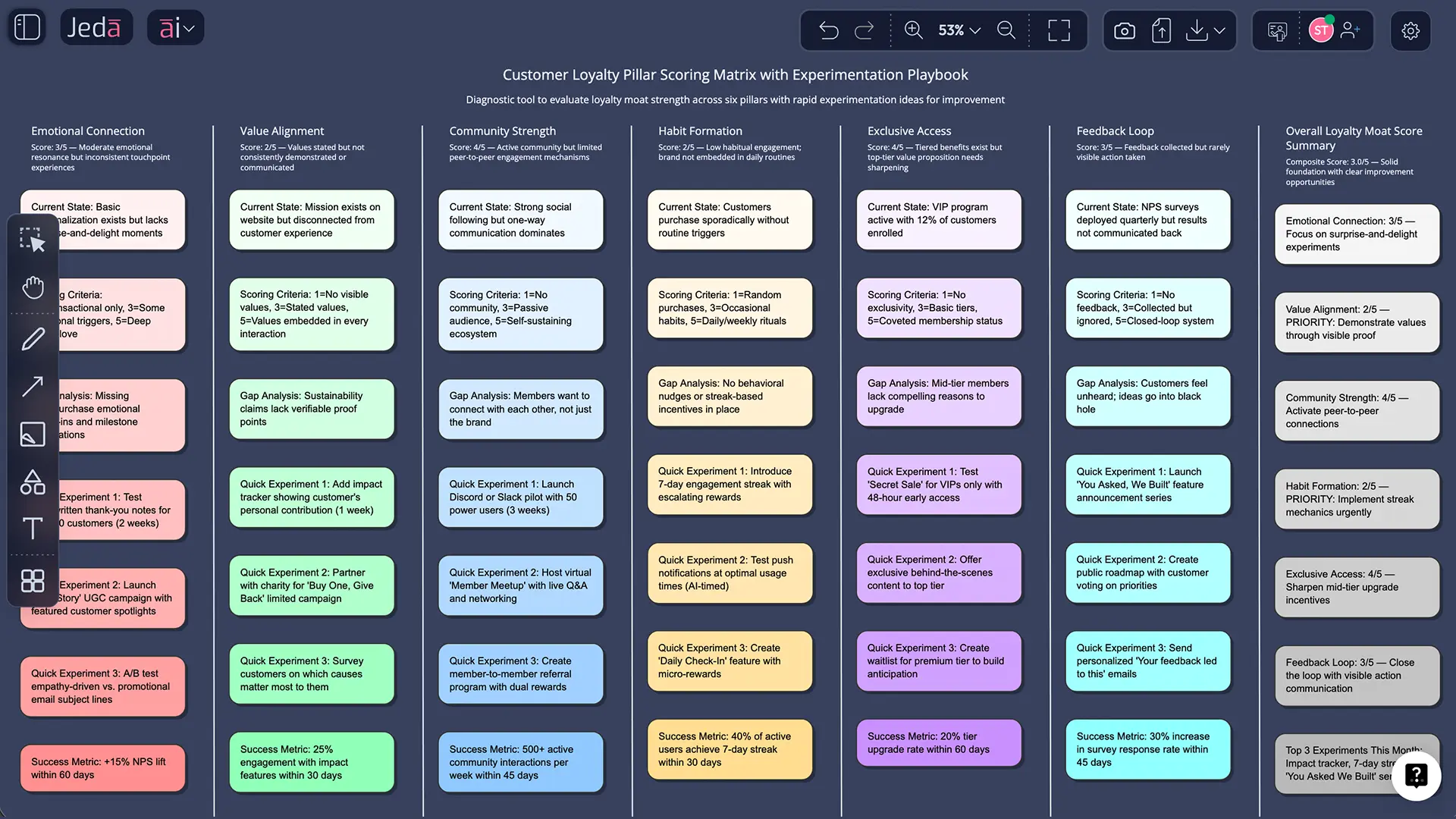
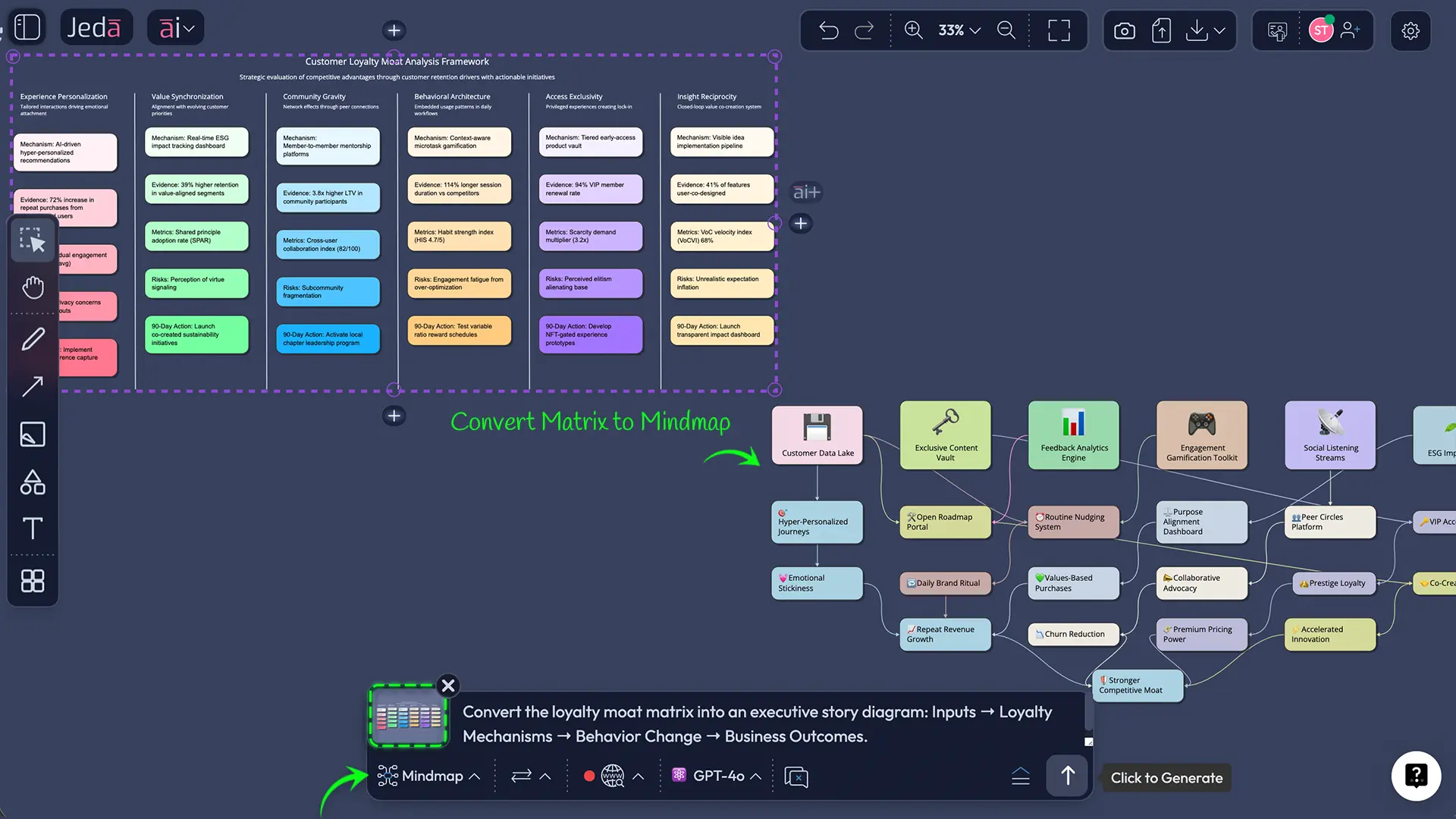
This workflow assumes you’re using the Moat Analysis recipe, and selecting the Customer Loyalty Moat sub-template (Matrix recipe category). If you prefer, you can also build it from the Prompt Bar.
- Choose where your evidence lives
Collect 3–5 inputs: retention cohorts, NPS verbatims, review themes, win/loss notes, and a competitor snapshot.
- Open Jeda.ai and select the Matrix command
In the Prompt Bar, choose Matrix. Or open the AI Menu and pick the Moat Analysis recipe, then the Customer Loyalty Moat template.
- Generate the first draft
Ask for drivers, proof, metrics, and actions (sample prompts below). Keep it specific: segment, market, competitor set.
- Audit for “real moat” vs “marketing”
Use AI+ to challenge weak claims: "What would a competitor copy in 30 days?" Flag fragile pillars.
- Convert and present
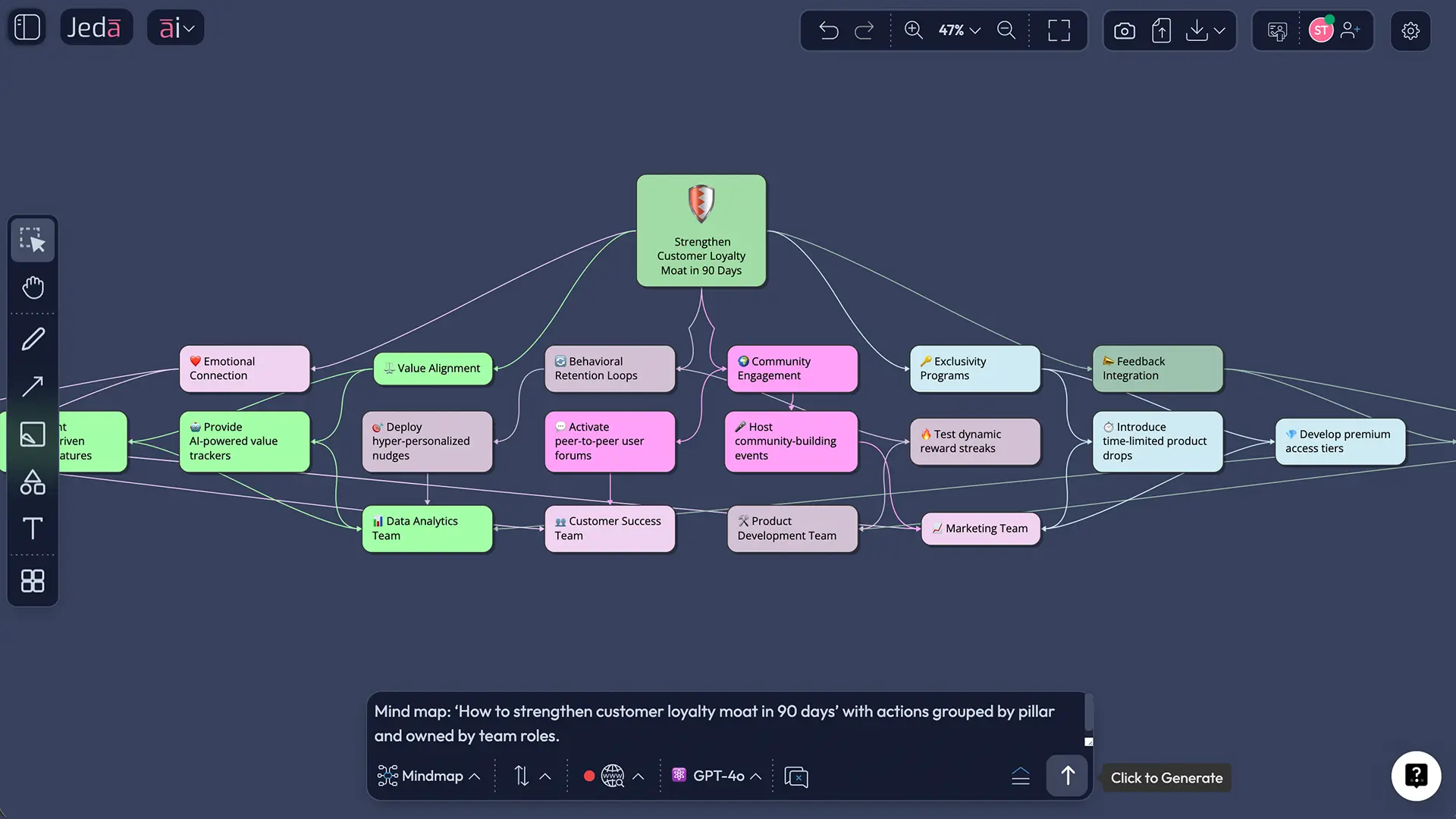
Use Vision Transform to convert the matrix into a Diagram for exec storytelling. Export as PNG, SVG, or PDF when you’re ready.
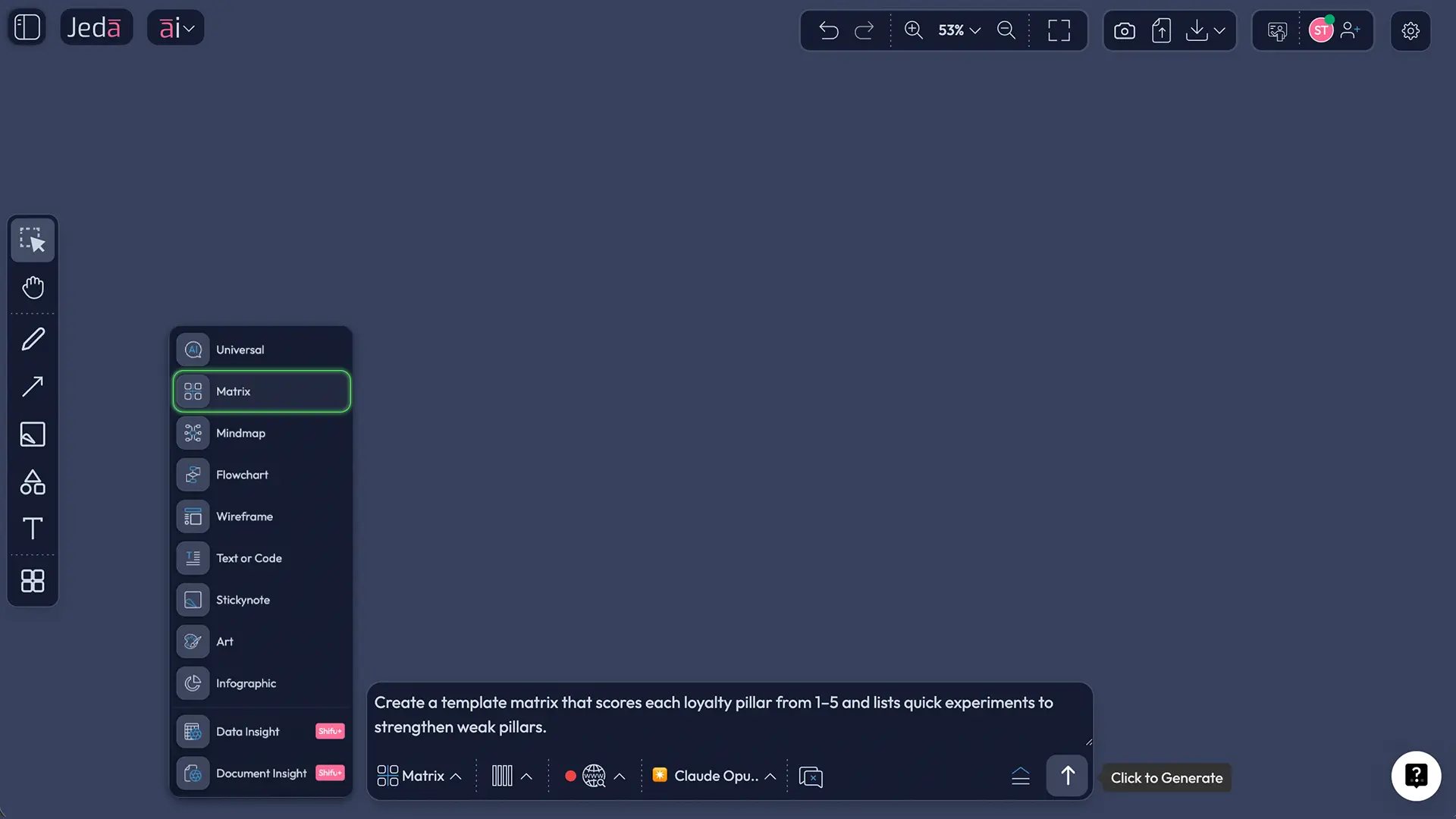
Copy-paste prompts you can use
Prompt A — Full moat board
Build a Customer Loyalty Moat Analysis for [Company/Product] in [Market].
Include the 6 loyalty moat pillars (Value lock-in, Switching costs, Habit loops, Community/identity, Trust, Data flywheel).
For each pillar: (1) mechanism, (2) strongest evidence we should collect, (3) leading + lagging metrics, (4) current risk to moat, (5) 2 actions to strengthen it in 90 days.
Competitors: [A, B, C]. Segments: [Segment 1, Segment 2].
Prompt B — “Is it real?” stress test
Here are our loyalty claims: [paste bullets].
Challenge them: classify each as (Moat / Temporary advantage / Pricing effect).
For anything not a moat, propose what would make it defensible.
Prompt C — Segment split
Create a loyalty moat analysis by segment.
Segments: [SMB, Mid-market, Enterprise] (or your own).
Show which pillars are strongest per segment and why.
Example: A loyalty moat in the wild (Starbucks, 2026)
A fast way to understand a loyalty moat is to watch what happens when a company changes incentives.
In January 2026, Reuters reported Starbucks planned to launch a three-tier U.S. loyalty program (Green, Gold, Reserve) and emphasized experiences over broad discounts. The report cited 35.5 million active members, and noted Starbucks’ view that even a small increase in transactions per member could add meaningful revenue.
That’s moat logic in plain English:
- Habit loops: coffee is routine, and the app reinforces it
- Identity/status: tiers and “Reserve” exclusivity signal belonging
- Switching friction: stored value, points, and app habits make switching annoying
- Trust: consistent product + store experience reduces risk
Would another coffee chain copy tiers? Sure. Can they copy the habit + identity + footprint at the same speed? Not really. That’s the difference between “a loyalty program” and “a loyalty moat.”
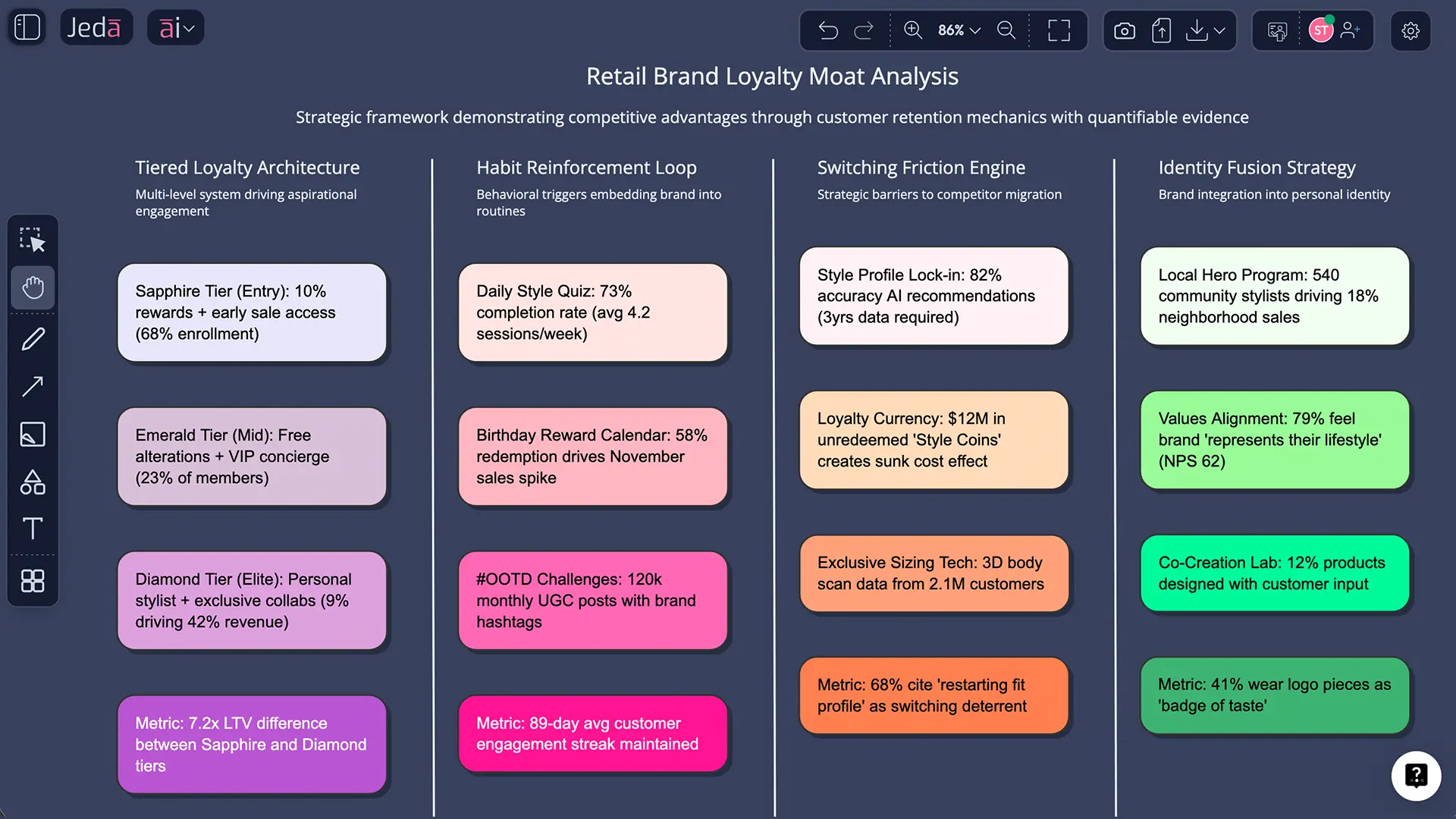
Best practices for a loyalty moat analysis
- Separate loyalty from lock-in. Some retention is “happy,” some is “stuck.” You need to know which is which.
- Use both attitude and behavior. NPS-style questions can be useful, but don’t treat them as the product. Pair them with cohort behavior.
- Track the post-purchase journey. Loyalty often forms after the first purchase, when customers decide whether to come back.
- Look for compounding mechanisms. Network effects and ecosystems can deepen customer stickiness over time.
- Include the “lost” customers. Churn interviews are brutally honest. That’s why they work.
Common mistakes to avoid
Mistake #1: Calling discounts a moat.
If customers disappear when promotions end, you built price sensitivity with extra steps.
Mistake #2: Treating NPS as the only truth.
NPS can be informative, but it’s a single lens. Even NPS has academic critiques around predictive validity and implementation.
Mistake #3: Ignoring the “situational” part of loyalty.
Dick & Basu’s view highlights that loyalty is shaped by context and social norms, not only preference.
Mistake #4: Not defining the competitor set.
Loyalty is relative. “Loyal” against whom?
Mistake #5: No action plan.
A moat analysis without owners and timelines is just a workshop souvenir.
Start Your Customer Loyalty Moat Analysis Today
Join over 150,000+ users who trust Jeda.ai’s AI Workspace to turn loyalty signals into decision-ready strategy boards.
Try Free TemplateFrequently Asked Questions
- What is customer loyalty analysis?
- Customer loyalty analysis is the process of explaining why customers stay, buy again, and recommend you—using both attitude signals (like surveys) and behavior signals (like repeat purchase rate and retention cohorts).
- What makes customer loyalty a real moat?
- Customer loyalty becomes a moat when it creates defensible switching friction, habit loops, identity/community pull, or compounding advantages that competitors can’t copy quickly—so customers stay even when alternatives exist.
- How is a loyalty moat different from a loyalty program?
- A loyalty program is a set of incentives. A loyalty moat is the underlying mechanism that changes behavior and stays durable even if a competitor copies the incentives—because the customer is locked-in by value, habits, trust, or ecosystem.
- Which metrics matter most for loyalty moat analysis?
- Start with retention rate, churn rate, repeat purchase rate, and expansion revenue. Then add leading signals like activation, usage frequency, referral rate, and segment-level NPS or satisfaction verbatims to explain the “why.”
- Can NPS predict loyalty?
- NPS is widely used as a loyalty signal, but it’s not a complete predictor on its own. Use it as one input, and validate it against cohort behavior and churn reasons so your decisions aren’t driven by a single number.
- How do switching costs show up in customer behavior?
- Switching costs show up as longer tenure, lower churn after onboarding, and resistance to competitor offers—especially when customers have integrated workflows, stored data, or learned processes that would be painful to rebuild elsewhere.
- How do I run this analysis using AI in Jeda.ai?
- Open Jeda.ai, choose the Matrix command, and prompt for the loyalty pillars, evidence, metrics, and a 90-day action plan. Then use AI+ to challenge weak claims and Vision Transform to convert the matrix into a Diagram for leadership review.
- Can I use documents and spreadsheets as input?
- Yes. Use Document Insight to extract loyalty drivers from surveys, interview notes, and research PDFs. Use Data Insight to analyze CSV/Excel cohort retention and repeat purchase tables, then visualize the findings as a Matrix or Diagram.
- What export formats does Jeda.ai support for this board?
- Jeda.ai exports boards as PNG, SVG, and PDF. If you need slides, export a PNG/PDF and place it into your deck workflow.
- How often should we revisit our loyalty moat analysis?
- Quarterly is a practical cadence for fast-moving markets. Re-run it when pricing changes, a major competitor launches a program, your retention shifts, or a new channel becomes your main acquisition source.
- What’s the fastest way to strengthen a weak loyalty moat?
- Pick one pillar and make it measurable. For example: reduce onboarding time (switching friction), improve time-to-value (habit loop), or build a referral loop (community). Then run a 90-day experiment plan tied to retention and repeat purchase changes.
Sources & Further Reading
- [1]
Alan S. Dick; Kunal Basu (1994) . “Customer loyalty: Toward an integrated conceptual framework” Journal of the Academy of Marketing Science.
View Source ↗ - [2]
Richard L. Oliver (1999) . “Whence Consumer Loyalty?” Journal of Marketing.
View Source ↗ - [3]
Frederick F. Reichheld (2003) . “The One Number You Need to Grow” Harvard Business Review.
View Source ↗ - [4]
David Court; Dave Elzinga; Susan Mulder; Ole Jørgen Vetvik (2009) . “The consumer decision journey” McKinsey & Company.
View Source ↗ - [5]
Investopedia Staff (2025) . “How an Economic Moat Provides a Competitive Advantage” Investopedia.
View Source ↗ - [6]
Morningstar (2025) . “Competitive Advantage With the Network Effect” Morningstar.
View Source ↗ - [7]
Reuters (2026) . “Starbucks revamps US loyalty program with three tiers” Reuters.
View Source ↗ - [8]
Jeda.ai (2024) . “Generate MOAT Analysis with Generative AI Workspace” Jeda.ai Resources.
View Source ↗