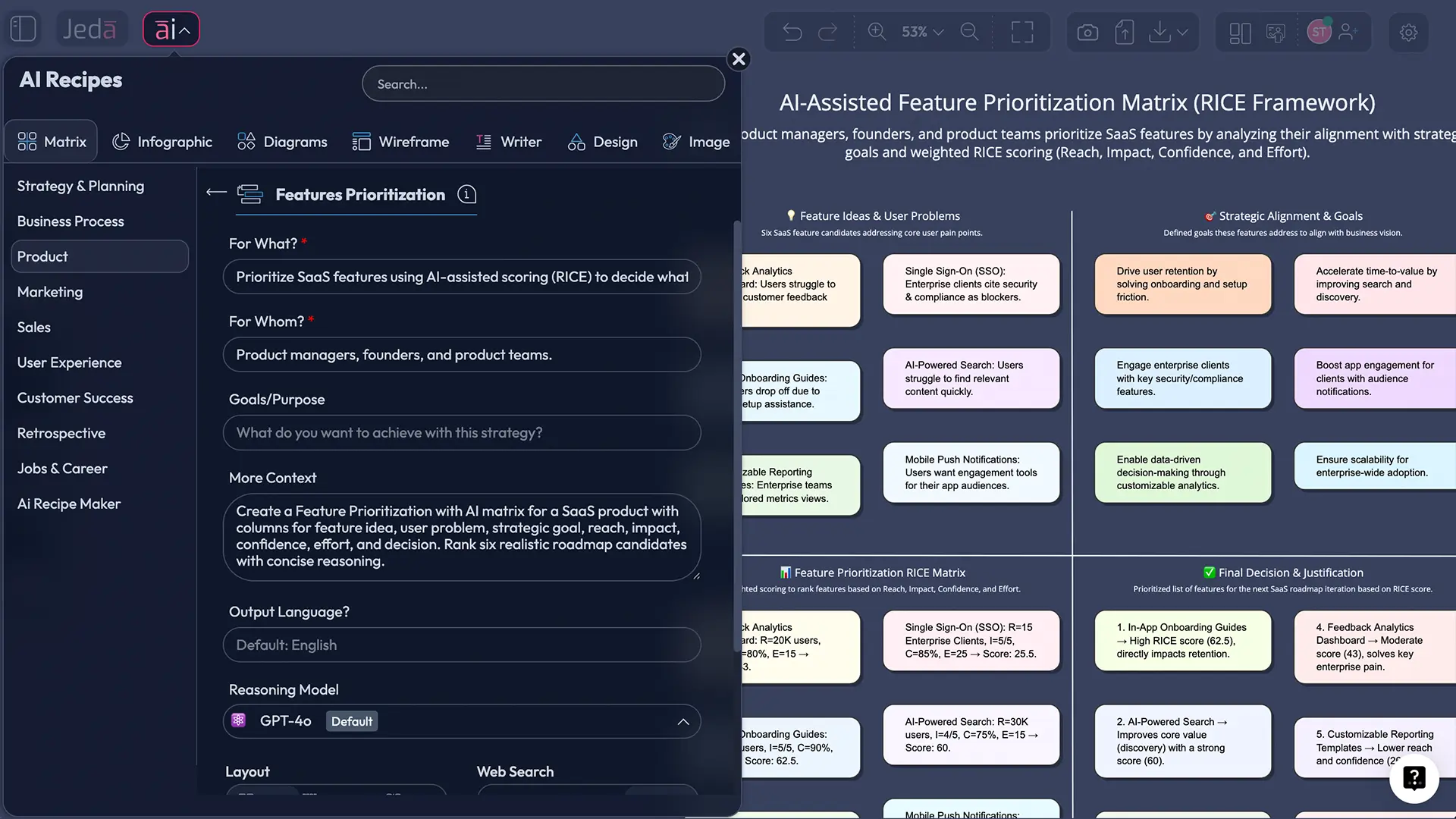
Feature Prioritization with AI works best when you stop treating prioritization as a quarterly spreadsheet ritual and start treating it like an ongoing product decision system. In Jeda.ai, you can turn messy backlog inputs, customer requests, strategy notes, and effort estimates into an editable matrix inside one AI Workspace and one AI Whiteboard — without losing the reasoning behind the call.
Look, most teams do not actually have a prioritization problem. They have an evidence problem. Too many roadmap calls get made by whoever talked last, whoever shouts “revenue,” or whichever request came from the biggest customer five minutes before planning. That is how nice-to-have features sneak into serious roadmaps wearing fake must-have badges.
Jeda.ai gives product teams a more disciplined way to work. You can use the guided Product-category recipe for prioritization, or build a custom matrix from the Prompt Bar, then extend weak areas with the AI+ button, convert the result with Vision Transform, and keep the full discussion in one AI Workspace. That matters when the same board has to serve PMs, design, engineering, leadership, and the occasional stakeholder who discovered the backlog yesterday and now has “just one quick idea.”
What is Feature Prioritization with AI?
Feature prioritization is the discipline of deciding what to build next based on customer value, business value, feasibility, and timing — not just enthusiasm. In plain English: which work earns its place on the roadmap now, which work should wait, and which work should be cut without ceremony.
That sounds obvious. It rarely is.
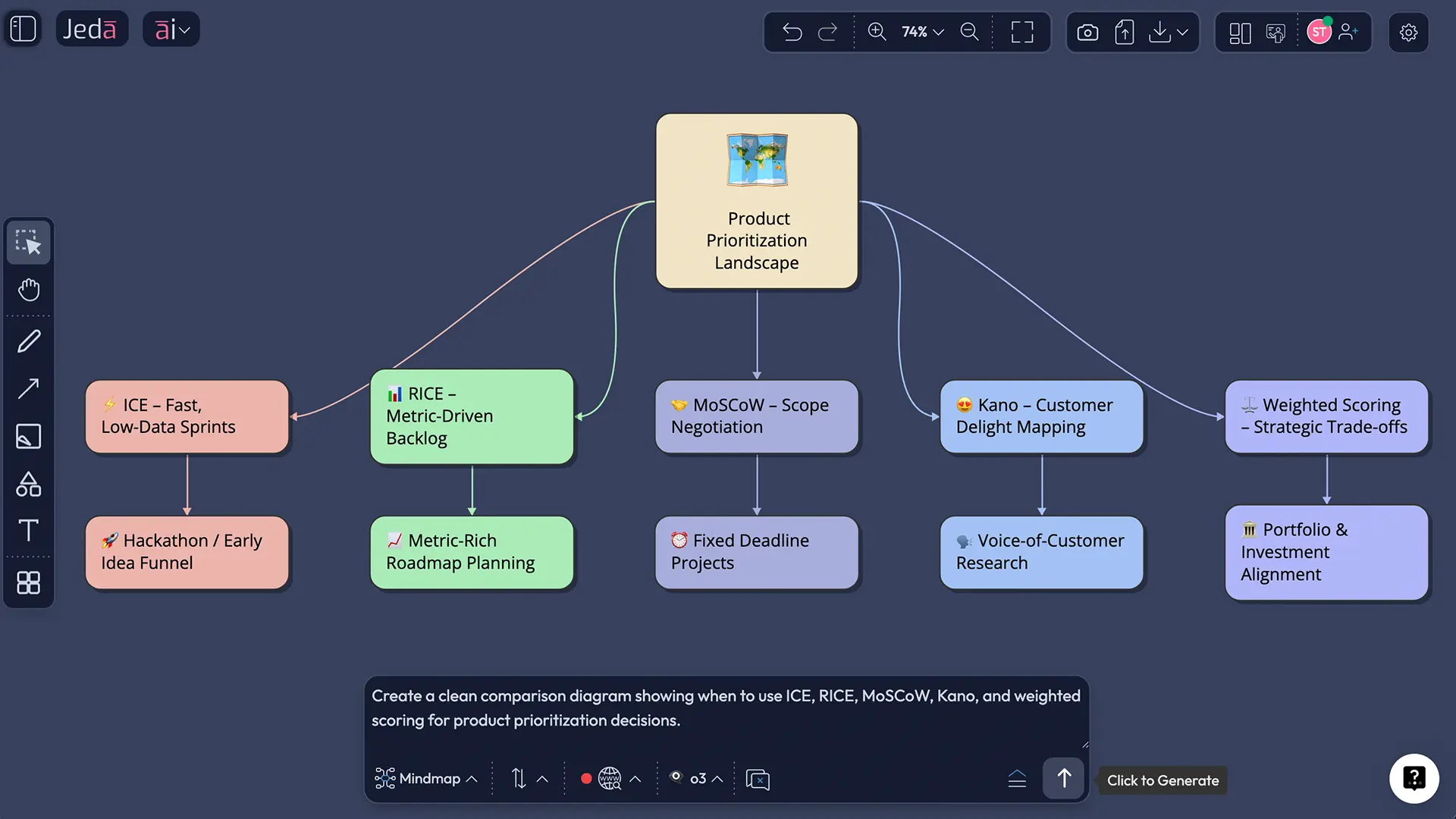
A decent prioritization system has to do four things at once. It needs to compare unlike items fairly, make assumptions visible, keep teams aligned to strategy, and create a record you can defend later. That is why product teams lean on frameworks such as RICE, ICE, MoSCoW, Kano, and weighted scoring. Each gives you a different lens. Some are fast. Some are more data-hungry. None are magic on their own.
Feature Prioritization with AI improves the process because AI is good at structuring scattered inputs and surfacing blind spots before they become roadmap debt. Instead of debating ten features in ten separate places, you can map them in one AI Whiteboard, ask Jeda.ai to clarify the scoring logic, attach evidence from documents or spreadsheets, and pressure-test the shortlist. So the conversation gets sharper. And faster.
Jeda.ai also fits how real product work actually happens. You are not choosing between a static note and a deck screenshot. You are working in a Visual AI environment where the matrix stays editable, connected, and shareable across the team.
Why use Feature Prioritization with AI?
Because backlog prioritization breaks down the minute inputs get messy. And they always get messy.
One feature request comes from enterprise sales. Another came from a churn interview. Design wants to fix a painful workflow. Engineering wants to reduce support load. Leadership wants a visible win next quarter. All of that can be valid. But valid does not mean equally urgent.
AI helps when you need structure without turning the process into a bureaucratic swamp. In Jeda.ai, your product team can generate an initial prioritization board in minutes, then refine it with real evidence instead of vibes. Use the board live during planning, add notes from customer calls, attach a PRD, upload a spreadsheet of usage metrics, and keep iterating in the same AI Workspace.
- Turn backlog noise into ranked bets
Jeda.ai structures raw ideas into an editable matrix so you can compare features by value, effort, confidence, and strategic fit instead of debating in circles.
- Bring evidence into the board
Use Document Insight or Data Insight to pull signal from PRDs, customer feedback, support summaries, and KPI exports before you score the roadmap.
- Align product, design, and engineering
A shared AI Whiteboard keeps the rationale visible so teams can see why a feature rose, fell, or got cut — and stop relitigating every call.
- Start simple, then add rigor
Use the guided Product recipe for ICE-style scoring first, then deepen with weighted scoring, Kano logic, or release constraints when the board needs more nuance.
- Stress-test the shortlist
Use AI+ to extend contested rows, expose dependency risks, or surface validation gaps before a roadmap promise gets locked in.
- Convert prioritization into execution
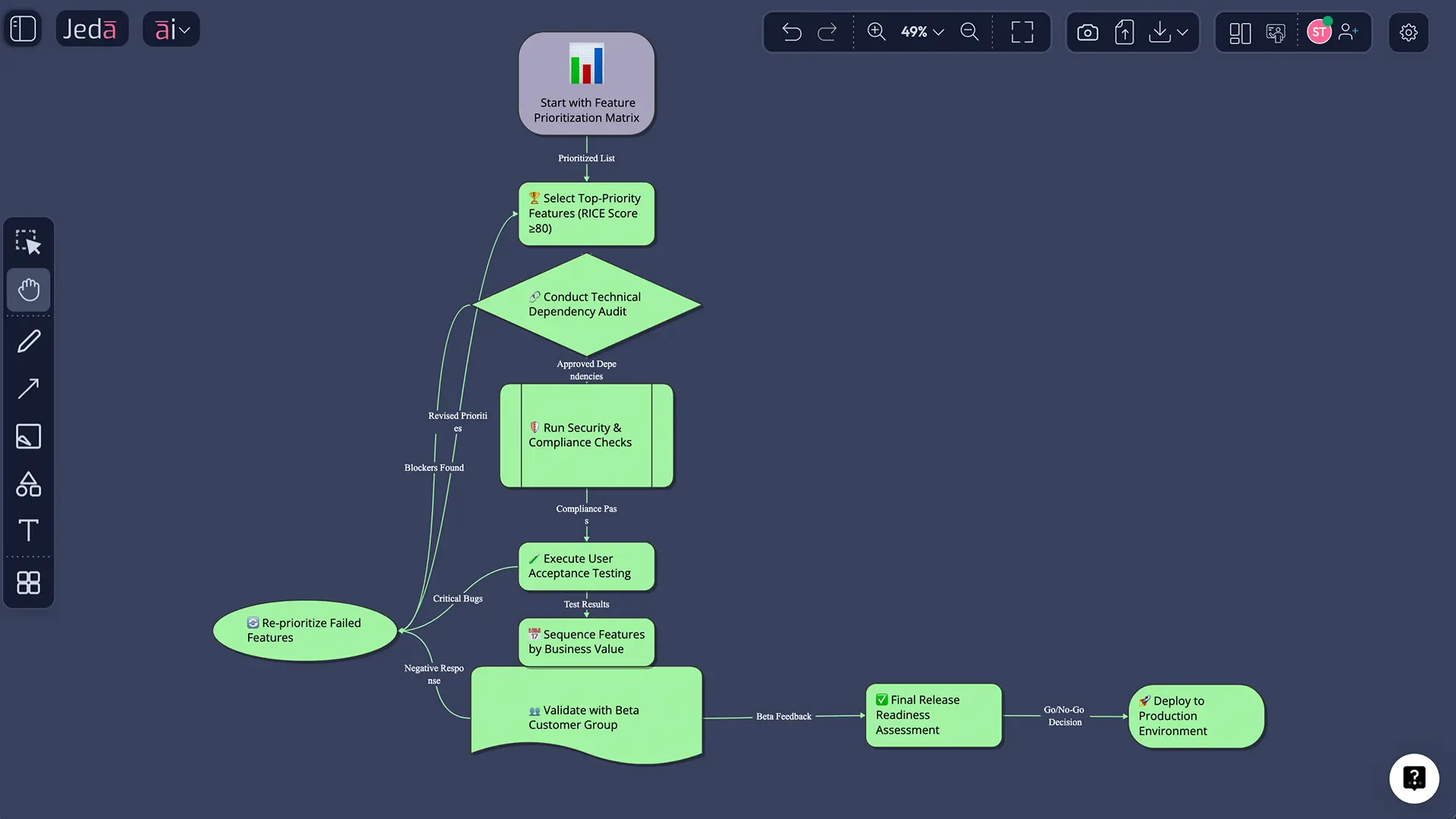
Vision Transform can turn the winning matrix into a release flow, dependency diagram, or planning sequence without rebuilding the logic from scratch.
Here is the real upside. Good prioritization is not only about choosing the top item. It is about making the trade-off visible enough that the whole team understands what you did not choose — and why. That is where Jeda.ai, with 300+ strategic frameworks, becomes useful well beyond a single scoring sheet.
How to create Feature Prioritization with AI in Jeda.ai
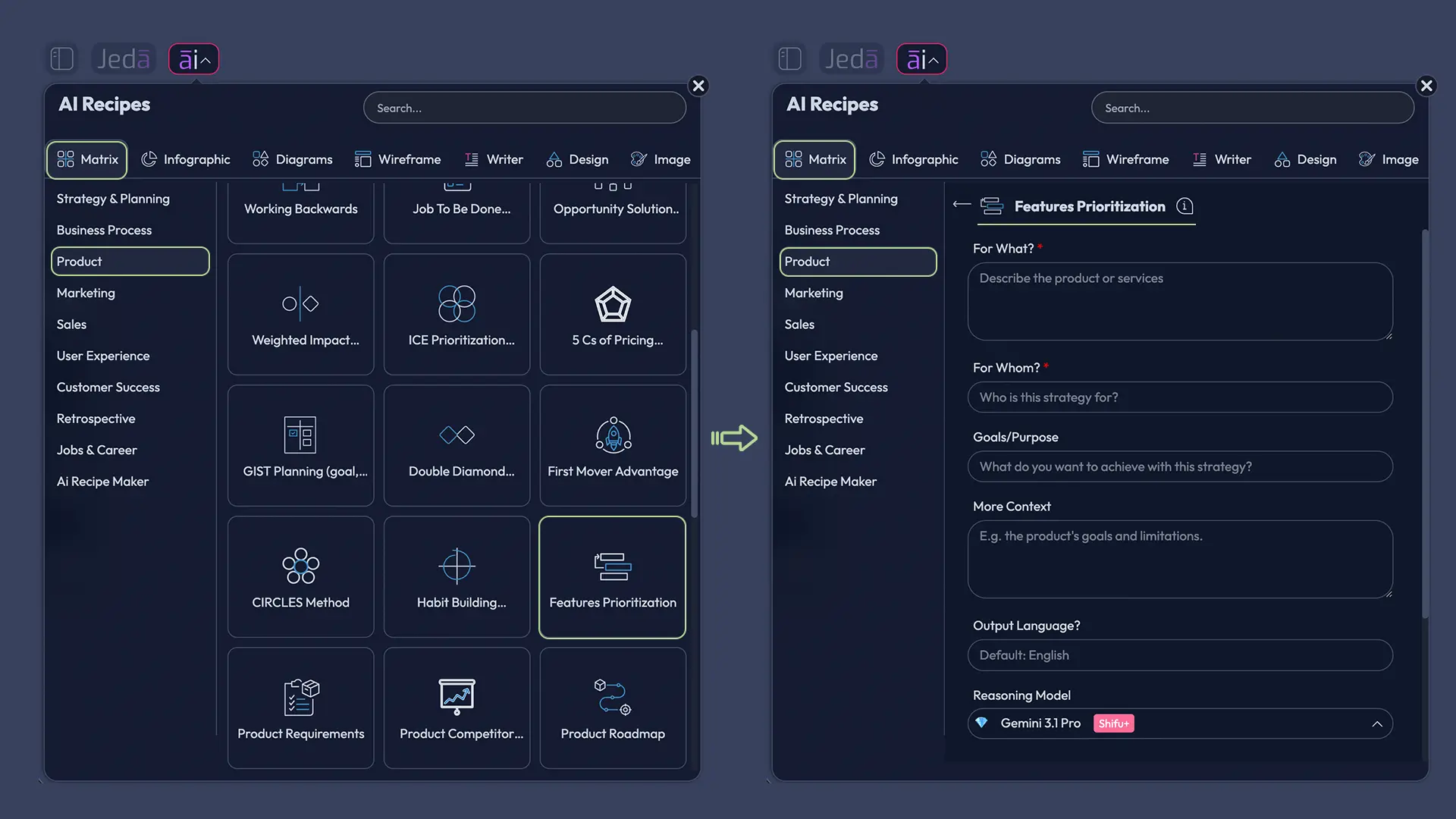
There are two clean ways to do this in Jeda.ai. Method 1 is the guided Recipe Matrix route through the AI Menu. Method 2 is the manual Prompt Bar route, which gives you more control over criteria, scoring rules, and board design.
For a fast start, use the Product-category prioritization recipe. It is the better option when your team wants a repeatable board without arguing about structure first. Then, once the matrix is generated, you can adapt the criteria, add extra columns, or bring in supporting material from docs and data.
- Open a board in your AI Workspace
Create or open a Jeda.ai workspace. This becomes the shared working board for roadmap discussion, scoring, and trade-off decisions.
- Method 1 (recommended): Use the Recipe Matrix
Open the AI Menu at the top-left, choose Matrix Recipes, go to the Product category, and select the prioritization recipe. Fill in the product, audience, goals, and context fields, then generate the board.
- Method 2: Use the Prompt Bar with the Matrix command
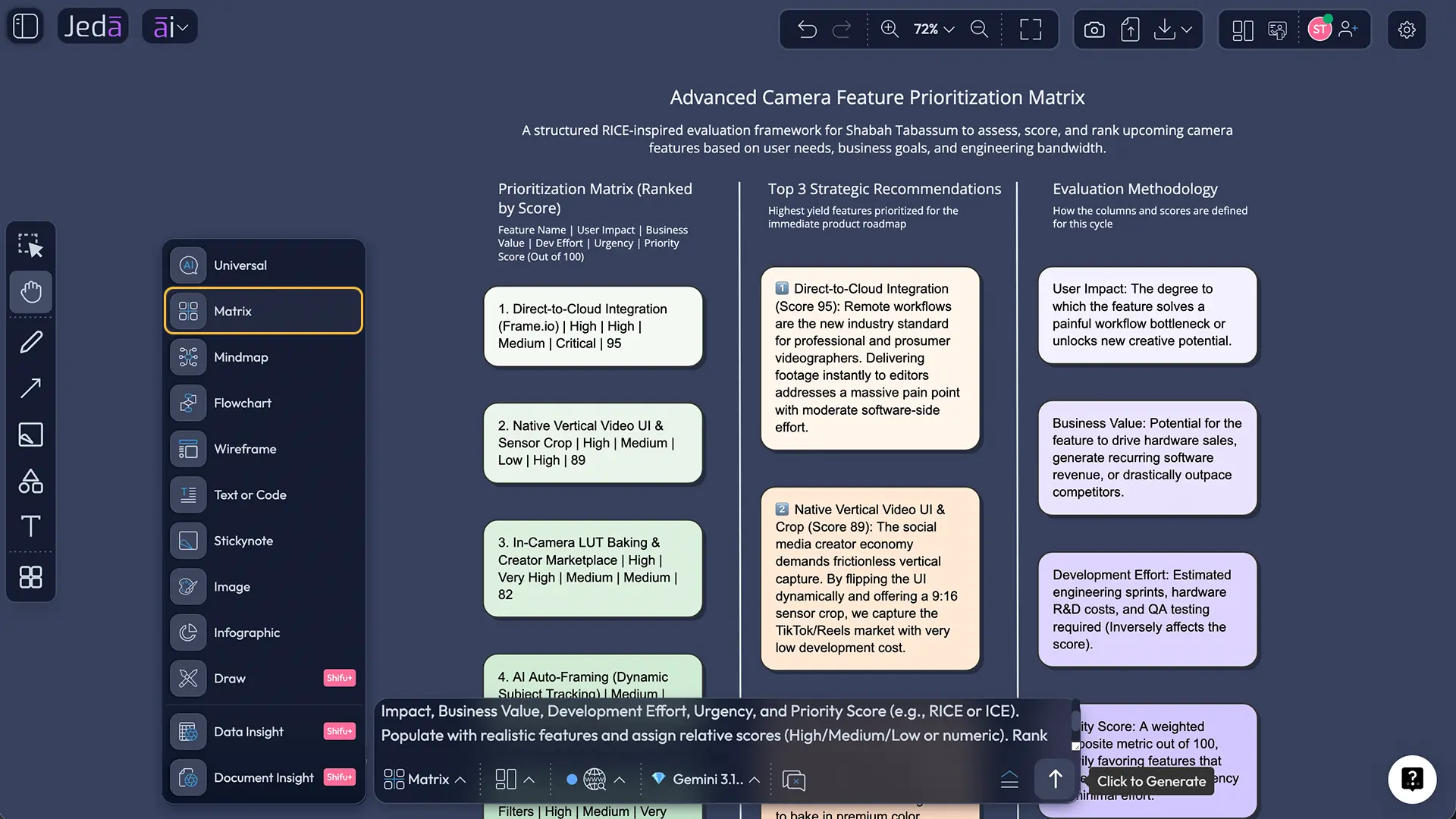
Open the Prompt Bar at the bottom, select the Matrix command, and enter a feature prioritization prompt with the scoring criteria you want to use. Press Enter to generate.
- Bring in real evidence
Upload PRDs, feedback docs, research summaries, or CSV/Excel files. Use Document Insight or Data Insight to pull signal into the same prioritization board before final ranking.
- Deepen the board with AI+
Select the most important or most disputed rows and use the AI+ button to extend the analysis. This is useful when you need richer rationale, missing assumptions, or a stronger validation path.
- Turn priorities into a release view
Use Vision Transform to convert the matrix into a flowchart, release sequence, or dependency view. Then collaborate, review, and export the board as PNG, SVG, or PDF.
Copy-paste prompt (Prompt Bar → Matrix)
Prompt:
Create a Feature Prioritization with AI matrix for [product or roadmap area].
Audience: [target users / segment].
Business goal for this cycle: [goal].
Evaluate these feature ideas: [paste ideas].
Build columns for: Feature, User problem, Strategic goal, Reach, Impact, Confidence, Effort, Dependencies / risks, Priority recommendation, and Why now / why later.
Use a practical product-management lens, keep the scoring logic explicit, and rank the features from highest to lowest priority.
Flag any item that should be delayed, split, validated first, or removed.
Feature Prioritization with AI template and examples
The best prioritization boards do not try to look clever. They try to be honest. That means each row should answer a few uncomfortable questions: Who does this help? How much? How sure are we? What does it cost? What gets delayed if we do it now?
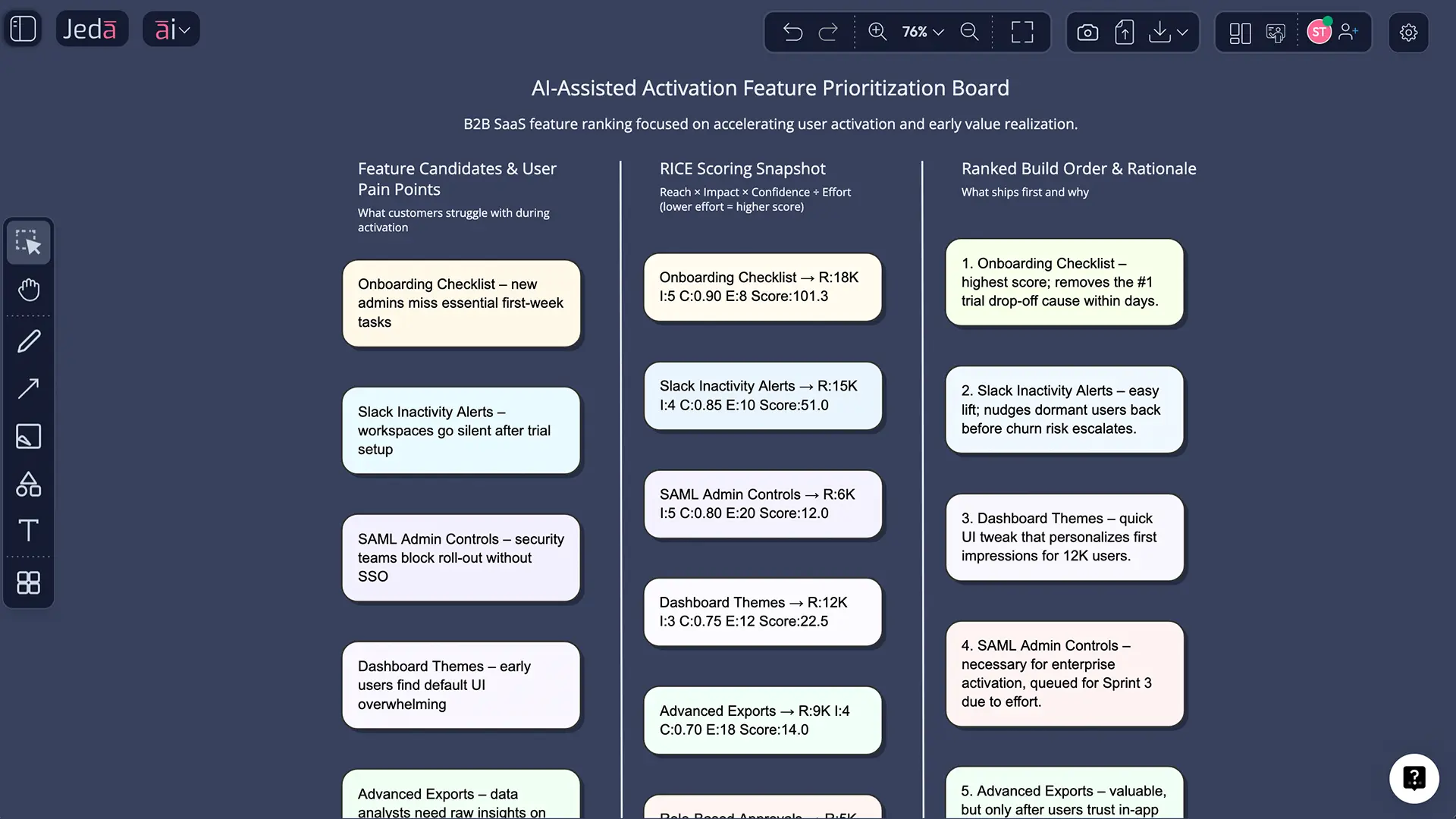
Example 1: Early-stage SaaS with activation pressure
Imagine your goal this quarter is better trial-to-paid conversion. A feature prioritization board for that scenario should not give equal weight to every request coming from sales, support, and leadership. It should favor work that moves activation, reduces confusion in the first-session experience, and can ship inside the planning window.
In that case, a feature like guided setup checklist often outranks custom dashboard themes. Not because themes are useless — they are not — but because the checklist directly supports the current strategic objective, reaches more users, and is easier to validate fast. That is a grown-up prioritization decision. Slightly less glamorous. Much more useful.
Example 2: Enterprise product with release constraints
Now flip the context. Your product is stable, but enterprise expansion is the business goal. Suddenly, SAML admin controls or role-based approvals may climb because strategic fit outweighs raw user count. This is where simple frameworks start helping rather than misleading.
Use ICE when you need a fast first pass and your team wants momentum over precision. Use RICE when you have stronger usage data and need a more defensible score. Use MoSCoW when a release deadline is fixed and the team must decide what makes the minimum shippable cut. Use Kano when the hard question is not “How big is this?” but “Is this a must-have, a satisfier, or just a shiny extra?”
That mix matters. Product teams get into trouble when they keep using one framework long after the decision context changed.
Example 3: Mature product with too many stakeholder requests
This one is brutal because everything sounds reasonable. Support wants fixes. Sales wants a promised feature. Design wants usability cleanup. Platform wants tech debt relief. Leadership wants a visible bet for the board update.
A strong Jeda.ai board helps by making trade-offs explicit. You can add a why now / why later column, attach a research summary, and use AI+ on the most disputed rows to deepen the discussion before prioritization becomes politics in nicer clothes.
Best practices for cleaner prioritization decisions
A good prioritization ritual should create clarity, not theater.
We have found that teams move faster when they keep the board small. Fifteen rows beat fifty. You do not need the whole universe in one matrix. Just the real contenders for the decision window in front of you.
And one more thing. Be careful with precision theater. A score of 7.3 is not automatically smarter than a score of 7. Use numbers to sharpen judgment, not to cosplay certainty.
Common mistakes to avoid in Feature Prioritization with AI
Treating every request like roadmap truth
A customer request is an input, not a verdict. If one loud account can override strategy every sprint, you do not have prioritization. You have escalation with better branding.
Using one framework for every decision
RICE is useful. It is not holy scripture. MoSCoW is useful. Also not holy scripture. Pick the method that fits the decision. Change the method when the situation changes.
Scoring without defining the scales
If “impact = 8” means one thing to product and another thing to engineering, your matrix will look neat while quietly lying to everyone in the room.
Ignoring effort outside engineering build time
Real effort includes design work, QA load, migration pain, support cost, documentation, enablement, and release risk. Teams that score only coding effort usually underprice reality.
Forgetting to document why something lost
This is the sneaky one. The next planning cycle arrives, someone reintroduces the same feature, and the whole argument starts from zero. Keep the rationale on the board. Future-you will be grateful. Current-you will look weirdly organized.
Frequently asked questions
- What is feature prioritization?
- Feature prioritization is the process of deciding what to build first based on customer value, business goals, urgency, and feasibility. The point is not to rank everything forever. The point is to make better decisions for a specific planning window and explain those decisions clearly to the team.
- Which framework should a product team start with?
- Start with the simplest framework your team can use consistently. ICE is often a practical first move because it is fast. RICE is stronger when you have better data. MoSCoW works well for fixed-scope release planning, while Kano helps when customer satisfaction is the real question.
- Can one prioritization framework handle every roadmap decision?
- Usually no. Different prioritization questions need different tools. A release-cut decision, a discovery-stage ranking, and a customer-delight conversation are not the same thing. Strong teams keep the scoring logic visible and switch frameworks when the decision context changes instead of forcing one model onto everything.
- How does AI help without replacing product judgment?
- AI is useful for structuring the inputs, exposing gaps, and accelerating comparison. It should not replace product judgment. In Jeda.ai, the board stays editable, so your team can challenge assumptions, add evidence, revise scores, and keep the human decision-making layer fully visible.
- Can we prioritize features from documents or spreadsheets?
- Yes. Jeda.ai supports Document Insight and Data Insight, so teams can pull signal from PRDs, customer-feedback docs, research notes, CSV files, or KPI exports and use that material inside the same prioritization board instead of scoring features in a vacuum.
- What should go into reach, impact, confidence, and effort?
- Reach should describe who or how many users will be affected in a defined period. Impact should connect to the goal you care about. Confidence should reflect evidence quality, not optimism. Effort should include build, design, QA, release, and operational complexity — not just engineering days.
- What should we do after the first prioritization board is generated?
- Clean the board, challenge the scoring assumptions, and deepen the most disputed rows. In Jeda.ai, that usually means selecting the important rows, using AI+ to extend the analysis, and then converting the final matrix into a release flow or dependency view with Vision Transform.
- Can we export the final prioritization board?
- Yes. Jeda.ai boards can be exported as PNG, SVG, or PDF. That makes the output useful for roadmap reviews, leadership updates, sprint planning, and documentation. The board stays more useful than a static slide because the working version remains editable inside the AI Workspace.
- Do we need web search for feature prioritization?
- Not always. But it helps when market context, competitor moves, or current trends affect the decision. In Jeda.ai, web search is a platform feature, so you can ground the board with fresher context when the roadmap call depends on information that is moving in the real world.
Sources and further reading
- [1]
Atlassian (2026) . “Six product prioritization frameworks and how to pick the right one” Atlassian.
View Source ↗ - [2]
Aha! (2025) . “How to prioritize product features” Aha! Roadmapping Guide.
View Source ↗ - [3]
Sean McBride (2018) . “RICE Prioritization Framework for Product Managers [+Examples]” Intercom.
View Source ↗ - [4]
Agile Business Consortium (n.d.) . “MoSCoW Prioritisation” DSDM Project Framework Handbook.
View Source ↗ - [5]
Productboard Support (n.d.) . “Model common prioritization frameworks in Productboard” Productboard.
View Source ↗ - [6]
Kano, N.; Seraku, N.; Takahashi, F.; Tsuji, S. (1984) . “Attractive Quality and Must-Be Quality” Journal of the Japanese Society for Quality Control.
View Source ↗ - [7]
Matzler, K.; Hinterhuber, H.H. (1998) . “How to Make Product Development Projects More Successful by Integrating Kano’s Model of Customer Satisfaction into Quality Function Deployment” Technovation.
View Source ↗
Prioritize What Actually Deserves to Ship
Join over 150,000+ users building clearer roadmap decisions in Jeda.ai’s AI Workspace and AI Whiteboard.
Try Free Template