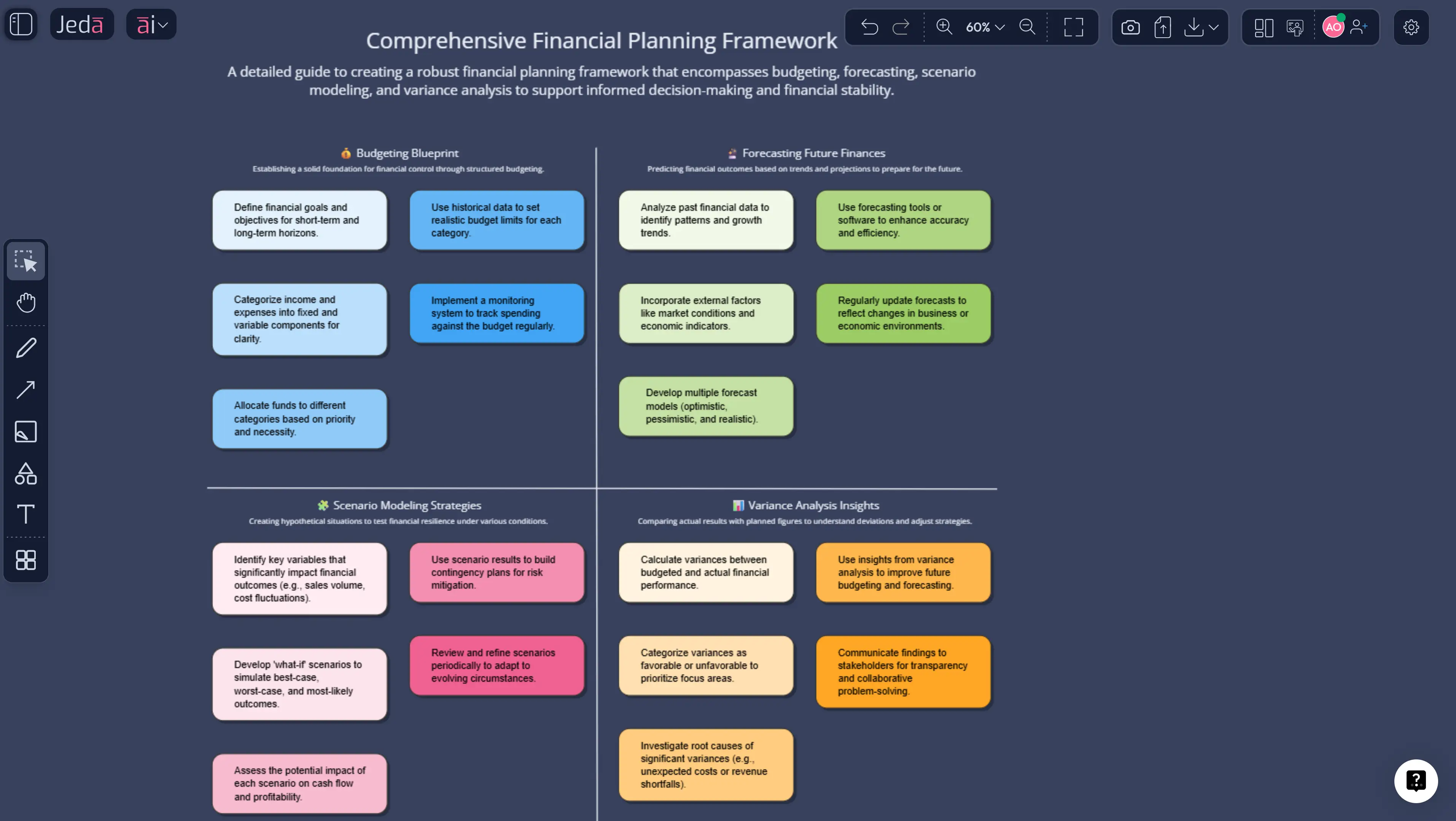
Financial planning has never been a simple exercise. But it's never been this complex, either.
Between volatile interest rates, shifting supply chain dynamics, and an economic landscape that rewrites itself quarterly, finance teams face a stark choice: continue relying on spreadsheet-driven planning cycles that take weeks to produce already-outdated forecasts, or adopt AI-powered tools that compress planning timelines from weeks to hours while improving accuracy.
The IBM Institute for Business Value found that organizations implementing AI end-to-end achieved top-quartile ROI compared to peers. Ernst & Young documented four key areas where AI produces measurable productivity gains for FP&A teams. And a 2025 survey from Vena Solutions reported that 57% of finance professionals already use AI in their operations, with another 14% planning to implement it.
Jeda.ai's AI Workspace brings a distinct approach to this transformation: Visual AI that turns financial data, strategy, and planning into editable, collaborative frameworks — not just dashboards you stare at, but artifacts you think with. Trusted by 150,000+ professionals across strategy, finance, and operations.
What Is AI-Powered Financial Planning?
AI-powered financial planning applies machine learning, natural language processing, and predictive analytics to the core activities of budgeting, forecasting, scenario modeling, and financial reporting. It replaces manual data consolidation and static models with dynamic systems that continuously learn from historical patterns and real-time inputs.
The discipline has deep roots. Modern financial planning and analysis (FP&A) evolved from the management accounting practices formalized by Robert Anthony at Harvard Business School in the 1960s. Anthony's framework distinguished between strategic planning, management control, and operational control — categories that still structure how organizations think about financial governance.
What AI changes is not the what of financial planning but the how and the speed. Traditional FP&A operates in cycles: monthly closes, quarterly forecasts, annual budgets. AI-powered FP&A operates continuously, adjusting projections as new data arrives and flagging variances before they compound into material problems.
Why Use AI for Financial Planning?
The case for AI in financial planning rests on three measurable advantages: speed, accuracy, and visibility.
Speed. McKinsey reported that companies using AI for financial modeling reduced planning cycle times significantly, with some cutting annual budgeting processes by 30%. Jeda.ai's AI Workspace generates financial frameworks — budget structures, variance analyses, scenario models — in seconds, not weeks.
Accuracy. Traditional forecasting relies heavily on linear extrapolation and manual adjustments. Machine learning models identify non-linear patterns in historical data that human analysts typically miss. The result: forecasts that better account for seasonality, market shifts, and operational variability. Organizations using AI tools reported 35% improvement in forecast reliability according to McKinsey's 2025 research.
Visibility. This is where Visual AI creates differentiation. A financial model buried in a 200-row spreadsheet communicates poorly. The same model rendered as an interactive framework on Jeda.ai's AI Whiteboard communicates immediately — to the CFO, the board, and the operating team simultaneously.
- Automated Forecasting
AI analyzes historical financial data and market variables to produce multi-variable forecasts that adapt as conditions change.
- Budget Optimization
Generate visual budget frameworks that identify over-allocated resources, under-invested areas, and reallocation opportunities.
- Variance Analysis
AI surfaces budget-to-actual variances in real time, categorized by materiality and root cause. No more month-end surprises.
- Scenario Modeling
Model what-if scenarios across revenue, cost, and market variables simultaneously using Jeda.ai's Matrix and Diagram commands.
- Risk Quantification
Move beyond qualitative risk registers. AI quantifies financial risk exposure and maps mitigation strategies visually.
- Multi-LLM Intelligence
Jeda.ai's Shifu plan runs prompts across GPT, Claude, Grok, and more simultaneously — an Aggregator model selects the strongest output.
How to Create Financial Planning Frameworks in Jeda.ai
Jeda.ai offers two methods for generating financial planning visuals, both designed for speed and quality.
Method 1 — AI Menu (Recommended):
- Open the AI Menu
Click the AI Menu button at the top-left corner of your Jeda.ai canvas. Navigate to the Matrix Recipes category for financial frameworks.
- Select a Financial Planning Recipe
Choose Financial Planning Matrix.
- Input Your Financial Context
Provide relevant details: revenue figures, cost categories, planning horizon, key assumptions, and strategic priorities.
- Generate the Framework
Click Generate. The AI Workspace produces a structured, editable visual framework ready for review and collaboration.
- Expand with AI+
Select any section of the generated framework and tap the AI+ button to extend it. Drill into specific line items, add sub-categories, or generate supporting analyses.
- Convert Formats with Vision Transform
Use Vision Transform to convert your financial matrix into a flowchart, diagram, or other visual format depending on your audience and presentation needs.
Method 2 — Prompt Bar:
Open the Prompt Bar at the bottom of the canvas. Select the Matrix command. Enter a detailed prompt such as: "Create a financial planning framework for a mid-market SaaS company with $15M ARR, showing budget allocation by department, quarterly revenue forecast, and key financial KPIs." Press Enter to generate.

Financial Planning Templates & Examples
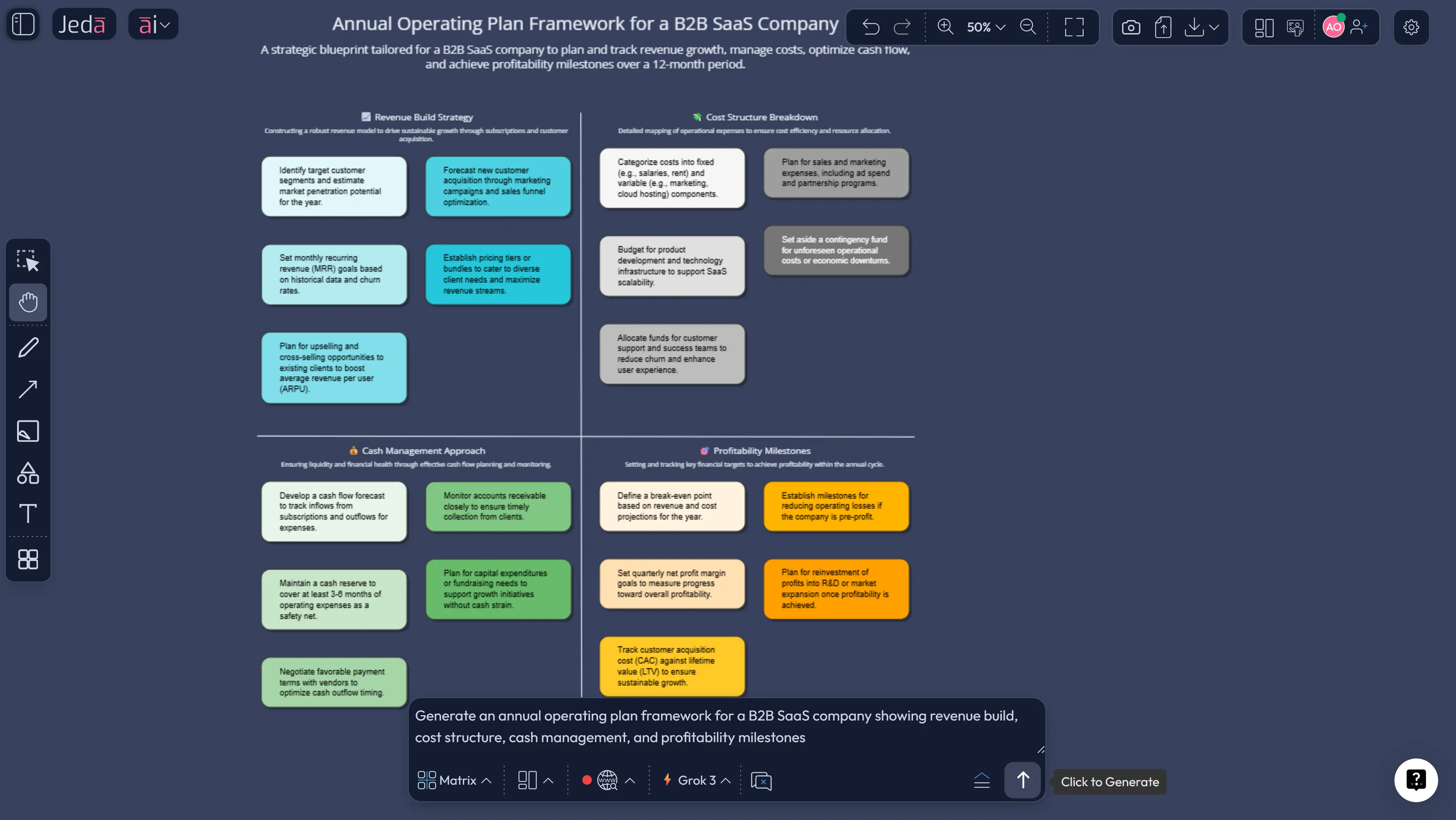
Effective financial planning requires different frameworks for different planning horizons and audiences. Here are the core templates that finance teams generate most frequently.
Additional frameworks available through Jeda.ai's AI Workspace:
Budget allocation matrix — departmental spending mapped against strategic priorities. Rolling forecast model — 12-month forward view that updates with each monthly close. Cost-benefit analysis — investment decisions visualized with projected returns and risk factors. Cash flow projection — monthly inflows and outflows mapped against critical thresholds. Financial KPI dashboard — real-time metrics framework covering revenue, margins, burn rate, and runway.
With 300+ strategic frameworks accessible through the AI Menu and Prompt Bar, Jeda.ai covers the full spectrum of financial planning needs from startup runway modeling to enterprise budget governance.
Best Practices & Tips
Ground AI outputs in real data. AI generates excellent structural frameworks, but the numbers must come from your actuals. Use Jeda.ai's Data Insight command to upload CSV or Excel financial data and generate visual analyses directly from your source data.
Separate strategic planning from operational planning. Strategic financial plans (3-year horizon, major investment decisions) require different frameworks than operational plans (quarterly budgets, monthly forecasts). Generate both on Jeda.ai's AI Whiteboard, but present them to different audiences.
Build in variance thresholds. When generating budget frameworks, include explicit tolerance bands for each line item. This transforms a budget from a rigid target into a management tool with built-in escalation triggers. AI can suggest appropriate thresholds based on historical variance patterns.
Automate the repeatable, humanize the strategic. Let AI handle data consolidation, initial forecast generation, and variance detection. Reserve human effort for interpreting results, making strategic trade-offs, and communicating decisions. This division of labor is where AI delivers the most value.
Version your frameworks. Save snapshots of your financial plans at key decision points. Jeda.ai's canvas preserves your work, allowing you to compare how assumptions evolved over time — a valuable exercise during annual planning retrospectives.
Common Mistakes to Avoid
Replacing financial judgment with AI output. AI generates frameworks and identifies patterns. It does not understand your board's risk appetite, your founder's strategic vision, or the competitive dynamics only your team knows. Use AI as the analytical foundation, then apply professional judgment.
Over-engineering the model. A financial framework that tries to capture every variable becomes unusable. The best frameworks generated on Jeda.ai's AI Workspace focus on the 10-15 variables that drive 80% of financial outcomes. Complexity does not equal accuracy.
Neglecting sensitivity analysis. Every financial plan has assumptions that, if wrong, change the conclusion materially. Generate sensitivity matrices that show how output metrics (margin, cash runway, revenue) change when key inputs vary by ±10%, ±20%, and ±30%.
Planning annually, reviewing quarterly. The organizations achieving the highest returns from AI in finance are those operating in continuous planning mode. Gartner's research emphasized that AI strategy must be regularly revisited to remain aligned with market realities. Monthly review cadence is the minimum effective frequency.
Presenting data without narrative. A financial framework communicates structure. The narrative explains why the structure looks the way it does and what actions follow from it. Annotate your Jeda.ai visuals with strategic context before sharing.
Frequently Asked Questions
- What is AI-powered financial planning?
- AI-powered financial planning uses machine learning and predictive analytics to automate budgeting, forecasting, scenario modeling, and variance analysis. Jeda.ai's AI Workspace generates visual financial frameworks from text prompts, turning complex planning into collaborative visual artifacts.
- How does AI improve financial forecasting accuracy?
- AI identifies non-linear patterns in historical data that manual analysis misses, producing forecasts that account for seasonality, market shifts, and operational variability. McKinsey found AI-powered forecasting improved reliability by 35% compared to traditional methods.
- What financial planning frameworks can Jeda.ai generate?
- Jeda.ai generates 300+ frameworks including budget allocation matrices, rolling forecasts, cost-benefit analyses, cash flow projections, financial KPI dashboards, scenario models, and breakeven analyses through its AI Workspace and AI Whiteboard.
- How to create a financial plan with AI?
- Open Jeda.ai's AI Menu, select a Matrix Recipe for financial planning, enter your business context and financial data, and click Generate. The AI Workspace produces an editable visual framework. Use AI+ to expand any section and Vision Transform to convert formats.
- Is AI financial planning suitable for small businesses?
- Yes. Small businesses benefit significantly because they often lack dedicated FP&A teams. Jeda.ai's Whitebelt plan is free and includes all 11 AI commands, providing professional-grade financial visualization without the cost of enterprise FP&A software.
- Can AI handle scenario modeling for financial planning?
- AI excels at scenario modeling by simultaneously processing multiple variables — revenue assumptions, cost changes, market conditions — to generate best-case, worst-case, and base-case projections. Jeda.ai visualizes these scenarios side by side on a shared canvas.
- How does Visual AI differ from traditional financial dashboards?
- Traditional dashboards display data. Visual AI on Jeda.ai's AI Whiteboard generates editable strategic frameworks you can think with, iterate on, and collaborate around. It's the difference between reading a report and building a plan.
- What data can I upload to Jeda.ai for financial analysis?
- Jeda.ai's Data Insight command accepts CSV and Excel files for AI-powered visual analysis. Upload your financial data and the system generates visual frameworks showing trends, anomalies, and strategic insights directly from your source data.
- How often should AI financial plans be updated?
- Monthly is the recommended cadence for most organizations. AI enables continuous planning by updating projections as new data arrives, but a formal monthly review ensures that strategic assumptions are still valid and actions are on track.
Sources & Further Reading
- [1]
Anthony, Robert N. (1965) . “Planning and Control Systems: A Framework for Analysis” Division of Research, Graduate School of Business Administration, Harvard University.
View Source ↗ - [2]
IBM (2025) . “AI in financial planning and analysis (FP&A)” IBM Think.
View Source ↗ - [3]
Ryan, Deirdre; Shifrin, Aaron (2026) . “How AI is transforming financial planning and analysis” EY.
View Source ↗ - [4]
Vena Solutions (2025) . “The State of Strategic Finance 2025” Vena Solutions.
View Source ↗ - [5]
McKinsey & Company (2025) . “How AI is transforming strategy development” McKinsey & Company.
View Source ↗
Build Your Financial Planning Framework Today
Join over 150,000 professionals who trust Jeda.ai's AI Workspace for data-driven financial strategy and planning.
Try Free Template