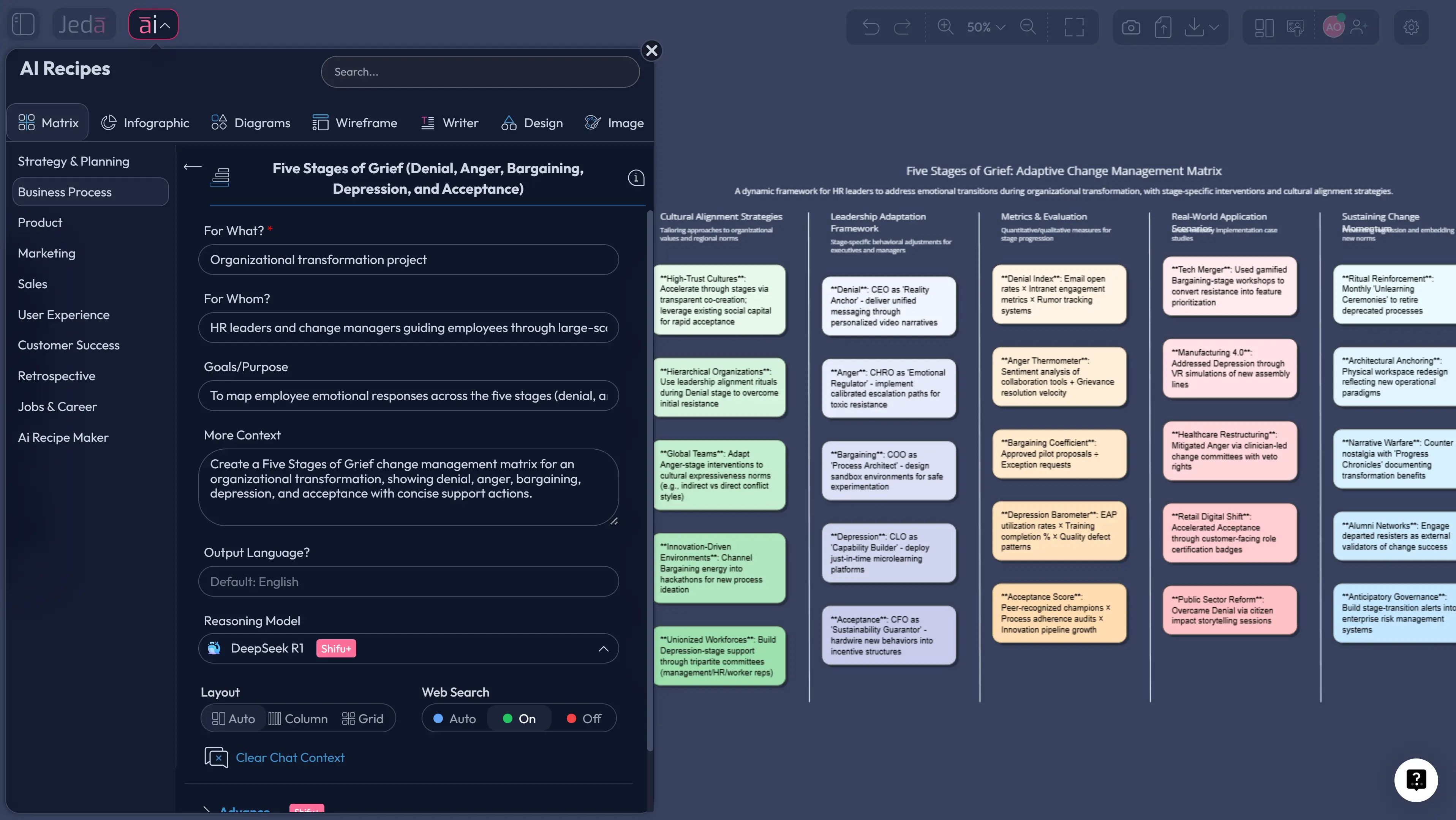
Five Stages of Grief with AI gives you a faster way to map the emotional side of change without flattening it into a sterile project update. When a team is dealing with a merger, restructuring, new software rollout, or leadership shift, the emotional pattern often matters as much as the task list. In Jeda.ai, you can turn that pattern into a practical AI Workspace your team can read, edit, discuss, and act on together. It’s a good example of Visual AI being useful instead of decorative. That’s one reason 150,000+ users turn to Jeda.ai as an AI Whiteboard for strategic thinking and execution.
The model comes from Elisabeth Kübler-Ross’s 1969 work On Death and Dying, where she described five common responses: denial, anger, bargaining, depression, and acceptance. Later, that framework was adapted into the Kübler-Ross Change Curve for organizational change. It still matters because it gives leaders a simple lens for reading resistance. But people do not move through the stages in a neat row, and the model works best as a discussion tool, not a rigid diagnosis.
If you want the broader product context, start with AI Workspace and AI Whiteboard. Both make this framework easier to operationalize across a real change program.
What is the Five Stages of Grief model in change management?
The Five Stages of Grief model, often adapted as the Kübler-Ross Change Curve, is a way to understand how people may emotionally respond to disruption. In change management, leaders use it to spot friction early, tailor communication, and reduce blind spots. It was not originally built as a workplace framework, though. It began as a model about responses to death and dying, then later evolved into a popular management tool.
The five stages are:
- Denial — “This won’t really affect us.”
- Anger — “Why are we doing this now?”
- Bargaining — “What if we keep part of the old process?”
- Depression — “This is exhausting.”
- Acceptance — “Alright. Let’s make it work.”
Real humans are messier than a five-box diagram. The Elisabeth Kübler-Ross Foundation notes that the stages are not fixed, linear, or mandatory. A person can loop back, skip one, or feel two at once. Recent scholarship makes the same point and argues that the curve is useful when treated as a relatable lens, but weaker when treated as a universal rule.
Why use Five Stages of Grief with AI instead of a static workshop board?
Because static templates are fine until the room gets complicated.
Someone says the team is “resistant.” Someone else says they “just need more training.” Meanwhile the real issue is emotional overload, poor communication, or fear of losing control. AI helps you get past that fuzzy middle and build a working picture faster.
Jeda.ai is useful here because it gives you an AI Workspace rather than a one-shot diagram. You can generate the matrix, edit each stage, add sticky notes, pull in context from documents, and keep working inside the same AI Whiteboard. And because Jeda.ai supports 300+ strategic frameworks, this model does not have to live alone. You can pair it with stakeholder mapping, a communication matrix, or a risk review on the same canvas.
- Read emotional signals faster
Turn vague resistance into named reactions your team can actually discuss.
- Keep nuance visible
Add examples, quotes, risks, and manager responses directly inside each stage.
- Expand with AI+
Use the AI+ button to deepen a stage after generation without rebuilding the whole board.
- Bring evidence in
Use document or data context to ground the board in real change signals.
- Collaborate in real time
Review the same board together, align faster, and keep one shared version of the truth.
- Convert the output
Use Vision Transform when you want to turn the matrix into a diagram or flowchart.
Five Stages of Grief with AI in Jeda.ai: when it works best
This framework works best when the change has emotional weight: layoffs, reorganizations, ERP rollouts, new compliance rules, post-merger integration, or a sharp shift in leadership direction. Prosci makes a similar point: the change curve can help leaders anticipate emotional reactions, but it is not a full methodology by itself. Use it as a lens, then pair it with communication, sponsorship, coaching, and training.
A good Jeda.ai board usually includes more than the five stage labels. Add the trigger event, representative employee comments, probable risks, leader response, communication priority, and the signal that tells you the team is moving forward. Now the board starts doing real work.
How to create Five Stages of Grief with AI in Jeda.ai
Method 1: Recipe Matrix
This is the recommended path when you want a clean first draft quickly.
Start from the AI Menu, choose the relevant Matrix recipe, and describe the change scenario in plain language. Keep it concrete: what is changing, who is affected, what tension exists, and what you want the board to help the team understand. Jeda.ai will generate a structured matrix you can edit immediately inside the AI Workspace.
- Open the AI Menu
From the top-left of Jeda.ai, open the AI Menu and choose the Matrix recipe called the Five Stages of Grief.
- Define the change event
Describe the real change scenario such as a merger, system rollout, restructure, or leadership transition.
- Generate the five-stage matrix
Create a board with denial, anger, bargaining, depression, and acceptance as the core structure.
- Edit each stage with team context
Add real employee reactions, risks, communication needs, and manager responses to each stage.
- Deepen and convert the output
Use the AI+ button to extend the board, then use Vision Transform if you want a diagram or flowchart version.
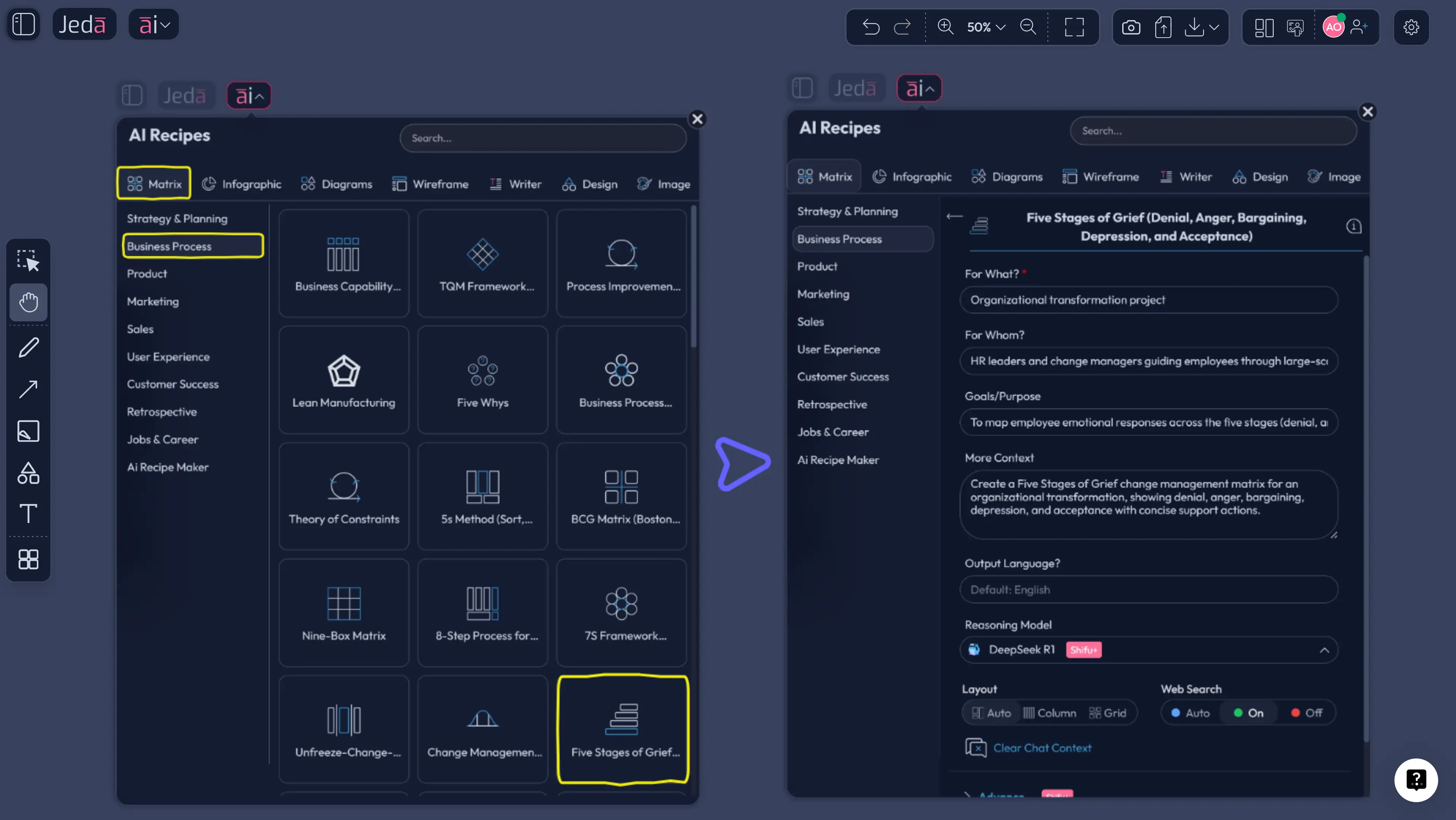
A strong starter prompt is:
Create a Five Stages of Grief change management matrix for a company rolling out a new ERP system across finance, operations, and procurement. Show likely employee reactions, common manager mistakes, and the best support response at each stage.
After the board appears, edit it like a human. AI gives you the scaffolding; you add the truth. Put in the phrases people are actually using. That’s where the board stops sounding corporate and starts sounding accurate.
Method 2: Prompt Bar
If you want tighter control, use the Prompt Bar at the bottom of the canvas. Select the Matrix command, type your prompt, and press Enter.
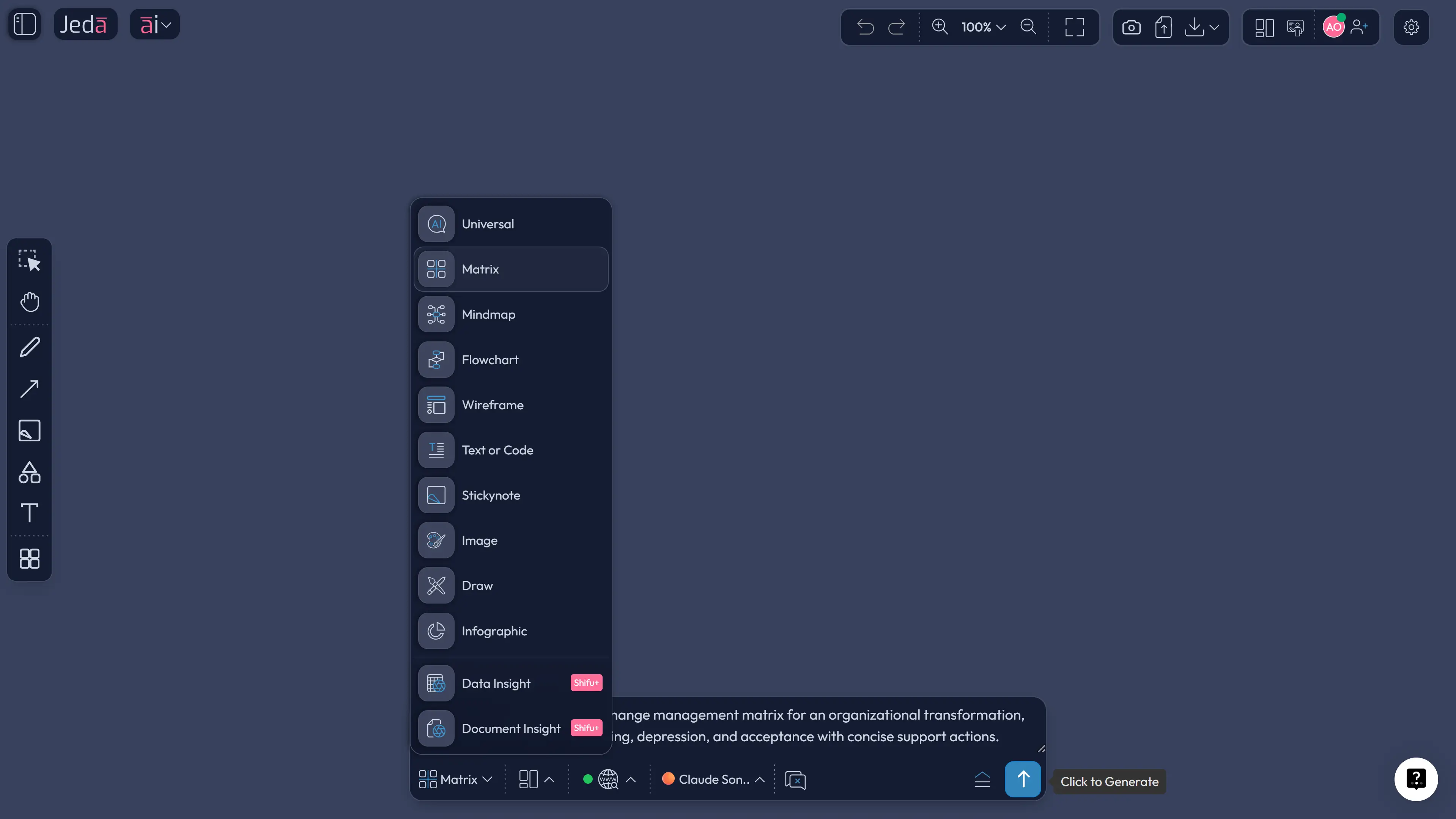
For example:
Build a Five Stages of Grief matrix for a post-merger team integration. For each stage, include employee mindset, manager response, communication goal, and risk if mishandled.
Once generated, use AI+ to extend the matrix into a deeper view of the same board. Then use Vision Transform if you want a diagram for presentation.
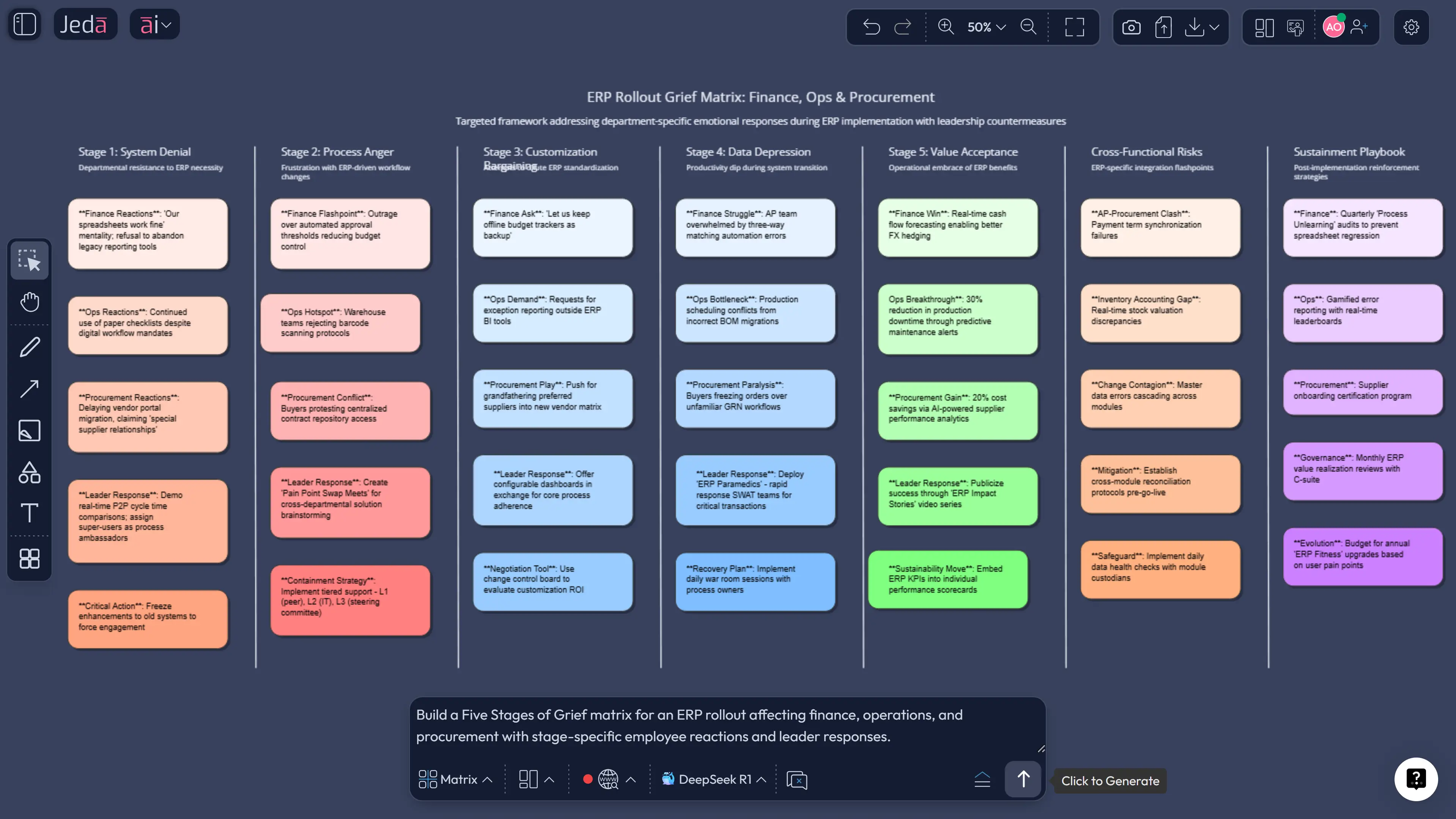
Five Stages of Grief with AI template example
Say a mid-sized company is replacing a patchwork of spreadsheets with a single ERP. Leadership thinks the problem is training. Employees think the problem is workload, control, and the suspicion that “standardization” really means “surveillance.”
A useful Jeda.ai matrix might look like this:
- Denial: “The rollout date will slip anyway.”
Leader move: Explain what is changing, what is not, and why timing is real. - Anger: “This was decided without the people doing the work.”
Leader move: Acknowledge friction directly and show where feedback still matters. - Bargaining: “Can our team keep the old approval path for one quarter?”
Leader move: Separate valid transitional needs from delay tactics. - Depression: “Everything is slower now.”
Leader move: Reduce load, add support, and celebrate early competence. - Acceptance: “Okay, we can work with this.”
Leader move: Shift from reassurance to capability-building and ownership.
Best practices for using this model well
Treat the stages as signals, not verdicts. You’re reading a pattern, not diagnosing a person.
Tie every stage to observable evidence. Pull in survey comments, workshop notes, interview snippets, or policy reactions. Jeda.ai is strongest when the visual is grounded in something real.
Pair the model with another framework when the stakes are high. The emotional map tells you where people are. It does not tell you everything you must do next.
And keep the board editable. That’s the whole point of using an AI Whiteboard instead of a dead document.
Common mistakes to avoid
The first mistake is pretending the stages are linear. They aren’t. People bounce around, overlap, stall, and surprise you. The foundation and recent scholarship both warn against treating the change curve like a universal sequence.
The second mistake is using the model as the whole change plan. It isn’t. Even Prosci, which teaches the curve, says it does not replace a full change methodology.
Third: making the board too generic. If every stage says “communicate more,” you built wallpaper, not a tool.
Fourth: forgetting the finish line. Acceptance is not passive agreement. In the workplace, acceptance should look like participation, confidence, and changed behavior.
Frequently asked questions
- What are the five stages of grief in change management?
- They are denial, anger, bargaining, depression, and acceptance. In workplace change, these stages are used as a lens for understanding emotional reactions to disruption, not as a strict rule every employee will follow in the same order.
- Who created the Five Stages of Grief model?
- Elisabeth Kübler-Ross introduced the model in 1969 in On Death and Dying. It originally described responses to death and dying, then later evolved into the Kübler-Ross Change Curve used in organizational change discussions.
- Does everyone go through the stages in order?
- No. Authoritative sources on the model stress that the stages are not fixed or linear. People may skip stages, feel several at once, or move back and forth depending on the type of loss or change.
- Is the Five Stages of Grief model enough for change management?
- No. It is useful for reading emotional responses, but it does not replace a full change approach. You still need communication planning, sponsorship, coaching, training, and reinforcement to move a change successfully.
- How does AI help with the Five Stages of Grief model?
- AI helps you generate the first structure fast, surface likely reactions, and organize supporting notes inside a shared visual board. In Jeda.ai, you can then edit the output, deepen it with AI+, and convert it into other visual formats.
- What is the best Jeda.ai command for this framework?
- Matrix is the best starting command because the Five Stages of Grief model is easiest to read as a structured framework. After that, Vision Transform can turn the board into a diagram if you need a different visual style.
- Can I use this model for mergers, layoffs, or system rollouts?
- Yes. The model is most helpful when a change carries emotional weight, such as reorganizations, layoffs, mergers, or major system implementations. It gives leaders a practical way to anticipate resistance and shape better responses.
- Can I export the board after I build it?
- Yes. Jeda.ai supports export to PNG, SVG, and PDF. That makes it easy to use the board in workshops, internal documentation, or leadership reviews without rebuilding the visual somewhere else.
Sources & Further Reading
- [1]
Kübler-Ross, Elisabeth (1969 / anniversary edition) . “On Death and Dying” Simon & Schuster.
View Source ↗ - [2]
Elisabeth Kübler-Ross Foundation (2026) . “Kübler-Ross Change Curve®” EKR Foundation.
View Source ↗ - [3]
Prosci (2024) . “Applying the Kübler-Ross Change Curve to Change Management” Prosci Blog.
View Source ↗ - [4]
Holdsworth, Logan and Bridgman, Todd (2024) . “From coping with dying to coping with organizational change: the bricolage of the change curve’s evolution” Journal of Organizational Change Management.
View Source ↗ - [5]
Shoolin, John S. (2010) . “Change Management – Recommendations for Successful Electronic Medical Records Implementation” Proceedings in Obstetrics and Gynecology / PMC.
View Source ↗
Start Your Five Stages of Grief with AI Board Today
Join over 150,000+ users who use Jeda.ai to turn emotional change into editable, decision-ready visuals inside one AI Workspace.
Try Free Template