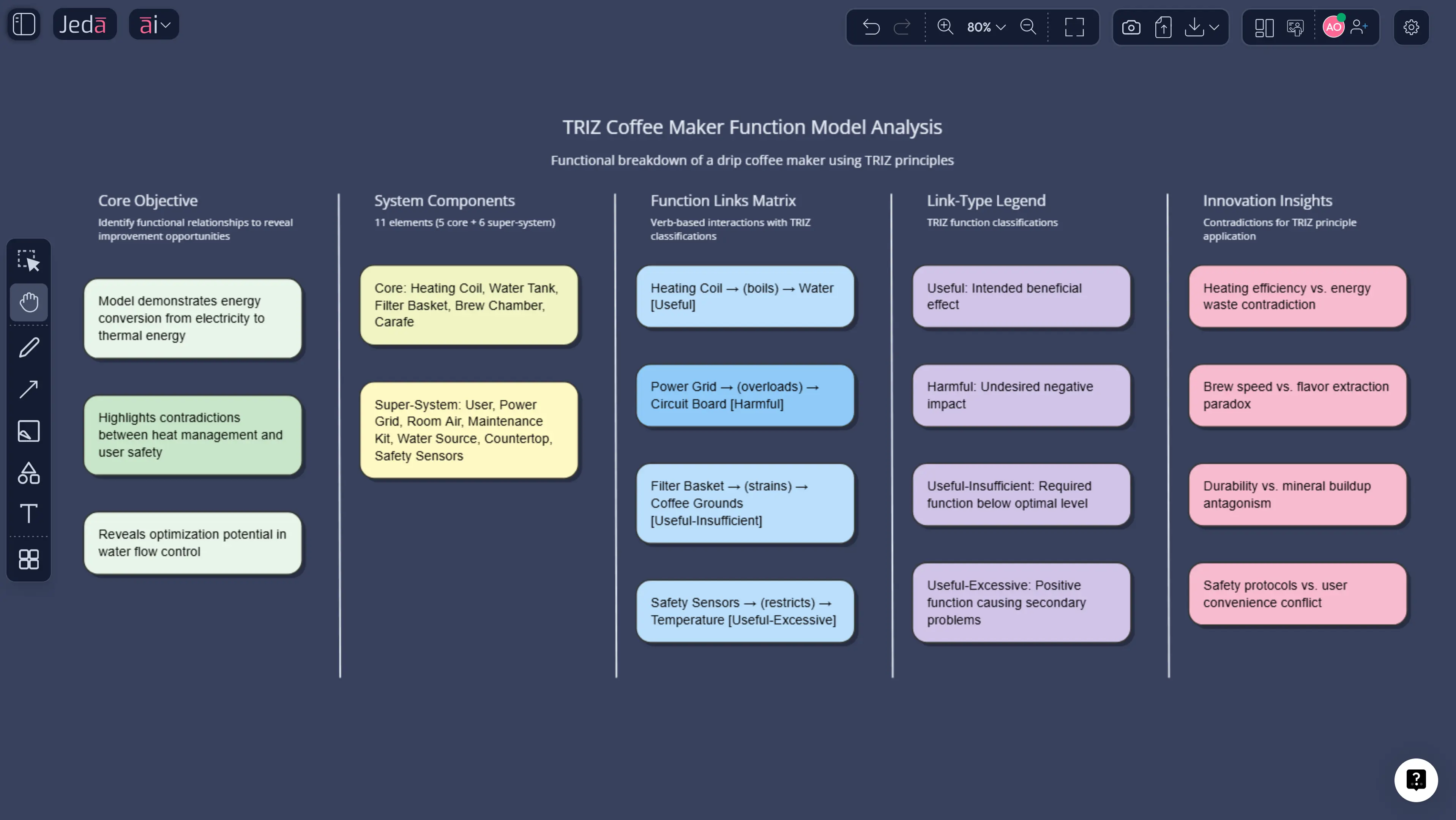
TRIZ function analysis is a disciplined way to understand what the system does, not what the system is called. It builds a function model that explicitly marks useful, harmful, insufficient, and excessive interactions. Several TRIZ training materials describe these interaction categories as fundamental to functional modeling.
An AI Workspace helps you do the part that normally drains energy: drafting clean diagrams, normalizing terminology, and keeping evidence and assumptions attached to each function.
What is TRIZ function analysis?
TRIZ function analysis (functional modeling) represents a system as:
- elements (components, actors, environment),
- connected by functions (verbs) such as “supports,” “heats,” “seals,” “transmits,”
- and each function classified by its effect: useful, harmful, insufficient, or excessive.
This classification is not cosmetic. It makes problem regions visible:
- harmful links become “remove/redirect” targets,
- insufficient useful links become “strengthen” targets,
- excessive useful links become “control/limit” targets.
Why TRIZ function analysis is a gateway tool
Function models frequently serve as inputs to other TRIZ steps:
- contradiction definition (what you improve vs what worsens),
- ideality reasoning (maximize useful, minimize harmful/cost),
- trimming and resource-based redesign.
A TRIZ paper on functional modeling explicitly discusses how useful/harmful functions connect to ideality reasoning.
Why use AI for function analysis?
Function analysis fails in teams for a boring reason: it’s tedious.
- People argue about verbs (“supports” vs “stabilizes”).
- Diagrams get messy.
- Evidence and assumptions disappear.
- The model becomes a poster, not a tool.
AI helps by:
- converting notes/specs into consistent function statements,
- proposing a first-pass function diagram,
- highlighting likely harmful/insufficient links,
- generating candidate improvement directions aligned to the model.
The human job remains: validate physics, boundaries, and priorities.
Function model anatomy (academic view)
A practical TRIZ function model usually includes:
- Core system elements
- Super-system elements (environment, user, adjacent systems)
- Function links (Tool → Product style interactions)
- Function category (useful/harmful/insufficient/excessive)
Some communities use line styles or symbols to denote categories; consistency is more important than the specific symbol set.
How to run Function Analysis with AI in Jeda.ai (step-by-step)
Method 1: AI Menu template (recommended)
- Open AI Menu → TRIZ / System Analysis.
- Choose Function Analysis .
- Paste your system description + constraints.
- Generate a draft function model.
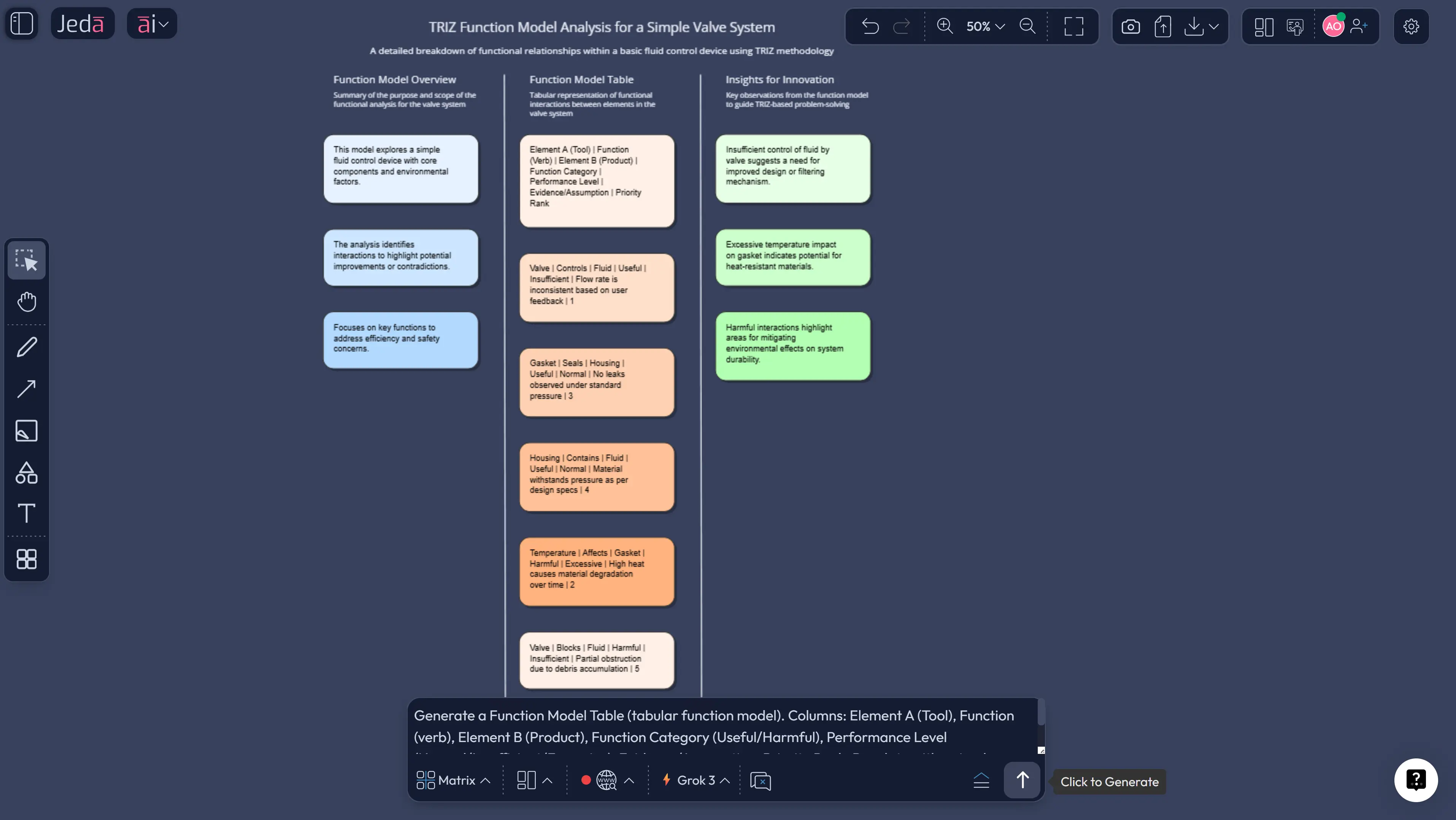
Method 2: Prompt Bar (more control)
- Choose Matrix in the Prompt Bar.
- Paste the prompt template below.
- (Optional) Multi‑LLM to compare alternative decompositions.
- Generate and edit on canvas.
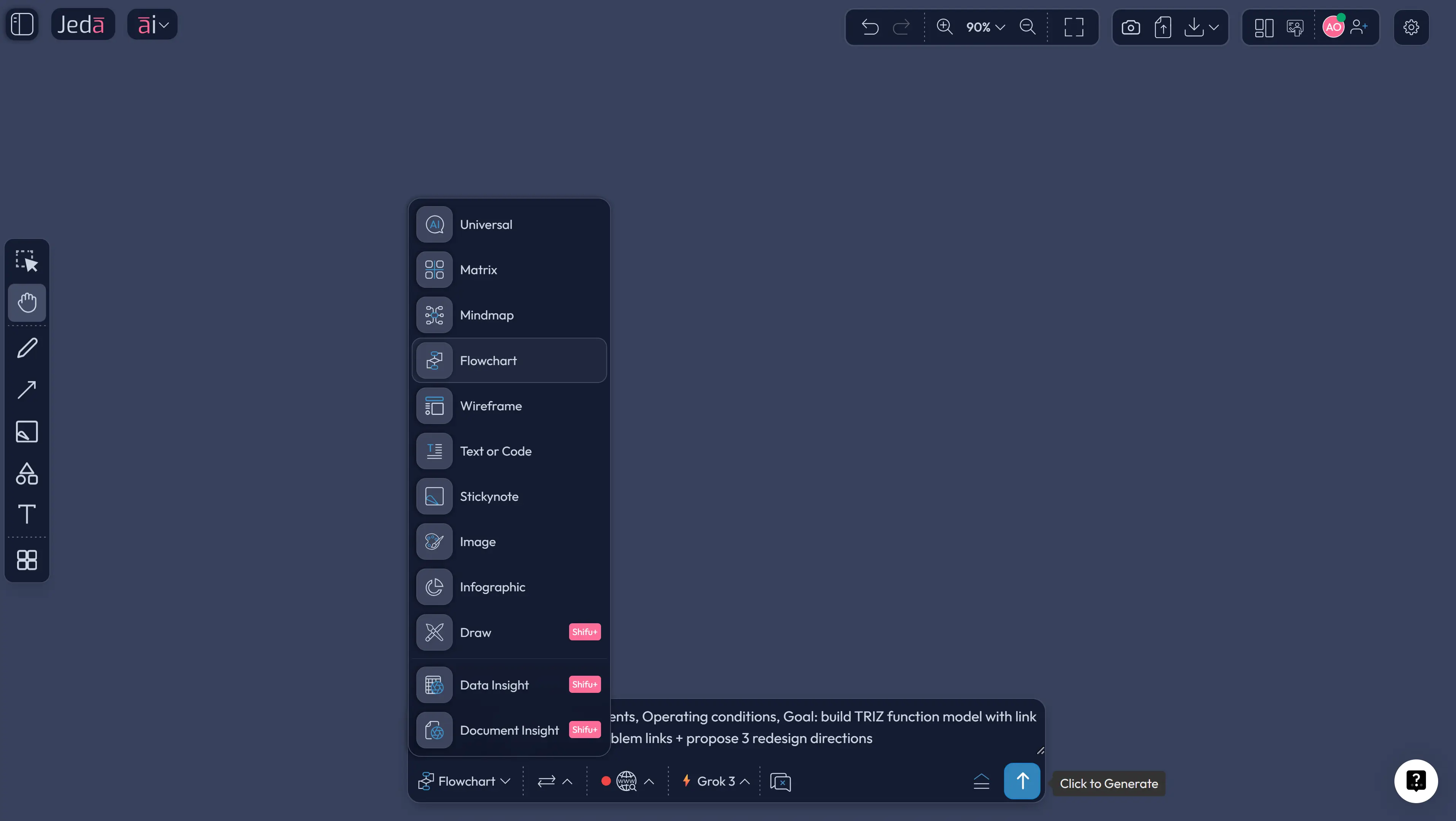
Prompt template (copy/paste):
- System: [name and purpose]
- Scope boundary: [what is inside vs outside]
- Elements: [list known components + environment actors]
- Operating conditions: [load, temperature, frequency, usage]
- Goal: Build a TRIZ function model matrix. Use verb-based links and classify each function as useful, harmful, insufficient, or excessive. Identify top 5 problem links and propose 3 redesign directions.
- Define scope
Lock the boundary: what is inside the system, what is super‑system. Avoid infinite decomposition.
- List elements
Include components + environment + user interactions relevant to the problem.
- Draft functions
Use verb links (supports, seals, transmits). Let AI draft first; you validate.
- Classify links
Mark each as useful/harmful/insufficient/excessive. Add evidence notes.
- Prioritize targets
Pick the top harmful and insufficient links that explain the undesired effect.
- Generate redesign directions
Ask AI for 3–5 directions tied to specific links (not generic ideas).
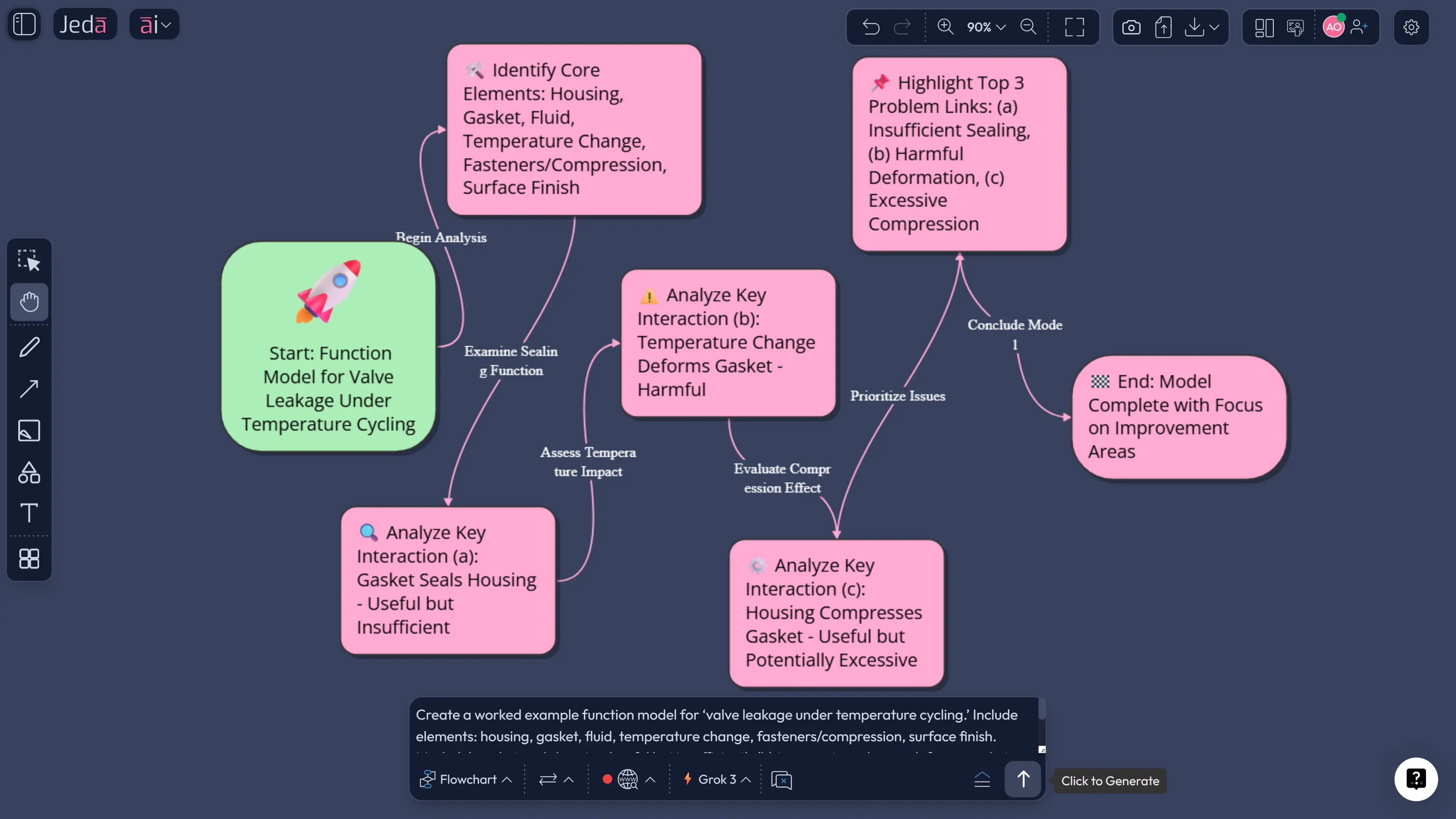
Worked micro-example: valve leakage under temperature cycling
Undesired effect: leakage increases after thermal cycling.
Function model focus:
- seal (gasket) → prevents leakage (useful but insufficient)
- temperature change → deforms gasket (harmful)
- housing → compresses gasket (useful but possibly excessive)
Once the harmful link is explicit, improvement directions become clearer:
- change compression distribution (control excessive),
- introduce a compensating element (strengthen insufficient),
- redesign contact surface interaction (reduce harm).
The function model becomes a map from symptom → interaction → redesign direction.
Common mistakes (and how to avoid them)
Mistake: using nouns instead of verbs (“gasket → leak”).
Fix: force verb links (“gasket seals housing”).Mistake: modeling too deep too early.
Fix: stop when you can explain the undesired effect.Mistake: not attaching evidence.
Fix: add a note per critical link: test data, observation, or assumption.Mistake: treating the diagram as the deliverable.
Fix: the deliverable is the shortlist of redesign targets and experiments.
FAQ
- What is TRIZ function analysis?
- TRIZ function analysis models a system as elements connected by functions, classified as useful, harmful, insufficient, or excessive. It helps identify where the system creates harm or fails to deliver a useful function strongly enough.
- What are the four function categories in TRIZ functional modeling?
- Common TRIZ functional modeling categories are useful, harmful, useful but insufficient, and useful but excessive. Teams use these categories to prioritize which interactions to eliminate, strengthen, or control.
- How does function analysis relate to ideality?
- TRIZ ideality reasoning emphasizes increasing useful functions while reducing harmful functions and costs. Function analysis makes useful and harmful functions explicit, which supports ideality-driven redesign.
- How can AI help with TRIZ function analysis?
- AI can draft consistent function statements, generate a first-pass function diagram, and propose improvement directions tied to specific harmful or insufficient links. Engineers validate the model and feasibility.
Citations
- [1]
J. Todhunter (n.d.) . “Function Modeling for the Rest of Us” AITRIZ (PDF).
View Source ↗ - [2]
Matriz TRIZ Wiki (2025) . “Function model” Matriz TRIZ Wiki.
View Source ↗ - [3]
O. O. J. et al. (n.d.) . “A method of system model improvement using TRIZ function (paper)” PDF.
View Source ↗ - [4]
P. R. Apte (IIT Bombay) (n.d.) . “Introduction to TRIZ – Innovative Problem Solving” IIT Bombay (course page).
View Source ↗