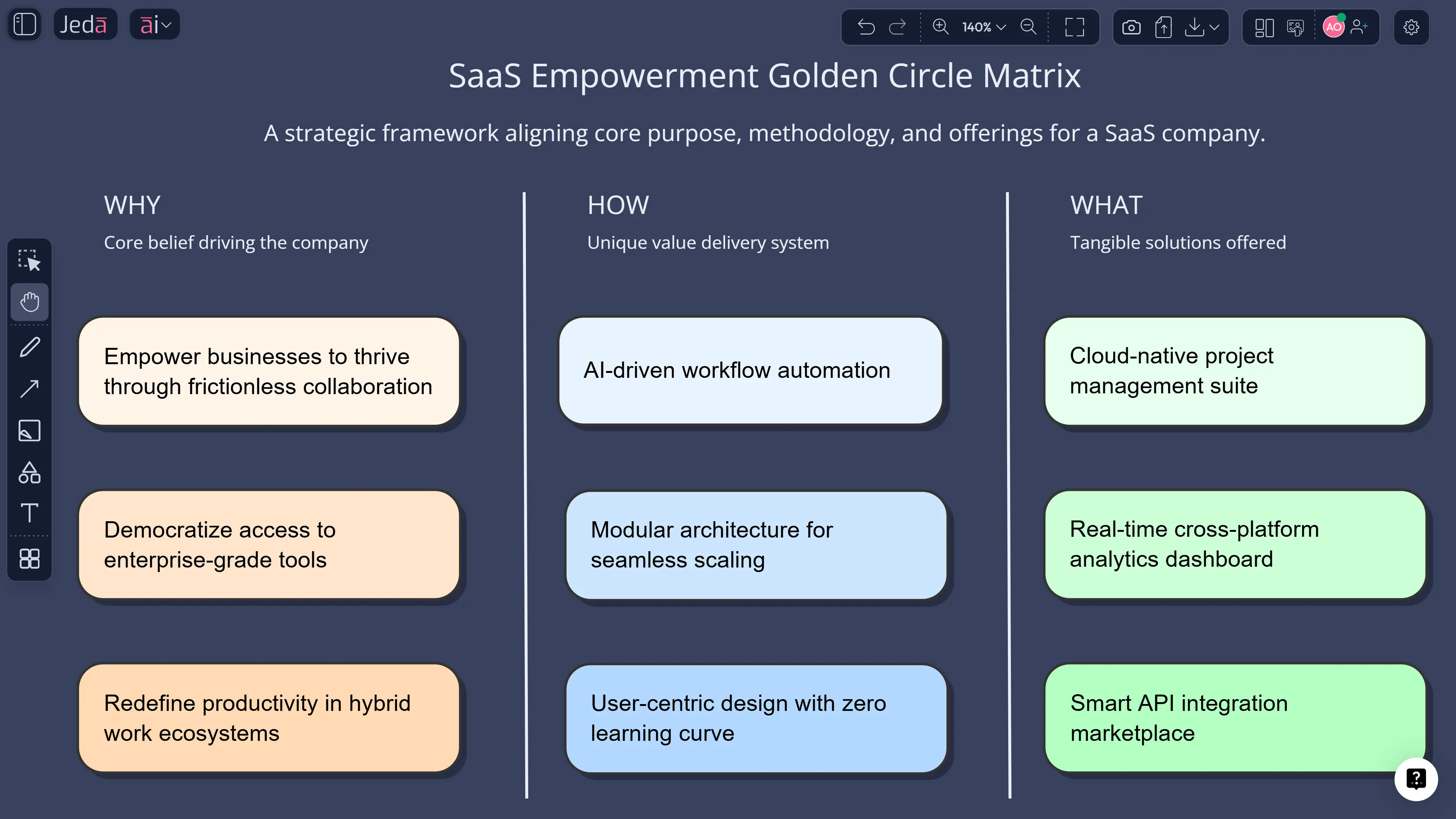
The Golden Circle model with AI is simple on paper and hard in real life: start with WHY, then explain HOW, then describe WHAT. Simon Sinek popularized the model in his 2009 talk “How great leaders inspire action” and in the book Start With Why (2009).
This page takes an academic view. It defines the model, clarifies common misuses, and shows how to build a Golden Circle board in an AI Workspace and AI Whiteboard. The goal is not motivational posters. The goal is clear reasoning that connects purpose to strategy, and strategy to execution.
Jeda.ai is used by 150,000+ users to build editable visuals and decision boards. That matters for Golden Circle work because the “WHY” gets tested in public: by customers, by talent, and by the numbers.
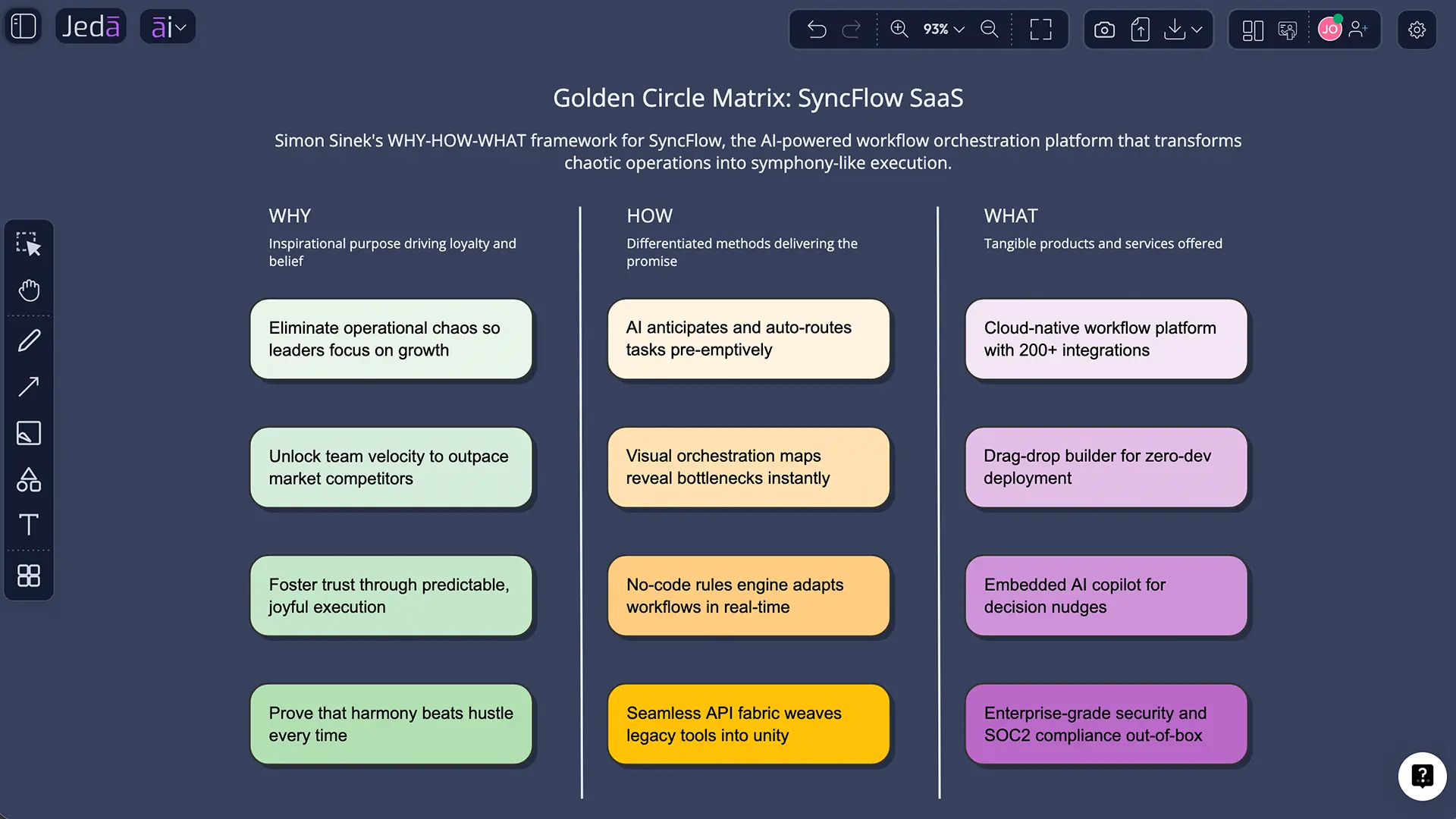
What is the Golden Circle model
The Golden Circle is a communication and leadership model with three layers:
- WHY: purpose, cause, belief
- HOW: principles, methods, differentiated approach
- WHAT: products, services, actions
Sinek’s claim is not that “WHY” replaces execution. It is that clarity of purpose changes how people interpret what you do, which affects trust, loyalty, and behavior.
One note, because teams get tangled here: people sometimes list the layers as “Why, What, How” because it sounds like a storyline. The original Golden Circle framing is “Why, How, What.” Keep WHY first either way. That is the only part that really matters.
Why use the Golden Circle model with AI
Golden Circle work fails for two boring reasons:
- Teams write vague WHY statements.
- Teams cannot connect WHY to measurable choices.
AI helps by forcing specificity. It can:
- Draft multiple WHY statements from stakeholder notes, then rank them by clarity.
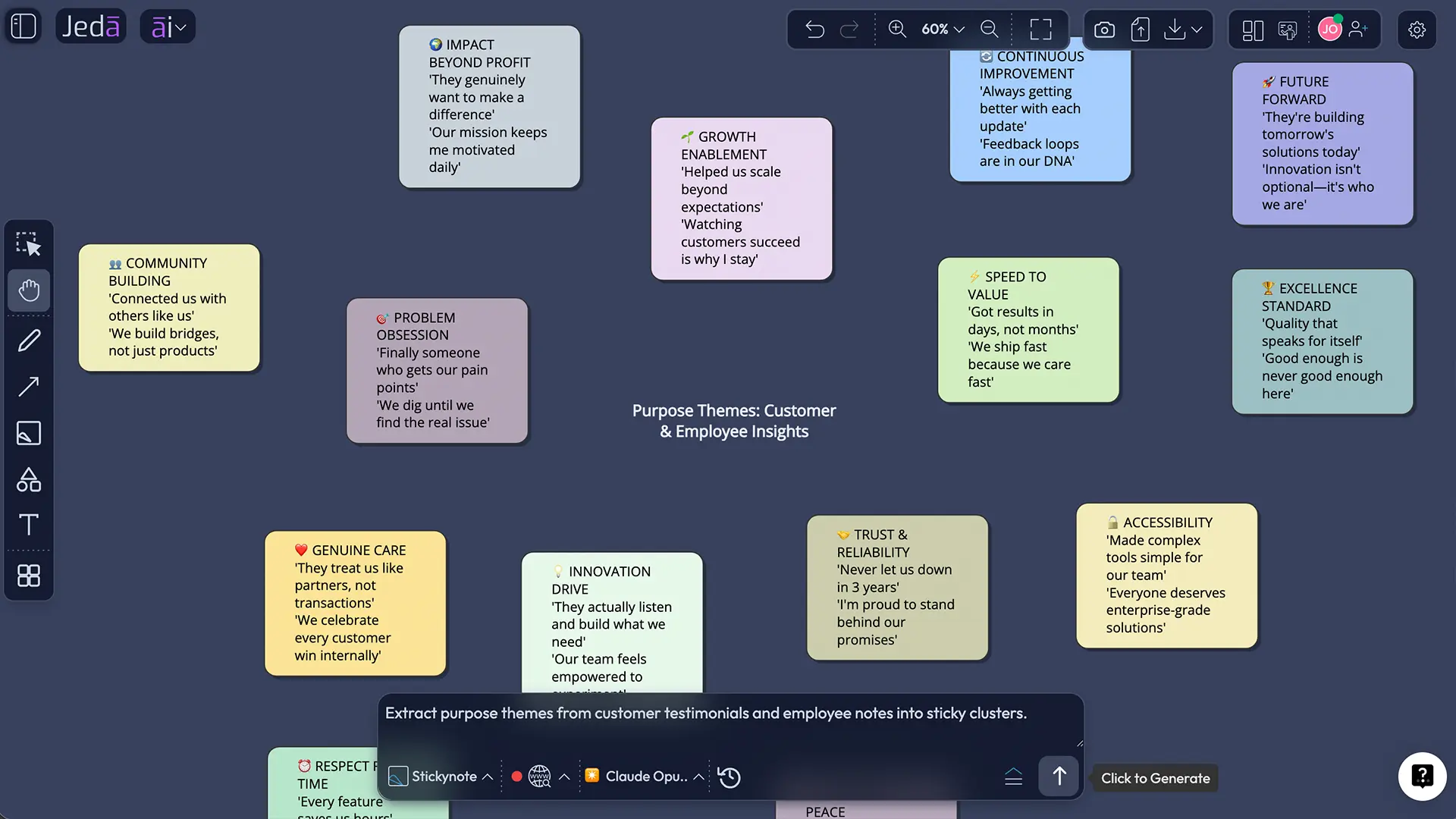
- Extract repeated beliefs from customer feedback and employee narratives.
- Map WHY into testable HOW principles (what you will do, and what you will refuse to do).
- Translate HOW into WHAT choices: product bets, messaging, hiring criteria, channel focus.
There is also empirical work on corporate purpose. For example, research on employee perceptions of purpose has been linked to future performance associations in large samples, though it does not magically prove causality for every firm.
- WHY statements that are not fluff
AI drafts 5–7 candidate WHY statements from real inputs, then rewrites them into plain language that can be challenged.
- HOW principles that guide trade-offs
AI turns a WHY into a set of operating principles and a “we will not” list, which reduces strategy drift.
- WHAT choices you can measure
AI maps principles into measurable bets: target segment, pricing posture, channel, onboarding, and product focus.
How to create the Golden Circle model with AI in Jeda.ai
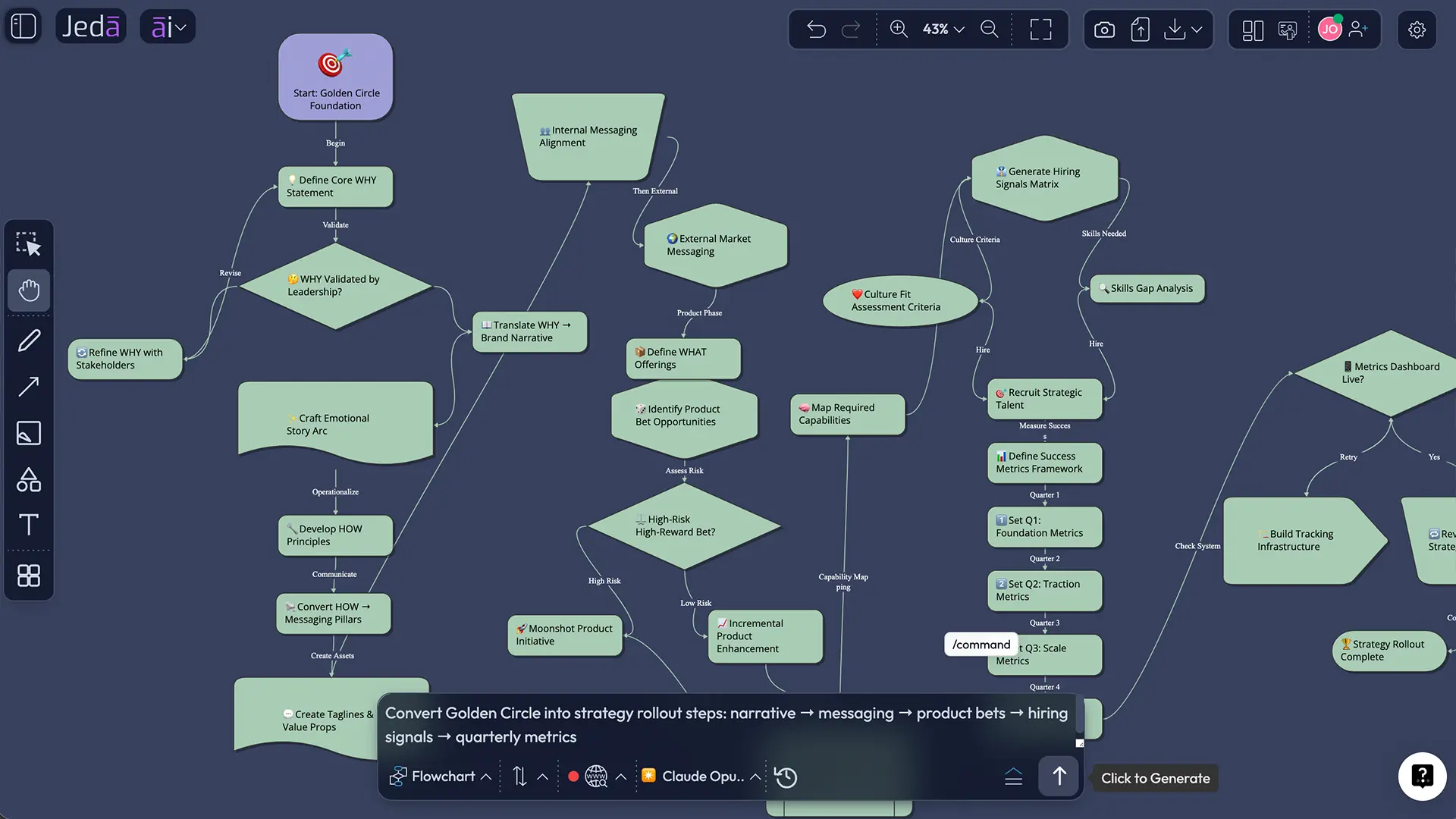
You can build a Golden Circle board in Jeda.ai using the Prompt Bar. Use Matrix for structured statements, and Diagram for the circle layout. If you have supporting docs, you can also use Document Insight to extract themes, then convert them into a Golden Circle.
- Collect source material
Bring in strategy notes, customer interviews, CEO memos, brand decks, and key product reviews. Keep it raw.
- Draft a candidate WHY set
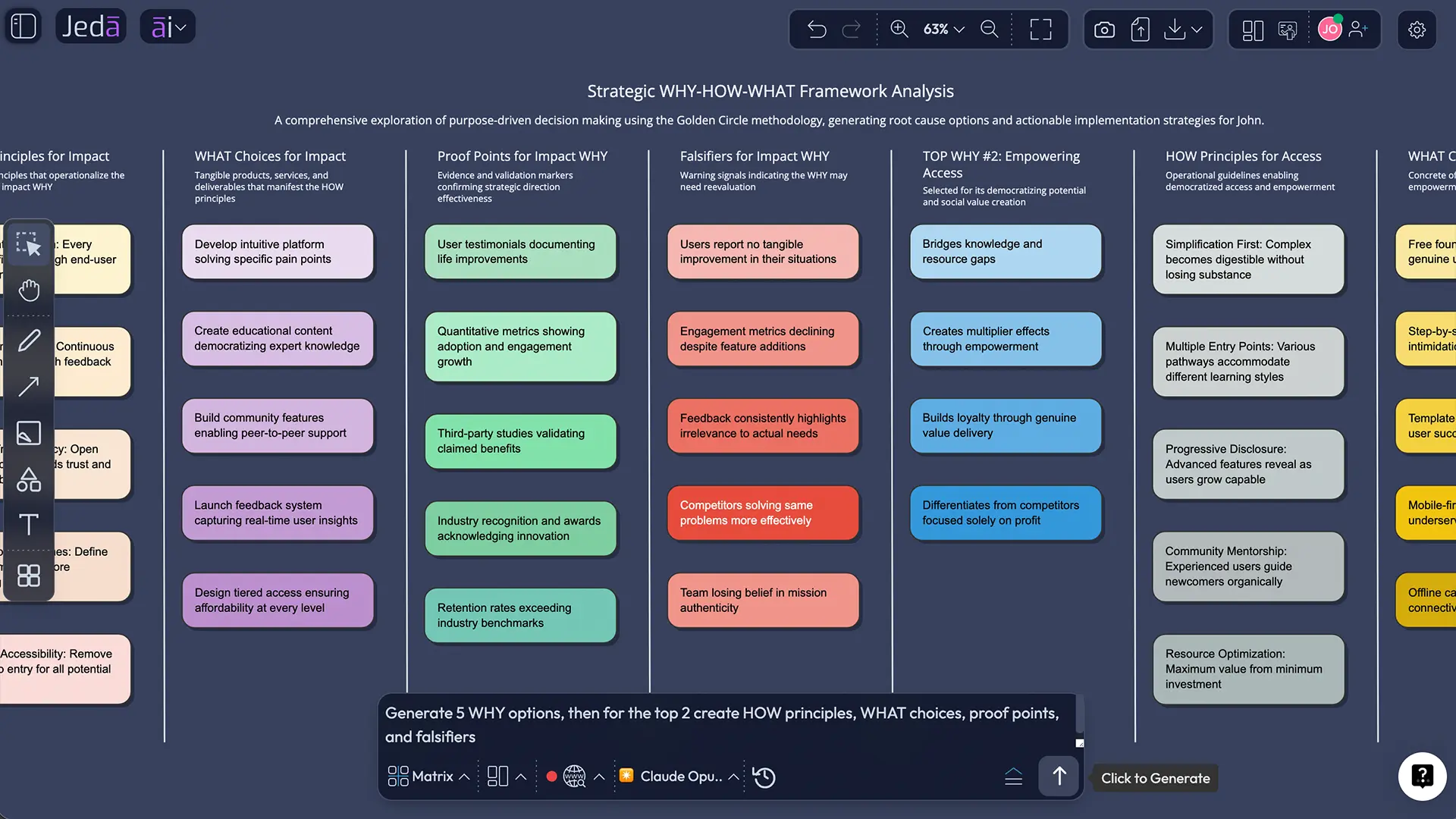
In Jeda.ai, select the Matrix command. Ask AI to draft 5–7 WHY statements. Require each to be short and specific.
- Define HOW principles
For the best 2 WHY options, ask AI to derive 4–6 HOW principles plus a clear “we will not” list.
- Translate into WHAT choices
Ask AI to list concrete WHAT choices: product bets, pricing stance, customer segment, channels, and proof points.
- Create the Golden Circle Model
Ask AI to generate the Golden Circle Model to convert the statements into a grid layout that shows WHY, HOW, WHAT as nested layers.
- Extend and stress-test
Tap the AI+ button on the WHY section to dive deep. If the WHY cannot be tested, rewrite it.
Prompt you can copy
Select the Matrix command:
Build a Golden Circle for: [organization or product].
Inputs: [paste notes or summarize].
Output: 5 candidate WHY statements (short, specific), then for the top 2: HOW principles (4–6), WHAT choices (6–10), proof points, and what would falsify the WHY.
Example: a cybersecurity SaaS
A weak WHY: “We help businesses stay safe.”
A stronger WHY: “We believe security should reduce anxiety, not create it.”
Now HOW principles might be:
- Default-safe configurations
- Transparent risk explanations
- Minimal alert noise
- Audit-ready reporting
And WHAT choices follow:
- Product focus on posture management
- Pricing aligned to asset count, not feature gating
- Messaging that emphasizes calm clarity, not fear
This is how the model becomes strategic.
Common mistakes in Golden Circle work
- Confusing WHY with values. Values guide behavior. WHY explains belief and purpose.
- Writing a WHY that cannot be falsified. If every outcome confirms it, it proves nothing.
- Skipping HOW. Without principles, WHY turns into a vibe and WHAT becomes random.
- Treating the model as brand-only. Golden Circle is a strategy constraint, not just a tagline generator.
- Never revisiting it. Purpose statements drift if they are not tested against actual decisions.
Frequently Asked Questions
- What is the Golden Circle model with AI?
- The Golden Circle model with AI uses AI to draft, refine, and stress-test WHY, HOW, and WHAT statements from real inputs such as strategy notes and customer evidence. The result is a structured narrative and decision guide that links purpose to principles and measurable actions.
- Who created the Golden Circle model?
- Simon Sinek popularized the Golden Circle model, including the WHY–HOW–WHAT structure, in a 2009 talk and the book Start With Why (2009).
- Is the order Why, How, What or Why, What, How?
- The common framing is Why, How, What. Some teams use Why, What, How as a storytelling order, but the key idea is to lead with Why and ensure How principles connect purpose to what you actually do.
- How do I know if my WHY is strong?
- A strong WHY is specific, short, and constrains choices. It should imply what you will prioritize and what you will avoid. If your WHY sounds like it fits every company, it needs revision.
- Does purpose actually affect performance?
- Research on corporate purpose often finds associations between employee-perceived purpose and future performance measures in large samples. Results vary by context, and purpose alone does not replace execution or strategy discipline.
- Can Jeda.ai export a Golden Circle board?
- Yes. Jeda.ai exports boards as PNG, SVG, or PDF. Export the diagram to share with stakeholders or include in documentation.
- How is Jeda.ai useful for this work?
- Golden Circle work improves when it is collaborative and editable. Jeda.ai provides an AI Workspace and AI Whiteboard to draft multiple versions, compare them, and keep proof points connected to the final narrative.
- What should I do after the Golden Circle is done?
- Translate HOW principles into operating rules, then map WHAT choices into a roadmap and messaging plan. Use the AI+ button to generate testable proof signals and convert the board into planning visuals.
Sources and further reading
- [1]
Sinek, Simon (2009) . “How great leaders inspire action” TED (embed).
View Source ↗ - [2]
Sinek, Simon (2009) . “Start With Why” SimonSinek.com.
View Source ↗ - [3]
Sinek, Simon (2009) . “The Golden Circle” SimonSinek.com.
View Source ↗
Build Your Golden Circle in an AI Workspace
Join over 150,000 professionals who use Jeda.ai to turn strategy narratives into editable visuals and aligned decisions.
Try Free Template