Strategic planning suffers from a persistent terminological confusion. Goals are conflated with objectives. Strategies are mistaken for tactics. And the resulting ambiguity — as Rich Horwath, founder of the Strategic Thinking Institute, has argued since introducing the GOST framework in 2009 — is not merely semantic. It is structural. When organizations cannot distinguish between what they are trying to achieve and how they intend to achieve it, execution breaks down systematically.
The GOST framework — Goals, Objectives, Strategies, and Tactics — provides a hierarchical model that resolves this confusion by establishing clear categorical boundaries between outcomes and activities, between direction and action. Its adoption has accelerated across corporate strategy, nonprofit management, and academic program administration, with institutions including Kent State University incorporating it into their Office of Strategy Management methodology.
This resource examines the GOST framework's theoretical foundations, its application across organizational contexts, and how AI-powered visual tools — specifically Jeda.ai's AI Workspace, used by 150,000+ professionals — enable teams to generate, iterate, and align GOST structures with unprecedented efficiency.
What Is the GOST Framework?
The GOST framework is a strategic planning model that decomposes organizational intent into four hierarchically ordered components:
Goals represent the broadest desired outcomes an organization seeks to achieve. They are qualitative, long-term, and directional. A goal articulates an aspirational end state — for example, "Become the market leader in sustainable packaging solutions." Goals belong to the "what" category within the framework: they define the destination without prescribing the route.
Objectives operationalize goals by introducing specificity and measurability. Where a goal describes direction, an objective quantifies progress. Following the example above: "Increase market share from 12% to 25% within 36 months." Objectives must be time-bound and verifiable, providing the criteria by which goal attainment is assessed.
Strategies constitute the high-level approaches an organization will pursue to achieve its objectives. They address the "how" at a macro level — the general pathways rather than specific tasks. A corresponding strategy might be: "Develop proprietary biodegradable material technology and secure exclusive distribution agreements with top-tier retailers."
Tactics are the specific, assignable actions that execute a strategy. They represent the most granular level of the framework — individual tasks with clear ownership, timelines, and deliverables. For the strategy above: "File patent application for bio-polymer compound by Q2; negotiate pilot program with Target's packaging division by Q3."
Horwath (2009) emphasized a critical distinction within the GOST model: the separation between outcomes (Goals, Objectives) and activities (Strategies, Tactics). This binary is the framework's core contribution to strategic thinking. When organizations blur these categories — describing an activity as a goal, or treating a strategy as an objective — planning loses its directional clarity.
Theoretical Context and Comparative Analysis
The GOST framework did not emerge in isolation. It builds upon and responds to several established strategic planning methodologies.
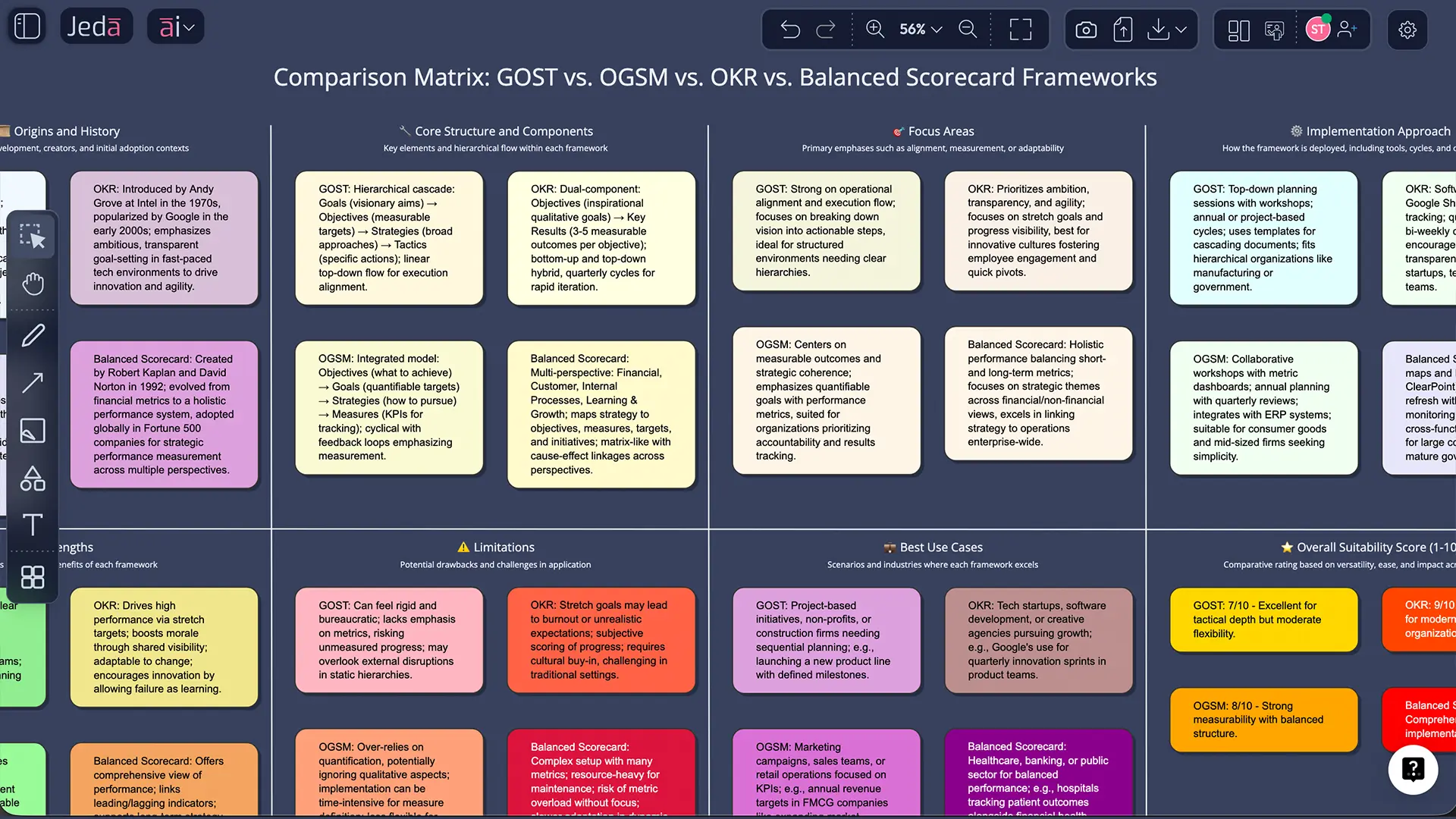
OGSM (Objectives, Goals, Strategies, Measures) is the closest analogue. However, as Horwath and subsequent practitioners have noted, OGSM conflates the distinction between strategies and tactics by omitting an explicit tactical layer. The GOST model's separation of strategies from tactics provides greater operational clarity — particularly valuable in large organizations where strategic decisions occur at the executive level while tactical execution is distributed across functional teams.
OKR (Objectives and Key Results), popularized by John Doerr's work at Intel and later Google (Doerr, 2018), shares GOST's emphasis on measurable outcomes but operates at a narrower scope. OKRs focus on quarterly alignment cycles and typically do not address the broader strategic and tactical layers that GOST encompasses. The two frameworks are complementary rather than competing: OKRs can function as the objective-setting mechanism within a broader GOST architecture.
Balanced Scorecard (Kaplan & Norton, 1992) provides a multi-dimensional measurement framework across financial, customer, internal process, and learning perspectives. While it excels at performance measurement, it offers less guidance on the hierarchical decomposition of intent into action — the specific contribution of the GOST model.
Peter Drucker's management by objectives (MBO) concept, articulated in The Practice of Management (1954), established the foundational principle that organizational effectiveness requires explicit, measurable goals cascaded throughout the organization. The GOST framework can be understood as a structural refinement of Drucker's principle, adding the strategic and tactical layers that MBO left implicit.
Why Apply AI to the GOST Framework?
The GOST framework's hierarchical structure presents both its strength and its primary implementation challenge. While the model provides conceptual clarity, the practical work of cascading goals through objectives, strategies, and tactics across an organization involves substantial complexity — particularly in multi-division enterprises where each business unit maintains its own GOST hierarchy that must align with corporate-level direction.
AI-powered visual tools address this complexity through three mechanisms:
Structural generation. Jeda.ai's AI Workspace generates complete GOST hierarchies from natural language descriptions, reducing the initial framework development from days of facilitated workshops to minutes of prompted generation. This is not a replacement for strategic thinking — it is an acceleration of structural articulation.
Cascading alignment. When a corporate goal changes, every downstream objective, strategy, and tactic potentially requires adjustment. AI can model these cascading effects visually, showing precisely which elements require revision. Amazon's multi-layered GOST implementation — from corporate goals cascading to business unit objectives to program-level tactics — exemplifies this complexity (as documented by StrategyKiln's analysis of Amazon's strategic architecture).
Cross-functional visibility. Strategy documents that exist only as text are invisible to the teams that must execute them. Visual AI on Jeda.ai's AI Whiteboard renders GOST frameworks as interactive, editable matrices that every stakeholder can see, reference, and contribute to in real time.
- Hierarchical Visualization
AI generates multi-level GOST matrices showing cascading relationships from corporate goals to departmental tactics.
- Cascade Modeling
Modify a goal and visualize the downstream impact on objectives, strategies, and tactics across the organization.
- Collaborative Alignment
Real-time collaboration on Jeda.ai's AI Workspace ensures cross-functional teams align their GOST components simultaneously.
- Multi-LLM Analysis
Jeda.ai's Shifu plan runs GOST prompts across multiple AI models simultaneously, with an Aggregator selecting the strongest output.
- Measurability Integration
AI auto-suggests measurable KPIs for each objective and success criteria for each tactic, enforcing GOST's specificity requirements.
- Iterative Refinement
Use AI+ to expand any GOST component. Drill from a broad strategy into 5-7 specific tactical workstreams with assigned ownership.
How to Create a GOST Framework in Jeda.ai
Generating a GOST framework in Jeda.ai involves either the AI Menu (recommended for structured outputs) or the Prompt Bar (for custom configurations).
Method 1 — AI Menu (Recommended):
- Access the AI Menu
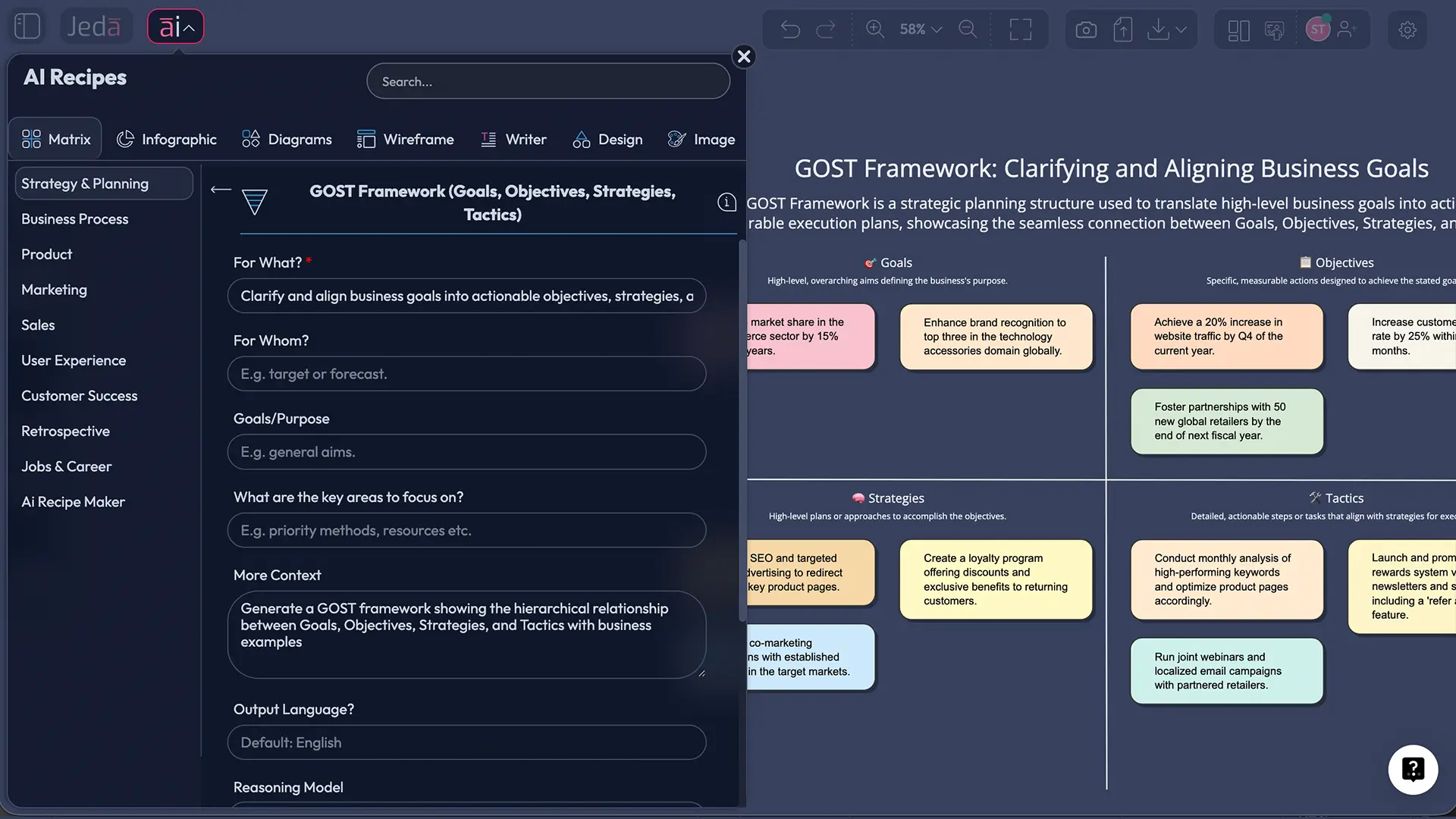
Click the AI Menu button at the top-left of your Jeda.ai canvas. Navigate to the Matrix Recipes category where strategic planning templates are organized.
- Select a Strategic Framework Recipe
Choose the GOST strategy framework template.
- Provide Organizational Context
Enter your organization's context: industry, current strategic position, planning horizon, key stakeholders, and any existing goals or objectives you want the framework to incorporate.
- Generate the GOST Matrix
Click Generate. Jeda.ai's AI Workspace produces an editable four-quadrant matrix distinguishing Goals, Objectives, Strategies, and Tactics with appropriate hierarchical relationships.
- Expand Each Component with AI+
Select any quadrant and tap the AI+ button to extend it.
- Convert for Different Audiences
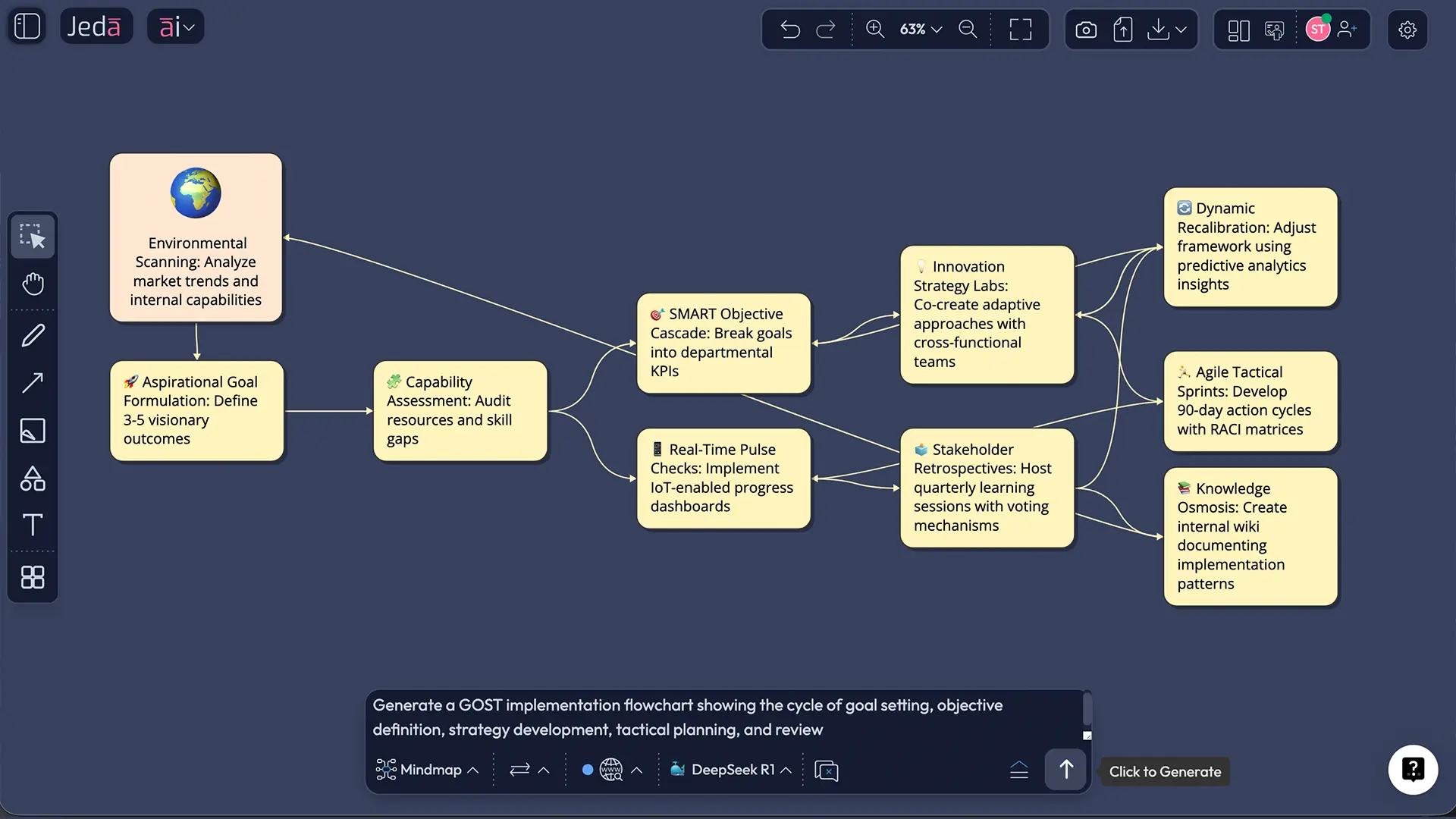
Use Vision Transform to convert the GOST matrix into a flowchart (showing sequential relationships), a diagram (showing dependencies), or a mindmap (showing conceptual connections).
Method 2 — Prompt Bar:
Open the Prompt Bar at the bottom of the canvas. Select the Matrix command. Enter a contextually rich prompt: "Generate a GOST framework (Goals, Objectives, Strategies, Tactics) for a mid-sized consulting firm aiming to double revenue within 3 years through digital transformation and geographic expansion." Press Enter.
GOST Framework Templates & Applied Examples
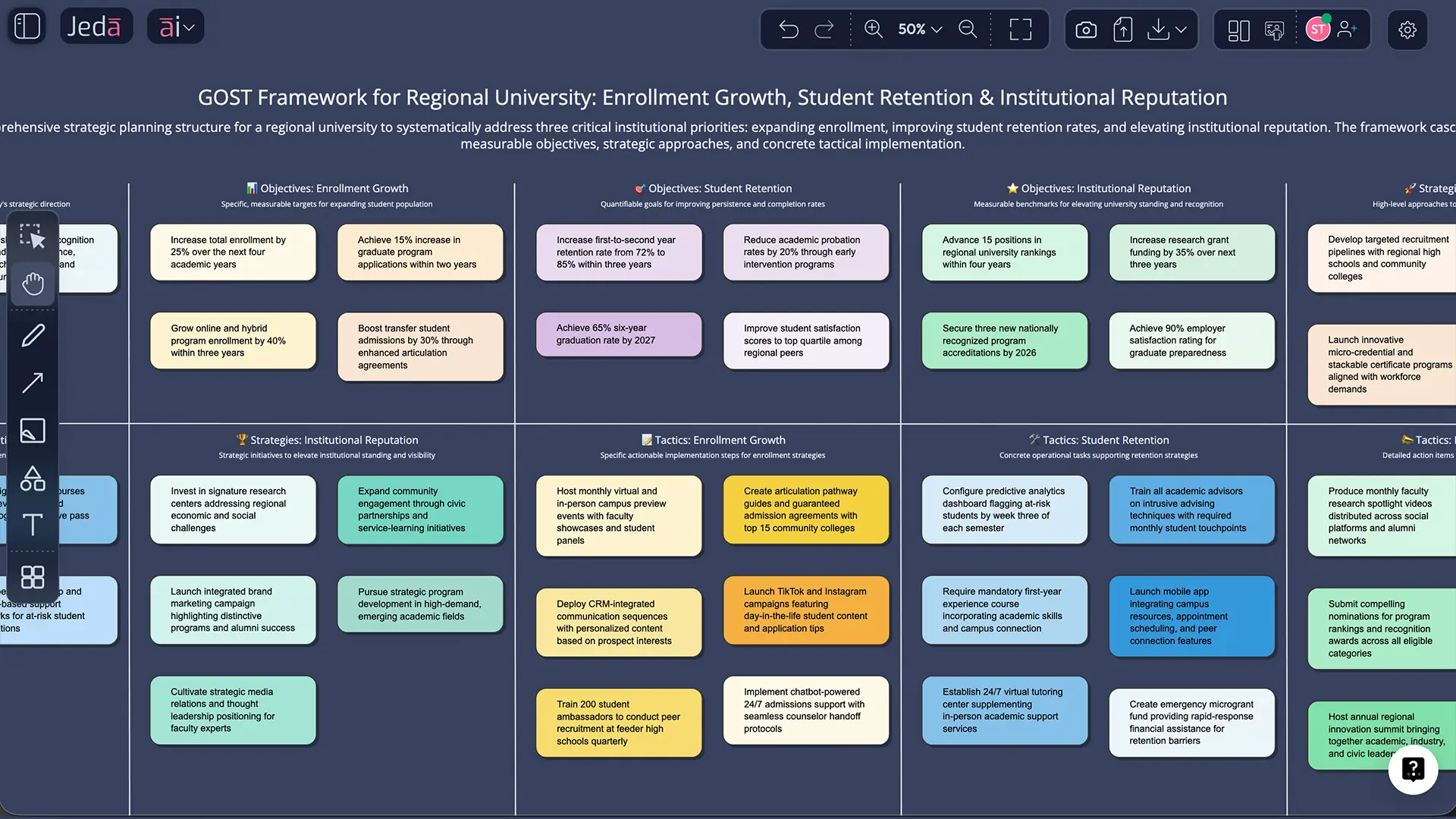
The GOST framework's utility becomes most apparent through application. The following worked example demonstrates how the model structures strategic intent across organizational levels.
Additional GOST applications:
The GOST framework applies across organizational types: corporate strategy divisions use it to cascade board-level goals to operating unit tactics; nonprofit organizations apply it to connect mission-level goals to program-level measurable outcomes; product management teams adapt it to align product vision (goal) with release objectives, go-to-market strategies, and feature-level development tactics.
Jeda.ai's AI Workspace supports all these applications through its 300+ strategic frameworks and the flexibility to customize generated outputs through AI+ extension and Vision Transform conversion.
Best Practices for GOST Implementation
Maintain categorical discipline. The most common error in GOST implementation is classification confusion — stating an activity as a goal or a tactic as a strategy. When using Jeda.ai's AI Workspace to generate GOST frameworks, review each component against the framework's definitional criteria: Goals are qualitative outcomes. Objectives are quantitative milestones. Strategies are approaches. Tactics are actions.
Ensure objectives satisfy SMART criteria. Every objective in a GOST framework should be Specific, Measurable, Achievable, Relevant, and Time-bound. Vague objectives undermine the entire cascade because strategies cannot be evaluated without clear success criteria. AI-generated frameworks on Jeda.ai typically suggest measurable objectives, but human review remains essential.
Limit the number of goals. Organizations performing well with the GOST framework typically maintain 3-5 goals at the corporate level. Each goal generates 2-4 objectives, each objective generates 2-3 strategies, and each strategy generates 3-5 tactics. This produces a manageable 36-300 tactical items rather than the thousand-item action plans that paralyze execution.
Review and revise cyclically. Horwath (2009) emphasized that GOST is not a static document. Goals should be revalidated annually. Objectives and strategies should be reviewed quarterly. Tactics should be assessed monthly. Jeda.ai's AI Whiteboard facilitates this cadence by maintaining the framework as a living document accessible to all stakeholders.
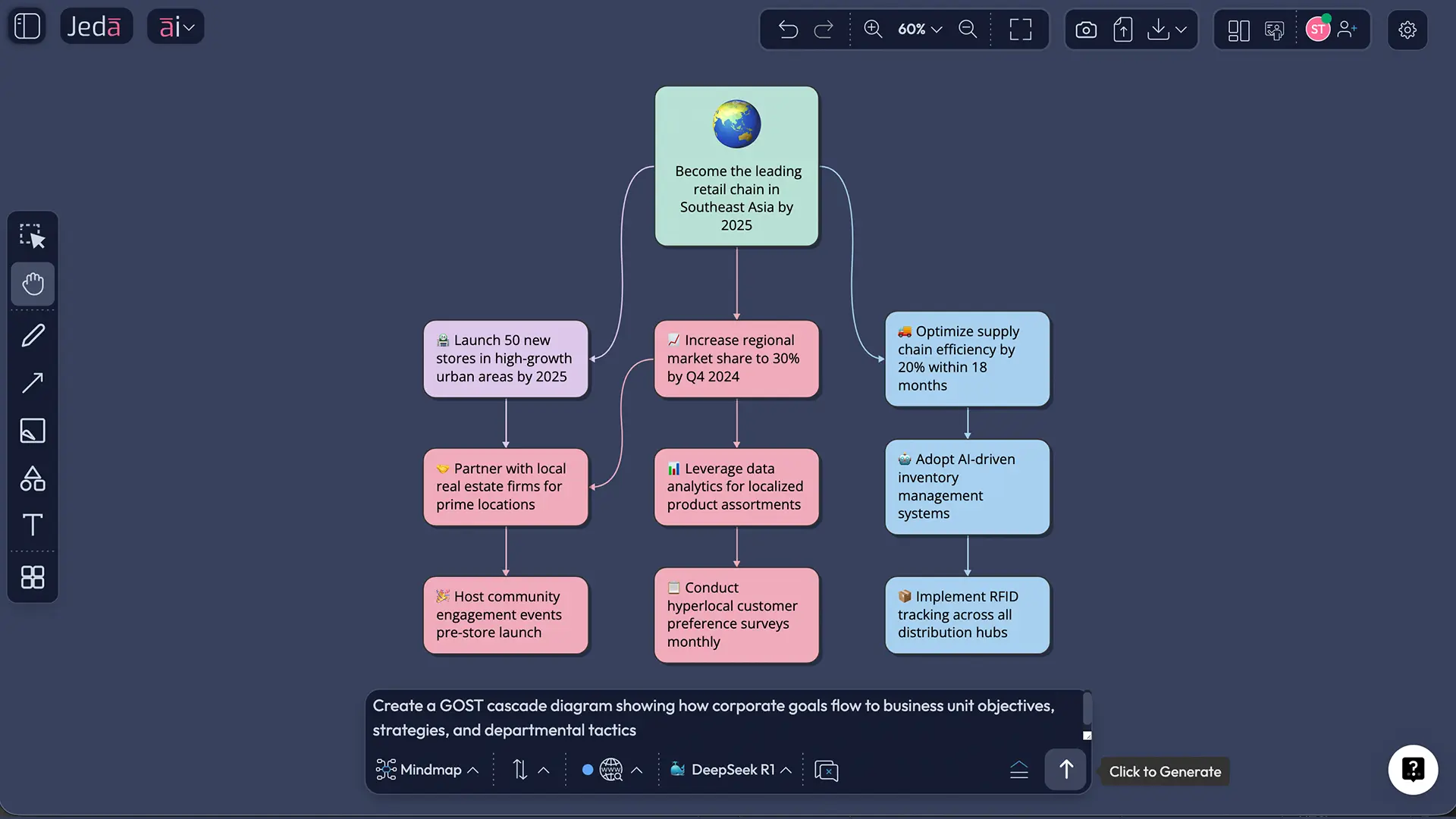
Cascade visually. The relationship between corporate GOST and departmental GOST structures should be explicit and visible. Use Jeda.ai's Diagram command to generate cascade diagrams showing how each departmental objective maps to a corporate strategy.
Common Mistakes to Avoid
Confusing goals with objectives. "Increase revenue by 20%" is an objective, not a goal. "Become the category-defining brand in our market" is a goal. This distinction matters because it determines whether the organization is measuring progress (objectives) or maintaining direction (goals). AI-generated GOST frameworks help enforce this separation through structural categorization.
Writing strategies as tactics. "Hire a VP of Sales" is a tactic. "Build a consultative sales organization that targets enterprise accounts" is a strategy. The test: if a single person can complete it in a defined timeframe, it's a tactic. If it requires multiple coordinated efforts over an extended period, it's a strategy.
Failing to cascade across levels. A corporate GOST framework that exists only at the executive level serves no operational purpose. Each business unit, department, and functional team should maintain a GOST hierarchy that explicitly connects to the organizational framework above it.
Creating too many goals. Strategic focus requires constraint. Organizations with 10+ corporate goals effectively have no strategy — they have a wish list. Limit corporate goals to 3-5, and use the GOST hierarchy to decompose ambition into manageable components.
Treating GOST as a one-time exercise. Strategic environments change. The GOST framework's value diminishes rapidly if it reflects conditions from 12 months ago. Establish review rhythms and use Jeda.ai's collaborative features to update frameworks as conditions evolve.
Frequently Asked Questions
- What is the GOST framework?
- The GOST framework is a strategic planning model comprising Goals, Objectives, Strategies, and Tactics. Introduced by Rich Horwath (2009) of the Strategic Thinking Institute, it provides a hierarchical structure distinguishing outcomes from activities to improve strategic clarity and execution.
- What is the difference between goals and objectives in GOST?
- Goals are qualitative, long-term desired outcomes that define organizational direction. Objectives are quantitative, time-bound milestones that measure progress toward goals. Goals answer 'where are we going?' while objectives answer 'how will we know we're getting there?'
- How do strategies differ from tactics in the GOST model?
- Strategies are high-level approaches that define how an organization will achieve its objectives. Tactics are specific, assignable actions that execute those strategies. Strategies describe the general path; tactics describe the individual steps along that path.
- How to create a GOST framework using AI?
- In Jeda.ai's AI Workspace, open the Prompt Bar, select the Matrix command, and describe your organizational context. AI generates a structured GOST matrix with hierarchically linked goals, objectives, strategies, and tactics. Use AI+ to expand any component.
- What is the difference between GOST and OKR?
- OKR (Objectives and Key Results) focuses on quarterly measurable outcomes, while GOST provides a broader four-tier hierarchy including strategic and tactical layers. OKRs can function within a GOST architecture — the objectives layer maps to OKR objectives, while GOST adds explicit strategy and tactics.
- How does GOST compare to OGSM?
- OGSM (Objectives, Goals, Strategies, Measures) is structurally similar but does not explicitly separate strategies from tactics. GOST's distinct tactical layer provides greater operational clarity, particularly valuable when strategic decisions and tactical execution are distributed across different organizational levels.
- Can the GOST framework be applied to nonprofits?
- Yes. The GOST framework adapts to any organizational type. For nonprofits, goals reflect mission-driven outcomes rather than financial targets, objectives measure community impact, strategies address program design and partnership approaches, and tactics specify operational actions.
- How does AI improve GOST framework development?
- AI accelerates structural generation, models cascading alignment across organizational levels, and provides visual clarity through tools like Jeda.ai's AI Whiteboard. Teams generate complete GOST hierarchies in minutes, iterate collaboratively, and maintain living frameworks across 300+ strategic template options.
- How often should a GOST framework be reviewed?
- Goals should be revalidated annually. Objectives and strategies warrant quarterly review. Tactics should be assessed monthly. Jeda.ai's collaborative AI Workspace maintains GOST as a living document, enabling continuous review without the overhead of recreating frameworks from scratch.
- What are common mistakes in GOST implementation?
- The most frequent errors include confusing goals with objectives, writing strategies as tactics, creating too many corporate goals, failing to cascade frameworks across organizational levels, and treating the GOST document as a one-time exercise rather than a living strategic artifact.
- Can Jeda.ai generate GOST frameworks for multiple organizational levels?
- Yes. Jeda.ai's AI Workspace generates separate GOST matrices for corporate, business unit, and departmental levels. Use the Diagram command to visualize cascade relationships between levels, showing how departmental tactics connect to organizational goals.
Sources & Further Reading
- [1]
Kaplan, Robert S. & Norton, David P. (1992) . “The Balanced Scorecard: Measures that Drive Performance” Harvard Business Review.
View Source ↗ - [2]
Kent State University Office of Strategy Management (2023) . “GOST Framework” Kent State University.
View Source ↗
Build Your GOST Strategic Framework Today
Join over 150,000 professionals who use Jeda.ai's AI Workspace to develop, visualize, and align strategic plans across their organizations.
Try Free Template