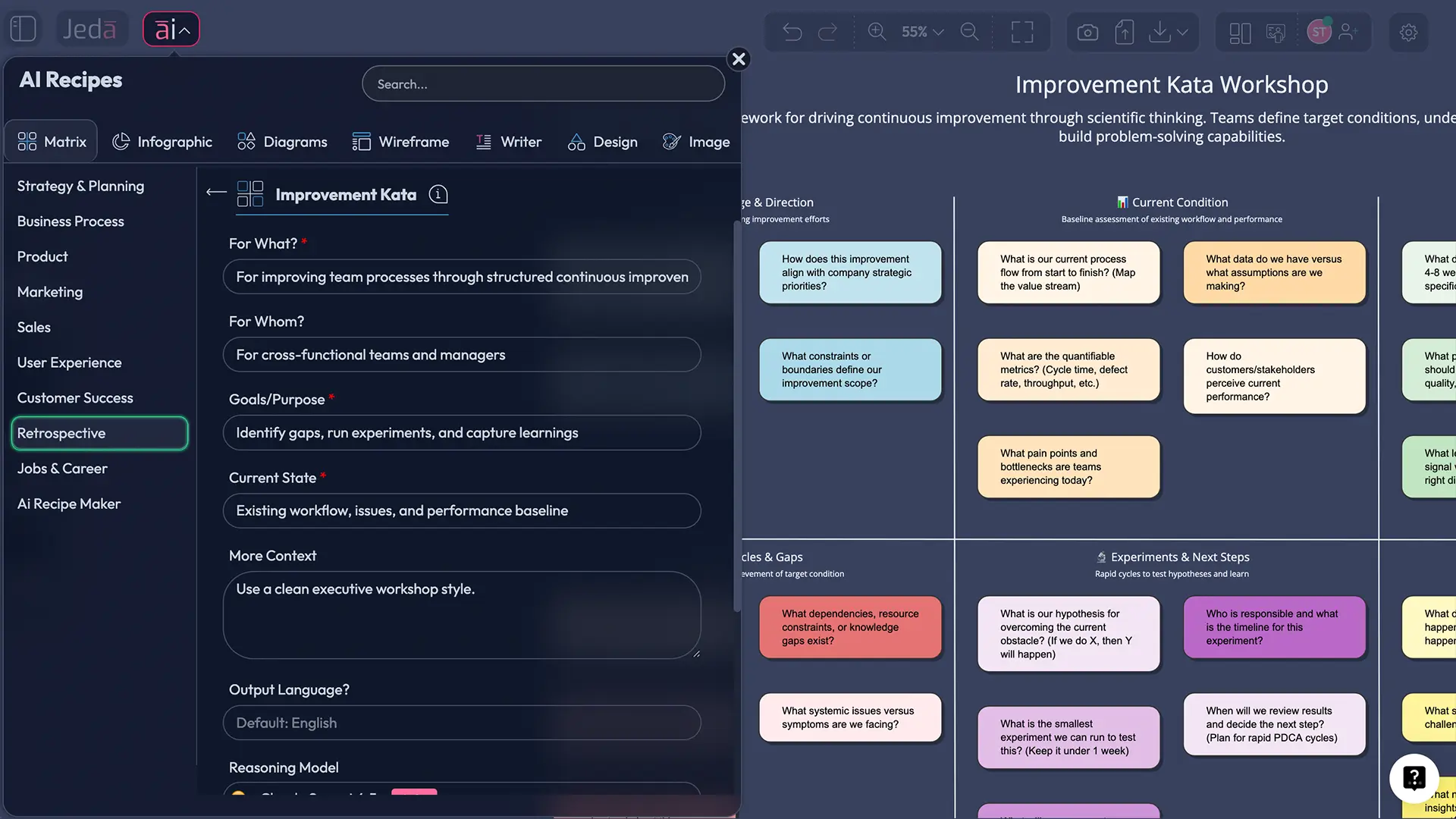
If your team’s retrospective ends with a polite list of “good ideas” and then quietly dies in the backlog, that is not a reflection problem. It is an operating-system problem. An Improvement Kata retrospective gives your team a tighter loop: define direction, understand the current condition, set a target condition, and run small experiments until the process actually changes. Mike Rother’s Toyota Kata work made that pattern famous, and it still holds up because it turns improvement into a routine instead of a mood. With Jeda.ai, you can run that routine inside an AI Workspace and AI Whiteboard, generate the matrix in minutes, and keep the learning visible to everyone. More than 150,000+ users already use Jeda.ai to turn messy thinking into editable visual outputs instead of scattered notes.
What is an Improvement Kata Retrospective?
An Improvement Kata retrospective is a structured reflection format based on the Improvement Kata pattern from Toyota Kata. Instead of asking a team to list everything that felt good, bad, or annoying, it narrows the conversation to a disciplined sequence: understand the broader challenge, grasp the current condition, define the next target condition, and move toward it through iterative experiments. That four-part model is well documented in Mike Rother’s work and in more recent explainers from AME and Atlassian. In plain English: stop admiring the problem, start testing your way forward.
That is why this format feels different from a generic sprint retro. It is less therapy circle, more learning loop.
And that is a good thing.
Teams use Improvement Kata retrospectives when they want to improve a workflow that keeps recurring: release delays, QA handoff friction, approval bottlenecks, weak discovery, slow client onboarding, meeting overload, or rework in design and engineering. The point is not to “solve everything.” The point is to choose the next condition worth reaching, then learn your way there one experiment at a time.
Why use an Improvement Kata Retrospective with AI?
Doing this manually on a blank board works. It also burns time, creates inconsistent structure, and usually depends on one facilitator who knows the method cold. Jeda.ai fixes that by giving teams a visual starting point inside an AI Workspace that is already built for frameworks, collaboration, and iteration. The result is faster setup, clearer synthesis, and far less “wait, what exactly are we filling in here?”
- Sharper focus
AI helps frame the improvement challenge so the team does not spiral into unrelated complaints.
- Current-condition clarity
Jeda.ai can organize messy inputs into a cleaner view of what is actually happening right now.
- Target-condition thinking
Instead of vague goals, teams can define the next reachable condition and make it concrete.
- Obstacle-to-experiment flow
You can turn blockers into testable next steps rather than a parking lot of frustration.
- Collaborative editing
Everyone can refine the same board live in the AI Whiteboard, not pass notes across tools.
- Extend with AI+
Use the AI+ button to deepen the board, expand experiment options, or continue the analysis.
Jeda.ai also has a real advantage here that most generic whiteboards do not: the product is already positioned around frameworks, not just freeform stickies. That matters because Improvement Kata only works when the structure stays intact. Jeda.ai’s broader strategy emphasizes framework-native, visual-first collaboration rather than blank-canvas chaos, which is exactly the right fit for a retrospective format that depends on disciplined thinking.
Improvement Kata Retrospective vs a standard retrospective
A standard retrospective is useful when you want a broad emotional and operational readout. An Improvement Kata retrospective is stronger when you already know there is a recurring system problem and you want to learn your way toward a better condition.
Here is the blunt version: if your team keeps leaving retros with five actions and finishing zero of them, you probably do not need more sticky notes. You need a tighter improvement loop. Writers and practitioners who compare Kata to classic retrospectives make the same point from different angles: retros often surface ideas, but Kata forces follow-through through cadence, experimentation, and coaching.
How to create an Improvement Kata Retrospective in Jeda.ai
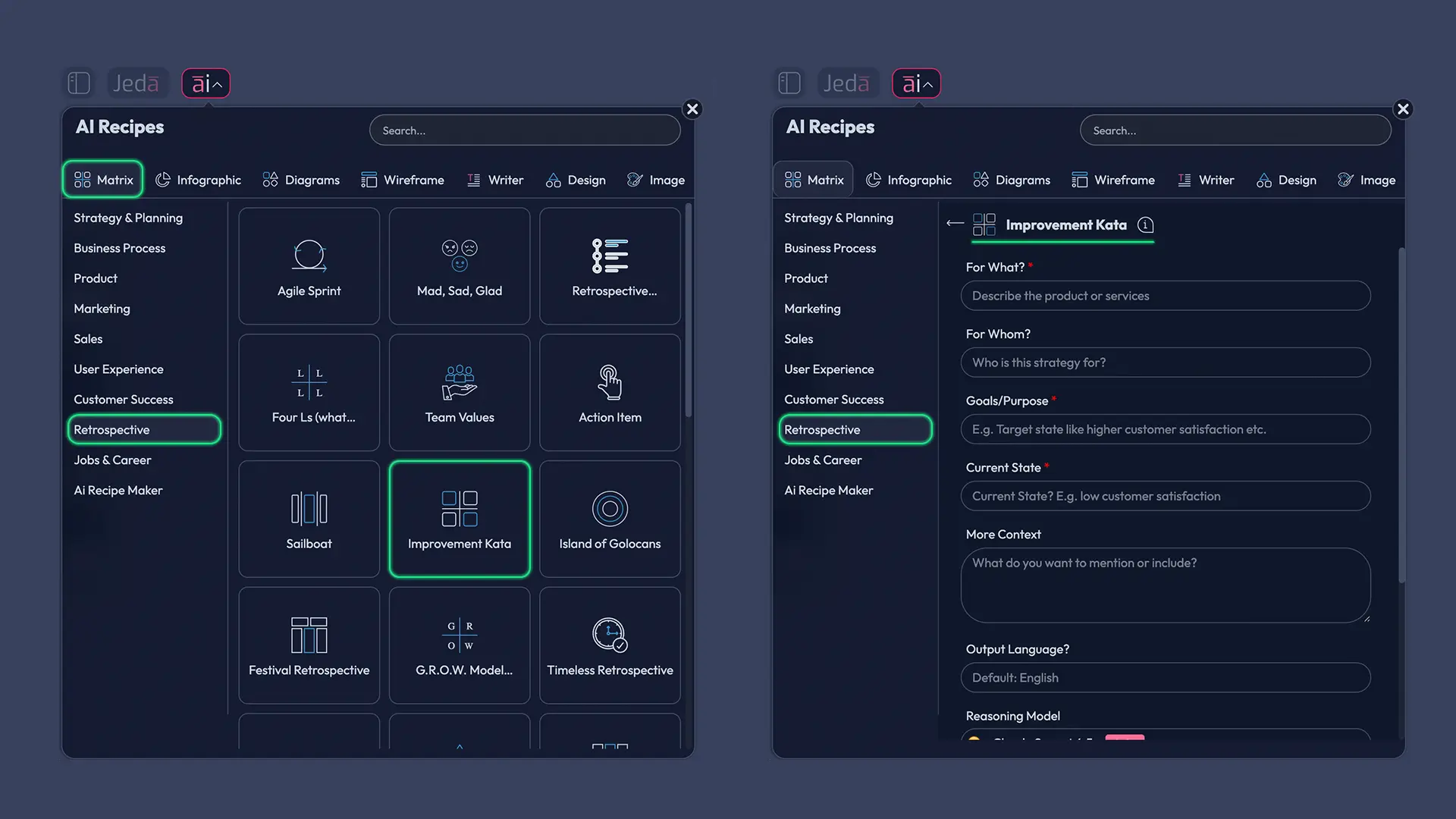
Jeda.ai already supports an Improvement Kata recipe in its AI workflow. The public Jeda.ai resource page shows the AI Menu route clearly: open the AI Menu, go to the retrospective options, and select Improvement Kata. That gives us enough confidence to treat this as a recipe-led matrix workflow rather than improvising from scratch.
Method 1: Recipe Matrix (recommended)
Use this when you want the fastest path and the cleanest starting structure. This is the best option for facilitators who do not want to rebuild the matrix manually every time.
- Open the AI Menu and choose the Improvement Kata recipe
Inside Jeda.ai, enter your AI Workspace, open the AI Menu, and select the Improvement Kata option from the retrospective recipe set.
- Feed the recipe the real context
Add the business or team context, the workflow you want to improve, the timeframe, and any current pain points or metrics you already know.
- Generate the matrix board
Let Jeda.ai create the Improvement Kata retrospective as a structured matrix with sections for challenge, current condition, target condition, obstacles, and initial experiments.
- Refine the board with the team
Edit language, add evidence, merge duplicates, and tighten each section so the board reflects the real process rather than abstract wishes.
- Use AI+ to deepen the board
Select the generated matrix and tap the AI+ button to expand the analysis, deepen obstacles, or extend experiment ideas without rebuilding the board.
- Convert or extend the output
If the team wants a different visual, use Vision Transform to convert the matrix into a flowchart, diagram, or mind map while keeping the insight path intact.
Method 2: Prompt Bar
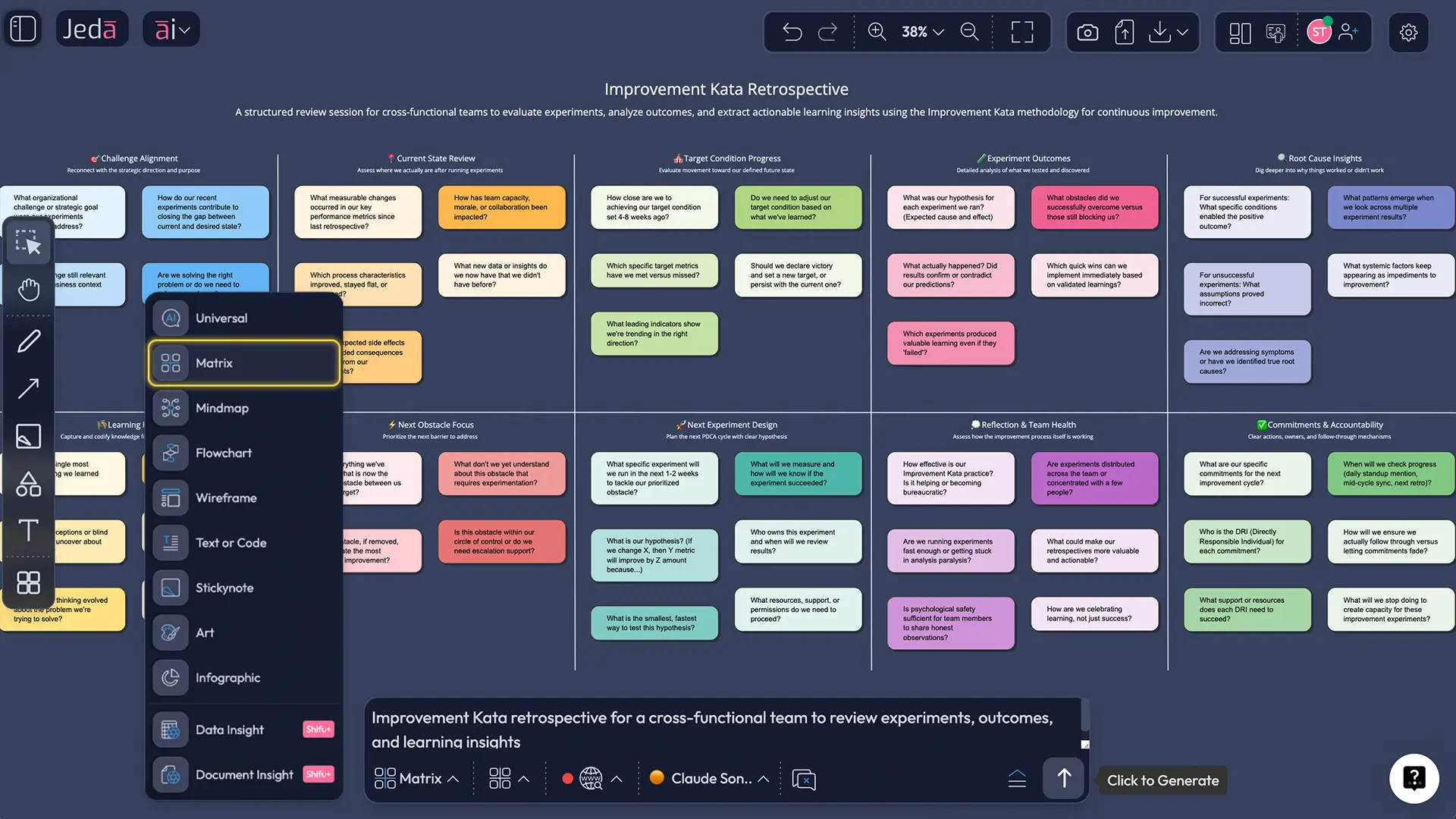
Use this when you want more freedom or when you want to tailor the board for a specific domain such as product delivery, consulting ops, design reviews, or software release management.
Choose the Matrix command from the Prompt Bar at the bottom of the canvas and use a prompt like this:
Create an Improvement Kata retrospective matrix for a cross-functional product team. Include sections for challenge, current condition, next target condition, measurable gaps, obstacles, first experiment, expected result, actual result, and learning notes. Keep it editable and workshop-ready.
That is enough to get the structure on the board. Then refine the language, invite collaborators, and push the conversation from “what annoyed us?” to “what are we testing next?”
AI+ button deep dive
This part matters because Improvement Kata is never really one-and-done.
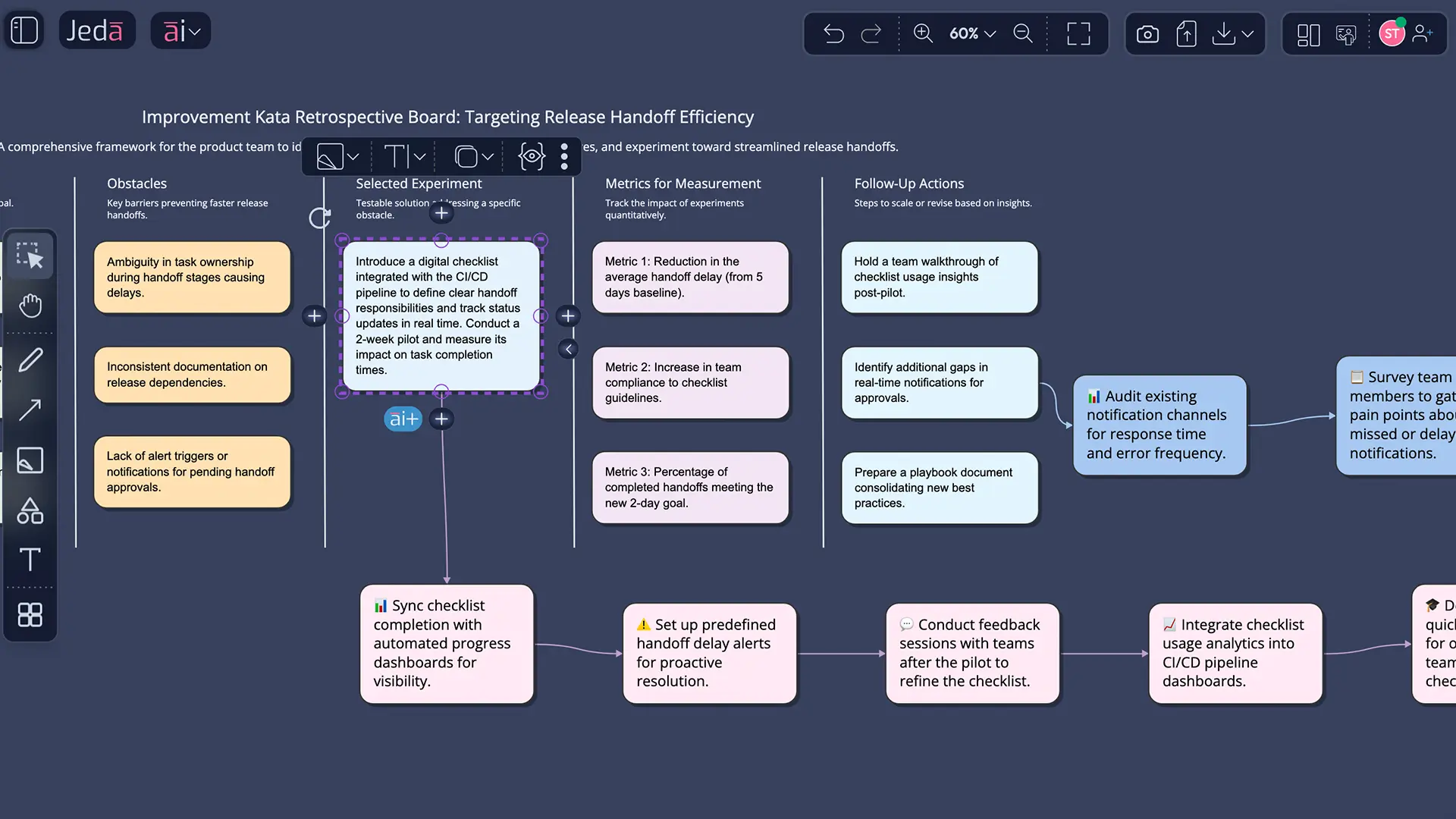
After the matrix is generated, select it and tap AI+ to extend the board. Jeda.ai can deepen the obstacle cluster, expand candidate experiments, suggest clearer target conditions, or continue the board as the team learns more. Keep it broad. Think “extend the analysis” or “deepen the board,” not ultra-granular micromanaging. The AI+ button is best used as a continuation layer, not a replacement for facilitation.
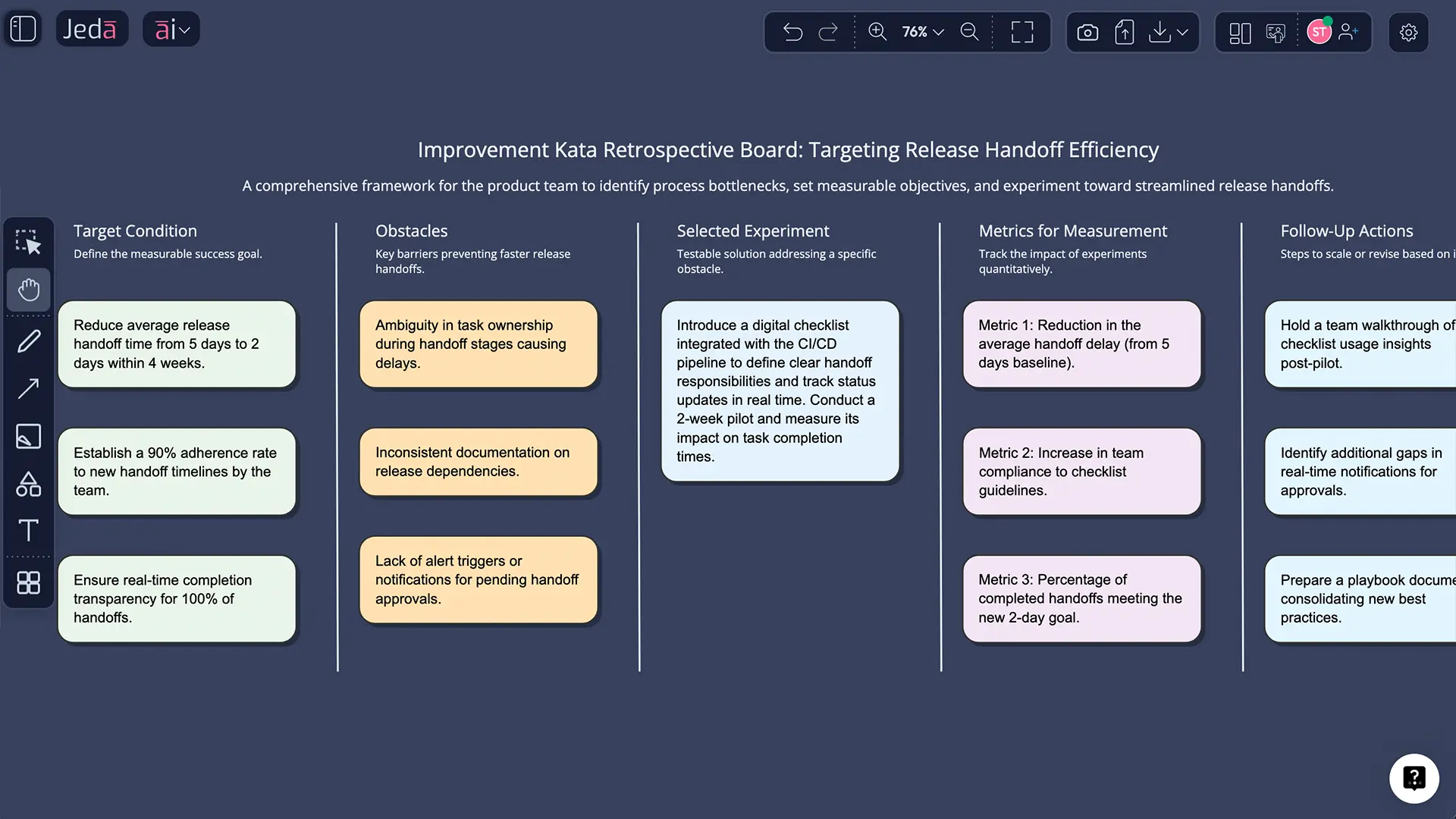
Improvement Kata Retrospective example: fixing release handoff delays
Let’s make this concrete.
Imagine a product team that ships late every other sprint. Everyone already has opinions. Dev says QA joins too late. QA says stories arrive half-baked. Product says priorities keep shifting. Engineering says approvals are too slow. A classic retro will surface all of that and probably end with three action items and vague optimism.
An Improvement Kata retrospective takes a cleaner route.
The challenge might be: reduce release handoff delays so the team can ship without last-minute thrash. The current condition could show that QA receives testable work only two days before release, acceptance criteria vary by squad, and deployment approvals are inconsistent. The target condition might be: within four weeks, 90% of stories enter QA with complete acceptance criteria and are handed off at least four days before release. Obstacles become visible fast: unclear story readiness, fragmented ownership, missing pre-release checklists, and no shared metric. Then the first experiment becomes small and testable: introduce a single definition-of-ready checklist for one squad this week and measure handoff timing.
That is the magic. Not the template. The learning loop.
Best practices for a better Improvement Kata Retrospective
The framework is simple. The facilitation is where teams usually either look brilliant or trip over their own shoelaces.
And one more thing: keep the board alive after the retrospective. Writers who adapt Toyota Kata to agile teams consistently emphasize cadence and follow-up, not just the workshop itself. If the board disappears after the session, you are not doing Improvement Kata. You are doing cosplay with better terminology.
Common mistakes to avoid
The first mistake is treating the target condition like a fuzzy goal. “Improve collaboration” is not a target condition. That is a motivational poster.
The second is stuffing too many obstacles into the active lane. Improvement Kata works because it narrows focus. A team can acknowledge ten blockers and still choose one to work on now.
Third, teams often jump straight from pain to solution. Bad move. Grasp the current condition first. The method is designed that way for a reason.
Fourth, people confuse activity with learning. Running an experiment is not the win. Learning whether the experiment moved the condition is the win.
And fifth, some teams run the retrospective but skip the ongoing coaching rhythm. Several practitioners who apply Toyota Kata in software and agile environments highlight the same issue: monthly retros alone often fail because improvement work loses momentum between sessions. The cadence is part of the system, not an optional garnish.
Frequently asked questions
- What is an Improvement Kata retrospective?
- An Improvement Kata retrospective is a structured reflection format that guides a team through challenge, current condition, target condition, obstacles, and experiments so improvement happens through learning loops rather than loose action lists.
- How is Improvement Kata different from a normal retrospective?
- A normal retrospective collects broad reflections across a sprint or project. Improvement Kata narrows the discussion to one improvement path and pushes the team toward measurable target conditions and small experiments.
- Who should use an Improvement Kata retrospective?
- Product teams, engineering teams, consultants, business analysts, project managers, and operations leaders can all use it when they need repeatable process improvement instead of one-off reflection sessions.
- Can Jeda.ai create an Improvement Kata retrospective automatically?
- Yes. Jeda.ai already has an Improvement Kata recipe path in its AI Menu, and you can also generate the same kind of board manually from the Prompt Bar using the Matrix command.
- Which Jeda.ai command should I use for this format?
- Use the Matrix command when generating from the Prompt Bar, because the Improvement Kata retrospective is best represented as a structured matrix board with clearly separated sections.
- What should be included in the current condition?
- The current condition should describe observed reality: metrics, workflow facts, delays, bottlenecks, defects, handoff timing, or other evidence that explains what is happening now.
- What makes a strong target condition?
- A strong target condition is specific, time-bound, and close enough to reach in the near term. It should describe a future operating pattern, not just a vague aspiration.
- What is the role of AI+ in this workflow?
- AI+ is best used after the board is generated. It can extend the matrix, deepen obstacle analysis, and expand next-step experiments without forcing the team to rebuild the retrospective from scratch.
- Can I convert the matrix into another visual?
- Yes. After generating the Improvement Kata retrospective in Jeda.ai, you can use Vision Transform to turn the output into another visual format such as a flowchart, diagram, or mind map.
- Is this only for software teams?
- No. Improvement Kata started in a broader continuous-improvement context and works anywhere teams need a disciplined way to improve a process, from delivery ops to consulting workflows to internal business systems.
Sources & Further Reading
- [1]
Rother, Mike (2009) . “Toyota Kata: Managing People for Improvement, Adaptiveness and Superior Results” McGraw-Hill.
View Source ↗ - [2]
Rother, Mike (2015) . “Improvement Kata Handbook” Improvement Kata / University of Michigan.
View Source ↗ - [3]
Association for Manufacturing Excellence (n.d.) . “Kata Resources | Improvement & Coaching Kata by AME” AME.
View Source ↗ - [4]
Atlassian (2026) . “Using Improvement Kata to support lean” Atlassian Agile at Scale.
View Source ↗ - [5]
Verhoeven, Vincent (2015) . “The vision: Improvement Kata as a retro format” Vincent Verhoeven's Blog.
View Source ↗ - [6]
Forss, Håkan (2012) . “Agile LEGO – Toyota Kata an alternative to Retrospectives” Håkan Forss's Blog.
View Source ↗ - [7]
Lebrero, Daniel (2021) . “Continuous improvement with Toyota Kata” danlebrero.com.
View Source ↗
Start Your Improvement Kata Retrospective with AI
Join over 150,000+ professionals who use Jeda.ai to turn reflection into clear, editable improvement boards inside one AI Workspace.
Try Free Template