Most companies obsess over what they can see: features, headcount, shiny “roadmaps,” office snacks. Meanwhile, the actual moat is invisible.
Intangible assets are the modern castle walls—brand trust, proprietary know-how, IP, relationships, data advantages, and the operating routines your competitors can’t copy without breaking their own org charts. If you can map and defend those assets, you can keep pricing power and margin when the market turns.
This page shows how to run an Intangible Assets Moat Analysis with AI inside Jeda.ai—an AI Workspace and AI Whiteboard used by 150,000+ users to produce editable, decision-ready visuals (not static chat). And yes, this is a sub-recipe inside the Moat Analysis templates.
What is an Intangible Assets Moat Analysis?
An Intangible Assets Moat Analysis is a structured way to identify the non-physical resources that protect your profits and market share, then test whether those resources are durable or fragile.
It sits at the intersection of:
- Economic moat thinking (a durable advantage that protects profitability)
- The resource-based view of the firm: sustained advantage comes from resources that are valuable, rare, hard to imitate, and supported by the organization
- A pragmatic reality check: if your “moat” can be copied by hiring three people and a weekend, it’s not a moat. It’s a memo.
What counts as an intangible asset (in plain English)
Accounting standards define an intangible asset as an identifiable non-monetary asset without physical substance.
Strategy is messier. Your moat can include things that never appear neatly on a balance sheet:
- Brand & reputation (trust, pricing power, “default choice” behavior)
- IP and legal protections (patents, trademarks, licenses)
- Data advantages (exclusive access, unique learning loops, better models)
- Know-how & routines (processes, playbooks, craft, culture)
- Relationships (distribution, partners, ecosystems, community)
Organizations and investors routinely treat these as core moat drivers.
Why use AI for intangible moat work?
Because intangible moats are not “one document.” They’re a moving target.
When you run this analysis manually, teams get stuck in three traps:
- Vague claims (“our brand is strong”) with no proof.
- Asset lists with no defensibility test.
- No decay model—no idea what kills the moat.
AI helps you go from “we think” to “here’s the evidence, the threat model, and the plan.” With Jeda.ai, you do it in a single AI Workspace, using editable visuals on an AI Whiteboard, with web context when needed (web search is a platform feature, not an LLM trick).
- Speed without losing rigor
Generate a moat map in minutes, then spend your time debating the assumptions instead of formatting boxes.
- Evidence-in, not vibes
Bring in PDFs, docs, screenshots, or CSV/Excel. Document Insight and Data Insight can extract what matters into a structured board.
- Align the team on one version
Run the analysis collaboratively on the canvas so strategy doesn’t split into 12 different slides and 9 different opinions.
- Defensibility tests
Stress-test each intangible asset using VRIO-style checks: value, rarity, imitability, and organization.
- Make it repeatable
Turn your moat analysis into a reusable template for quarterly planning and competitive reviews.
- Extend and convert instantly
Use the AI+ button to expand weak areas, then Vision Transform to convert a matrix into a diagram or flowchart when the story needs it.
The Intangible Moat Map
Here’s the simple model we recommend (and what the recipe generates).
You’re building a map, not a list. Each asset gets scored, challenged, and linked to proof.
Asset types to include (the “modern moat stack”)
The defensibility questions that matter
Use a VRIO-style lens: a resource drives sustained advantage when it’s valuable, rare, hard to imitate, and the organization can capture the value.
In practice, ask:
- Value: Does this asset increase willingness-to-pay or reduce cost?
- Rarity: Do only a few competitors have it?
- Imitation cost: Can a rival replicate it fast without burning cash or time?
- Organization: Do you actually exploit it (process, incentives, distribution, governance)?
And one extra question most teams skip:
- Decay: What erodes it over 6–18 months?
How to create an Intangible Assets Moat Analysis in Jeda.ai
This recipe exists as a sub-template under Moat Analysis. Use the AI Menu for the guided version, then use the Prompt Bar when you want full control.
- Open a board in your AI Workspace
Create or open a canvas in Jeda.ai. This becomes your shared source of truth for the moat discussion.
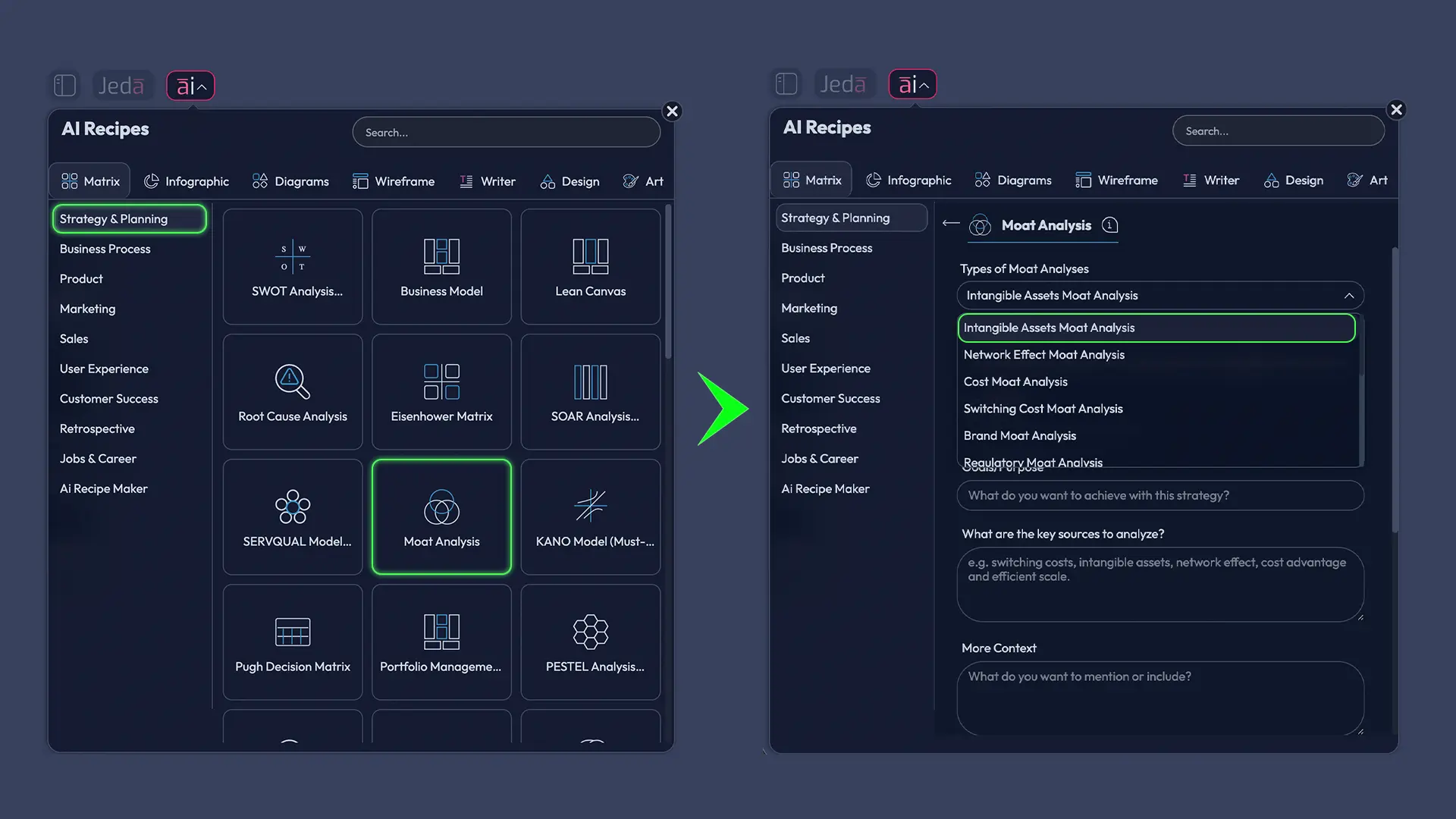
- Method 1 (recommended): Use the AI Menu recipe
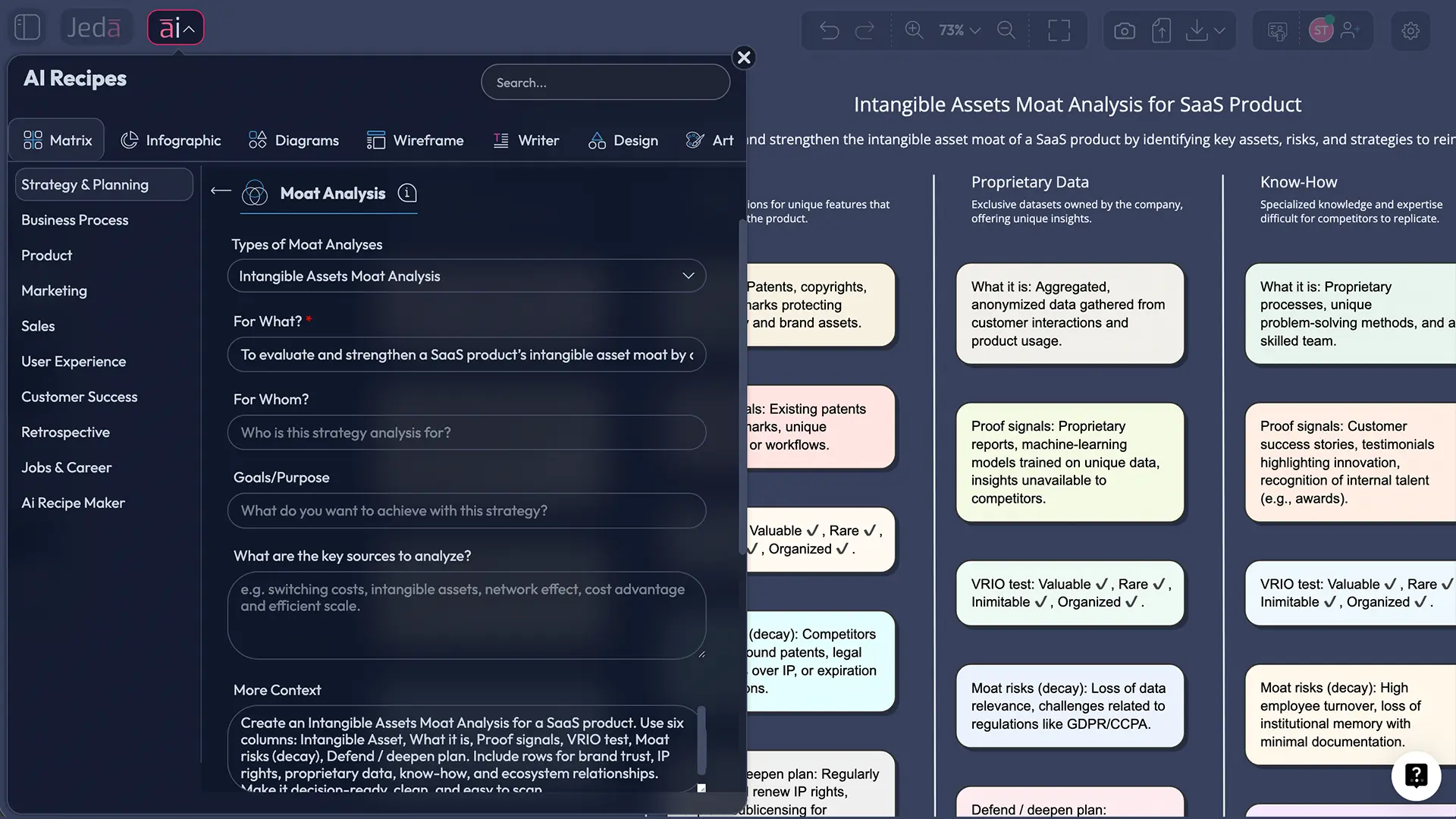
Open the AI Menu (top-left). Go to Strategy & Planning → Moat Analysis, then choose the Intangible Assets focus. Fill in the prompts (company, market, competitors, and constraints) and click Generate.
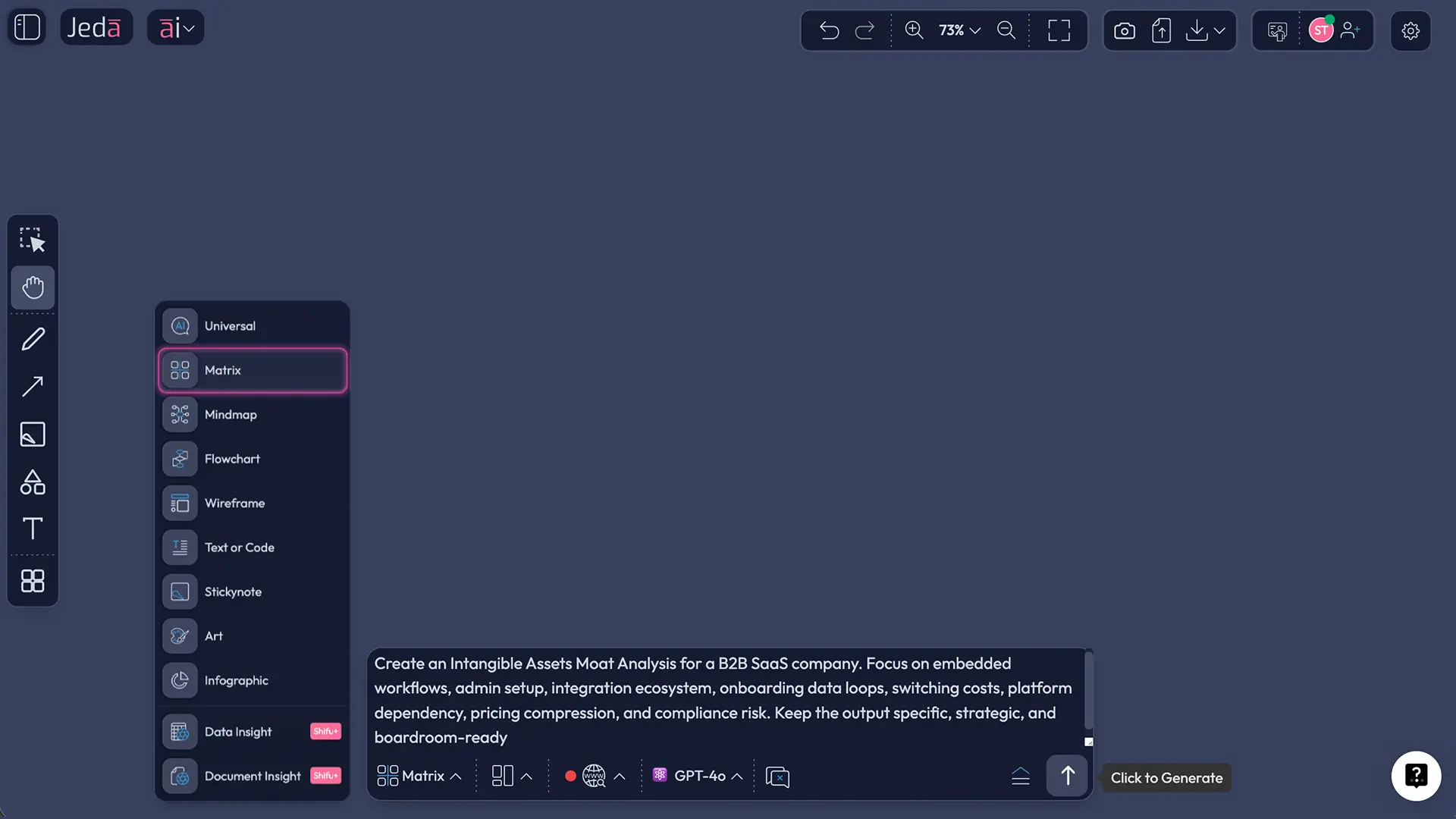
- Method 2: Use the Prompt Bar with the Matrix command
Open the Prompt Bar at the bottom, select the Matrix command, and paste the prompt below. Press Enter.
- Add proof: docs, screenshots, and data
Upload a brief, pitch deck, customer feedback, win/loss notes, or KPI exports. Use Document Insight or Data Insight to extract signals into the board.
- Stress-test with AI+ and convert with Vision Transform
Select any weak or disputed section, tap AI+ to expand or challenge it, then use Vision Transform to convert the output into a diagram (threat model) or flowchart (defense plan).
- Share and export
Collaborate live, then export the board as PNG, SVG, or PDF for stakeholders and archives.
Copy-paste prompt (Prompt Bar → Matrix)
Prompt:
Create an Intangible Assets Moat Analysis for: [Company / Product].
Market: [Market + segment]. Competitors: [3–5 competitors].
Include a matrix with 6 columns: Intangible Asset, What it is, Proof signals, VRIO test, Moat risks (decay), Defend / deepen plan.
Cover at least: brand, IP/legal rights, data advantage, know-how/routines, and ecosystem/relationships.
Keep outputs specific and decision-ready (no generic buzzwords).
End with 3 “hard questions” leadership must answer this quarter.
Template walkthrough with real examples
Below are three common patterns. Pick the one that matches your business model.
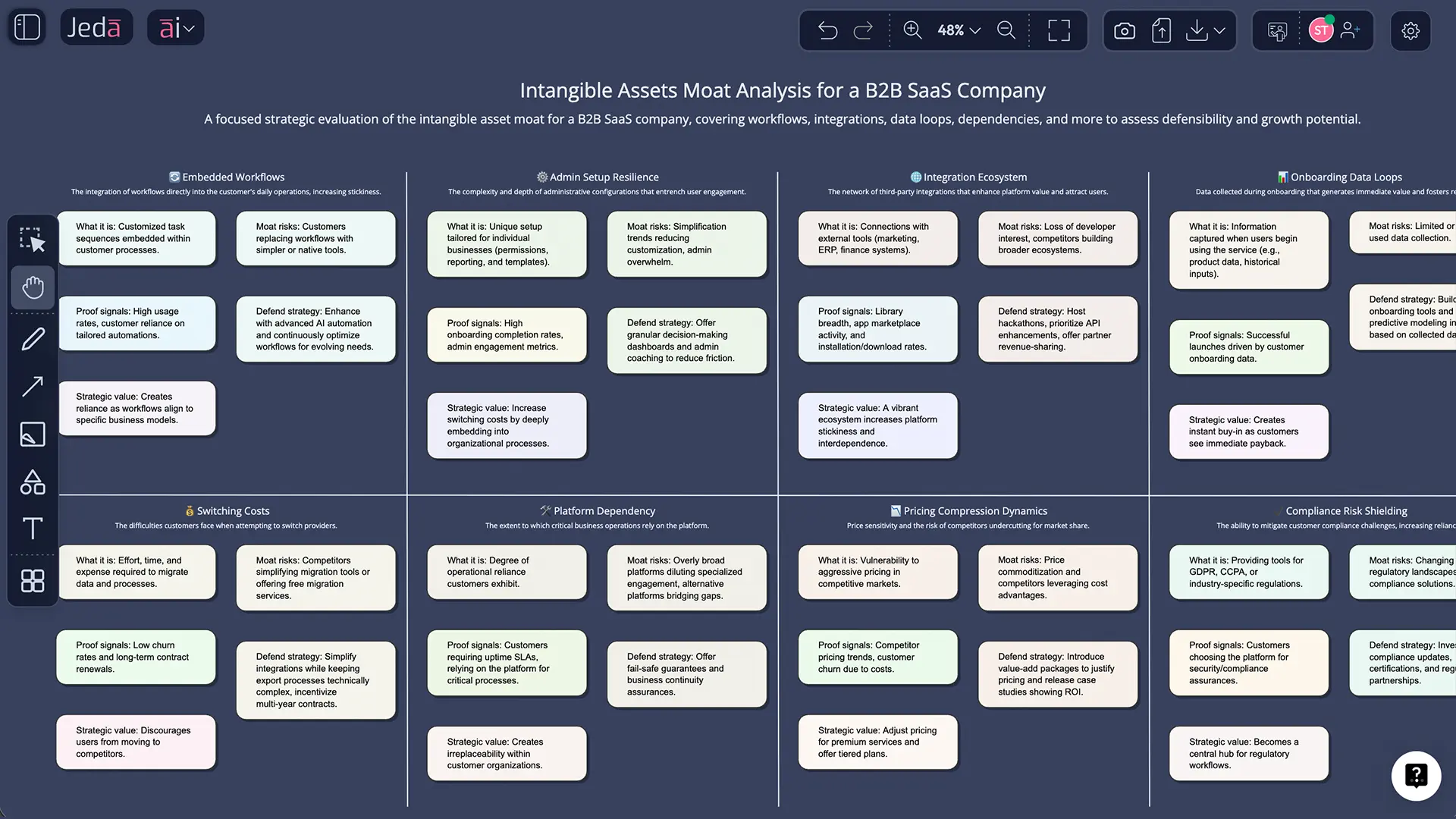
Example 1: B2B SaaS with workflow lock-in
Moat assets that usually matter
- Embedded workflows and admin setup (switching costs)
- Integration ecosystem (partners, “it just works” expectation)
- Usage data that improves onboarding and automation
What breaks the moat
- A platform shift (new API standard, new platform owner)
- Pricing compression + easy migration tooling
- Compliance expectations you can’t meet
Example 2: Consumer brand with pricing power
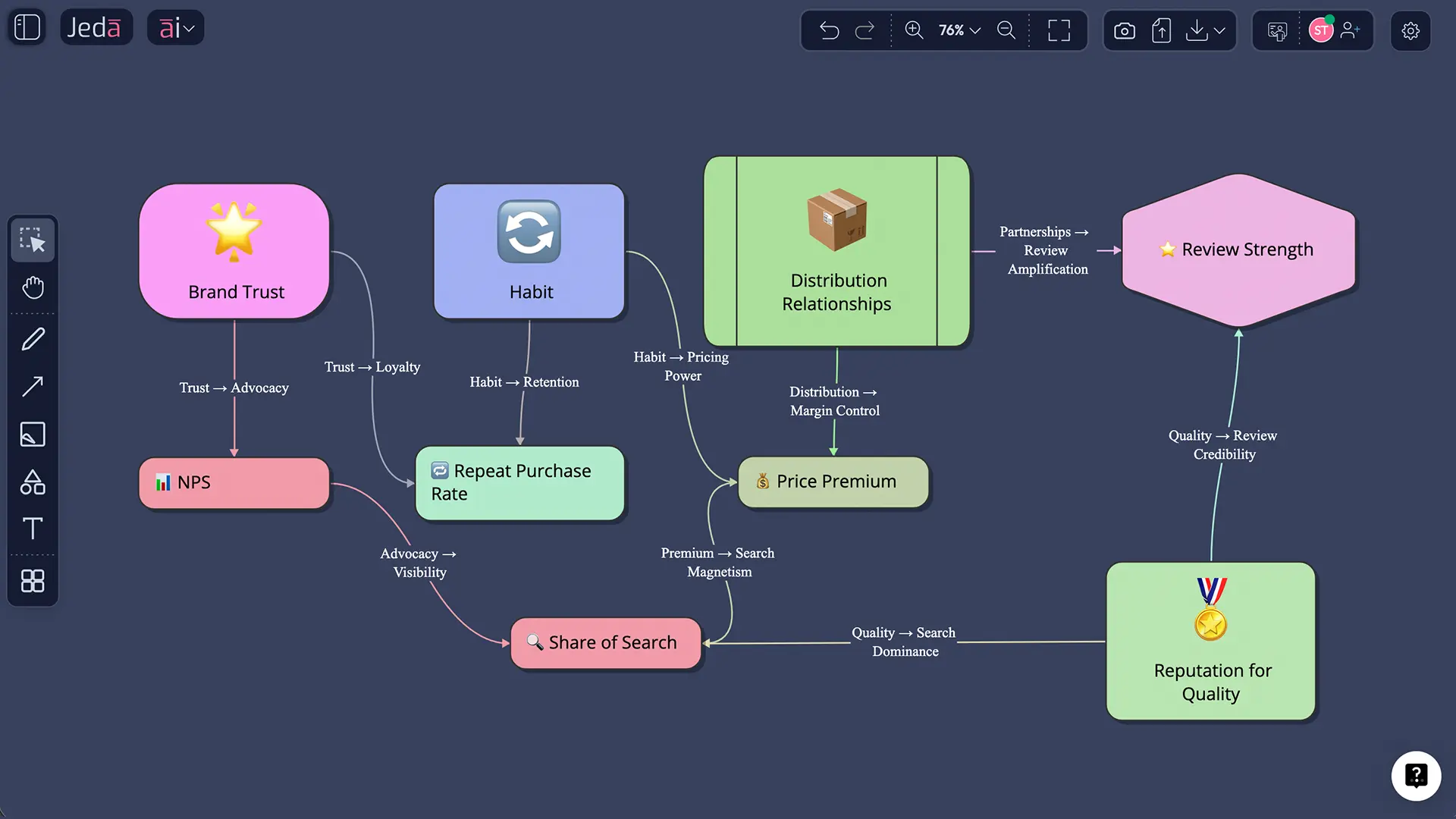
Brand equity isn’t just awareness. It’s a differential response driven by brand knowledge—meaning customers react differently to your offer because the brand exists.
Moat assets that usually matter
- Habit + identity association
- Distribution relationships and shelf priority
- Reputation for quality (and the receipts to prove it)
What breaks the moat
- Trust loss (quality issues, scandals, broken promises)
- Private label matching “good enough”
- Platform changes (ad targeting restrictions, retail shifts)
Example 3: Regulated / IP-heavy businesses (biotech, deep tech)
Legal rights can form a moat because they raise imitation cost. But they also expire. And competitors plan around that date with the enthusiasm of a kid watching the microwave timer.
Moat assets that usually matter
- Patent portfolio scope and remaining life
- Regulatory approvals and compliance capability
- Specialized know-how and manufacturing process control
What breaks the moat
- Patent cliffs
- Regulatory changes
- A substitute technology
Best practices: how to make this analysis useful
- Tie every intangible asset to a measurable signal. Pricing power, churn, win rate, time-to-implement, patent citations, partner attach rate—anything that forces clarity.
- Write the competitor’s “copy plan.” Pretend you’re them. What would you do to copy you? How long would it take?
- Model decay explicitly. Intangibles depreciate too. Some fast (reputation), some slow (patents), some weirdly (data quality).
- Decide what you will invest in this quarter. Intangible capital is built by repeated investment, not one brainstorm.
Common mistakes to avoid
1) Confusing popularity with defensibility
A big following is nice. A defensible following is better. If your audience can switch with one click, your “community” is just a mailing list.
2) Treating data as a moat without checking data rights
Exclusive access, consent, and distribution matter. “We have lots of data” is not a moat if you can’t use it, or if others can buy the same dataset.
3) Ignoring organizational capture
The “O” in VRIO is where moats go to die. If your incentives and processes don’t support the asset, it won’t show up in performance.
4) Leaving out the attack surface
You need a threat model: substitutes, regulation, platform dependency, talent concentration, and reputational fragility.
Frequently Asked Questions
- What is an intangible asset moat?
- An intangible asset moat is a durable competitive advantage created by non-physical assets such as brand trust, intellectual property, proprietary know-how, data advantages, and relationships. These assets raise the cost of imitation and protect pricing power or market share over time.
- How is an intangible assets moat different from a cost moat?
- A cost moat protects profits by letting you produce or deliver at a lower cost than rivals. An intangible assets moat protects profits through preference, protection, or lock-in—customers choose you, stay with you, or competitors can’t legally or practically copy you.
- What are the best signals that a brand moat is real?
- A brand moat is real when you can charge a price premium without losing demand, retain customers through market shocks, and win even when competitors match features. Track repeat purchase rate, churn, share of search, and willingness-to-pay data to validate it.
- How do I run a VRIO test on intangible assets?
- List each asset and answer four questions: Is it valuable, rare, costly to imitate, and is your organization set up to capture its value? If you can’t defend all four, treat the asset as temporary advantage or table stakes.
- Can data be an economic moat?
- Yes, when the data is hard to access, improves your product through a learning loop, and is paired with distribution that keeps the loop running. If competitors can obtain similar data quickly, the data advantage is short-lived.
- What destroys intangible moats the fastest?
- Trust loss, platform shifts, regulatory changes, and talent concentration are common moat killers. Patents expiring and customers gaining easy migration paths can also weaken defensibility quickly.
- How often should we revisit an intangible moat analysis?
- Quarterly is a practical cadence for most teams, with a lighter monthly check on the top two or three assets. Intangibles change faster than factories, so annual reviews are often too slow.
- How does Jeda.ai help with intangible assets moat analysis?
- Jeda.ai lets you generate a moat map as an editable matrix or diagram, attach proof (docs, screenshots, data), and collaborate in real time on an AI Whiteboard. You can extend weak sections with the AI+ button and convert formats using Vision Transform.
- Can we export the final moat analysis?
- Yes. Export boards from Jeda.ai as PNG, SVG, or PDF. Those formats work well for exec reviews, investor updates, and internal knowledge bases.
- Do I need multiple AI models for this analysis?
- Not required, but it helps. Multi-LLM mode can generate different viewpoints (investor lens, competitor lens, product lens), and the Aggregator can help choose the strongest synthesis for the board.
Sources and further reading
- [1]
Jay Barney (1991) . “Firm Resources and Sustained Competitive Advantage” Journal of Management.
View Source ↗ - [2]
R. Hall (1993) . “A framework linking intangible resources and capabilities to sustainable competitive advantage” Strategic Management Journal.
View Source ↗ - [3]
Kevin Lane Keller (1993) . “Conceptualizing, Measuring, and Managing Customer-Based Brand Equity” Journal of Marketing.
View Source ↗ - [4]
IFRS Foundation (n.d.) . “IAS 38 Intangible Assets (definition and identifiability)” IFRS Standards.
View Source ↗ - [5]
OECD (2020) . “Productivity and finance: the intangible assets channel – a firm level analysis” OECD Working Paper.
View Source ↗ - [6]
VanEck (2023) . “An Investor's Guide to Intangible Assets” VanEck Moat Investing Blog.
View Source ↗ - [7]
World Intellectual Property Organization (WIPO) (n.d.) . “Intangible assets and intellectual property” WIPO.
View Source ↗
Run an Intangible Moat Review This Week
Join over 150,000+ users building decision-ready strategy in Jeda.ai’s AI Workspace.
Try Free Template