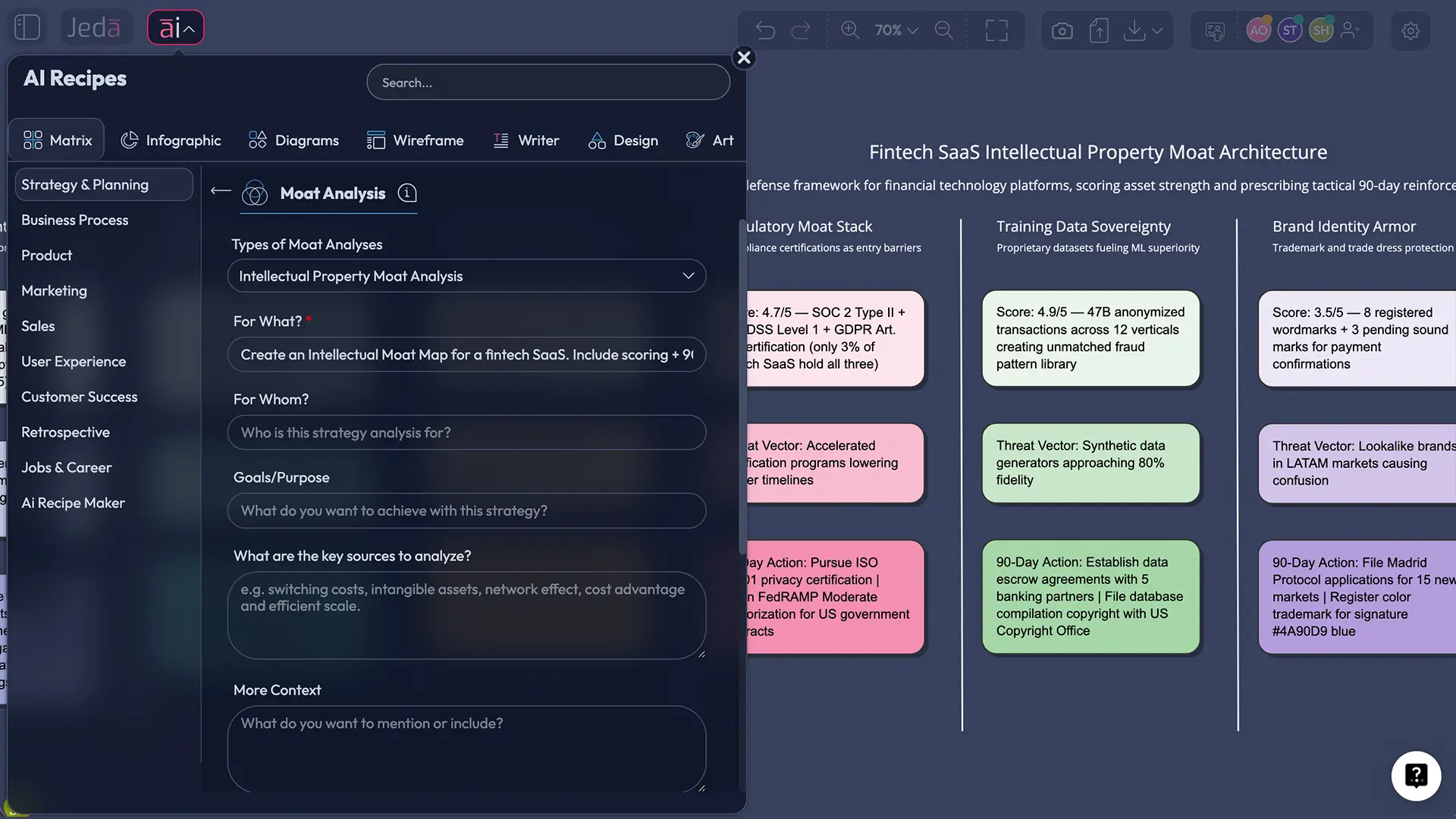
Most “moat analysis” content still treats defensibility like a static wall: patents here, brand there, switching costs somewhere in the middle. That view is dated.
In an AI-heavy market, the real edge is the compounding kind: the way your organization captures expertise, turns it into reusable decision logic, and then feeds it back into the system so the next decision gets faster and sharper. That’s the intellectual moat. And yes—AI can help you map it, stress-test it, and strengthen it in one working session inside an AI Workspace.
This guide shows how to run intellectual moat analysis with AI in Jeda.ai (used by 150,000+ users)—not as a fluffy brainstorm, but as a decision-ready model you can share, edit, and export (PNG, SVG, PDF) from your AI Whiteboard.
What is intellectual moat analysis?
Intellectual moat analysis is a structured way to identify, evaluate, and defend the intangible assets that make you hard to copy. Think: proprietary knowledge, patents and trade secrets, unique datasets, repeatable decision trees, and “how we do things here” expertise that competitors can’t reproduce on schedule.
It borrows from classic strategy logic—competitive advantage and value-chain thinking (Porter), resource-based advantage (Barney), and dynamic capabilities (Teece)—but it zooms in on intangible, knowledge-driven value creation: what you know, what you’ve captured, what you can teach a system to do, and how hard that system is to replicate.
Here’s the modern twist: some of the most defensible advantage isn’t just “IP filed with the patent office.” It’s codified expertise—tacit judgment turned into AI-ready artifacts like playbooks, ontologies, decision trees, and internal knowledge graphs. Lazard’s Technology Advisory work explicitly frames this as an “Intellectual Moat” that emerges after knowledge capture, structuring, integration, and governance.
Why use AI for intellectual moat analysis?
You can do moat analysis manually. You’ll also be finished sometime around 2038.
AI helps because an intellectual moat is multi-layered. It spans legal assets (patents, trademarks), operational assets (workflows), data assets (proprietary datasets), and human assets (tacit judgment). AI can:
- Inventory intangible assets fast (docs, product notes, customer calls, research, internal wikis)
- Cluster and label them into moat categories (IP, data, workflow lock-in, community, etc.)
- Score each asset on durability, defensibility, scalability, and imitation risk
- Stress-test: “What if a competitor ships a look-alike in 6 months?” “What if regulation changes?”
- Convert analysis into action: what to codify, what to protect, what to productize, what to abandon
And the big win: AI doesn’t have to live in a separate chat. In Jeda.ai, you run the analysis directly in the AI Workspace and keep the output editable on your AI Whiteboard—so your team can argue (politely), adjust assumptions, and ship an aligned plan.
- Moat inventory in minutes
Pull signals from docs, notes, and prior strategy artifacts, then structure them into a moat map you can actually review.
- Defensibility scoring
AI helps score each moat element by durability, protectability, and imitation speed—so you know what’s real and what’s a vibe.
- From insight to system
Turn judgment into repeatable assets: decision trees, playbooks, workflows, and knowledge graphs that compound over time.
The Intellectual Moat Map: the model we’ll build
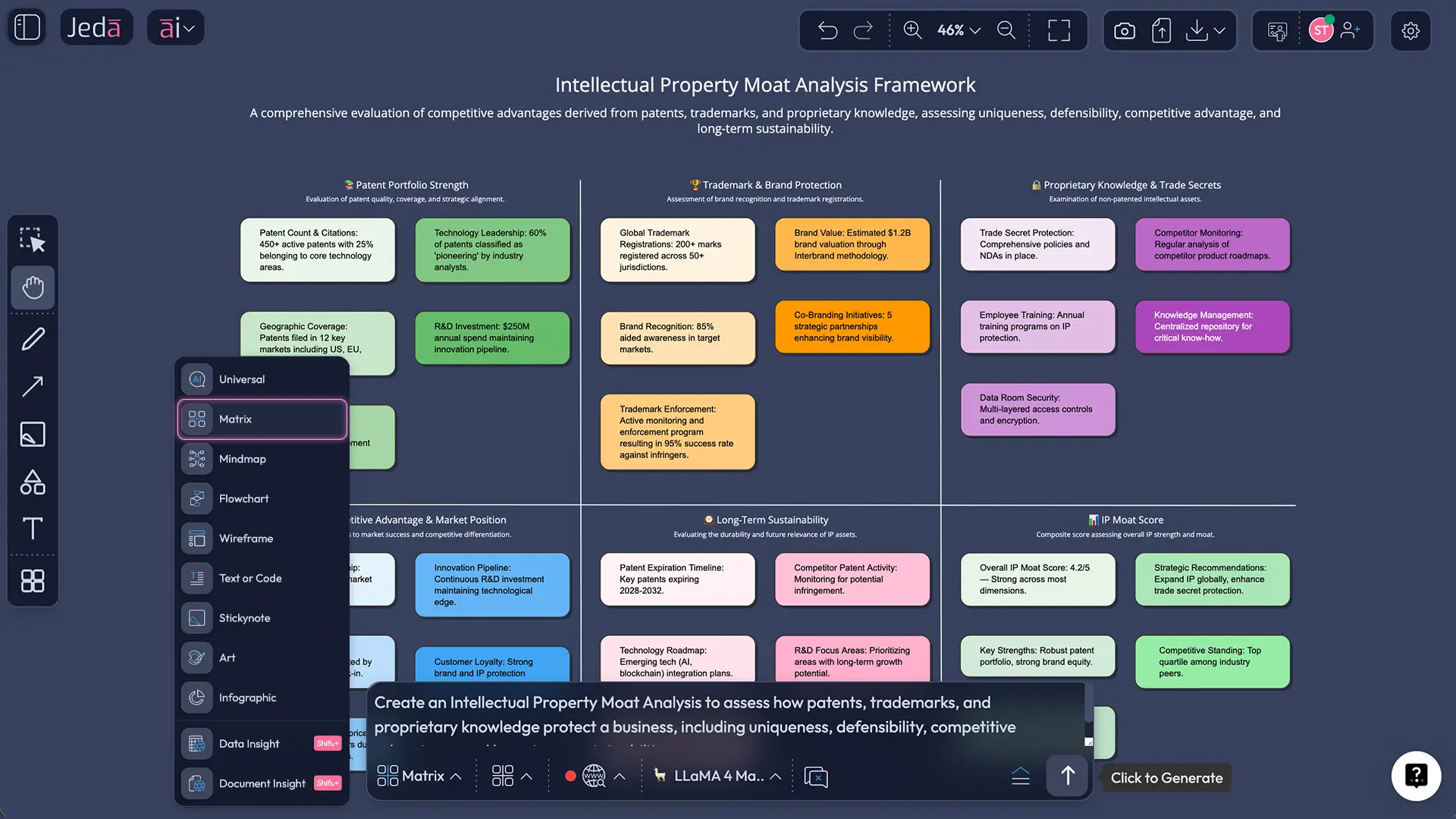
An Intellectual Moat Map is a simple matrix with one job: show what’s defensible, why it’s defensible, and how you widen it.
Core moat sources (practical version)
- Protected IP: patents, trademarks, copyrights, trade secrets
- Tacit expertise: hard-earned judgment, methods, heuristics, internal playbooks
- Proprietary data advantage: exclusive datasets or “data network effects”
- Workflow lock-in: your product becomes the “way work happens,” not a feature
- Community + distribution: trust, audience, partnerships, ecosystem gravity
- Learning loops: feedback loops that make the system better with use
- Compliance + governance: processes and approvals competitors can’t shortcut
You’ll score each area with four lenses:
- Durability (how long it lasts)
- Defensibility (how hard it is to copy / litigate / reverse-engineer)
- Scalability (how well it scales without heroics)
- Imitation risk (how quickly a competitor can match it)
How to create an Intellectual Moat Analysis in Jeda.ai
Because this is a sub-recipe of the Moat Analysis templates in Jeda.ai, you can generate it two ways:
- AI Menu recipe (recommended)
- Prompt Bar (flexible, faster for custom variants)
Method 1 — AI Menu (recommended)
Use this when you want the cleanest structure with the least prompt babysitting.
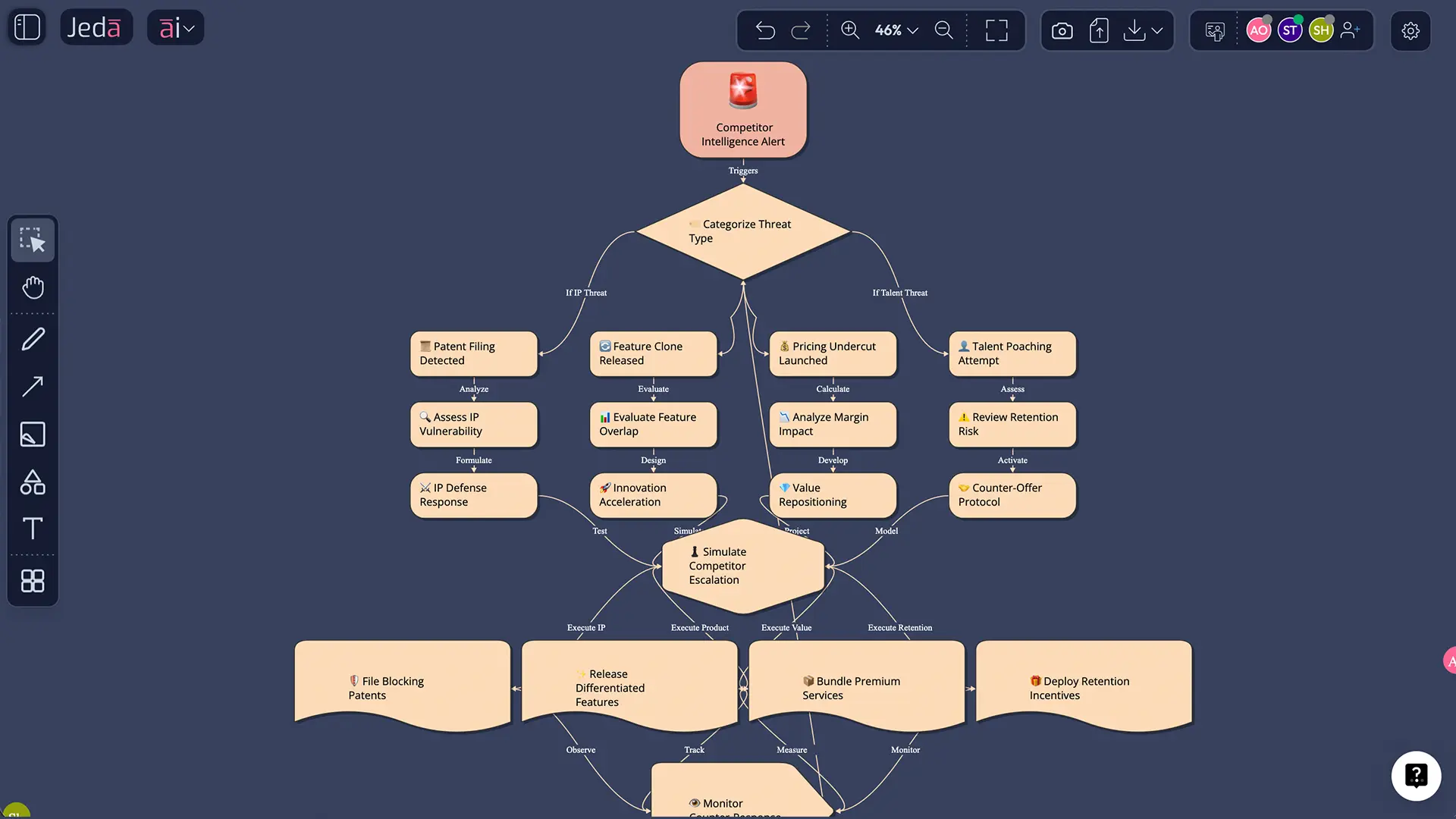
- Open AI Menu (top-left on the canvas)
- Go to Matrix Recipes
- Search for Moat Analysis
- Choose the Intellectual Moat variant (sub-recipe)
- Fill in inputs (industry, company, product, target customer, key competitors, constraints)
- Click Generate and review the matrix on your AI Whiteboard
Method 2 — Prompt Bar (build your own)
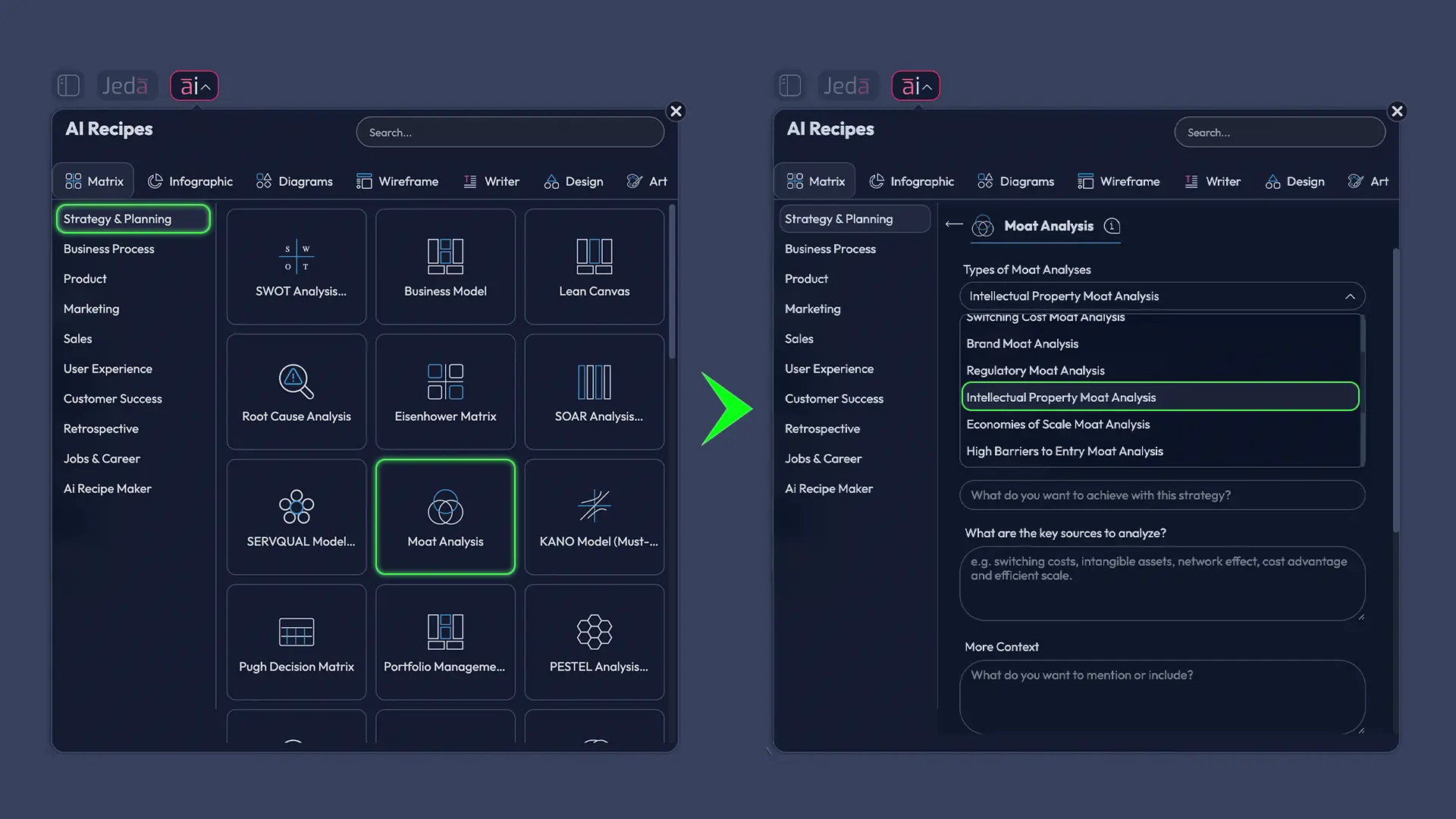
Use this when you want to add a scoring model, custom moat categories, or a more aggressive “stress test” section.
- Open the Prompt Bar at the bottom
- Select the Matrix command
- Paste the prompt below (edit the brackets)
- Press Enter to generate
- Define the competitive arena
Add industry, customer segment, and 3–5 competitors. You’re not building a moat in a vacuum.
- Generate the Intellectual Moat Map
In Jeda.ai, use the Moat Analysis recipe (Intellectual Moat) or select the Matrix command in the Prompt Bar.
- Score each moat element
Rate durability, defensibility, scalability, and imitation risk. Keep scores explainable, not mystical.
- Stress-test your assumptions
Ask what breaks if a competitor gets cheaper, faster, or AI-native. Capture counter-moves as actions.
- Codify and protect
Turn tacit expertise into artifacts: playbooks, decision trees, templates. Apply governance and access controls.
- Extend and convert outputs
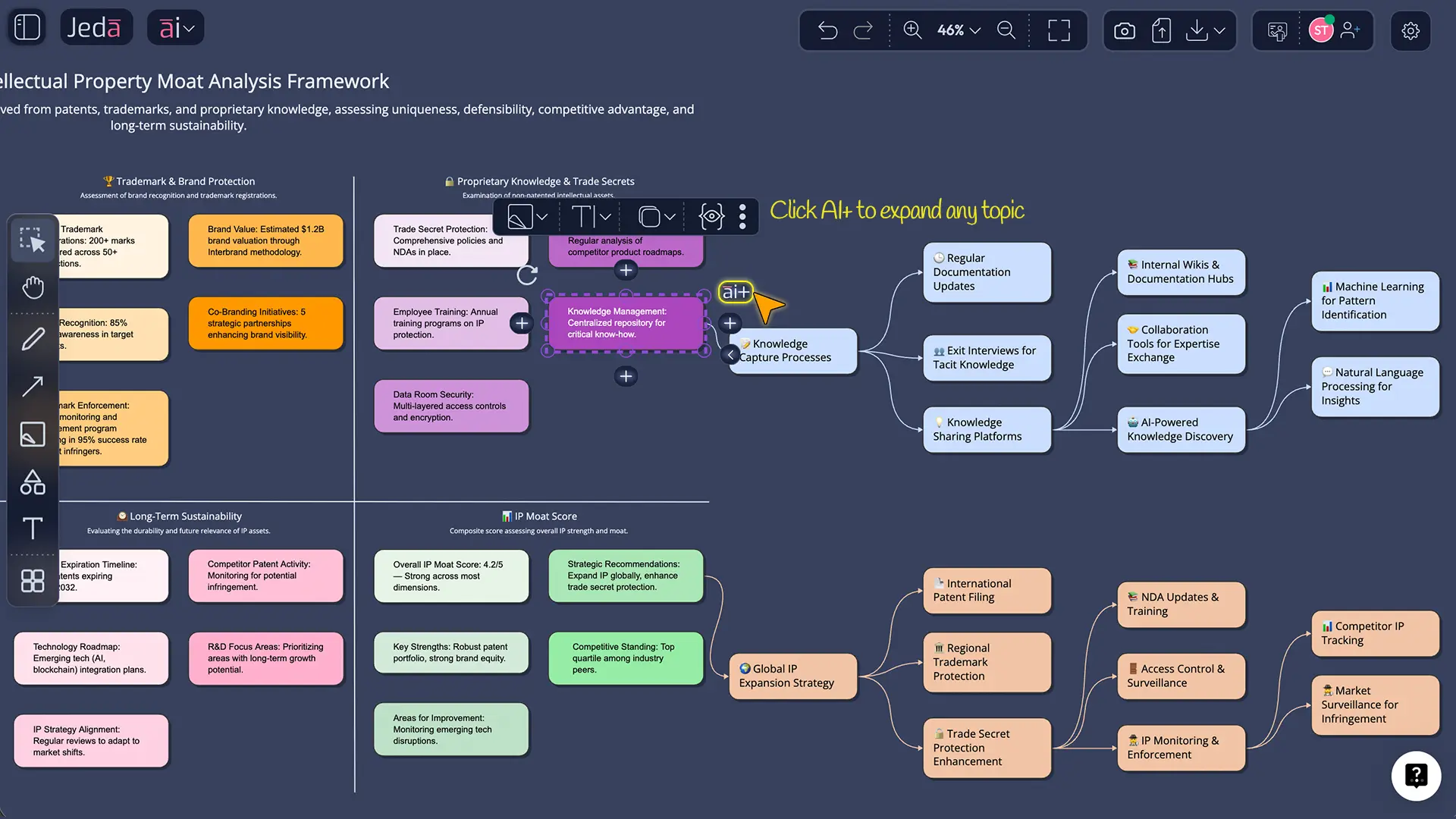
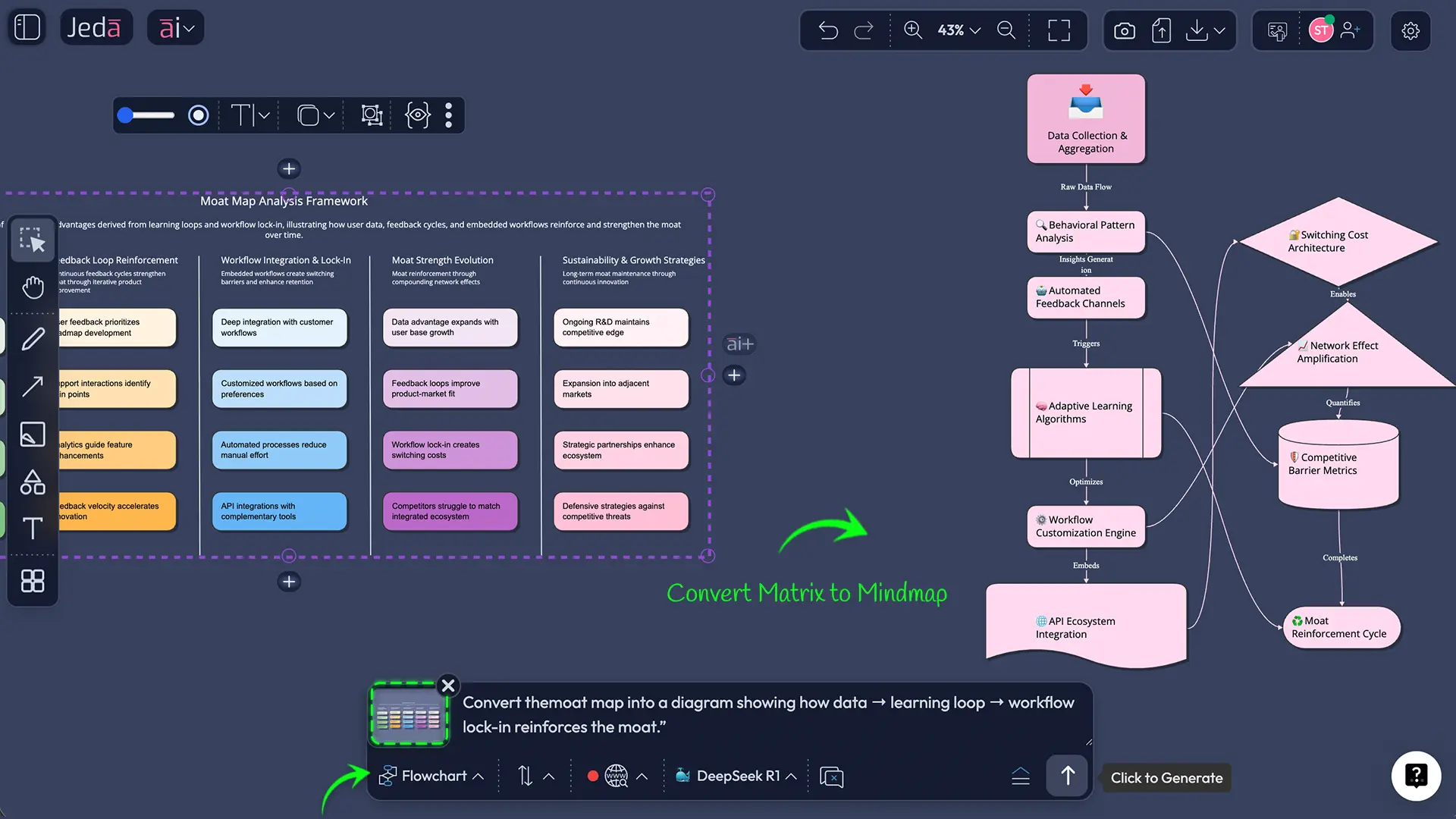
Tap the AI+ button to expand weak areas. Use Vision Transform to convert the matrix into a diagram or flowchart for execution planning.
Copy-paste prompt (Prompt Bar → Matrix)
Prompt:
Create an Intellectual Moat Analysis for [Company/Product] in [Industry] targeting [Customer Segment].
Build a matrix with 7 rows (Protected IP, Tacit Expertise, Proprietary Data Advantage, Workflow Lock-in, Community & Distribution, Learning Loops, Compliance & Governance).
For each row, include: (1) Current assets, (2) Evidence/examples, (3) Defensibility score 1–5 with 1-sentence justification, (4) Imitation risk 1–5, (5) “Widen the moat” actions for the next 90 days.
Include a final section: “If a well-funded competitor tries to copy us in 6 months, what do they do first—and how do we respond?”
Intellectual Moat template with a worked example
Let’s make it concrete. Example: “SignalStack”, a mid-market B2B SaaS that automates compliance reporting for fintech vendors.
Intellectual Moat Map (example snapshot)
Protected IP
- Assets: trademarked product suite name, proprietary rule engine implementation
- Evidence: internal technical docs + claims chart drafts (if any)
- Defensibility: 3/5 (protectable, but patents not filed yet)
- Imitation risk: 4/5 (features can be cloned)
- 90-day actions: file trademark in key markets; decide patent vs trade secret; tighten OSS license compliance
Tacit expertise
- Assets: compliance edge cases, auditor negotiation scripts, “what fails in audits” heuristics
- Evidence: customer support logs, analyst notes, implementation retros
- Defensibility: 4/5 (hard to copy if codified and kept current)
- Imitation risk: 2/5 (copying requires years of scar tissue)
- 90-day actions: interview top 5 experts; build a “decision-tree library” for common audit scenarios; ship internal playbooks
Proprietary data advantage
- Assets: anonymized patterns of audit findings across customers
- Evidence: aggregated dashboards and trend reports
- Defensibility: 4/5 (data scale matters)
- Imitation risk: 3/5 (competitor can buy some data, but not your longitudinal history)
- 90-day actions: formalize data collection; improve consent; build feedback loop from resolved cases into models
Workflow lock-in
- Assets: embedded into quarterly audit cycle, approval workflows, and vendor onboarding
- Evidence: customer process maps + renewal notes
- Defensibility: 4/5 (switching cost is process change)
- Imitation risk: 3/5
- 90-day actions: create “audit-season workspace template”; integrate approvals into existing workflows; publish export-ready evidence packs
Community & distribution
- Assets: niche compliance newsletter, partnerships with 2 audit firms
- Evidence: subscriber growth, referral counts
- Defensibility: 3/5
- Imitation risk: 4/5
- 90-day actions: build practitioner community calls; co-author field guides; widen distribution with templates
Learning loops
- Assets: each audit cycle generates new edge cases + resolved resolutions
- Evidence: post-mortems and time-to-resolution metrics
- Defensibility: 5/5 (compounding advantage)
- Imitation risk: 2/5
- 90-day actions: instrument feedback loop; make “case outcome → new rule → updated playbook” automatic
Compliance & governance
- Assets: certified cloud infrastructure, internal access policies, audit trails
- Evidence: security policy docs, access logs
- Defensibility: 3/5 (table stakes in some markets, differentiator in others)
- Imitation risk: 3/5
- 90-day actions: tighten permissioning; formalize role-based controls; build “trust” collateral for enterprise buyers
Use AI to widen the moat, not just describe it
Here’s the piece that separates “analysis theater” from real strategy: codification.
Lazard’s framework lays out a clear ladder: knowledge capture → structuring → integration/augmentation → governance/security → Intellectual Moat. That ladder is operational. You can implement it.
Practical playbook: turn tacit expertise into defensible systems
And yes—this is where Jeda.ai is built to be useful. You’re not pasting a theory into a doc. You’re building the map in an AI Workspace, collaboratively, on an AI Whiteboard, and then exporting a shareable artifact your team can act on.
Common mistakes to avoid
- Calling anything “a moat” because it’s clever. Clever is easy to copy. Durable is not.
- Over-indexing on patents. Patents can help, but strategy also lives in data, workflows, and learning loops.
- Mistaking “we have data” for “we have a data advantage.” If competitors can buy similar data, you don’t have a moat.
- Not capturing tacit knowledge. If your best people leave and your advantage leaves with them, your moat is imaginary.
- Ignoring governance. A moat that leaks (internally or externally) doesn’t compound—it evaporates.
- Failing to test imitation speed. If a competitor can match you in one sprint, that’s not a moat; that’s a feature request.
Frequently Asked Questions
- What is intellectual moat analysis?
- Intellectual moat analysis is a structured method for identifying and evaluating the intangible assets—knowledge, IP, data, and decision systems—that make a business hard to copy. The output is a defensibility map with scores and concrete actions to widen the moat.
- How is an intellectual moat different from an economic moat?
- An economic moat is the broad umbrella of durable competitive advantage. An intellectual moat focuses specifically on intangible, knowledge-driven advantages—codified expertise, proprietary data, IP, and learning loops—often accelerated by how AI systems are trained, used, and improved.
- Can AI really help with moat analysis, or does it just generate buzzwords?
- AI helps when it’s forced into structure: categories, evidence, scoring, and stress tests. In a visual AI Workspace like Jeda.ai, you can keep the analysis accountable by attaching examples, scoring logic, and actions directly to each moat element.
- What inputs do I need to run intellectual moat analysis with AI?
- Start with your product description, target customers, competitors, and any proof you have: patents, technical docs, customer feedback, usage patterns, and internal process notes. The richer the evidence, the sharper the moat map and scoring.
- Which Jeda.ai command should I use for intellectual moat analysis?
- Use the Matrix command for the moat map and scoring table. Then use Diagram to map how moat elements reinforce each other, or Flowchart to convert moat actions into an execution plan. You can also use AI+ to expand weak areas.
- Does Jeda.ai have a template for this?
- Yes. Intellectual Moat Analysis is a sub-recipe inside the Moat Analysis templates in Jeda.ai’s AI Menu. You can also generate custom variants using the Prompt Bar with the Matrix command.
- How do I score an intellectual moat fairly?
- Use clear criteria: durability (years of advantage), defensibility (legal or practical barriers), scalability (can it grow without heroics), and imitation speed (time for a strong competitor to match). Keep each score justified in one sentence.
- What are examples of intellectual moats?
- Examples include proprietary datasets that improve a product with use, codified expert playbooks that guide decisions, decision-tree libraries built from years of edge cases, patented methods with strong claims, or workflow lock-in where customers build their operations around your system.
- How often should a company update its moat analysis?
- Quarterly is a practical cadence for most teams. Update faster if your market is moving quickly, a competitor changes pricing, or a new technology shift alters imitation speed. Treat moat analysis like strategy hygiene, not a one-off workshop.
- What’s the fastest way to widen an intellectual moat in 30–90 days?
- Codify what your experts know into reusable assets: templates, playbooks, decision trees, and a shared domain glossary. Then add governance—access control and audit trails—and connect the loop so each customer interaction improves your system.
Sources & further reading
- [1]
Lazard Technology Advisory (2025) . “AI Impact on Technology M&A (Intellectual Moat and tacit knowledge codification)” Lazard.
View Source ↗ - [2]
Barney, Jay (1991) . “Firm Resources and Sustained Competitive Advantage” Journal of Management.
View Source ↗ - [3]
Porter, Michael E. (1985) . “Competitive Advantage: Creating and Sustaining Superior Performance” Free Press / Harvard Business School Faculty.
View Source ↗ - [4]
Teece, David J.; Pisano, Gary; Shuen, Amy (1997) . “Dynamic Capabilities and Strategic Management” Strategic Management Journal.
View Source ↗ - [5]
Levin, Richard C.; Klevorick, Alvin K.; Nelson, Richard R.; Winter, Sidney G. (1987) . “Appropriating the Returns from Industrial Research and Development” Brookings Papers on Economic Activity.
View Source ↗ - [6]
Morningstar (2025) . “Economic Moat (Investing Terms and Definitions)” Morningstar.
View Source ↗
Build Your Intellectual Moat in One AI Workspace
Join over 150,000+ users who use Jeda.ai to turn knowledge into editable, defensible strategy on an AI Whiteboard.
Try Free Template