The 40 Inventive Principles are TRIZ’s most-used library of solution patterns for breaking trade-offs. The canonical list is widely published by TRIZ bodies and teaching resources.
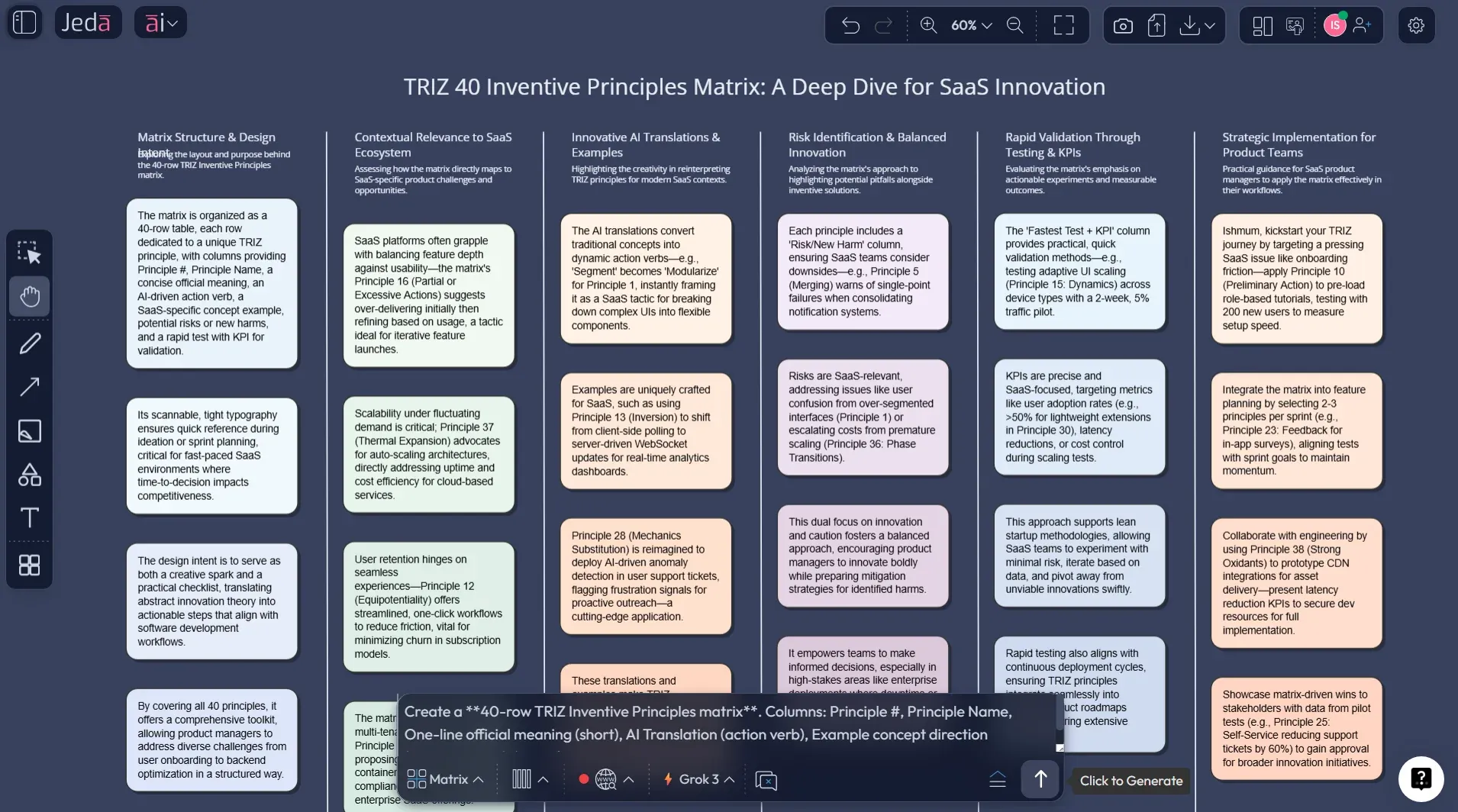
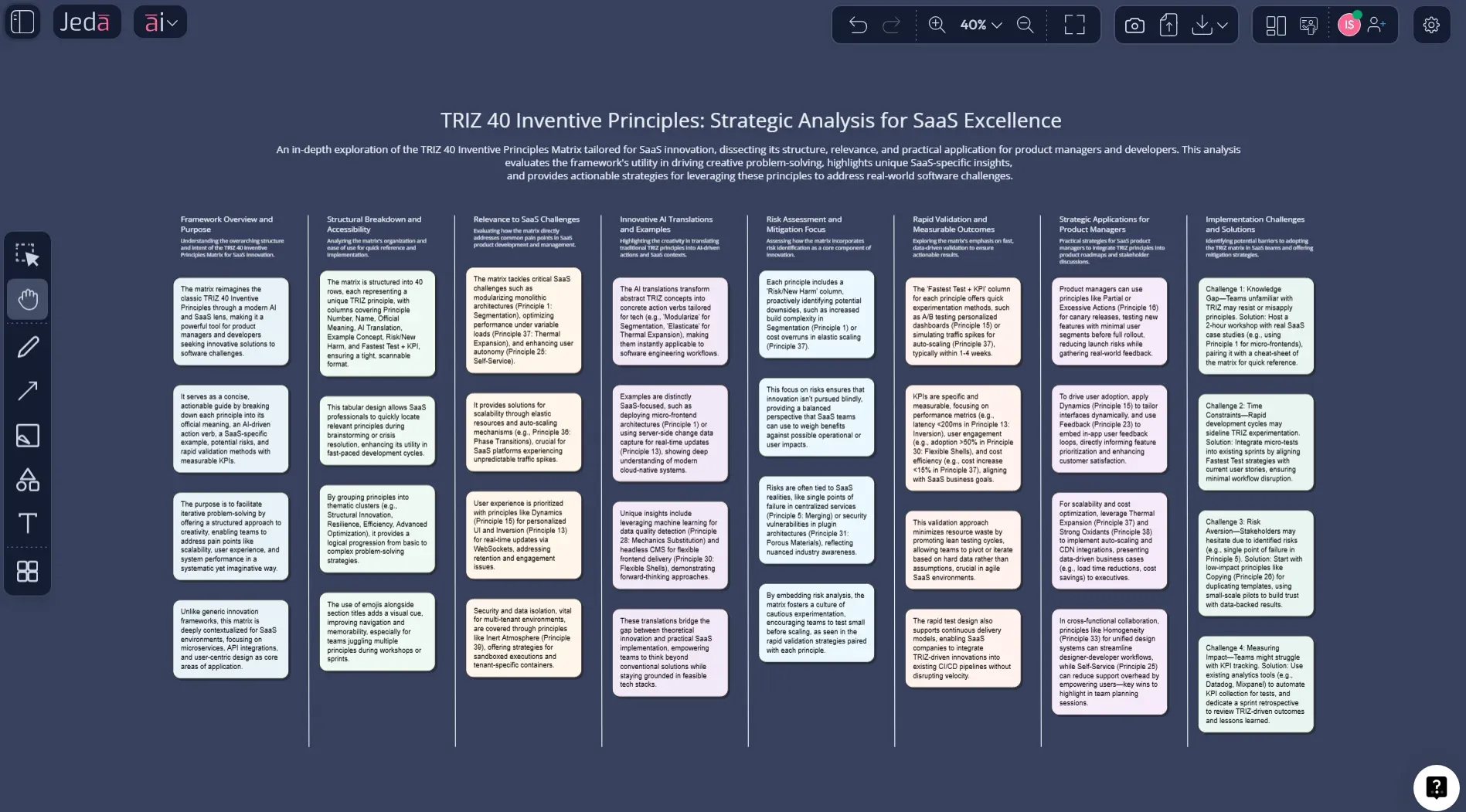
This page turns the principles into a matrix workflow you can run with AI in Jeda.ai: principle → translation → concept direction → risk → fastest test.
What this page delivers (professional output)
You will end up with a 40-row matrix where each row contains:
- Principle # + name
- “AI translation” (action verb)
- One context-specific concept direction
- Risk / new harm
- Fastest falsifiable test + KPI
This matters because teams often stop at “list principles.” A matrix forces execution.
How to run Inventive Principles with AI in Jeda.ai (Matrix)
Method 1 — AI Recipe Templates (AI Menu)
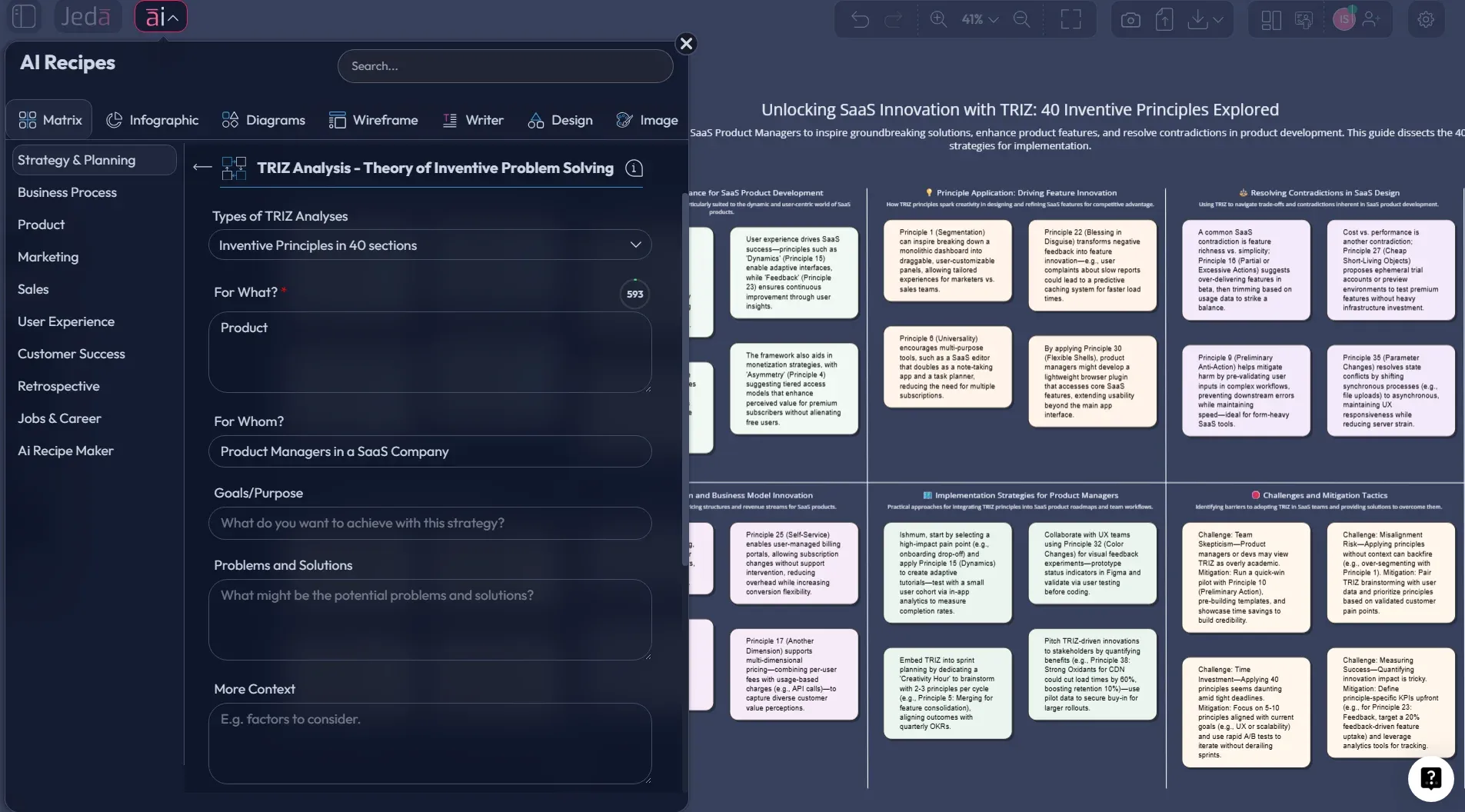
- Open your board → AI Menu / AI Recipes.
- Go to TRIZ → select Inventive Principles.
- Input:
- Contradiction statement: Improve X → worsens Y
- System context
- Constraints (must-not-change)
- Generate the 40-row principles matrix.
- Score and shortlist 5–8 principles. Expand only those into prototypes/tests.
The 40 Inventive Principles (40 sections)
Format per principle: AI translation → concept direction → fastest test + KPI
Use these as copy/paste rows into your matrix.
1) Segmentation
Translate: modularize / split into parts.
Direction: split the subsystem so only the critical region is optimized.
Test: prototype modular variant; KPI: defect rate or cycle time improvement vs baseline.
2) Taking out (Extraction)
Translate: remove or isolate the disturbing element.
Direction: isolate the harmful interaction into a removable insert or externalize it.
Test: A/B insert vs baseline; KPI: failure mode reduction.
3) Local quality
Translate: vary properties locally.
Direction: strengthen only hot-spots; keep non-critical zones lightweight.
Test: strain/thermal map; KPI: peak reduction with minimal mass increase.
4) Asymmetry
Translate: break symmetry intentionally.
Direction: asymmetric geometry to prevent misalignment or distribute load.
Test: misalignment tolerance test; KPI: error rate reduction.
5) Merging
Translate: combine steps/functions.
Direction: merge two process steps into one pass.
Test: pilot run; KPI: throughput increase without defect increase.
6) Universality
Translate: make one element do multiple jobs.
Direction: reuse an existing structural element as a heat sink or guide.
Test: functional validation; KPI: parts count reduction + performance maintained.
7) Nested doll
Translate: place one object inside another.
Direction: nested protective sleeve in impact zone rather than thickening the whole body.
Test: drop test; KPI: survivability improvement without mass increase.
8) Anti-weight (Counterbalance)
Translate: counteract weight with counterforce.
Direction: add counterbalance to reduce actuator load instead of upgrading motor.
Test: measure required torque; KPI: torque reduction %.
9) Preliminary anti-action
Translate: preemptively counter the harm.
Direction: pre-compensate expected distortion before it occurs.
Test: cycle test; KPI: drift reduction.
10) Preliminary action
Translate: do it in advance.
Direction: pre-stage components or pre-align before the critical step.
Test: time study; KPI: cycle time reduction.
11) Beforehand cushioning
Translate: add protection in advance.
Direction: sacrificial buffer in high-wear or impact path.
Test: wear test; KPI: lifetime increase.
12) Equipotentiality
Translate: reduce potential differences.
Direction: level/standardize the environment to avoid spikes (pressure, voltage, height).
Test: variance measurement; KPI: variance reduction.
13) The other way round (Inversion)
Translate: invert the action or arrangement.
Direction: pull instead of push; cool from inside instead of outside.
Test: compare efficiency; KPI: energy reduction at equal output.
14) Spheroidality / Curvature
Translate: replace straight with curved/rounded.
Direction: curved flow path to reduce local stress or turbulence.
Test: CFD or bench test; KPI: loss reduction.
15) Dynamics
Translate: make it adjustable/adaptive.
Direction: adaptive parameter control (e.g., force, speed) based on feedback.
Test: closed-loop pilot; KPI: variance reduction.
16) Partial or excessive action
Translate: do less or more than “perfect.”
Direction: over-provide a feature to relax tolerance constraints.
Test: tolerance study; KPI: defect reduction.
17) Another dimension
Translate: add a dimension / reorient.
Direction: stack vertically instead of expanding footprint.
Test: layout prototype; KPI: space saving.
18) Mechanical vibration
Translate: introduce controlled vibration.
Direction: micro-vibration to reduce friction during insertion/transport.
Test: insertion force test; KPI: force reduction.
19) Periodic action
Translate: pulse instead of continuous.
Direction: pulsed heating/cooling to reduce energy while maintaining effect.
Test: energy audit; KPI: kWh reduction.
20) Continuity of useful action
Translate: keep the useful action running.
Direction: remove idle time via buffering or parallelization.
Test: utilization analysis; KPI: utilization increase.
21) Skipping
Translate: bypass unnecessary steps.
Direction: eliminate a step by redesigning sequence or using in-process sensing.
Test: pilot; KPI: time reduction without quality drop.
22) Blessing in disguise
Translate: convert harm into benefit.
Direction: use waste heat, vibration, or byproducts as a useful function input.
Test: measurement; KPI: net energy reduction or new function achieved.
23) Feedback
Translate: close the loop.
Direction: add measurement + control to auto-correct drift.
Test: feedback pilot; KPI: drift reduction.
24) Intermediary
Translate: add a mediator.
Direction: coupling layer to reduce stress transfer or isolate contamination.
Test: fatigue/contamination test; KPI: failure reduction.
25) Self-service
Translate: make the system serve itself.
Direction: self-cleaning/self-calibrating using existing flows or cycles.
Test: long-run test; KPI: maintenance interval increase.
26) Copying
Translate: use a cheap copy/simulation.
Direction: digital twin or mock substitute for early validation.
Test: prototype count; KPI: iterations reduced.
27) Cheap short-living objects
Translate: replace with disposable parts.
Direction: replaceable wear insert instead of replacing whole component.
Test: lifecycle cost model; KPI: cost per cycle reduced.
28) Mechanics substitution
Translate: replace mechanical with field/software.
Direction: replace a mechanical switch with sensor + control logic.
Test: reliability test; KPI: MTBF improvement.
29) Pneumatics and hydraulics
Translate: use fluid/air power.
Direction: air cushion/bearing to reduce contact wear.
Test: wear bench; KPI: wear rate reduction.
30) Flexible shells and thin films
Translate: use membranes/films.
Direction: thin protective layer instead of thick structure.
Test: protection vs weight; KPI: strength-to-weight improvement.
31) Porous materials
Translate: introduce porosity.
Direction: porous layer for damping, filtration, or heat exchange.
Test: vibration/thermal test; KPI: amplitude or peak reduction.
32) Color changes
Translate: add visual state signaling.
Direction: indicator coating for wear/temperature state.
Test: detection accuracy; KPI: error rate reduction.
33) Homogeneity
Translate: align materials/properties.
Direction: match interacting materials to reduce corrosion/wear.
Test: corrosion/wear test; KPI: rate reduction.
34) Discarding and recovering
Translate: discard temporarily, then recover.
Direction: temporary supports removed after curing/assembly.
Test: process trial; KPI: defect reduction.
35) Parameter changes
Translate: change physical parameters.
Direction: vary temperature/pressure/viscosity during process for stability.
Test: DOE; KPI: quality metric improvement.
36) Phase transitions
Translate: use state changes.
Direction: phase-change material to buffer peaks.
Test: peak monitoring; KPI: peak reduction.
37) Thermal expansion
Translate: use expansion/contraction.
Direction: thermal fit instead of fasteners.
Test: assembly time + strength; KPI: time reduced without strength loss.
38) Strong oxidants
Translate: intensify chemical action (controlled).
Direction: stronger cleaning/oxidation only in controlled micro-zone.
Test: efficacy + safety; KPI: cleaning rate improved under constraints.
39) Inert atmosphere
Translate: change environment to inert/neutral.
Direction: inert gas to prevent oxidation during sensitive step.
Test: defect measurement; KPI: oxidation defects reduced.
40) Composite materials
Translate: combine materials for tailored properties.
Direction: composite layer: stiff where needed, compliant elsewhere.
Test: strength-to-weight; KPI: improvement vs baseline.