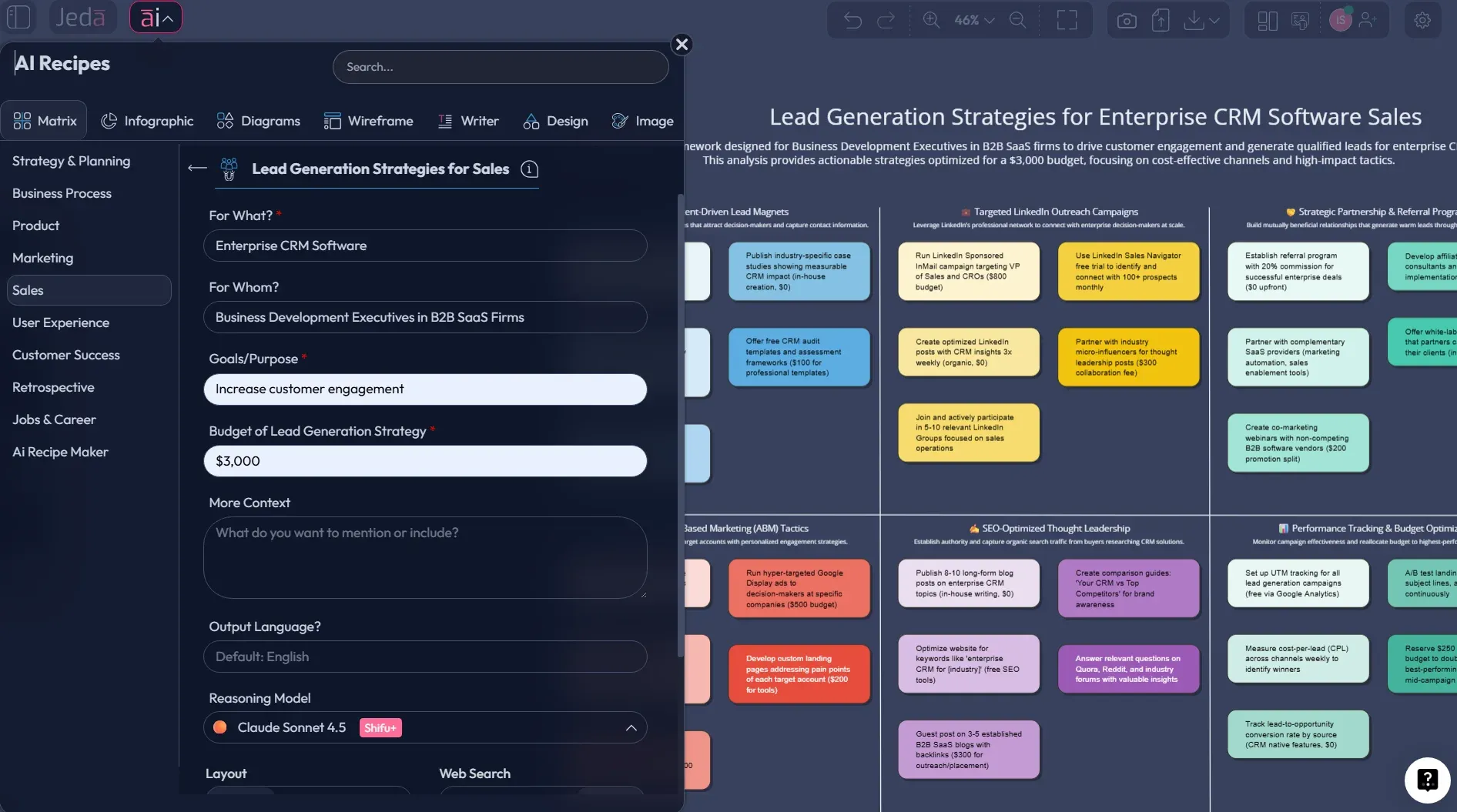
Lead generation strategies with AI are no longer a nice extra for ambitious sales teams. They are becoming the operating system for how modern teams identify demand, qualify real opportunities, and stop wasting time on leads that were never going to buy in the first place. In Jeda.ai, you can turn that messy work into a clear, visual system inside one AI Workspace and AI Whiteboard—not five tabs, three docs, and one sad spreadsheet.
That shift matters because the old model is cracking. Buyers move across channels, expect relevance, and often arrive with opinions already formed. McKinsey points to omnichannel sales, automation, data analytics, and hyperpersonalization as core practices among stronger B2B performers, while 6sense’s 2025 Buyer Experience Report says the average B2B buying cycle was 10.1 months and that buyers often decide on likely winners before first contact.
And that is exactly why this page exists.
Instead of treating lead gen like a pile of disconnected tactics, you can map the whole thing visually in Jeda.ai: target segments, channel bets, offers, qualification rules, follow-up paths, objections, and KPIs. Better yet, you can generate it fast, extend it with AI+, and keep the whole thing editable on the canvas for your team.
What are lead generation strategies?
Lead generation strategies are structured ways to attract potential buyers, capture their interest, qualify them, and move them toward a sales conversation. Salesforce defines lead generation as building interest in a product or service and then turning that interest into a sale. Mailchimp frames lead generation strategies as systematic approaches used to attract and capture interest across channels.
The useful distinction is this: tactics are isolated moves; strategy is the system.
A webinar is a tactic. A referral request is a tactic. A landing page is a tactic. But the strategy is how those pieces connect. Who are you targeting? What promise gets attention? Which channel fits which segment? What counts as a qualified lead? Which touch gets the handoff to sales?
Most teams skip that structure. Then they wonder why volume goes up while pipeline quality quietly falls off a cliff.
That is where Jeda.ai earns its keep. The platform’s Matrix command is built for structured frameworks, the AI Menu provides 300+ strategic frameworks and recipe-led workflows, web search is a platform capability, and AI+ can extend existing visuals without forcing you to start over. Those details matter because this topic is not just “write me some ideas.” It is strategy design.
Why use lead generation strategies with AI?
Because modern lead generation is a coordination problem.
Content, outreach, paid channels, qualification, chat, nurture flows, CRM handoff, and reporting all affect each other. HubSpot’s guide highlights content, SEO, email, social media, blog posts, trials, and referrals as active lead-generation levers; its 2025 marketing data also points to website/blog/SEO, email, content, and paid social as meaningful ROI channels.
AI helps when you need to do four things at once:
- Spot patterns faster.
- Prioritize channels more rationally.
- Personalize messaging without hand-writing every variant.
- Keep the plan visible enough that sales and marketing can actually use it.
There is another layer now. McKinsey notes that gen AI can help sellers find next-best opportunities by processing disparate and unstructured data sources. Springer research on AI-powered B2B marketing also shows adoption is not just a tooling issue; it changes how teams coordinate work and decision-making.
That makes Jeda.ai a strong fit because it is not just an answer box. It is a Visual AI environment where you can generate a lead generation system, edit it, debate it, and refine it together in one AI Workspace.
- Segment-first planning
Map ICPs, buyer pains, entry offers, and channels in one matrix instead of scattered notes.
- AI-assisted qualification
Use AI to sharpen lead scoring logic, signal thresholds, and conversion assumptions before campaigns go live.
- Visible workflows
Turn strategy into follow-up paths, nurture logic, and routing flows your team can actually follow.
- Current context
Use Jeda.ai web search as a platform feature when your strategy needs live market or competitor context.
- Shared alignment
Keep sales, marketing, and leadership on one editable board instead of arguing across tools.
- Fast iteration
Use AI+ to extend parts of the strategy without regenerating the whole board from scratch.
Why the old lead-gen playbook breaks
Look, plenty of teams still confuse activity with pipeline.
They publish content with no offer architecture. They buy traffic without qualification logic. They run outbound without a clear segment hierarchy. Then they celebrate “more leads” and spend the next quarter filtering junk.
That is not a lead generation problem. It is a system design problem.
Two current realities make the old playbook brittle:
First, buying journeys are long and distributed. The 6sense 2025 B2B Buyer Experience Report says average cycles were 10.1 months. That means you cannot judge channel value with cartoonishly short windows.
Second, conversational experiences are changing capture behavior. A 2025 field-experiment study in the Journal of Business Research found that WhatsApp-based chatbots generated significantly more, and higher-quality, B2B leads than traditional landing pages in the tested context. That does not mean “replace every landing page.” It does mean static forms are no longer the only serious option.
So the teams that win are usually the ones that think in systems: segment → offer → channel → capture → qualify → route → nurture → measure.
That sequence is exactly what a matrix-led visual planning workflow handles well.
How to create lead generation strategies in Jeda.ai
You asked for the workflow exactly this way, so here it is without unnecessary jazz hands.
Method 1: Use the Recipe Matrix in the AI Menu
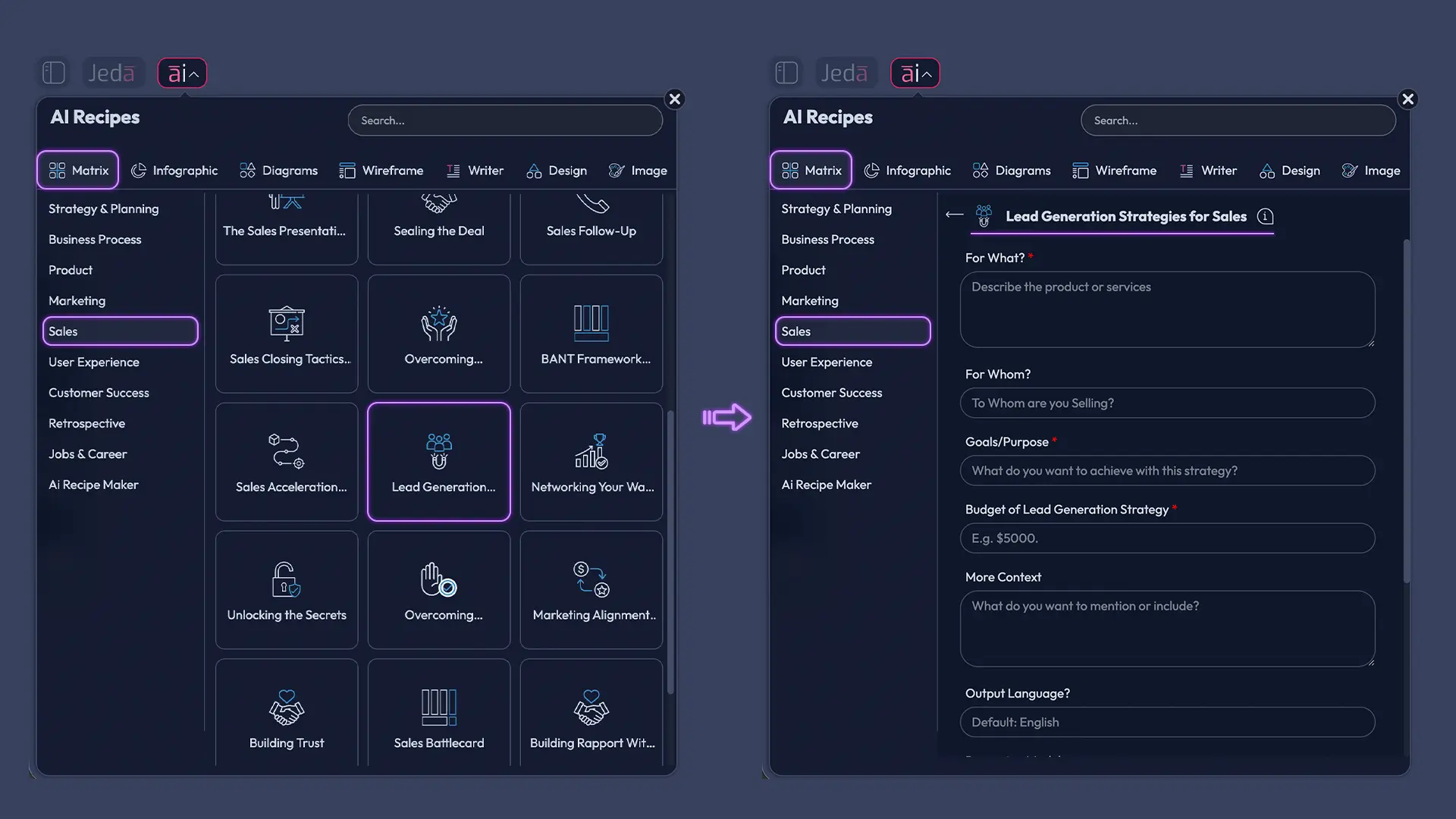
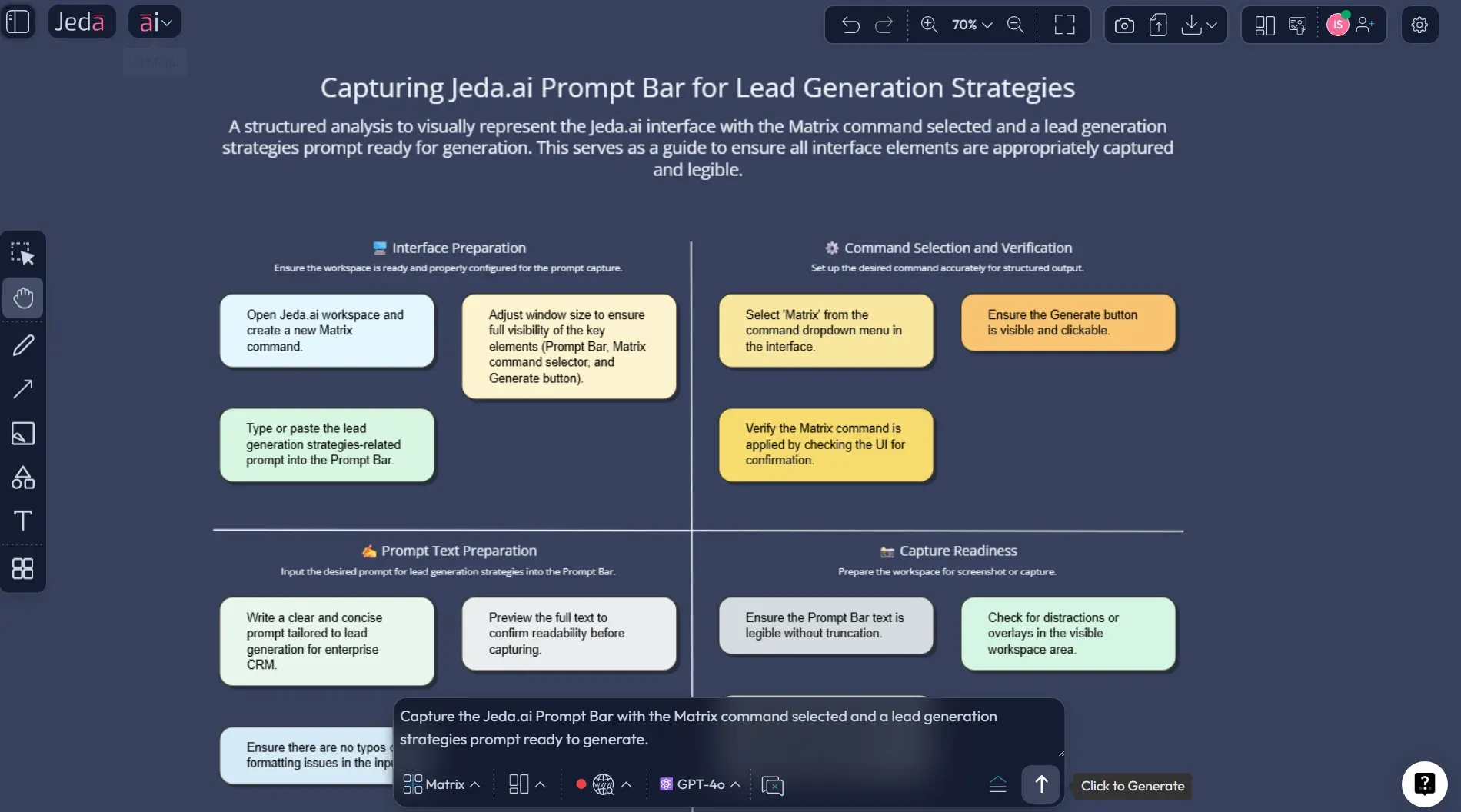
This is the recommended route because your topic is a Sales matrix recipe. In Jeda.ai, the AI Menu gives access to guided AI Recipes, and Matrix recipes are designed for structured analytical frameworks. The platform documentation shows the AI Menu at the top-left and confirms Matrix recipes are used for structured strategic outputs.
Start with the recipe when you want cleaner setup, better prompting guardrails, and less blank-canvas nonsense.
- Open the AI Menu
Click the AI Menu in the top-left corner of the Jeda.ai workspace to open AI Recipes.
- Choose Matrix and go to Sales
Select the Matrix recipe category, then open the Sales subcategory and choose the Lead Generation Strategies recipe.
- Fill in the business context
Add your offer, target audience, buying triggers, ideal channels, qualification criteria, and core conversion goal.
- Generate the lead strategy matrix
Let Jeda.ai create a structured lead generation plan with channel ideas, campaign logic, and qualification paths arranged visually.
- Review and edit on canvas
Refine messaging, rename quadrants, change priorities, and adjust segments directly on the AI Whiteboard.
- Extend the strongest section with AI+
Select any high-potential part of the matrix and use the AI+ button to expand it with more detail, variants, or supporting ideas.
- Transform if needed
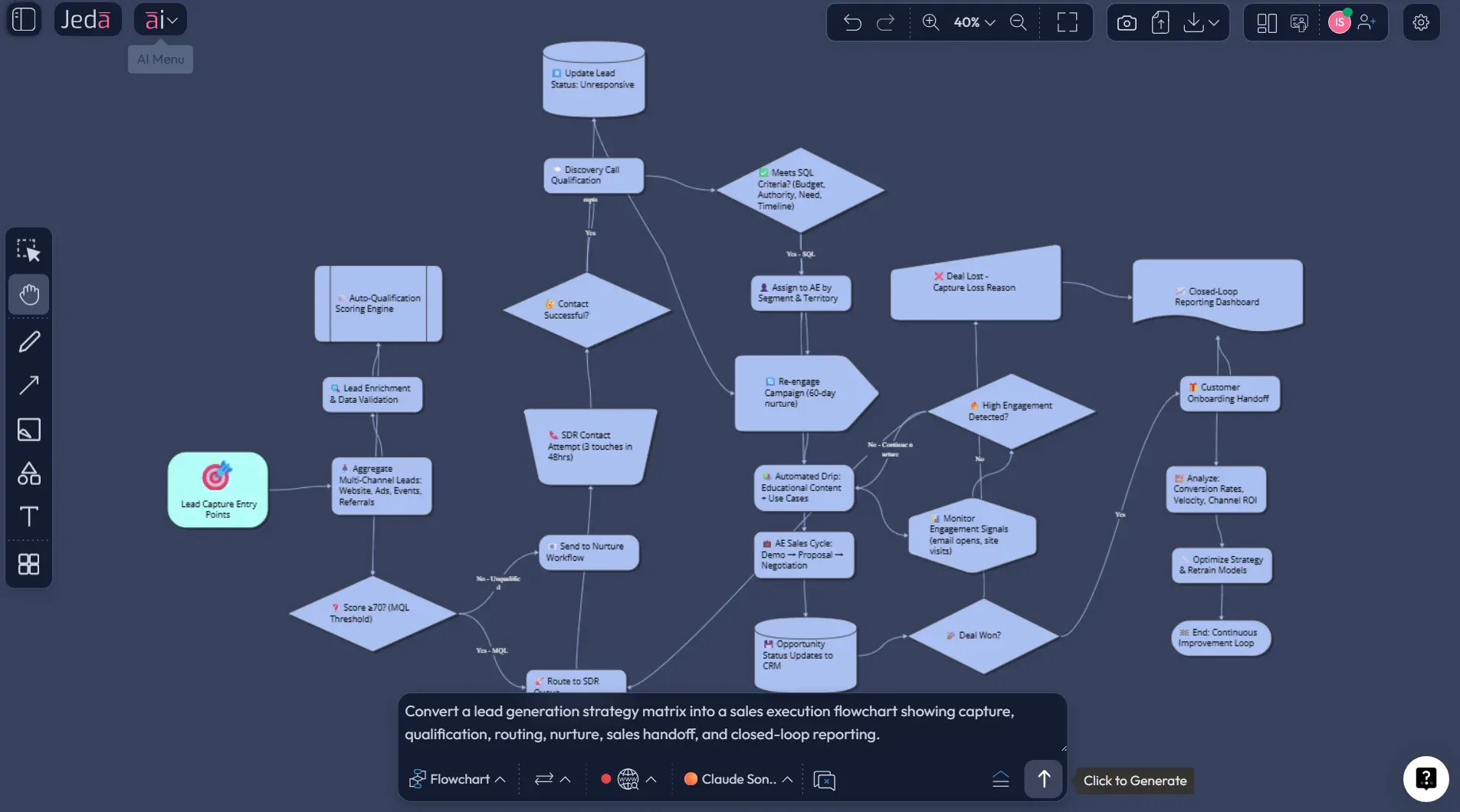
Use Vision Transform to convert the matrix into a flowchart, mind map, or another visual format for execution planning.
Method 2: Use the Prompt Bar
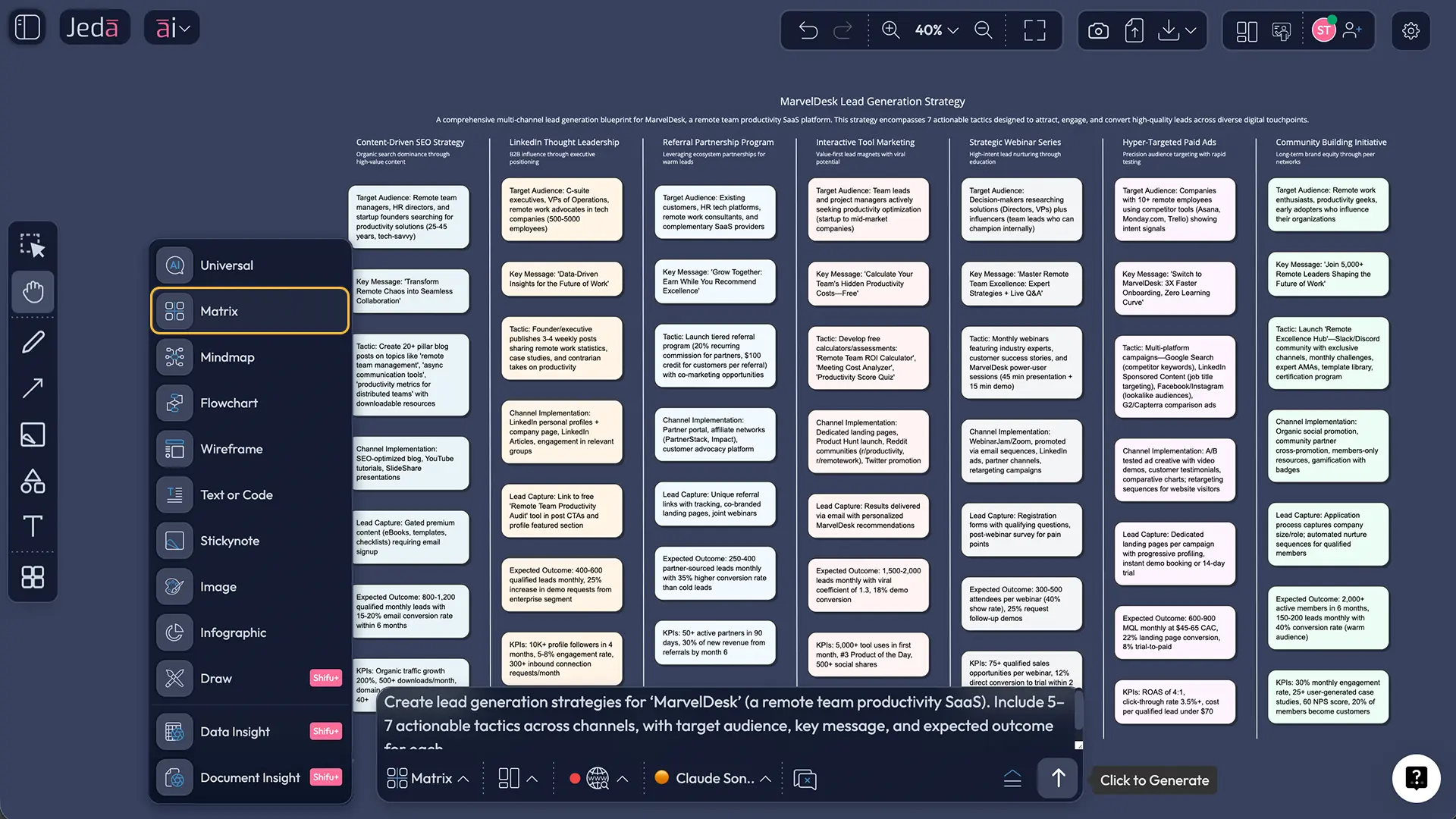
This route is better when you already know what you want and do not need the guided form. The Jeda.ai workflow file makes it clear: choose the command in the Prompt Bar, enter your prompt, and generate. For this topic, the command mapping points to Matrix, Diagram, and Mindmap because the topic is strategic and planning-heavy.
Here is a prompt that works:
Prompt example:
“Create a lead generation strategies matrix for a B2B SaaS company selling workflow automation to operations leaders. Include ICP segments, high-intent channels, lead magnets, qualification criteria, nurture motions, common objections, and KPIs.”
Method 3: Use AI+ for a deeper dive
AI+ is for extension, not for replacing your original structured prompt. That is the right way to use it here.
Select a quadrant like “High-intent channels” or “Lead qualification rules,” then use the AI+ button to deepen that section. Ask it to expand channel-specific plays, add scoring criteria, suggest follow-up variations, or broaden the objection map. Keep it additive. Keep it attached to existing context. That is where AI+ shines in Jeda.ai.
A practical example: what a strong AI-led lead generation board looks like
Imagine a mid-market B2B SaaS team targeting operations directors.
A weak strategy board says: “Use LinkedIn, email, content, webinar.”
That is wallpaper.
A strong board says:
- ICP 1: Operations leaders at 200–1000 employee companies
- Pain: Workflow delays, poor visibility, too many manual approvals
- Top channels: SEO for bottom-funnel use cases, LinkedIn retargeting, webinar partnerships, outbound to engaged accounts
- Lead magnet: ROI calculator + operational bottleneck assessment
- Qualification signals: demo-page views, repeat visits, case-study engagement, buying committee size, fit score
- Nurture motion: problem education → workflow benchmark → proof asset → consultative CTA
- Sales handoff rule: MQL only when fit and intent both cross threshold
- KPIs: CPL, MQL-to-SQL, opportunity rate, sales-cycle compression, influenced pipeline
That is strategy. It gives the team a system, not a slogan.
And yes, you can build that inside one AI Workspace, keep it editable, and keep pushing it forward with AI+ as more data comes in.
Best practices for lead generation strategies with AI
A few rules make this work much better.
HubSpot’s lead-gen guidance supports a multi-channel model built around content, email, social, offers, trials, and referrals, while McKinsey’s current B2B sales work reinforces omnichannel, automation, and hyperpersonalization as meaningful growth levers.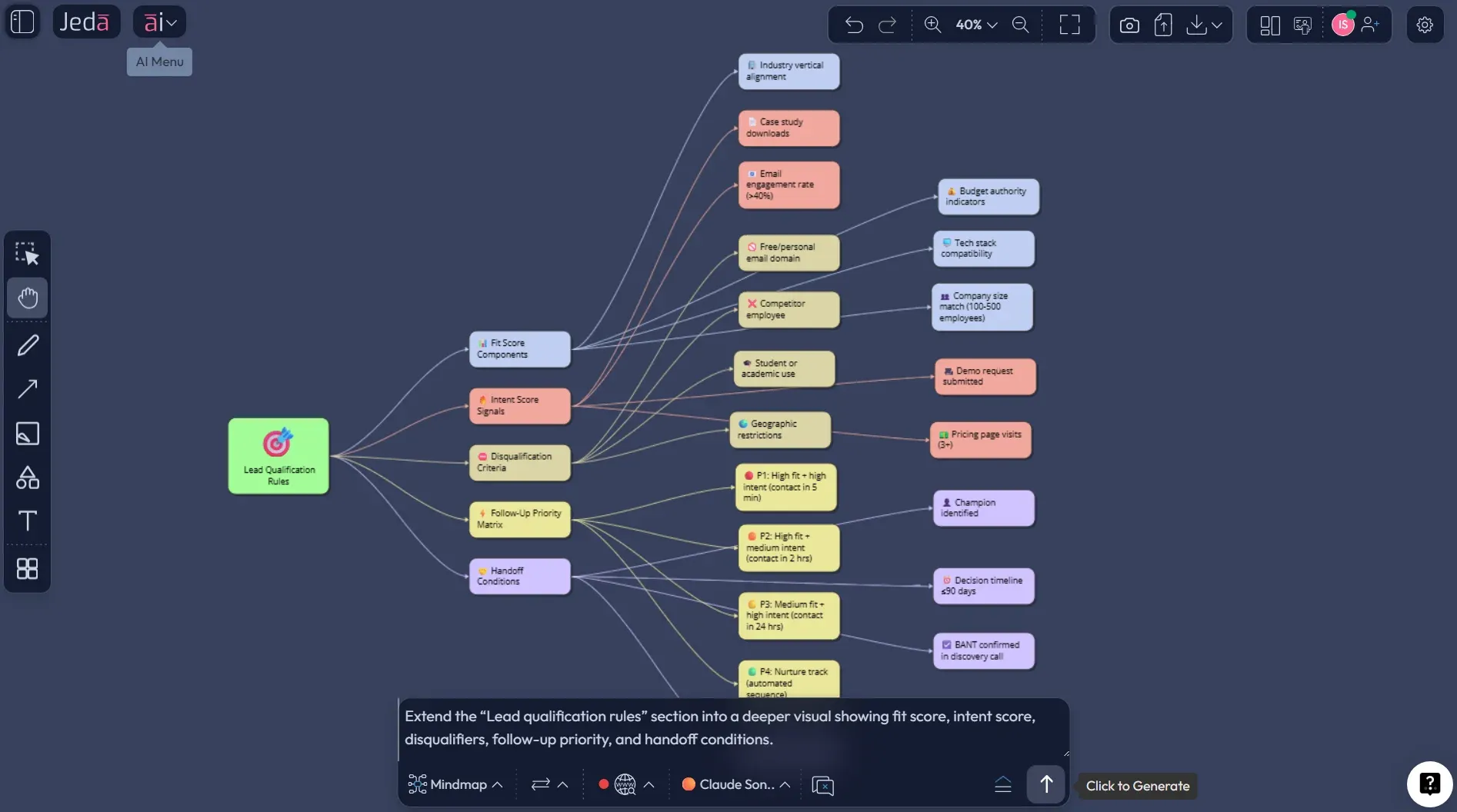
Common mistakes to avoid
The biggest one? Asking AI for “lead generation ideas” and expecting strategy to magically appear.
That usually gives you a mixed bag of generic tactics with no audience logic, no qualification model, and no revenue lens.
Other mistakes show up fast:
- Treating volume as success.
- Mixing brand campaigns and lead capture campaigns into one KPI bucket.
- Sending every lead into the same follow-up flow.
- Using forms or chat without a serious routing rule.
- Forgetting that buying cycles can be long, so early-touch value gets undercounted.
And one more. A fun one.
Do not let AI produce polished nonsense. If the board looks pretty but no one knows what happens after capture, it is still nonsense. Just premium nonsense.
Frequently asked questions
- What are lead generation strategies?
- Lead generation strategies are structured ways to attract, capture, qualify, and nurture potential buyers. They connect target audience selection, channel choice, offer design, lead capture, qualification logic, and follow-up into one repeatable system.
- Why use AI for lead generation strategy?
- AI helps teams analyze patterns faster, generate channel and messaging options, improve personalization, and refine qualification logic. It is most useful when paired with a clear visual system rather than used as a random idea machine.
- Can Jeda.ai create a lead generation matrix?
- Yes. Jeda.ai’s Matrix workflows are built for structured visual planning. You can use the Sales recipe in the AI Menu or use the Prompt Bar with the Matrix command to generate and edit a lead generation strategy board.
- What is the best way to start a lead generation plan in Jeda.ai?
- Start with the AI Menu recipe if you want guided structure. Start with the Prompt Bar if you already know your audience, offer, and channel assumptions. In both cases, define ICP, buyer pain, conversion goal, and qualification rules first.
- Should I use AI+ when building lead generation strategies?
- Yes, but use AI+ as an extension step. Generate the main framework first, then select a specific section such as channel strategy, scoring logic, or objections and use the AI+ button to deepen that part.
- Can I turn a lead generation matrix into another visual?
- Yes. Jeda.ai supports Vision Transform, which lets you convert an existing visual into another format. A lead generation matrix can become a flowchart, mind map, or diagram for execution planning.
- Are chatbots better than landing pages for lead capture?
- Not always, but recent B2B research shows conversational capture can outperform traditional landing pages in some contexts. The better question is which format fits your buyer, offer complexity, and qualification needs.
- Which lead generation channels still matter most?
- It depends on your audience and offer, but current evidence still points to website content, SEO, email, social, and paid distribution as important channels. The strongest systems connect these channels instead of treating them in isolation.
- How often should I update a lead generation strategy board?
- Review it monthly if you are actively running campaigns. That cadence is frequent enough to catch messaging problems, weak qualification logic, and channel drift without turning every week into a strategy rewrite.
- Who should own lead generation strategy?
- Sales and marketing should co-own it. Marketing usually owns attraction and early conversion mechanics, while sales owns qualification feedback and pipeline quality. The board works best when both teams can edit and review it together.
Sources & further reading
- [1]
HubSpot (2025) . “Lead generation strategies to start attracting business and drive growth” HubSpot Blog.
View Source ↗ - [2]
Salesforce (2026) . “What is Lead Generation? Guide & Best Practices” Salesforce.
View Source ↗ - [3]
Mailchimp (2024) . “Lead Generation Strategies for Business Growth” Mailchimp.
View Source ↗ - [4]
McKinsey & Company (2024) . “Key tactics for successful next-gen B2B sales” McKinsey.
View Source ↗ - [5]
McKinsey & Company (2025) . “Unlocking profitable B2B growth through gen AI” McKinsey.
View Source ↗ - [6]
Isabella, G. et al. (2025) . “From static to conversational: The role of landing pages and chatbots in B2B lead generation” Journal of Business Research.
View Source ↗ - [7]
Keegan, B. J. et al. (2024) . “Implementing Artificial Intelligence in Traditional B2B Marketing Practices: An Activity Theory Perspective” Information Systems Frontiers.
View Source ↗ - [8]
6sense (2025) . “The B2B Buyer Experience Report for 2025” 6sense.
View Source ↗
Start Your Lead Generation Strategy in Jeda.ai
Join over 150,000 professionals using Jeda.ai to turn scattered sales ideas into structured, editable, AI-assisted strategy boards.
Try Free Template