The Lean Startup model is basically a reality check with a calendar invite. You build something small, you measure what actually happens, you learn, and you decide whether to pivot or keep going. Now add AI and an AI Workspace to the loop and you get faster cycles, clearer hypotheses, and fewer “we shipped it so it must be good” moments.
This guide shows how to run the Lean Startup model with AI inside Jeda.ai, an AI Whiteboard used by 150,000+ users to turn ideas and evidence into editable, shareable visuals.
What is the Lean Startup model
The Lean Startup method was popularized by Eric Ries and centers on the Build-Measure-Learn feedback loop, where teams treat product development as a series of experiments rather than a long, untested plan.
Two concepts matter most:
- Minimum Viable Product (MVP): the smallest version that tests a key assumption.
- Validated learning: learning based on evidence, not vibes.
You are not trying to be “fast” for sport. You are trying to reduce time spent building the wrong thing.
Why run Lean Startup with AI
Lean Startup is already about learning faster. AI just makes it easier to do the boring parts:
- Draft hypothesis statements quickly (and make them testable).
- Turn research notes into crisp customer problems.
- Suggest instrumentation events and success thresholds.
- Summarize experiments into one-page decisions.
- Generate alternative pivots when the data is ugly.
And because Jeda.ai is an AI Workspace, your whole team can see the loop on one board. No tool hopping. No lost context. You can also use Jeda.ai’s platform web search when you need quick market context, because the web search is a platform feature, not a “model trick.”
- Hypothesis clarity
AI rewrites fuzzy ideas into testable hypotheses with explicit assumptions and measurable outcomes.
- Metrics without drama
AI suggests leading metrics, guardrails, and what to instrument before you ship the MVP.
- Better pivots
When the test fails, AI proposes pivot options (segment, channel, problem, or tech) and maps trade-offs.
How to create the Lean Startup model with AI in Jeda.ai
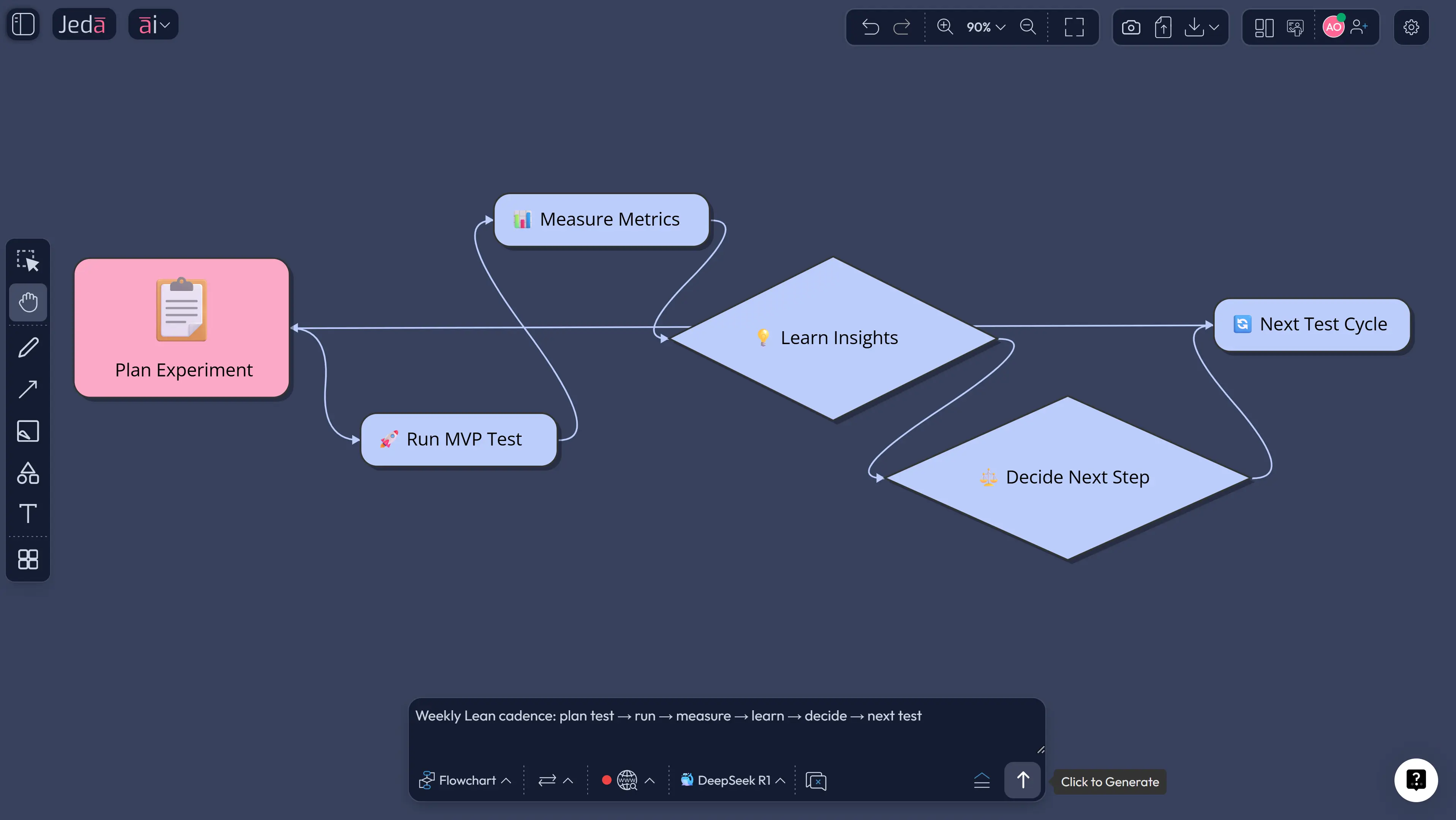
Lean Startup fits naturally in a visual format. Use a matrix for hypotheses and experiments. Use a diagram for the loop. Use a flowchart when you want a repeatable weekly cadence.
- Pick one riskiest assumption
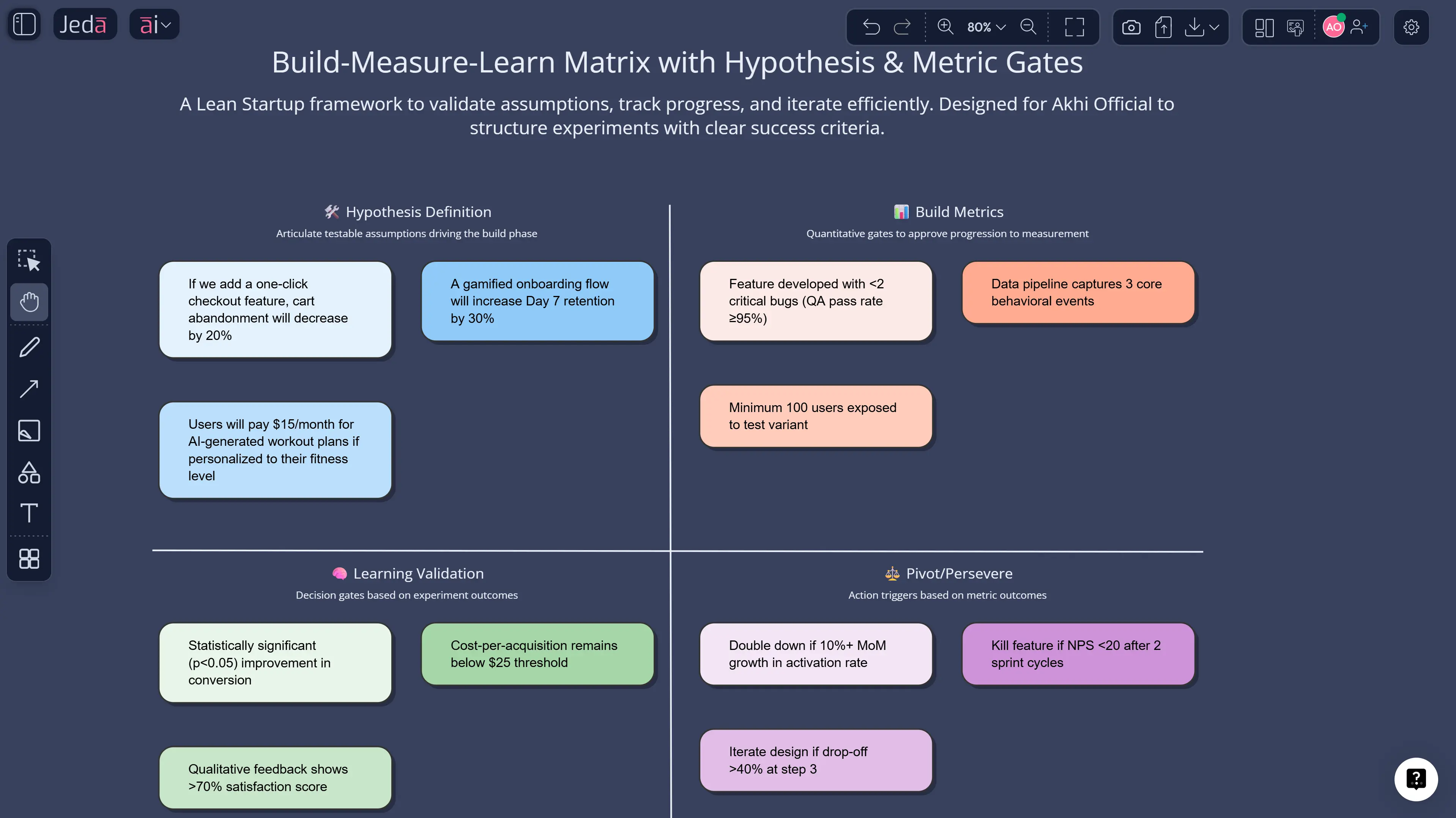
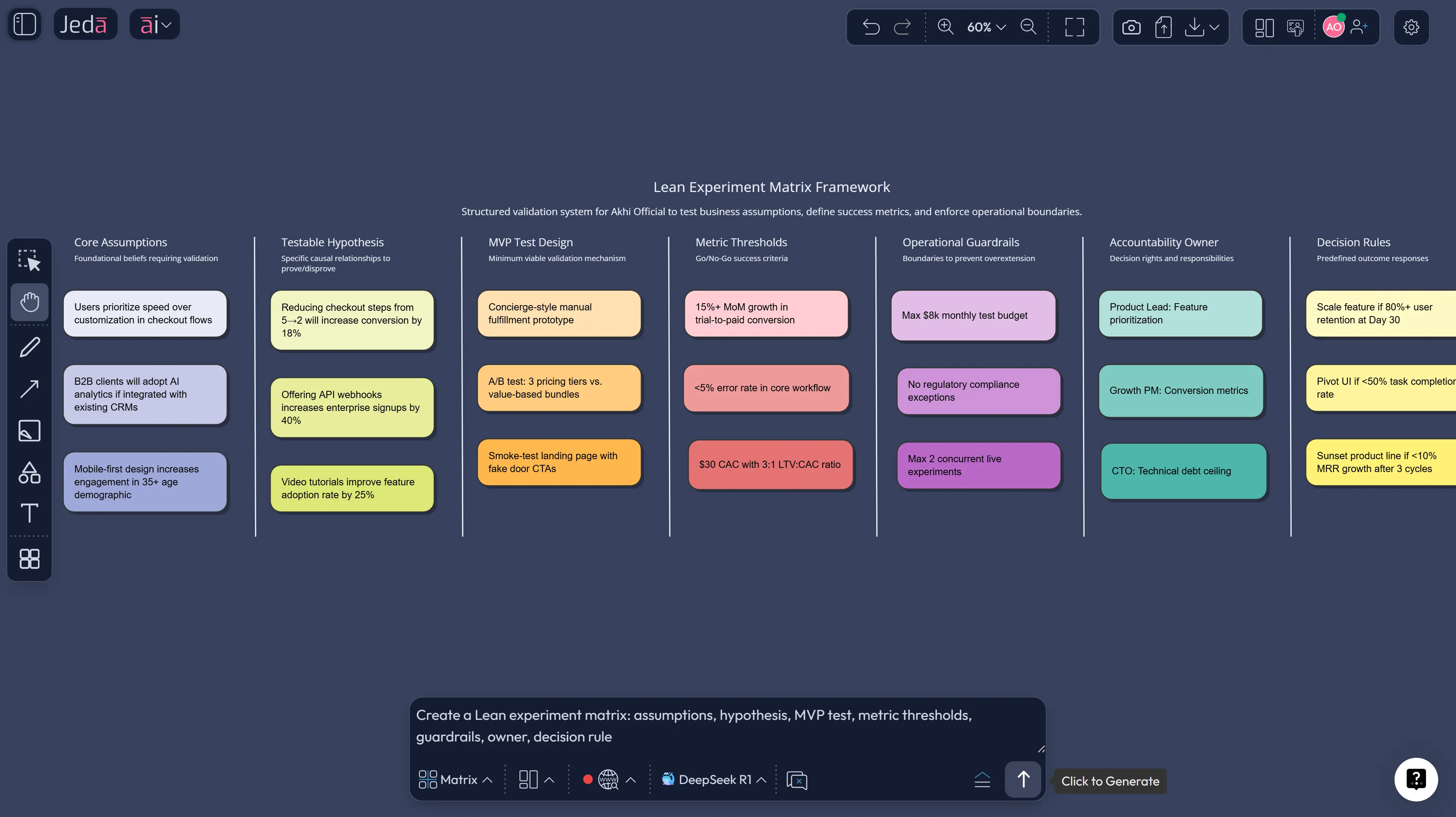
In Jeda.ai, open the Prompt Bar and select the Matrix command. Ask AI to list assumptions and rank them by risk.
- Write a testable hypothesis
Tell AI: “When [user], they struggle with [problem]. If we offer [solution], then [metric] will improve by [threshold] within [time].”
- Design the MVP test
Ask AI for the smallest experiment: landing page, prototype, concierge test, or limited feature flag. Add success and failure criteria.
- Decide what to measure
List events, funnels, and guardrails. Add segmentation (new vs returning users, role, region) so results are not averaged into meaninglessness.
- Run the test and summarize results
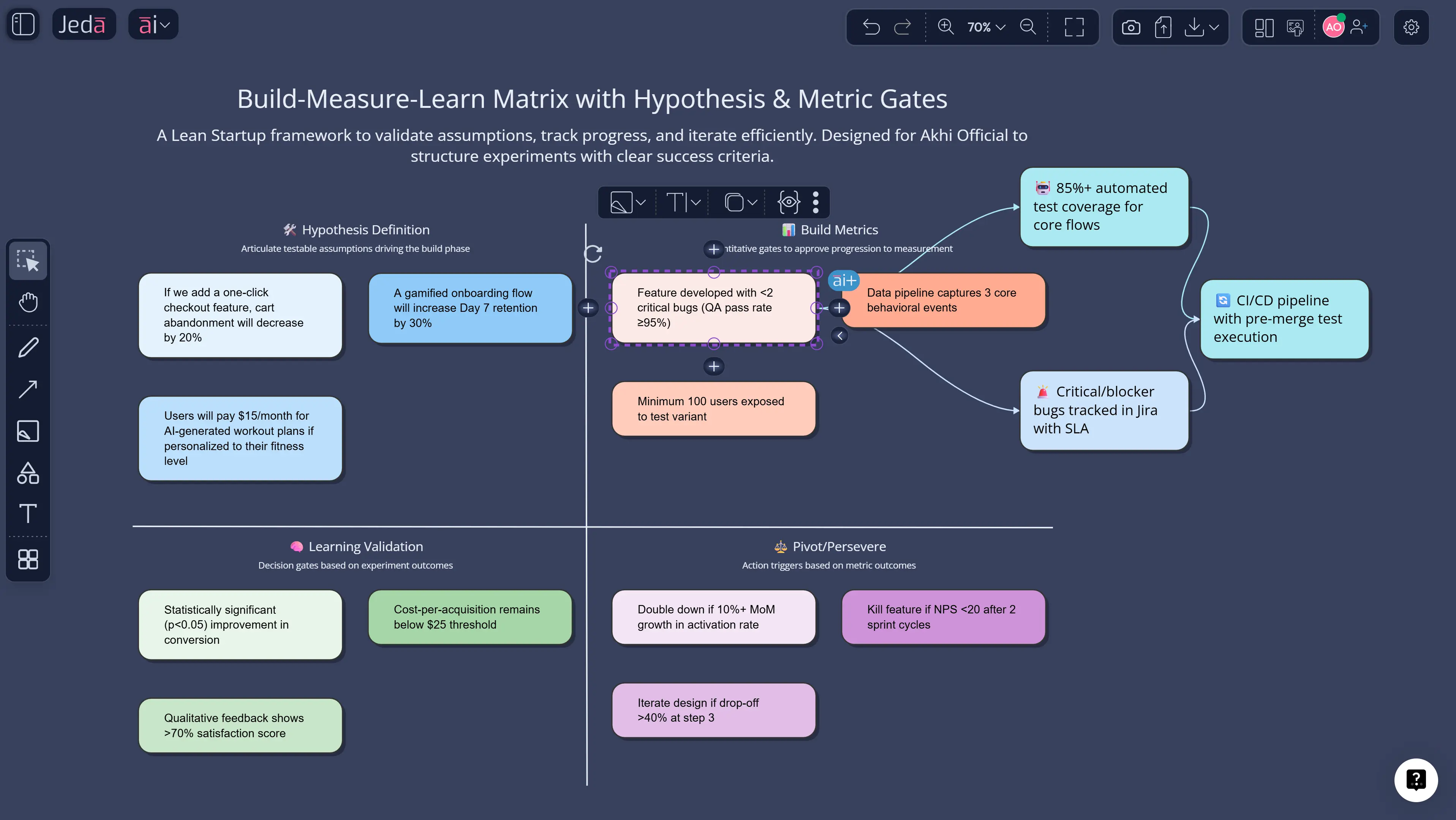
Paste findings into the board. Tap the AI+ button to dive deep.
- Pivot or persevere
Use Vision Transform to convert the matrix into a flowchart that shows the decision path. Then lock the next loop.
Prompt you can copy
Select the Matrix command in the Prompt Bar and paste:
Build a Lean Startup experiment board for: [idea].
Customer segment: [who].
Core problem: [problem].
Include: assumptions list, riskiest assumption, hypothesis statement, MVP test design, metrics + thresholds, guardrails, timeline, owner, decision rule, pivot options.
Worked example: a “Team Notes” feature
Let’s say you want to ship “Team Notes” for a collaboration app.
Your riskiest assumption might be: “Teams will invite others if notes are shared.”
A clean hypothesis could be:
- If we let a user share a note with teammates, then the invite rate will increase by 20% within 14 days, without increasing support tickets.
MVP test ideas:
- Fake door: add a “Share with team” button that collects intent.
- Concierge: manual sharing for 10 pilot teams.
- Limited release: enable for a small cohort with event tracking.
Now AI can help you decide what “success” means before you code too much.
Best practices that keep Lean from getting sloppy
Common mistakes to avoid
- Calling a feature an MVP. An MVP is a test, not a smaller roadmap.
- Tracking vanity metrics. Page views are not proof of value.
- Skipping segmentation. The “average user” is imaginary.
- No instrumented events. If you cannot measure, you cannot learn.
- Endless iteration without a decision. Learning only matters when it changes direction.
Frequently Asked Questions
- What is the Lean Startup model with AI?
- The Lean Startup model with AI applies Build-Measure-Learn experimentation while using AI to draft hypotheses, design MVP tests, suggest metrics, and summarize results into pivot-or-persevere decisions inside a shared visual workspace.
- Who created the Lean Startup method?
- The Lean Startup method was popularized by Eric Ries and centers on Build-Measure-Learn, MVPs, and validated learning as a way to reduce waste in early product development.
- What should an MVP include?
- An MVP should include only what is required to test the riskiest assumption. It can be a prototype, a landing page, a concierge test, or a limited feature release, as long as it produces measurable learning.
- How do I choose metrics for a Lean test?
- Pick one primary metric that reflects the hypothesis outcome, then one guardrail metric to catch side effects. Define the population, timeframe, and success threshold before the test begins.
- Can Lean Startup work in big companies?
- Yes, but it needs governance. Teams must align experiments to strategic goals, avoid vanity metrics, and protect learning from politics. Many large organizations use Lean principles as part of a broader innovation system.
- Can Jeda.ai export Lean Startup boards?
- Yes. Jeda.ai exports boards as PNG, SVG, or PDF. Export a board image and place it into slides if needed.
- How does Jeda.ai help compared to a doc?
- A doc is linear. Jeda.ai is an AI Workspace and AI Whiteboard where hypotheses, tests, metrics, and decisions are visual, editable, and collaborative. That makes the loop easier to run and easier to repeat.
- What is the fastest way to get started?
- Start with one idea, identify the riskiest assumption, and create a matrix with hypothesis, MVP test, and success thresholds. Then use the AI+ button to extend the board after each test cycle.
Sources and further reading
- [1]
Ries, Eric (2011) . “The Lean Startup” Crown Business.
View Source ↗ - [2]
Blank, Steve (2013) . “Why the Lean Start-Up Changes Everything” Harvard Business Review.
View Source ↗ - [3]
Eisenmann, Thomas (2011) . “Hypothesis-Driven Entrepreneurship: The Lean Startup” Harvard Business School.
View Source ↗ - [4]
Mollick, Ethan (2019) . “What the Lean Startup Method Gets Right and Wrong” Harvard Business Review.
View Source ↗
Run Your Next Lean Startup Loop in One AI Workspace
Join over 150,000 professionals who use Jeda.ai to turn hypotheses into visual experiments and decisions, fast.
Try Free Template