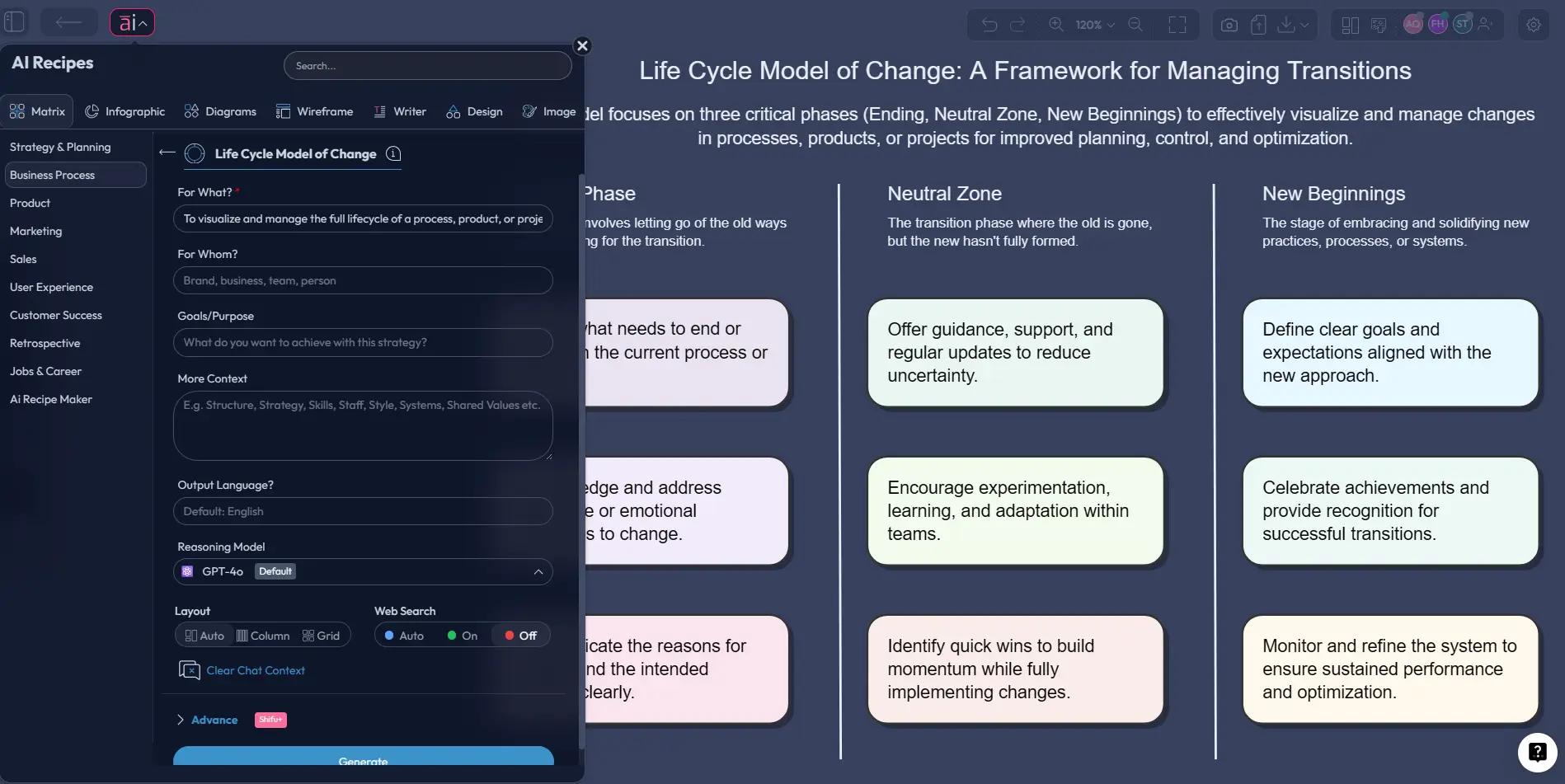
Life Cycle Model Of Change with AI gives teams a cleaner way to understand where an organization is now, why change keeps getting stuck, and what kind of change makes sense at this stage. Most teams do not fail because they lack effort. They fail because they apply the wrong change playbook to the wrong growth stage. That is exactly where an AI Workspace helps. Inside Jeda.ai, you can map the model visually, pressure-test assumptions with multiple AI models, and turn a fuzzy conversation into an editable decision board on an AI Whiteboard.
And that matters more than most leaders admit.
A lot of change programs are still treated like one-size-fits-all management theater: one kickoff deck, one communication plan, one training wave, then crossed fingers. The life cycle lens pushes back on that. It says organizations change differently as they move from early-stage hustle to collective growth, then into formalization, then renewal. Smits and Bowden describe life-cycle change as the natural process through which startup organizations grow and mature, drawing on well-known stage models from Greiner, Quinn and Cameron, and Daft. Poole and Van de Ven frame life-cycle models more broadly as prescribed or regulated models of organizational change with identifiable stages.
What is the Life Cycle Model Of Change?
The Life Cycle Model Of Change is a stage-based way to diagnose organizational change. Instead of asking only, “What do we want to change?” it asks, “What stage is this organization in, and what kind of change usually fits that stage?” In the management literature, one commonly used version describes four stages: Entrepreneurial, Collectivity, Formalization, and Elaboration. Each stage comes with its own structure, leadership pattern, decision style, and failure mode.
That is the useful part. Not the label. The diagnosis.
Greiner’s classic growth model made a similar argument decades ago: organizations move through phases, and each phase eventually runs into a crisis that calls for a different management response. Quinn and Cameron later synthesized multiple organizational life cycle models into a stage-based view of development and effectiveness. In practice, the framework helps leaders see why a founder-led business, a fast-scaling division, and a mature enterprise unit should not all be managed with the same change script.
Why use the Life Cycle Model Of Change with AI?
Because the hard part is rarely drawing four boxes.
The hard part is deciding which box you are actually in, what signals prove it, what risks come next, and how to get a leadership team to stop arguing in circles. Jeda.ai helps there because it is not just a blank canvas. It is a Visual AI environment built for structured thinking, editable outputs, and live collaboration. The platform gives you an AI Workspace, an AI Whiteboard, 300+ strategic frameworks, multi-model support, and AI+ extension so you can deepen the analysis without starting over. Those platform capabilities are defined in the workflow reference and platform guide you uploaded.
- Stage diagnosis
Map symptoms, leadership style, structure, and bottlenecks into a clean matrix instead of burying them in slides.
- AI-assisted reasoning
Use multiple models to challenge stage assumptions, surface weak signals, and generate more balanced change options.
- Collaborative alignment
Turn debate into an editable board your team can refine together in real time inside the AI Workspace.
- Visual alternatives
Convert the same analysis into a diagram, flowchart, or mind map with Vision Transform when the audience needs a different format.
- AI+ deep dive
Use the AI+ button to extend a stage analysis, expand risks, or continue the change plan without rebuilding the whole board.
- Decision-ready output
Move from theory to a usable change roadmap with owners, risks, milestones, and discussion history all in one place.
The four stages of the Life Cycle Model Of Change
Here is the plain-English version.
1. Entrepreneurial stage
This is the early stage. The organization is driven by a founder or tight leadership core, fueled by speed, improvisation, and survival energy. Structure is loose. Planning is light. Decisions happen fast because the same few people are doing almost everything.
The upside is momentum. The downside is chaos.
Change at this stage usually works when it protects speed while adding just enough clarity to reduce friction. Heavy process too early can suffocate the thing that made the organization work in the first place.
2. Collectivity stage
Now the organization grows quickly and develops a stronger shared identity. People are committed. Communication is still fairly informal. Teams often feel like a family, which is great until scale exposes role confusion, uneven management, and hidden bottlenecks.
This stage often needs change around coordination, role clarity, communication rhythm, and management depth. Not bureaucratic overload. Just enough structure so growth does not trip over itself.
3. Formalization stage
This is where the organization becomes more professionalized. Systems, policies, reporting, and standardization grow because scale demands control. Efficiency improves. Repeatability improves. But innovation can get squeezed if rules start running the place.
So the change challenge flips. Earlier stages need more structure. This stage often needs selective release valves: better cross-functional collaboration, simpler approvals, faster learning loops, and fewer decision bottlenecks.
4. Elaboration or renewal stage
A mature organization reaches a point where yesterday’s structure is no longer enough. Markets shift. Complexity rises. Coordination becomes heavier. The response is usually some combination of decentralization, teamwork, adaptation, and renewal.
This is where change becomes less about installing control and more about regaining adaptability.
Honestly, this is the stage where mature firms either rediscover their edge or become very efficient at becoming irrelevant.
How to create a Life Cycle Model Of Change in Jeda.ai
Because this topic is a matrix, the best primary command is Matrix, with Diagram as the supporting visual format.
Method 1: Recipe Matrix
Use this when you want a faster structured start in the AI Menu.
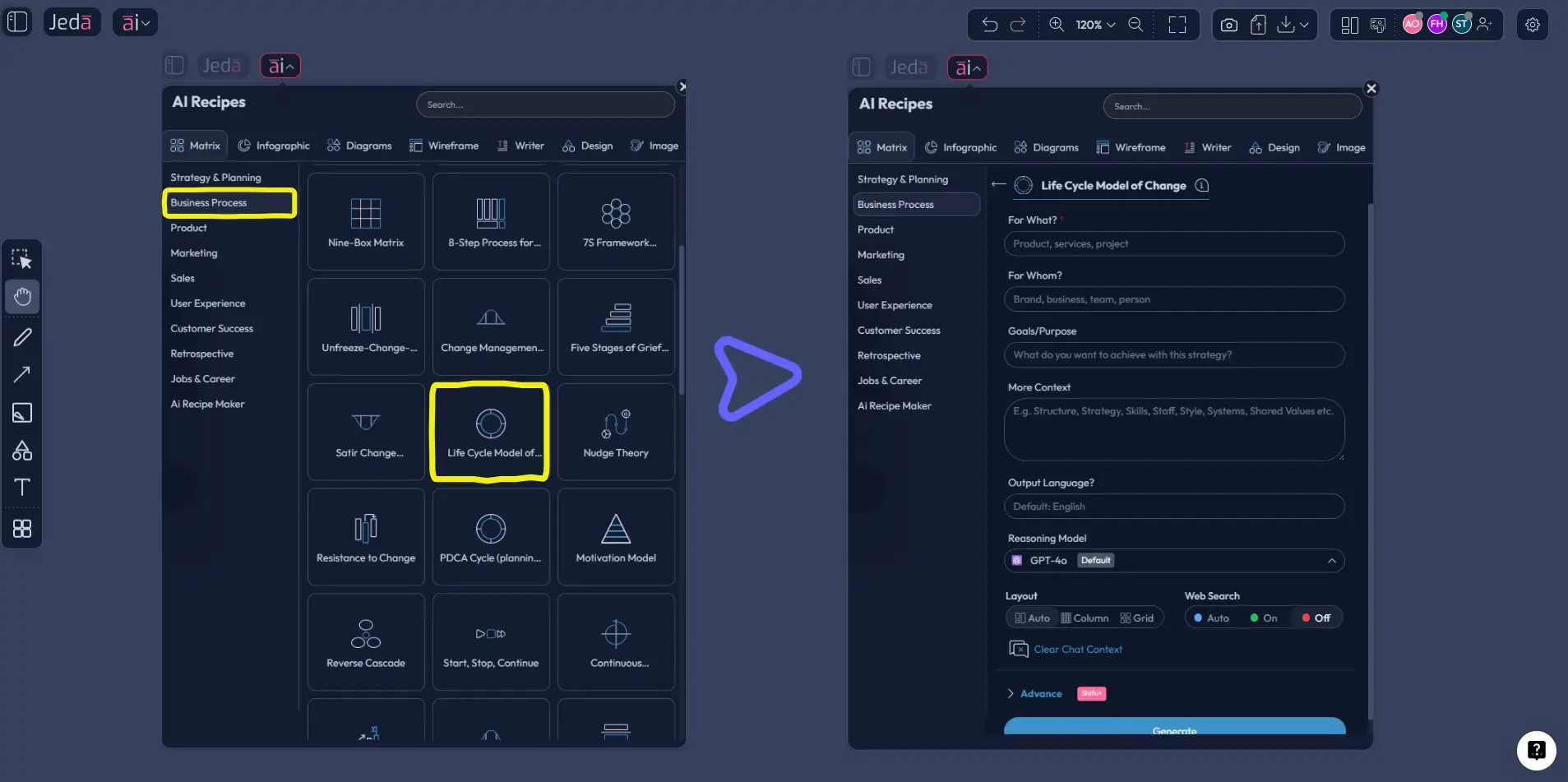
- Open AI Menu and choose a Matrix recipe
From the top-left AI Menu, open Matrix recipes and select the Life Cycle Model Of Change recipe.
- Enter the organization context
Describe the company, team, business unit, or transformation you are diagnosing, including size, growth pace, structure, and current pain points.
- Ask for the four-stage life cycle matrix
Prompt Jeda.ai to generate Entrepreneurial, Collectivity, Formalization, and Elaboration/Renewal stages with stage traits, risks, and recommended change moves.
- Refine the board collaboratively
Edit labels, add sticky notes, reword risks, and assign decision owners directly on the AI Whiteboard.
- Use AI+ to extend the analysis
Tap the AI+ button on the generated visual to deepen one stage, expand leadership risks, or continue into a change roadmap.
- Convert if needed with Vision Transform
Use Vision Transform to turn the matrix into a diagram or flowchart for executive storytelling, workshop facilitation, or training.
Method 2: Prompt Bar
Use this when you want more direct control.
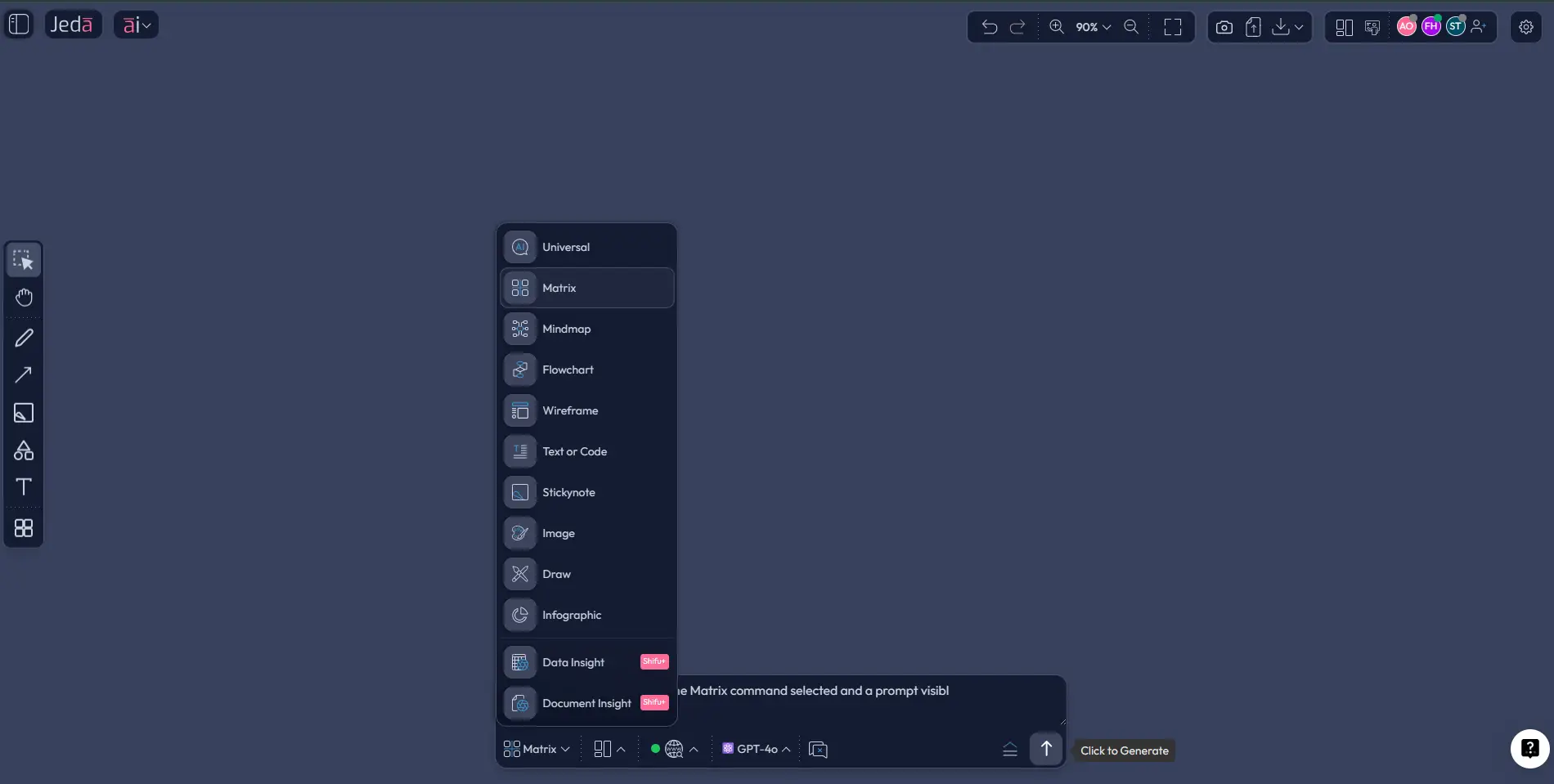
- Open the Prompt Bar at the bottom of the workspace.
- Select the Matrix command.
- Paste a prompt like this:
Create a Life Cycle Model Of Change matrix for a mid-sized company. Use four stages: Entrepreneurial, Collectivity, Formalization, and Elaboration/Renewal. For each stage, show leadership style, structure, common resistance patterns, change priorities, warning signs, and recommended interventions.
- Press Enter to generate.
- Edit the matrix on the canvas.
- Use AI+ to extend the analysis or deepen one stage.
- Use Vision Transform if you want the same thinking turned into a Diagram or Flowchart.
AI+ button deep dive
AI+ is best used after the base framework exists. That is the point.
Do not try to make AI+ do hyper-specific magic before you have a decent board. Use it to extend, expand, or continue the existing visual. For example:
- Extend the Formalization stage with bottlenecks and over-control risks.
- Expand the Renewal stage into a 90-day change roadmap.
- Continue the matrix into a stakeholder communication plan.
- Extend the board with KPIs, decision owners, and milestones.
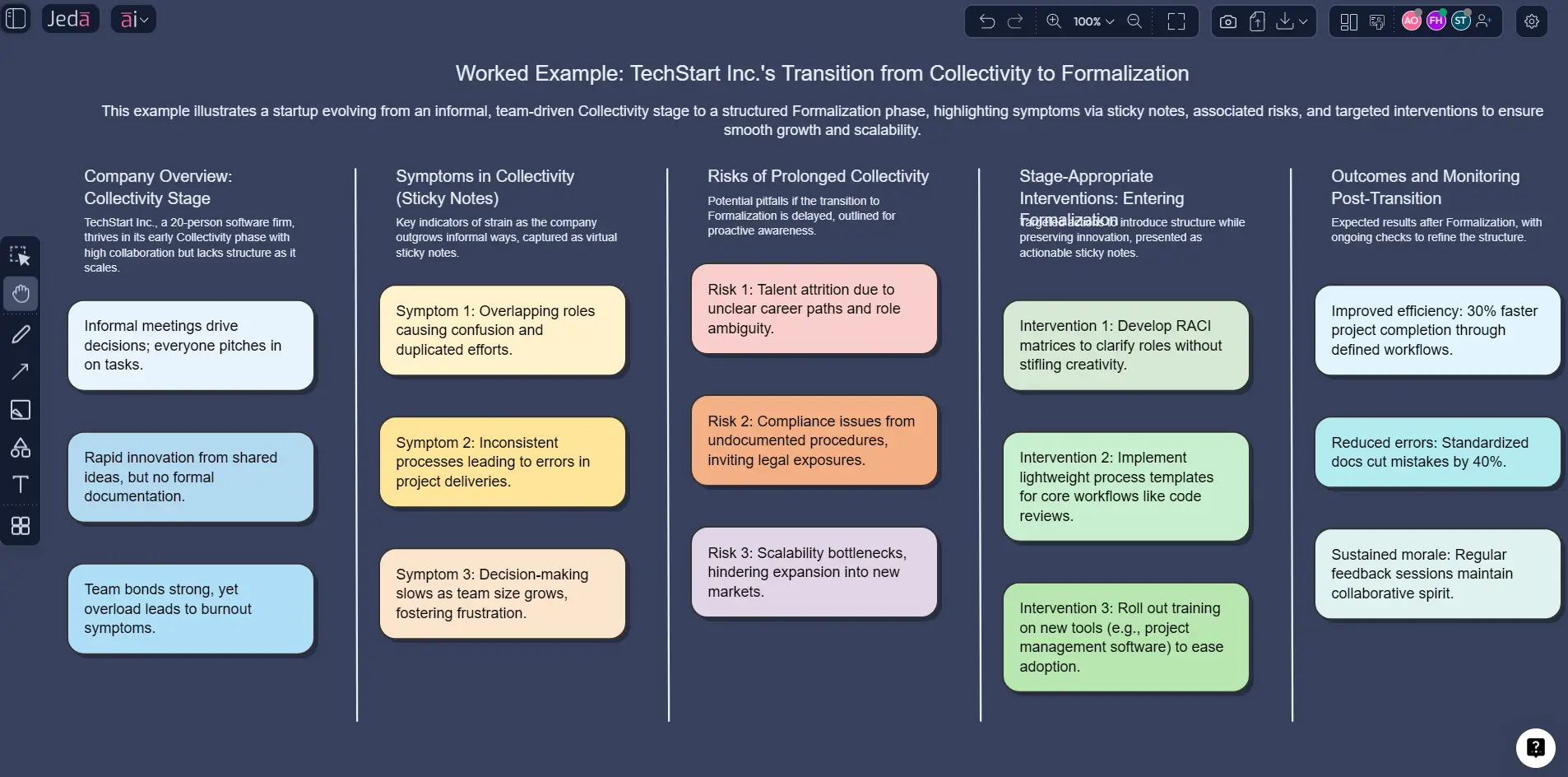
Example: using the model for a scaling company
Picture a company that grew fast on founder instinct and hustle. It now has 250 employees, more managers, more approvals, and more rework. Leadership keeps saying, “We need to move faster again,” while middle managers keep saying, “We need clearer process.”
That usually signals a transition from Collectivity toward Formalization.
The wrong move would be pretending the company can go back to pure startup improvisation. The better move is to formalize the right things, not all things: define decision rights, simplify handoffs, tighten cross-functional planning, and protect experimentation at the edges. The life cycle model helps the team see that the answer is not “less change” or “more change.” It is stage-appropriate change.
Best practices when using the Life Cycle Model Of Change
Common mistakes to avoid
Mistake 1: treating the model like destiny
A life cycle model is a lens, not a prison sentence. Plenty of organizations show traits from multiple stages at once.
Mistake 2: confusing maturity with health
A more formal organization is not automatically better run. It may just be more procedural.
Mistake 3: copying startup behavior in a mature business
Leaders sometimes romanticize early-stage speed and forget why formal systems were added in the first place.
Mistake 4: using one change plan for the whole organization
Different units often sit in different stage realities. That is where one corporate master plan starts to wobble.
Frequently asked questions
- What is the Life Cycle Model Of Change?
- The Life Cycle Model Of Change is a stage-based framework for diagnosing how organizations evolve and what kinds of change fit each stage. It is commonly used to assess structure, leadership style, growth pressures, and likely change priorities.
- What are the stages in the Life Cycle Model Of Change?
- A widely used four-stage version includes Entrepreneurial, Collectivity, Formalization, and Elaboration or Renewal. Each stage reflects a different level of structure, coordination, and adaptability in the organization.
- Who created the Life Cycle Model Of Change?
- There is no single origin point for every version. The model draws from organizational life cycle research, especially work by Greiner, Quinn and Cameron, Daft, and later change-management writers who adapted those stage ideas to organizational change.
- How is the Life Cycle Model Of Change different from Lewin's model?
- Lewin's model explains the movement of change through unfreeze, change, and refreeze. The Life Cycle Model Of Change explains how change needs differ depending on the organization's development stage, structure, and growth pattern.
- Why use AI for a Life Cycle Model Of Change?
- AI helps teams turn messy observations into a structured stage diagnosis faster. In Jeda.ai, you can generate the matrix, compare alternative interpretations, extend the board with AI+, and convert the same thinking into other visual formats.
- Is the Life Cycle Model Of Change only for startups?
- No. It is useful for startups, scaling firms, mature enterprises, and even specific departments. The key is diagnosing the current stage logic of the unit you are analyzing rather than assuming the whole organization behaves the same way.
- Can one organization show more than one stage at once?
- Yes. Large organizations often have divisions operating with different stage characteristics. That is why the model works best as a diagnostic conversation tool rather than a simplistic one-label classification system.
- How do you create a Life Cycle Model Of Change in Jeda.ai?
- Start with the Matrix command or a Matrix recipe in the AI Menu, describe the organization and its pain points, generate the four-stage board, then refine it with AI+, collaboration, and Vision Transform as needed.
- What should you put in the matrix?
- Include stage name, leadership style, structure, communication patterns, resistance signals, change priorities, risks, and recommended interventions. Those fields make the board more useful for real decision-making.
- What is the biggest benefit of this framework?
- Its biggest benefit is fit. The model helps leaders choose stage-appropriate change instead of forcing the same intervention style on every team, which usually creates resistance, delay, or wasted effort.
Sources & further reading
- [1]
Smits, S.J.; Bowden, D.E. (2015) . “A perspective on leading and managing organizational change” Economics and Business Review.
View Source ↗ - [2]
Poole, Marshall Scott; Van de Ven, Andrew H. (2021) . “The Life Cycle Process Model” The Oxford Handbook of Organizational Change and Innovation.
View Source ↗ - [3]
Greiner, Larry E. (1972/1998) . “Evolution and Revolution as Organizations Grow” Harvard Business Review.
View Source ↗ - [4]
Quinn, Robert E.; Cameron, Kim (1983) . “Organizational Life Cycles and Shifting Criteria of Effectiveness” Management Science.
View Source ↗ - [5]
APQC (2024) . “What is the Change Management Process?” APQC Blog.
View Source ↗ - [6]
Mosca, Laura et al. (2021) . “Organizational life cycle models: a design perspective” Heliyon.
View Source ↗
Start Your Life Cycle Model Of Change Today
Join over 150,000 professionals who use Jeda.ai as an AI Workspace to turn messy change conversations into editable visual decisions.
Try Free Template