Mad Sad Glad Retrospective with AI: Turn Team Feelings Into Better Sprint Decisions
Mad Sad Glad Retrospective with AI gives your team a cleaner way to talk about what actually happened in the sprint — not just what shipped, but what annoyed people, what drained energy, and what genuinely worked. That matters because the point of a retrospective is to improve quality and effectiveness, not to perform a polite ritual and then forget it by Tuesday. In Jeda.ai, you can run this format inside an AI Workspace and AI Whiteboard, organize emotional signals visually, and turn scattered comments into next-step actions your team can actually track.
And here’s the real edge: most teams already have the feelings. They just don’t have a fast, low-friction way to surface them without the meeting turning into a blame carnival. Jeda.ai helps you structure the conversation, cluster patterns, extend useful threads with the AI+ button, and convert the board into an action-oriented follow-up visual when you need one. That’s a big deal for remote teams, hybrid teams, and frankly any team that has been saying “we should talk about morale” for three sprints straight.
Used well, this approach sits right at the sweet spot between honesty and action. It is simple enough for a 30-minute sprint retro, but rich enough for release reviews, post-launch debriefs, onboarding feedback, or cross-functional tension checks. And because Jeda.ai combines Visual AI, editable smart shapes, collaboration, and guided recipe workflows, you do not have to choose between speed and depth.
Need the broader picture first? Explore Jeda.ai’s AI Workspace and AI Whiteboard pages before you run your next retro.
What is a Mad Sad Glad retrospective?
A Mad Sad Glad retrospective is an emotion-first retro format. Instead of asking only what went well and what did not, it prompts people to sort experiences into three buckets: what made them mad, what made them sad, and what made them glad. Atlassian describes it as a technique focused on how the work made the team feel, while Scrum guidance reminds us that retrospectives exist to increase quality and effectiveness. Put those two together and the point becomes obvious: emotion is not fluff. It is signal. It tells you where friction, disappointment, pride, and momentum are hiding.
That emotional framing is exactly why this format works when a team feels a bit off, but nobody has named the problem yet. A plain “what should we improve?” question often gets you safe answers. A Mad Sad Glad board tends to pull out what people were holding back. Not always dramatic. Often the small stuff: too many last-minute scope changes, unclear handoffs, one teammate doing invisible hero work, a release that felt more chaotic than it looked from the outside.
The format is easy to understand, which is part of its charm. But simple does not mean shallow. Team reflection and psychological safety are both linked to better learning and performance outcomes in research on teams and agile environments. So when you create room for honest reflection — and keep it blame-free — you are not just running a nice workshop. You are improving how the team learns together.
Why use a Mad Sad Glad retrospective with AI?
Without AI, a Mad Sad Glad retro is still useful. With AI, it gets sharper.
Jeda.ai does not replace the human part of the session. It does the boring part faster: grouping similar comments, spotting patterns across notes, helping facilitators phrase follow-up prompts, and converting a messy emotional board into an organized next-step visual. That is where an AI Workspace earns its keep.
- Emotional clarity
Capture what people felt, not just what they remember. That gives you a more honest picture of team health.
- Faster pattern finding
Cluster repeated frustrations, recurring disappointments, and real wins before the discussion gets lost in side quests.
- AI-assisted follow-through
Use AI+ to extend promising threads, suggest themes, and turn raw notes into actions, owners, or future-state prompts.
- Better remote collaboration
Run the full retro visually in a shared AI Whiteboard so distributed teams can contribute at the same time.
Here is the blunt version: many retros fail because teams collect comments and stop there. They identify pain, nod gravely, then move on. Jeda.ai helps you go one step further. Generate the matrix. Discuss the patterns. Use AI+ to deepen a cluster. Then use Vision Transform to turn the board into a flowchart, mind map, or action plan. That is how a retro stops being therapy theater and starts affecting the next sprint.
And yes, the speed matters. Jeda.ai is used by 150,000+ users, and one of its strongest content angles is turning structured frameworks into editable visual outputs inside an AI Workspace. For this page, that matters because Mad Sad Glad is not just a meeting activity. It is a repeatable matrix recipe that teams can revisit sprint after sprint.
How to create a Mad Sad Glad retrospective in Jeda.ai
Because this topic is a Matrix Recipe under the Retrospective category, the cleanest path is the guided recipe first, then the Prompt Bar method for fast custom boards.
Method 1: Recipe Matrix
The recipe route is the better choice when you want guardrails, consistent structure, and a board that junior facilitators can run without getting clever in all the wrong ways.
- Method 1 — Open the AI Menu
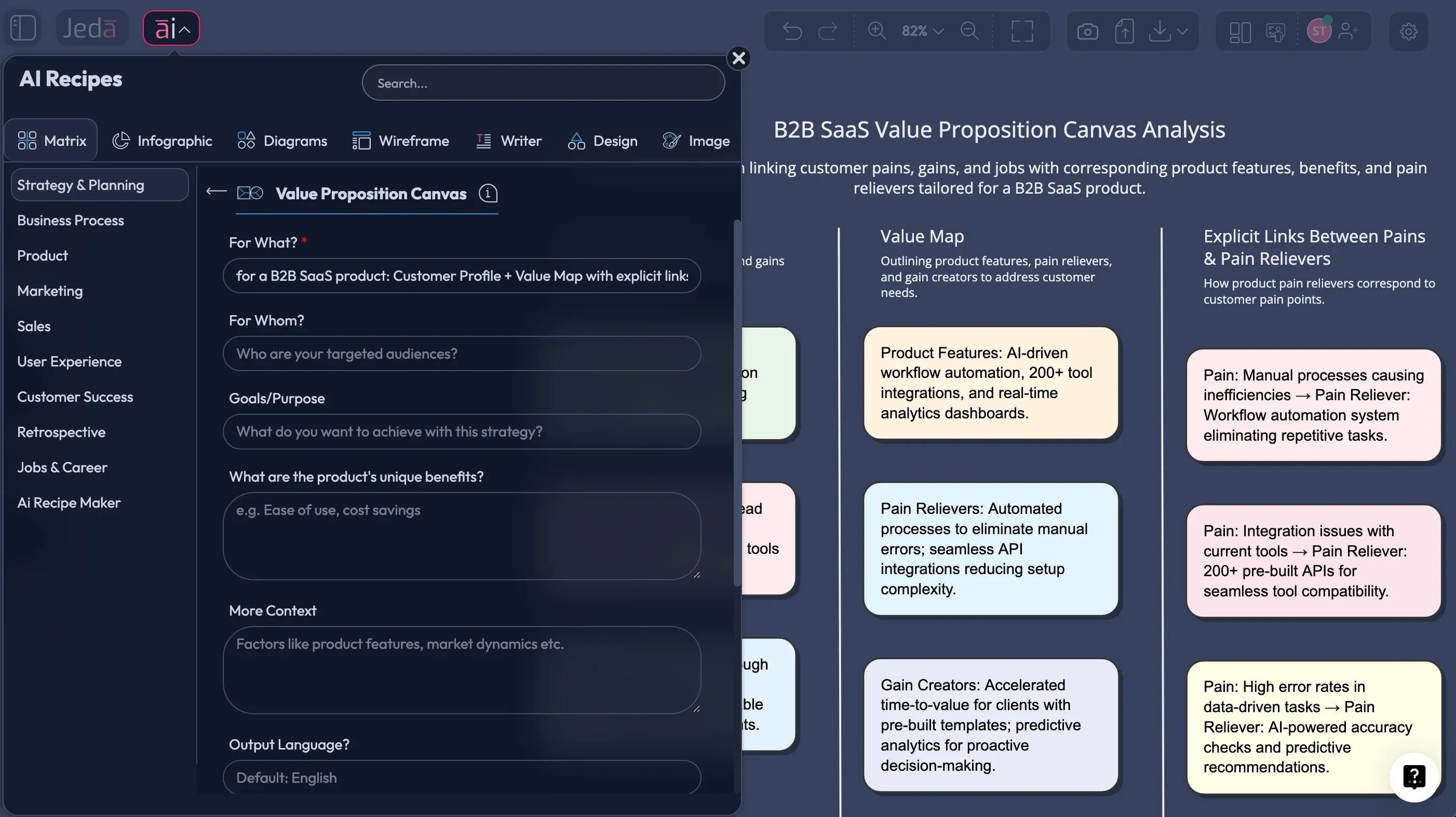
In Jeda.ai, click the AI Menu in the top-left corner of the canvas. This opens the recipe library inside your AI Workspace.
- Go to Matrix Recipes and choose Retrospective
Open Matrix Recipes, then select the Retrospective category and choose the Mad Sad Glad recipe.
- Fill in the recipe fields
Add the sprint, project, release, or workshop context. Keep it concrete: timeframe, team name, what happened, and what kind of reflection you want.
- Generate the initial matrix board
Let Jeda.ai create the three-column structure with editable smart shapes for Mad, Sad, and Glad. Review the language before the team starts adding notes.
- Invite the team to contribute
Run silent brainstorming first. Let each person add notes to each column before discussion starts. This reduces anchoring and gives quieter teammates room.
- Cluster and discuss the strongest patterns
Group duplicate notes, name the themes, and talk through the patterns. Keep the focus on events, behaviors, and process issues rather than personal blame.
- Use AI+ to deepen the board
Select a meaningful cluster and tap the AI+ button to extend it. Use AI+ for deeper synthesis and follow-up expansion, not for a brand-new ultra-specific brief.
- Turn insights into next-step visuals
Use Vision Transform to convert the finished matrix into a flowchart, mind map, or action board for the next sprint. Export when needed as PNG, SVG, or PDF.
Method 2: Prompt Bar
This is the fast lane. It works well when you already know the structure you want or when the team wants a custom spin on the retro.
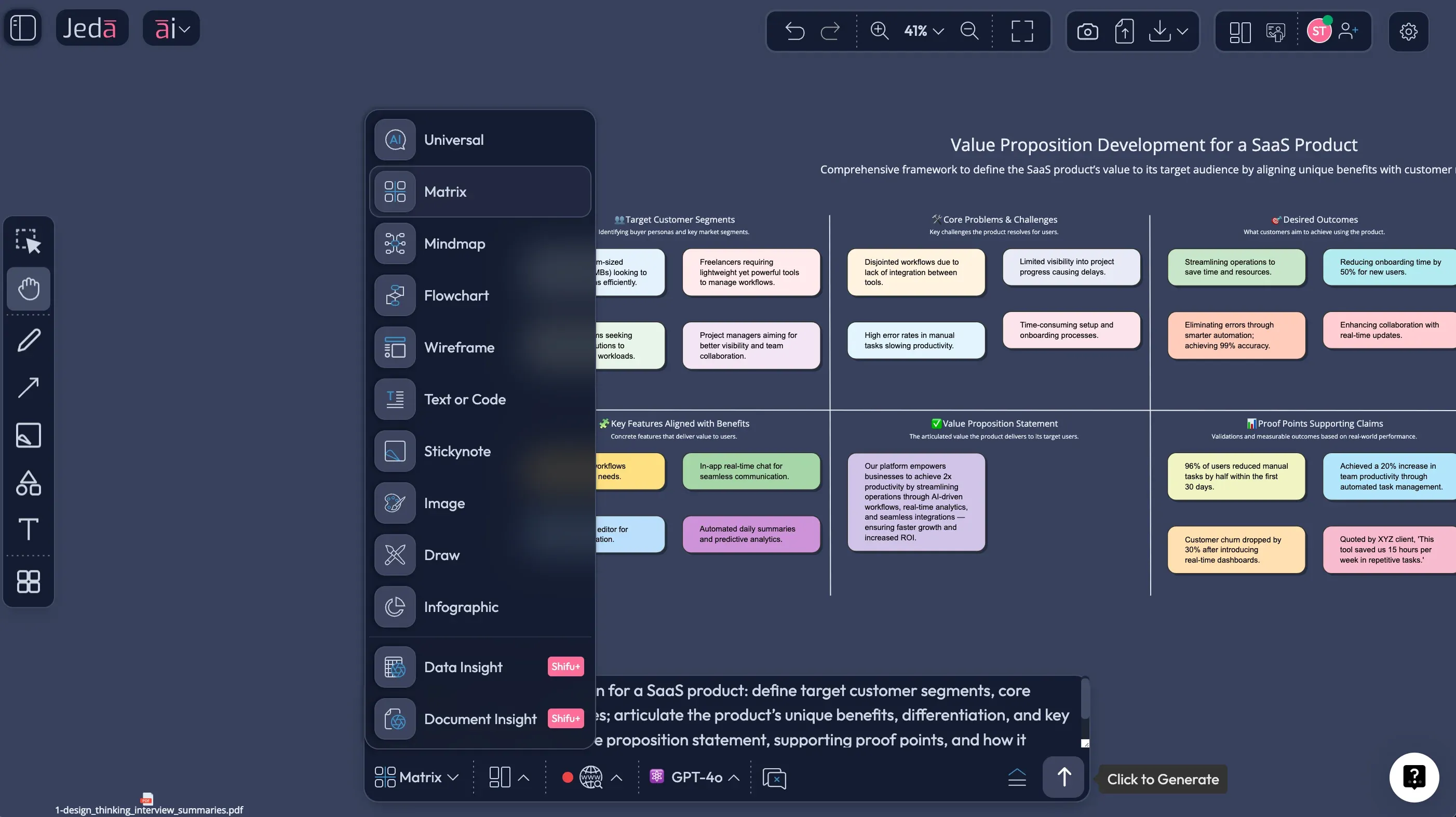
- Open the Prompt Bar at the bottom of the canvas.
- Select the Matrix command.
- Choose a layout such as Column or Grid.
- Enter a prompt like this:
Create a Mad Sad Glad retrospective matrix for a product, design, and engineering team after a two-week sprint. Use three columns for Mad, Sad, and Glad. Add example prompts under each column, include a small area for grouped themes, and leave space for action items and owners.
- Generate the board.
- Edit the text, colors, and notes live on the canvas.
- Use AI+ on a column or grouped cluster to expand the discussion.
- Use Vision Transform if you want to convert the retro into an action flow or improvement roadmap.
Mad Sad Glad retrospective template and example
Let’s make this concrete.
Imagine a product team has just finished a two-week sprint tied to a feature release. The release went out on time. Great. But the team is tired, design felt rushed, QA got squeezed, and customer feedback came in late enough to annoy everyone. A generic retro might produce the usual corporate wallpaper: “communication,” “planning,” “alignment.” That tells you almost nothing.
A Mad Sad Glad board gets more specific:
- Mad: scope changed on day eight, bug triage stole maker time, reviews were blocked by missing context
- Sad: onboarding copy shipped without research input, one teammate was overloaded, testing happened too late
- Glad: customer response was strong, a new handoff doc saved time, engineering/design collaboration improved during the final two days
Now the board has texture. It feels like a team talking, not a robot filling a template.
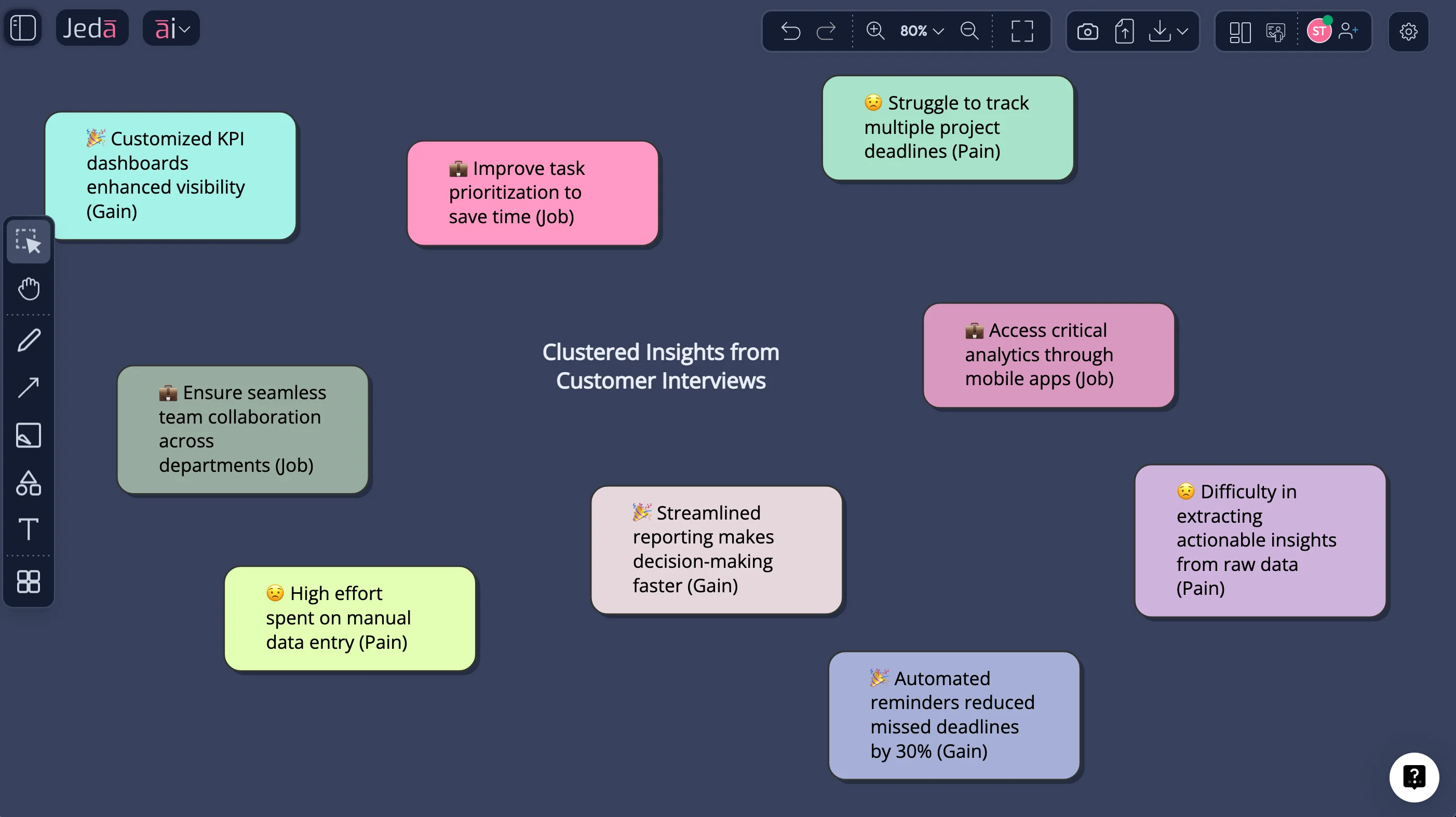
And this is where AI helps. Once the team has contributed notes, Jeda.ai can help you:
- summarize the biggest emotional themes
- identify repeated process failures
- draft neutral, non-blaming action statements
- convert one theme into a mini root-cause thread
- create a follow-up flowchart for the next sprint
That last part matters more than people admit. Teams do not suffer from a lack of retrospectives. They suffer from a lack of visible follow-through.
Best practices for running a Mad Sad Glad retrospective
Start with safety. No safety, no honesty. And without honesty, this retro becomes decorative office furniture.
Use these rules:
A few facilitation moves are worth calling out.
First, decide whether contributions should be anonymous. Anonymous input can surface buried issues, especially when trust is shaky. Named input can improve accountability when the team is already fairly open. There is no holy answer here. Read the room.
Second, keep the first pass focused on emotion, not problem-solving. Miro makes the same point in its guidance: if people jump too early into tactics, they often dodge the actual feeling behind the note. Let the feeling land first. Then move to action.
Third, do not try to fix every note in the meeting. That is how retros turn into swampy discussions with no ending. Capture, cluster, prioritize, assign, move.
Common mistakes to avoid
1. Treating the retro like a complaint wall
People need space to vent, sure. But the session should not stall there. The goal is reflection that improves the next cycle.
2. Confusing feelings with blame
“Mad” does not mean “find a villain.” It means identify what created friction, anger, or unnecessary stress.
3. Writing vague notes
If a note cannot guide a future action, it probably needs one more sentence.
4. Skipping the Glad column
This happens a lot when teams are under pressure. Bad move. Wins show you what to protect and repeat.
5. Leaving without owners or follow-up
A retro with no next-step visibility is just expensive nostalgia.
When should you use Mad Sad Glad instead of another retrospective?
Use it when the emotional tone of the work matters as much as the process itself. That usually includes:
- tense sprints
- release weeks
- post-incident debriefs
- cross-functional friction
- morale dips
- new team formation
- heavy change periods
If your team mainly needs process experimentation, another retro format may fit better. If your team needs to surface what people are feeling but not saying, Mad Sad Glad is usually the better call.
For related reflection styles, you can pair this with a follow-up action framework such as a Starfish or 4Ls retro. But Mad Sad Glad is often the fastest way to expose the emotional truth of the sprint before people sand off the edges.
Frequently asked questions
- What is a Mad Sad Glad retrospective?
- A Mad Sad Glad retrospective is an emotion-focused team reflection format that sorts experiences into three buckets: what made people mad, sad, and glad. It helps teams surface hidden friction, disappointment, and positive momentum before those signals get buried under generic process talk.
- When should teams use a Mad Sad Glad retrospective?
- Use it after tense sprints, releases, incidents, organizational change, or any period where morale and team dynamics need attention. It works especially well when a standard retro feels too dry or when people are holding back what they really experienced.
- How is Mad Sad Glad different from a normal sprint retrospective?
- A standard sprint retrospective often starts with what went well and what did not. Mad Sad Glad starts with emotion. That shift makes it easier to uncover trust issues, frustration, disappointment, and real wins that might not appear in a more process-heavy retro format.
- Can you run a Mad Sad Glad retrospective remotely?
- Yes. A shared visual board works well for remote and hybrid teams because everyone can add notes at the same time, cluster themes together, and review action items in one place. That makes the format much easier to facilitate across locations and time zones.
- How long should a Mad Sad Glad retrospective take?
- For most sprint teams, 30 to 60 minutes is enough. A larger release review or cross-functional debrief may need 60 to 90 minutes. Keep the reflection phase short, the pattern discussion focused, and the action section tight so the meeting does not sprawl.
- Should Mad Sad Glad feedback be anonymous?
- It depends on team trust. Anonymous input can surface issues that people would otherwise keep quiet. Named input can improve accountability when the team already feels safe. Choose the mode that increases honesty without pushing the session into blame or defensiveness.
- How does AI help with a Mad Sad Glad retrospective?
- AI helps by structuring the board, clustering repeated notes, summarizing themes, suggesting neutral follow-up prompts, and turning discussion points into visible action items. It speeds up the messy middle of the session without replacing the team’s judgment or conversation.
- How do you create a Mad Sad Glad retrospective in Jeda.ai?
- You can use the Matrix Recipe in the AI Menu for a guided setup or use the Prompt Bar by selecting the Matrix command and describing the board you want. After generation, the team can edit the board, extend parts with AI+, and convert it into another visual with Vision Transform.
- What should go in the Mad, Sad, and Glad columns?
- Mad should capture frustration, blockers, and recurring irritants. Sad should capture disappointment, missed chances, or energy drains. Glad should capture wins, helpful behaviors, and moments the team wants to repeat. The point is honest reflection, not polished wording.
- What comes after a Mad Sad Glad retrospective?
- After the board is discussed, the team should identify the few changes worth testing next. Assign owners, define timing, and revisit those actions in the next retro. That step is what turns emotional insight into actual team improvement instead of just a cathartic meeting.
Sources and further reading
- [1]
Schwaber, Ken; Sutherland, Jeff (2020) . “The Scrum Guide” Scrum Guides.
View Source ↗ - [2]
Atlassian (2025) . “9 retrospective techniques that won't bore your team to tears” Atlassian Work Life.
View Source ↗ - [3]
Scrum.org (2026) . “What is a Sprint Retrospective?” Scrum.org Resources.
View Source ↗ - [4]
Miro (2026) . “Mad Sad Glad Retrospective Template” Miro Templates.
View Source ↗ - [5]
TeamRetro (2026) . “Mad Sad Glad retrospective” TeamRetro.
View Source ↗ - [6]
Alami, Adam; Zahedi, Mansooreh; Krancher, Oliver (2023) . “Antecedents of psychological safety in agile software development teams” Information and Software Technology.
View Source ↗ - [7]
Krys, Sabrina; Otte, Kai-Philip (2024) . “Self- and observer ratings of team reflection: A mixed methods approach” Methods in Psychology.
View Source ↗ - [8]
Konradt, Udo; Otte, Kai-Philip; Schippers, Michaéla C.; Steenfatt, Corinna (2021) . “Teams in Transition: A Three-Wave Longitudinal Study of Reflection, Implicit and Explicit Coordination and Performance Improvements” Frontiers in Psychology.
View Source ↗
Start Your Mad Sad Glad Retrospective with AI
Join over 150,000+ users who use Jeda.ai to turn team reflection into visible action inside an AI Workspace and AI Whiteboard.
Try Free Template