Your business doesn't succeed in a vacuum. It competes. And the winners—the ones who thrive for decades—have something competitors can't easily copy: a moat. An economic moat, to borrow Warren Buffett's famous metaphor, is a durable competitive advantage that protects profit margins and keeps new entrants at bay. The question isn't whether your company has a moat. It's whether you can identify, measure, and strengthen it before your competitors do.
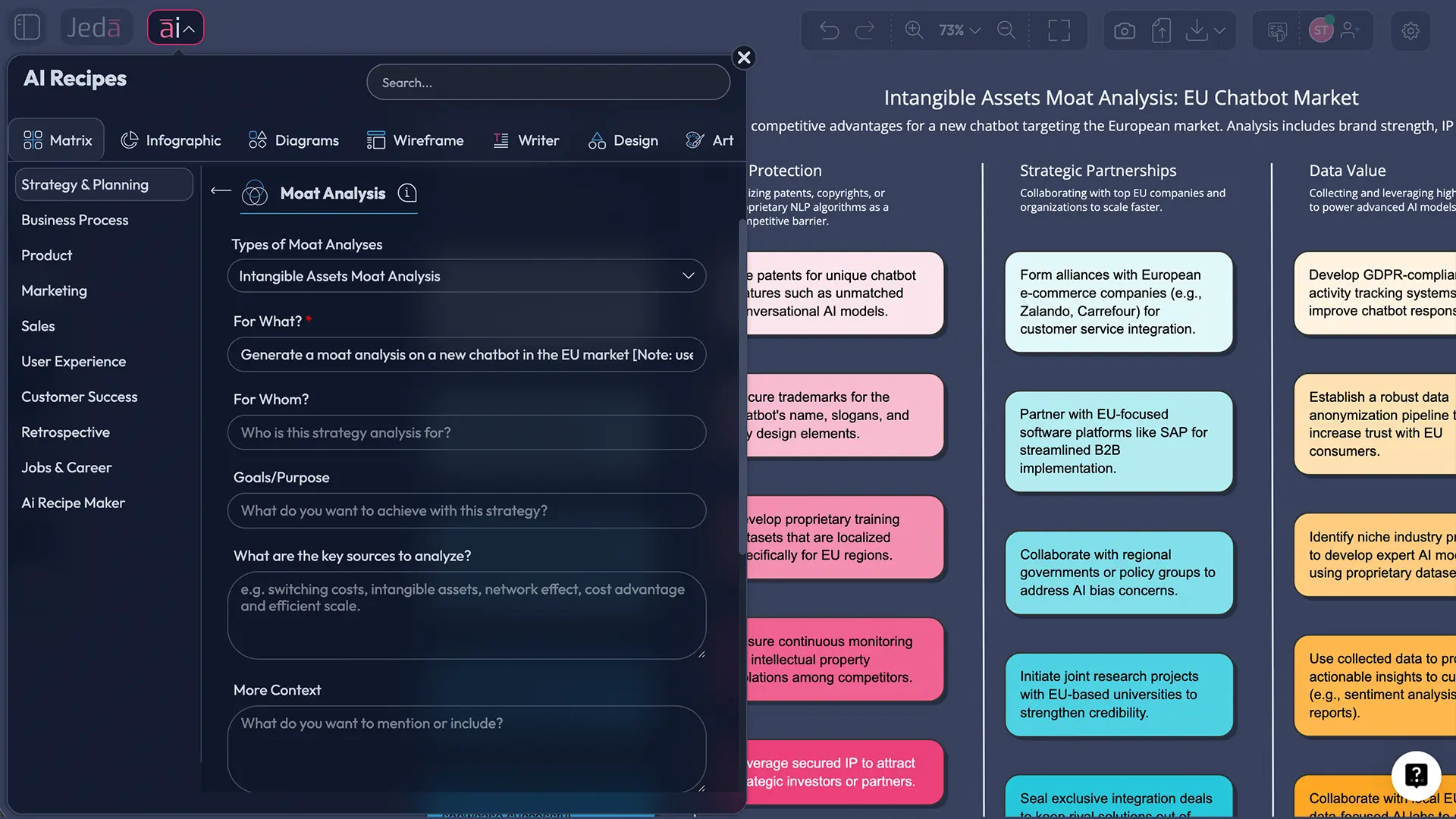
That's where AI comes in. Using Jeda.ai's AI Workspace, you can analyze competitive advantages faster, visualize complex frameworks, and stress-test your business resilience in hours instead of weeks. This guide walks you through everything—from the foundational concept of economic moats to actionable frameworks like Porter's Five Forces, VRIO analysis, and Morningstar's five sources of moat—and shows you exactly how to apply them using AI.
Whether you're a strategy consultant, business leader, or startup founder, you'll learn how to create professional, data-driven moat analyses that inform real business decisions. With Jeda.ai trusted by 150,000+ professionals worldwide, you have the tools to compete smarter.
What Is a MOAT Analysis?
A moat analysis is a strategic assessment of your company's sustainable competitive advantages. It answers the question: "What protects our business?" In 1995, Warren Buffett introduced the economic moat concept, defining it as the enduring competitive advantage that allows a company to earn excess returns on invested capital and defend those returns over time—ideally for 10+ years.
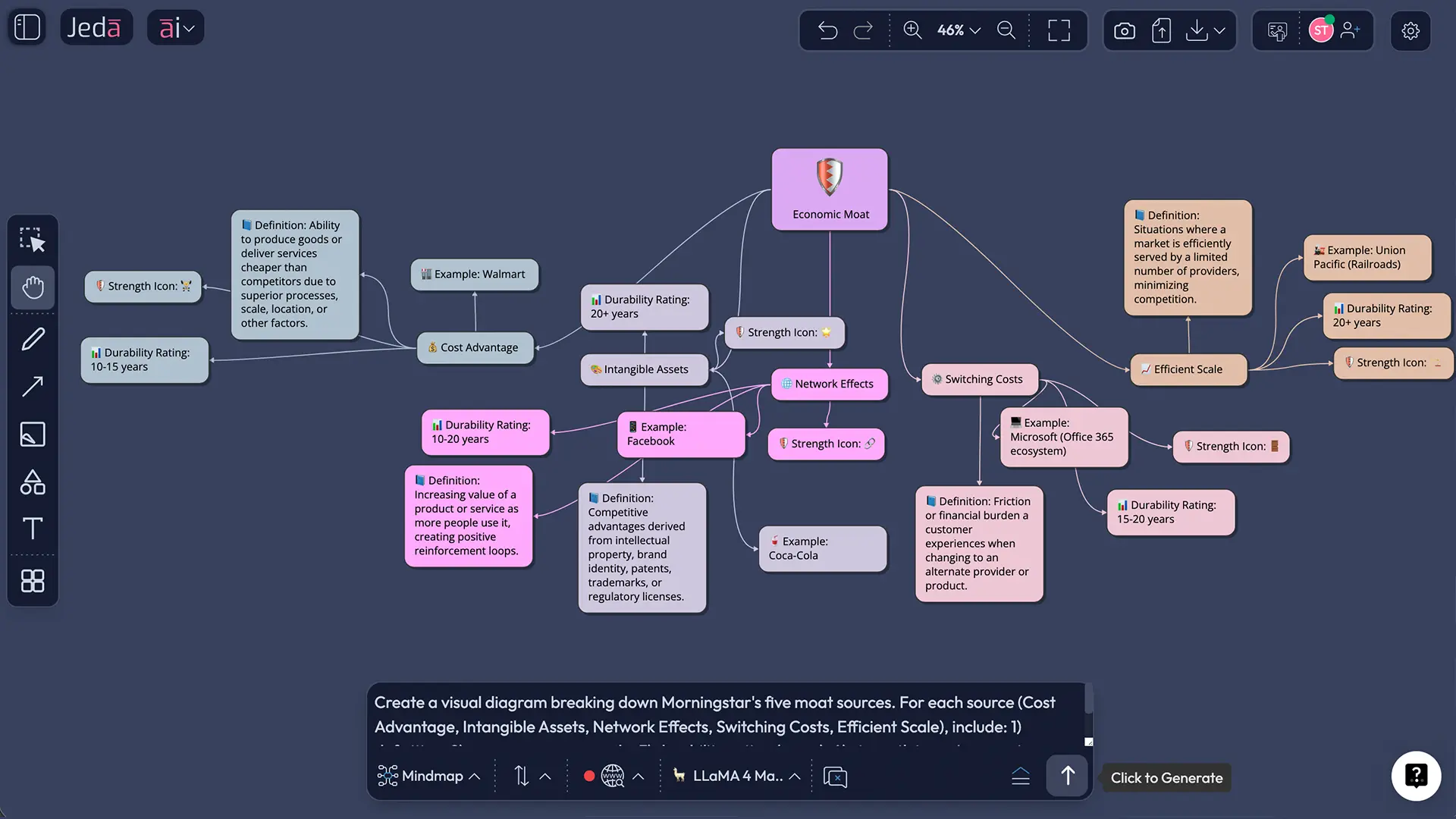
But moats aren't one-size-fits-all. Morningstar, the investment research firm, identified five distinct sources of moat: Cost Advantage (operational efficiency), Intangible Assets (brand and intellectual property), Network Effects (platform power), Switching Costs (customer lock-in), and Efficient Scale (economies of scale). Together, these frameworks—plus complementary tools like Porter's Five Forces and VRIO analysis—give you a complete picture of competitive health.
A moat analysis isn't just for investors. Product managers use it to prioritize features that deepen competitive advantages. Business leaders use it to allocate resources to defensible positions. Startups use it to validate business model resilience. And consultants use it to advise clients on strategic positioning.
The challenge? Conducting a thorough moat analysis traditionally requires hours of research, spreadsheet wrangling, and manual chart creation. Jeda.ai's AI Whiteboard simplifies this. You can generate professional matrices, diagrams, and mindmaps in minutes, then edit them visually until they reflect your strategic reality.
The Five Sources of Economic Moat
Morningstar's five sources of moat give you a concrete language for competitive advantage. Here's what each means and how to assess your business against it.
Cost Advantage: Your company produces goods or services at lower cost than competitors. This might stem from proprietary manufacturing processes, economies of scale, or access to cheaper raw materials. Examples: Amazon's logistics network, Apple's supply chain dominance, and IKEA's flat-pack design and production scale.
Intangible Assets: Your brand, patents, or regulatory licenses are so valuable that customers prefer your product despite alternatives. Coca-Cola's brand is worth an estimated $17 billion. Nike's swoosh commands a 20%+ price premium. Pharmaceutical patents create 10-year moats.
Network Effects: Value increases as more users join. LinkedIn's network is worth more as more professionals join. Microsoft Teams' integration with Office creates switching costs and network power. Slack's dominance depends on its position as the central hub of workplace communication.
Switching Costs: Customers find it expensive (in time, money, or effort) to move to a competitor. Enterprise software creates this moat through customization and training investment. Apple's ecosystem locks users in through iCloud, services integration, and device interdependence. Banking relationships create switching costs through data inertia.
Efficient Scale: A market is large enough to support only a few profitable competitors. This moat is rare in digital businesses, but it exists in infrastructure (railroads), water utilities, and some B2B software where per-customer acquisition costs are so high that only leaders survive profitably.
- Cost Advantage
Lowest cost producer through scale, efficiency, or proprietary methods
- Intangible Assets
Brand, patents, licenses, and regulatory approvals competitors can't duplicate
- Network Effects
Product becomes more valuable as more users adopt it
- Switching Costs
High cost for customers to move to competing products
- Efficient Scale
Market structure supports only a few profitable competitors
In 2024, Morningstar found that only 17% of companies in their analyst coverage had wide moats (moats lasting 20+ years). In 2025, that figure climbed to 26% of 836 evaluated US stocks, with 219 stocks rated as wide moat, 341 as narrow moat (~10 years), and 273 with no moat. Wide-moat stocks outperformed the broader market by 28.92% in 2024, showing that durable competitive advantages translate directly to shareholder value.
Complementary Frameworks: Porter's Five Forces & VRIO
Morningstar's five sources are outcome-focused: "What competitive advantage do we have?" But to understand why you have it—or why you're losing it—you need complementary frameworks.
Porter's Five Forces — Industry-Level Analysis
Michael Porter's 1979 model examines five competitive forces shaping an industry's attractiveness and profitability. Buyer Power: Do customers have alternatives and pricing flexibility? Supplier Power: Can suppliers raise costs or reduce quality? Threat of New Entrants: How easily can competitors enter? Threat of Substitutes: Are there alternative ways to solve the customer's problem? Competitive Rivalry: How intense is head-to-head competition?
Porter's framework is external and structural. It helps you understand the industry you're fighting in. If buyer power is high (many alternatives), you have less leverage. If supplier power is high and you're dependent on few suppliers, your margins are vulnerable. New entrant threats tell you whether your position is defensible or under pressure from startups and adjacencies.
Use Porter's Five Forces to assess industry headwinds and tailwinds. Then layer in moat sources to understand your competitive position within that industry context.
VRIO Framework — Resource-Level Analysis
Developed by Jay Barney in 1991, VRIO evaluates your internal resources and capabilities. Each letter stands for a criterion: Value: Does the resource provide customer benefits or reduce costs? Rarity: How many competitors have it? Imitability: How hard is it to copy? Organization: Are you structurally organized to exploit it?
If your resource is valuable and rare but easy to imitate, it's a temporary advantage. If it's valuable, rare, hard to imitate, and you're organized to leverage it, it's a sustained competitive advantage. VRIO is inward-facing. It asks: "What do we have that's hard to replicate?"
Together, Porter's Five Forces (external environment) and VRIO (internal resources) tell the full story. You might have a rare, hard-to-imitate resource (VRIO), but if your industry has high buyer power and substitutes (Porter's), your margins still compress. Conversely, a favorable industry (Porter's) without defensible resources (VRIO) invites competition.
Why Use AI for MOAT Analysis?
Competitive advantage analysis has always been slow. Researchers spend weeks gathering data, building spreadsheets, running scenarios, and creating visual artifacts. Most companies do it once a year, at best. But markets change fast. Your moat can erode in months.
AI changes the equation. According to McKinsey's 2024 survey, 78% of enterprise leaders now use AI in business decision-making, yet most still analyze competitive advantage manually.
With Jeda.ai's AI Workspace, you can:
- Generate frameworks instantly. Select the Matrix command, describe your business, and AI creates a structured competitive advantage analysis in seconds.
- Stress-test assumptions. Use multi-LLM agents (GPT, Claude, Llama) simultaneously to surface blind spots and alternative perspectives.
- Visualize complex data. Convert raw moat data into clear diagrams, matrices, and infographics without design skills.
- Iterate fast. Edit, refine, and regenerate visuals on the fly. No locked templates. No back-and-forth with designers.
- Share immediately. Export PNG, SVG, or PDF and present to stakeholders within minutes.
Visual AI accelerates decision-making. When you can see your moat sources mapped visually, conversations shift from "tell me about our advantages" to "how do we strengthen these specific sources?"
- AI Speed
Analyze competitive advantage in minutes instead of weeks—run faster cycles and iterate
- Multi-LLM Intelligence
Combine GPT, Claude, and Llama perspectives in one analysis for more robust insights
- Visual Clarity
Transform abstract frameworks into clear, actionable diagrams and matrices
- Rapid Iteration
Edit and refine visuals in real-time without recreating from scratch
How to Create a MOAT Analysis in Jeda.ai
Creating a professional moat analysis in Jeda.ai takes minutes. Here are the two primary methods:
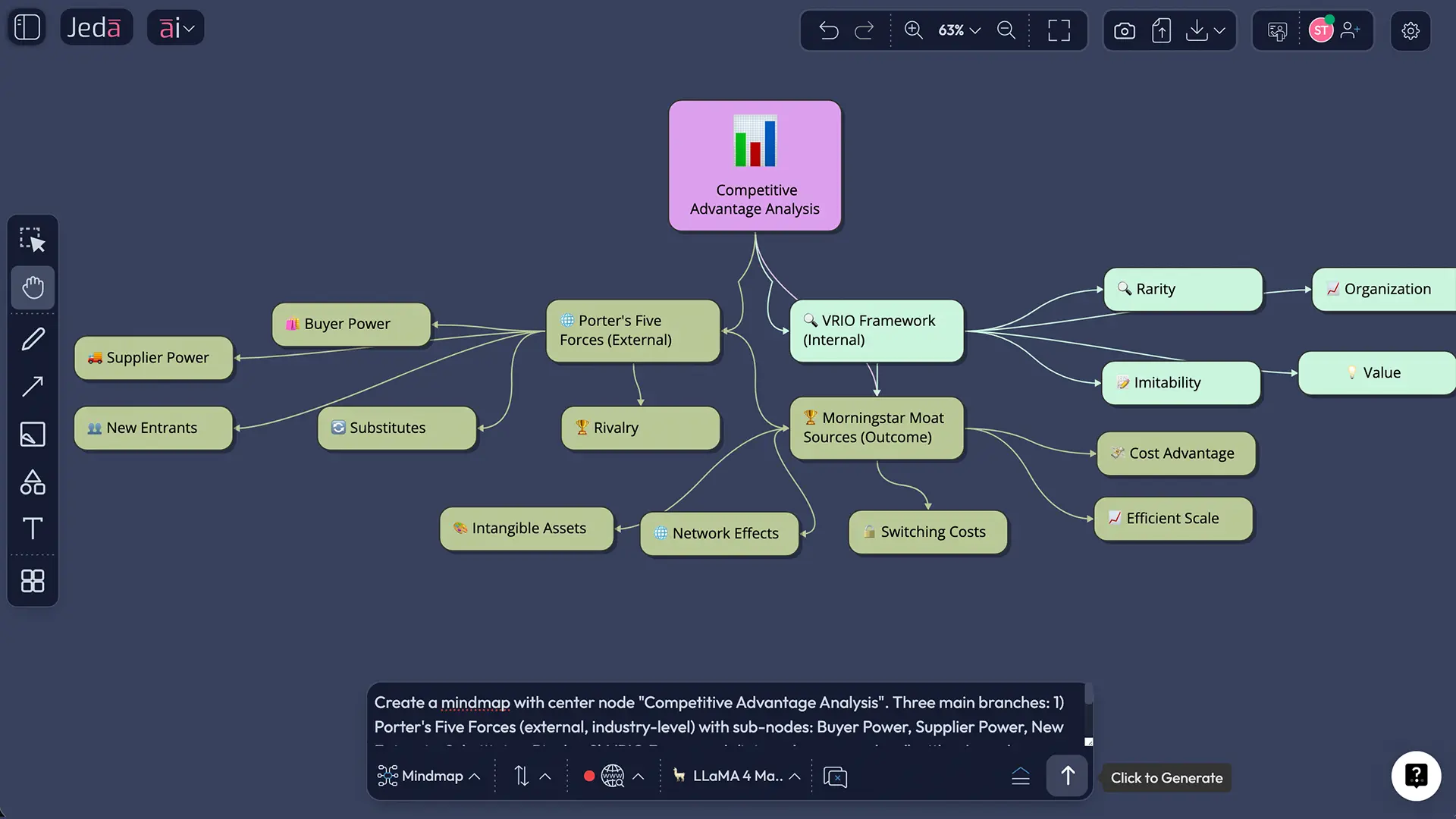
Method 1: AI Menu (Recommended) Open Jeda.ai. At the top-left, select the Matrix command from the AI Menu. The AI Menu includes 300+ strategic frameworks, including dedicated MOAT Analysis recipes. Type your business context. Hit generate. AI builds your matrix.
Method 2: Prompt Bar Alternatively, click the Prompt Bar at the bottom of your canvas and enter your MOAT analysis request directly (e.g., Create a moat analysis for SaaS company selling HR software to mid-market enterprises using Morningstar's five sources). Jeda.ai's AI agents interpret the prompt and generate an appropriate visual. Select the matrix AI command before running the prompt.
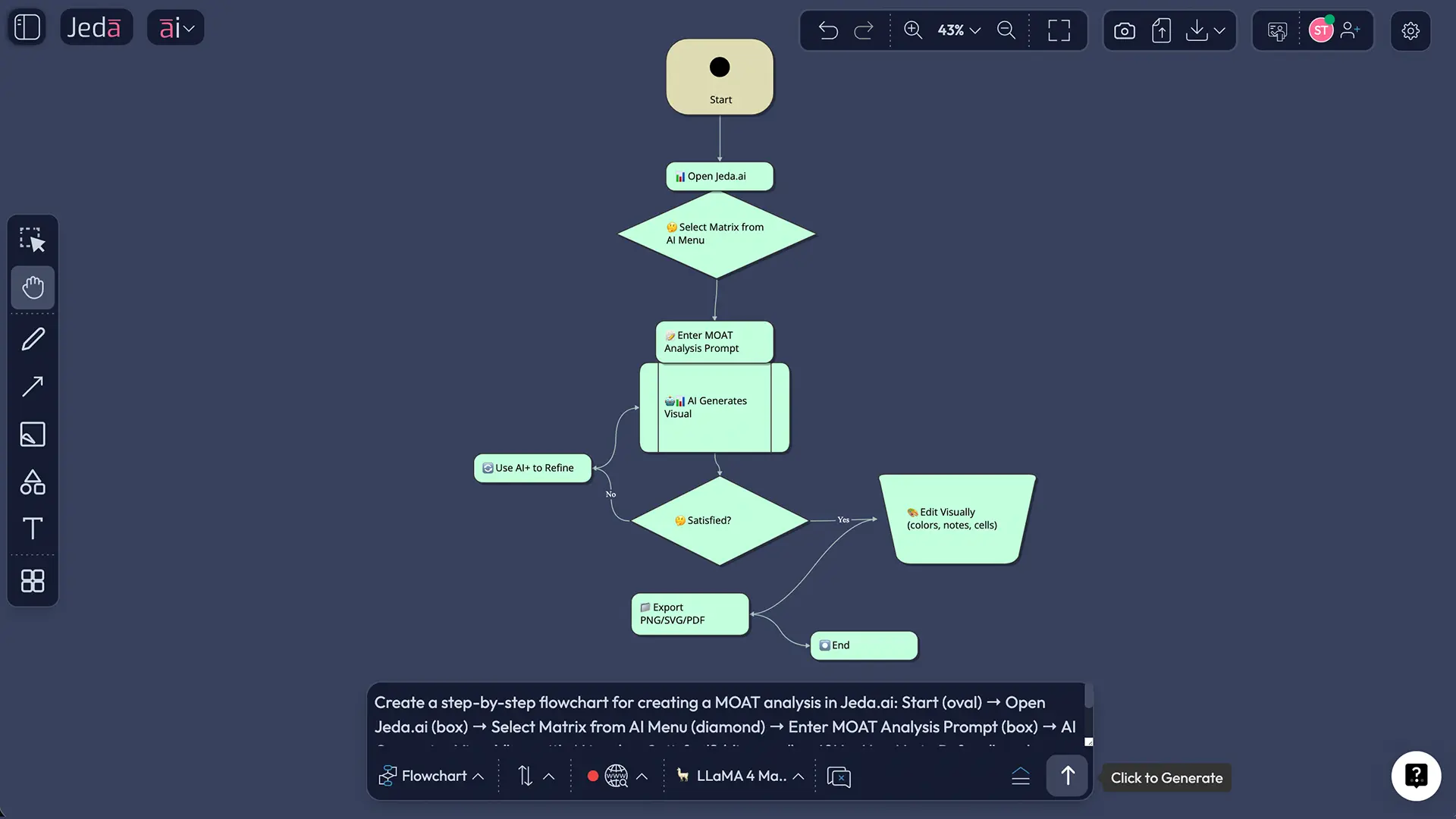
- Open Jeda.ai and Select Matrix
Navigate to Jeda.ai. From the top-left AI Menu, select the Matrix command. (Or use the Prompt Bar at the bottom if you prefer typing.)
- Enter Your MOAT Analysis Prompt
Be specific with your context. Prompt bar Example: 'Create a MOAT analysis for Apple Inc. across Morningstar's five sources: Cost Advantage, Intangible Assets, Network Effects, Switching Costs, and Efficient Scale. Include current strength (1-10) and sustainability (10-year outlook) for each.'
- AI Generates Your Analysis
Jeda.ai's multi-LLM agents process your prompt and generate a structured matrix. The AI Aggregator Model synthesizes insights from multiple models into one coherent visual.
- Use AI+ to Extend & Refine
Select the AI+ button to drill into specific moat sources. Regenerate any section that needs rework.
- Edit Visually & Export
Edit colors, add notes, reorder rows, insert logos. Click export and download as PNG, SVG, or PDF. No design skills required.
Pro Tips:
Vision Transform: Once your matrix is built, select the Vision Transform command to convert it into a Diagram, Mindmap, or Infographic. Same data, different format—useful for presentations where visual variety matters.
AI+ Button: The AI+ button is your secret weapon. Use it to extend a moat source description, add a row for competitor comparison, or regenerate a cell that didn't capture your intent.
Prompt Specificity: The better your prompt, the better your output. Instead of "analyze our moat," try: "Analyze our software-as-a-service moat relative to three competitors (Competitor A, B, C) across cost, switching costs, brand, and network effects. Rate each source 1-10."
MOAT Analysis Templates & Real-World Examples
Theory is useful. Seeing it in action is better.
Apple's Economic Moat
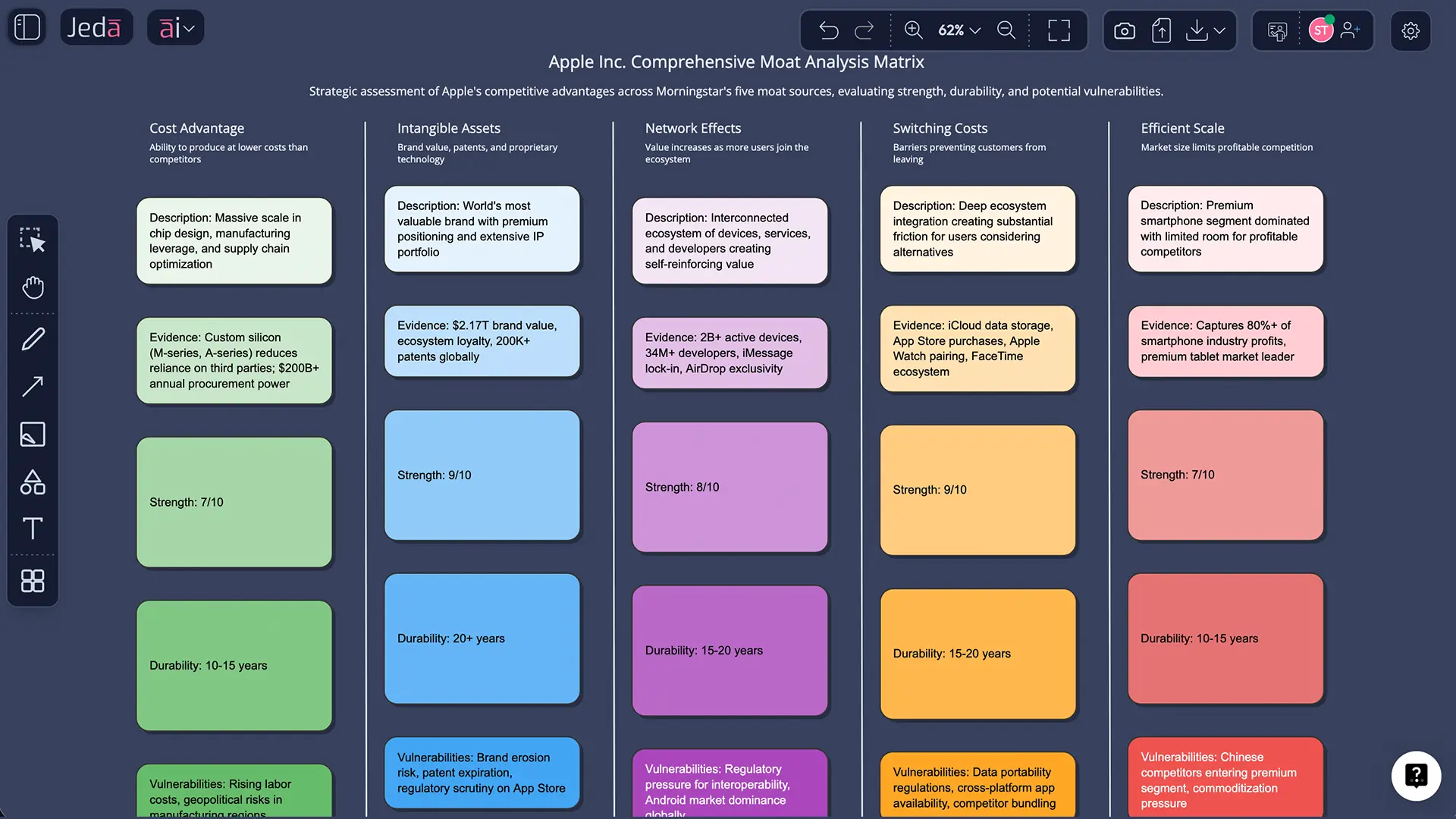
Let's analyze Apple Inc. using Morningstar's five sources:
Intangible Assets (Strength: 9/10, Durability: 20+ years) Apple's brand is worth an estimated $2.17 trillion. The "Apple ecosystem"—iCloud, services integration, design language—creates a halo effect. Customers trust Apple with privacy and quality. This advantage is durable because brand reputation, once earned, is extremely hard to replicate.
Switching Costs (Strength: 9/10, Durability: 20+ years) An iPhone user with an Apple Watch, AirPods, iPad, and Mac is deeply embedded in Apple's ecosystem. Leaving Apple means replacing multiple devices and retraining family members. Apple's services—Apple Music, iCloud, Apple TV+—increase stickiness. This is a potent moat.
Efficient Scale (Strength: 8/10, Durability: 10-20 years) Apple's supply chain and manufacturing scale are legendary. No competitor can negotiate component costs as aggressively. This scale generates 46% gross margins. As long as Apple maintains volume leadership, this moat holds.
Cost Advantage (Strength: 7/10, Durability: 10-20 years) Due to scale and vertical integration, Apple manufactures efficiently. Competitors must match this or accept lower margins.
Network Effects (Strength: 6/10, Durability: 10+ years) Weaker than other sources, but growing. The Apple ecosystem benefits from developer integration (App Store), services network, and device ecosystem network effects. As services grow, network effects strengthen.
Overall Moat Assessment: Apple has a wide moat (20+ years). The combination of intangible assets, switching costs, and scale creates a fortress. Vulnerabilities? AI commoditization (if AI services become standardized), environmental regulations on device durability, and emerging competition in services.
This kind of analysis—detailed, visual, and forward-looking—is what separates strategic thinking from guesswork. And with Jeda.ai, building it takes hours, not weeks.
Best Practices for AI-Powered MOAT Analysis
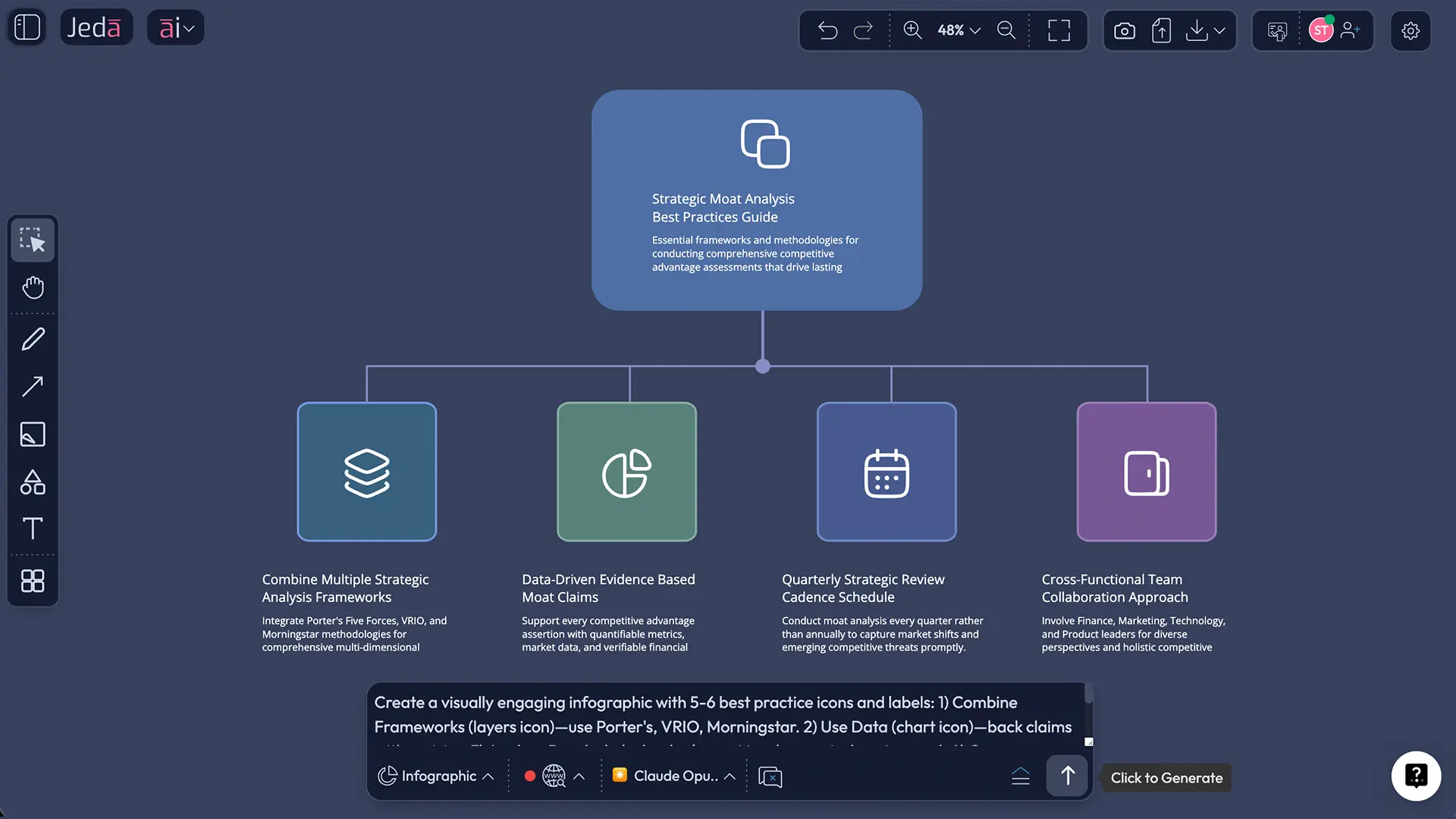
A moat analysis is only as good as your rigor. Here's how to do it right:
Common Mistakes to Avoid
Mistake 1: Confusing Revenue Scale with Moat. A company with $10 billion in revenue but 3% margins has no moat. A company with $1 billion in revenue and 40% margins has a fortress. Moats generate outsized returns on capital. Size alone isn't enough.
Mistake 2: Assuming Brand = Durable Competitive Advantage. Brand matters, but it's fragile. Kodak had a legendary brand and still collapsed. Facebook's brand didn't stop people from switching to TikTok. Brand is an asset, but it's not a moat unless it drives pricing power and customer retention and resistant to new entrants. Apple's brand works because it's backed by ecosystem lock-in. Tesla's brand works because superior engineering creates switching costs. Brand alone is insufficient.
Mistake 3: Ignoring Competitor Moats. A great moat analysis doesn't just evaluate your moats. It benchmarks them against competitors. If you have a cost advantage but a competitor has cost advantage + switching costs + network effects, you're behind. Always analyze your moat relative to the competitive set.
Mistake 4: Treating Moats as Static. Technology, regulation, and customer preferences change. A moat that seemed durable in 2015 might be obsolete in 2025. Remote work transformed commuting moats. Cloud computing undermined enterprise software stickiness. Electric vehicles undermine internal combustion engine manufacturing moats. Analyze moat durability under different scenarios.
Mistake 5: Confusing Porter's Five Forces with Moat Sources. Porter's framework assesses industry attractiveness. A favorable industry (low rivalry, high switching costs) doesn't mean your company has a moat. You still need defensible resources or advantages. Many companies compete in attractive industries and earn commodity returns.
The Verdict: Jeda.ai uniquely combines AI-powered generation, 300+ frameworks, fully editable visuals, and competitive pricing. Competitors excel in user base (Miro, Lucidchart) or strategy depth (Cascade) or AI focus (SCOPY.ME), but none integrate all four. For a business leader, consultant, or analyst who needs fast, professional, AI-accelerated moat analyses, Jeda.ai is the optimal choice.
Frequently Asked Questions
- What is an economic moat and why does it matter?
- An economic moat is a sustainable competitive advantage that protects profit margins and resists competitive pressure. Warren Buffett popularized the term. Companies with wide moats (20+ year durability) earn excess returns and compound shareholder value. Identifying your moat tells you what to defend and how to allocate resources.
- What are Morningstar's five sources of moat?
- Cost Advantage (lowest cost producer), Intangible Assets (brand and IP), Network Effects (value increases with users), Switching Costs (expensive to leave), and Efficient Scale (market structure supports few competitors). Most durable businesses have multiple moat sources.
- How do you analyze a company's moat?
- Use a multi-framework approach: Porter's Five Forces (industry dynamics), VRIO (internal resources), and Morningstar's five sources (competitive advantages). Gather evidence—financial metrics, customer retention, market share trends, pricing power. Use Jeda.ai to synthesize into a visual analysis.
- What's the difference between VRIO and Porter's Five Forces?
- Porter's Five Forces examines external industry attractiveness (buyer power, supplier power, rivalry, substitutes, new entrants). VRIO evaluates internal resources (Value, Rarity, Imitability, Organization). Together they answer: Is the industry favorable, and do we have defensible advantages?
- Can AI tools help speed up moat analysis?
- Absolutely. AI-powered tools like Jeda.ai generate frameworks instantly, synthesize data across multiple sources, and produce professional visuals without design skills. What once took weeks now takes hours, enabling quarterly competitive reviews instead of annual ones.
- What companies have the strongest economic moats?
- Apple (brand, switching costs, ecosystem), Microsoft (switching costs, network effects), Google (network effects, data moat), Coca-Cola (brand, scale, distribution), Visa (network effects, switching costs). Each has multiple moat sources creating fortress-like positions.
- What does 'switching costs' mean in competitive advantage analysis?
- Switching costs are the economic or operational barriers preventing customers from moving to competitors. Examples: enterprise software requires retraining and migration costs; Apple's ecosystem requires replacing multiple devices; banking relationships involve data inertia. High switching costs = durable moat.
- How long do economic moats typically last?
- Morningstar classifies wide moats as lasting 20+ years, narrow moats as ~10 years, and no moat as less than 10 years. But durability depends on context. Tech moats often erode faster due to disruption. Consumer brand moats can last generations if managed carefully.
- How do you create a VRIO analysis?
- Evaluate your resources or capabilities across four dimensions: Is it Valuable (customer benefit or cost reduction)? Is it Rare (few competitors have it)? Is it Imitable (hard to copy)? Is the Organization structured to exploit it? Resources meeting all four criteria = sustained advantage. Use Jeda.ai's Matrix to map this visually.
- What percentage of companies have wide economic moats?
- As of 2025, 26% of 836 evaluated US stocks have wide moats (219 companies), 41% have narrow moats (341), and 33% have no moat (273). In 2024, only 17% were wide moat. Wide-moat stocks outperformed by 28.92% in 2024, proving durability = returns.
Sources & Further Reading
- [1]
Porter, M.E. (1979) . “How Competitive Forces Shape Strategy” Harvard Business Review.
View Source ↗ - [2]
Barney, J.B. (1991) . “Firm Resources and Sustained Competitive Advantage” Journal of Management, 17(1), 99-120.
- [3]
Morningstar, Inc. (2025) . “What Makes a Moat? Morningstar's Five Sources of Moat” White Paper.
View Source ↗ - [4]
Morgan Stanley Investment Management (2016) . “Measuring the Moat: Assessing the Magnitude and Sustainability of Value Creation” Counterpoint Global Insights.
- [5]
McKinsey & Company (2024) . “The State of AI in Early 2024” McKinsey Global Survey.
View Source ↗
Start Your MOAT Analysis Today
Join over 150,000+ professionals who use Jeda.ai's AI Workspace to analyze competitive advantage and make smarter strategic decisions. No design skills. No spreadsheets. Just AI-powered insights.
Try Free Template