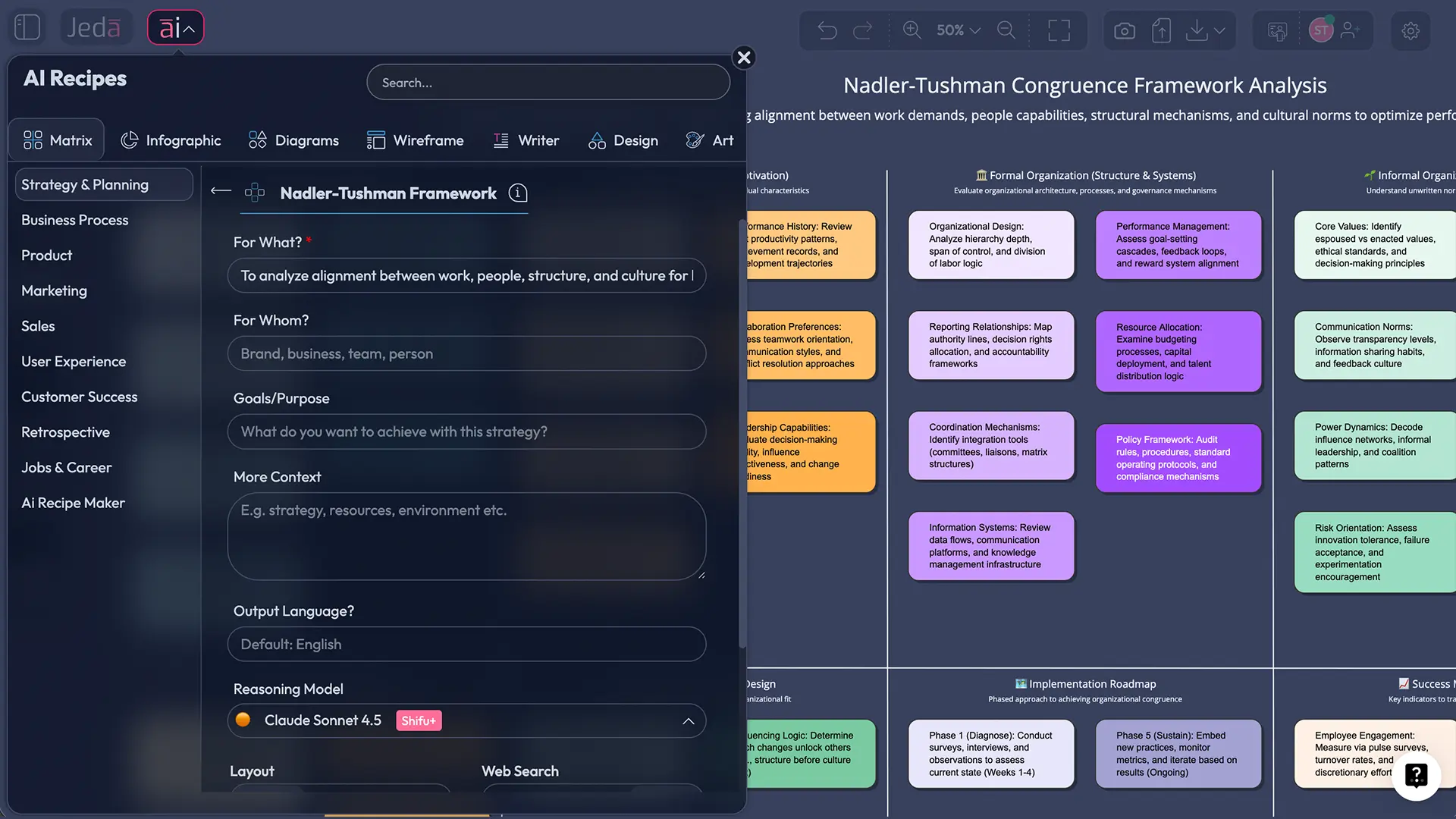
The biggest performance gaps in your organization aren't hiding in your financials. They're buried in the invisible friction between your people, your processes, your structure, and your culture — and most leaders don't see them until the damage is done. The Nadler-Tushman Congruence Model, developed by David Nadler and Michael Tushman in the early 1980s at Columbia University, gave us a diagnostic lens to surface these misalignments. But here's the shift nobody's talking about: when you pair this framework with an AI Workspace like Jeda.ai, you stop diagnosing problems after they've metastasized. You catch them in real time.
This isn't incremental improvement. It's a fundamentally different way to think about organizational design.
What Is the Nadler-Tushman Congruence Model?
David A. Nadler and Michael L. Tushman published their congruence model in 1980 through their seminal paper "A Model for Diagnosing Organizational Behavior" in Organizational Dynamics. The core idea is elegant: an organization's performance depends not on any single element, but on how well four interdependent components fit together.
Those four components are Work (the tasks and processes that drive output), People (the skills, knowledge, and behaviors of employees), Structure (the formal hierarchy, roles, and systems), and Culture (the informal norms, values, and unwritten rules). When these four elements align — when they're congruent — performance follows. When they clash, you get inefficiency, disengagement, and strategic drift.
Tushman and his co-author Charles O'Reilly later expanded this thinking in Competing by Design (1997), arguing that organizational architecture is a deliberate leadership choice. The model treats every organization as an open system: inputs like strategy, resources, and environmental context flow through these four components and produce outputs measured by organizational, group, and individual performance.
What makes the Congruence Model distinctive from something like McKinsey's 7-S Framework is its emphasis on the relationships between components rather than the components themselves. You're not just listing what exists. You're mapping where the fit breaks down. And that's precisely what AI accelerates.
Why the Congruence Model Needs AI — and Why Now
Let's be direct. Running a proper Nadler-Tushman analysis manually is exhausting. You need interviews across departments, survey data on culture and engagement, structural audits, and process documentation. Even experienced consultants spend weeks — sometimes months — collecting and synthesizing this information. And by the time the analysis is complete, the organization has already shifted.
That's the core tension. Organizational dynamics move faster than traditional diagnostic cycles.
Here's where AI changes the equation entirely. Jeda.ai's Visual AI Workspace lets teams generate congruence models in under 60 seconds, map all six pairwise relationships between the four components, and iterate on the analysis collaboratively in real time. We're not talking about a static template. We're talking about a living diagnostic artifact that evolves as your understanding deepens.
- Instant Framework Generation
Generate complete Nadler-Tushman models from a single prompt. No blank-canvas paralysis — start with an AI-built structure and refine from there.
- Multi-Model Intelligence
Run your congruence analysis through GPT, Claude, and Grok simultaneously. Jeda.ai's Aggregator picks the most insightful diagnostic output.
- Real-Time Collaboration
Strategy teams, HR leaders, and operations can all annotate the model live. Follow Me mode syncs everyone's view during working sessions.
- Vision Transform
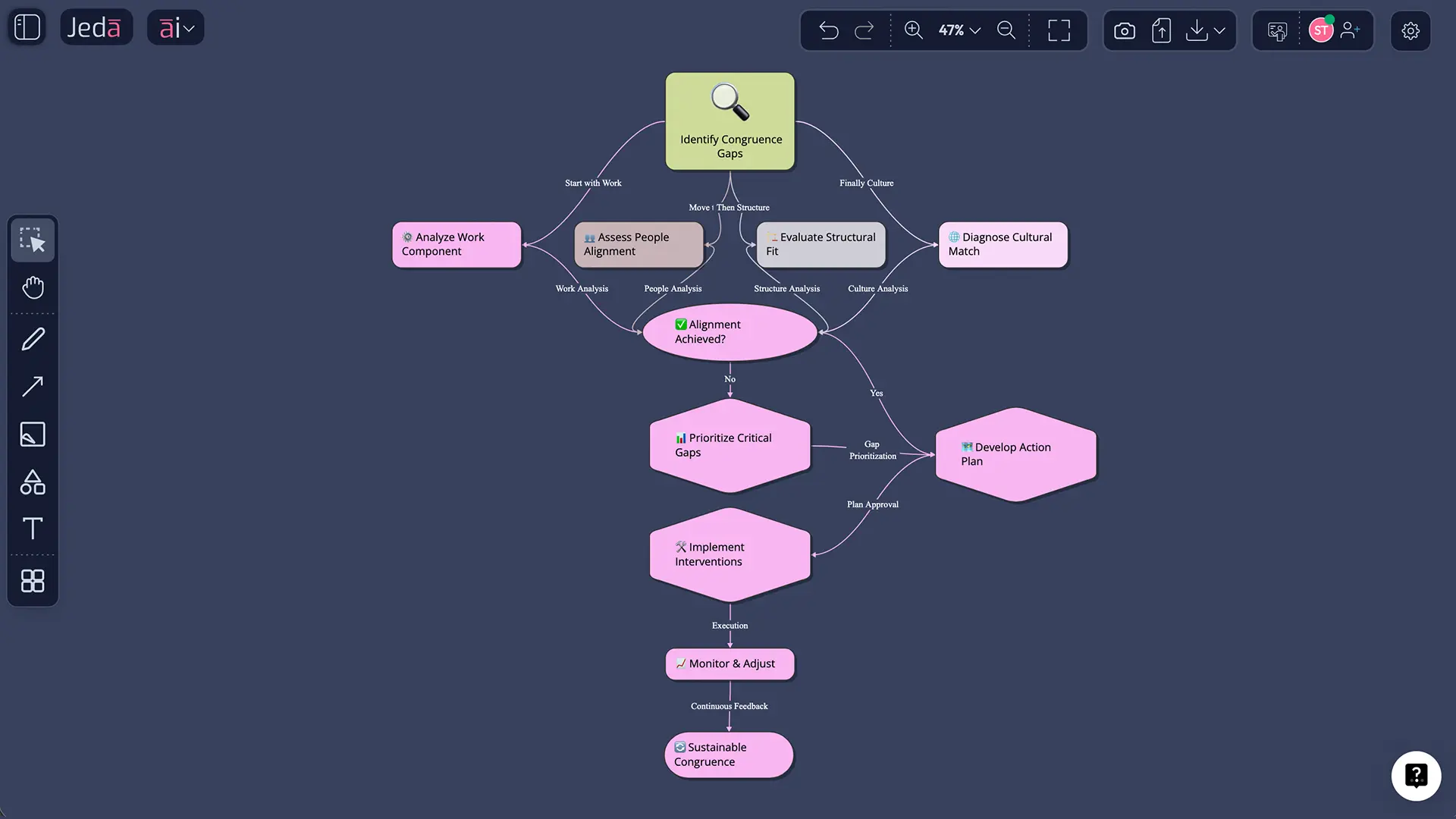
Convert your congruence diagram into a flowchart showing intervention steps, or a mindmap exploring root causes. One click.
- Data-Informed Diagnosis
Upload engagement surveys or process data via Document Insight. Let AI extract the congruence gaps from your actual organizational data.
The companies leading organizational transformation in the next decade won't be the ones with the best consultants. They'll be the ones that can diagnose and respond to misalignment faster than their competitors can even identify it.
How to Create a Nadler-Tushman Congruence Model in Jeda.ai
Building a congruence analysis on Jeda.ai's AI Whiteboard takes a fraction of the time you'd spend in traditional tools. Here are two approaches depending on your workflow.
Method 1 — AI Menu (Recommended):
- Click the AI Menu button in the top-left corner of the canvas
- Browse to the Matrix Recipes category
- Select a framework template called Nadler Tushman Framework
- Enter your specific context
- Click Generate to produce a structured congruence model
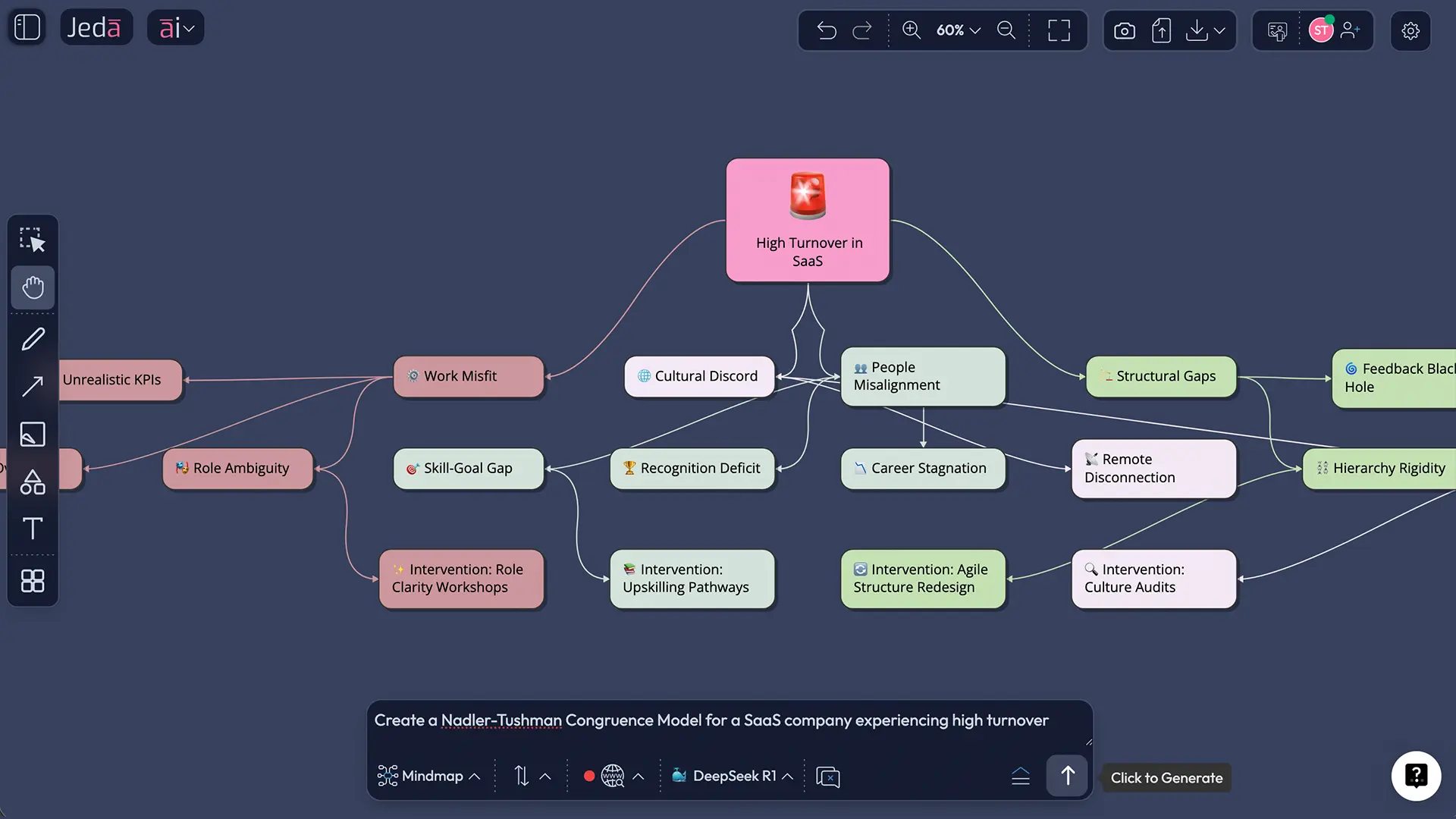
Method 2 — Prompt Bar:
- Open the Prompt Bar at the bottom of the canvas
- Select the Matrix command
- Type something like: "Create a Nadler-Tushman Congruence Model for a mid-size SaaS company experiencing high turnover despite strong revenue growth. Map all six component relationships."
- Press Enter to generate
After generating your initial model, use AI+ to extend any section. Use Vision Transform to convert your diagram into a flowchart showing recommended intervention steps.
- Define Your Inputs
Identify the organizational strategy, key resources, environmental context, and historical factors that set the stage for your congruence analysis.
- Generate the Framework
Use the Prompt Bar with the Diagram or Matrix command to generate a Nadler-Tushman model. Include specific organizational details for a more targeted output.
- Map Component Details
Expand each of the four components — Work, People, Structure, Culture — with specifics from your organization. Use AI+ to deepen any area.
- Assess Pairwise Congruence
Evaluate all six relationships: Work-People, Work-Structure, Work-Culture, People-Structure, People-Culture, and Structure-Culture. Mark each as aligned or misaligned.
- Identify Root Causes
For each misalignment, use AI+ to generate potential root causes. Convert to a mindmap using Vision Transform for deeper exploration.
- Design Interventions
Transform your diagnosis into an action plan. Use Vision Transform to convert the analysis into a flowchart of prioritized interventions.
Real-World Application: Diagnosing a Post-Merger Integration Gap
Here's a scenario that illustrates why this matters. A $2B manufacturing company acquires a 400-person tech firm to accelerate its digital transformation. Eighteen months in, the integration is stalling. Turnover among acquired engineers hits 35%. Product timelines slip. The board wants answers.
A congruence analysis reveals the problem isn't about bad hires or inadequate pay. It's structural and cultural misalignment:
On Jeda.ai, you could map this entire diagnosis visually in under five minutes. The AI generates the framework, you populate it with real organizational data (or upload engagement survey results via Document Insight), and your leadership team can see — in a single visual — exactly where the fit breaks down and why.
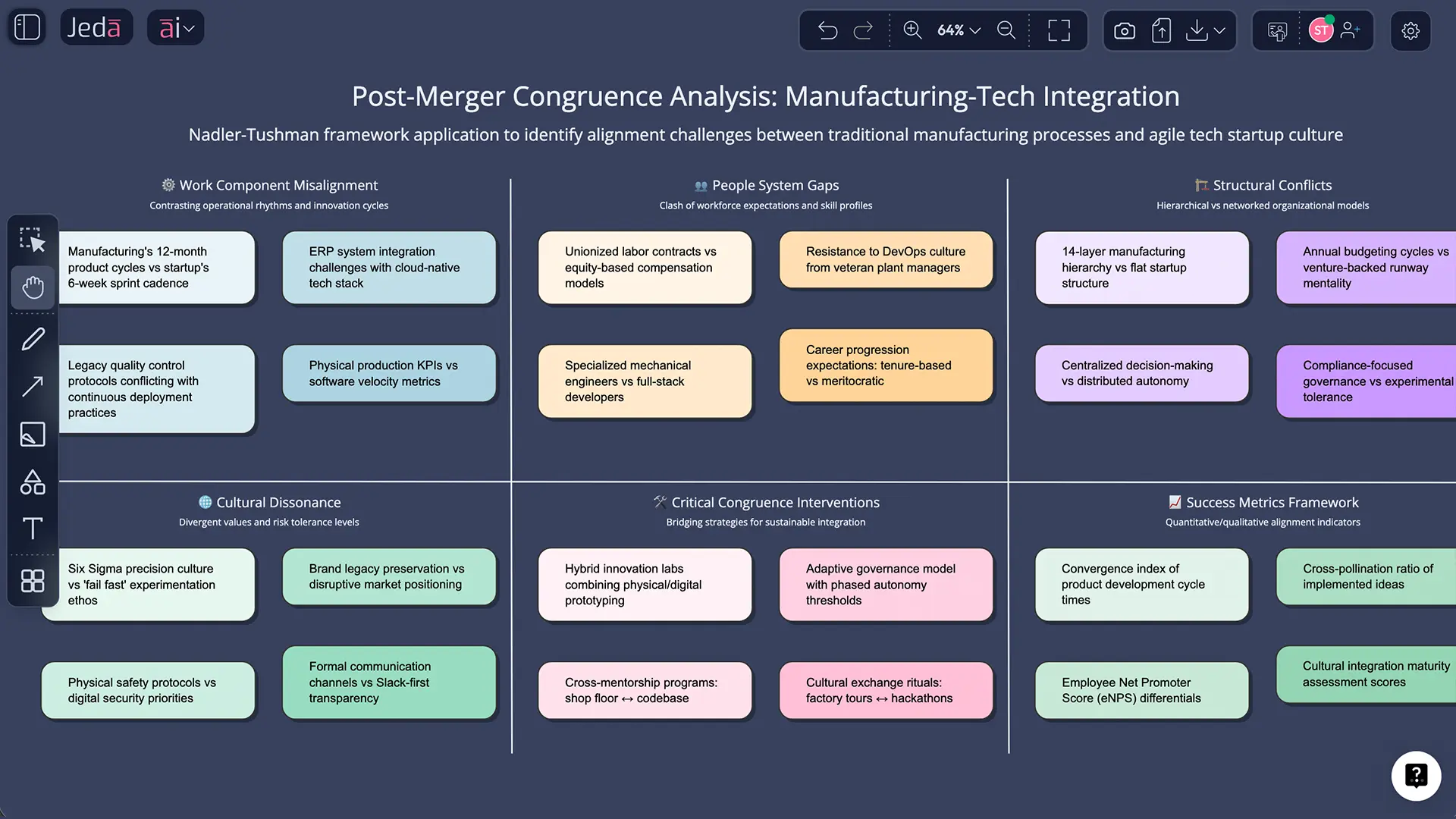
That's diagnostic power you simply can't replicate in a slide deck or a spreadsheet.
Best Practices for AI-Powered Congruence Analysis
The organizations getting the most from AI-powered congruence analysis share a few patterns we've observed across 150,000+ users on Jeda.ai:
They treat the model as a living artifact. Not a one-time exercise, but a quarterly diagnostic check that lives on the AI Whiteboard and gets updated as conditions change. They involve cross-functional voices early. A congruence model built by the strategy team alone will miss cultural dynamics that HR sees daily. Real-time collaboration on Jeda.ai makes this practical, not aspirational.
They use AI to challenge assumptions. When you generate a congruence model with AI, the output sometimes surfaces relationships you hadn't considered. That's a feature, not a bug. The multi-LLM intelligence behind Jeda.ai — running GPT, Claude, and Grok simultaneously — means you get diverse analytical perspectives, not just one model's bias.
And they go beyond diagnosis. The Congruence Model is powerful for identifying misalignments, but as Tushman himself noted, it's diagnostic, not prescriptive. Use Vision Transform to convert your diagnosis into intervention flowcharts, action-priority matrices, or implementation roadmaps.
Common Mistakes When Using the Congruence Model
Treating all misalignments as equally urgent. Not every incongruence is a crisis. Some misalignments are structural trade-offs that leadership has consciously accepted. Focus your intervention energy on the misalignments directly causing the performance gap you're investigating.
Ignoring the informal organization. Culture is the hardest component to assess because it's the least visible. Teams often describe what culture should be rather than what it actually is. Use Jeda.ai's AI to generate probing questions that surface real cultural dynamics, not aspirational ones.
Analyzing components in isolation. The entire value of the Congruence Model is in the relationships. If you're listing what each component contains without mapping how they interact, you're using the model wrong. Every Jeda.ai-generated congruence diagram should show the six pairwise connections explicitly.
Skipping the input analysis. Strategy, resources, environment, and history are inputs that constrain all four components. If your strategy has fundamentally shifted but your congruence analysis still reflects the old strategy, your diagnosis will be misleading. Start by validating your inputs before mapping component relationships.
Using the model as a one-time exercise. Nadler and Tushman designed this as a diagnostic tool for ongoing organizational leadership, not a consulting project deliverable. The AI Workspace makes it practical to maintain and update your congruence analysis continuously.
Frequently Asked Questions
- What is the Nadler-Tushman Congruence Model used for?
- The Nadler-Tushman Congruence Model is a diagnostic tool that identifies organizational performance gaps by analyzing how well four components — Work, People, Structure, and Culture — fit together. When these elements are misaligned, performance suffers. Leaders use it to find root causes of inefficiency, disengagement, or strategic drift before designing targeted interventions.
- How do I create a Nadler-Tushman Congruence Model with AI?
- In Jeda.ai, open the Prompt Bar and select the Diagram or Matrix command. Type your organizational context and press Enter. The AI generates a complete congruence model with all four components and their relationships mapped. Use AI+ to extend any section and Vision Transform to convert between visual formats.
- Who created the Nadler-Tushman Congruence Model?
- David A. Nadler and Michael L. Tushman developed the Congruence Model at Columbia University in the early 1980s. Their foundational paper, published in Organizational Dynamics in 1980, introduced the framework. Tushman later expanded it with Charles O'Reilly in their 1997 book Competing by Design.
- What are the four components of the Congruence Model?
- The four components are Work (tasks and processes), People (skills, knowledge, and behaviors), Structure (formal hierarchy and systems), and Culture (informal norms and values). The model evaluates how well each pair of components fits together — six pairwise relationships in total — to determine organizational congruence.
- How is the Nadler-Tushman model different from McKinsey 7-S?
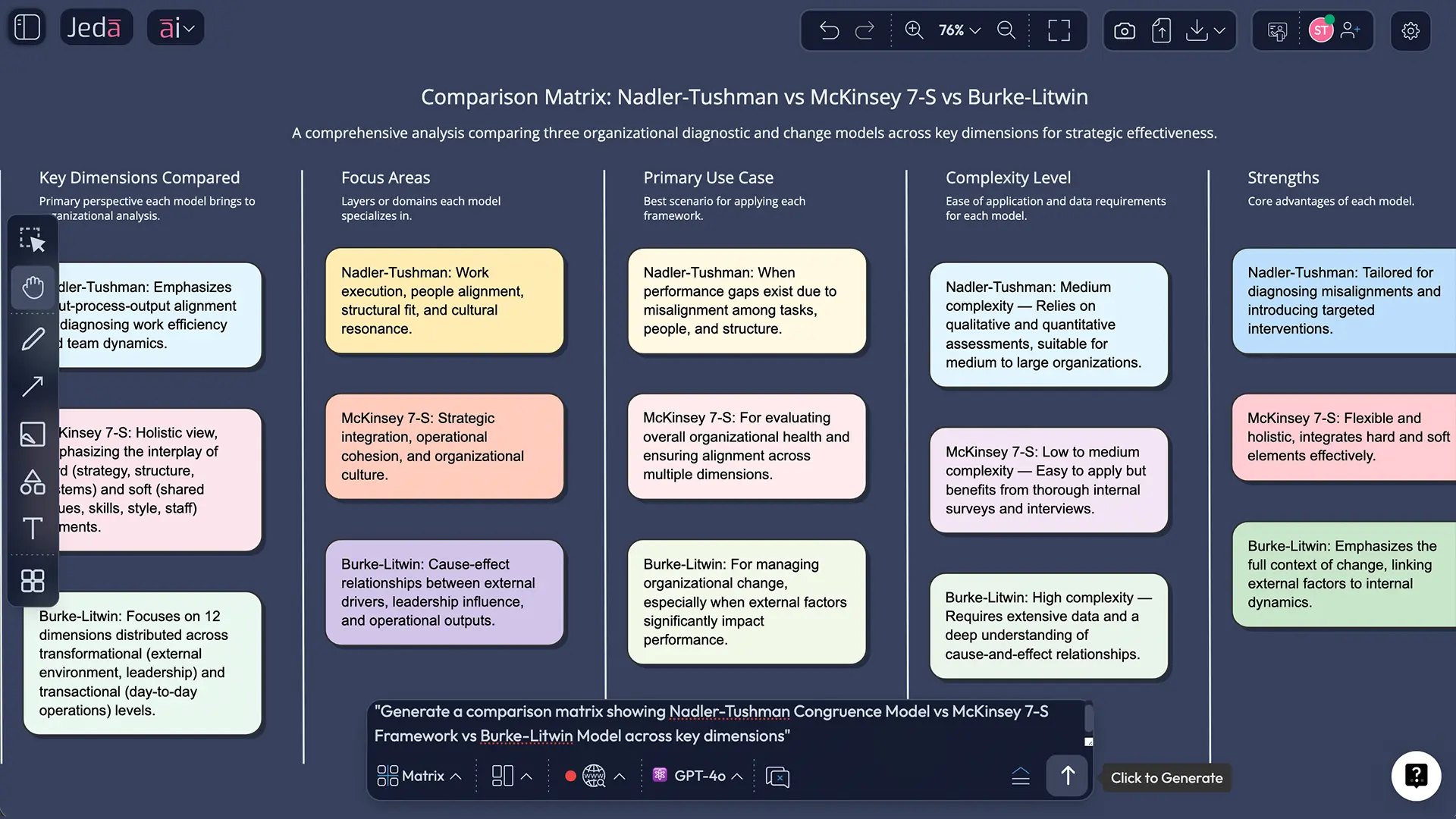
- While both analyze organizational alignment, the Congruence Model focuses on four components and emphasizes the fit between each pair. McKinsey 7-S examines seven elements without the same pairwise congruence analysis. The Nadler-Tushman approach is more diagnostic and root-cause oriented, while 7-S is broader in scope.
- Can I use Jeda.ai to analyze organizational data with the Congruence Model?
- Yes. Jeda.ai's Document Insight command lets you upload engagement surveys, process documentation, or organizational data in PDF or Word format. The AI extracts relevant patterns and maps them to congruence model components, grounding your diagnosis in real evidence rather than assumptions.
- What is a congruence gap in organizational design?
- A congruence gap occurs when two organizational components are misaligned — for example, when a company's culture rewards individual performance but its work requires cross-functional collaboration. These gaps create friction that reduces performance and are the primary targets for organizational intervention.
- Is the Nadler-Tushman framework suitable for small businesses?
- Absolutely. While the model was developed for complex organizations, small businesses benefit from its structured approach to diagnosing misalignment. Jeda.ai simplifies the process — generate a congruence model in seconds, even without a dedicated strategy team. The Whitebelt plan provides free access to all 11 AI commands.
- How often should I update my organizational congruence analysis?
- Best practice is quarterly, or whenever a significant change occurs — leadership transition, merger, strategic pivot, or rapid growth. Jeda.ai's AI Workspace lets you maintain a living congruence model on your canvas that your team can update collaboratively as conditions evolve.
- What industries use the Nadler-Tushman Congruence Model most?
- The model is widely used in management consulting, healthcare administration, financial services, technology, and manufacturing. Any industry facing complex organizational challenges benefits from congruence analysis. Strategy consultants frequently use it as a diagnostic foundation for transformation engagements.
Sources & Further Reading
- [1]
Nadler, D.A. and Tushman, M.L. (1980) . “A Model for Diagnosing Organizational Behavior” Organizational Dynamics, 9(2), 35-51.
View Source ↗ - [2]
Nadler, D.A. and Tushman, M.L. (1997) . “Competing by Design: The Power of Organizational Architecture” Oxford University Press.
View Source ↗ - [3]
Kayani, N. and Nadeem, S. (2015) . “ERP Implementation: An Application of Nadler's Congruence Model” Academy of Management Proceedings, 2015(1), 14005.
View Source ↗ - [4]
Harvard Business School Online (2024) . “Understanding the Nadler-Tushman Congruence Model” HBS Online Business Insights.
View Source ↗
Diagnose Organizational Alignment with AI
Join over 150,000 professionals using Jeda.ai to generate strategic frameworks in seconds — not weeks.
Try Free Congruence Model