Network effects moat analysis is how you prove (or disprove) that "more users" actually makes your product harder to beat — not just louder on social.
A real network-effect moat has three traits: value rises as participation rises, it compounds through feedback loops, and it survives stress (multi-homing, copying, regulation, and the inevitable “we’re launching a competitor” announcement). Jeda.ai helps you run this analysis inside an AI Workspace that produces editable visuals on an AI Whiteboard — not a static chat answer. And yes, it’s easier to argue with a board than with a paragraph.
What is a network effect moat?
A network effect exists when the value of a product increases as more people use it. A network effect moat is the defensible advantage created when those effects make it meaningfully harder for rivals to pull users, suppliers, or developers away.
The idea is grounded in long-standing economics research on network externalities and compatibility (Katz & Shapiro), and it shows up repeatedly in platform competition work on two-sided markets (Rochet & Tirole). It’s also a practical investing lens: Morningstar lists network effects as one of the primary sources of economic moats.
But here’s the trap: plenty of products “grow” without building a moat. Viral growth can be rented. A network effect moat has to be structural.
Direct vs indirect network effects (and why your moat depends on the type)
Network effects aren’t one thing. Your analysis gets sharper when you label the mechanism:
- Direct (same-side) network effects: More users make the product better for other users. Think: messaging apps, social networks.
- Indirect (cross-side) network effects: More of one side attracts the other side. Think: marketplaces (buyers ↔ sellers), payments (cardholders ↔ merchants), dev platforms (developers ↔ users).
- Data/learning effects: Usage improves the system through better recommendations, matching, risk scoring, or moderation.
Most serious moats are bundles. A marketplace might have cross-side effects plus reputation effects plus data effects. When that stack is real, it’s nasty to compete with.
Why use AI for network effects moat analysis?
Moat work fails for predictable reasons: teams argue in circles, examples are anecdotal, and no one writes down assumptions.
AI helps in three practical ways:
- Loop discovery: AI can surface multiple plausible network loops (invite loops, liquidity loops, creator loops, developer ecosystem loops) and force you to choose which one matters.
- Stress testing: AI is great at “attack planning” — it will generate competitor playbooks (subsidies, multi-homing, compatibility, bundling) that you can model and pre-empt.
- Decision-ready visuals: In Jeda.ai, the output lands on an AI Whiteboard, editable by your team in real time. You can tag owners, add evidence, and keep the analysis alive.
- Loop mapping
Turn fuzzy claims into clear loops: who joins, what improves, why retention rises, and where the flywheel breaks.
- Moat strength scoring
Score strength, durability, and replicability across your network effects. Then prioritize what to reinforce first.
- Collaborative debate
Work inside one AI Workspace. Comment, edit, and iterate together instead of trading screenshots and opinions.
The Network Effect Moat Analysis framework (what you actually evaluate)
Use this as your core structure. It’s simple enough to run weekly, but detailed enough to hold up in a board meeting.
1) Network definition
Be strict:
- Participants: Who’s in the network? (buyers, sellers, creators, viewers, developers, partners)
- Value unit: What gets better with scale? (matches, reach, liquidity, content relevance, acceptance coverage)
- Interaction: What action creates value? (messages, transactions, follows, API calls)
If you can’t define these three, you’re not analyzing a network effect. You’re writing fan fiction.
2) Loop identification
Map 2–4 loops maximum. Examples:
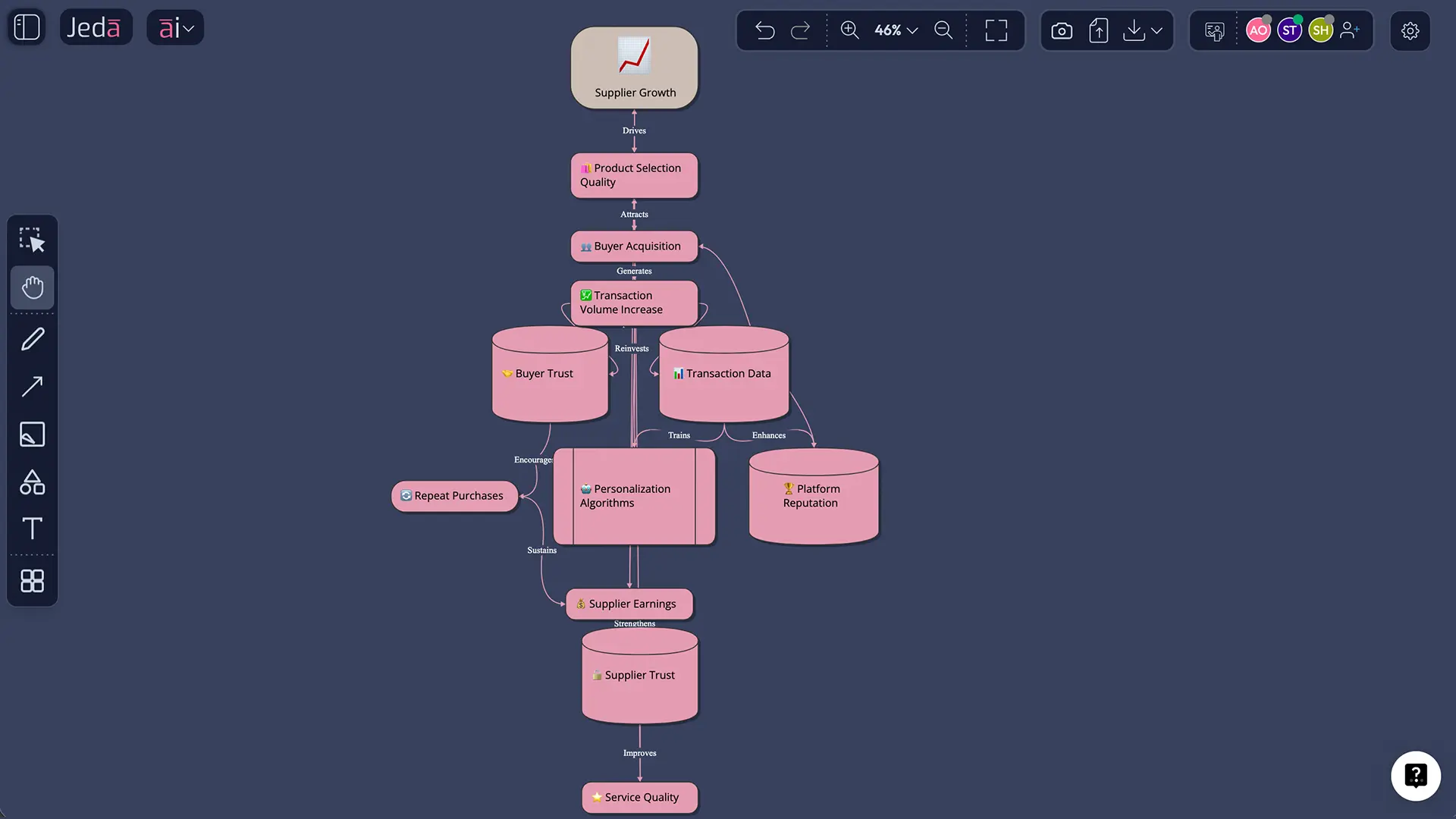
- Liquidity loop (marketplace): more sellers → better selection → more buyers → higher seller earnings → more sellers
- Creator loop (UGC): more creators → more content → more viewers → better monetization → more creators
- Developer loop (platform): more developers → more integrations/apps → more user value → more users → more developers
3) Strength and elasticity
Ask: How much does value increase with each incremental participant? You can proxy this with measurable signals:
- Marketplace: match rate, time-to-first-transaction, repeat purchase rate
- Social: DAU/MAU, session depth, retention cohorts
- Payments: acceptance coverage, share-of-wallet, repeat usage
4) Thresholds (critical mass)
Most networks are weak until they pass a threshold.
- Where does the product flip from “meh” to “must-have”?
- What local density is required (city, vertical, community, category)?
5) Defensibility under attack
This is where moats die.
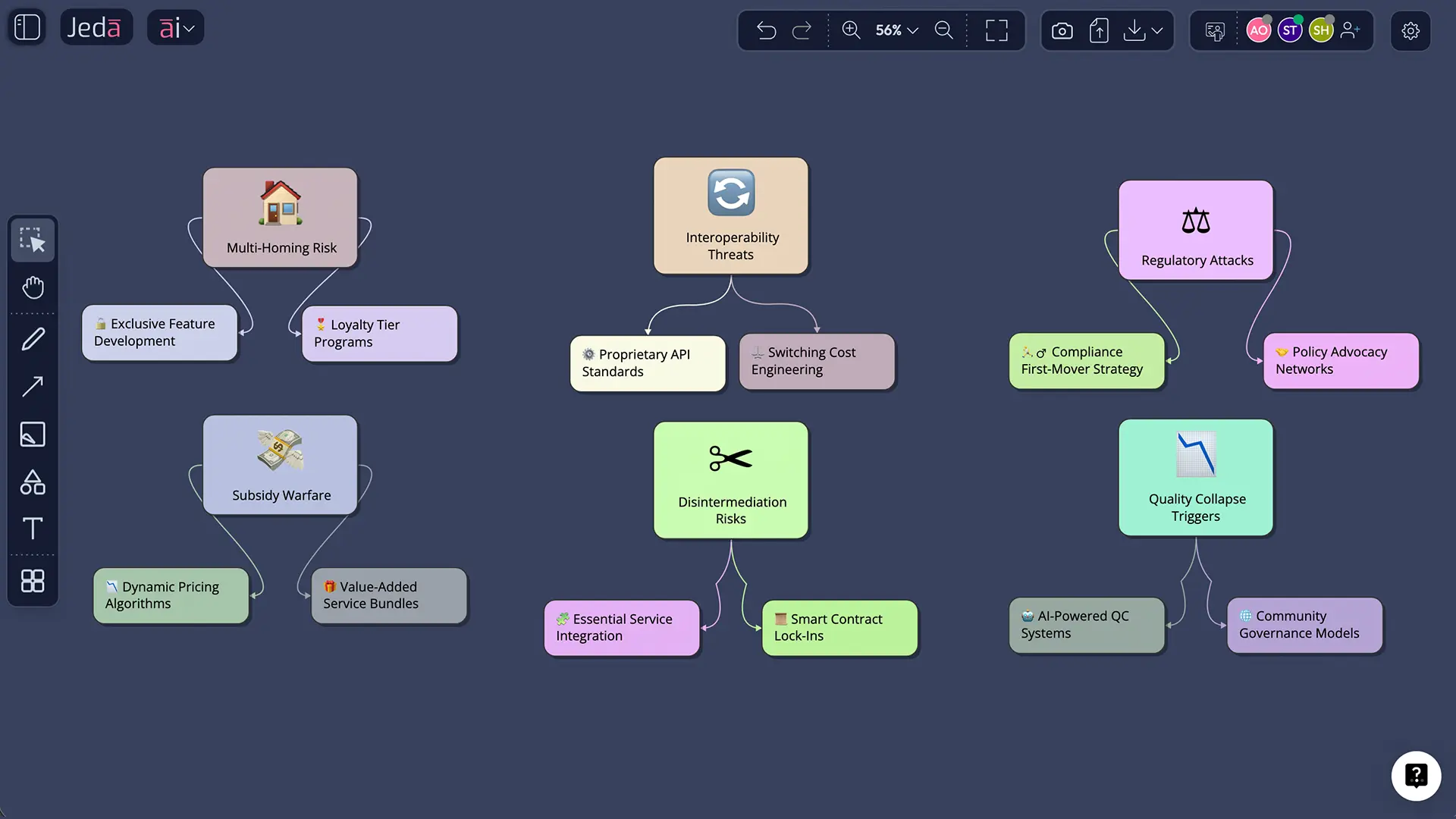
- Multi-homing: can users easily use two products?
- Interoperability: can a competitor “connect” to your network or import your graph?
- Subsidy wars: can someone outspend you for long enough?
- Disintermediation: can participants bypass you once matched?
6) Reinforcement mechanisms
Network effects get defended by design choices:
- Reputation systems and identity (hard to copy, hard to port)
- Switching costs (workflows, saved graphs, history)
- Exclusive supply or contracts
- Developer ecosystem governance
- Trust, safety, and compliance tooling
How to create a Network Effect Moat Analysis in Jeda.ai
You can build this analysis two ways in Jeda.ai’s AI Workspace. Either way, keep it visual. Your future self will thank you.
Method 1 — AI Menu recipe (recommended when available)
- Open the AI Menu (top-left).
- Choose Matrix Recipes.
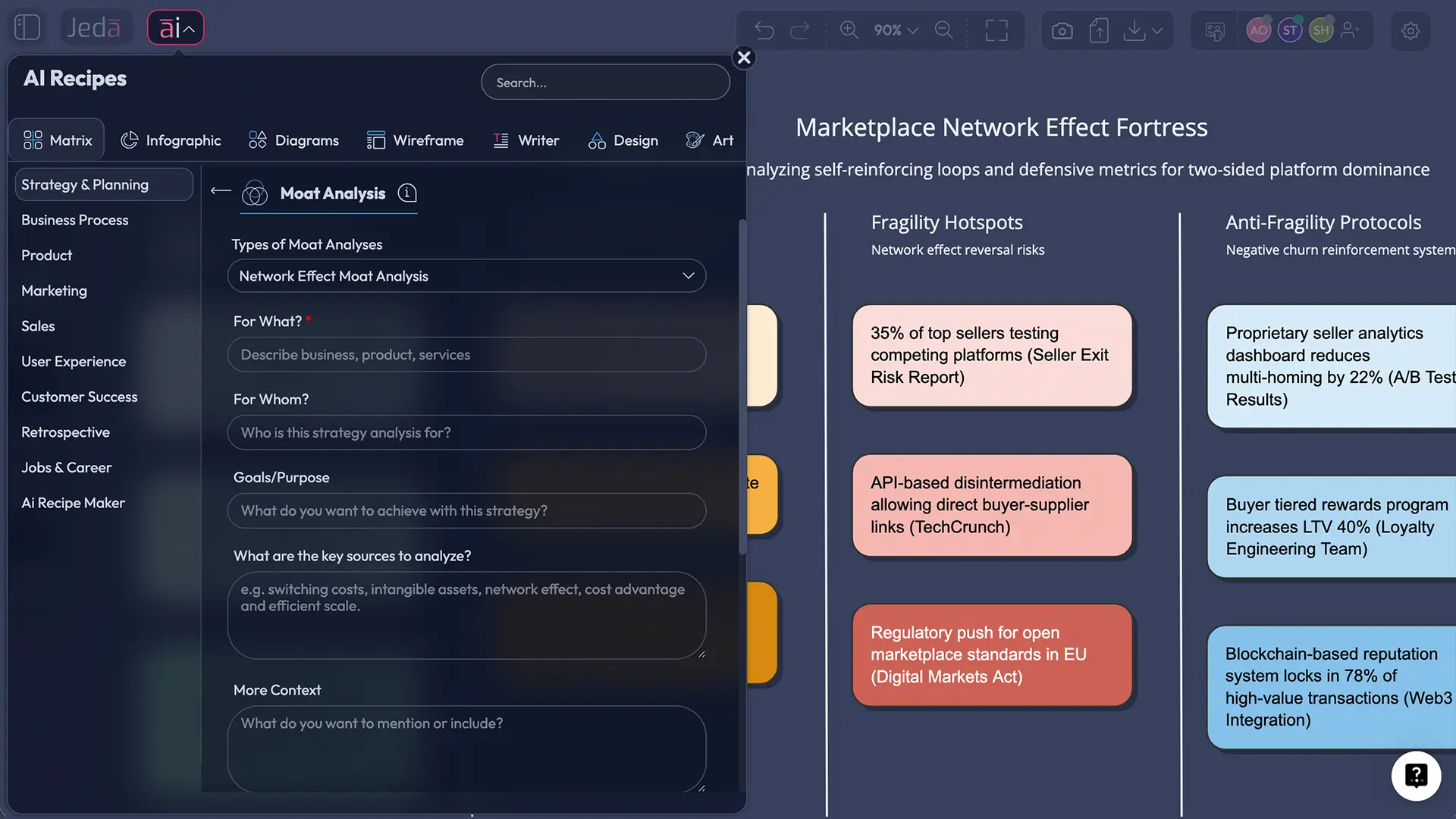
- Search for a Moat Analysis template and select the Network Effects section.
- Paste your company/product context (market, participants, pricing model, geography).
- Click Generate.
- Edit the matrix on the AI Whiteboard: add evidence, links, and owner notes.
Method 2 — Prompt Bar (fast + flexible)
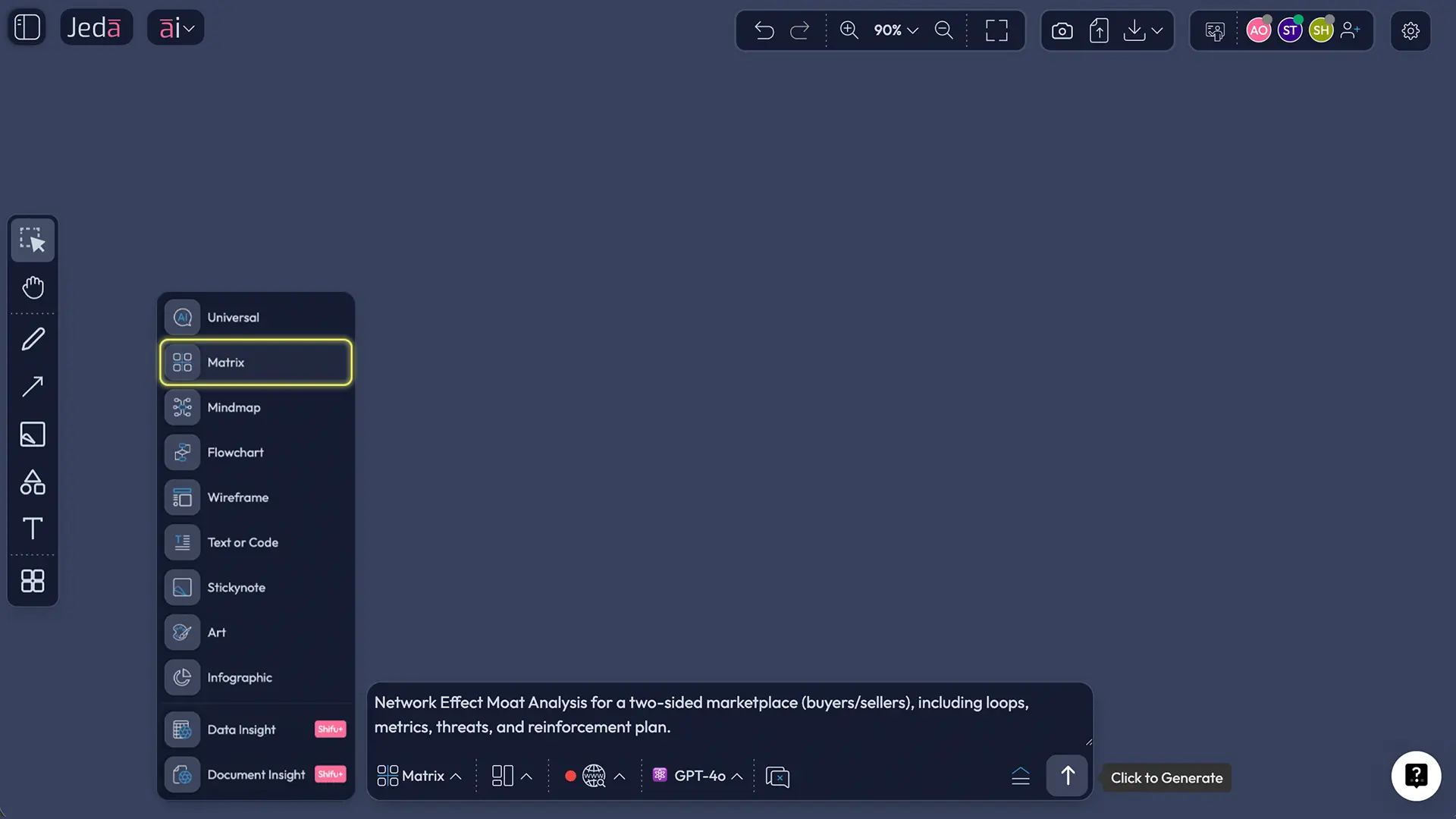
- Open the Prompt Bar at the bottom of the canvas.
- Select the Matrix command.
- Paste the prompt below (adjust the bracketed fields).
- Press Enter to generate.
- Define the network
List participants, value unit, and the interaction that creates value. Keep it concrete.
- Map 2–4 loops
Draft the smallest plausible feedback loops (liquidity, creator, developer, data).
- Score moat strength
Rate strength, durability, and replicability. Add 1–2 metrics per loop.
- Stress-test attacks
Model multi-homing, subsidies, interoperability, disintermediation, and regulation.
- Plan reinforcements
Choose the 3–5 product or go-to-market moves that strengthen the loop.
- Extend and convert
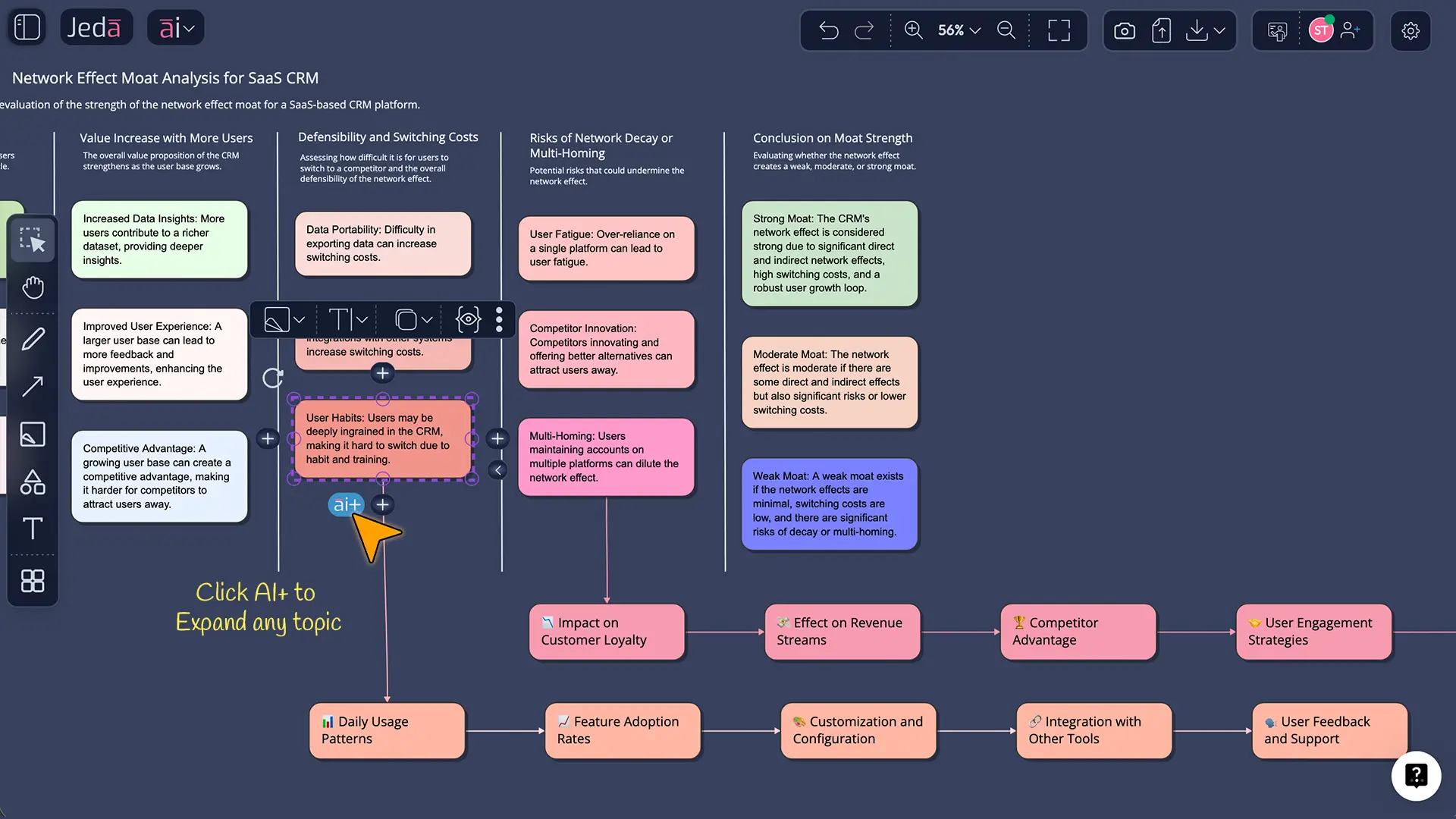
Use the AI+ button to expand weak sections. Use Vision Transform to convert matrix → diagram or mind map.
Copy-paste prompt (Matrix)
Prompt:
Create a Network Effect Moat Analysis for: [Company/Product].
Context: [Market + business model].
Participants: [Side A], [Side B], and any third side (e.g., developers/partners).
Deliver a matrix with these sections:
- Network definition (participants, value unit, interaction)
- Direct vs indirect network effects (same-side and cross-side)
- Core feedback loops (2–4 loops, each with inputs → mechanism → outputs)
- Strength scoring (1–5) for each loop + 1–2 measurable metrics
- Critical mass thresholds (what density/volume makes it work)
- Attack surface (multi-homing, subsidies, interoperability, disintermediation)
- Reinforcement plan (3–5 moves to strengthen defensibility)
Keep it decision-ready, specific, and practical.
Network Effect Moat Analysis template (with a worked example)
Let’s run a concrete example: a B2B marketplace connecting construction companies with equipment rental suppliers.
Snapshot: what the “network” actually is
- Participants: contractors (demand), rental suppliers (supply)
- Value unit: faster match + higher utilization (for suppliers) + reliable availability (for contractors)
- Interaction: quote requests → booked rentals → repeat contracts
The loops
Liquidity loop: more suppliers → better availability → more contractor adoption → higher supplier utilization → more suppliers
Trust loop: more transactions → better ratings + fraud detection → more trusted matches → more transactions
Data loop: more searches/quotes → better pricing + availability prediction → higher conversion → more searches/quotes
Now the moat question: can a competitor replicate these loops quickly?
- If suppliers multi-home without friction, liquidity is weaker.
- If contractors can take supplier contact info and bypass the platform, disintermediation is a risk.
- If your trust system is generic, a competitor can copy it.
The reinforcement plan practically writes itself:
- Build supplier-side tooling that’s genuinely sticky (inventory sync, pricing rules, utilization analytics).
- Make reputation portable within your product but not easily exportable.
- Reduce disintermediation with value-added services (insurance, dispute resolution, compliance documents).
Best practices for stronger network effects (the boring stuff that wins)
These aren’t sexy. They work.
Common mistakes to avoid
- Calling distribution a moat. Growth ≠ defensibility.
- Ignoring multi-homing. If your users can use you and a rival in parallel, the moat is softer than you think.
- Skipping the threshold analysis. Many networks fail because they never reach local density.
- Over-crediting data effects. Data only defends if it meaningfully improves outcomes and is hard to reproduce.
- No governance story. Platforms that can’t manage quality, safety, and incentives eventually eat themselves.
Frequently Asked Questions
- What is network effects moat analysis?
- Network effects moat analysis is a structured way to test whether adding participants increases value in a compounding loop and creates defensibility against competitors. It maps the network, identifies feedback loops, assigns measurable metrics, and stress-tests multi-homing, subsidies, interoperability, and disintermediation.
- Are network effects always a moat?
- No. Network effects only become a moat when they produce durable, compounding advantages and survive competitive pressure. If users can easily multi-home, if the network isn’t tied to trust or workflow, or if a rival can reach critical mass quickly, the “network effect” may not defend you.
- What’s the difference between direct and indirect network effects?
- Direct network effects happen when more users on the same side increase value for each other (e.g., messaging). Indirect network effects happen when one side attracts another (e.g., buyers attract sellers). Many strong platforms combine both, plus reputation and data effects.
- How do you measure network effect strength?
- You measure network effect strength by tracking how incremental participation changes outcomes: match rate, time-to-value, retention cohorts, engagement depth, conversion rates, and acceptance coverage. The key is to link metrics to a specific loop rather than reporting vanity growth metrics.
- What is critical mass in network effects?
- Critical mass is the threshold where the product shifts from being “not worth it” to “obviously useful” because participation density is high enough. It’s often local: a city, a niche community, or a category. Good analyses define the threshold and design a seeding plan to reach it.
- What are common threats to a network effect moat?
- Common threats include multi-homing, heavy subsidy spending by entrants, interoperability or data portability that reduces lock-in, disintermediation after matching, and quality collapse from spam or fraud. A network effect moat plan should explicitly address these threats.
- How do two-sided markets relate to network effects?
- Two-sided markets are a common setting for indirect network effects, where a platform must attract both sides (for example, buyers and sellers). Pricing and incentives often need to be balanced across both sides to reach critical mass, which is why loop mapping and threshold planning matter.
- How does Jeda.ai help with network effect moat analysis?
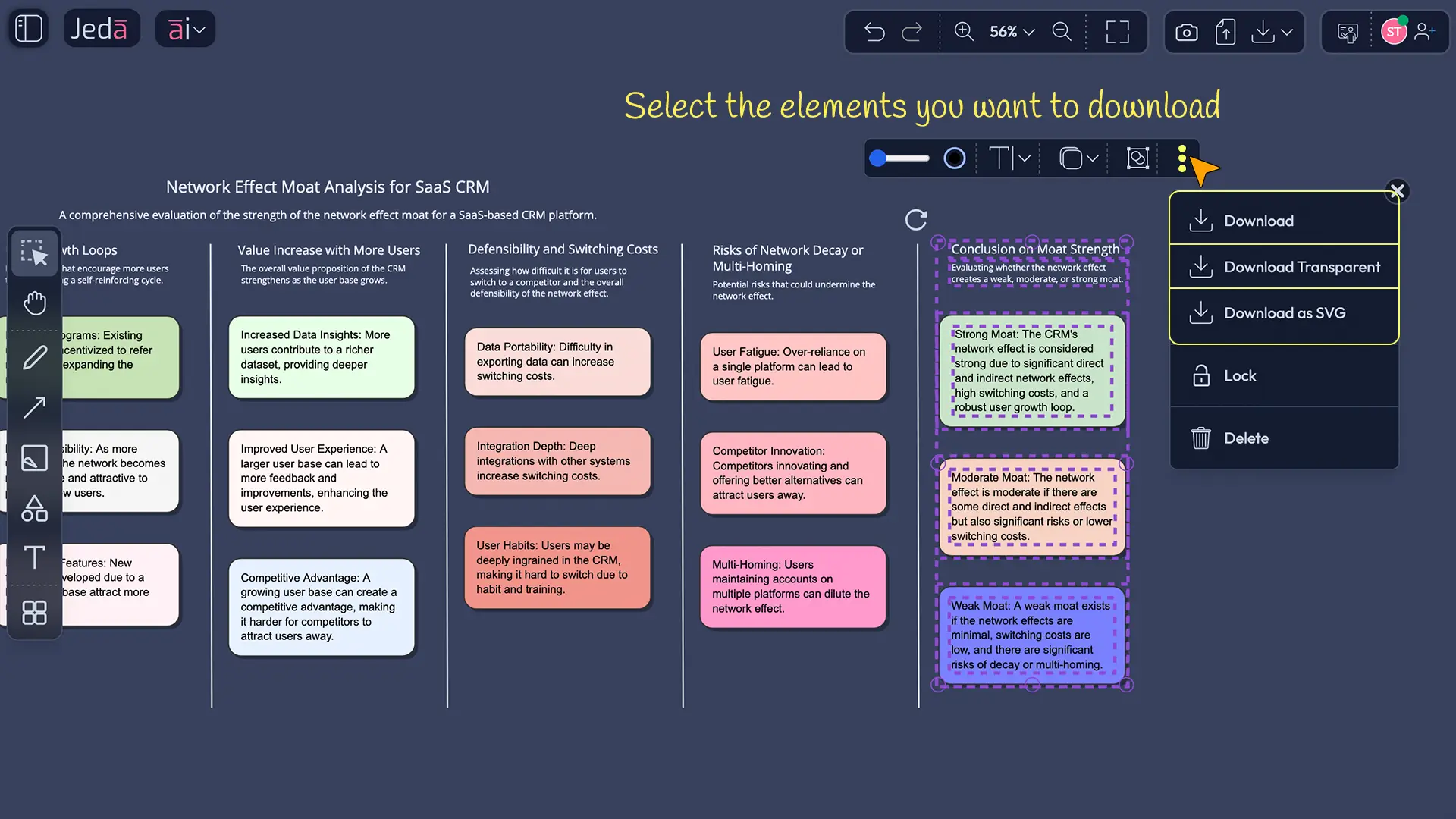
- Jeda.ai helps by generating a structured moat analysis matrix, mapping feedback loops visually, and letting teams refine the logic together on an AI Whiteboard. You can extend weak areas with the AI+ button, convert the output with Vision Transform, and export results as PNG, SVG, or PDF.
- Can I run this analysis with multiple AI models?
- Yes. Jeda.ai’s Multi-LLM Agent lets you run the same prompt with up to three models and compare answers. If you’re on Shifu, the Aggregator model can synthesize the best response — useful when you want both strategic clarity and devil’s-advocate stress testing.
- What should I do after I finish the analysis?
- Turn the highest-risk assumptions into experiments: onboarding tests, supply acquisition pilots, incentive changes, or trust improvements. Then store the board as a living artifact and revisit it monthly, updating loop metrics and threat signals so the “moat” doesn’t become a stale slide.
Sources & further reading
- [1]
Michael L. Katz & Carl Shapiro (1985) . “Network Externalities, Competition, and Compatibility” American Economic Review.
View Source ↗ - [2]
Jean-Charles Rochet & Jean Tirole (2003) . “Platform Competition in Two-Sided Markets” Journal of the European Economic Association.
View Source ↗ - [3]
W. Brian Arthur (1996) . “Increasing Returns and the New World of Business” Harvard Business Review.
View Source ↗ - [4]
Morningstar (2025) . “Understanding Network Effect and Moats” Morningstar.
View Source ↗ - [5]
Ben Thompson (2018) . “The Moat Map” Stratechery.
View Source ↗
Run a Network Effect Moat Analysis in Minutes
Join over 150,000+ users who use Jeda.ai as their AI Workspace for decision-ready strategy work on an AI Whiteboard.
Try Free Template