You can use the PAS copywriting formula to turn a vague “we should post something” into a clear message that hooks attention, raises urgency, and lands on a credible solution. Now add an AI Workspace and an AI Whiteboard on top, and you stop writing in circles. You generate the structure, then you iterate the words.
Jeda.ai is built for this style of work: a Visual AI workspace where you can map the Problem → Agitation → Solution as a Matrix, expand it with the AI+ button, and convert it into other deliverables (a landing page outline, email sequence flow, or an infographic snippet) without losing context. Join 150,000+ users already building decision-ready visuals in Jeda.ai.
What is the PAS framework?
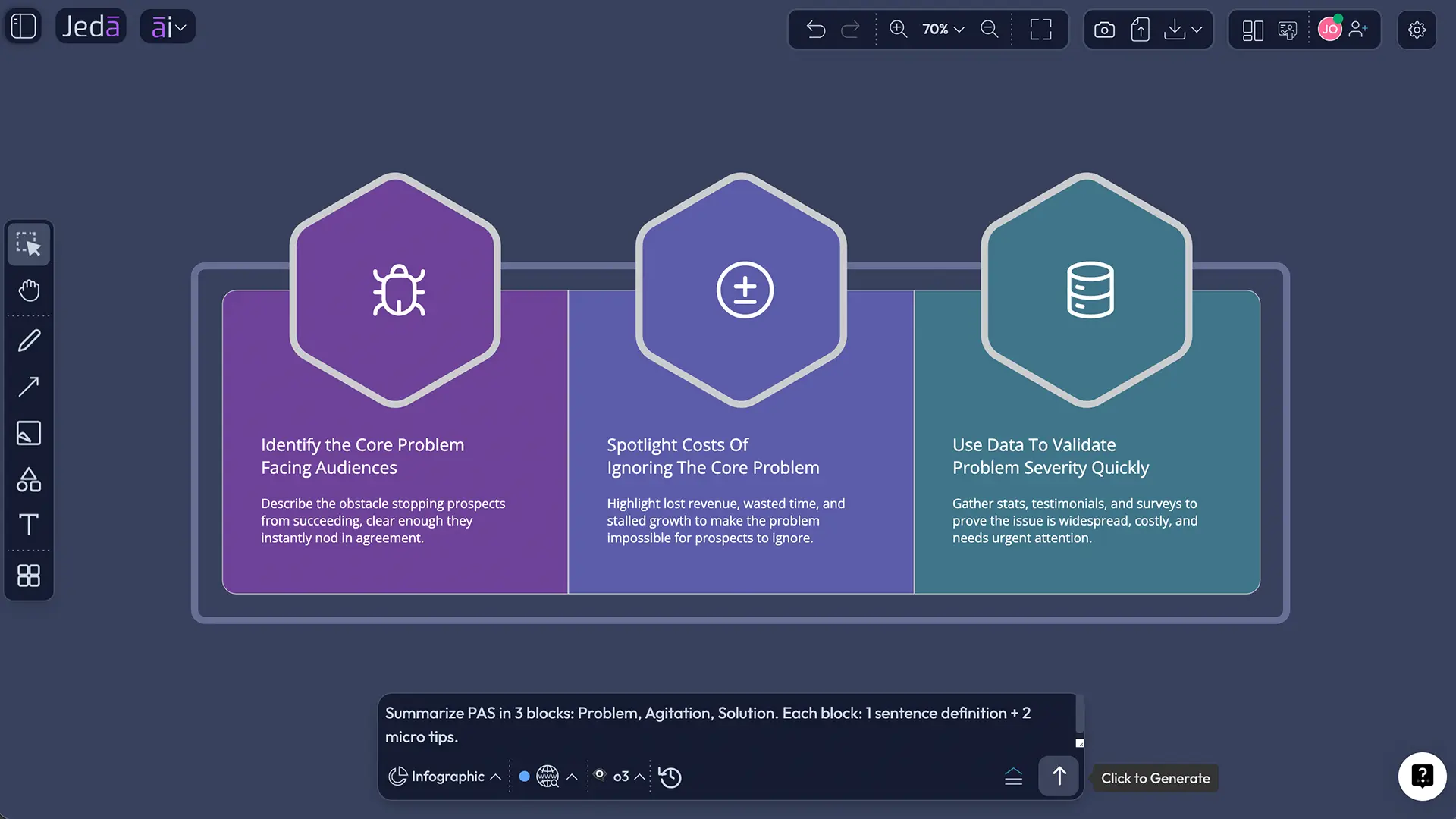
PAS is a copywriting structure that moves through three beats: Problem, Agitation, Solution. It starts by naming a real pain your reader recognizes, intensifies the cost of leaving it unfixed, and then offers a clear path out.
Here’s the part people forget: PAS is not “be dramatic.” PAS is “be specific.” If your problem is fuzzy, your agitation becomes cringe, and your solution sounds like a random product pitch.
And yes, you’ll see different people credited with “inventing” PAS. Attribution gets messy in direct-response history. The structure is what matters, and the structure is stable.
Why PAS still wins (and why AI makes it sharper)
PAS works because it matches how humans decide under pressure. People pay attention when:
- A threat feels real (negativity bias),
- A loss feels imminent (loss aversion),
- The “cost of doing nothing” is visible.
But PAS has a failure mode: the agitation can become a cheap scare tactic. Research on fear appeals is clear that intensity without efficacy can trigger avoidance instead of action. So the goal is controlled urgency, not panic.
This is where AI helps, if you use it correctly:
- AI can generate multiple agitation intensities (mild, moderate, high) so you can choose the ethical level.
- AI can propose evidence-based agitation (missed revenue, time wasted, error rates) instead of emotional noise.
- AI can keep the solution grounded (steps, proof, constraints) so it doesn’t read like magic.
In a Visual AI workflow, you can see these trade-offs instead of guessing them in a doc.
Why build PAS inside an AI Workspace (not in a blank doc)
If you only write PAS as text, you lose the strategy behind it. In Jeda.ai, the PAS becomes a living model your team can critique, refine, and reuse.
- Structure first, words second
Generate a Matrix that forces clarity: one problem, real stakes, one clean solution. Then write copy from the board instead of from vibes.
- Team alignment without long meetings
Marketing, product, and sales can edit the same PAS board in real time. You get one shared source of truth, not five conflicting drafts.
- Variation at speed
Use multi-model intelligence to produce alternatives: different pain points, angles, and solutions. Then keep the winners and delete the rest.
Jeda.ai also includes 300+ strategic frameworks, so PAS can sit next to your positioning work (value propositions, competitive analysis, go-to-market planning) inside one AI Whiteboard.
How to create a PAS Matrix in Jeda.ai
Two methods:
- Method 1: Recipe Matrix (AI Menu)
- Method 2: Prompt Bar (Matrix command)
Both end in the same place: an editable PAS Matrix you can extend with the AI+ button.
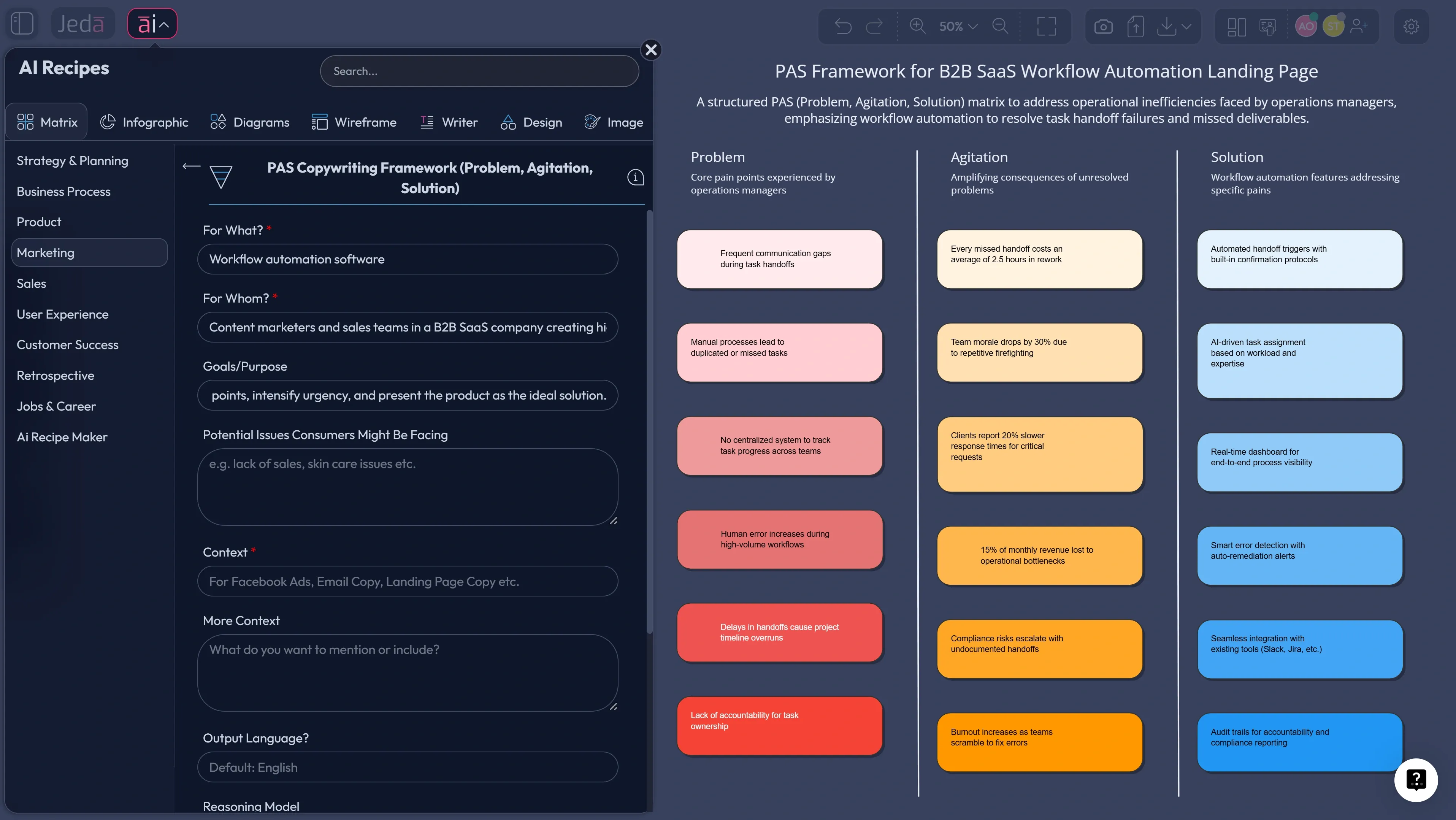
Method 1 — Recipe Matrix (recommended when available)
- Open the AI Menu
In the top-left of your canvas, open the AI Menu. This is where Jeda.ai keeps its library of structured templates.
- Choose Matrix Recipes and select PAS
Go to Matrix Recipes and pick the PAS (Problem–Agitation–Solution) template. If you don’t see PAS, use Method 2 below.
- Add your context in plain language
Provide your audience, offer, and the one pain you want to focus on. Keep it concrete: who, what, and why it hurts.
- Generate the Matrix
Click Generate. Jeda.ai creates a 3-column PAS board with sticky notes you can edit, reorder, delete, or expand.
- Extend sections with the AI+ button
Select a sticky note and tap the AI+ button to expand it. Ask for more angles, stronger proof points, or calmer agitation versions.
- Convert the output when needed
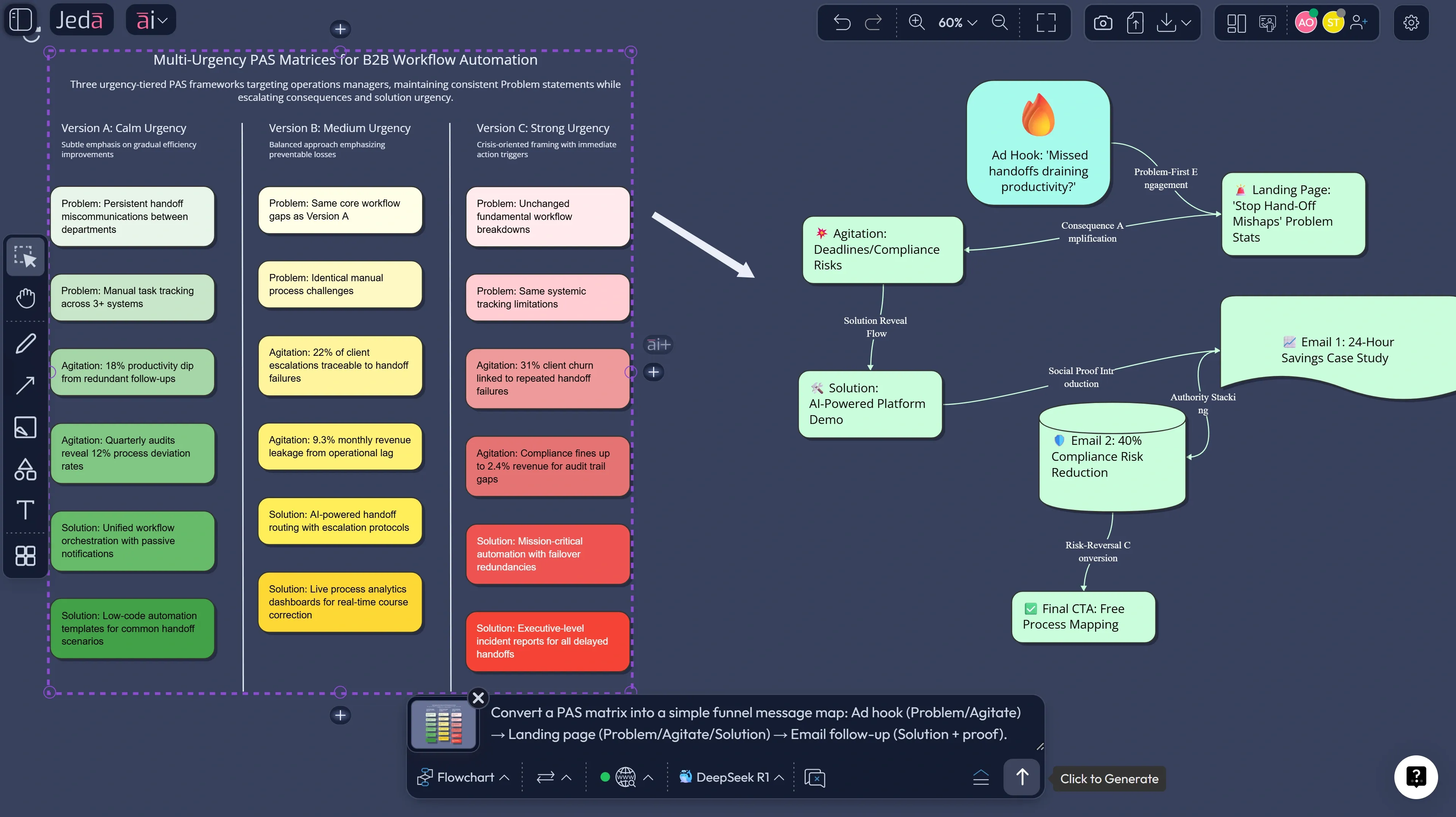
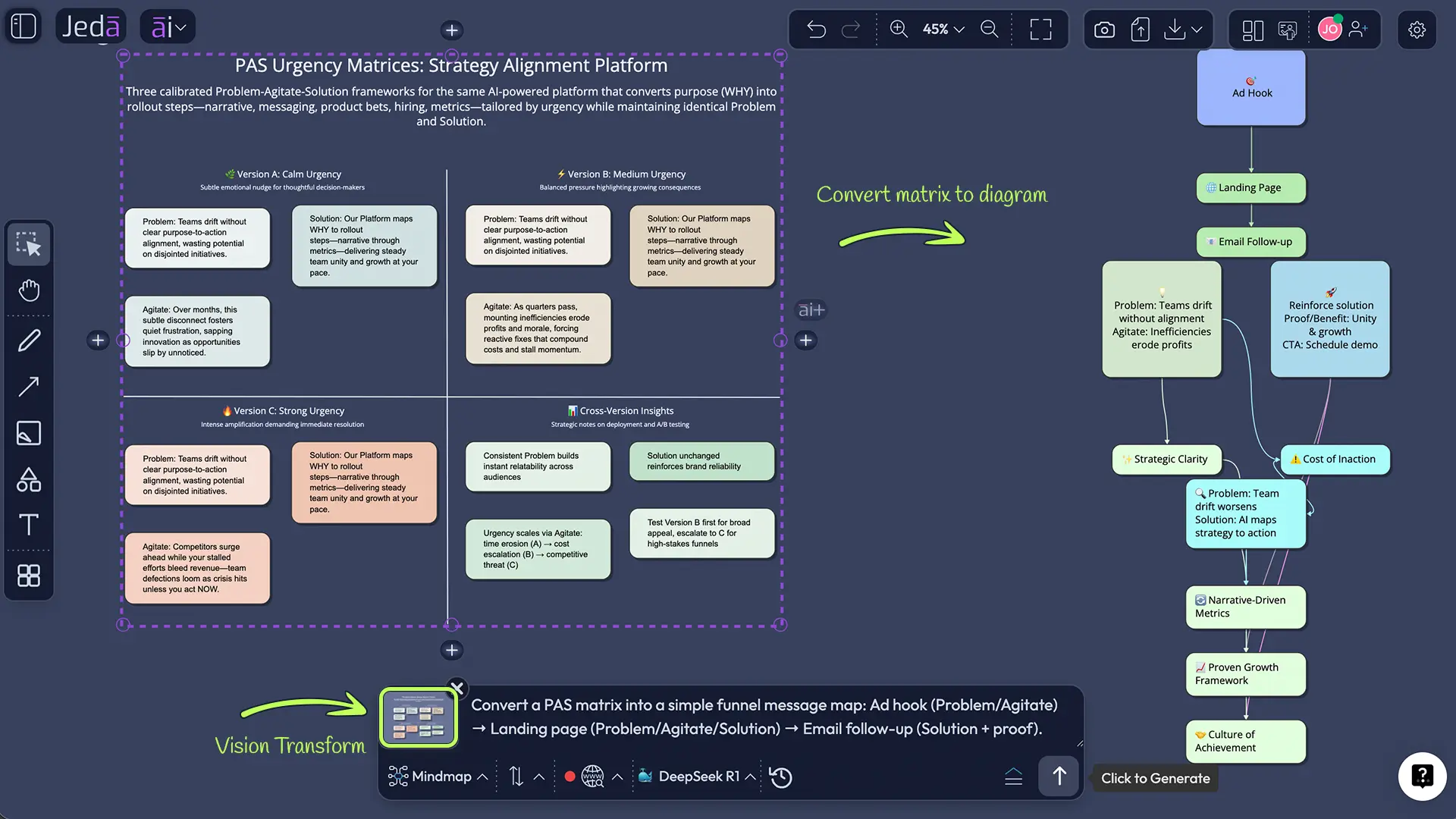
Use Vision Transform to convert your Matrix into a Flowchart, Diagram, or Infographic layout for different channels.
Method 2 — Prompt Bar (Matrix command)
- Open the Prompt Bar at the bottom of the canvas
- Select the Matrix command
- Paste a PAS prompt (examples below)
- Press Enter to generate
- Use AI+ to extend any part of the output
Copy-paste prompts for PAS (Matrix)
Use these in the Prompt Bar with the Matrix command.
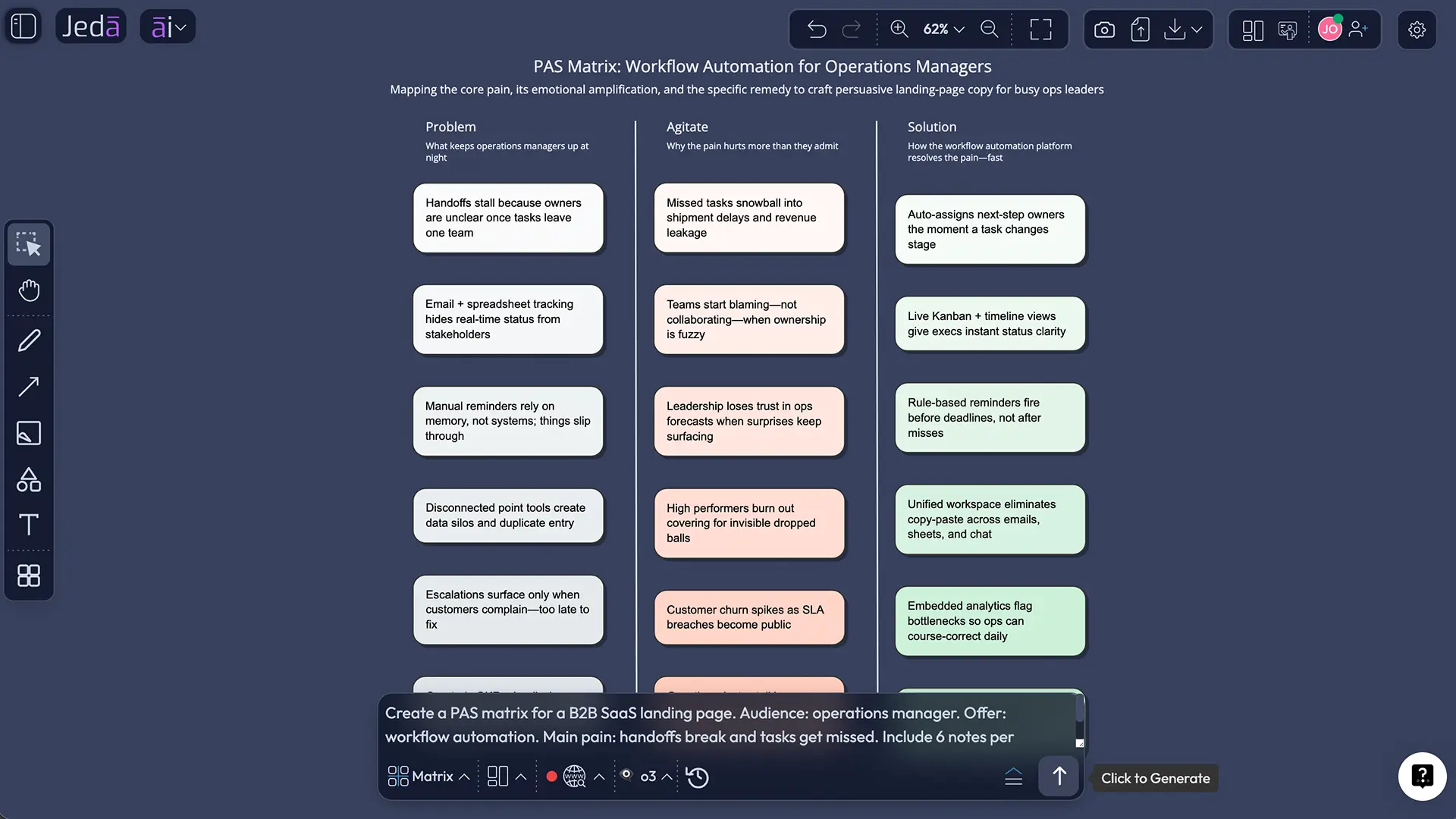
Prompt 1 — Core PAS board (fastest)
Prompt: Create a PAS (Problem–Agitation–Solution) matrix for:
- Audience: [who]
- Offer: [what you sell]
- Main pain: [specific problem] Rules:
- 3 columns: Problem, Agitation, Solution
- 6 sticky notes per column
- Use short, direct phrases (no fluff)
- Agitation must include 3 measurable consequences (time, money, risk)
Prompt 2 — B2B PAS with proof placeholders
Prompt: Create a B2B PAS matrix for [product/service] targeting [role]. Include:
- Problem: operational pain + strategic risk
- Agitation: business impact, missed KPI, and “status quo cost”
- Solution: 3-step path + proof placeholders (case study, metric, quote)
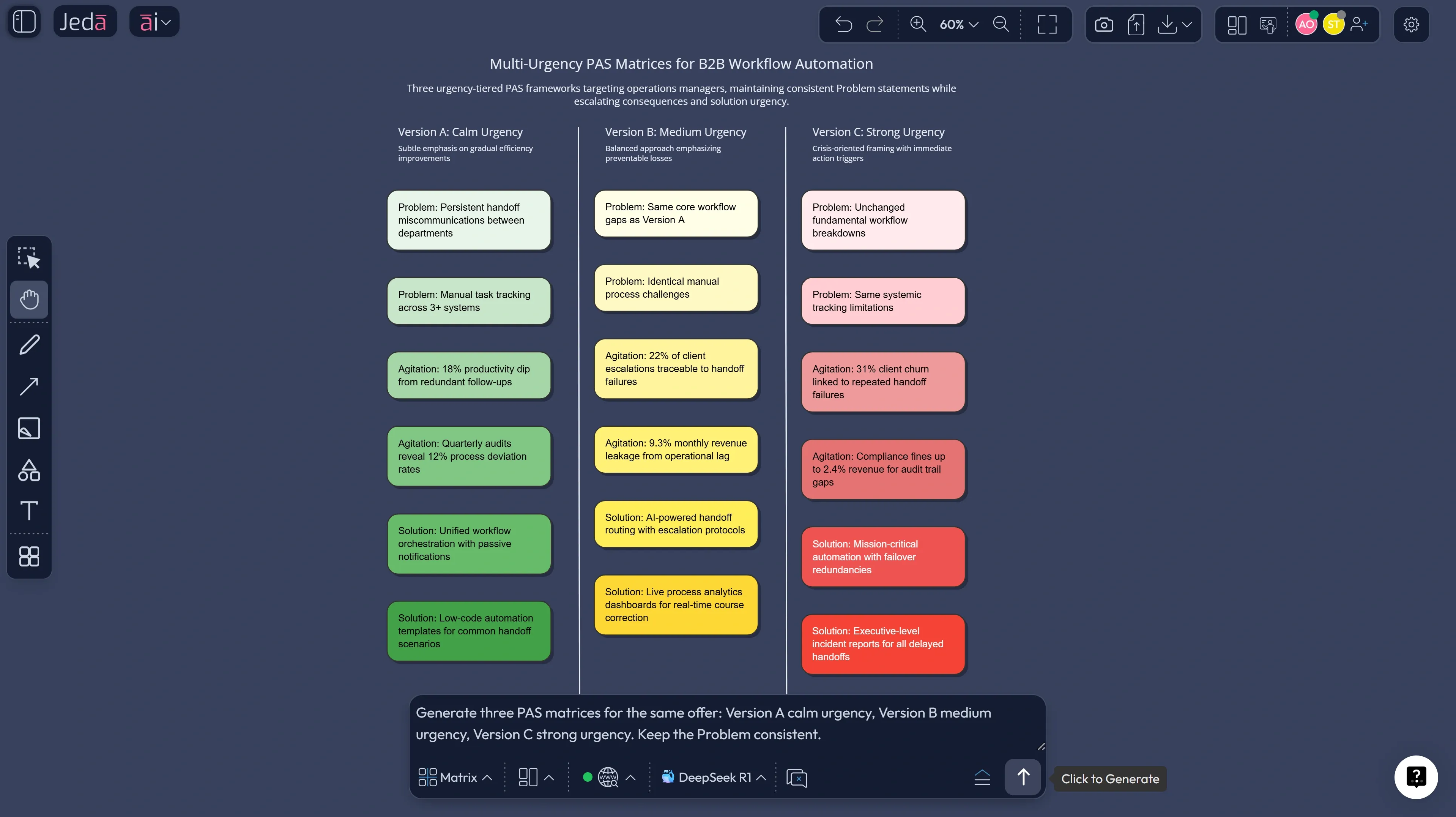
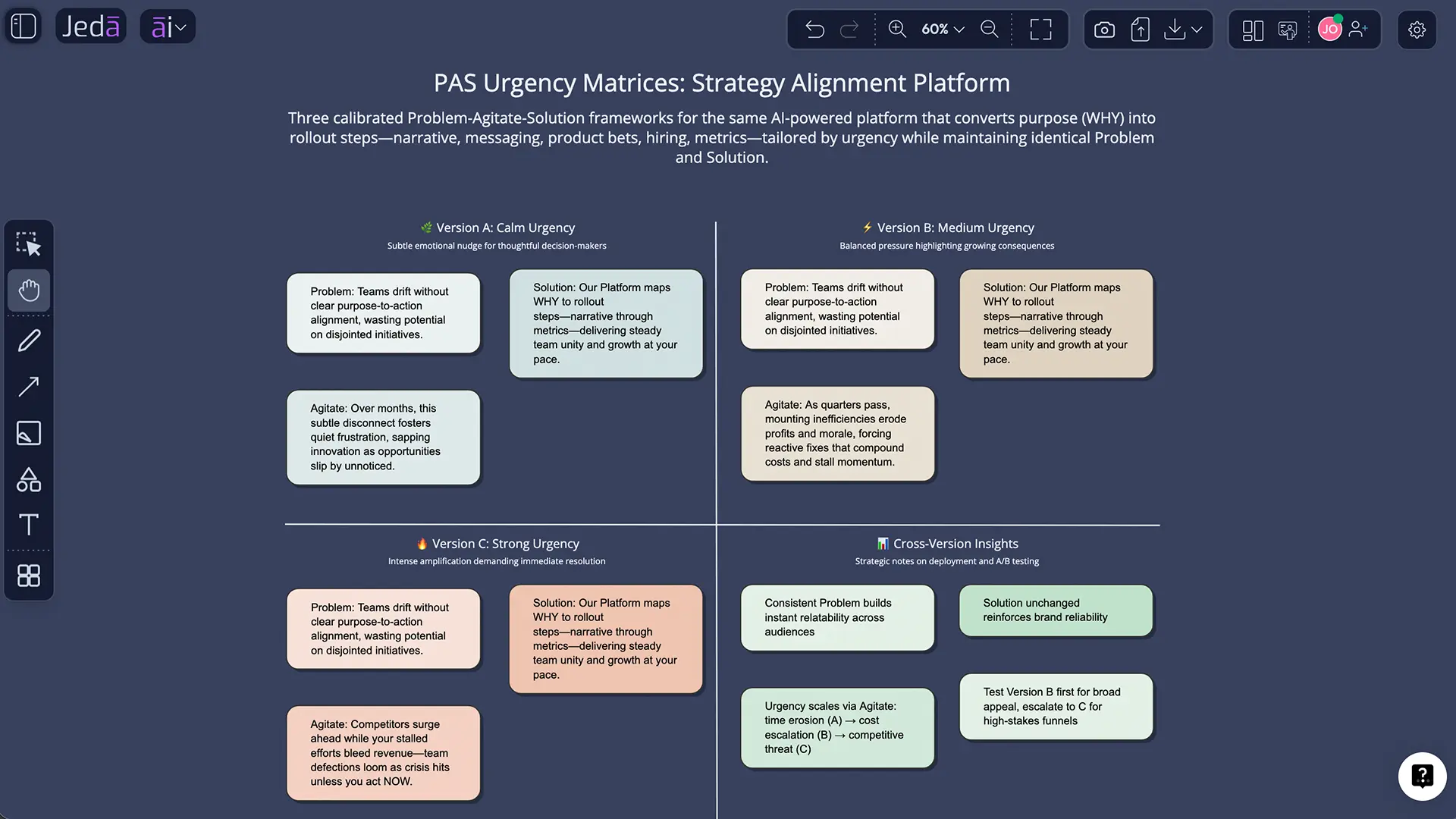
Prompt 3 — PAS variations (calm, medium, intense)
Prompt: Generate 3 PAS matrices for the same offer: Version A: calm urgency Version B: medium urgency Version C: strong urgency Keep Problem consistent. Change the Agitation intensity and Solution framing accordingly.
PAS template you can reuse (board structure)
This is the board layout I recommend if you want repeatability across campaigns:
Worked example: PAS for a SaaS “meeting notes to action items” tool
Let’s make it real. Here’s a clean PAS example you could generate in Jeda.ai and then turn into copy.
Problem (what they feel):
- Meetings end, nothing moves.
- Action items live in people’s heads.
- Follow-ups become “next week.”
Agitation (what it costs):
- Dead time: 6 people × 45 minutes = half a day burned.
- Missed details create rework.
- Accountability becomes awkward chasing.
Solution (what changes):
- Auto-capture notes and decisions.
- Assign action items instantly.
- Track completion in one view.
Now you can extend with AI+:
- Add industry variants (sales teams, product teams, consulting teams)
- Add proof placeholders (time saved per week, fewer missed handoffs)
- Create calmer vs stronger agitation versions
Best practices (so PAS doesn’t backfire)
Common mistakes to avoid
- A problem that isn’t a problem. “Struggling to grow?” is vague. Pick a sharp pain.
- Agitation that sounds manipulative. If it feels like fearmongering, it is.
- Solution that doesn’t match the problem. If the problem is “handoffs break,” don’t pitch “AI magic.” Pitch reliability.
- No proof, no next step. Even one metric placeholder makes the solution feel real.
- Overstuffed PAS. PAS is short by nature. If it’s long, you’re probably mixing frameworks.
Frequently Asked Questions
- What is the PAS copywriting formula?
- The PAS copywriting formula is a three-step structure: Problem, Agitation, Solution. You name a specific pain, show the real cost of leaving it unsolved, and then present a clear path out. It’s widely used for landing pages, ads, emails, and short-form posts because it stays focused.
- Is PAS the same as AIDA?
- PAS is not the same as AIDA. PAS starts with a pain and moves to relief, while AIDA moves from attention to interest, desire, and action. PAS is often faster and more direct, especially when the audience already knows the problem and needs urgency plus a clear solution.
- When should you use PAS vs AIDA?
- You should use PAS when the audience already feels the pain and needs a push to act now. You should use AIDA when you need to build desire from a colder start, such as a new category or unfamiliar offer. Many teams use PAS for ads and AIDA for longer sales pages.
- How do you write the agitation part without sounding manipulative?
- Agitation is strongest when it stays factual and specific. Use measurable consequences, real scenarios, and second-order effects instead of threats or exaggerated language. If you can’t defend the agitation with logic or evidence, reduce the intensity and focus on clarity and relevance.
- Can AI write PAS copy that converts?
- AI can write PAS copy that converts when you give it precise context and you review the output like an editor. The best workflow is to generate a PAS matrix first, pick the strongest problem and stakes, then draft copy from that structure. Human judgment is still required for tone and truthfulness.
- How do you create a PAS matrix in Jeda.ai?
- To create a PAS matrix in Jeda.ai, you generate a 3-column Matrix labeled Problem, Agitation, and Solution. You can do this via the AI Menu Matrix Recipe if available, or by selecting the Matrix command in the Prompt Bar and entering a PAS prompt. Then you edit, extend with AI+, and export.
- What channels work best for PAS?
- PAS works best in channels where attention is limited and urgency matters. That includes landing pages, paid ads, email sequences, social posts, and cold outreach. It can also be used as the opening structure of longer content, as long as you add proof and a clear next step.
- What are good PAS examples for B2B?
- Good B2B PAS examples focus on operational pain and business impact. The problem is usually process friction, missed KPIs, or risk exposure. The agitation quantifies time loss, revenue leakage, or compliance risk. The solution shows a short implementation path and includes proof placeholders like metrics or case studies.
- How long should PAS copy be?
- PAS copy should be as long as it needs to be to be believed. For ads and social, it can be 3–8 lines. For landing pages, PAS can be the opening section and then expand into proof, objections, and details. The structure stays the same even when the length changes.
- Can I turn a PAS matrix into other formats inside Jeda.ai?
- Yes, you can turn a PAS matrix into other formats using Vision Transform in Jeda.ai. Many teams convert the matrix into a Flowchart for funnel messaging, a Diagram for campaign planning, or an Infographic for quick sharing. You keep the same logic while changing the visual format.
Sources & further reading
- [1]
Baumeister, Roy F.; Bratslavsky, Ellen; Finkenauer, Catrin; Vohs, Kathleen D. (2001) . “Bad Is Stronger Than Good” Review of General Psychology.
View Source ↗ - [2]
Kahneman, Daniel; Tversky, Amos (1979) . “Prospect Theory: An Analysis of Decision under Risk” Econometrica.
View Source ↗ - [3]
Witte, Kim; Allen, Mike (2000) . “A Meta-Analysis of Fear Appeals: Implications for Effective Public Health Campaigns” Health Education & Behavior.
View Source ↗ - [4]
Otamendi, F. J. et al. (2020) . “The Emotional Effectiveness of Advertisement” Frontiers in Psychology (via PubMed Central).
View Source ↗ - [5]
Copyhackers (2015) . “Copywriting Formulas: The Ultimate Guide (includes PAS)” Copyhackers.
View Source ↗ - [6]
Drip (2024) . “9 Proven Copywriting Formulas (includes PAS)” Drip.
View Source ↗ - [7]
Very Good Copy (2019) . “Problem-Agitation-Solution Copywriting Formula” VeryGoodCopy.com.
View Source ↗
Build your next PAS campaign in one AI Workspace
Join over 150,000+ users who use Jeda.ai to turn messy ideas into editable, decision-ready visuals on an AI Whiteboard.
Try Free Template