If your roadmap debates sound like: “I feel the market wants X,” you’re not alone. Product evolution is messy—until you look at it through TRIZ patterns of evolution.
TRIZ suggests technical systems evolve along recurring patterns (sometimes called laws or trends). These patterns can be used for forecasting and directed evolution, not just fixing today’s issues.
This guide shows how to do it inside an AI Workspace so the output becomes:
- a clear map of where the system is now,
- a set of plausible “next states,”
- and roadmap experiments you can actually run.
What are TRIZ patterns of evolution?
TRIZ patterns of evolution are generalized trends observed in how technical systems develop over time. The core claim is that systems don’t improve randomly; they often move in recognizable directions such as increasing ideality, increased dynamization, transition to micro-level effects, and so on.
Some sources use “laws,” some use “patterns,” some use “trends.” In practice, teams use them as lenses for forecasting and design exploration.
Why use patterns instead of pure market guessing?
Patterns give you a structured “menu” of plausible next moves. That helps in three ways:
- You generate more options (not just your team’s default ideas).
- You spot missing evolution steps (why your category feels “stuck”).
- You create experiments that validate the direction quickly.
It’s not prophecy. It’s disciplined imagination with constraints.
The “friendly” way to apply patterns (no TRIZ gatekeeping)
You do not need to memorize a canonical list.
Instead, do this:
- Pick 3–5 patterns that plausibly apply to your system.
- For each pattern, propose:
- what change would represent that pattern,
- what benefit it would increase,
- what harm/cost it might introduce.
- Generate roadmap options and test hypotheses.
That’s it.
Common patterns you’ll actually use on roadmaps
Below are patterns often discussed in TRIZ forecasting literature and overviews.
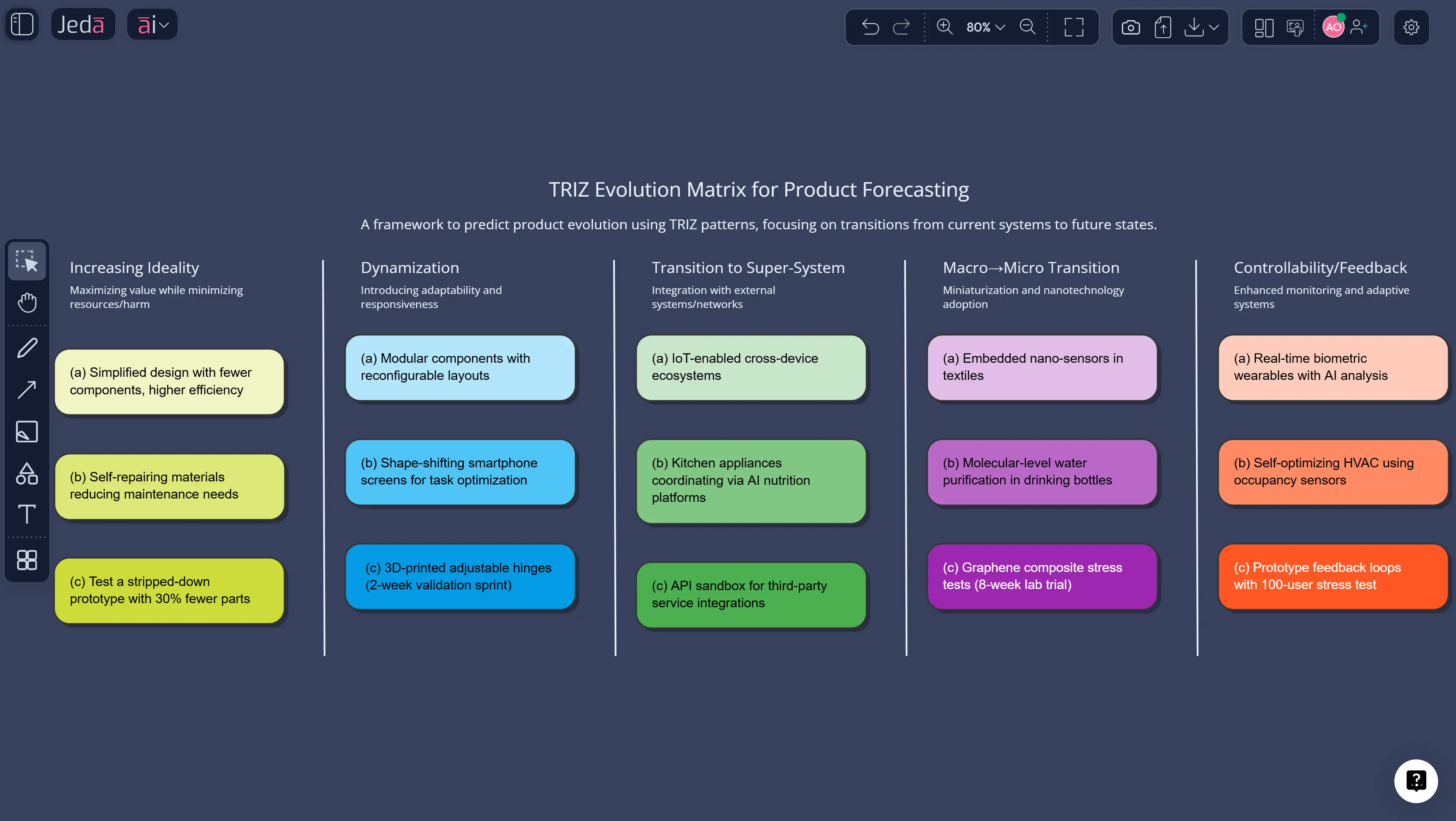
1) Increasing ideality
Systems evolve toward higher benefit with lower cost and harm. This often looks like:
- fewer parts,
- less energy,
- less user effort,
- fewer maintenance steps.
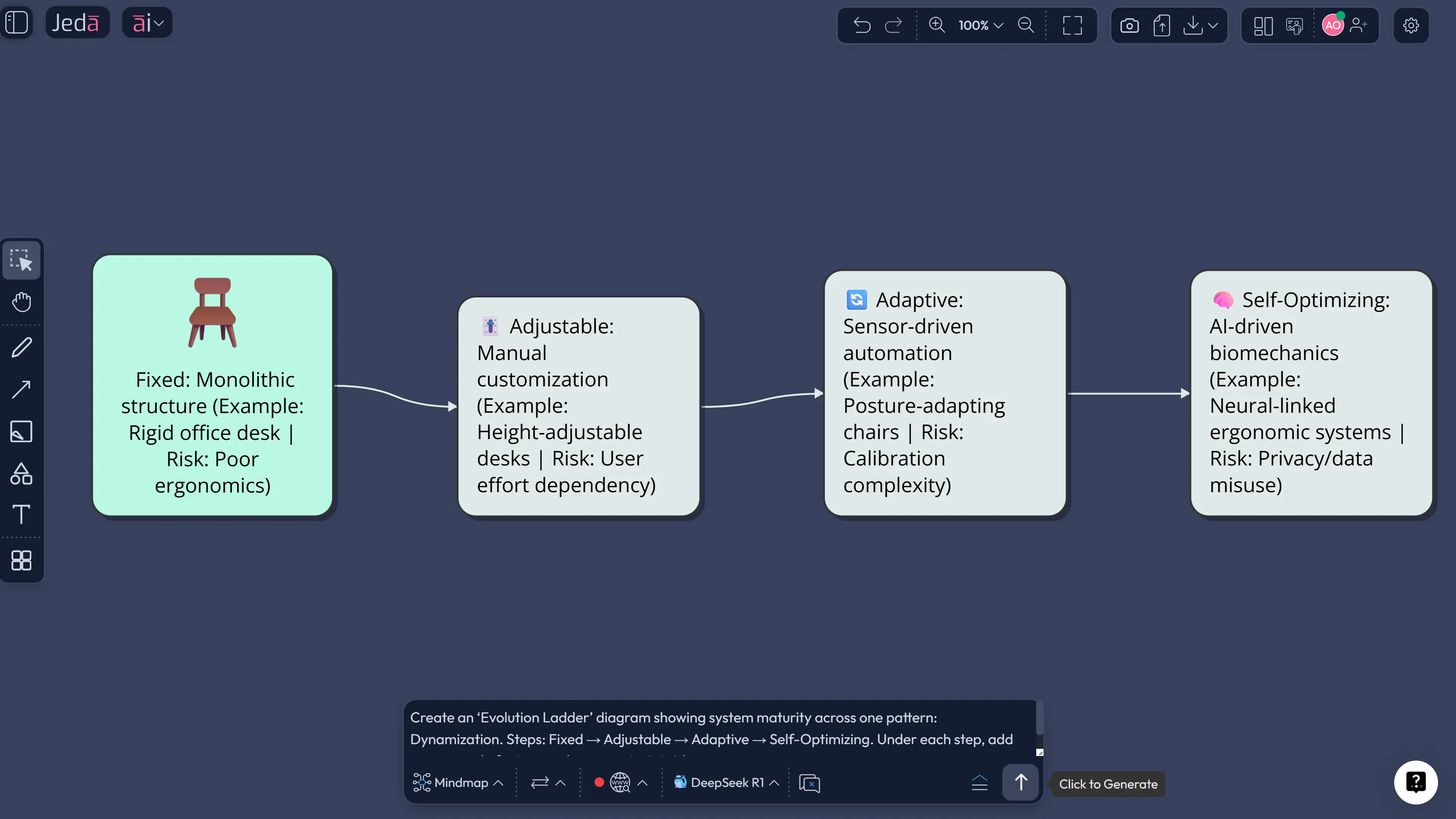
2) Dynamization (from fixed → adjustable → adaptive)
A rigid, one-size design becomes adjustable, then adaptive (self-tuning).
Examples:
- fixed settings → presets → auto-optimization.
3) Transition to higher-level system (integration)
A product becomes part of a larger system:
- add interoperability,
- create ecosystem features,
- integrate sensors/data/services.
4) Transition from macro to micro-level effects
Mechanisms move from big physical changes to finer-grained control:
- mechanical → electronic → software/algorithmic,
- bulk material → surface engineering,
- manual → automated.
5) Increased controllability and feedback
Systems add sensing and feedback loops:
- observe, measure, adjust, learn.
You can think of this as “less guessing, more closed loop.”
How to build a Patterns-of-Evolution board with AI in Jeda.ai
Step 1: Define the system and maturity stage
- What is the system boundary?
- What is the primary function?
- What is the “customer-perceived output”?
- Where does value show up?
Step 2: Map current state vs candidate patterns
Use a Matrix with columns:
- Pattern
- Current evidence (does the system already show it?)
- Next-state hypothesis
- Risks/costs
- Fast experiment
Step 3: Generate options using Multi‑LLM
Have one model suggest patterns (broad), another model propose next-state features (concrete), and a third model propose experiments (practical). Then aggregate.
Step 4: Convert into a roadmap timeline
Use Timeline or a simple phased roadmap:
- Now (stabilize),
- Next (pilot),
- Later (scale).
- Describe the system
Define the system boundary and maturity. Keep it customer-visible and measurable.
- Select patterns
Pick 3–5 patterns that plausibly apply (ideality, dynamization, feedback, etc.).
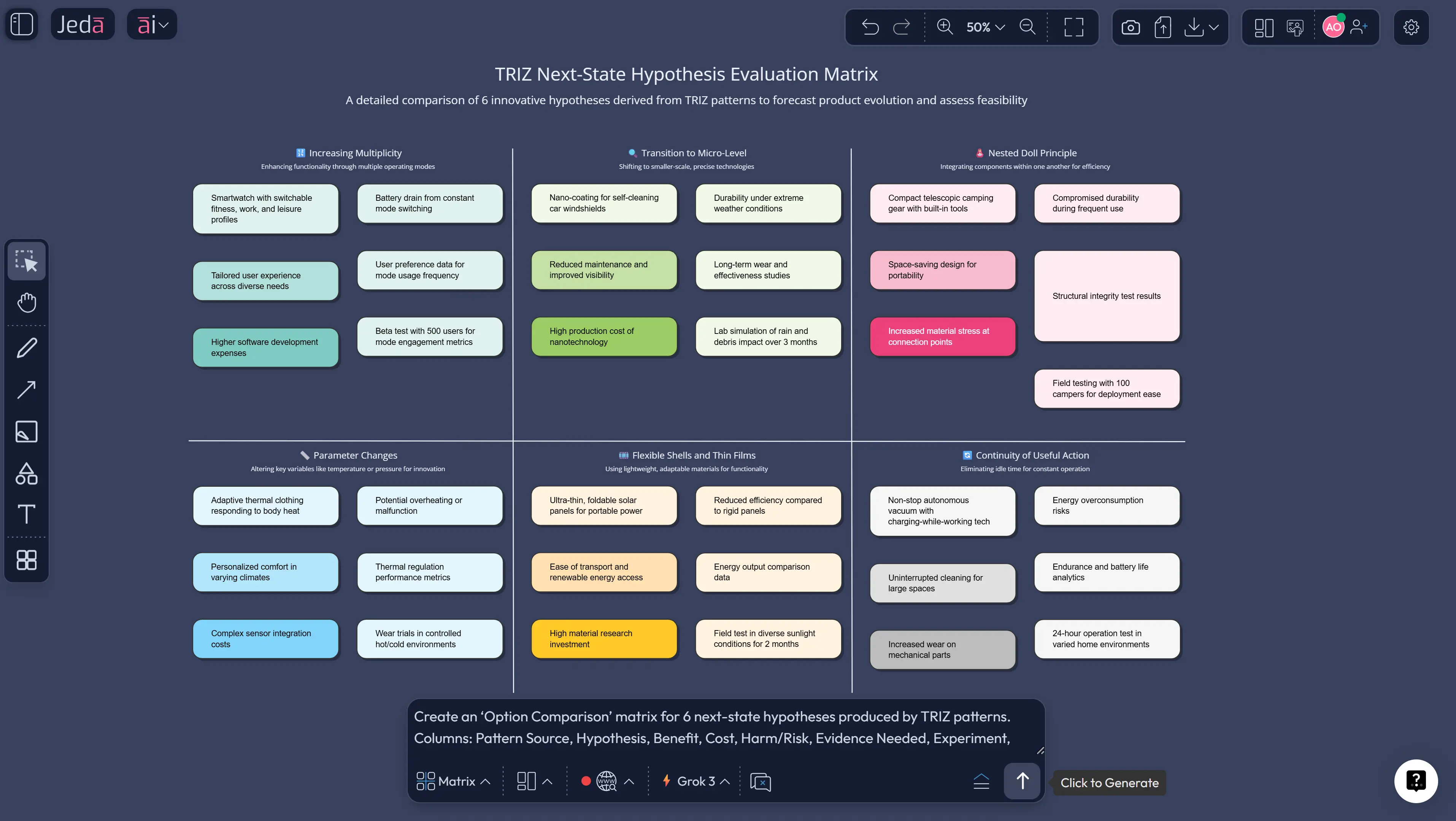
- Generate next states
Use AI to propose next-state hypotheses for each pattern. Keep them testable.
- Design experiments
For each hypothesis, define a fast experiment or prototype to validate direction.
- Roadmap it
Convert hypotheses into phased roadmap options and choose one to pursue.
A concrete example: “smart” maintenance for industrial equipment
Let’s say you’re improving a maintenance workflow.
Current state: scheduled maintenance + manual checks
Pain: downtime is costly, manual checks miss early signals
Apply patterns:
- Feedback/controllability: add sensing and continuous monitoring.
- Integration: connect to an operations platform.
- Dynamization: move from fixed schedules to adaptive maintenance windows.
- Increasing ideality: reduce downtime and manual labor.
Your “next state” might be predictive maintenance. Your experiment might be: instrument 10 units, collect vibration/temperature, and see if you can detect failure signatures earlier.
Patterns of evolution give you the shape of the roadmap. AI helps you draft options fast—and the team validates feasibility.
What AI adds to TRIZ forecasting
- Speed: generate multiple next-state options quickly.
- Coverage: you’re less likely to miss a plausible evolution direction.
- Documentation: the forecast becomes a board artifact, not a meeting memory.
But AI can also hallucinate “inevitable futures.” Your job is to convert options into experiments.
FAQ
- What are TRIZ patterns of evolution?
- TRIZ patterns of evolution are generalized trends describing how technical systems tend to develop over time. Teams use them for technology forecasting and directed evolution, not just problem fixing.
- Are patterns of evolution the same as ‘laws of technical systems evolution’?
- Many TRIZ sources use ‘laws,’ ‘trends,’ or ‘patterns’ to describe similar ideas: recurring directions of development such as increasing ideality, dynamization, and transition to higher-level systems.
- How do I use patterns of evolution in a product roadmap?
- Pick a few relevant patterns, propose next-state hypotheses for your system, define risks and fast experiments, then convert the validated hypotheses into phased roadmap options.
- Can AI predict the future with TRIZ patterns?
- AI can generate structured hypotheses and options quickly, but it cannot guarantee outcomes. Use patterns as lenses, then validate with experiments and real constraints.
Sources & further reading
- [1]
Wikipedia (overview) (n.d.) . “Laws of technical systems evolution” Wikipedia.
View Source ↗ - [2]
W. Livotov (ed.) (2012) . “Patterns of Technological Evolution” Springer Reference Work Entry.
View Source ↗ - [3]
D. Chybowska & L. Chybowski (2019) . “A Review of TRIZ Tools for Forecasting the Evolution of Technical Systems” Management Systems in Production Engineering.
View Source ↗ - [4]
M. Ghane et al. (2022) . “TRIZ trend of engineering system evolution: A review on applications, benefits, challenges, and enhancement with computer-aided aspects” Computers & Industrial Engineering.
View Source ↗ - [5]
D. W. Clarke Sr. (2000) . “Strategically Evolving the Future: Directed Evolution and TRIZ” Technological Forecasting and Social Change.
View Source ↗ - [6]
S. E. Gore (ETRIA TRIZ Future) (2007) . “TRIZ Instruments for Forecasting – Past, Present and Future” TRIZ Future Conference Paper (PDF).
View Source ↗