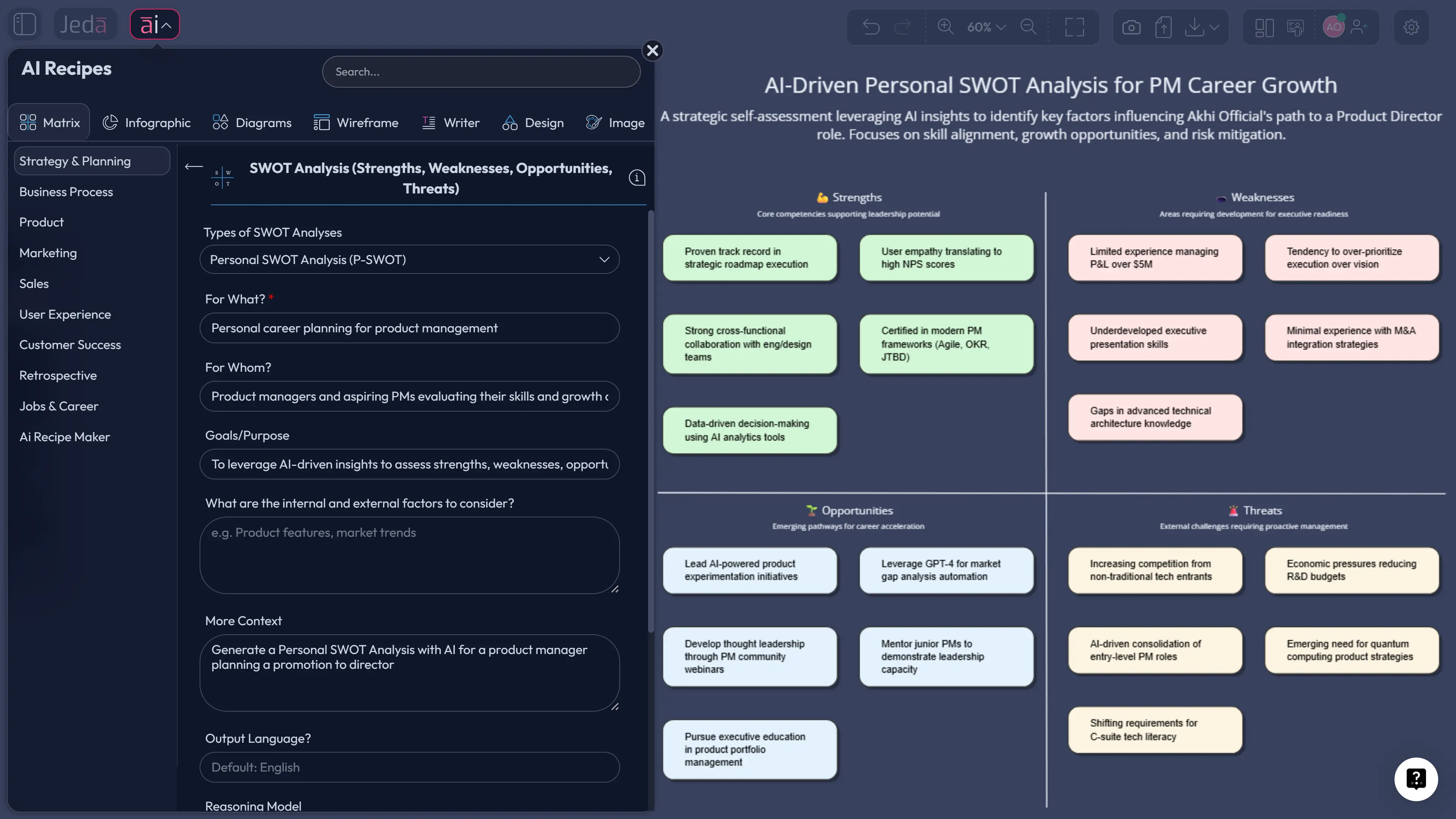
Personal SWOT Analysis with AI works best when you stop treating self-reflection like a diary entry and start treating it like strategy. That is the real shift. In Jeda.ai, you can map your strengths, weaknesses, opportunities, and threats inside an editable AI Workspace, pressure-test the picture on an AI Whiteboard, and move from vague “I should improve” thoughts to an actual plan. For ambitious professionals, founders, consultants, and managers, that matters. A lot. Jeda.ai already supports 300+ strategic frameworks and is used by 150,000+ users who want clearer thinking, not more tabs.
What is Personal SWOT Analysis with AI?
Personal SWOT Analysis with AI is a structured way to assess your internal strengths and weaknesses alongside external opportunities and threats, then use AI to organize the messier parts of self-assessment into something you can act on.
The original SWOT method is often traced to strategic planning work at Stanford Research Institute in the 1960s and is commonly associated with Albert Humphrey’s later account of that research. Over time, the framework moved well beyond corporate planning and became a practical tool for career planning, leadership development, and personal growth. Recent personal-development guides still use the same four-quadrant logic because it is simple, memorable, and surprisingly hard to outgrow.
But here is where people usually fumble it: they make a neat four-box chart, feel briefly enlightened, and do absolutely nothing with it.
That is why Personal SWOT Analysis with AI is more useful than a blank worksheet. AI helps you surface patterns, challenge soft assumptions, connect one quadrant to another, and turn your matrix into next actions. In Jeda.ai, that happens inside a Visual AI workflow where the matrix is not the end state. It is the starting point.
Why use Personal SWOT Analysis with AI in Jeda.ai?
Manual personal SWOT work can be honest, but it is often slow, repetitive, and weirdly flattering. You understate your strengths, over-explain your weaknesses, or confuse a passing inconvenience with a structural threat. AI does not magically know you better than you know yourself. It does, however, give you a stronger structure for thinking.
Jeda.ai adds another advantage: your thinking becomes visual, editable, and easier to extend. Instead of a static note buried in a doc, you get an AI Whiteboard output you can refine, share with a mentor, convert with Vision Transform, or deepen with the AI+ button. The platform also includes Matrix Recipes, Prompt Bar generation, and 300+ strategic frameworks, so your personal SWOT can sit next to related planning tools instead of living alone like a sad sticky note on a forgotten app.
- Faster first draft
You start with a structured matrix in minutes, which is useful when self-assessment would otherwise stall in overthinking.
- Sharper pattern spotting
AI helps connect strengths to opportunities, or weaknesses to threats, so the matrix becomes strategic instead of descriptive.
- Editable visual output
Your SWOT lands in Jeda.ai’s AI Workspace as an editable matrix on an AI Whiteboard, not a dead block of text.
- Better next-step thinking
You can use AI+ to extend a quadrant, or Vision Transform to convert the analysis into a mind map or diagram for action planning.
How to create Personal SWOT Analysis with AI in Jeda.ai
Jeda.ai supports two practical routes. Use the recipe when you want more guardrails. Use the Prompt Bar when you already know what you want to ask.
Method 1: Recipe Matrix
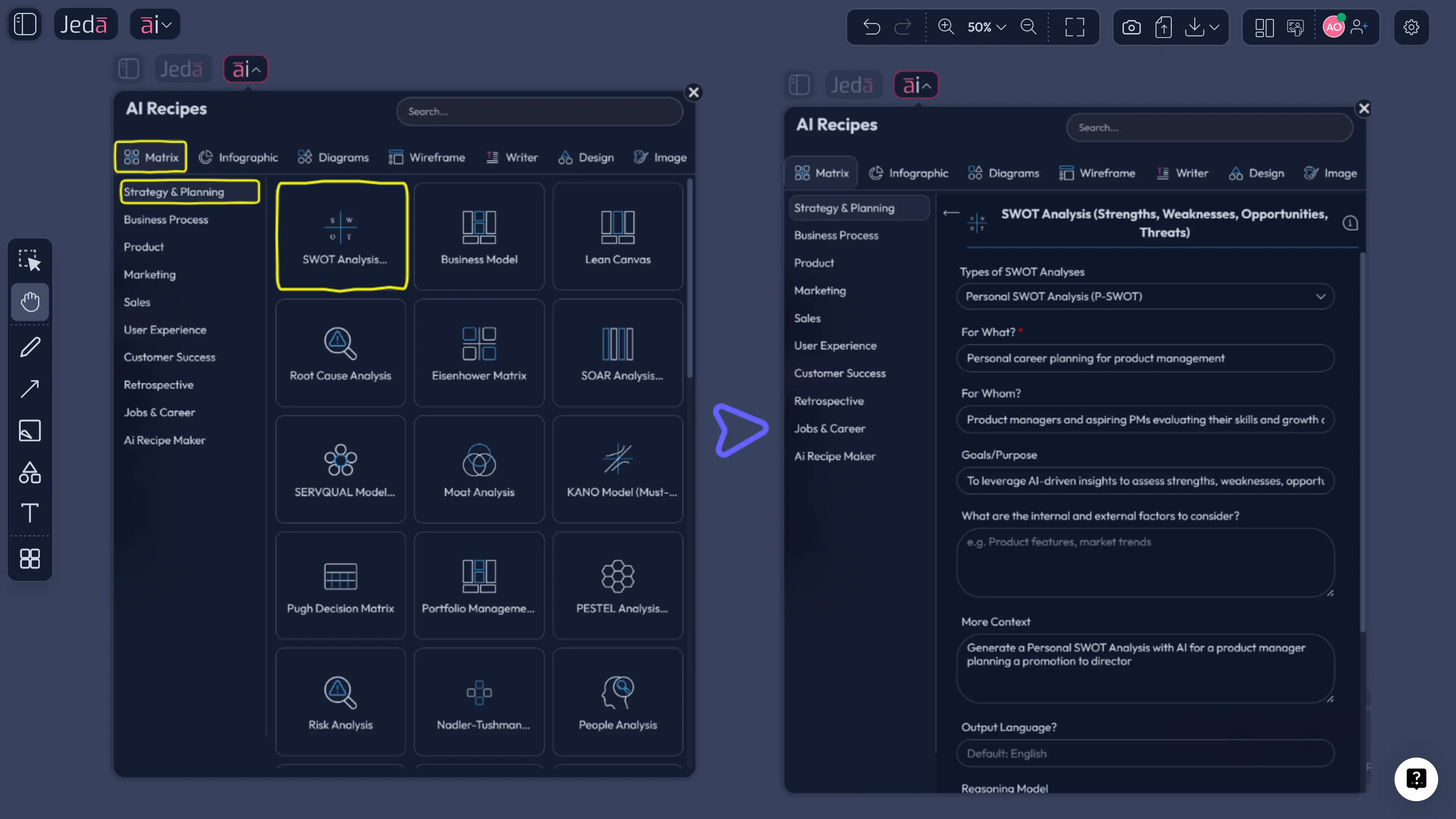
Jeda.ai’s AI Recipes include Matrix recipes under Strategy & Planning, and Jeda.ai’s own gallery specifically shows Personal SWOT Analysis (P-SWOT) as a SWOT sub-recipe. That makes this the cleanest method when you want a reliable structure without reinventing the prompt. The recipe flow also lines up with the guided form fields shown in the user guide.
- Open the AI Menu
Click the AI Menu in Jeda.ai and go to Matrix Recipes under Strategy & Planning.
- Choose SWOT Analysis, then the Personal SWOT sub-recipe
Select the SWOT recipe and choose Personal SWOT Analysis (P-SWOT) so the matrix structure is preconfigured for self-assessment.
- Fill in the guided fields
Add your goal, role, time horizon, and context. Keep it specific, such as promotion readiness, career pivot, founder capability gaps, or leadership development.
- Pick layout and model
Choose a matrix layout that is easy to scan, then select your preferred reasoning model before generating.
- Review the matrix critically
Edit weak bullets, remove generic points, and sharpen anything that sounds flattering but unprovable.
- Extend with AI+
Use the AI+ button on any quadrant to deepen patterns, surface blind spots, or add mitigation ideas without rebuilding the whole matrix.
Method 2: Prompt Bar
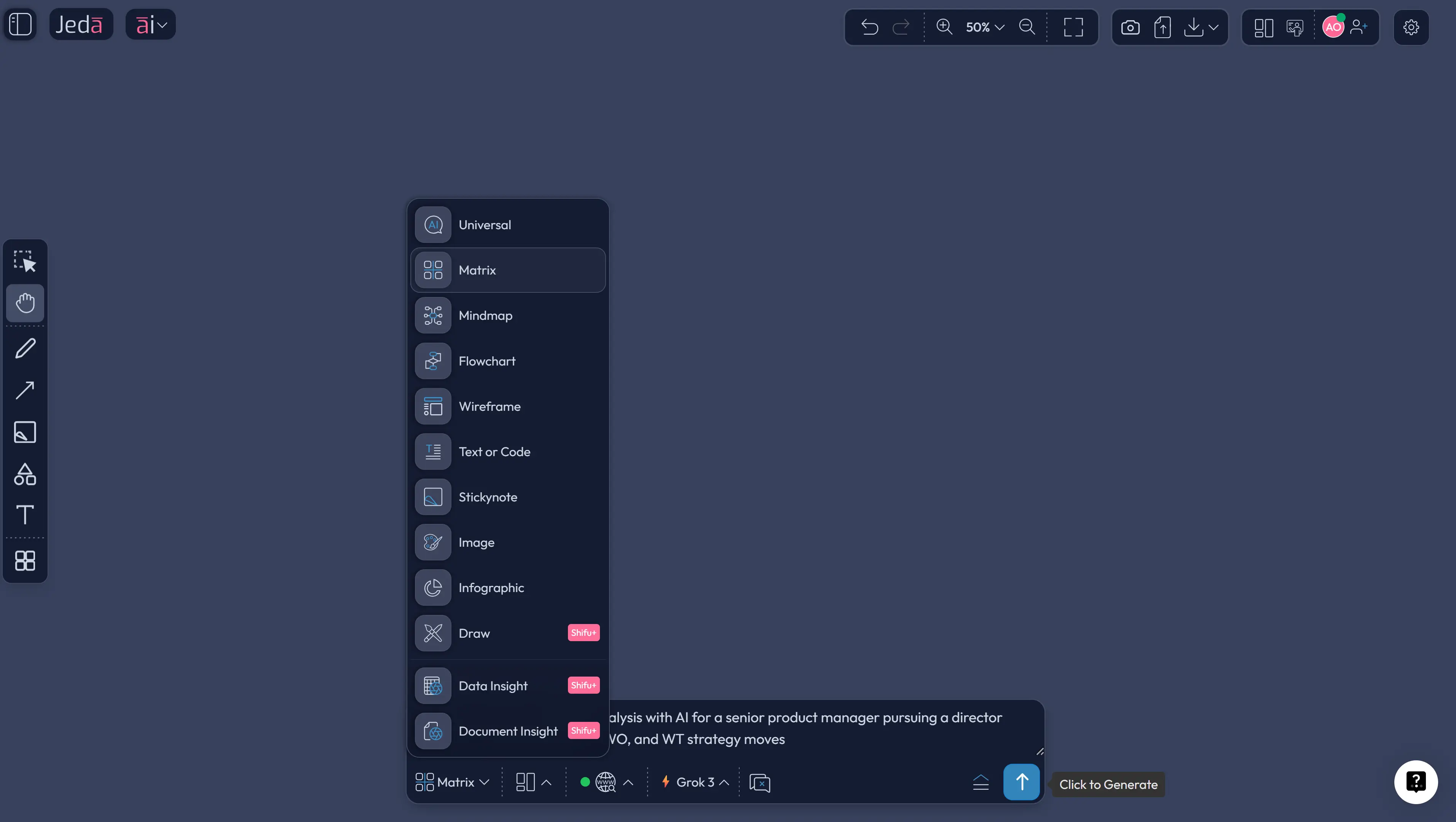
The Prompt Bar method is faster when you already know the context and want more control over the wording. In Jeda.ai, select the Matrix command from the Prompt Bar, write the request in plain English, and generate. The result appears directly on the canvas inside the AI Workspace. That is the no-fuss route.
- Open the Prompt Bar
At the bottom of the canvas, click the Prompt Bar and select the Matrix command.
- Write a goal-led prompt
Describe who the analysis is for, what goal matters, and what time frame you are planning around.
- Generate the matrix
Press Generate and let Jeda.ai build the first draft on the AI Whiteboard.
- Refine weak quadrants
Tighten broad language such as 'good communicator' or 'lack confidence' into evidence-backed statements.
- Use Vision Transform if needed
Convert the result into a mind map or diagram when you want to discuss actions, dependencies, or coaching themes visually.
Prompt you can start with
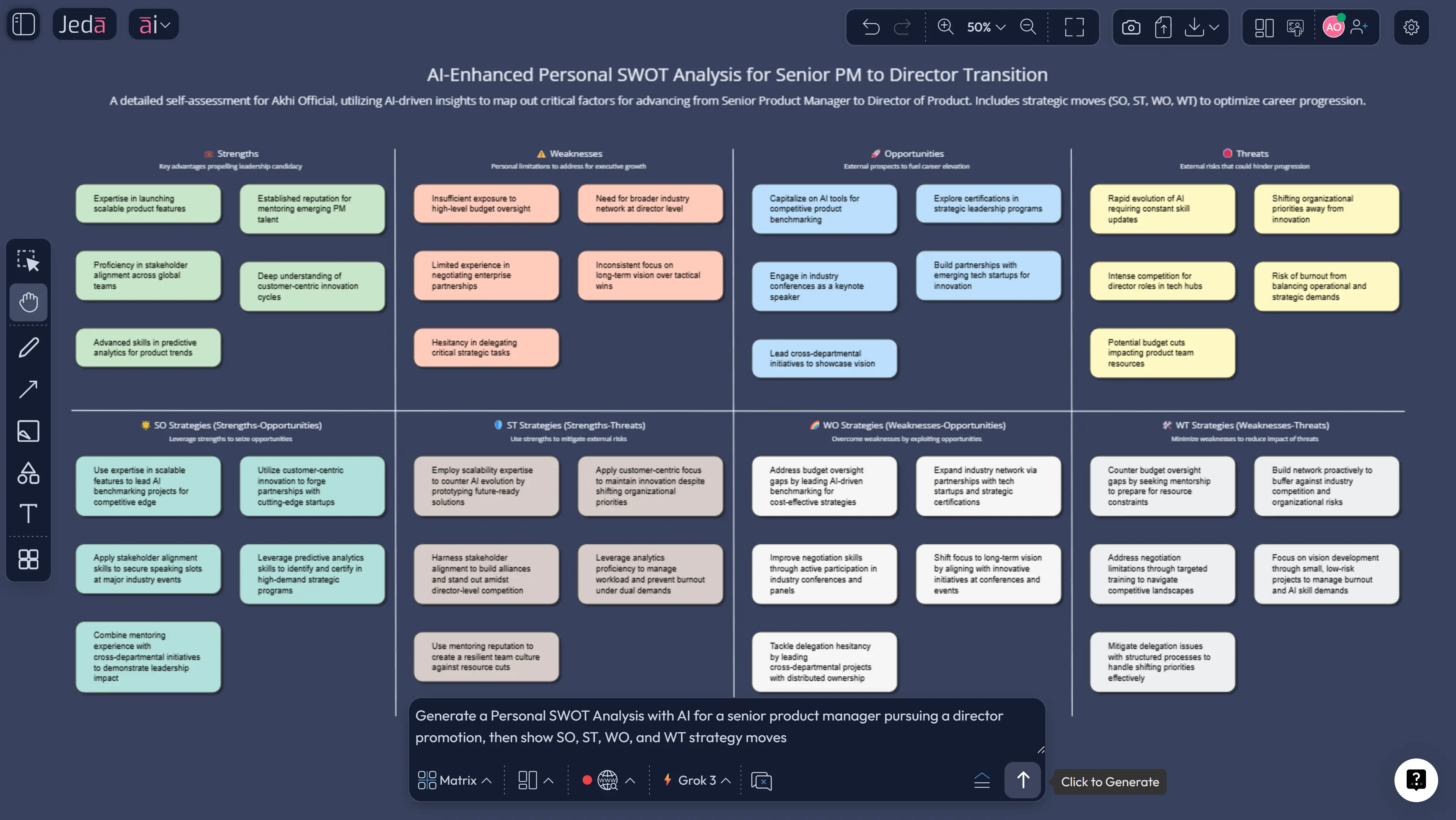
Create a Personal SWOT Analysis with AI for a senior product manager aiming to become a director within 12 months. Use four quadrants: strengths, weaknesses, opportunities, and threats. Make each point specific, evidence-based, and career-relevant. Then suggest 4 strategic moves by connecting the quadrants: SO, ST, WO, and WT.
Use AI+ for the deep dive
This part matters. A lot of people ask AI to generate the whole thing, then stop. Better move: generate the matrix first, then click a quadrant and use AI+ to extend one section at a time.
Ask for broader expansions, not ultra-scripted micromanagement. Good AI+ requests sound like this:
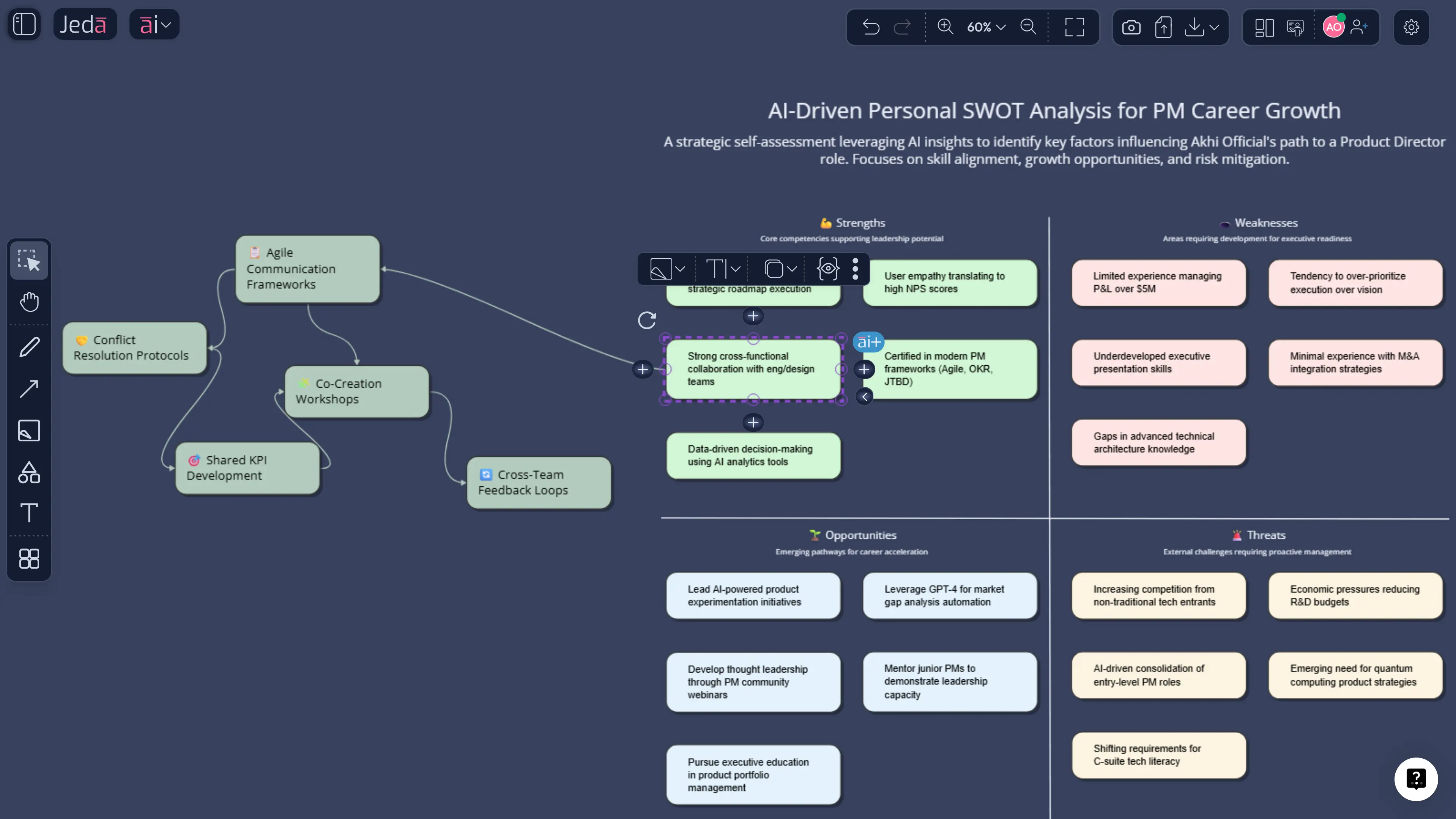
Personal SWOT Analysis with AI example
Imagine a senior product manager who wants a director role within the next year. Good scenario. Real stakes.
Their first draft might look like this:
That is already useful. But not useful enough.
The real value shows up when you connect the boxes:
- SO move: use trusted cross-functional relationships to lead a visible slice of the AI initiative.
- WO move: pair executive-storytelling practice with mentor feedback before promotion-review season.
- ST move: use customer credibility and delivery history to defend your leadership case during a reorg.
- WT move: delegate more operational work now so burnout and execution gravity do not bury the promotion path.
That cross-quadrant step is not fluff. Irene Owens argues that personal SWOT becomes more useful when you define outcomes, examine cross-quadrant relationships, and develop a timed action plan. Goal-setting research from Locke and Latham points the same direction: broad intention is weaker than specific goals tied to action.
How to turn your Personal SWOT into an action plan
A personal SWOT should end with choices. Not vibes.
The simplest upgrade is to pull one strategic move from each relationship pair, assign a time horizon, and decide what evidence will prove progress. If your weakness is executive communication, “get better at storytelling” is too soft. “Present one monthly strategy readout to VP-level stakeholders and get written feedback from two leaders” is harder, clearer, and way more useful.
And yes, Jeda.ai helps here because the matrix stays editable. You can extend one quadrant with AI+, turn it into a mind map with Vision Transform, or keep the original matrix on the AI Whiteboard as your reference board in the same AI Workspace.
Best practices for a sharper Personal SWOT Analysis with AI
Most bad personal SWOTs are not wrong. They are just mushy.
Be specific. “Good under pressure” is weak unless you can tie it to something real. “Led an at-risk product launch back on schedule across engineering, legal, and sales” is better. Same story on weaknesses. “I procrastinate” is not nearly as useful as “I delay executive-facing work when the narrative is still messy.”
A few practical rules help:
Pepperdine’s career guidance stresses starting with the outcome you want, while Wake Forest frames SWOT as a useful tool for figuring out what is next by looking honestly at where you are now. That is the right posture: clear target, honest inventory, then action.
Common mistakes to avoid
1. Writing personality slogans instead of evidence
“Resilient,” “visionary,” and “hardworking” sound nice. They also prove nothing.
2. Mixing internal and external factors
A market slowdown is not a weakness. Low financial literacy is not a threat. Keep the categories clean or the strategy gets muddy.
3. Listing everything at the same importance level
Not every bullet deserves oxygen. Prioritize the few factors that shape your goal most.
4. Ignoring threats because they feel negative
Threats are not pessimism. They are context. Reorgs, skill commoditization, burnout, and stronger competition are strategic realities.
5. Stopping at the matrix
The boxes are diagnostic. The action plan is where the value shows up.
6. Letting AI be too agreeable
If the output feels suspiciously flattering, it probably is. Push back. Edit it. Ask for harder questions.
Frequently Asked Questions
- What is a personal SWOT analysis?
- A personal SWOT analysis is a self-assessment framework that maps your strengths, weaknesses, opportunities, and threats for a specific goal. It helps you see what is working, what is holding you back, and what outside conditions could accelerate or block your progress.
- How is a personal SWOT different from a business SWOT?
- A personal SWOT uses the same four-part structure as a business SWOT, but the subject is you rather than a company, product, or market. The strongest use cases are career planning, promotion readiness, leadership growth, role changes, and skill development.
- When should I use Personal SWOT Analysis with AI?
- Use Personal SWOT Analysis with AI when you need clarity before a meaningful decision. Good moments include a promotion push, job search, leadership transition, career pivot, founder role shift, or any period when vague self-reflection is no longer enough.
- Can AI make a personal SWOT analysis more accurate?
- AI can make a personal SWOT analysis more structured and more challenging, but not automatically more true. The output improves when you give clear context, add evidence, and edit the result critically instead of accepting every bullet just because it sounds polished.
- What should go into each quadrant?
- Strengths and weaknesses should describe internal factors such as skills, habits, credibility, knowledge, and behavioral patterns. Opportunities and threats should describe outside conditions such as market demand, leadership changes, competition, technology shifts, or timing-related risks.
- How often should I revisit my personal SWOT?
- Revisit it quarterly, or anytime the context changes sharply. A new manager, reorganization, layoff wave, certification, major win, burnout period, or changing market demand can all shift your opportunities, threats, and the relevance of certain strengths or weaknesses.
- Can I use a personal SWOT for leadership development?
- Yes. Personal SWOT is especially useful for leadership development because it forces self-awareness, exposes behavioral gaps, and reveals external conditions that affect your growth. It becomes even stronger when you convert the matrix into a timed action plan with feedback loops.
- What are the most common mistakes in a personal SWOT?
- The most common mistakes are being generic, confusing internal and external factors, making the matrix too broad, ignoring threats, and never translating the analysis into decisions. The framework is helpful only when it leads to choices, priorities, and measurable next steps.
- How do I create Personal SWOT Analysis with AI in Jeda.ai?
- In Jeda.ai, you can create it either through the AI Menu using the SWOT matrix recipe and Personal SWOT sub-recipe, or through the Prompt Bar by selecting the Matrix command and describing your goal. After generation, use AI+ to deepen and Vision Transform to reframe.
Sources & Further Reading
- [1]
Humphrey, Albert S. (2005) . “SWOT Analysis for Management Consulting” SRI Alumni Newsletter.
View Source ↗ - [2]
Owens, Irene (2020) . “Supplementing the SWOT Matrix for Personal Growth and Leadership” Library Diversity and Residency Studies.
View Source ↗ - [3]
Locke, Edwin A.; Latham, Gary P. (2002) . “Building a Practically Useful Theory of Goal Setting and Task Motivation: A 35-Year Odyssey” American Psychologist.
View Source ↗ - [4]
Pepperdine Graziadio Business School (2021) . “A Guide to a Personal SWOT Analysis: Preparing for Your Next Role” Pepperdine Graziadio.
View Source ↗ - [5]
Wake Forest University Alumni Personal & Career Development Center (2024) . “Use a SWOT Analysis for Career Planning” Wake Forest University.
View Source ↗ - [6]
Da Fonseca, Shannon (2022) . “The influence of self-awareness on effective leadership outcomes in South Africa” South African Journal of Business Management.
View Source ↗
If you want clearer direction, better self-awareness, and a plan that survives contact with reality, start your next Personal SWOT Analysis with AI in Jeda.ai’s AI Workspace and build it visually on the AI Whiteboard.
Start Your Personal SWOT Analysis with AI Today
Join over 150,000+ users who use Jeda.ai to turn reflection into strategy inside one AI Workspace.
Try Free Template