A technical contradiction says: if we improve X, Y gets worse.
A physical contradiction says something stricter: the same parameter must be in two opposite states (A and not‑A), because each state enables a different function or avoids a harm.
TRIZ resolves physical contradictions using separation principles, commonly framed as separation in time, space, upon condition, and between the whole and its parts.
This guide is matrix-first and academic: you will create a structured contradiction statement, map it into separation logic, and generate testable solution directions as an editable Matrix inside Jeda.ai.
What is a physical contradiction?
A physical contradiction can be written as:
- Parameter P must be A to enable useful function F1
- Parameter P must be not‑A to enable useful function F2 or prevent harm H1
Examples (canonical TRIZ style):
- Landing gear must be present (takeoff/landing) and absent (reduce drag) → separation in time.
- Water must be hard (support diver) and soft (avoid injury) → separation in space via air bubbles.
Physical contradictions are not “opinions.” They are constraint statements you can test.
Separation principles (the resolution mechanism)
Separation principles resolve the “A and not‑A” requirement by allocating the opposite states to different:
- times,
- spaces,
- operating conditions,
- or system levels (whole vs parts).
This is the reason separation principles are central in TRIZ contradiction work: they operationalize the resolution of physical contradictions into design strategies.
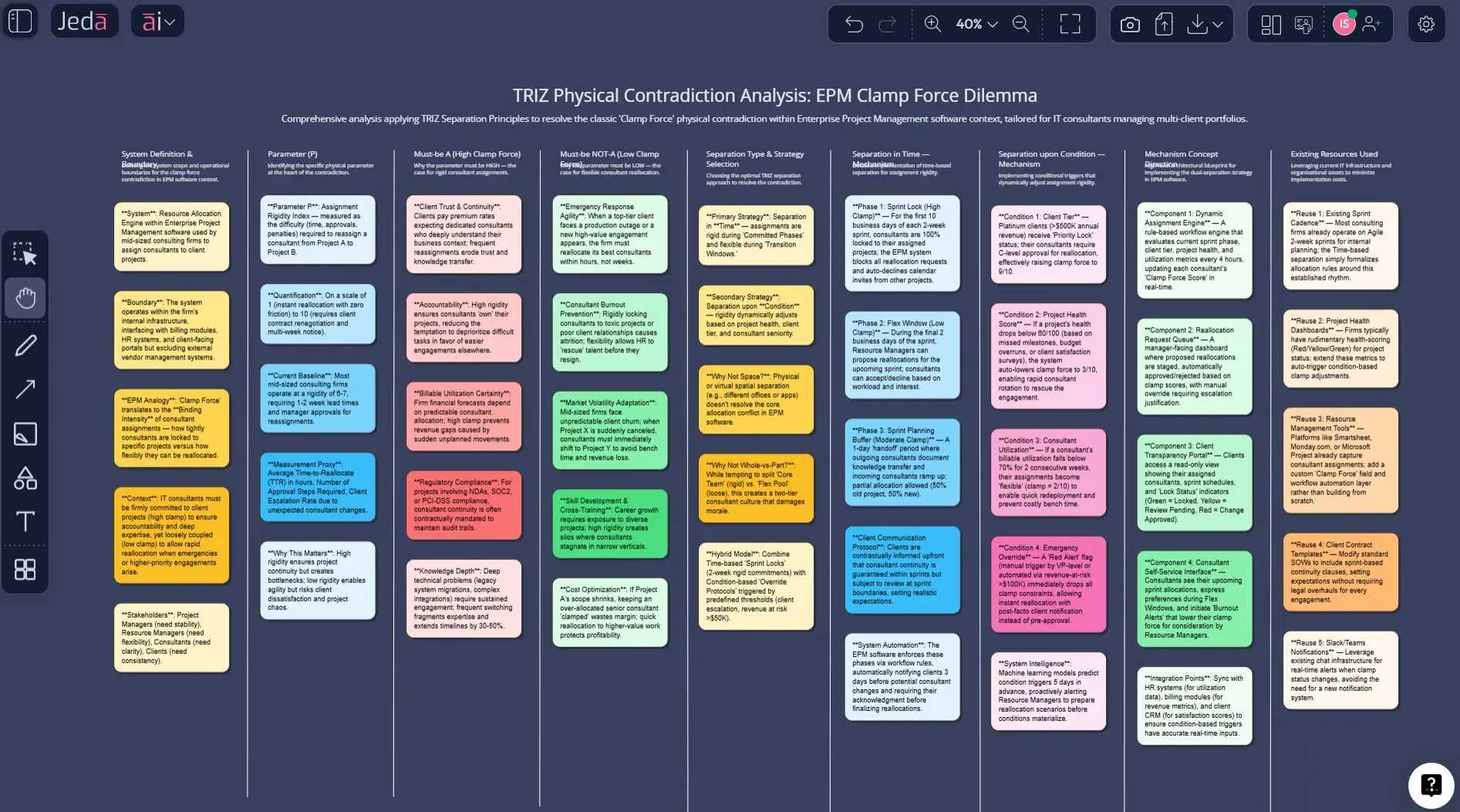
The Physical Contradiction Matrix (core deliverable)
Use this as your standard on-canvas matrix.
Columns
- System + boundary
- Parameter (P)
- Must‑be state (A) + why
- Must‑be opposite (not‑A) + why
- Separation type (time / space / condition / whole‑vs‑part)
- Separation strategy (how to separate)
- Concept direction (mechanism-level)
- Existing resources used
- Risk / new harm
- Fastest falsifiable test + KPI
Separation type mapping (quick academic table)
| Separation type | When it fits | What you are separating |
|---|---|---|
| Separation in time | Opposite states are needed at different phases | A at time t1, not‑A at time t2 |
| Separation in space | Different zones need different states | A in region r1, not‑A in region r2 |
| Separation upon condition | State depends on conditions | A if C1, not‑A if C2 |
| Separation between parts and the whole | Whole needs one state, parts need the opposite | global property differs from local property |
Why use AI for physical contradictions?
AI helps most with:
- drafting clearer contradiction formulations (multiple candidates),
- generating separation strategies systematically (coverage),
- producing a clean matrix linking each strategy to a concept and test.
AI helps least with:
- physics validation,
- safety/regulatory feasibility,
- hidden constraints not present in your input.
Use AI to generate options, then validate them with evidence.
How to run Physical Contradictions + Separation in Jeda.ai (Matrix)
Method 1 — AI Recipe Templates (AI Menu)
- Open your board → AI Menu / AI Recipes.
- Navigate to TRIZ → choose Physical Contradiction and Separation.
- Provide:
- System + boundary
- Parameter P
- Must‑be state A (why)
- Must‑be opposite not‑A (why)
- Constraints (must‑not‑change)
- Click Generate to create the Separation Matrix.
- Review: ensure each row explicitly separates A vs not‑A (not “compromise”).

Method 2 — Prompt Bar (Matrix command)
- Open AI Prompt/Command Bar.
- Select Matrix.
- Paste:
- System: …
- Boundary: …
- Parameter (P): …
- Must be A because: …
- Must be not‑A because: …
- Constraints: …
- Deliverable: “Create a matrix with separation types (time/space/condition/whole‑vs‑part). For each type, propose 2 strategies, 1 mechanism concept, resources used, risks, and a falsifiable test + KPI.”
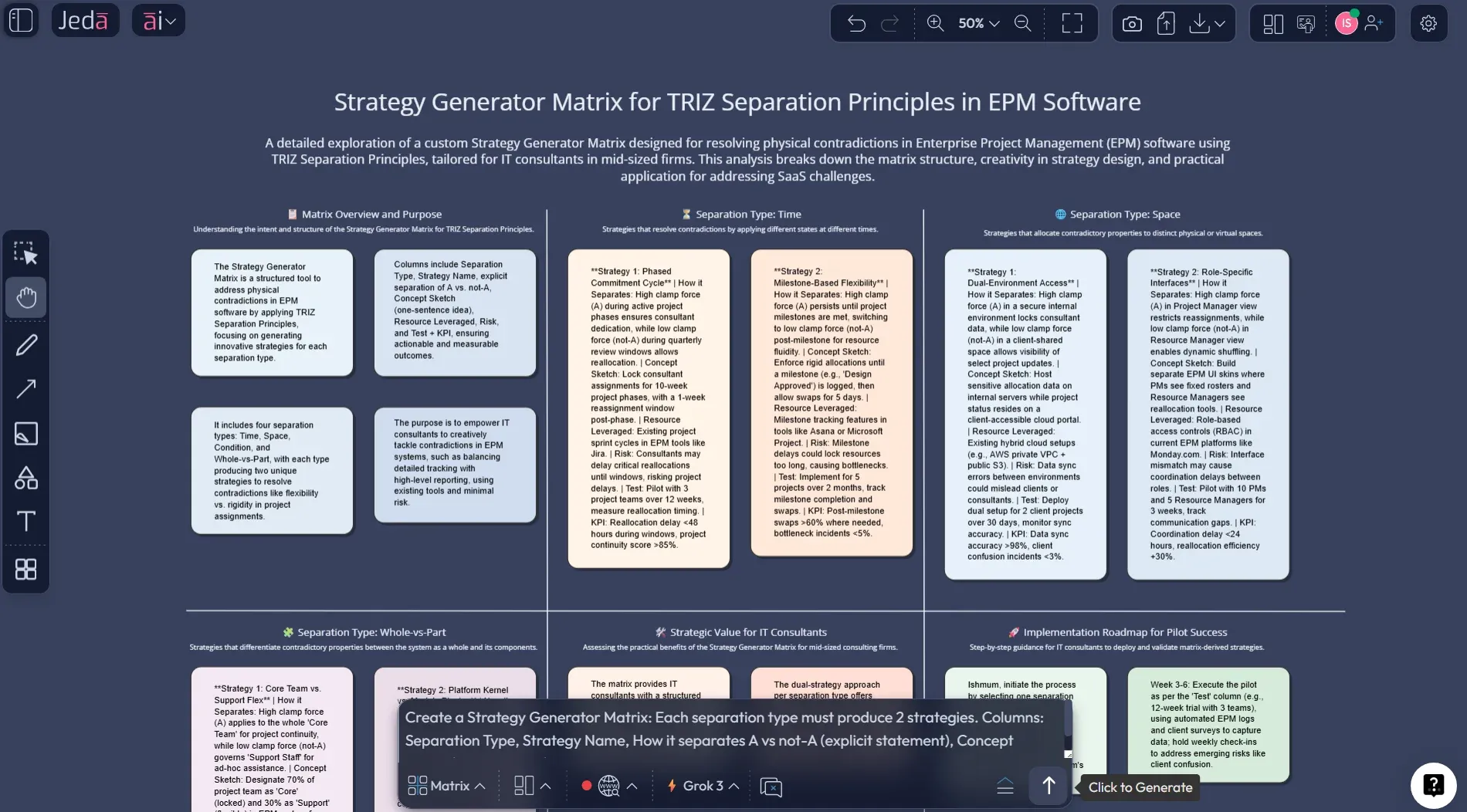
- Generate → delete rows that do not explicitly separate opposite states.
- Formulate the physical contradiction
Write the same parameter that must be A and not‑A, each tied to a specific function or harm.
- Choose separation type(s)
Decide whether the contradiction separates best by time, space, operating condition, or whole-vs-part.
- Generate separation strategies
Use AI to propose 2–3 strategies per type and keep only those that explicitly separate A vs not‑A.
- Translate into mechanism concepts
Convert each strategy into a mechanism-level concept and list which existing resources enable it.
- Attach tests and select
Add a falsifiable test + KPI per concept, then select 1–2 to prototype.
Worked micro-example (academic)
Problem: A clamp must prevent slip but must not deform the part.
Physical contradiction: Clamping force must be high (prevent slip) and low (avoid deformation).
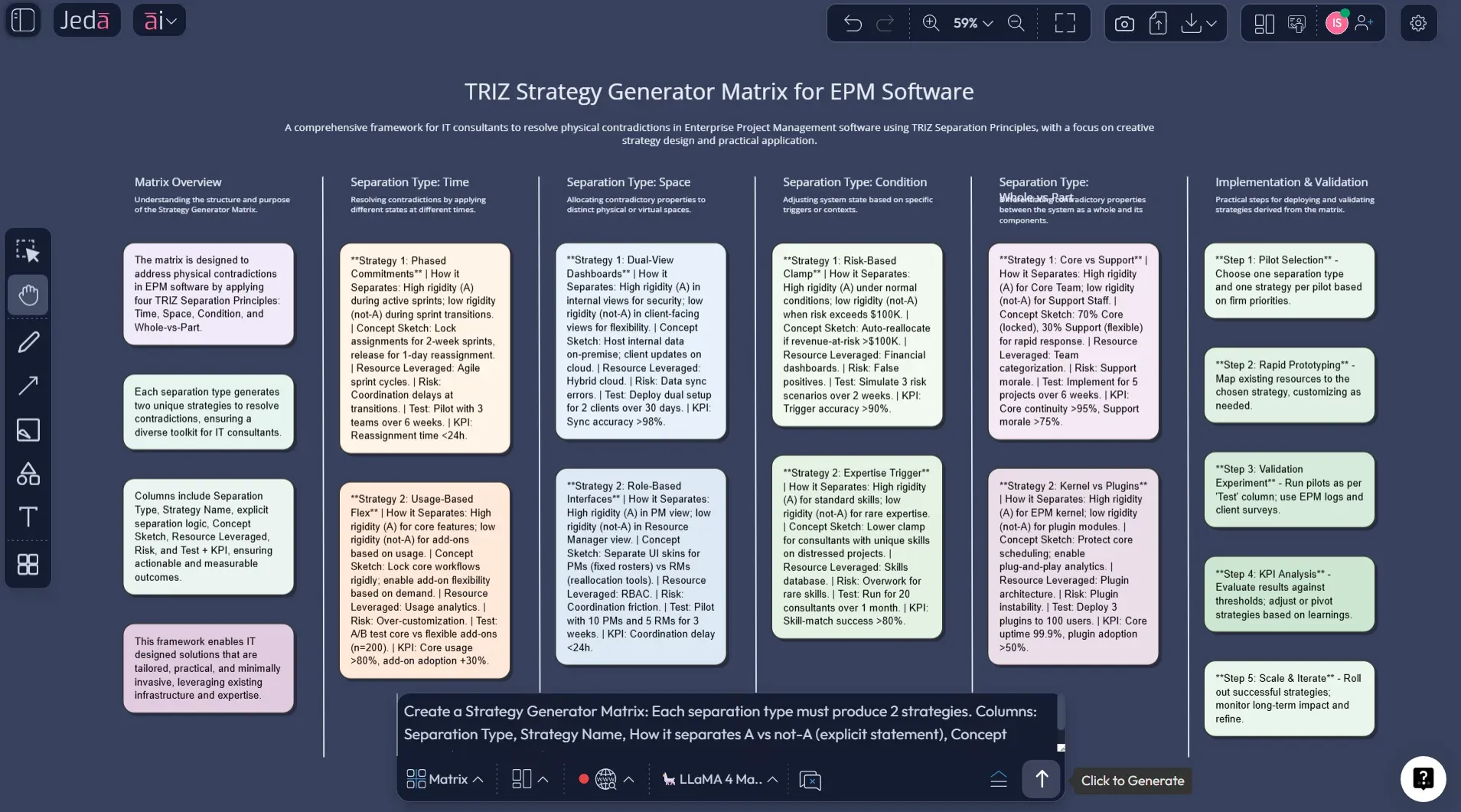
Matrix outputs (example):
- Time separation: high force during alignment, low force during operation via self-locking geometry.
- Space separation: high pressure only at reinforced zones; low pressure at fragile zones via local contact design.
- Condition separation: force increases only when slip is detected (feedback control).
- Whole vs part: gentle global clamp + local micro-features provide anti-slip.
Common mistakes (and how to avoid them)
Mistake: Writing two different parameters (that’s a technical contradiction).
Fix: Same parameter must be A and not‑A.Mistake: “Compromise solutions” (make it medium).
Fix: Separation means A and not‑A both exist, but in different allocations.Mistake: Strategies without tests.
Fix: Each row needs a falsifiable experiment and KPI.
FAQ
- What is a physical contradiction in TRIZ?
- A physical contradiction occurs when the same parameter must be in two opposite states (A and not‑A) to achieve functions or avoid harms. TRIZ resolves this by separation principles.
- What are TRIZ separation principles?
- Separation principles are TRIZ strategies for resolving physical contradictions by separating conflicting requirements in time, space, operating conditions, or between the whole and its parts.
- How can AI help with physical contradictions?
- AI can draft clearer contradiction statements, propose separation strategies systematically, and generate a matrix of mechanism concepts with risks and tests. Humans validate feasibility and constraints.
Citations
- [1]
triz.org (n.d.) . “Contradictions (includes physical contradiction examples and separation)” triz.org.
View Source ↗ - [2]
innovation-triz.com (n.d.) . “The use of TRIZ Separation Principles to resolve physical contradictions” innovation-triz.com.
View Source ↗ - [3]
P. R. Apte (IIT Bombay) (n.d.) . “Introduction to TRIZ – Innovative Problem Solving (physical contradictions + separation)” IIT Bombay.
View Source ↗ - [4]
MATRIZ (2019) . “Level 1 Training Manual (physical contradiction separation in time + linked principles)” MATRIZ (Word/PDF).
View Source ↗ - [5]
J. Delgado‑Maciel et al. (2025) . “Dynamic inventive problem solving (notes four separation principles for physical contradictions)” Results in Engineering (Elsevier).
View Source ↗