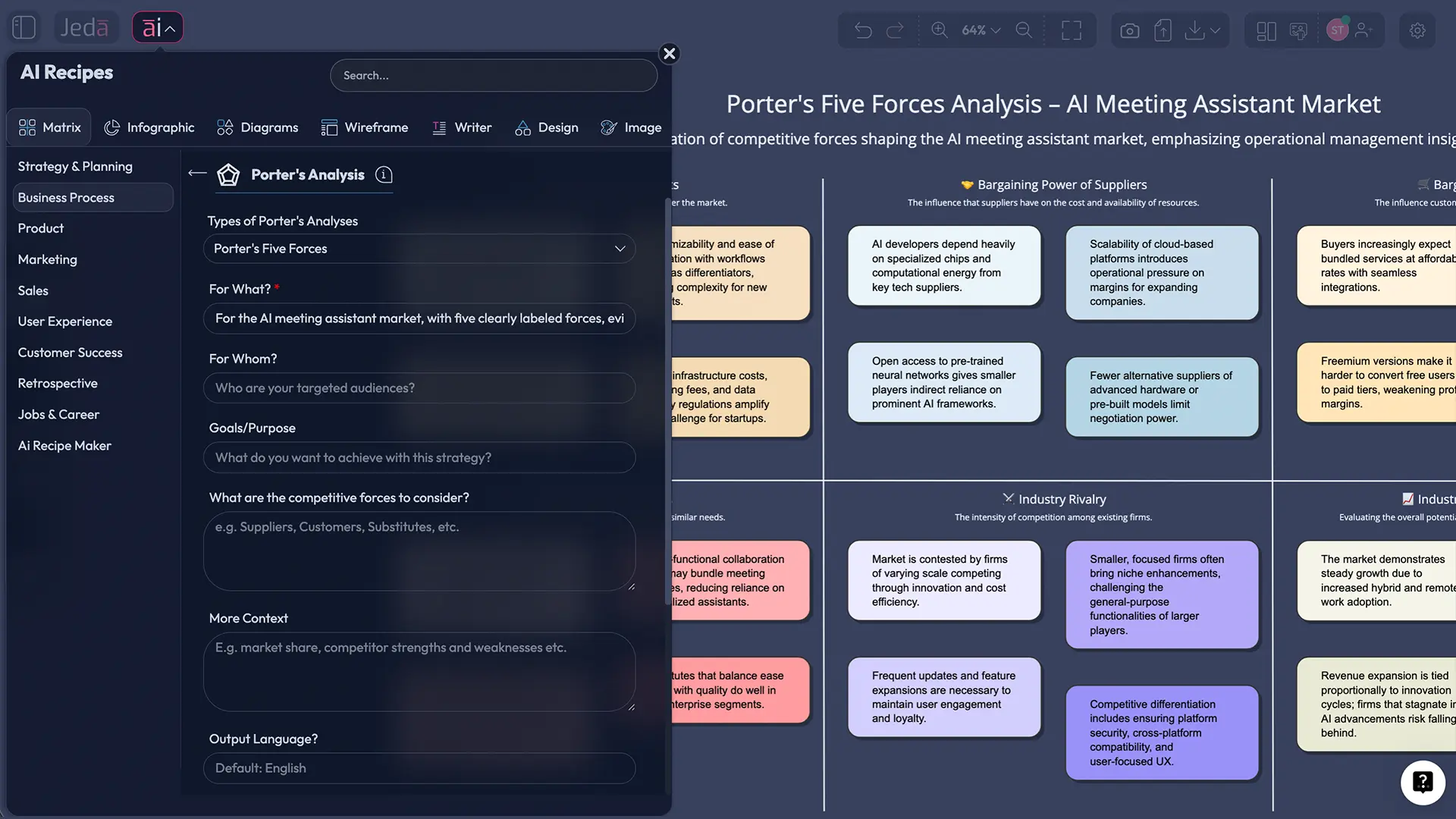
If you came here looking for Porter's Five Forces analysis, you’re in the right place. But most teams use Porter’s analysis as shorthand for a wider toolkit: Five Forces, the Value Chain, Generic Strategies, the Diamond Model, and the Three Tests for diversification. In Jeda.ai, you can start with the matrix most people know, then expand the work inside one AI Workspace instead of rebuilding the whole thing from scratch.
Jeda.ai fits this job well because the output stays visual, editable, and collaborative. In one AI Whiteboard, you can generate a Porter board, extend it with the AI+ button, convert it with Vision Transform, and keep the evidence attached to the decision. No blank-canvas paralysis. More signal, less mess. That’s part of why more than 150,000+ users use Jeda.ai for strategic analysis.
What is Porter's analysis?
Porter’s analysis is best understood as a family of strategy tools, not a single diagram. In practice, most people mean Five Forces, because that’s the best-known framework Michael Porter introduced in 1979 to analyze industry structure and profit pressure. But Porter’s body of work goes further than that.
At a practical level, the Porter toolkit usually breaks down like this:
- Five Forces: analyze industry attractiveness and competitive pressure.
- Value Chain: find where a company creates value and where cost or differentiation actually happens.
- Generic Strategies: choose how to compete—cost leadership, differentiation, or focus.
- Diamond Model: examine why certain nations or regions become strong in certain industries.
- Three Tests: pressure-test diversification decisions before a company wanders into a shiny new market and regrets it later.
So when someone asks for “Porter’s analysis,” the real question is: which decision are you trying to make? If you want industry pressure, start with Five Forces. If you want internal economics, use Value Chain. If you need positioning, use Generic Strategies. If geography matters, use the Diamond Model. If leadership is debating diversification, use the Three Tests.
That’s why this page doesn’t trap you in a five-forces-only tunnel. The workflow centers on the matrix version because it’s the fastest entry point in Jeda.ai, but the discussion shows how to branch into the rest of the Porter stack inside the same AI Workspace.
Which Porter model should you use?
Use the Porter model that matches the decision, not the one you remember from a lecture slide. Teams lose time when they run Five Forces for a problem that’s really about internal activity design or market-entry logic.
In real strategy work, these tools often chain together. A consultant might start with Porter’s Five Forces analysis, switch to a Value Chain view, then use Generic Strategies to decide the actual position. That’s why a good AI Whiteboard beats a static template. The thinking evolves.
Why use Porter's analysis with AI?
AI speeds up the setup, but the bigger win is better structure. You still need judgment. You still need evidence. What AI changes is the time you waste turning raw notes into something a team can actually debate.
- Faster first draft
Generate a clean Porter matrix in seconds instead of building the layout by hand and losing momentum before the analysis even starts.
- Evidence stays attached
Bring in notes, documents, screenshots, CSVs, or market context so each force or activity is tied to something defensible, not just vibes.
- Move across Porter tools
Start with Five Forces, then switch to a Value Chain or Porter Diamond view using Diagram or Vision Transform when the conversation expands.
- AI+ for deeper branches
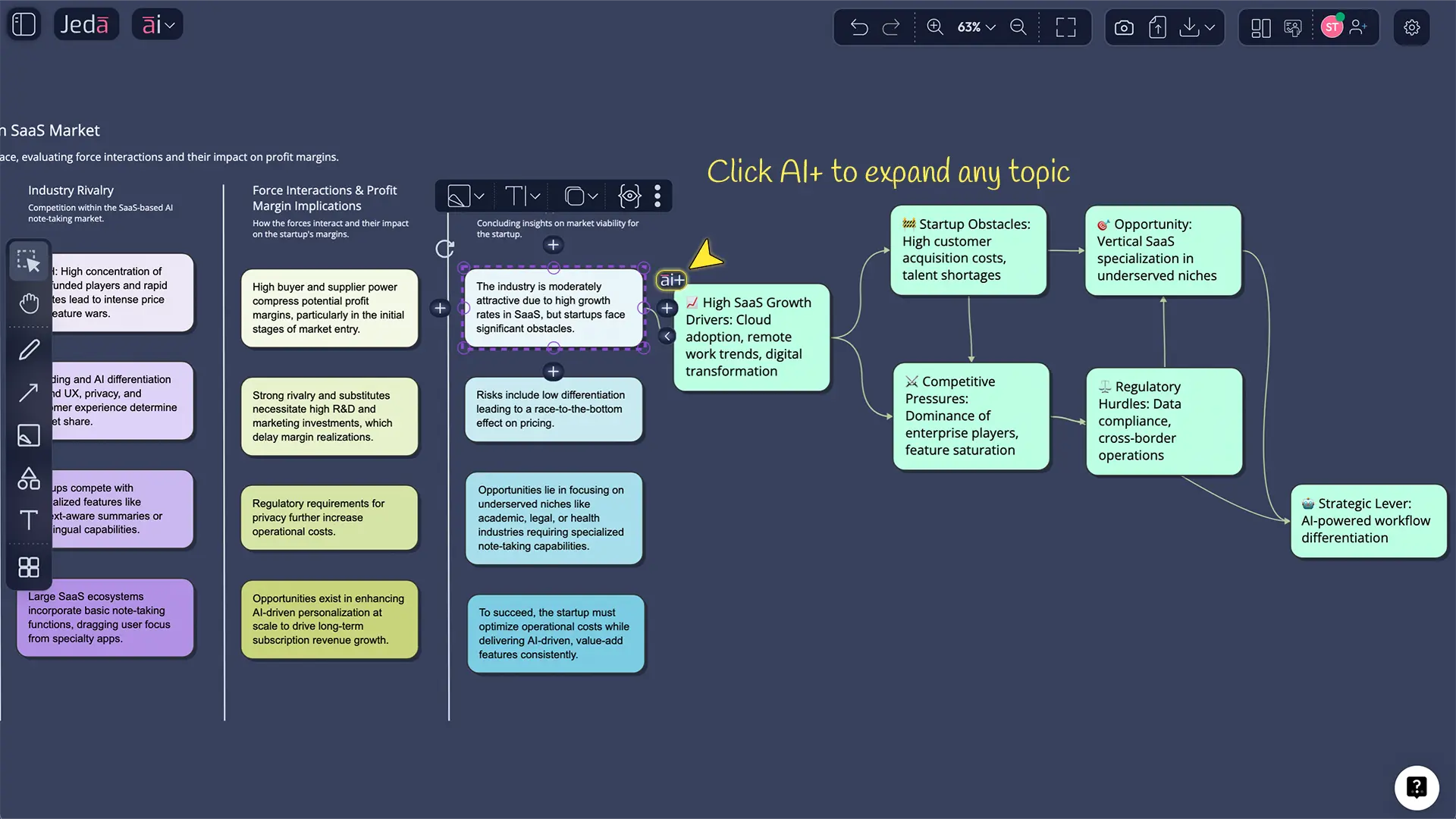
Use the AI+ button to extend the strongest force, deepen a risk branch, or expand a strategy implication without starting over.
- Live collaboration
Strategy rarely happens alone. Teams can review the same board, comment, refine, and align in a shared Visual AI workspace.
- Decision-ready output
You end with an editable board your team can present, challenge, update, and export as PNG, SVG, or PDF when it’s ready.
The other thing? Jeda.ai doesn’t force you into a blank canvas. The platform is built around 300+ strategic frameworks, so you start closer to the insight.
How do you create Porter's analysis in Jeda.ai?
For the matrix workflow, use Method 1 first: Recipe Matrix. It’s the cleanest way to generate a Porter board that your team can edit right away. Then use Method 2 when you want a faster custom prompt or you’re adapting Porter to a niche market.
Method 1: Recipe Matrix
Use the matrix-style workflow when your main goal is Porter’s Five Forces analysis. It gives you the strongest structured starting point, and it’s the easiest way to keep competitive rivalry, supplier power, buyer power, substitutes, and new entrants in one readable board.
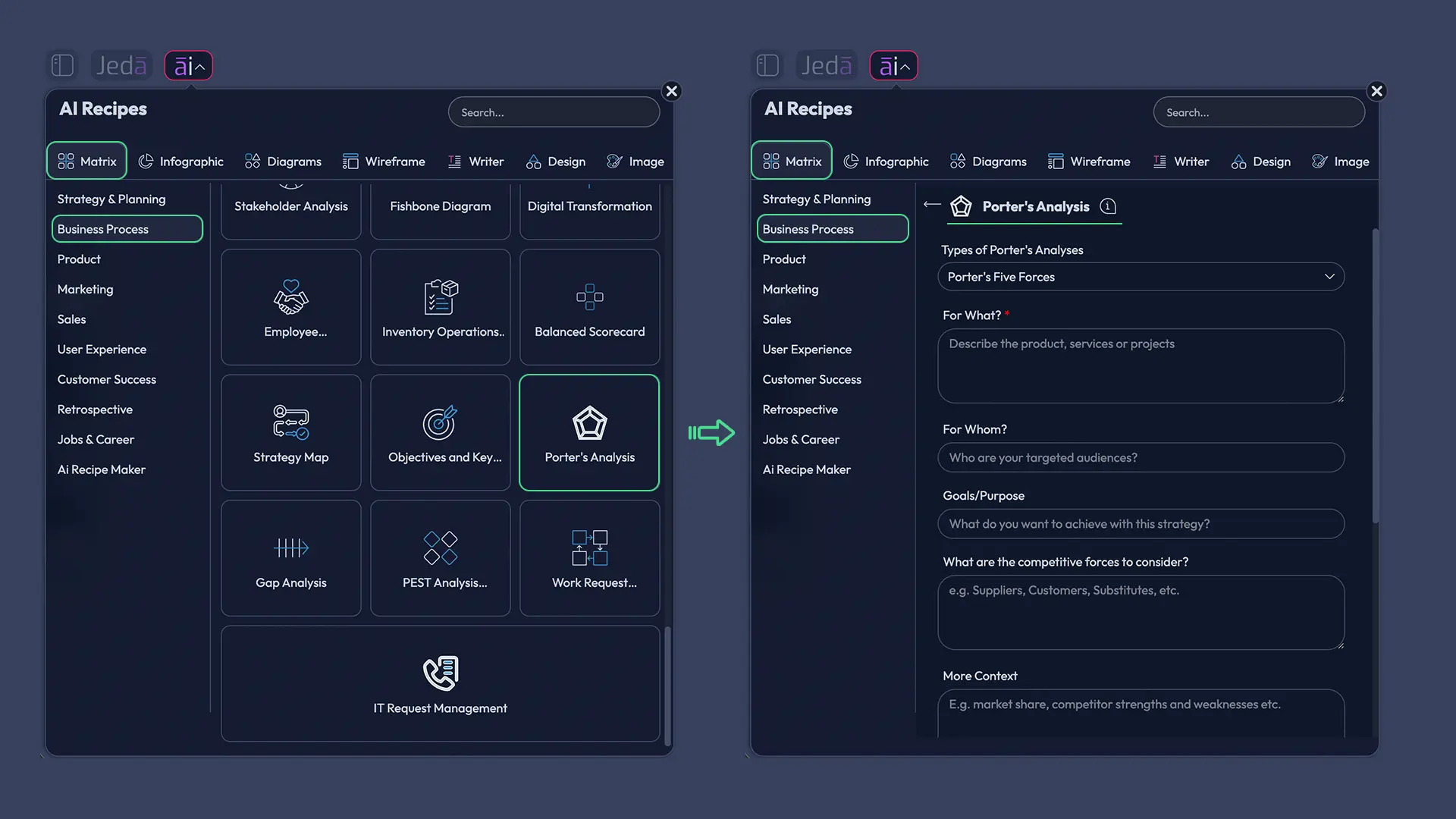
- Open the AI Menu and choose the Matrix recipe
On the canvas, open the AI Menu, go to the Matrix recipe area, and select the Porter’s Five Forces analysis.
- Define the industry and the decision question
Be specific. Don’t write 'analyze fintech.' Write something like 'Analyze the competitive pressure in the U.S. B2B payments market for a mid-market SaaS entrant.'
- Add evidence and context
Include the market, geography, buyer type, business model, known competitors, substitutes, barriers to entry, and any notes or files that sharpen the context.
- Generate the force matrix
Let Jeda.ai create the initial five-force structure with draft insights, then edit every cell so the board reflects your actual evidence and business reality.
- Rate force strength and capture implications
Label each force as low, medium, or high pressure. Add a short strategic implication under each one so the board drives action instead of staying descriptive.
- Use AI+ to deepen the heaviest force
Select the most important force, tap the AI+ button, and extend it into deeper reasoning, risks, or counter-moves. AI+ works best for continuation and expansion, not tightly specified brand-new instructions.
Method 2: Prompt Bar
Use the Prompt Bar when you already know what you want the board to do and you don’t need a preset layout. This is great for niche industries, hybrid Porter workflows, or fast workshop facilitation.
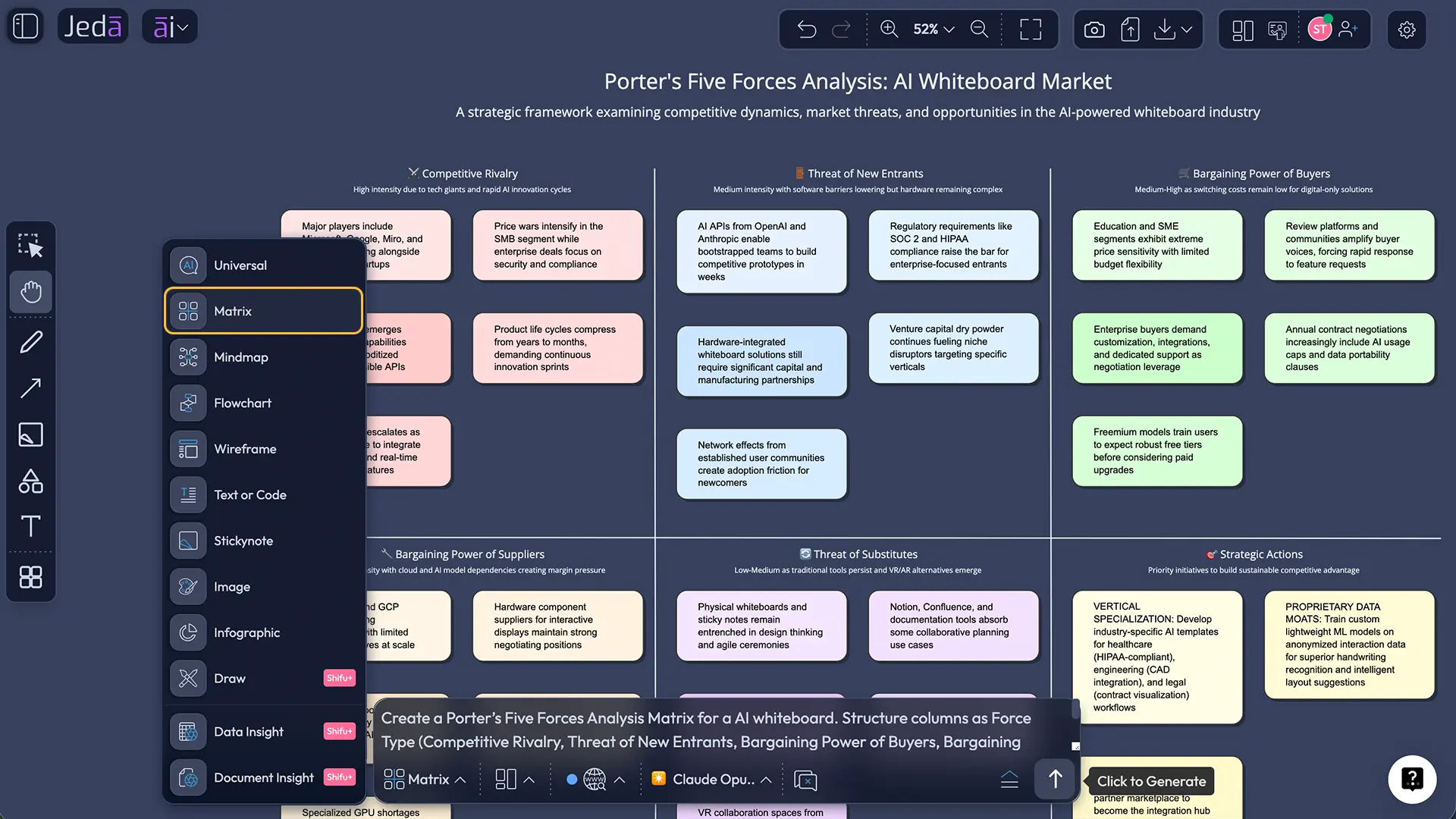
- Open the Prompt Bar
At the bottom of the canvas, open the Prompt Bar and select the Matrix command.
- Write a decision-led prompt
Try: 'Create a Porter’s Five Forces analysis for EV charging software in the UK, rate each force, explain the reason, and end with the three strategic threats that matter most.'
- Generate and edit the matrix
Press Enter, review the output, and tighten the assumptions. Porter work gets stronger when the team challenges each force, not when everyone nods politely.
- Extend or convert
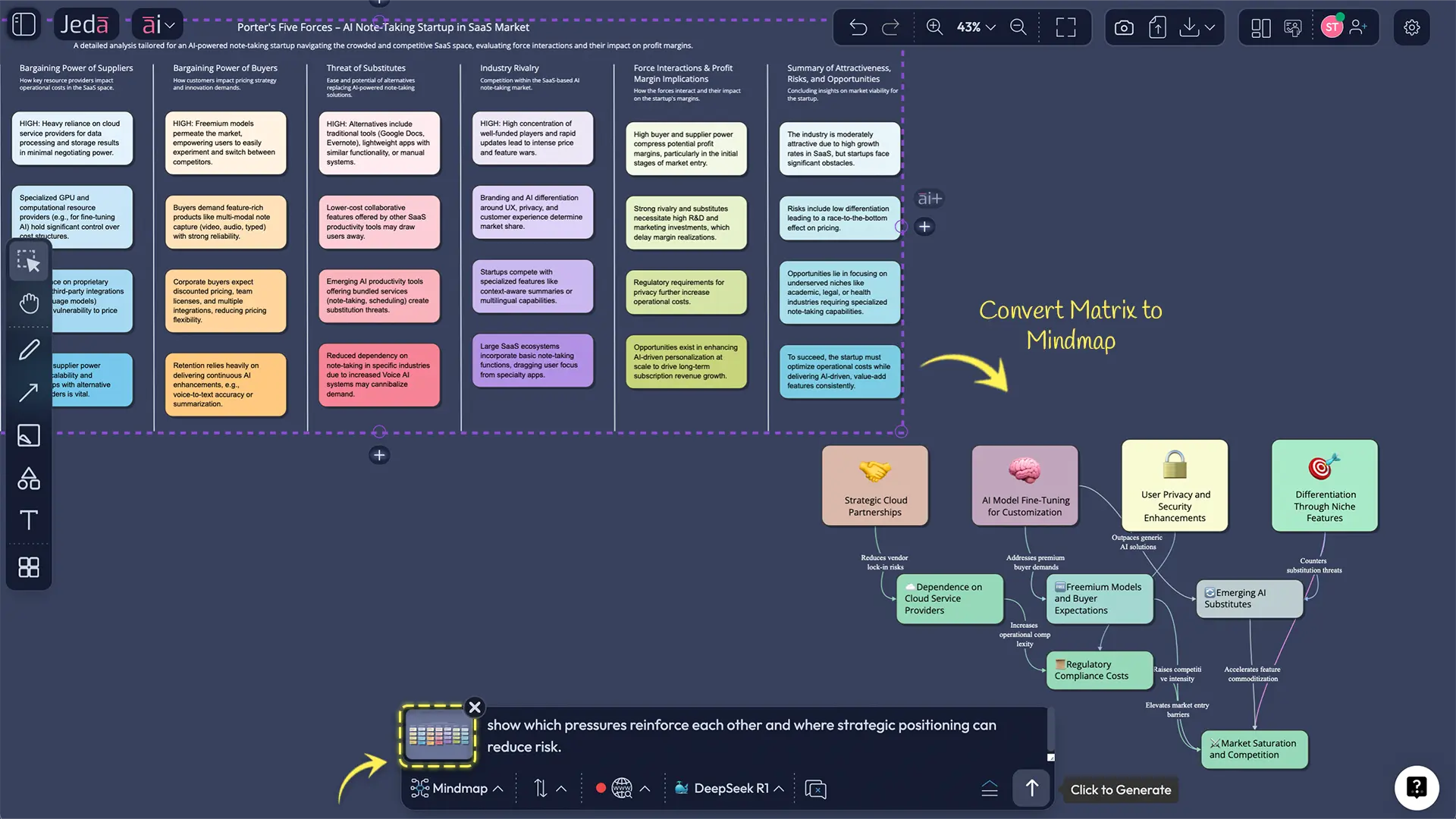
Use the AI+ button to deepen one force, or use Vision Transform to turn the matrix into a Diagram if the next conversation is about value chain logic, positioning, or market structure.
How do you go beyond Five Forces inside the same board?
This is where Porter's analysis becomes more useful than a classroom exercise. Five Forces tells you how pressure works around the business. It does not automatically tell you how the business should respond. That’s where the rest of the Porter toolkit earns its keep.
A simple flow works well:
- Start with Five Forces to map outside pressure.
- Switch to Value Chain to find where cost or differentiation can improve.
- Use Generic Strategies to decide the stance.
- Pull in the Diamond Model if geography matters.
- Use the Three Tests if leadership is asking, “Should we enter that adjacent market at all?”
In Jeda.ai, you don’t need separate tools for that journey. Build the first Porter matrix in the AI Workspace, then create a second view with Diagram for the Value Chain or a follow-on matrix for Generic Strategies.
Porter's analysis template and example
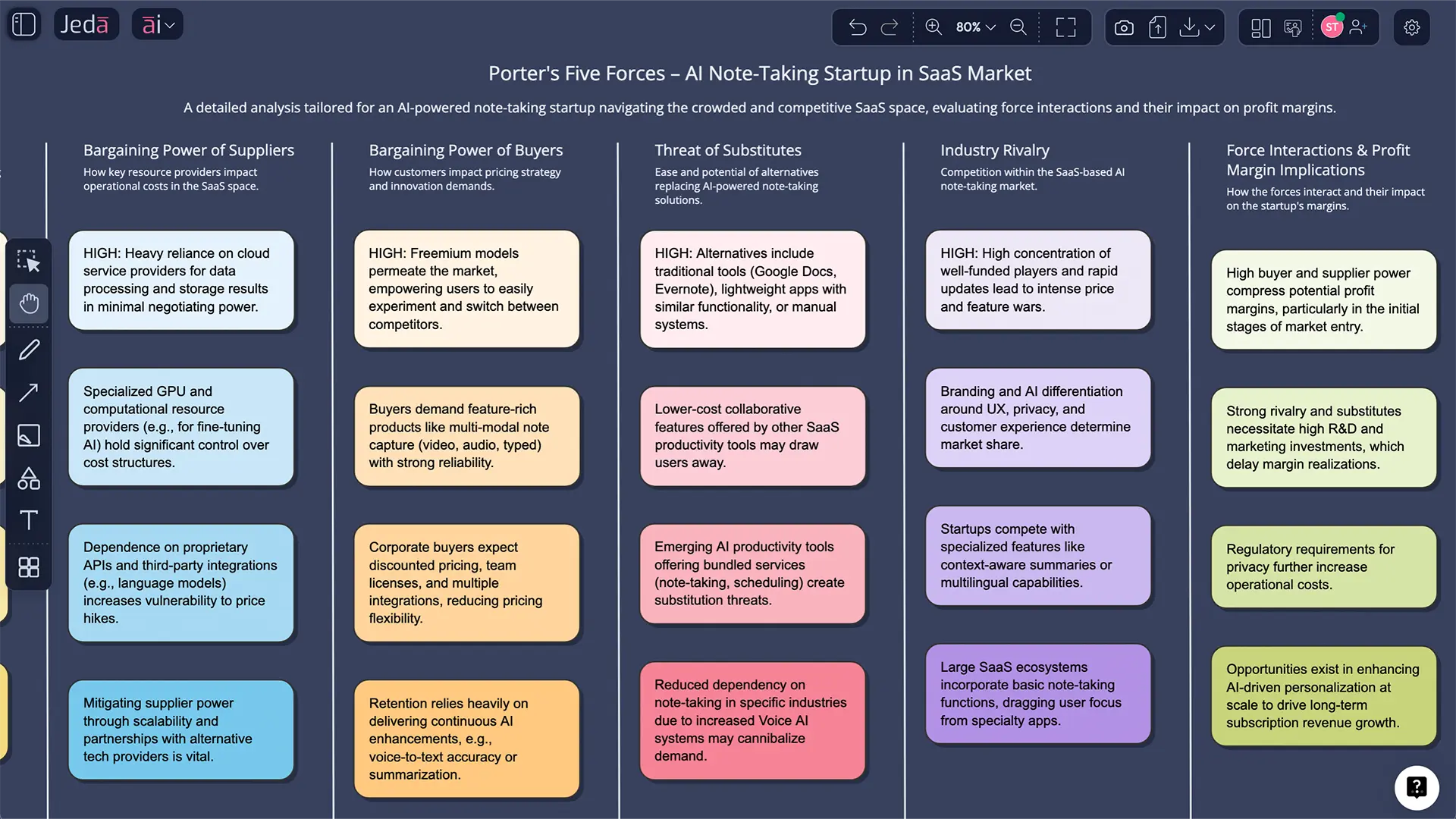
A good Porter board doesn’t just name the forces. It shows what they mean for one real decision. Let’s use a hypothetical example: a mid-market EV charging software company considering expansion into the UK.
A fast first-pass Porter board for that company could look like this:
- Threat of new entrants: moderate. Software entry is easier than hardware entry, but partnerships, compliance, and utility integration slow real scale.
- Supplier power: moderate to high. Platform dependencies, mapping data, charging hardware integrations, and energy-data providers can pinch margins.
- Buyer power: high. Enterprise buyers often run formal procurement, compare multiple vendors, and pressure pricing.
- Threat of substitutes: moderate. In-house tools, broad fleet platforms, or bundled energy-management suites may replace a standalone product.
- Rivalry among existing competitors: high. The market is crowded, category definitions overlap, and buyers can struggle to see meaningful differences.
Now the board gets interesting. Use AI+ to deepen buyer power. Then switch to a Value Chain view and ask where the company creates unique value: onboarding, interoperability, reporting, uptime analytics, or utility workflows. After that, use a Generic Strategies matrix to test whether the business should compete on price, differentiate on reliability, or focus on a narrower fleet segment.
Best practices and tips
Use Porter to drive a decision, not to decorate a workshop. The framework works best when you define the market tightly, force the team to explain why a force is strong or weak, and connect each force to a strategic move.
Be ruthless about time too. Forty-five focused minutes with real evidence beats two hours of generic statements every time.
Common mistakes to avoid
Most bad Porter analysis fails before the framework fails. The model gets blamed for problems the team created.
The first mistake is using Porter on a market definition that’s way too broad. If the market is fuzzy, the forces become vague and the recommendations become mush.
The second mistake is treating all five forces as equally important. They rarely are. In some industries, buyer power dominates. In others, substitutes or barriers to entry matter much more.
Third, teams often stop at description. They identify pressure, but they never translate that pressure into strategy. Porter is supposed to help you shape positioning and profitability, not just label competitive stress.
And finally, some teams use Five Forces when the real problem is internal. If the question is where the company gains or loses value, jump to the Value Chain. If the question is whether diversification creates value, use the Three Tests. Wrong tool, wrong answer. Brutal but true.
Frequently Asked Questions
- What does Porter's analysis usually mean?
- In most business searches and workshops, Porter’s analysis usually means Porter’s Five Forces analysis. But the broader Porter toolkit also includes the Value Chain, Generic Strategies, the Diamond Model, and the Three Tests for diversification.
- Is Porter's Five Forces the same as Porter's analysis?
- Not exactly. Five Forces is the most recognized Porter framework, so people often use the terms interchangeably. Strictly speaking, Porter’s analysis can refer to several related models created by Michael Porter for different strategic questions.
- When should I use Porter's Five Forces analysis?
- Use Porter’s Five Forces analysis when you need to understand industry attractiveness, profit pressure, and competitive intensity. It works best for market entry, category review, competitor pressure mapping, and board-level discussions about external market structure.
- When should I use Value Chain instead of Five Forces?
- Use Value Chain when the question is internal: where value is created, where cost accumulates, and where differentiation can actually happen. Five Forces looks outside the business; Value Chain helps you redesign what happens inside it.
- Can I create Porter's analysis in Jeda.ai for free?
- Yes. You can start on Jeda.ai with the Whitebelt plan, which includes all 11 commands with limited daily usage. Blackbelt expands usage limits, and Shifu adds advanced multi-LLM intelligence plus the Aggregator model.
- Which Jeda.ai command is best for Porter work?
- For Porter’s Five Forces, start with the Matrix command or the recipe-style matrix workflow. For Value Chain and Diamond Model views, Diagram is often a better fit. Mindmap works well when you want to branch the wider Porter toolkit visually.
- What should I include in a good Porter prompt?
- Include the industry, geography, buyer type, business model, and the decision you’re trying to make. A good prompt is specific enough that the output feels like strategy work, not a recycled business-school summary.
- Can AI replace strategic judgment in Porter analysis?
- No. AI can speed up structure, synthesis, and first drafts, but Porter analysis still depends on market definition, evidence quality, and managerial judgment. The best use of AI is faster framing and clearer collaboration, not blind automation.
- How do I extend a Porter board after it is generated?
- Select the relevant section of the board and use the AI+ button to extend it. AI+ is best for deeper explanation, continuation, and expansion of an existing visual, rather than highly specific brand-new instructions.
- What can I export after building Porter's analysis in Jeda.ai?
- You can export the finished board from Jeda.ai as PNG, SVG, or PDF. The board stays editable on canvas, which is the useful part, because strategy boards usually change after the first executive review.
Sources & Further Reading
- [1]
Porter, Michael E. (1979) . “How Competitive Forces Shape Strategy” Harvard Business Review.
View Source ↗ - [2]
Porter, Michael E. (1980) . “Competitive Strategy: Techniques for Analyzing Industries and Competitors” Free Press / Harvard Business School faculty listing.
View Source ↗ - [3]
Porter, Michael E. (1985) . “Competitive Advantage: Creating and Sustaining Superior Performance” Free Press / Harvard Business School faculty listing.
View Source ↗ - [4]
Porter, Michael E. (1987) . “From Competitive Advantage to Corporate Strategy” Harvard Business Review.
View Source ↗ - [5]
Porter, Michael E. (1990) . “The Competitive Advantage of Nations” Harvard Business Review.
View Source ↗ - [6]
Brandenburger, Adam M., and Barry J. Nalebuff (1995) . “The Right Game: Use Game Theory to Shape Strategy” Harvard Business Review.
View Source ↗ - [7]
Porter, Michael E. (2008) . “The Five Competitive Forces That Shape Strategy” Harvard Business Review.
View Source ↗
Start Your Porter's Analysis Today
Join over 150,000 professionals who use Jeda.ai to turn market pressure into editable, collaborative strategy boards inside one AI Workspace.
Try Free Template