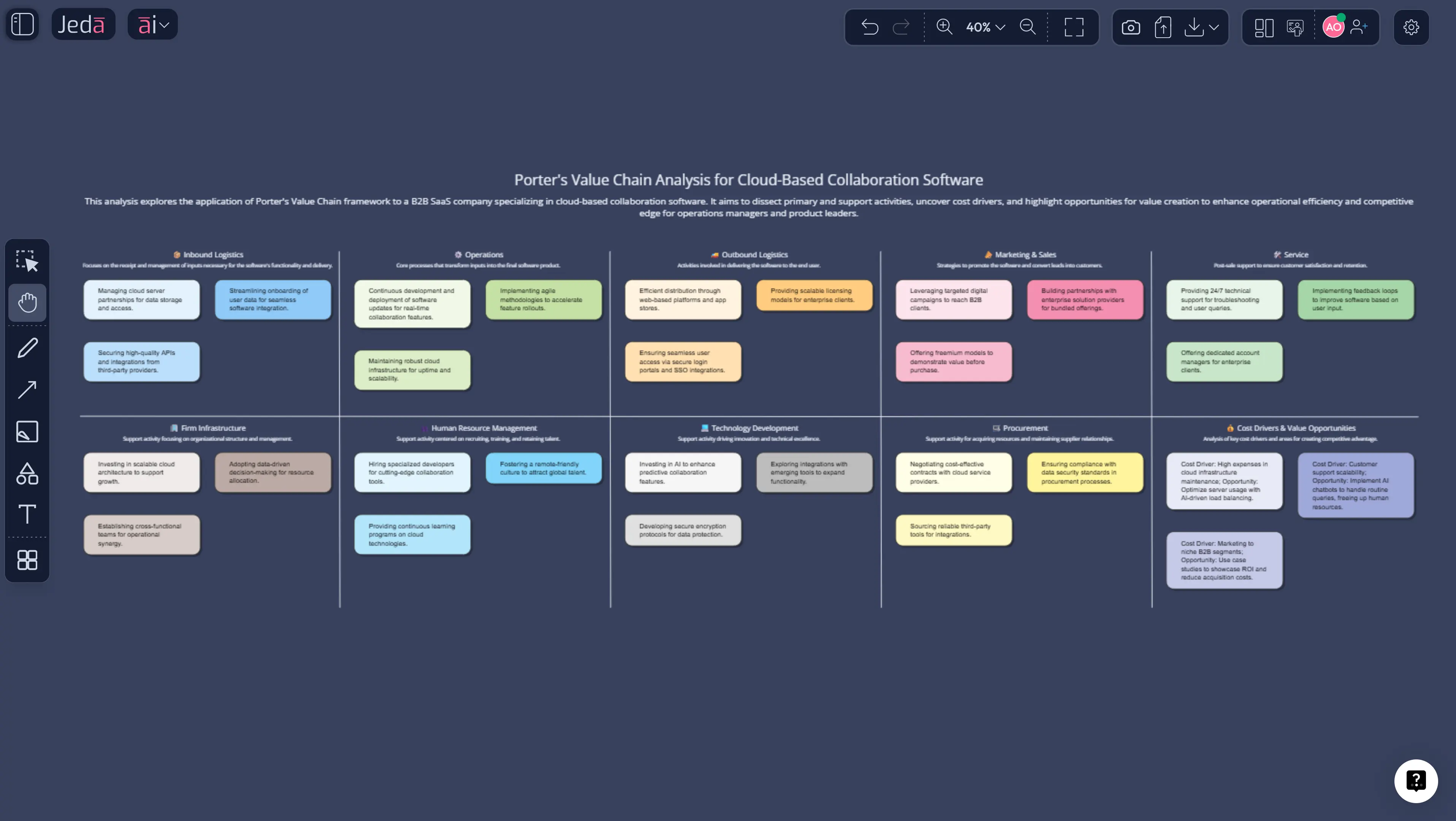
Most teams say “strategy” when they really mean intentions. Porter’s Value Chain with AI forces the conversation back to activities — the actual chain of work through which value is created, costs accumulate, and competitive advantage either gets built or quietly leaks away. Inside Jeda.ai, you can map that chain in one AI Workspace, connect primary and support activities on an editable AI Whiteboard, and move from vague ambition to operational clarity without leaving the board every five minutes.
That shift is bigger than it looks. Michael Porter’s value chain was powerful because it changed the unit of analysis. Not the company as a whole. Not the mission statement. The activities. In Jeda.ai, you can generate the initial structure with a Recipe Matrix, refine each activity with real evidence, extend weak spots using the AI+ button, and convert the result into a diagram, operating map, or roadmap when the discussion changes direction. With 150,000+ users, 300+ strategic frameworks, and a practical Visual AI workflow, Jeda.ai makes the value chain useful again for operators, consultants, and founders who do not have time for decorative theory.
This page also connects naturally to Jeda.ai’s AI Workspace, AI Whiteboard, Porter’s Generic Strategies, and Porter’s Five Forces, because value chain choices are how strategy becomes real.
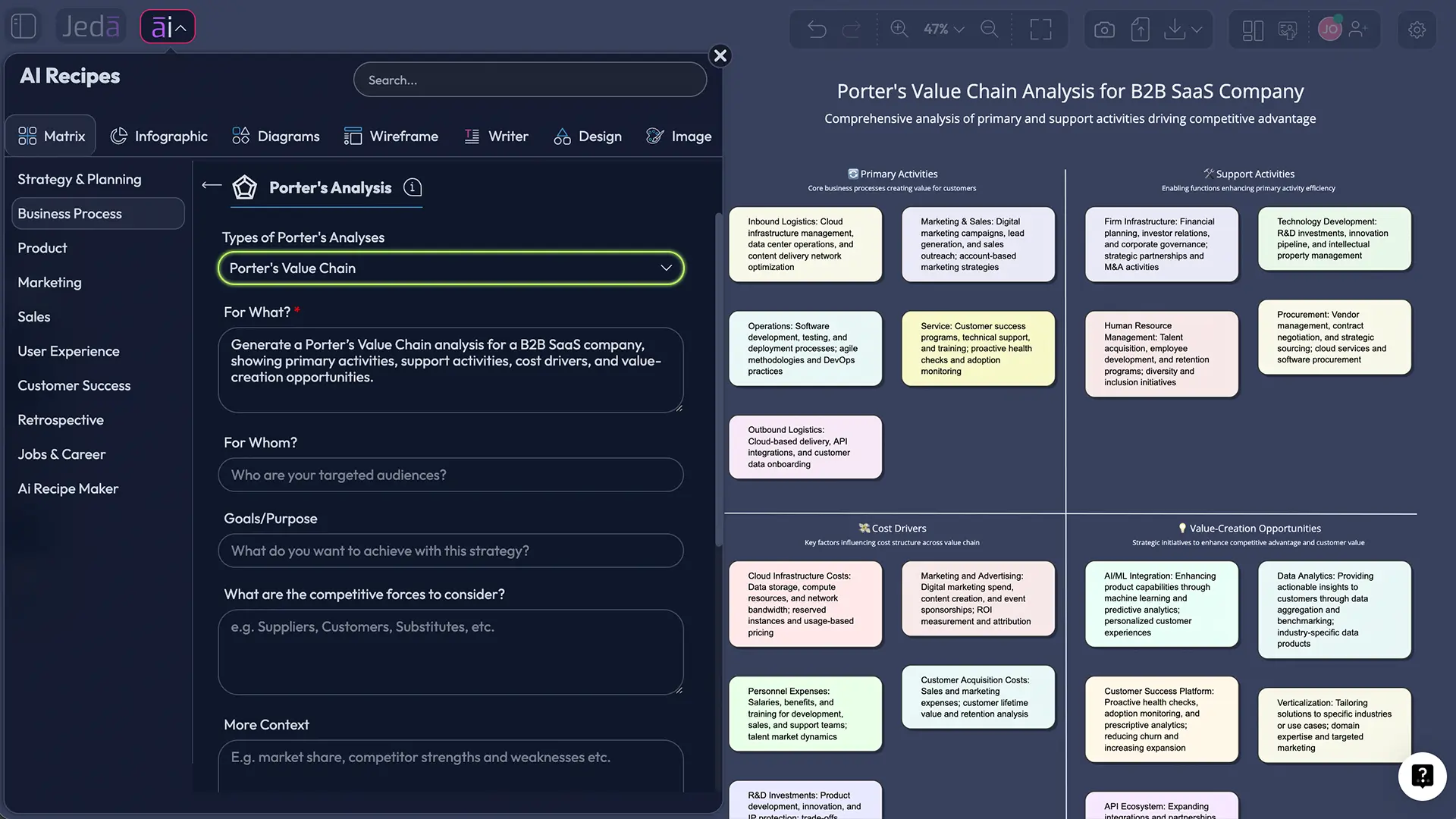
What is Porter's Value Chain?
Porter’s Value Chain is a framework for breaking a firm into strategically relevant activities so you can understand where value is created, where cost is incurred, and where advantage can be strengthened. Porter introduced the concept in Competitive Advantage in 1985. The core move was deceptively simple: instead of treating the firm as one big black box, analyze the set of activities involved in delivering value to customers.
Porter grouped those activities into two broad categories.
Primary activities
These are the activities directly involved in creating, delivering, marketing, selling, and supporting the offering.
- Inbound logistics
- Operations
- Outbound logistics
- Marketing and sales
- Service
Support activities
These activities do not usually deliver the product directly, but they shape the efficiency, quality, and distinctiveness of the whole chain.
- Firm infrastructure
- Human resource management
- Technology development
- Procurement
The usual mistake is to read this as a checklist. It is not a checklist. It is a way of asking which activities matter most, how they connect, and where advantage actually comes from.
For a manufacturer, operations and procurement may dominate. For a SaaS firm, technology development, onboarding, service, and ecosystem integration may be more decisive than “outbound logistics” in the traditional sense. The power of the framework comes from adapting the activity logic without losing discipline.
Why use Porter's Value Chain with AI?
Because activity systems are messy.
They cut across departments, data, vendors, service levels, customer experience, margin decisions, and technical constraints. AI helps because it can draft the structure quickly, surface weak links, compare cost and value implications across activities, and keep everything editable while the team argues about what actually matters. Which they will. And they should.
- Activity-level clarity
Jeda.ai helps you map the business by activity instead of by department slogan, which is usually where real cost and value logic becomes visible.
- Better linkage analysis
The value chain becomes much more useful when you show how one activity affects another, such as product design affecting service cost or procurement affecting lead times.
- AI+ for weak-link expansion
Use AI+ after the first chain exists to deepen one activity, unpack cost drivers, or explore how a change in one node affects the rest of the chain.
- From matrix to system map
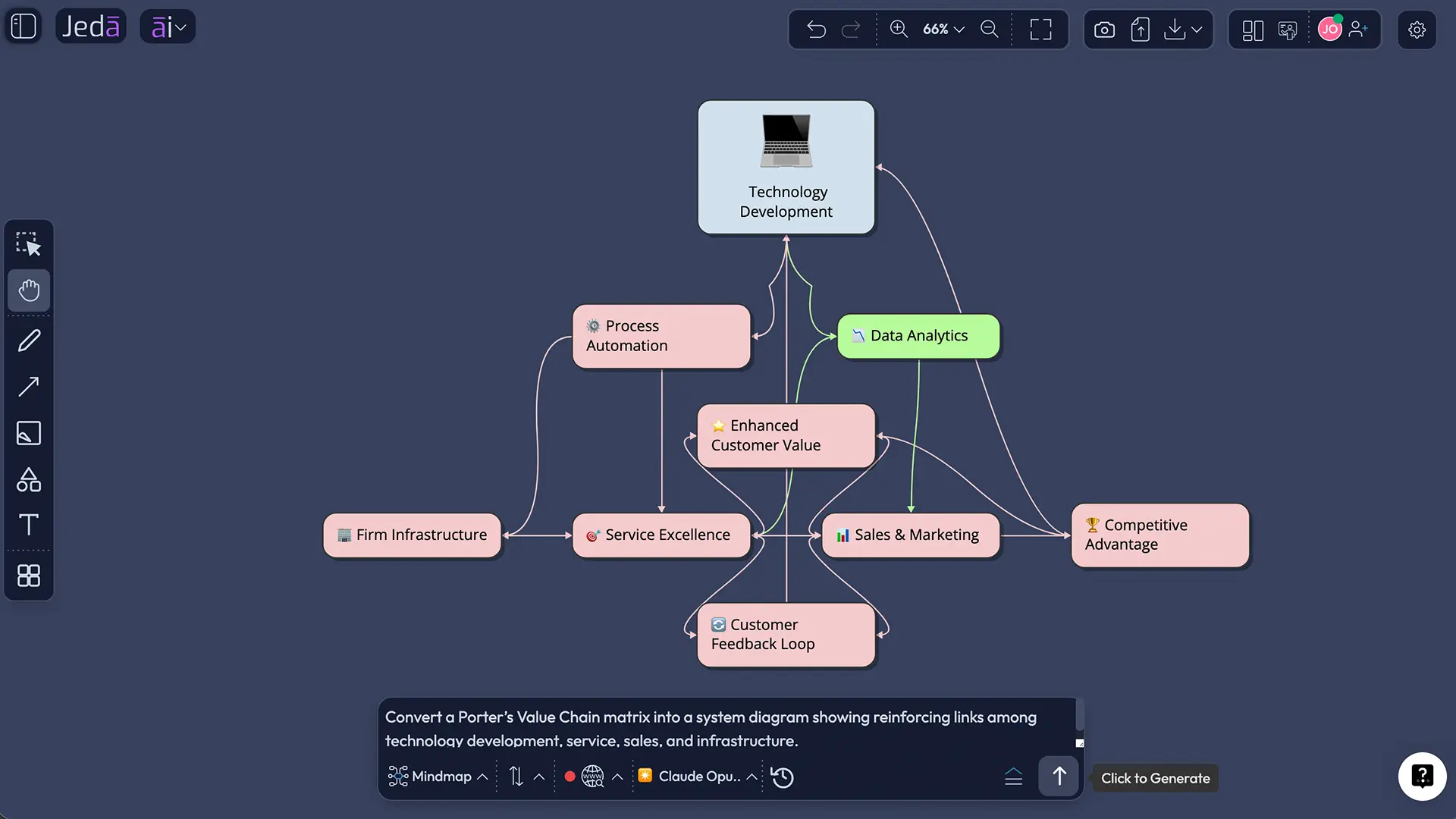
Start with Matrix for structure, then convert to Diagram or Mindmap when you want a richer view of dependencies, bottlenecks, or capability gaps.
- Cross-functional alignment
Operations, product, finance, procurement, and leadership can challenge the same board together inside the AI Whiteboard instead of defending departmental turf.
- Sharper strategic fit
The board makes it easier to connect activity design to cost leadership, differentiation, or focused positioning rather than treating strategy as a separate document.
There is another reason. The value chain is often misused as a glorified process map. That misses Porter’s point. A process map tells you what happens. A value chain asks where advantage comes from and whether the activity system reinforces the chosen position.
How to create Porter's Value Chain in Jeda.ai
Method 1: Recipe Matrix
Use the recipe-led matrix when you need a clean first draft and a workshop-friendly structure.
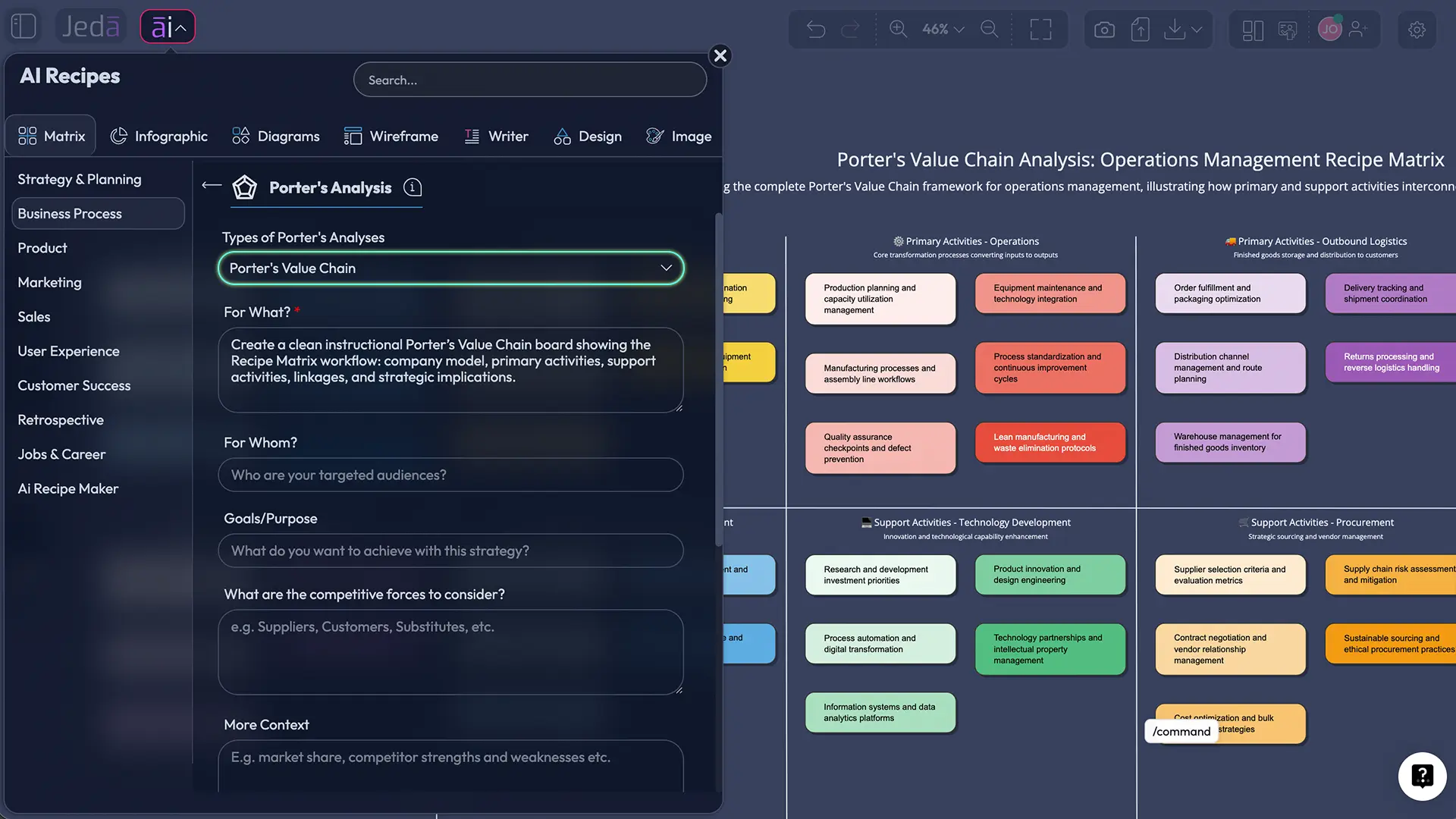
- Open the AI Menu and choose the Matrix recipe
From the canvas, open the AI Menu, go to Matrix Recipes, and select the Porter’s Value Chain recipe.
- Define the business model clearly
Specify the company type, offering, customer segment, geography, and what kind of advantage you are trying to understand: lower cost, stronger differentiation, or operational resilience.
- Generate the value chain structure
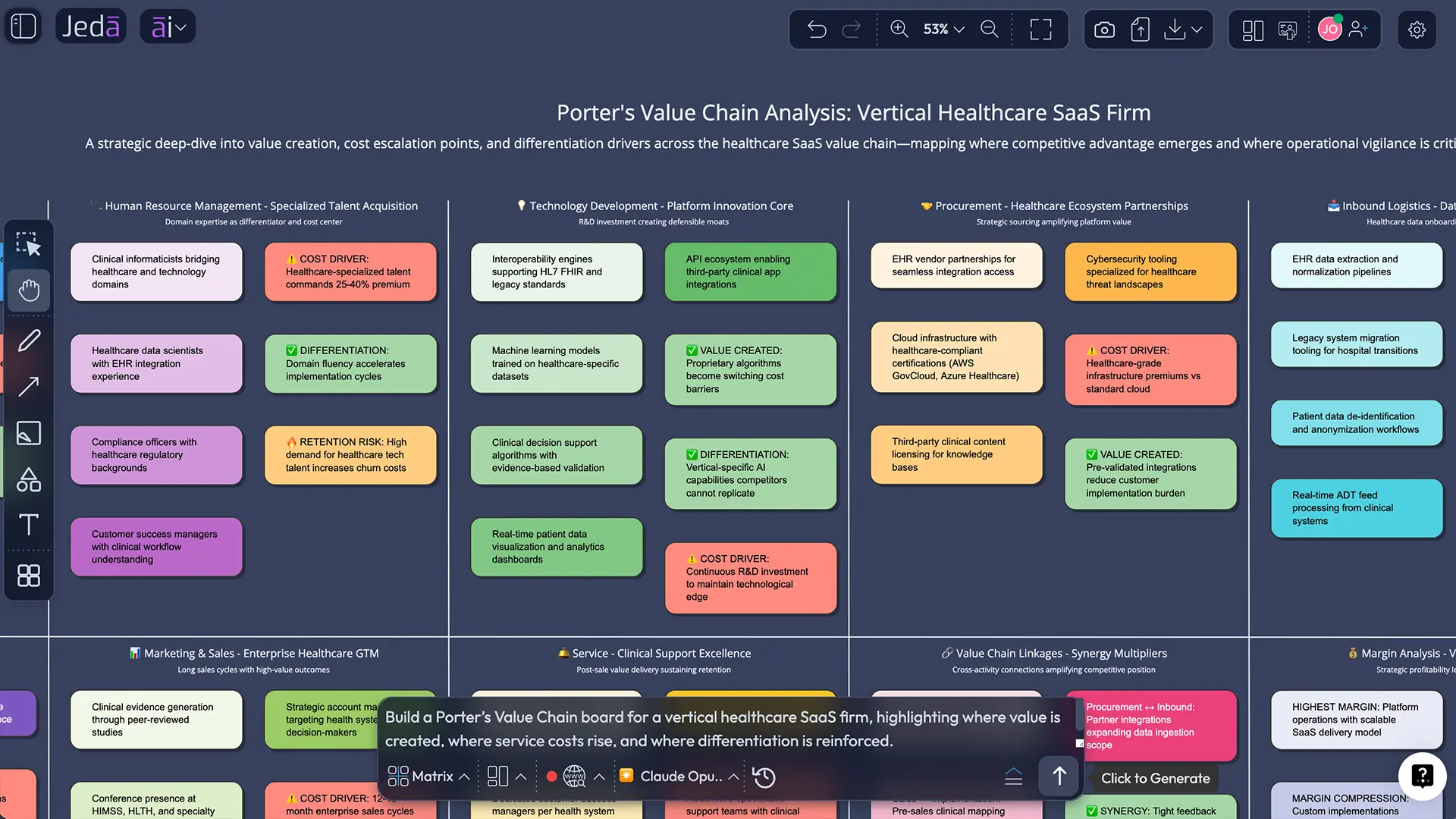
Ask Jeda.ai to organize the board into primary and support activities, with space for cost drivers, value drivers, bottlenecks, and activity interactions.
- Add activity-level evidence
Edit the board with actual operational details such as supplier complexity, onboarding friction, defect rates, service burden, product handoff delays, and margin pressure.
- Highlight reinforcing links
Mark how activity choices interact. Better product design may lower service cost. Better data infrastructure may improve both marketing efficiency and renewal quality.
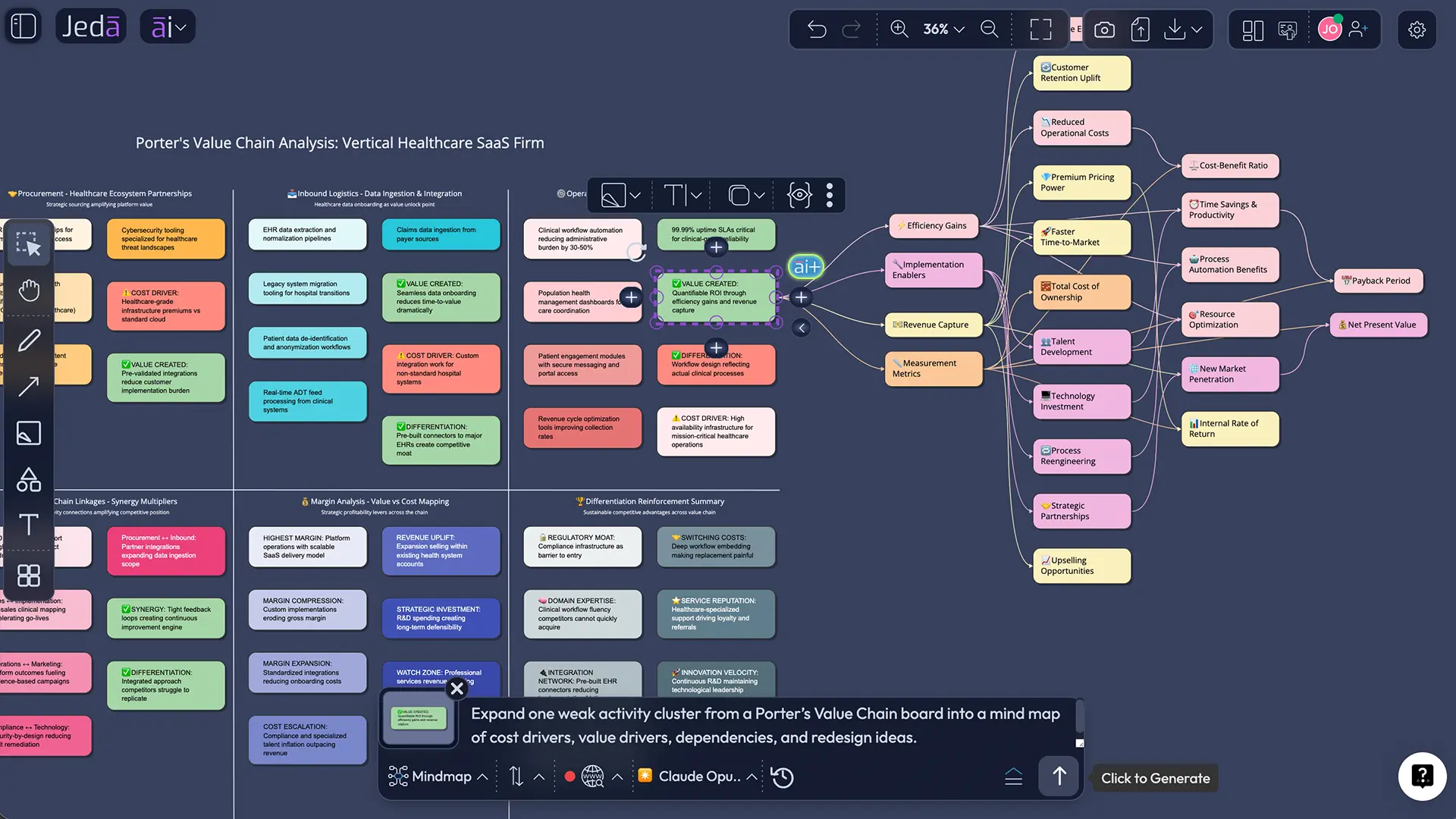
- Use AI+ to deepen one activity cluster
Once the board exists, select one activity or cluster and use AI+ to expand cost drivers, quality risks, differentiation opportunities, or redesign ideas. AI+ works best as a continuation, not as a blank new request.
Method 2: Prompt Bar
The Prompt Bar gives you more control when the business does not fit the classic textbook picture.
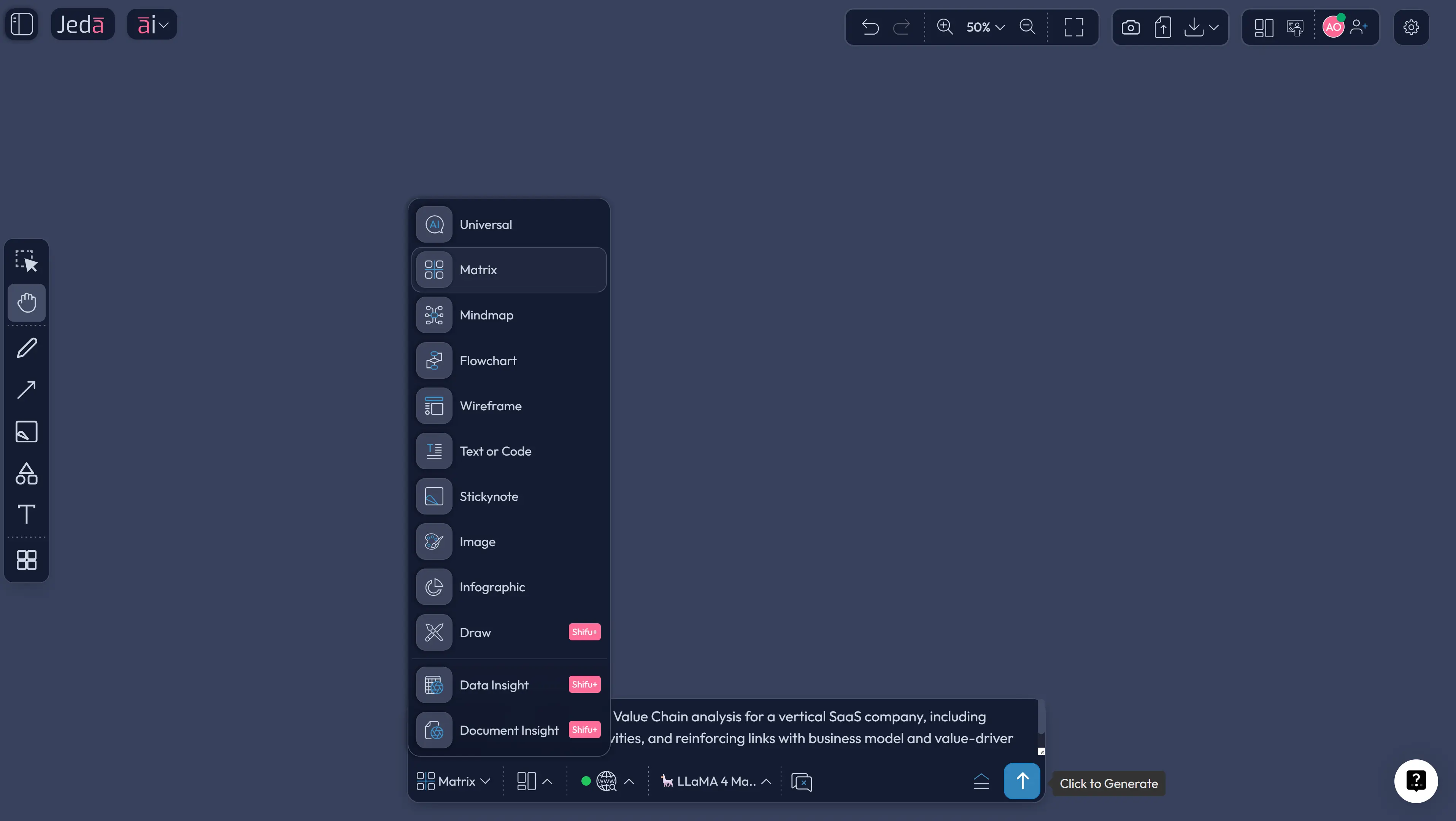
Open the Prompt Bar. Select the Matrix command. Then use a prompt like this:
Create a Porter’s Value Chain analysis for a B2B SaaS company selling workflow automation to finance teams. Organize the output into primary and support activities. For each activity, note major cost drivers, value drivers, bottlenecks, and opportunities to improve differentiation or margin.
Then challenge the output. Always.
If the board treats every activity as equally important, rewrite it. If it confuses process descriptions with strategic weight, rewrite it again. Then use AI+ on the weakest activity cluster to go deeper, or use Vision Transform to convert the board into a system map that shows linkages more clearly.
How the value chain creates real advantage
This is where the framework gets interesting. Not in the list of activities. In the fit among them.
Harvard’s strategy material makes the point bluntly: the activities, and the overall value chain in which activities are embedded, are the basic units of competitive advantage. That means advantage is rarely sitting inside one isolated activity. It usually comes from a pattern.
Take a vertical B2B SaaS firm serving healthcare providers.
- Its technology development may create compliance-specific workflows that generic tools cannot match.
- Its service model may reduce onboarding friction for nontechnical staff.
- Its marketing and sales function may rely on domain trust rather than mass lead generation.
- Its firm infrastructure may include audit readiness and security governance that directly support premium pricing.
Now the key question: which of those activities matter alone, and which matter because they reinforce each other?
If security governance supports trust, trust supports enterprise selling, enterprise selling supports retention, and retention supports sustainable service investment, then the chain has reinforcing fit. That is much harder to copy than a single product feature.
This is why Porter’s Value Chain still has bite. It forces the strategist to stop asking, “What is our strength?” and start asking, “Which linked set of activities produces the value customers notice and the economics competitors struggle to imitate?”
And there is one more modern twist worth noting. Later research, especially Stabell and Fjeldstad’s work, argued that pure “value chain” logic does not fit every kind of firm equally well. Problem-solving organizations may resemble a value shop more than a chain. Platforms may resemble a value network. That does not make Porter obsolete. It means the value chain is strongest when you use it thoughtfully rather than mechanically.
Best practices and tips
The best value chain work is concrete and slightly uncomfortable. It forces teams to admit which activities are bloated, generic, slow, or misaligned with the chosen strategy.
A second best practice is to time-stamp the board. Activity economics change. The chain that made sense 18 months ago may now be dragging the company backward.
Common mistakes to avoid
The first mistake is treating the value chain like a process flow. A process flow shows sequence. A value chain asks where advantage and cost sit.
Second, teams describe activities at wildly inconsistent levels. One box says “operations,” another says “vendor onboarding ticket routing.” That mismatch ruins the analysis.
Third, they ignore support activities because they look indirect. In many firms, support activities are where real differentiation hides.
Fourth, they assume efficiency automatically equals strategy. Porter was clear on this point later: operational effectiveness is not the same thing as strategic positioning.
And finally, they never connect the chain to a competitive choice. If the value chain is not linked to how the firm competes, it becomes very organized trivia.
Frequently Asked Questions
- What is Porter’s Value Chain used for?
- Porter’s Value Chain is used to analyze a company’s activities in order to understand where value is created, where costs are incurred, and where competitive advantage can be improved or defended.
- Who created the value chain framework?
- Michael E. Porter introduced the value chain in his 1985 book Competitive Advantage as a way to break firms into strategically relevant activities rather than treating the firm as one undifferentiated whole.
- What are the primary activities in Porter’s Value Chain?
- The classic primary activities are inbound logistics, operations, outbound logistics, marketing and sales, and service. They can be adapted thoughtfully depending on the firm’s business model.
- What are the support activities in Porter’s Value Chain?
- The support activities are firm infrastructure, human resource management, technology development, and procurement. These activities often shape cost, speed, quality, and differentiation more than teams initially expect.
- What is the difference between a value chain and a process map?
- A process map shows what happens and in what order. A value chain asks which activities create value, which activities drive cost, and how the configuration of activities produces or weakens competitive advantage.
- How does AI help with value chain analysis?
- AI helps teams draft the activity structure quickly, compare cost and value drivers across the chain, extend weak spots using AI+, and keep the board editable in Jeda.ai as the analysis evolves.
- Which Jeda.ai command fits the value chain best?
- Start with the Matrix command or a Matrix recipe to organize primary and support activities clearly. Then use Diagram if you want to emphasize linkages, dependencies, or reinforcing fit.
- Can AI+ create a whole value chain from scratch?
- AI+ is best used after the first visual exists. Create the initial value chain first, then select one activity cluster and use the AI+ button to deepen, extend, or continue that part of the analysis.
- Does Porter’s Value Chain fit service and digital businesses?
- Yes, but it often needs adaptation. Many digital or knowledge-intensive firms require you to reinterpret the activity labels and pay more attention to linkages, support activities, and newer value-configuration ideas.
- What framework should I use after a value chain analysis?
- Often the next step is a positioning decision, a generic-strategies comparison, a capability roadmap, or a redesign workshop focused on the highest-impact activity links identified in the board.
Sources & Further Reading
- [1]
Porter, Michael E. (1985) . “Competitive Advantage: Creating and Sustaining Superior Performance” Free Press / Harvard Business School.
View Source ↗ - [2]
Institute for Strategy and Competitiveness (n.d.) . “The Value Chain” Harvard Business School.
View Source ↗ - [3]
Porter, Michael E. (1996) . “What Is Strategy?” Harvard Business Review.
View Source ↗ - [4]
Hergert, Michael, and Deigan Morris (1989) . “Accounting Data for Value Chain Analysis” Strategic Management Journal.
View Source ↗ - [5]
Stabell, Charles B., and Øystein D. Fjeldstad (1998) . “Configuring Value for Competitive Advantage” Strategic Management Journal.
View Source ↗
Start Your Porter's Value Chain Analysis Today
Join 150,000+ users who use Jeda.ai to map activities, expose weak links, and turn strategy into an editable operating picture inside one AI Workspace.
Try Free Template