Product Market Fit with AI: A Rigorous Way to Test Demand Before You Scale
Product Market Fit with AI is not about making a prettier startup board. It is about reducing the odds that your team builds for a market that does not care. In academic terms, product-market fit is the alignment between a product’s value proposition and a market segment that actually pulls it. In practical terms, customers keep using it, keep paying for it, and would miss it if it disappeared. Jeda.ai gives teams a structured AI Workspace and AI Whiteboard to run that assessment visually, collaboratively, and fast — without turning the process into guesswork.
What is Product Market Fit?
Product-market fit describes the point at which a product satisfies a real market need strongly enough that demand starts to pull the product forward. Marc Andreessen’s well-known definition still holds up: product-market fit means being in a good market with a product that can satisfy that market. The implication is blunt. A strong product in a weak market still loses. A decent product in a market with urgent demand often learns its way into growth.
That idea later became central to customer discovery and lean startup practice. Steve Blank’s customer development logic treats early product work as a search process, not a shipping contest. More recent management research makes the same point in cleaner language: experimentation, validation, and business-model learning are not side quests. They are the work required to reach a scalable match between offer and demand.
In Jeda.ai, that logic becomes visual. You can assess product-market fit in one AI Workspace, pressure-test assumptions on an AI Whiteboard, and keep the evidence, objections, and next experiments in one place. Jeda.ai also gives you access to 300+ strategic frameworks, which matters because product-market fit almost never stands alone — it sits beside segmentation, positioning, Jobs To Be Done, pricing, and competitive choice.
Why use AI for Product Market Fit analysis?
Because PMF work usually breaks in predictable ways.
Teams overvalue enthusiastic anecdotes. They confuse usage spikes with durable retention. They fall in love with a broad market when the real pull is coming from one narrow segment. And then they scale too early.
AI helps because it can force structure where teams prefer intuition. With Jeda.ai, you can map segments, pains, alternatives, and evidence into a matrix instead of burying them in meeting notes. You can compare what users say, what they do, and what they pay for. And you can turn a fuzzy debate into an explicit decision trail.
- Structured PMF thinking
Turn customer, market, and product assumptions into a matrix that exposes weak logic fast.
- Shared interpretation
Product, research, sales, and founders can work in the same visual board instead of arguing across separate docs.
- Evidence-in workflow
Bring in interview notes, PDFs, screenshots, and spreadsheets through Jeda.ai’s visual workflow when your fit analysis needs real context.
- Iterate without chaos
Use the AI+ button to extend weak sections, generate follow-up questions, or deepen the most promising segment.
- Signal over vanity
Separate retention, willingness-to-pay, and must-have pull from noisy top-of-funnel metrics that flatter weak products.
- Convert and reuse
Start with a matrix, then use Vision Transform to convert the output into a flowchart, diagram, or roadmap for action.
The Product Market Fit matrix: what the recipe should capture
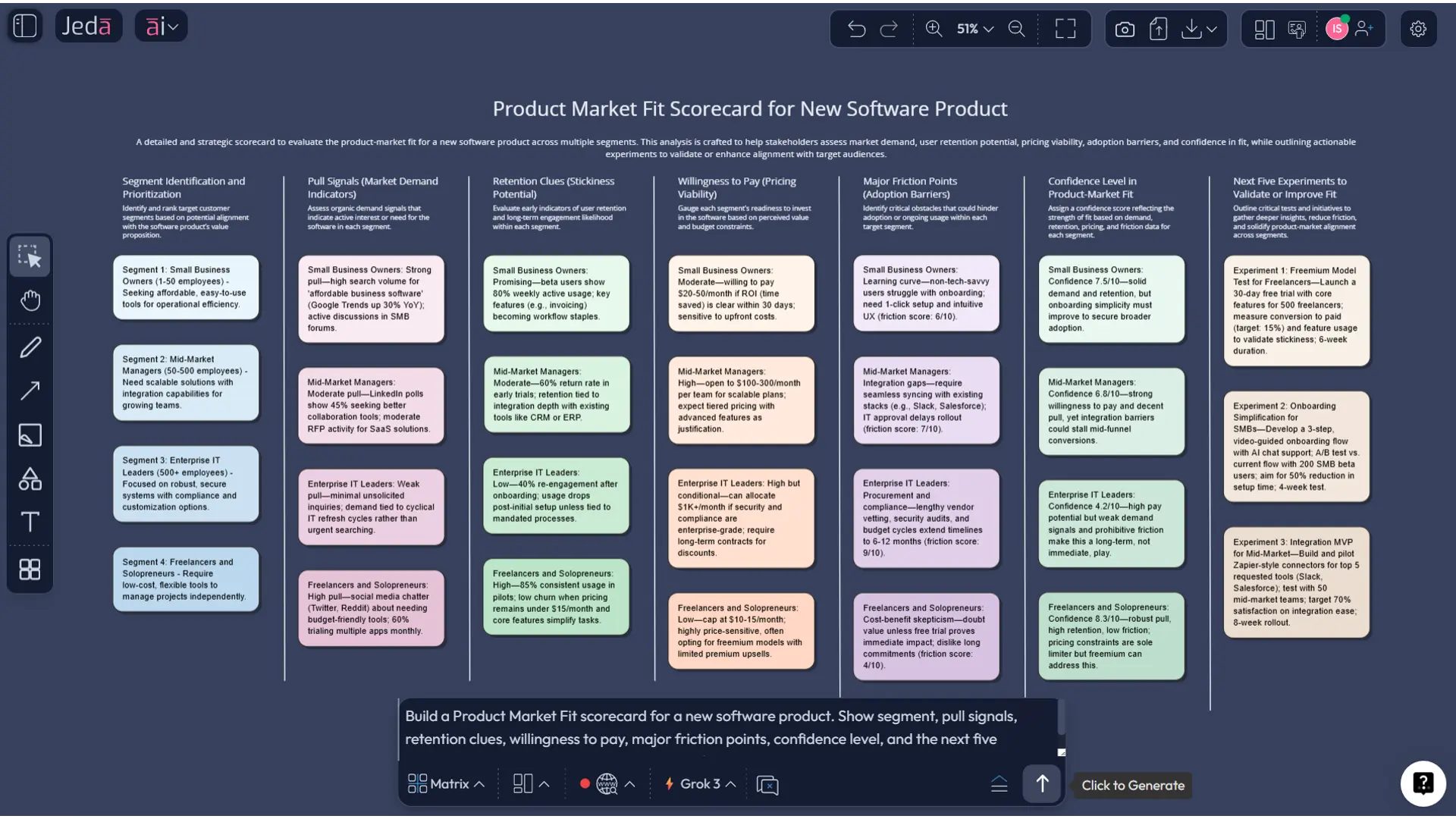
A useful PMF assessment is not a slogan like “users love it.” It needs at least seven fields:
That last point matters more than most teams admit. Product-market fit is rarely binary. There is usually one segment with strong pull, one with shallow interest, and one that looked attractive in slides but refuses to convert in real life.
How to create Product Market Fit with AI in Jeda.ai
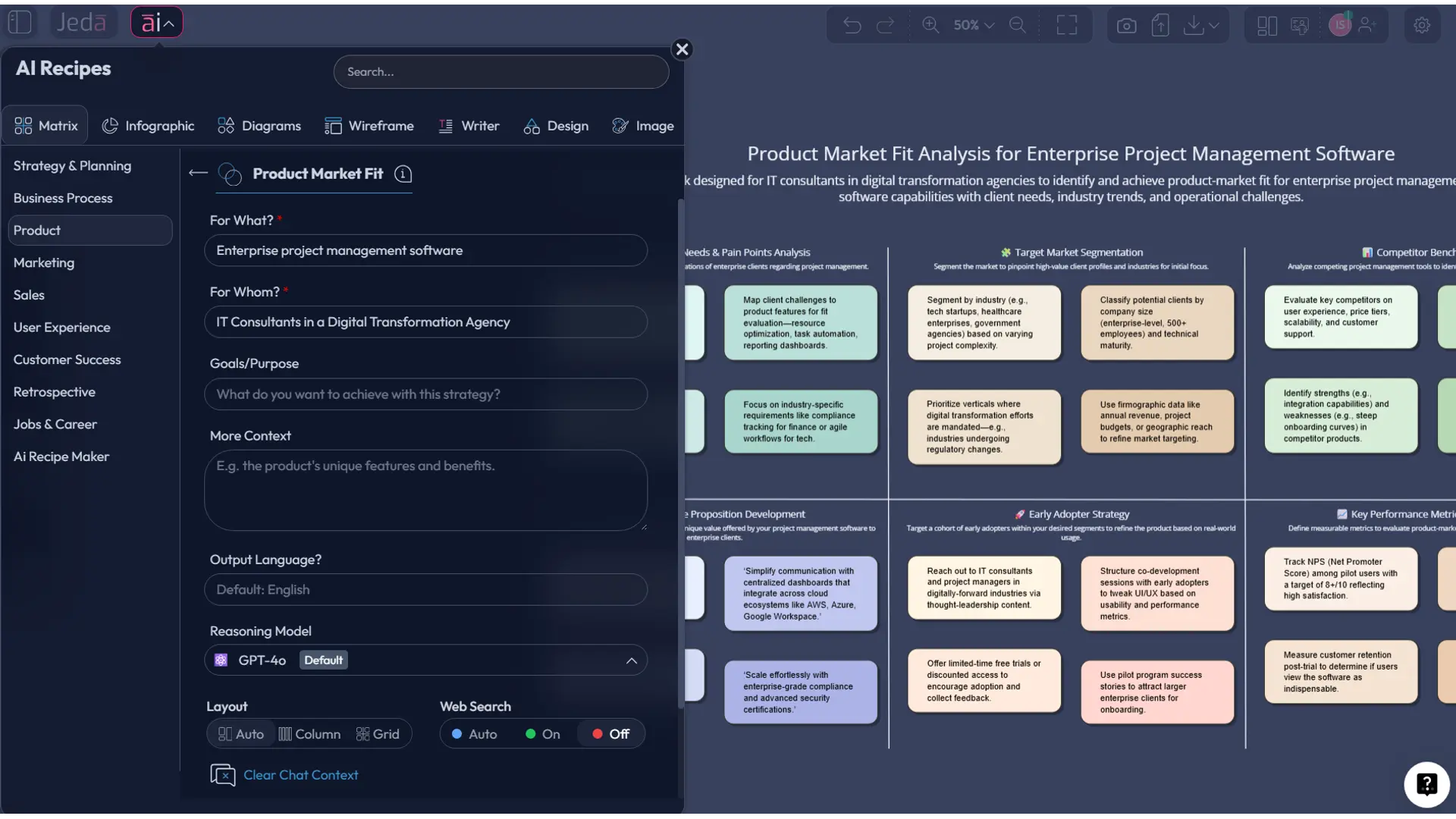
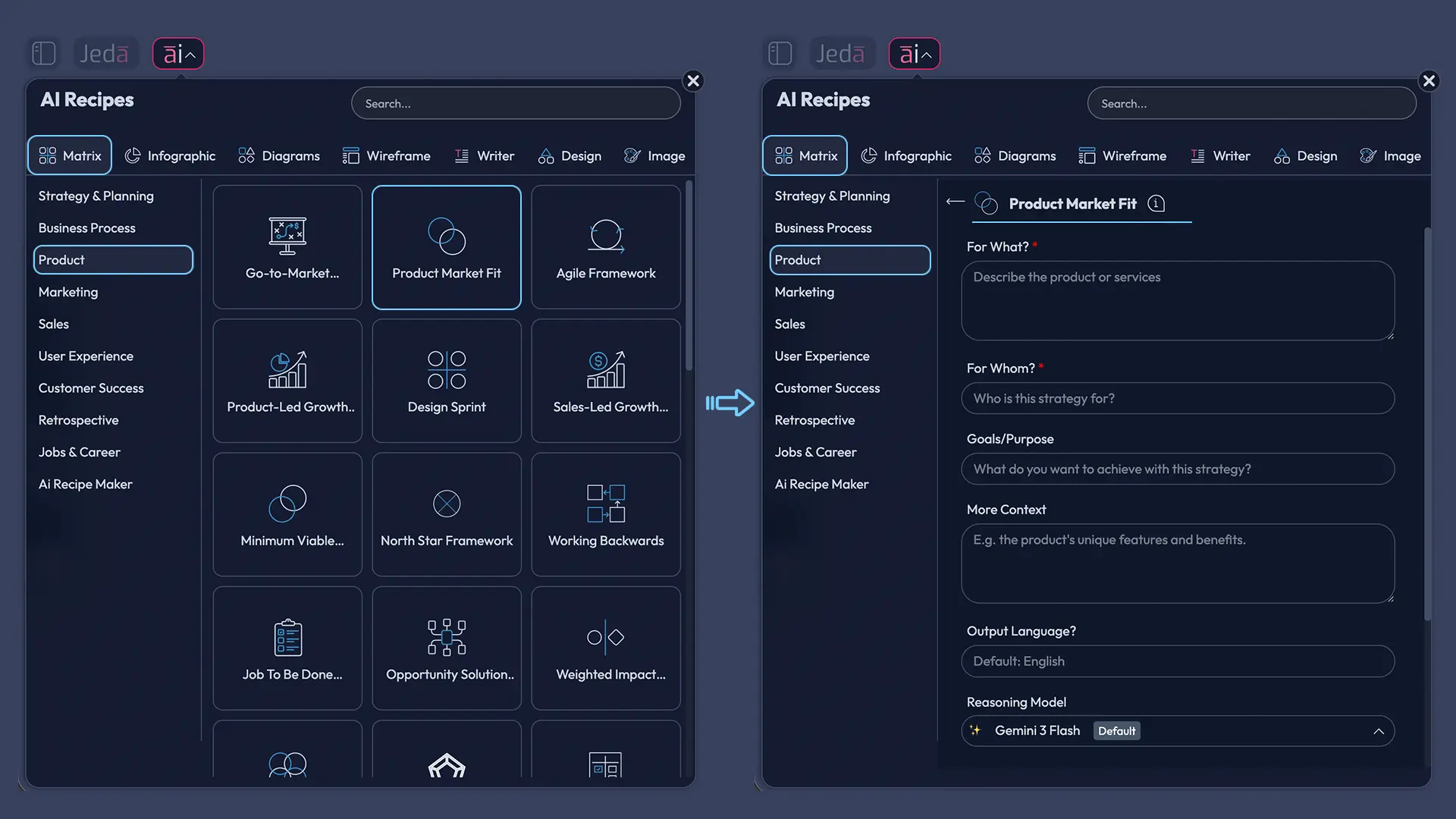
Jeda.ai has a dedicated Product Market Fit matrix recipe in the AI Menu, with guided inputs for For What?, For Whom?, Goals/Purpose, More Context, and Output Language. That makes the recipe method the cleanest starting point for teams that want consistency.
Method 1: Recipe Matrix
- Open the AI Menu
In Jeda.ai, open the AI Menu from the top-left corner and go to Matrix Recipes under the Product category.
- Choose the Product Market Fit recipe
Select the Product Market Fit recipe so the matrix structure is preconfigured for product, segment, goals, and supporting context.
- Fill the guided fields
Enter what the product is, who it is for, what success should look like, and any relevant market, pricing, workflow, or competitor context.
- Generate and inspect the matrix
Review the output for segment clarity, evidence of demand, alternative solutions, friction points, and whether the board reflects real market pull rather than optimism.
- Extend and convert the result
Use the AI+ button to deepen weak areas, then use Vision Transform if you want to turn the matrix into a flowchart, diagram, or action plan.
Method 2: Prompt Bar
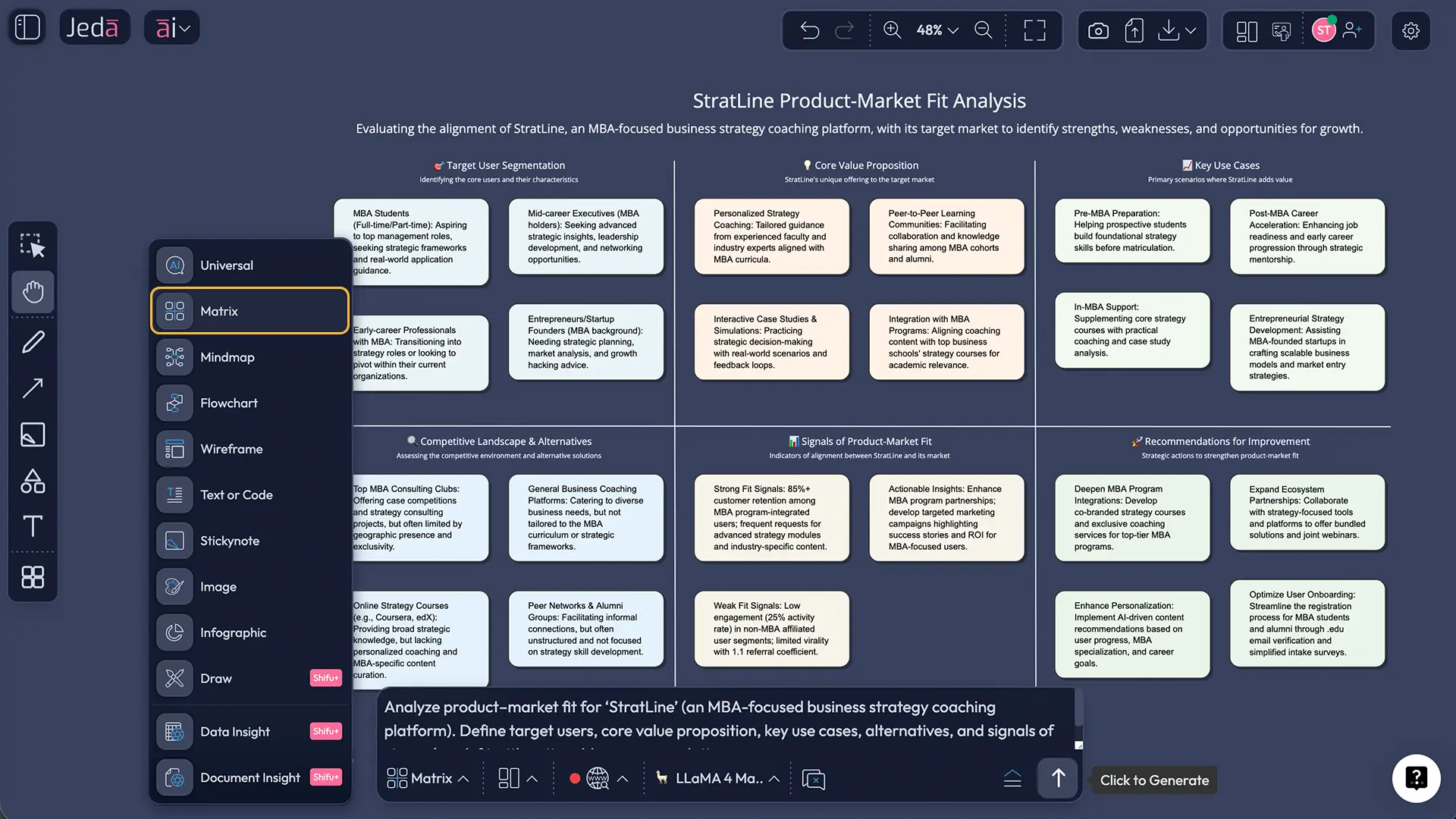
The Prompt Bar is better when you already know the segment and want tighter control over the framing.
Copy-paste prompt for Prompt Bar → Matrix
Prompt:
Create a Product Market Fit matrix for [product name].
Primary target segment: [segment].
Core job to be done: [job or pain].
Current alternatives: [competitors, substitutes, or manual workarounds].
Success definition: [retention, conversion, revenue, survey threshold, adoption milestone].
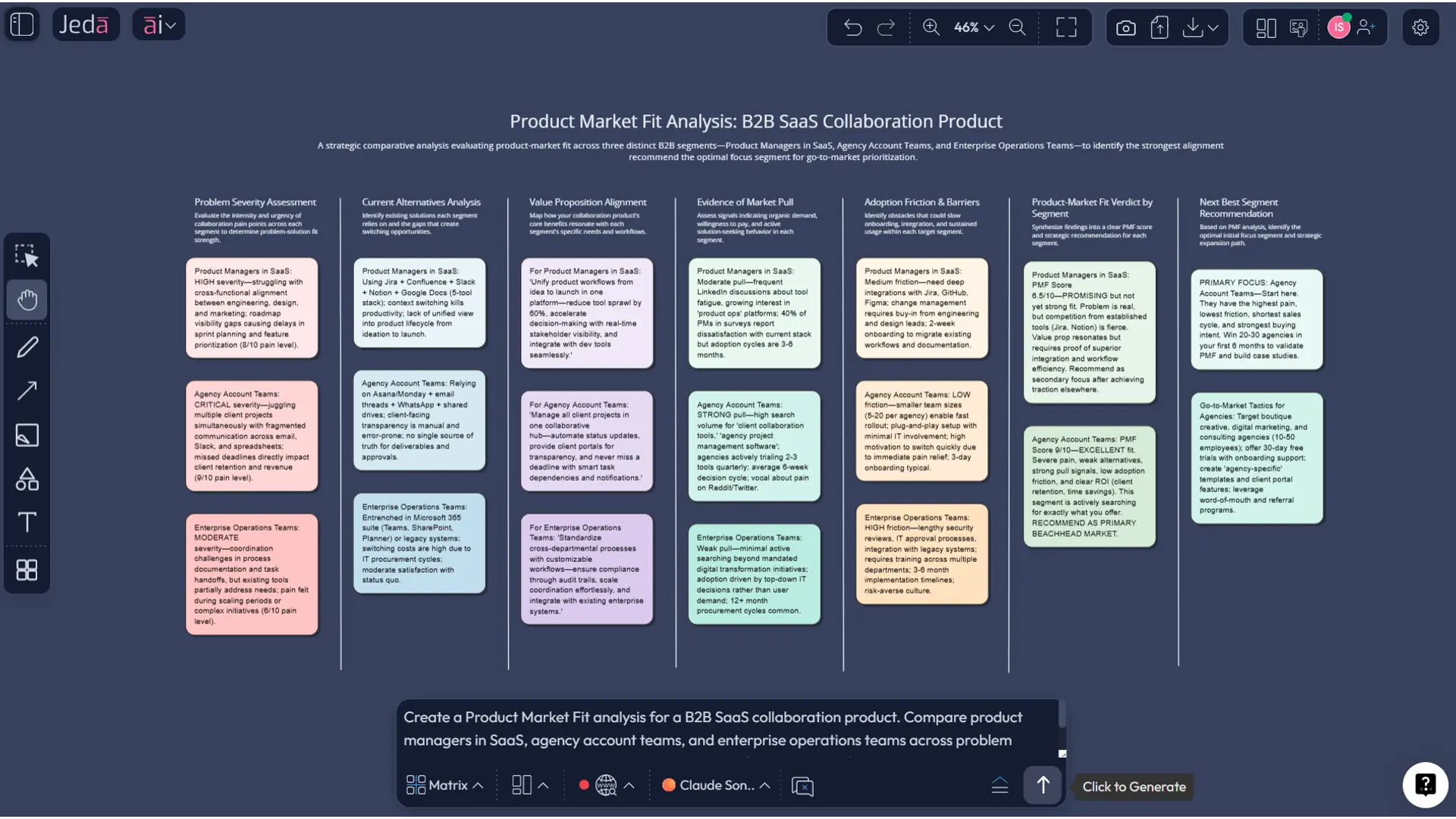
Include columns for Target Segment, Problem Severity, Current Alternatives, Value Proposition, Evidence of Pull, Adoption Friction, and PMF Verdict.
Keep the output specific, evidence-led, and decision-ready. End with 5 next experiments.
How to measure Product Market Fit without fooling yourself
This is where teams usually get slippery.
One of the most popular PMF heuristics is Sean Ellis’s survey question: how would users feel if they could no longer use the product? When at least 40% of surveyed users answer “very disappointed,” it is often treated as a strong signal of product-market fit. That benchmark is useful — but only as one signal. Even Ellis-style survey work can produce false confidence if the segment is too broad, the sample is wrong, or usage is still shallow.
So the better approach is triangulation.
Use three classes of evidence
1. Behavioral evidence
Do users come back? Do they complete the core workflow? Does retention hold after novelty fades?
2. Economic evidence
Will users pay, renew, expand, or defend budget for the product? Interest is cheap. Budget is less sentimental.
3. Attitudinal evidence
Would users be very disappointed without it? Do they recommend it? Can they explain the value clearly in their own words?
A worked example: B2B SaaS collaboration product
Suppose the product is an AI-assisted meeting synthesis tool for distributed product teams.
The first instinct might be to target “all knowledge workers.” That is the classic PMF trap: a broad market statement with no buying urgency. Once you run the matrix, a narrower segment may show stronger pull — for example, product managers in mid-market SaaS firms who run cross-functional weekly planning and need fast decision summaries.
A serious PMF board would compare at least three candidate segments:
- Product managers in SaaS teams
- Agency account teams
- Internal operations teams at large firms
The board might reveal that product managers have the strongest problem intensity and shortest time-to-value, while enterprise operations teams show interest but face higher compliance and rollout friction. That is not a small insight. It changes roadmap, messaging, onboarding, and go-to-market.
What strong Product Market Fit usually looks like
Academic writing tends to describe PMF carefully. Operators describe it more viscerally.
Customers adopt the product without heroic persuasion. Usage repeats. Referrals show up unprompted. Retention cohorts stop collapsing. Pricing conversations become easier because the product is solving an expensive problem. And the team starts hearing sharper language from customers — not “interesting,” but “we need this.”
Andreessen described the contrast memorably: when PMF is absent, usage feels flat, deals drag, and customers do not quite get value. When PMF is present, the market starts pulling the product. That is still one of the cleanest ways to frame the phenomenon.
Common mistakes to avoid
1. Measuring too early
A tiny sample of enthusiastic early users can flatter a weak product. Early signal matters, but it should be segmented and interpreted with restraint.
2. Mixing segments
A blended average across very different customers hides where the real pull is. PMF is often segment-specific before it becomes category-wide.
3. Treating the 40% survey as a verdict
The Sean Ellis test is a heuristic, not divine law. Pair it with retention, conversion, renewal, and willingness-to-pay evidence.
4. Scaling before fit is stable
Many teams try to solve a PMF problem with distribution spend. That usually buys noise, not learning.
5. Ignoring alternatives
The real competition is often not a named rival. It is the spreadsheet, the consultant, the assistant, or the ugly workflow users already tolerate.
Frequently asked questions
- What is Product Market Fit with AI?
- Product Market Fit with AI is the use of AI-assisted structure to evaluate whether a product meaningfully satisfies demand in a target market. In practice, AI helps teams organize segments, pains, alternatives, evidence of pull, and next experiments into a decision-ready board instead of scattered notes.
- Is Product Market Fit the same as problem-solution fit?
- No. Problem-solution fit asks whether the product appears to solve a real problem for a plausible user. Product-market fit asks whether that solution is strong enough, repeatable enough, and valued enough by a real segment to support sustained adoption and growth.
- Can a company have product-market fit in one segment but not another?
- Yes. That is common. A product may show strong pull in one narrow segment while underperforming in adjacent segments. Good PMF analysis should therefore separate customers by segment rather than collapse all demand into one average score.
- How should we use the Sean Ellis 40% test?
- Use it as one meaningful signal, not a final ruling. If at least 40% of surveyed users say they would be very disappointed without the product, that can indicate strong pull. But you still need supporting evidence from retention, usage depth, and willingness to pay.
- What metrics matter most when assessing PMF?
- Retention is usually the hardest evidence to fake, because it reflects repeated value. After that, teams should examine conversion, activation, renewal, referrals, willingness to pay, and the clarity with which customers describe the product’s core value in their own words.
- Why use a matrix for Product Market Fit analysis?
- A matrix forces explicit comparison. It helps teams line up segments, pains, alternatives, and pull signals side by side. That reduces the risk that one loud anecdote or one charismatic internal opinion dominates a strategically important decision.
- How does Jeda.ai help with Product Market Fit work?
- Jeda.ai gives teams a visual AI Workspace where they can run the Product Market Fit recipe, organize evidence on an AI Whiteboard, extend weak sections with the AI+ button, and convert outputs into other visual forms when the team needs a roadmap, diagram, or decision flow.
- Should we scale growth before we are confident about PMF?
- Usually no. Premature scaling can hide weak fit behind paid acquisition, discounts, and founder-led heroics. A better sequence is to tighten the segment, improve activation and retention, confirm value, and then invest in broader acquisition with clearer economic logic.
- Can established companies use Product Market Fit analysis too?
- Yes. PMF is not only for startups. Mature companies use it when entering a new market, launching a new product line, repositioning an existing offer, or reassessing whether a once-strong fit has weakened because the market changed.
Sources and further reading
- [1]
Marc Andreessen / Andreessen Horowitz (2017) . “12 Things About Product-Market Fit” a16z.
View Source ↗ - [2]
Rahul Vohra (2018) . “How Superhuman Built an Engine to Find Product Market Fit” First Round Review.
View Source ↗ - [3]
Steve Blank (2014) . “Customer Discovery: The Search for Product/Market Fit” Steve Blank.
View Source ↗ - [4]
Christoph Zott, Raphael Amit, and Lorenzo Massa (2024) . “Business Models and Lean Startup” Academy of Management Annals.
View Source ↗ - [5]
Heather Myers and Zasima Razack (2022) . “Validating Product-Market Fit in the Real World” Harvard Business Review.
View Source ↗ - [6]
Stefano Sanasi et al. (2023) . “What happens after market validation? Experimentation for scaling in technology-based startups” Technological Forecasting and Social Change.
View Source ↗
Assess Product Market Fit in One Visual Workflow
Join over 150,000+ users using Jeda.ai’s AI Workspace to turn messy product questions into structured decisions.
Try Free Template