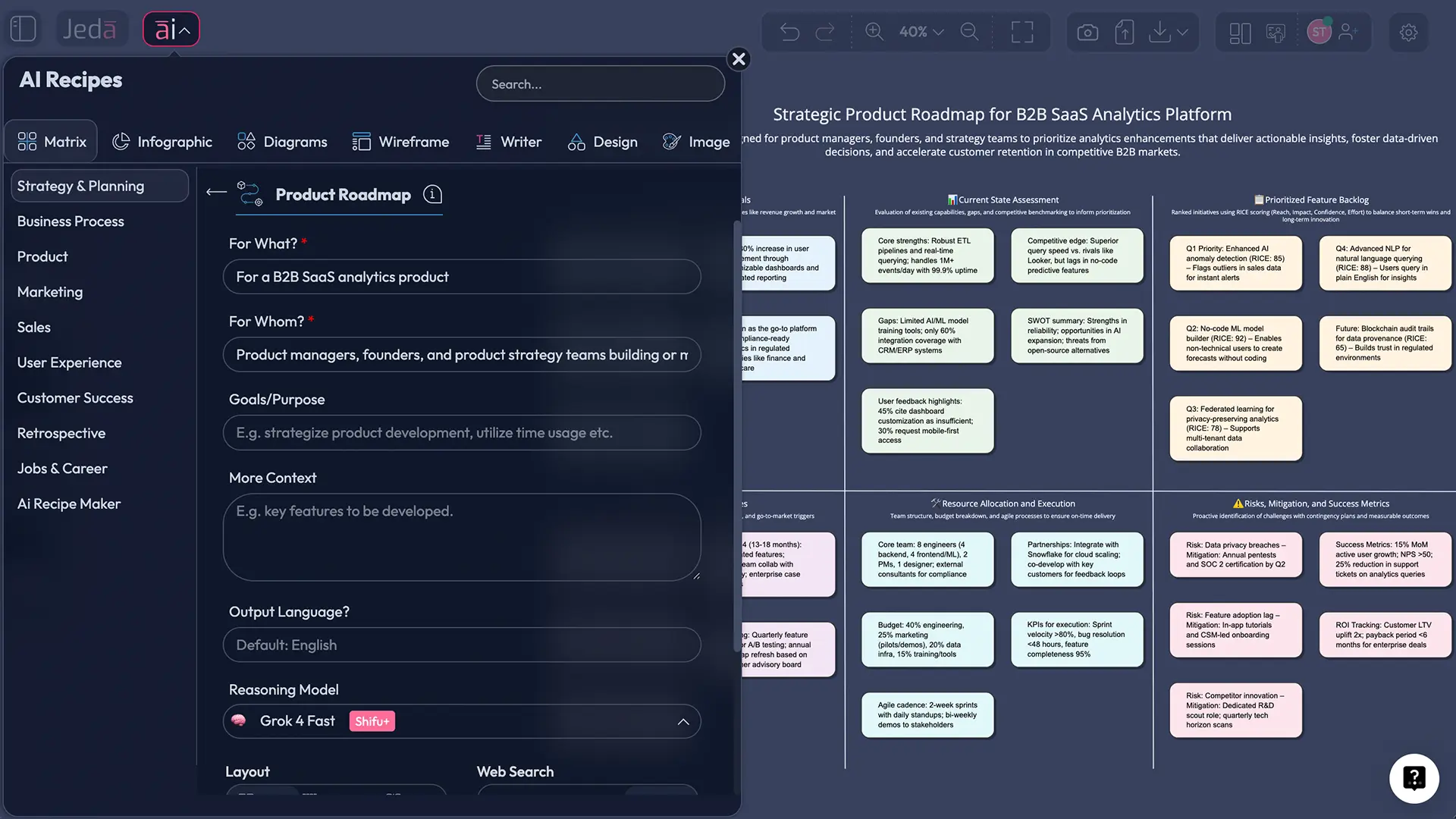
If you’ve ever watched a “quick roadmap sync” turn into a 90‑minute debate about one feature, welcome to the club. An AI product roadmap fixes the two classic problems: (1) roadmaps become a dumping ground, and (2) timelines become fake promises.
With Jeda.ai—an AI Workspace and AI Whiteboard used by 150,000+ users—you can generate a roadmap as a clean, editable matrix, then refine it with your team in real time. No Frankenstein spreadsheet. No “we’ll clean this up later.” You’ll actually want to show this to stakeholders.
What is a product roadmap?
A product roadmap is a shared source of truth that outlines a product’s vision, direction, priorities, and progress over time. It’s not a task list. It’s the “why + what” that helps teams and stakeholders agree on what matters next.
Here’s the practical version: a roadmap is how you stop rebuilding priority decisions every week. It creates continuity, sets expectations, and keeps the team aligned when requests start flying in from every direction.
Why use a product roadmap with AI?
Because roadmaps usually fail for predictable reasons:
- Too much output, not enough outcome. Teams list features, but forget what the product is trying to change in the real world. (Output is easy. Outcomes are hard.)
- Stakeholders want certainty you can’t give. A roadmap becomes a promise instead of a plan.
- The “priority pile” grows forever. Nothing is removed. Everything is “urgent.”
- Context gets lost between tools. Notes in docs, decisions in Slack, roadmap in a spreadsheet, strategy in a slide deck.
An AI product roadmap helps because AI is good at: clustering messy inputs into themes, turning raw research into “Now / Next / Later” initiatives, spotting missing dependencies, and rewriting roadmap items into outcome language your stakeholders can actually understand.
And since Jeda.ai is an AI Workspace that outputs editable visuals—not static chat—you can keep refining the roadmap like a living artifact.
What you can build with a Roadmap Matrix in Jeda.ai
Most teams don’t need one roadmap. They need a few views of the same roadmap.
- Now–Next–Later roadmap
High-signal roadmap for execs. Focuses on direction and sequencing without brittle dates. Great when priorities shift monthly.
- Quarter-by-quarter themes
Useful when you have capacity planning cycles. Keep it at theme/initiative level—avoid dropping epics and stories into the roadmap.
- Theme × Release matrix
A clean view for product + engineering. Themes on one axis, planned releases on the other. Helps you spot overloaded releases fast.
- Outcome roadmap
Maps initiatives to measurable outcomes (activation, retention, cost-to-serve). Helpful when you’re running OKRs.
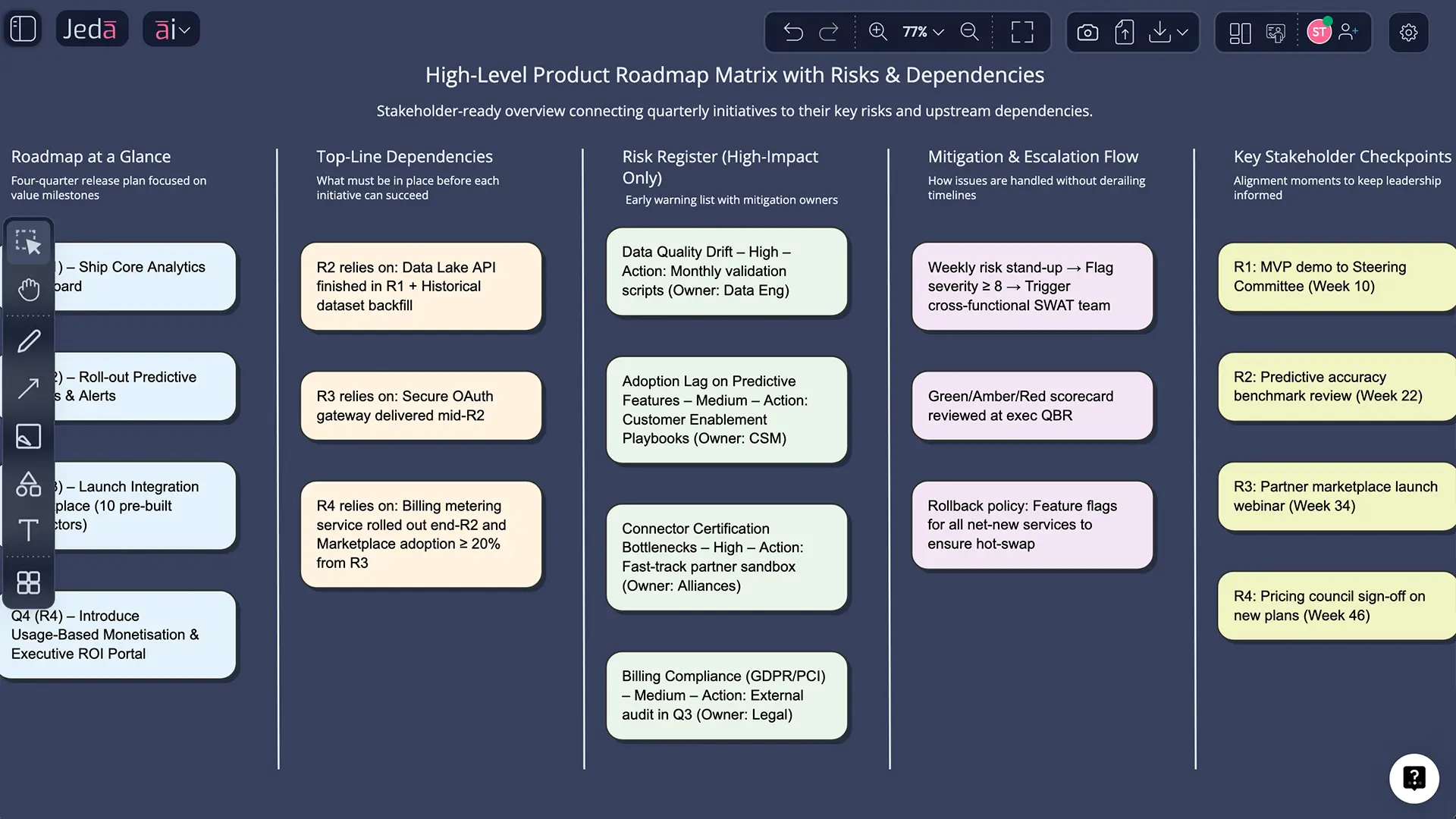
- Risk & dependency roadmap
Pairs roadmap items with key risks, dependencies, and “what could block this.” The stakeholder-friendly version of reality.
- Audience-based roadmap
Segments the roadmap by persona or customer tier. Great for B2B products with different buyers and users.
How to create an AI product roadmap in Jeda.ai
Two ways to do it:
- Method 1: Recipe Matrix (AI Menu)
- Method 2: Prompt Bar (Matrix command)
And after you generate a first draft: use the AI+ button to extend, refine, or expand sections.
Method 1 — Recipe Matrix (recommended)
This is the fast path when you want a clean structure from the start.
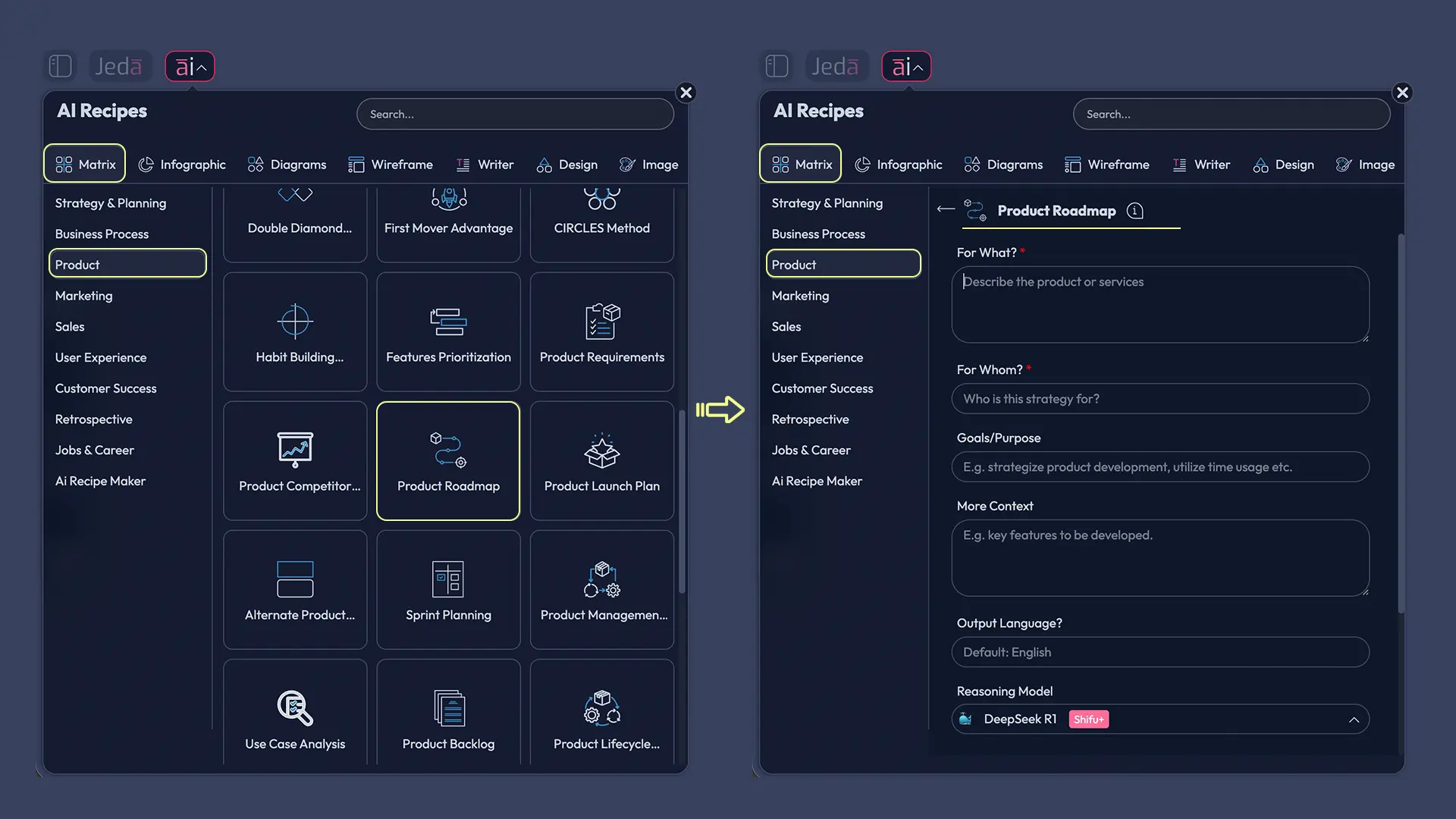
- Open the AI Menu
From the top-left of the canvas, open the AI Menu and go to the Matrix Recipes category.
- Pick a Roadmap recipe
Choose a product roadmap recipe.
- Provide context (short, but specific)
Add your product, target users, business goal, and constraints (team size, timeline granularity, and top risks). Include any must-win outcomes.
- Generate the Roadmap Matrix
Click Generate. You’ll get an editable roadmap matrix on the canvas. Treat it as a draft you can pressure-test, not a contract.
- Use AI+ to deepen the best parts
Select a roadmap row or theme, then tap the AI+ button to expand details
- Convert views with Vision Transform
If you want a different representation (e.g., roadmap → flowchart for release process), use Vision Transform to convert the visual without starting over.
- Export the shareable version
Export as PNG, SVG, or PDF for stakeholders. Keep the editable version in the board for ongoing updates.
Method 2 — Prompt Bar (Matrix command)
This is perfect when you already know the exact structure you want.
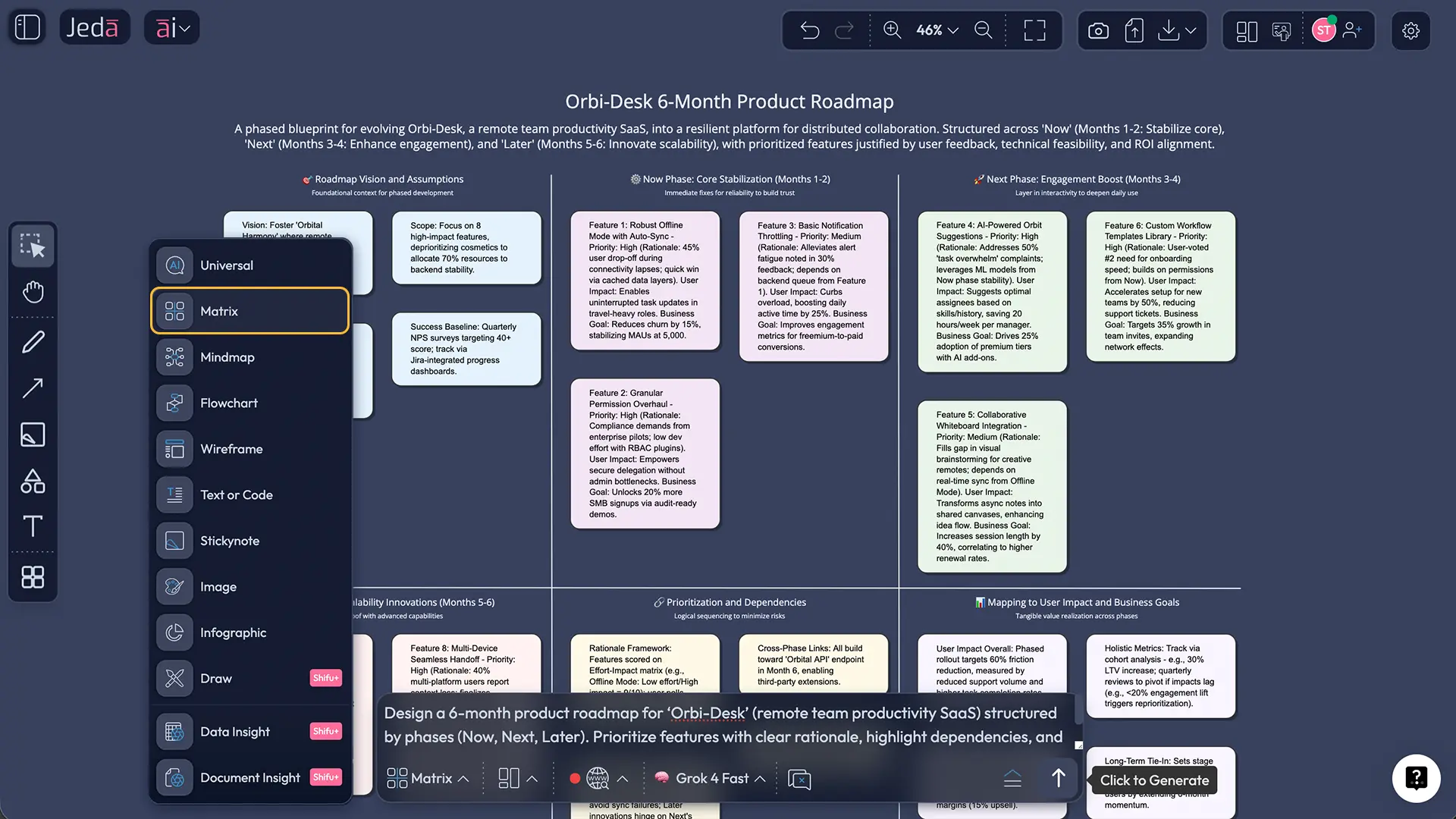
- Open the Prompt Bar at the bottom of the canvas.
- Select the Matrix command.
- Paste a prompt like one of the examples below.
- Press Enter to generate.
- Select any part and use AI+ to extend it.
Prompt Bar examples you can copy
Example A — Now–Next–Later (outcome-first):
“Create an AI product roadmap matrix for [product]. Use columns: Now, Next, Later. Use rows: Theme, Target user, Outcome metric, Key initiatives, Dependencies, Risks. Context: [1–2 sentences]. Constraints: [team size, time].”
Example B — Quarterly themes (stakeholder-friendly):
“Create a product roadmap matrix for the next 3 quarters. Columns: Q2, Q3, Q4. Rows: Theme, Why it matters, What success looks like, Major initiatives, What we’re not doing.”
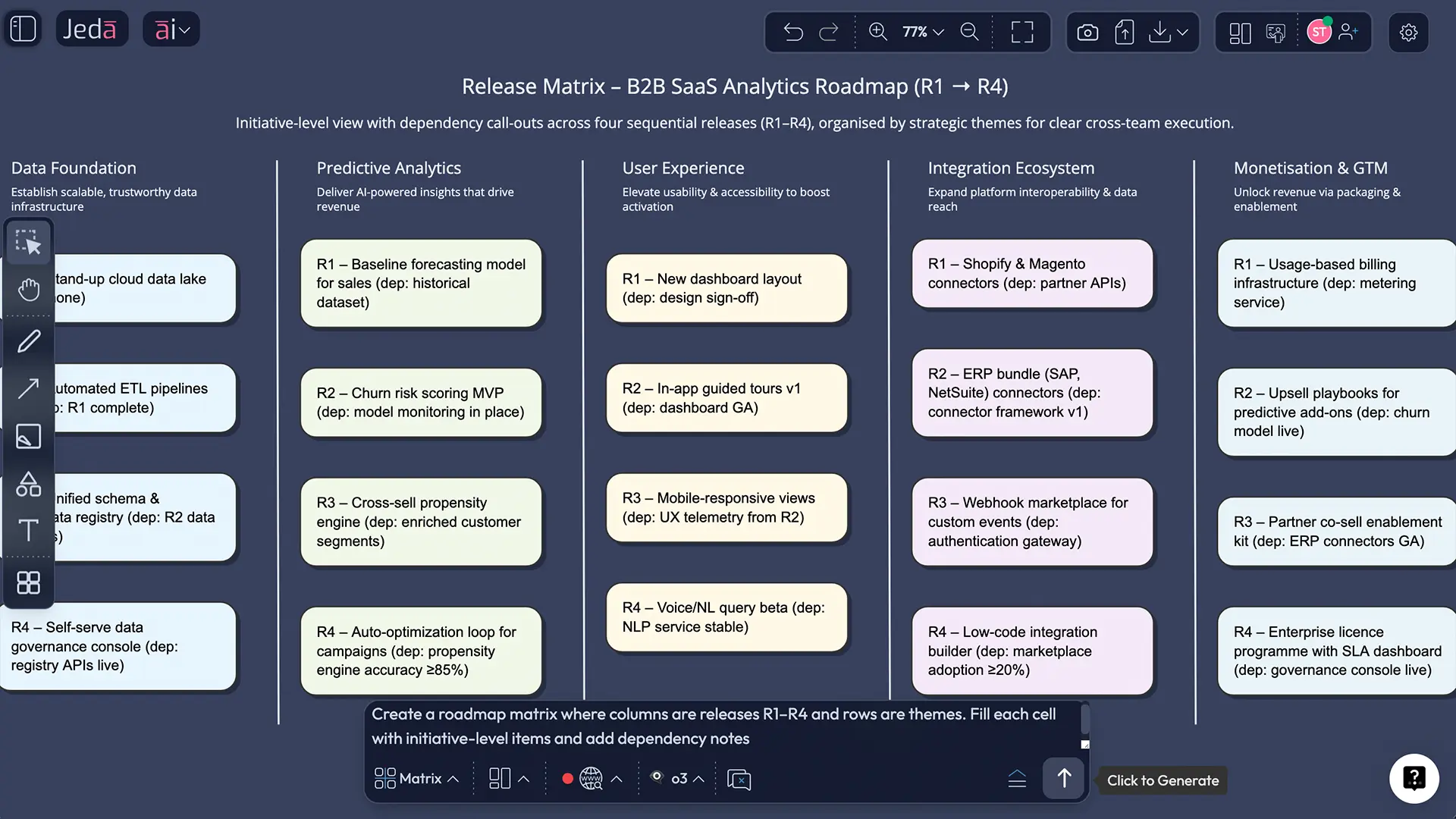
Example C — Theme × Release (engineering alignment):
“Create a roadmap matrix with columns as Releases (R1–R4) and rows as Themes. In each cell, list initiatives at ‘initiative level’ (not user stories). Add a separate row for Dependencies and Risks per release.”
Product roadmap template you can use today (with worked examples)
Let’s make this real. Below are three roadmap examples you can generate in a minute, then refine.
Example 1 — B2B SaaS: reduce churn without a “feature flood”
Suggested structure (Matrix):
- Columns: Now / Next / Later
- Rows: Theme, Key problem, Target segment, Outcome metric, Initiatives, Dependencies, Risks
Outcome ideas to include:
- Time-to-first-value (TTFV) reduced from 7 days → 2 days
- Activation rate +12%
- Support tickets per account -20%
Example 2 — Mobile app: move from “growth hacks” to repeatable growth
A mobile roadmap gets chaotic fast. The fix is to anchor work to one or two levers (activation + retention) and treat everything else as “nice, later.”
Theme examples:
- Onboarding clarity
- Habit loop (weekly return)
- Performance + crash reduction
- Monetization experiments
AI+ deep dive use: Select “Onboarding clarity” and use AI+ to expand hypotheses, experiment ideas, and success metrics.
Example 3 — Internal platform: roadmap as a credibility machine
Internal platform teams get hit with two kinds of requests: “please build a feature” and “why are things so slow?” A roadmap that includes dependencies and risk makes your work legible.
Theme examples:
- Reliability (SLOs, incident reduction)
- Developer experience (CI speed, local dev)
- Governance & security guardrails
- Cost control (FinOps)
Best practices (the stuff nobody tells you until it hurts)
Here are the practices that consistently produce roadmaps people trust:
Common mistakes to avoid
- Using dates as a shield. A roadmap with fake dates creates fake confidence. If you must include time, use ranges (Now/Next/Later or quarters) and keep it honest.
- Listing everything stakeholders asked for. Your roadmap is not a suggestion box export.
- Forgetting to delete items. If “Later” only grows, you’re not prioritizing—you’re postponing.
- No explicit assumptions. If an initiative depends on “we’ll get API access soon,” say that out loud.
- No owner, no metric, no chance. Roadmap items without ownership and success measures die quietly.
Frequently Asked Questions
- What is an AI product roadmap?
- An AI product roadmap is a roadmap draft generated with AI that clusters inputs into themes, prioritizes initiatives, and suggests sequencing (Now–Next–Later, quarters, or releases). The best AI roadmaps stay outcome-focused and remain editable, so your team can review assumptions, adjust priorities, and maintain a living plan.
- What should a product roadmap include?
- A product roadmap should include direction (vision/themes), priority order, and a clear explanation of why each item matters. Most strong roadmaps also include an outcome metric, key dependencies, and a short note on risk. It should not include user stories or granular tasks.
- How often should we update a product roadmap?
- Most teams update a product roadmap weekly or biweekly, with a lightweight review in regular product rituals. The goal is consistent alignment, not perfect forecasting. If you’re in a fast-moving market, updating “Now” frequently and keeping “Next/Later” more flexible usually works best.
- Is Now–Next–Later better than a dated timeline?
- Now–Next–Later is usually better when uncertainty is high because it communicates sequencing without pretending you know exact delivery dates. Timeline roadmaps can work for stable commitments, but they tend to become brittle when priorities change. Many teams use both: Now–Next–Later for execs and timeline views for internal planning.
- How do we keep stakeholders from treating the roadmap as a promise?
- Set expectations explicitly: describe the roadmap as a directional plan based on current knowledge, not a delivery contract. Use ranges (quarters or Now–Next–Later), include assumptions, and keep a visible “Not doing” list. Regular updates also reduce the urge for stakeholders to interpret the roadmap as fixed.
- Can AI replace product prioritization?
- AI can’t replace product prioritization because prioritization is ultimately a business decision with trade-offs and context. What AI can do is speed up the messy work: grouping ideas, drafting options, highlighting dependencies, and rewriting roadmap items in outcome language. Humans still make the call.
- How do I turn a roadmap into an execution plan?
- Turn each roadmap initiative into a delivery plan that includes scope, milestones, owners, and risks—often in a separate workflow tool. In Jeda.ai, you can also use Vision Transform to convert a roadmap matrix into a flowchart that shows the delivery steps and approval gates, then keep both views linked on the same board.
- What is the biggest mistake teams make with roadmaps?
- The biggest mistake is stuffing the roadmap with output—features and tasks—without tying them to outcomes or measurable value. That turns the roadmap into a backlog mirror and creates constant churn. A roadmap that starts with outcomes is easier to defend, easier to update, and more trustworthy.
- Can I export my roadmap from Jeda.ai?
- Yes. You can export your roadmap as PNG, SVG, or PDF for sharing with stakeholders. Keep the editable board inside Jeda.ai so your team can keep updating it and extending it with AI using the AI+ button.
- Do I need a separate roadmap for different audiences?
- Usually, yes. Executives want clarity and outcomes, while delivery teams need dependencies and sequencing detail. The fastest approach is to keep one source board and generate multiple views: an exec Now–Next–Later view, an internal Theme×Release view, and a risk/dependency view. Same truth, different lenses.
Sources & further reading
- [1]
Atlassian (2026) . “Product roadmaps: What is it & how to create one” Atlassian Agile / Product Management.
View Source ↗ - [2]
Roman Pichler (2013) . “The GO Product Roadmap (Goal-Oriented Agile Product Roadmap)” romanpichler.com.
View Source ↗ - [3]
Roman Pichler (2025) . “Product Roadmap FAQs” romanpichler.com.
View Source ↗ - [4]
Agile Alliance (2025) . “All you need to know about product roadmaps: a hands-on guide” agilealliance.org.
View Source ↗ - [5]
Gartner (2024) . “Product planning: What it is, process and roadmap” gartner.com.
View Source ↗ - [6]
Silicon Valley Product Group (Marty Cagan) (2025) . “Outcomes Are Hard” svpg.com.
View Source ↗
Start your AI product roadmap in Jeda.ai
Join over 150,000+ users building roadmaps, frameworks, and decision-ready visuals in one AI Workspace.
Try Free Template