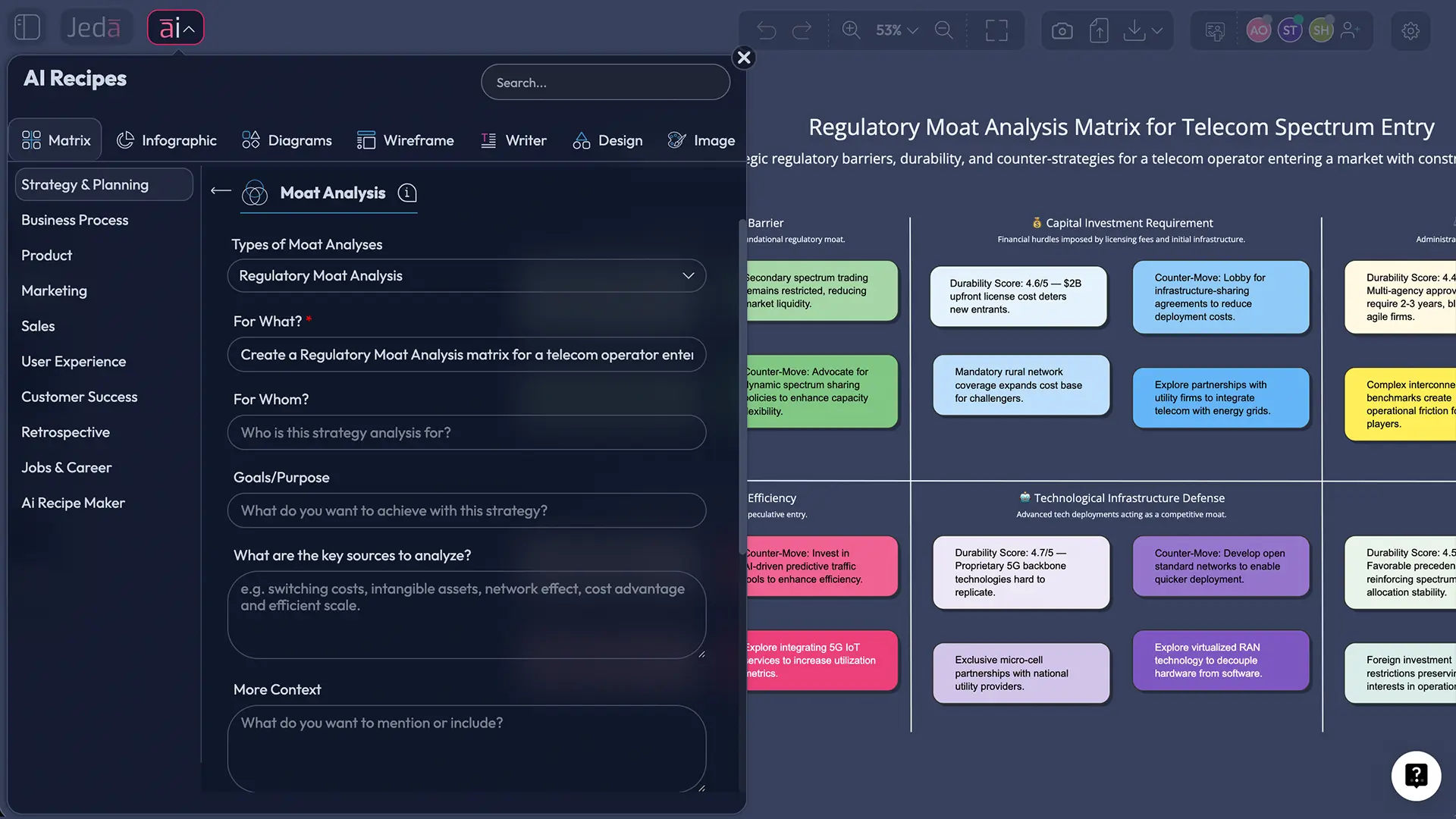
A regulatory moat analysis explains how laws, licenses, standards, and enforcement realities shape competitive advantage—and where that advantage can disappear overnight. If you’re building strategy in a regulated market (finance, telecom, energy, healthcare, transport, defense, data), you’re not just competing with rivals. You’re competing inside a rulebook.
Jeda.ai helps you run regulatory moat analysis inside an AI Workspace that produces editable visuals (not static chat) and keeps evidence, assumptions, and decisions on one canvas. It’s an AI Whiteboard approach to strategy: visual, collaborative, and auditable. Jeda.ai is used by 150,000+ users, and includes 300+ strategic frameworks in its AI Menu.
What is a regulatory moat?
A regulatory moat is a defensible advantage created (directly or indirectly) by regulation—through licensing, permits, compliance obligations, standards, and access to regulated distribution channels. In classic competitive strategy terms, it often operates as a barrier to entry that reduces the threat of new entrants (Porter’s five forces), but it also affects rivalry, buyer power, and substitutes.
Two distinctions matter:
- Regulation as structure (rules that create entry barriers).
- Regulation as politics (who influences rulemaking and enforcement, and how durable that influence is).
If you analyze only the first, you’ll overestimate durability. If you obsess over the second, you’ll drift into speculation. A good regulatory moat analysis treats regulation as both institution and incentive system—and then tests the “moat” for stability.
Why run regulatory moat analysis with AI?
Regulation is document-heavy, slow to read, and full of “gotchas” (definitions, exceptions, cross-references). AI speeds up the synthesis, but you still need a framework that keeps the analysis disciplined.
Using Jeda.ai’s AI Workspace, you can:
- convert regulatory PDFs into structured “requirements → implications → risks” tables,
- generate a moat map that separates hard constraints (licenses, capital requirements) from soft constraints (procurement relationships, operational credibility),
- stress-test policy volatility and substitution risk,
- document assumptions and evidence so your team can audit the logic later.
And because it’s an AI Whiteboard, you can collaborate in real time, annotate sources, and evolve the board as regulations change.
- Make the barrier explicit
Turn vague 'regulatory advantage' claims into concrete constraints: licenses, quotas, approvals, capital rules, reporting duties, and enforcement patterns.
- Evidence-in, not vibes
Pull requirements straight from documents (laws, guidance, filings). Keep citations and excerpts attached to the same canvas section.
- Durability stress test
Model policy reversal risk, election cycles, court challenges, and regulator incentives. A moat is only a moat if it survives change.
- Operational capability lens
Separate 'permission to operate' from 'ability to operate.' Compliance execution quality is often the real moat.
- Cross-functional alignment
Legal, compliance, product, and strategy teams can review the same visual board and resolve disagreements quickly.
- Editable visuals out
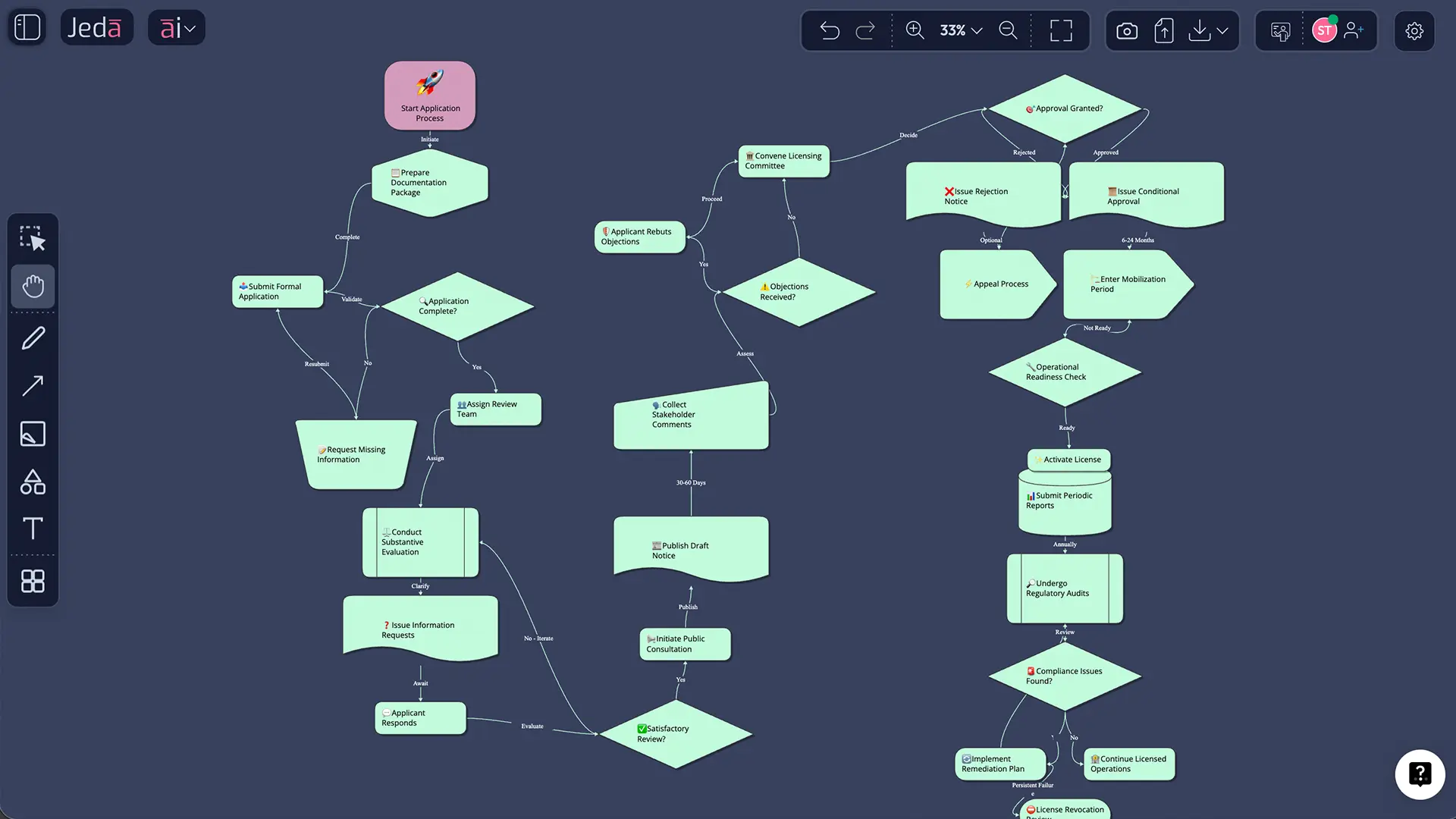
Convert the same analysis into a diagram, flowchart, or risk register using Vision Transform—without rebuilding from scratch.
Regulatory moat vs. regulatory capture (don’t mix these)
A regulatory moat can exist without capture. It can also be a byproduct of legitimate public-interest regulation (safety, systemic stability, consumer protection).
Regulatory capture describes a situation where regulators systematically favor special interests over the public interest. Capture is a political economy risk—and an ethical and strategic risk—because it can trigger backlash, enforcement swings, and reputational damage. A regulatory moat analysis should explicitly test: Is the advantage defensible as policy, or fragile because it relies on undue influence?
A practical regulatory moat analysis framework
Use the following six-layer framework to keep the analysis rigorous. You can represent it as a Matrix in Jeda.ai.
Layer 1: Authorization scarcity
- Is entry capped (limited licenses, spectrum, concessions, quotas)?
- What is the approval timeline, and who grants it?
- What are disqualifiers (fit-and-proper tests, ownership limits, local presence)?
Layer 2: Compliance cost curve
- What fixed costs exist (audit, reporting systems, capital buffers, certifications)?
- Do incumbents enjoy economies of compliance (scale lowers unit cost)?
- Is compliance “learned” and hard to copy (process maturity, control culture)?
Layer 3: Standards & infrastructure lock-in
- Are there mandated technical standards that favor incumbents?
- Is interoperability required, and who sets the standards?
- Does the market require certified infrastructure and recurring audits?
Layer 4: Regulated channels & procurement access
- Are key customers public agencies or regulated enterprises?
- Is procurement gated by certifications, track record, or security clearance?
- Do long-term concessions or contracts exist?
Layer 5: Political economy dynamics
- Who benefits from the regulation (consumers, incumbents, labor, state revenue)?
- What is the regulator’s incentive structure (independence, funding, enforcement style)?
- Where could lobbying or capture be alleged—and what would that do?
Layer 6: Durability & policy volatility
- How exposed is the sector to elections, court rulings, or geopolitical shocks?
- Are there credible deregulatory paths (new entrants, sandboxes, open banking/open access)?
- Is technological substitution reducing the relevance of the regulation?
How to create a regulatory moat analysis in Jeda.ai
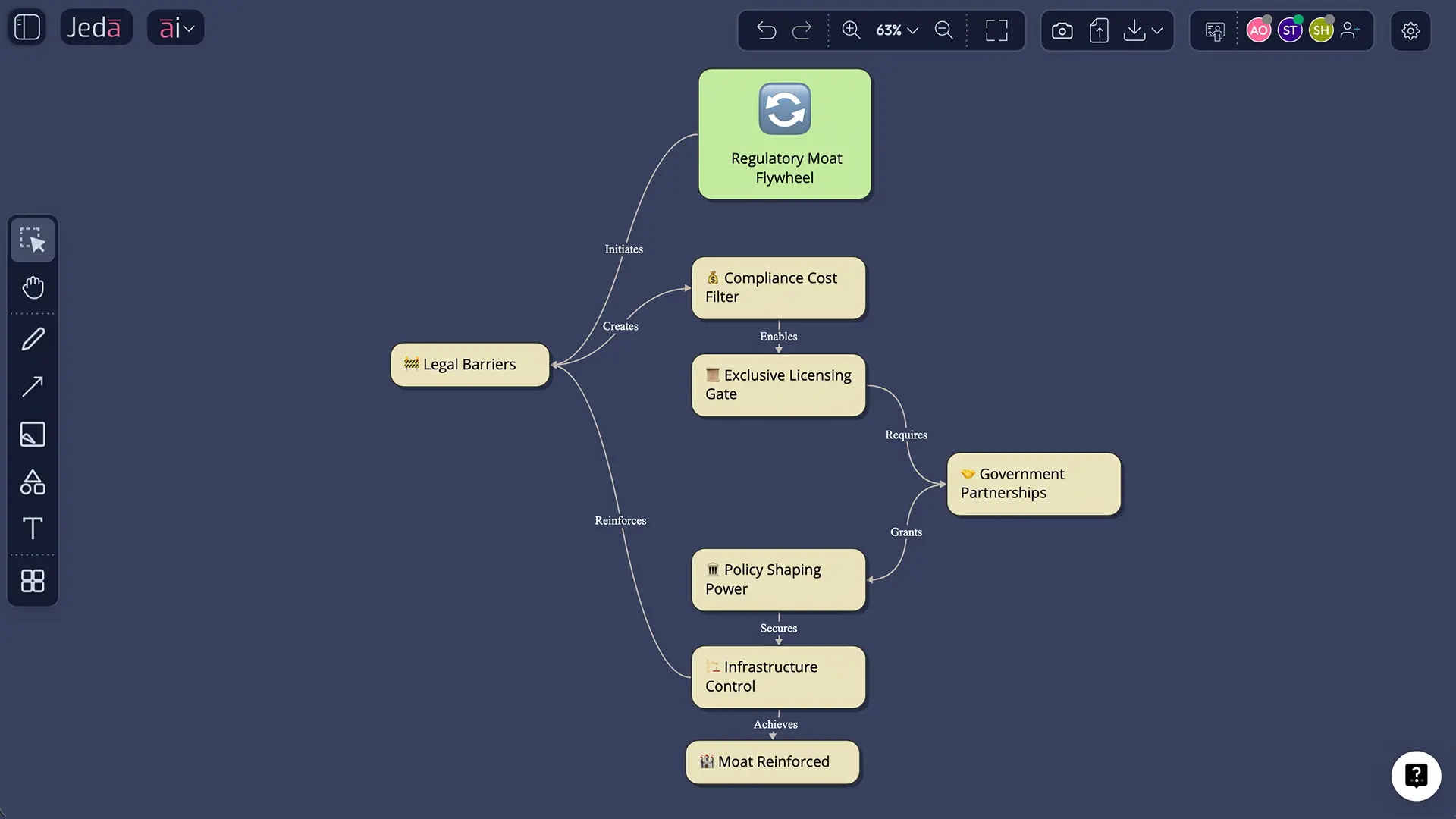
Because you noted this is a sub-recipe under the Moat Analysis templates, you can use either the AI Menu recipe method (fastest) or the Prompt Bar (most customizable).
Method 1 (recommended): Use the AI Menu recipe
- Open a workspace
Create a new board and name it for the market/company you’re analyzing (e.g., 'Regulatory Moat — Digital Banking').
- Open AI Menu
In the top-left AI Menu, choose Matrix Recipes and find Moat Analysis. Select the Regulatory Moat sub-recipe.
- Enter inputs
Provide jurisdiction(s), industry, business model, and the specific regulation(s) or license regime involved.
- Add evidence
Upload relevant PDFs (regulations, guidance, filings) using Document Insight so the output reflects real requirements.
- Generate the matrix
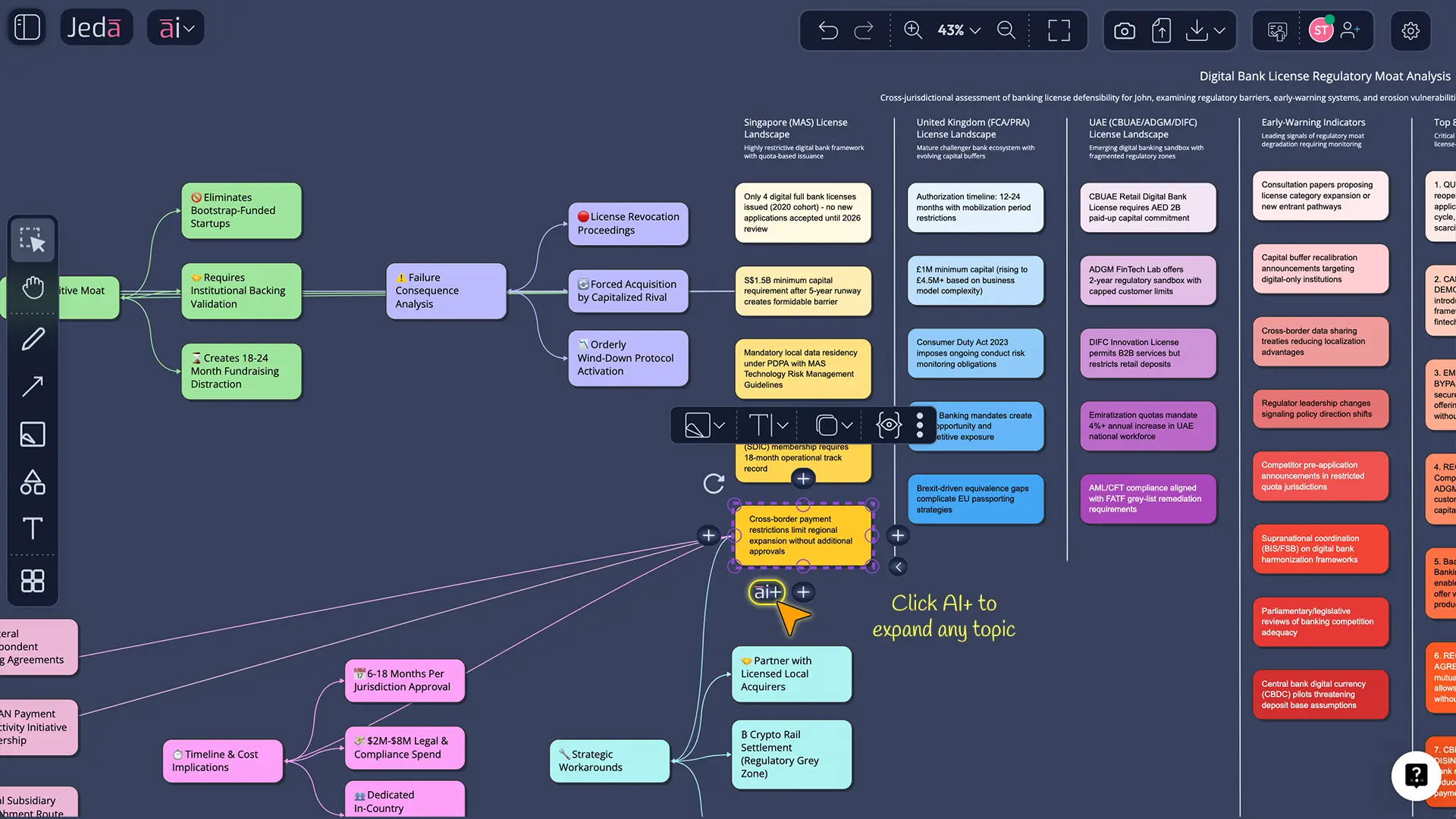
Click Generate. Jeda.ai will create an editable matrix mapping the moat source, its mechanism, and durability risks.
- Extend with AI+
Select any cell and tap the AI+ button to expand: add counter-moves, edge cases, enforcement history, or compliance cost estimates.
- Convert outputs
Use Vision Transform to convert the matrix into a flowchart (approval process) or a diagram (stakeholder map).
- Share and export
Collaborate live, then export as PNG, SVG, or PDF for decks and decision memos.
Method 2: Use the Prompt Bar (Matrix command)
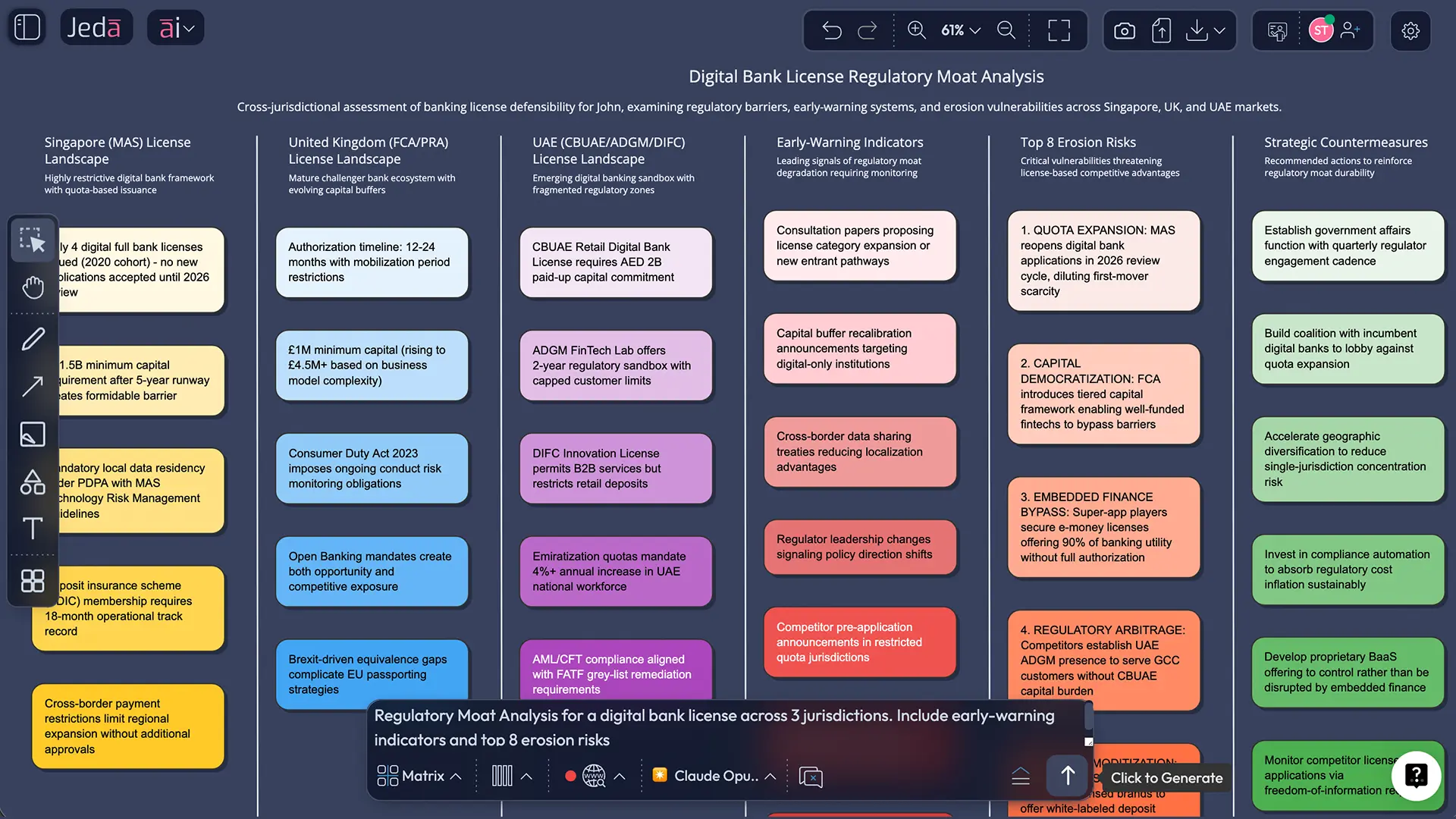
Open the Prompt Bar → select the Matrix command → paste a structured prompt like one of the examples below → press Enter.
Copy-paste prompts (Matrix command)
Prompt A — new market entry (licensed industry)
Context: We are evaluating entry into [industry] in [jurisdiction].
Task: Create a Regulatory Moat Analysis matrix with 6 sections: Authorization Scarcity, Compliance Cost Curve, Standards & Infrastructure, Regulated Channels/Procurement, Political Economy Dynamics, Durability & Volatility.
For each section: (1) list the moat mechanism, (2) evidence signals to verify, (3) how incumbents exploit it, (4) how a challenger could overcome it, (5) a durability score 1–5 with rationale.
Output constraints: concise but specific; avoid generic claims; include assumptions explicitly.
Prompt B — incumbent assessment (defend vs. disruption)
Analyze [company]’s regulatory moat in [industry] across [countries/regions]. Produce: (1) a matrix of moat sources and mechanisms, (2) top 8 moat erosion risks, (3) early warning indicators, and (4) recommended strategic investments in compliance capability, standards participation, and regulated channel partnerships.
Prompt C — regulated product launch (safety + data)
We are launching [product/service] that touches [consumer safety / medical / finance / data]. Build a regulatory moat analysis that maps approvals, certifications, reporting, audit requirements, and enforcement history. Then suggest how to design the operating model so compliance becomes a competitive advantage (time-to-approval, lower audit findings, faster expansion).
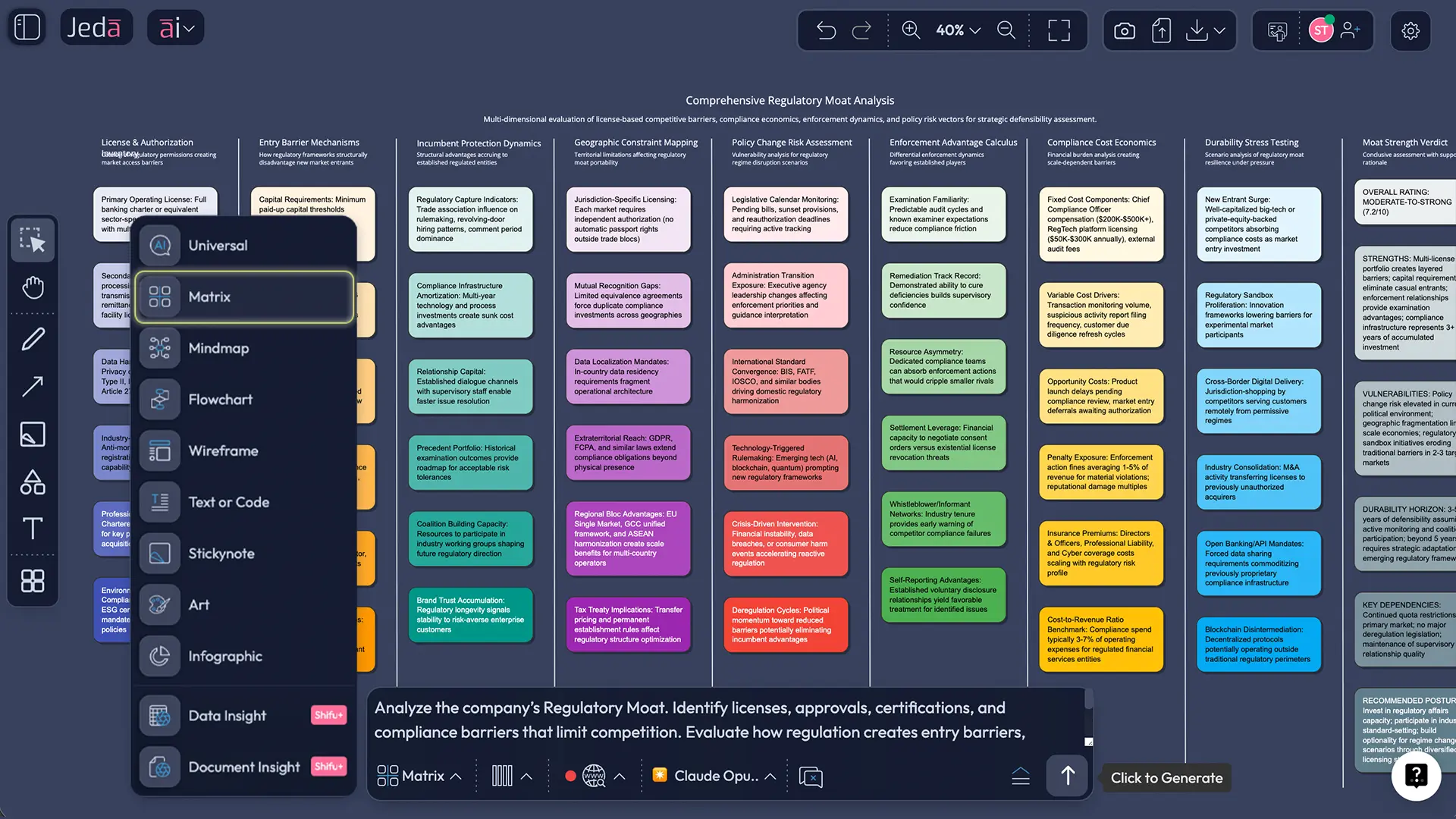
Worked example (short): digital bank license in a multi-country expansion
Imagine a fintech that wants to become a licensed digital bank across three jurisdictions.
A first-pass matrix often reveals the real story:
- Authorization scarcity: licenses are limited, timelines are long, and ownership rules vary by country.
- Compliance cost curve: AML/KYC monitoring, capital buffers, audit readiness, and governance become fixed costs that scale with users.
- Standards lock-in: data localization, reporting schemas, and cybersecurity controls force investment in certified infrastructure.
- Regulated channels: partnerships with payment rails and national ID systems are gated and relationship-heavy.
- Political economy: incumbents argue “stability,” challengers argue “inclusion,” and regulators balance systemic risk.
- Durability: policy shifts (elections, banking crises, major fraud incidents) can tighten or loosen requirements quickly.
Best practices for rigorous analysis
Common mistakes to avoid
- Confusing “regulated” with “protected.” Many regulated markets are competitive; regulation can raise costs for everyone.
- Assuming enforcement equals statute. Written rules and enforced reality often diverge.
- Over-crediting lobbying. Influence can backfire through capture allegations and enforcement swings.
- Ignoring cross-border friction. A moat in one jurisdiction can become a liability in another.
- Missing substitutes. Fintech, renewables, and software often route around regulation rather than entering head-on.
Frequently Asked Questions
- What is regulatory moat analysis?
- Regulatory moat analysis is the structured evaluation of how licenses, permits, compliance obligations, and enforcement realities create (or fail to create) durable barriers to competition. It maps the moat mechanism, evidence signals, and the risks that can erode the advantage over time.
- Which industries have the strongest regulatory moats?
- Industries with scarce authorizations and high ongoing compliance burdens tend to show stronger regulatory moats—banking, telecom spectrum, utilities, aviation, healthcare, and defense procurement. The moat is strongest when approvals are limited and compliance capability scales better for incumbents.
- Is a regulatory moat the same as a license moat?
- A license moat is one form of regulatory moat. Regulatory moats also include standards lock-in, procurement access, reporting obligations, capital requirements, and enforcement patterns. Licenses are often the entry gate, but operating compliance is usually what sustains the advantage.
- How is regulatory moat analysis different from Porter’s barriers to entry?
- Porter’s barriers to entry emphasize structural factors that deter entrants, including government policy. Regulatory moat analysis extends this by adding political economy dynamics and durability testing—how rulemaking and enforcement can shift, and whether the firm’s compliance capability makes the moat defensible.
- How do you measure whether a regulatory moat is durable?
- Assess durability by testing policy volatility (elections, crises, court decisions), substitution risk (new tech routes around regulation), and operational maturity (audit readiness, control culture). A useful practice is to score each moat mechanism and attach early warning indicators for erosion.
- Can AI analyze regulations reliably?
- AI can accelerate extraction and synthesis—summarizing requirements, spotting exceptions, and structuring checklists—especially when you provide the source documents. You still need expert review for legal interpretation, but AI is effective for organizing evidence and generating a disciplined analysis board.
- How do you run regulatory moat analysis in Jeda.ai?
- In Jeda.ai, use the AI Menu Moat Analysis template (Regulatory Moat sub-recipe) or select the Matrix command in the Prompt Bar and paste a structured prompt. Upload regulation PDFs via Document Insight, expand with AI+ for deeper risk tests, then convert outputs with Vision Transform.
- Can I export the regulatory moat analysis for stakeholders?
- Yes. Jeda.ai boards and visuals can be exported as PNG, SVG, or PDF. That makes it straightforward to include the matrix, stakeholder map, or approval flow in a decision memo or a slide deck workflow.
- Does Jeda.ai use web search in regulatory moat analysis?
- Yes—web search is a platform feature in Jeda.ai that can pull external context when needed. You can also keep the analysis entirely document-driven by uploading your own sources, which is often preferable for regulated, high-stakes decisions.
- Is the output editable, or is it a static image?
- Matrix, Diagram, Flowchart, Mindmap, and other outputs in Jeda.ai are editable on the canvas. The only output type that is static and non-editable is Art. For regulatory moat analysis, you’ll typically use editable visuals.
Sources & Further reading
- [1]
Michael E. Porter (1979) . “How Competitive Forces Shape Strategy” Harvard Business Review.
View Source ↗ - [2]
Michael E. Porter (1982) . “Gateways to Entry” Harvard Business Review.
View Source ↗ - [3]
George J. Stigler (1971) . “The Theory of Economic Regulation” The Bell Journal of Economics and Management Science (JSTOR).
View Source ↗ - [4]
Sam Peltzman (1976) . “Toward a More General Theory of Regulation” Journal of Law and Economics (NBER working paper entry).
View Source ↗ - [5]
Daniel Carpenter & David A. Moss (eds.) (2014) . “Preventing Regulatory Capture: Special Interest Influence and How to Limit It” Cambridge University Press.
View Source ↗ - [6]
OECD (2017) . “Preventing Policy Capture: Integrity in Public Decision Making” OECD Publishing (PDF).
View Source ↗ - [7]
OECD (2006) . “Barriers to Entry” OECD Publishing (PDF).
View Source ↗
Build a regulatory moat analysis you can defend
Join over 150,000+ users who use Jeda.ai’s AI Workspace to turn documents and decisions into editable, decision-ready visuals.
Try Jeda.ai Free