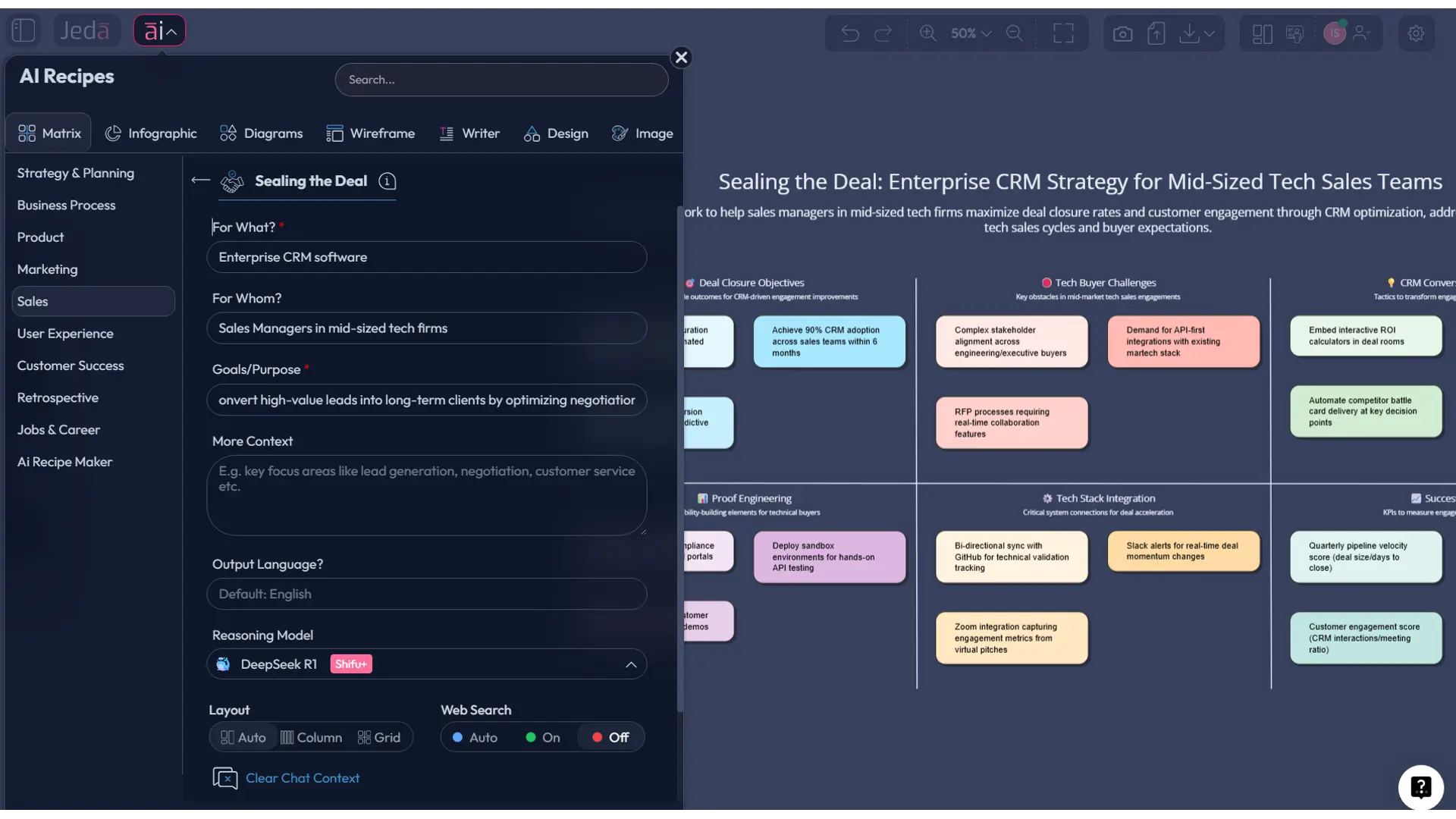
Sales closing techniques with AI matter now because the final stage of a deal is messier than most sales advice admits. Buyers are overloaded. Committees are larger. Proof is scattered across notes, decks, emails, and half-remembered call takeaways. And the old “just ask for the sale” advice? That still has its place, but it breaks down fast when the deal depends on alignment, timing, and trust. Jeda.ai turns that late-stage chaos into an editable AI Workspace and AI Whiteboard where your team can see exactly what’s blocking the deal — and what moves it forward.
A lot of teams still treat closing like theatre. One rep. One heroic call. One perfect phrase. Nice story. Not how modern B2B buying works.
What actually wins late-stage deals is clarity.
Clarity on stakeholders. Clarity on objections. Clarity on commercial terms. Clarity on what the buyer still needs to believe before they sign.
And that’s why Jeda.ai is useful here. It doesn’t just help you write better closing language. It helps you build a visible closing system with structure, context, and shared ownership — the kind that 150,000+ users already rely on when decisions need to move, not drift.
What Does “Sealing the Deal” Mean in Modern Sales?
Sealing the deal is the process of turning buyer interest into a committed next step, commercial agreement, and documented path to signature. It is not just a persuasive sentence at the end of a call. In modern B2B sales, it usually means removing friction around decision-making, not adding pressure.
That distinction matters more than most teams realize. Harvard Business Review reported that in a study of more than 2.5 million recorded sales conversations, 40% to 60% of deals were lost not to competitors, but to customers who intended to buy and then failed to act. In other words, the enemy is often indecision, not rejection.
So the job of a closer has changed. You are not just “asking for the order.” You are helping the buyer cross the final gap between interest and internal action.
This is where a Visual AI workflow earns its keep. Instead of treating the final stage like a scattered mix of CRM notes and Slack pings, Jeda.ai lets you lay the deal out as a visible system: who matters, what is unresolved, what proof is missing, what terms are sensitive, and what must happen next.
Why Traditional Closing Advice Breaks Down
Most closing content on the web gives you one of three things: techniques, phrases, or confidence coaching. Useful? Sure. Sufficient? Not even close.
The problem is that modern deals rarely fail because a rep forgot a textbook close. They fail because the team did not surface a silent blocker early enough.
Maybe procurement is slowing things down. Maybe the internal champion can’t get legal comfortable. Maybe the real decision-maker never saw the proof. Maybe everyone likes the product, but nobody owns the final step. That last one is brutal.
Late-stage deals are usually broken by:
- hidden stakeholders,
- weak business-case proof,
- unresolved objections,
- misread urgency,
- or buyer drift into “we’ll revisit this next quarter.”
A text document can list those. A CRM can tag those. But an AI Whiteboard can make them visible at once.
That’s the difference.
A closing board lets you stop debating the deal in fragments. Your team sees the blockers, the supporting proof, the negotiation issues, and the next action in one place. That makes closing less emotional and more operational.
- See the true blocker
Map objections, proof gaps, and buyer indecision so your team stops guessing what is really holding the deal back.
- Align the whole team
Bring sales, leadership, solutions, and customer-facing stakeholders into one editable board instead of five disconnected threads.
- Use AI where it matters
Generate deal summaries, objection maps, next-step plans, and stakeholder views with Jeda.ai’s structured visual workflow.
Why Use AI for Sales Closing Instead of Guesswork?
AI is no longer some experimental sidekick in sales. It is becoming part of the operating layer.
Salesforce reported that 81% of sales teams were either experimenting with or had fully implemented AI, and 83% of AI-using teams reported revenue growth compared with 66% of teams without AI. McKinsey, meanwhile, argues that gen AI can improve the B2B seller journey by helping teams prioritize, synthesize unstructured information, and identify the next-best opportunity.
But here’s the part that gets missed: AI helps most when it is paired with structure.
That’s why Jeda.ai is more useful than a chat-only workflow for late-stage deals. A generic AI assistant can give you advice. Jeda.ai can turn that advice into an editable deal-closing system.
Inside Jeda.ai, you can:
- generate a closing matrix from deal context,
- map stakeholders visually,
- surface objections and counter-proof,
- use multiple models for broader reasoning,
- extend weak areas with the AI+ button,
- and collaborate in real time on the same board.
That’s not just faster. It’s more reliable.
Because when a deal is late-stage, speed without visibility can actually make you sloppier. The goal is not automation for its own sake. The goal is decision momentum.
How to Create a Sealing the Deal Board in Jeda.ai
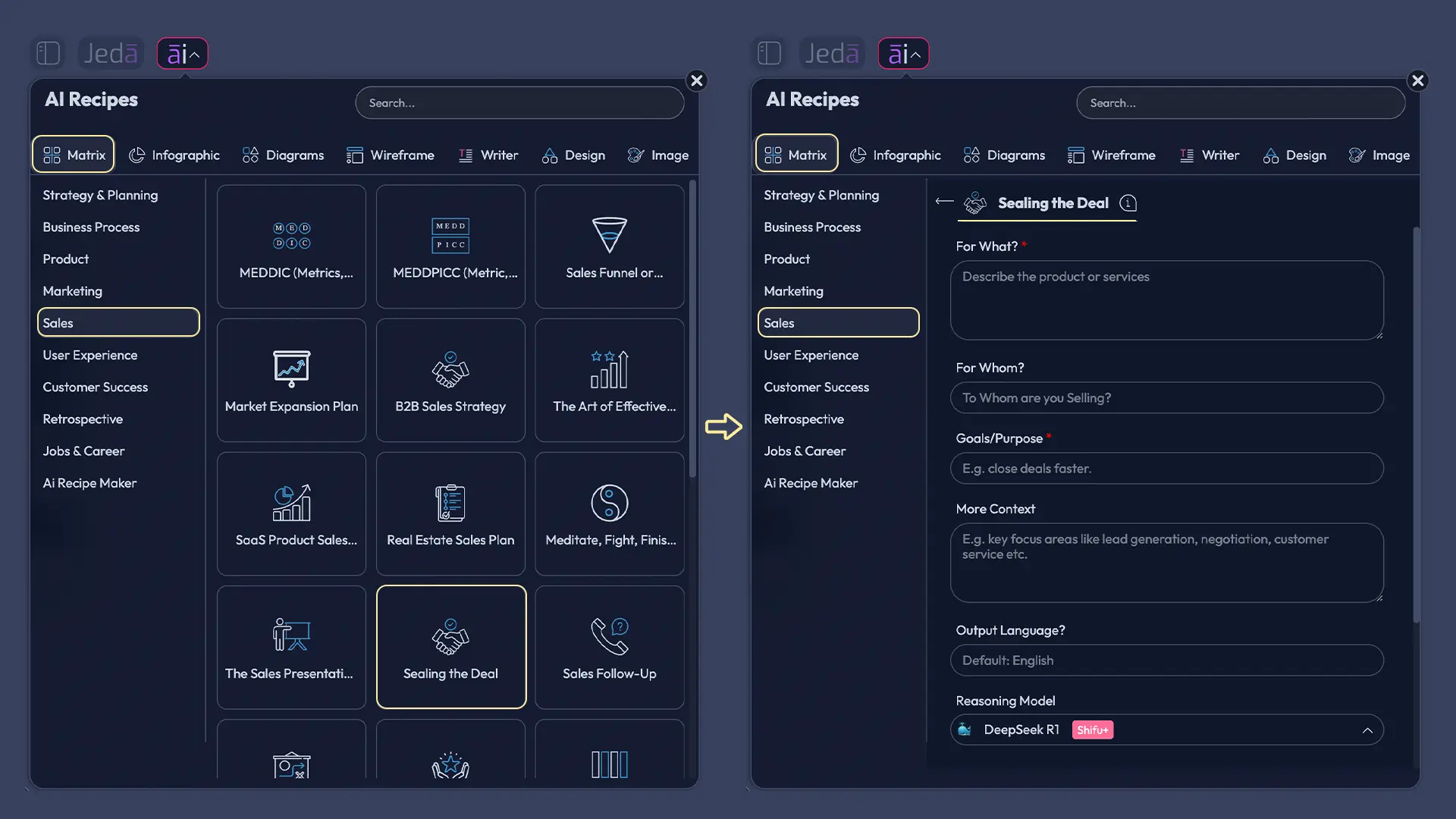
If you are using the Sealing the Deal recipe under the Sales matrix category, start there. It gives you the best structured path because the frame is already aligned to a late-stage sales situation.
Method 1 — Use the Sales Matrix Recipe
Open the AI Menu in the top-left corner of the canvas. Go to the Sales recipe category and choose the Sealing the Deal matrix recipe. Add the late-stage context that matters most:
- what the buyer wants to achieve,
- current objections,
- who is involved in the decision,
- urgency or timing pressure,
- commercial or legal concerns,
- and the next milestone you need.
Then generate the board.
You should expect a structure that makes the deal easier to inspect. For example:
- stakeholder / role,
- current position,
- objection or concern,
- evidence or proof needed,
- risk level,
- next action,
- owner,
- deadline.
That’s the board. Now the deal becomes visible.
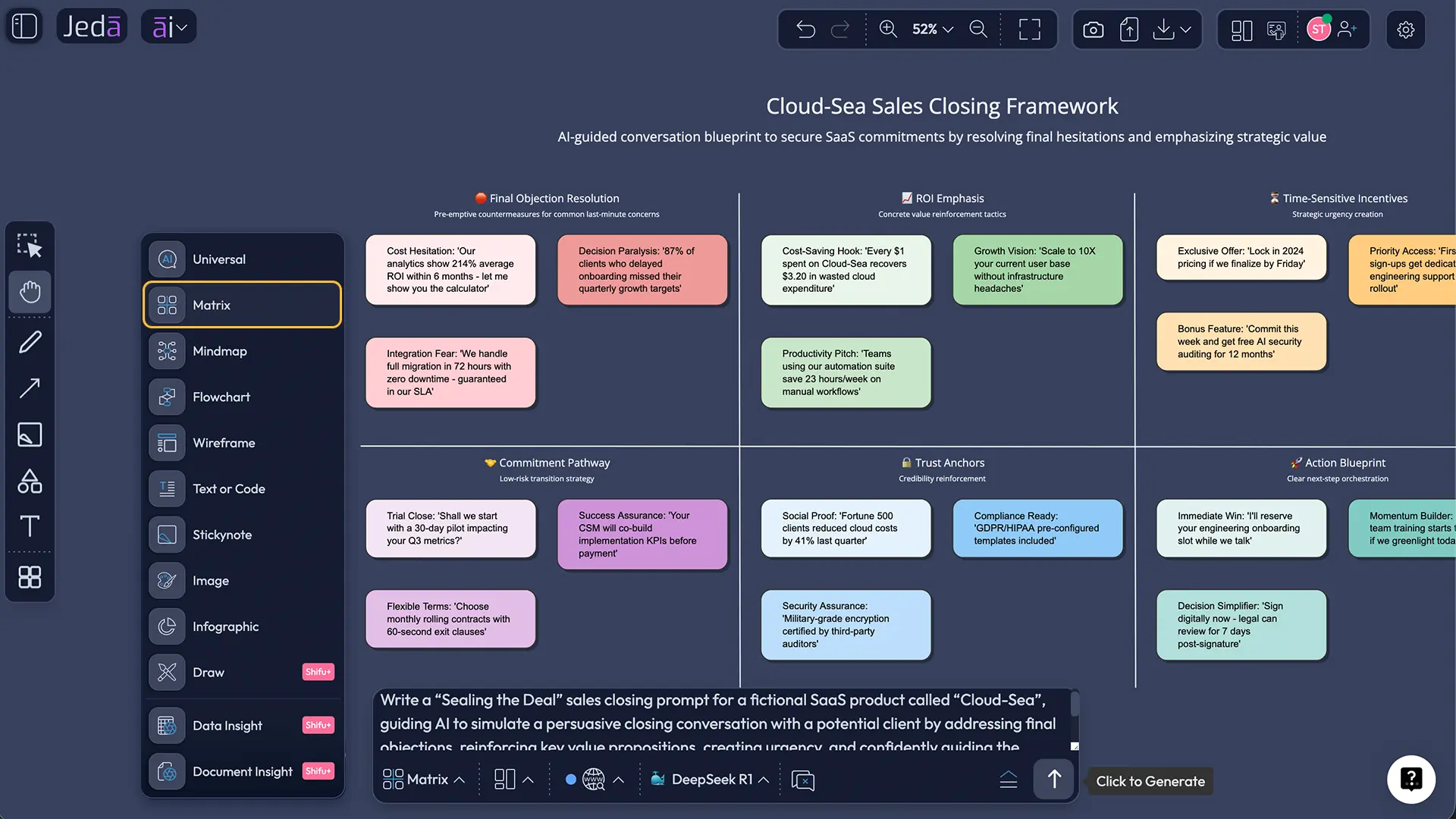
Method 2 — Use the Prompt Bar
Open the Prompt Bar at the bottom of the canvas and choose the Matrix command. Then enter a prompt like this:
Create a late-stage B2B sales closing matrix for a SaaS deal. Include columns for stakeholder, buying role, objection, proof needed, urgency trigger, commercial issue, confidence level, next action, owner, and target date. Make it concise, executive-readable, and editable.
Generate the matrix, then review it with your team. If the opportunity has a lot of moving parts, this method is excellent because you can tune the structure more aggressively.
Use AI+ to Extend Weak Deal Areas
This is where Jeda.ai gets fun.
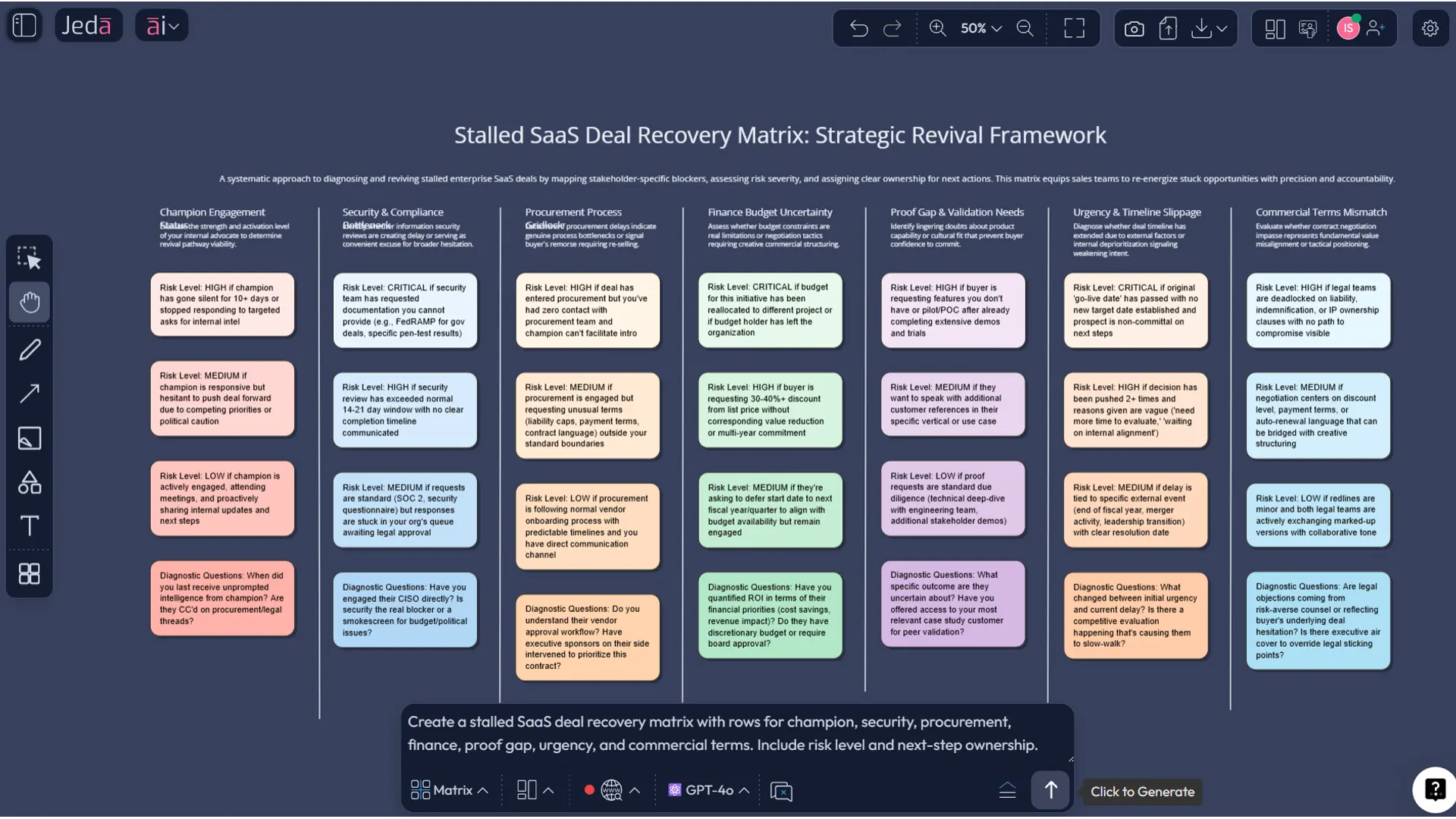
Click a weak or incomplete area of the board — maybe “security objection,” “procurement delay,” or “economic buyer not aligned.” Then use the AI+ button to extend that section. The board grows around the real friction instead of forcing you to rewrite the whole thing.
You can also use Vision Transform to turn the matrix into another format if needed. For example:
- matrix → diagram for stakeholder influence,
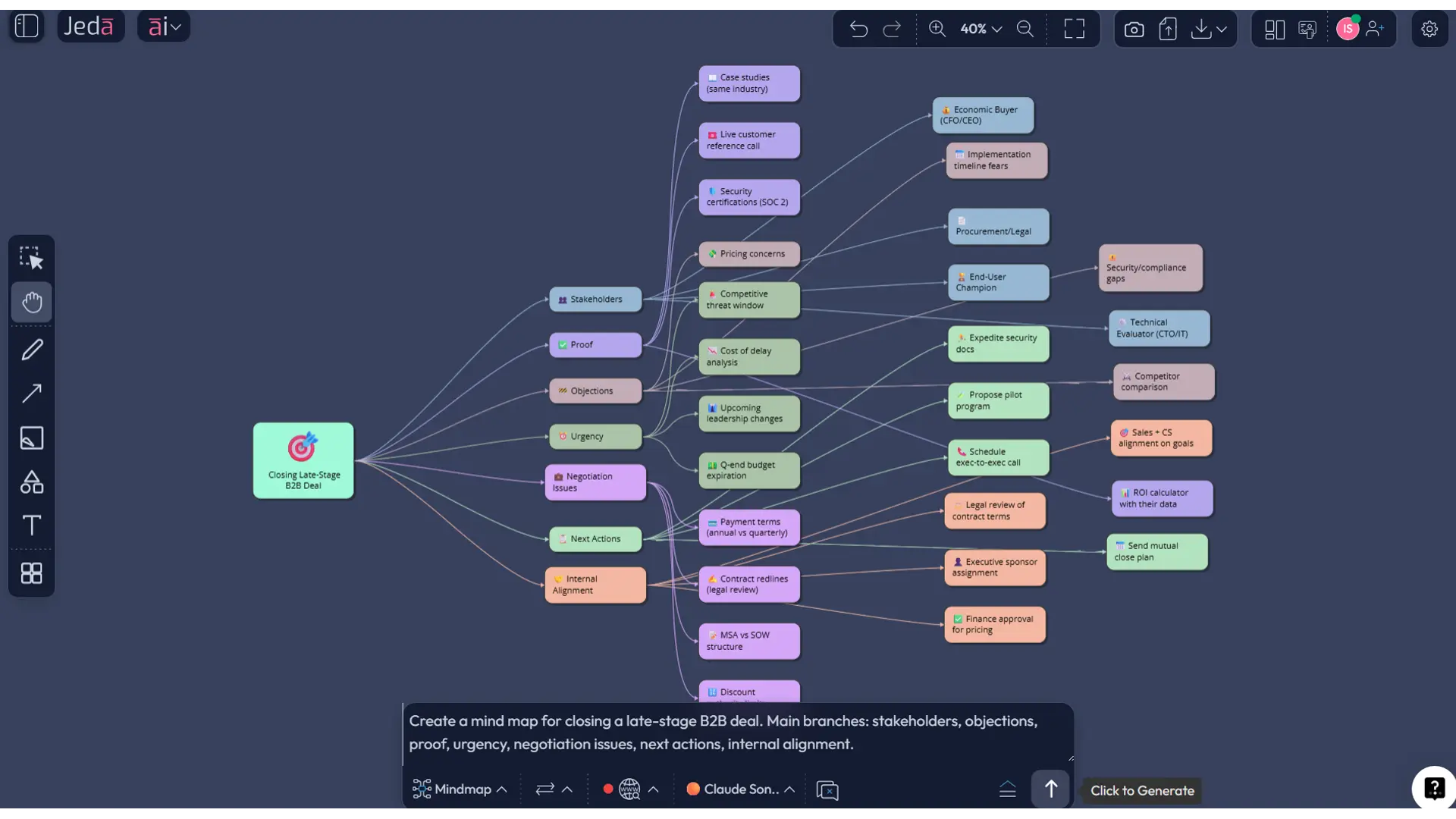
- matrix → mind map for objection branching,
- matrix → flowchart for approval path and next steps.
That flexibility matters because some deals are easier to understand as a grid, while others reveal more when you visualize the approval chain.
- Open the Sealing the Deal recipe
In the AI Menu, choose the Sales matrix recipe for Sealing the Deal and start with the late-stage context you already know.
- Add the real deal inputs
Enter the buyer goal, objections, stakeholders, decision status, commercial issues, and the exact milestone you need next.
- Generate the board
Create the matrix so the team can see blockers, proof gaps, ownership, and next actions in one editable view.
- Stress-test the weak sections
Review the matrix for silent blockers, unclear owners, weak urgency, or missing proof before the next buyer interaction.
- Use AI+ to deepen the risky areas
Select any shape or section and use the AI+ button to expand objections, proof, stakeholder plans, or negotiation paths.
- Convert and share
Use Vision Transform if another visual works better, then collaborate, align, and export the final board when you are ready.
A Real-World Example: Turning a Stalled Deal into a Closing Plan
Imagine a SaaS team has a healthy pipeline opportunity. The champion loves the product. The demo landed. Security has asked questions. Procurement wants revised terms. Finance has gone quiet. Nobody is saying no. Nobody is signing either.
Classic.
A chat-only AI tool could give the rep advice. A CRM could log activity. But Jeda.ai lets the team convert the whole late-stage picture into one editable AI Workspace.
The board might show:
- Champion: supportive, needs internal ROI summary
- Security lead: waiting on architecture proof
- Procurement: pushing on payment terms
- Finance approver: not engaged yet
- Proof gap: missing total-cost comparison
- Urgency trigger: launch date in six weeks
- Next action: send security packet, prep ROI view, schedule finance call
Now the team has a plan, not a vibe.
This is exactly the point. Closing gets stronger when the team can see the work. The best sales organizations do not just “push harder” near the end. They reduce ambiguity faster than the buyer’s indecision can grow.
Best Practices for Closing Deals with an AI Workspace
1) Build the board before the deal feels “stuck”
Don’t wait until the opportunity is wobbling. The best time to create a closing board is when the deal first enters the late stage.
2) Separate objections from proof gaps
Those are not always the same thing. An objection is what the buyer says. A proof gap is what they still need to believe.
3) Map the buying committee explicitly
The 2025 research on large B2B deals reinforces how critical stakeholder management is. If you are not visualizing stakeholder roles and influence, you are leaving risk hidden.
4) Turn every next step into an owner + date
No vague action items. No “circle back soon.” Put a name and a deadline on each move.
5) Use multiple AI models when the deal is complex
When the opportunity is strategic, run a broader reasoning pass. One model may surface stakeholder issues. Another may sharpen the commercial angle. The aggregation workflow helps synthesize that.
Common Mistakes That Kill Late-Stage Deals
1) Confusing enthusiasm with commitment
A champion can love your product and still fail to carry the deal internally. Closing requires commitment, not just positivity.
2) Treating closing as a rep-only event
Complex deals are rarely won by one person improvising well. Leadership, finance, legal, security, and implementation often matter more than the final flourish.
3) Overusing pressure and underusing clarity
Pushiness can create motion. It can also break trust. The better move is usually to reduce uncertainty, tighten next steps, and make commitments visible.
4) Letting “no decision” remain invisible
HBR’s findings on customer indecision should scare more revenue teams than they do. If there is no clear internal buying motion, you are not competing against another vendor. You are competing against drift.
5) Leaving the proof outside the workflow
If the security answers live in one email thread, ROI logic in a deck, and commercial questions in Slack, the deal is harder to move. Consolidate the reasoning where the team can actually work with it.
Frequently Asked Questions
- What is sales closing?
- Sales closing is the stage where buyer interest becomes a committed next step, commercial agreement, or signed deal. In modern B2B sales, it usually means reducing friction around decision-making rather than relying on one persuasive line at the end of a call.
- What causes deals to stall right before signature?
- Late-stage deals usually stall because of hidden stakeholders, weak proof, unresolved objections, procurement delays, or buyer indecision. Often the problem is not that the buyer dislikes the offer — it is that nobody has made the path to action clear enough.
- How can AI help close more sales?
- AI can summarize conversations, surface patterns, personalize follow-ups, organize objections, and recommend next actions. In a visual system like Jeda.ai, AI also helps structure the deal into an editable board so teams can see blockers and move them faster.
- What is a closing matrix?
- A closing matrix is a structured board that maps the key elements of a late-stage deal, such as stakeholders, objections, proof gaps, urgency, commercial issues, and next actions. It helps teams inspect the deal instead of relying on scattered notes or memory.
- Can Jeda.ai help with objection handling?
- Yes. Jeda.ai can generate and organize objection-handling views inside a matrix, diagram, or mind map. You can show the objection, the required proof, the owner, the risk level, and the next action, then extend the weak sections using the AI+ button.
- What should be on a deal-closing board?
- A practical deal-closing board should include stakeholders, buying role, current position, objections, proof needed, urgency trigger, commercial issue, confidence level, next action, owner, and target date. That structure keeps the team focused on movement, not noise.
- Is this only for enterprise sales teams?
- No. Enterprise teams benefit the most because stakeholder complexity is higher, but startups, agencies, consultants, and SMB teams can use the same logic. If your deals involve multiple concerns or slow final decisions, a visual closing workflow helps.
- Can we use multiple AI models on the same deal?
- Yes, on eligible plans Jeda.ai supports a Multi-LLM workflow so you can compare different reasoning perspectives and use an aggregation model to synthesize the strongest output. That can be useful when the deal has technical, commercial, and political complexity.
- Can I export the final board?
- Yes. Jeda.ai supports exporting work as PNG, SVG, and PDF. That makes it easier to share closing plans with executives, revenue leaders, and cross-functional stakeholders who need a decision-ready view outside the workspace.
- How is Jeda.ai different from a chat-only AI tool for sales?
- A chat-only AI tool gives you advice in text. Jeda.ai gives you an editable visual workspace where the whole team can inspect stakeholders, objections, proof, and next actions together. That shift from suggestion to shared execution is the real difference.
Sources and Further Reading
- [1]
Harvard Business Review (2022) . “Stop Losing Sales to Customer Indecision” HBR.
View Source ↗ - [2]
Salesforce (2024) . “Sales Teams Using AI 1.3x More Likely to See Revenue Increase” Salesforce News.
View Source ↗ - [3]
McKinsey & Company (2025) . “Unlocking profitable B2B growth through gen AI” McKinsey.
View Source ↗ - [4]
M. Z. Rateb et al. (2025) . “Micro-level tactics salespeople use to pursue large B2B deals: A semi-systematic review and research agenda” Journal of Business Research.
View Source ↗ - [5]
Program on Negotiation at Harvard Law School (2026) . “7 Tips for Closing the Deal in Negotiations” PON.
View Source ↗ - [6]
HubSpot (2025) . “How to Close a Sale: Tips, 18 Techniques & Why They Work” HubSpot Sales Blog.
View Source ↗ - [7]
HubSpot (2025) . “How to use AI to close more sales” HubSpot Sales Blog.
View Source ↗ - [8]
Pipedrive (2026) . “6 Powerful Techniques for Closing Sales Deals” Pipedrive.
View Source ↗ - [9]
HubSpot (2025) . “31 Closing Phrases to Seal a Sales Deal” HubSpot Sales Blog.
View Source ↗
Build Your Next Closing Plan in Jeda.ai
Join over 150,000+ users using Jeda.ai’s AI Workspace to turn messy late-stage deals into visible, decision-ready action.
Try Free Template