Some TRIZ tools feel like engineering textbooks. Smart Little People feels like a weird art exercise.
It works anyway.
SLP (also known as Moving Little Men / Miniature Dwarfs in some TRIZ references) is a pictorial idea-generation method where you imagine tiny “agents” inside the system performing actions to resolve the problem. Multiple TRIZ resources describe SLP/MSLP as a pictorial technique that engages users in sketching “troops” of little people to solve the problem.
AI makes SLP easier because it can turn your narrative into consistent micro-agent sketches, roles, and mechanism hypotheses—without killing the playful energy.
What is Smart Little People (SLP) in TRIZ?
SLP is a creative modeling method:
- Represent the system as a simple scene.
- Populate it with tiny “smart” agents.
- Ask: “What would they do to remove the harm or strengthen the function?”
- Translate the actions into real mechanism changes.
It is explicitly presented as a creativity tool in TRIZ communities and training resources.
The trick is that SLP forces you to think in actions (push, block, separate, transport, absorb) rather than vague nouns (“improve stability”).
When SLP is the best tool
SLP is especially useful when:
- the physics are hard to “see” mentally,
- you need rapid ideation in workshops,
- you’re stuck in abstract debate,
- you want multiple mechanism directions quickly.
SLP is less useful when the problem is primarily mathematical optimization (unless you use SLP to propose structural changes first).
Why AI + SLP is a strong combo
SLP output quality depends on clarity:
- what the “bad interaction” is,
- what must remain unchanged,
- and what the agents are allowed to do.
AI helps by:
- converting problem statements into a clean “scene description,”
- generating multiple agent-based action ideas (3–10 variants),
- suggesting how to map each action to a real mechanism.
But you still decide what is physically plausible.
How to run Smart Little People (SLP) with AI (Matrix) in Jeda.ai (2 ways)
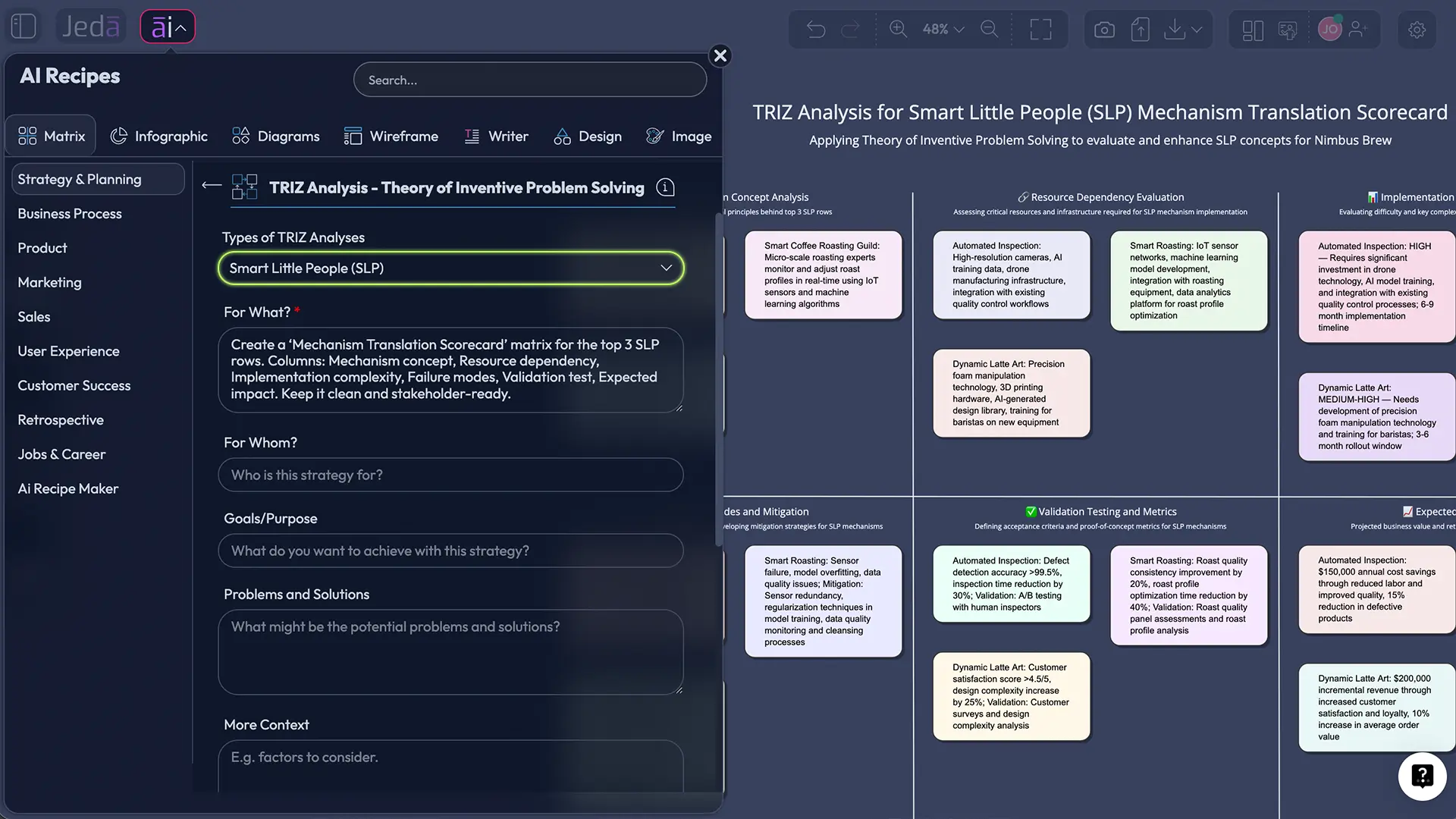
Method 1 — AI Recipe Templates (AI Menu)
Open your board → open AI Menu / AI Recipes.
Go to TRIZ → choose Smart Little People (SLP) / Moving Little Men. (SLP is commonly described as a pictorial TRIZ ideation method where you “sketch troops of little people” solving the problem.)
Fill recipe inputs
Click Generate → get an on-canvas SLP output.
Convert the output into a Matrix next to it: SLP action → mechanism translation → risk → fastest test.
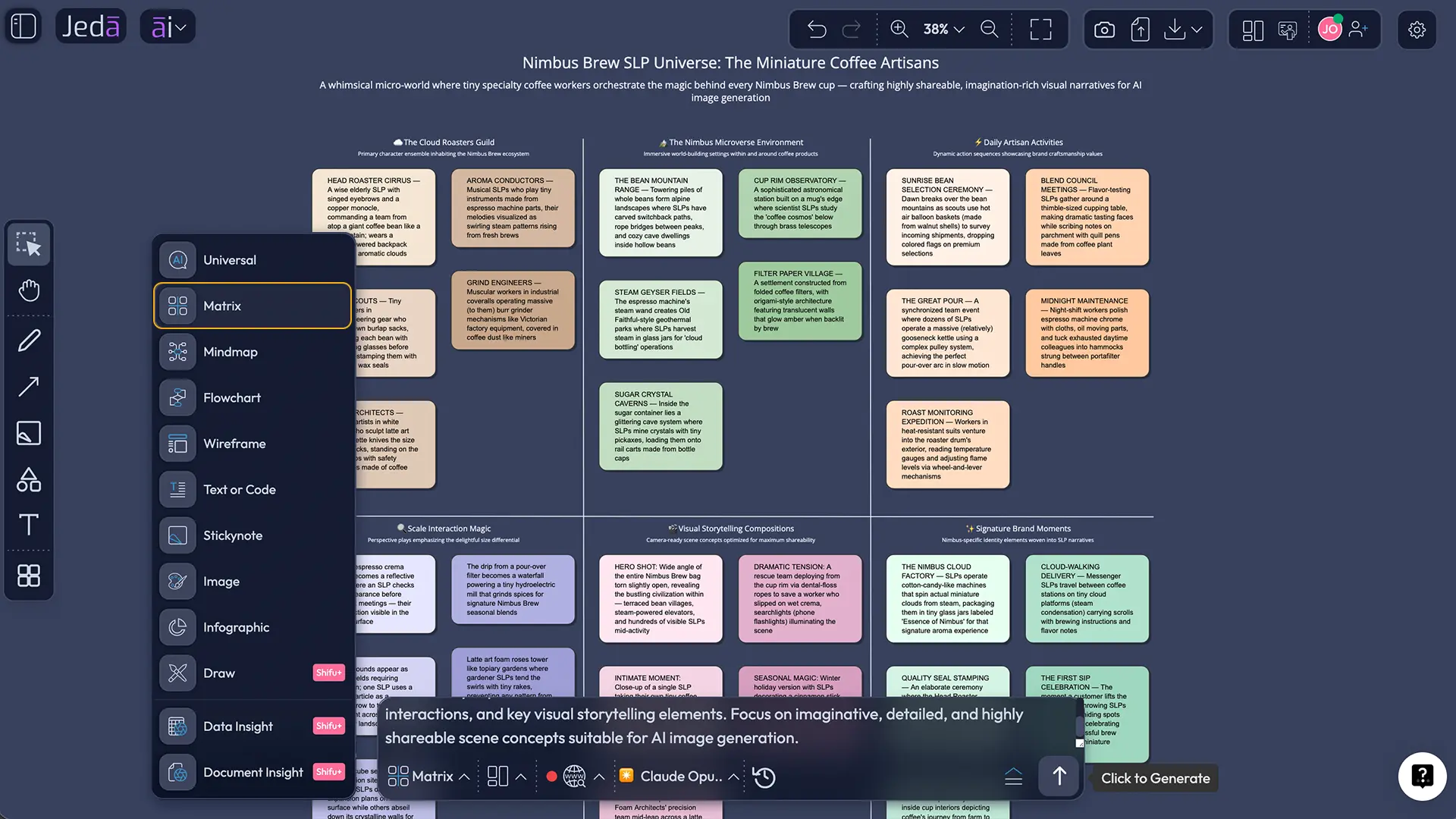
Method 2 — Prompt Bar (Matrix-first workflow)
Open the AI Command/Prompt Bar at the bottom of the workspace. (Jeda.ai calls it the AI Command Bar in their guides.)
Select Matrix.
Paste a structured SLP prompt Deliverable: “Create an SLP ideation matrix with 8 rows. Columns: (1) Little people action (verb), (2) What they manipulate (force/heat/fluid/info), (3) Real mechanism translation, (4) Existing resource used, (5) Risk/new harm, (6) Fastest falsifiable test + KPI.”
Generate → edit rows (kill duplicates, tighten verbs, ensure each row uses a real available resource).
Pick top 1–2 rows and generate a supporting Diagram (optional) to visualize the best mechanism direction.
- Describe the scene
Write a concrete picture: objects, flows (force/heat/liquid/data), and where the harm happens.
- Define constraints
List what must not change (no new parts, no size increase, no extra energy, safety rules).
- Generate SLP actions
Use AI to produce 6–10 ‘little people’ action verbs (block, redirect, separate, absorb, transport, shield).
- Translate to mechanisms
For each action, write the real mechanism change and the existing resource it uses.
- Test and rank
Add risk + fastest falsifiable test per row, then rank by feasibility and impact.
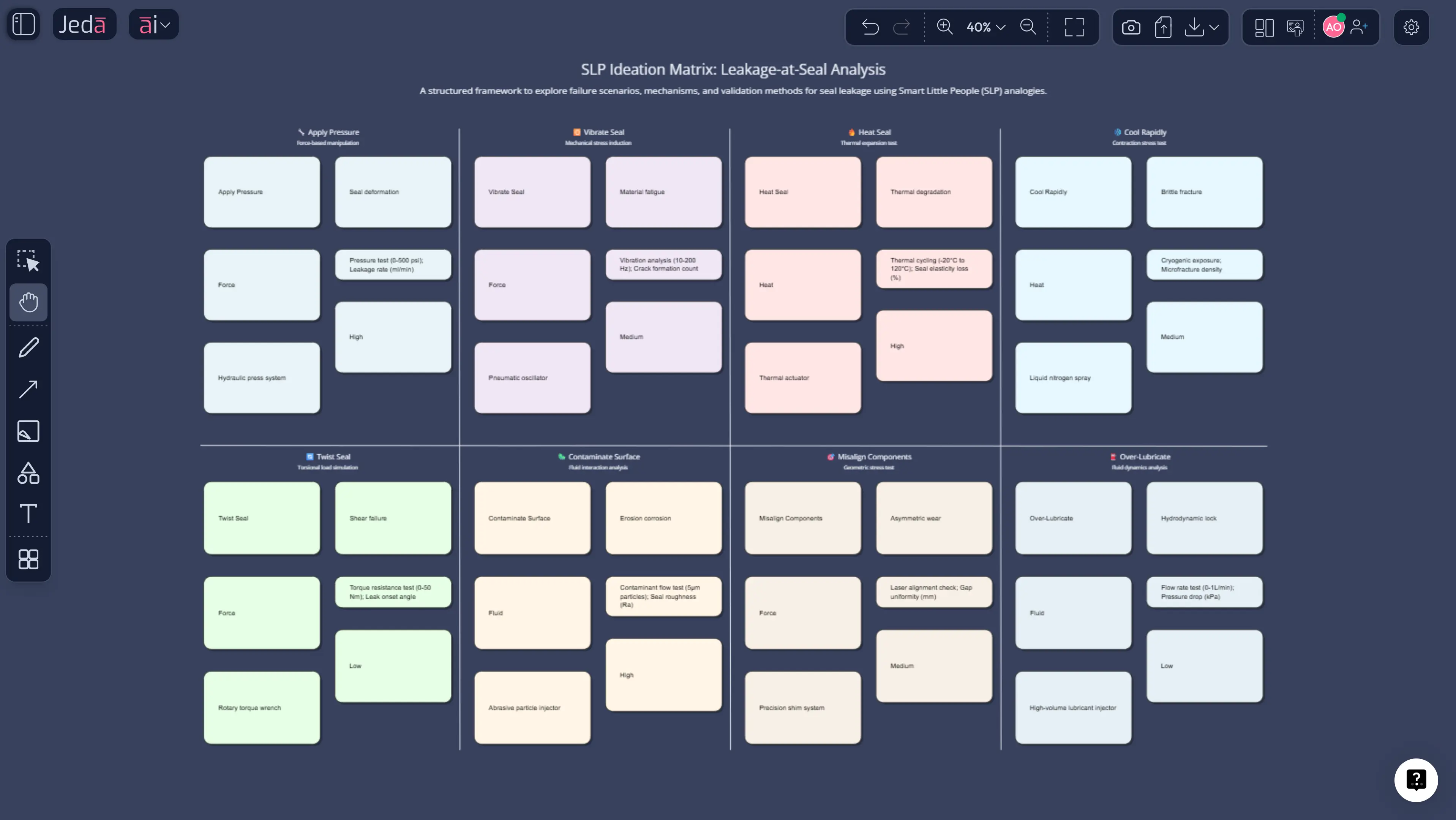
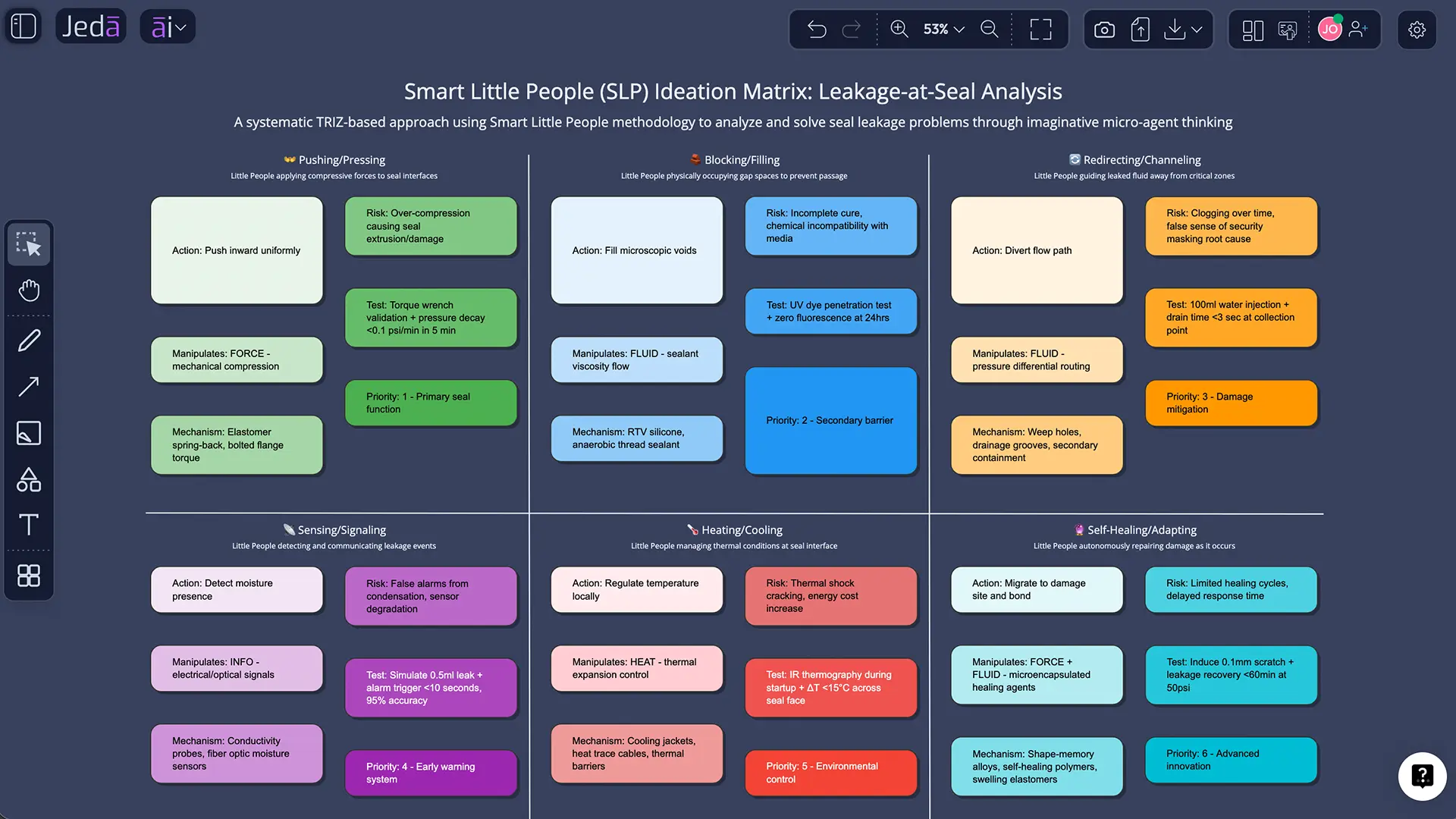
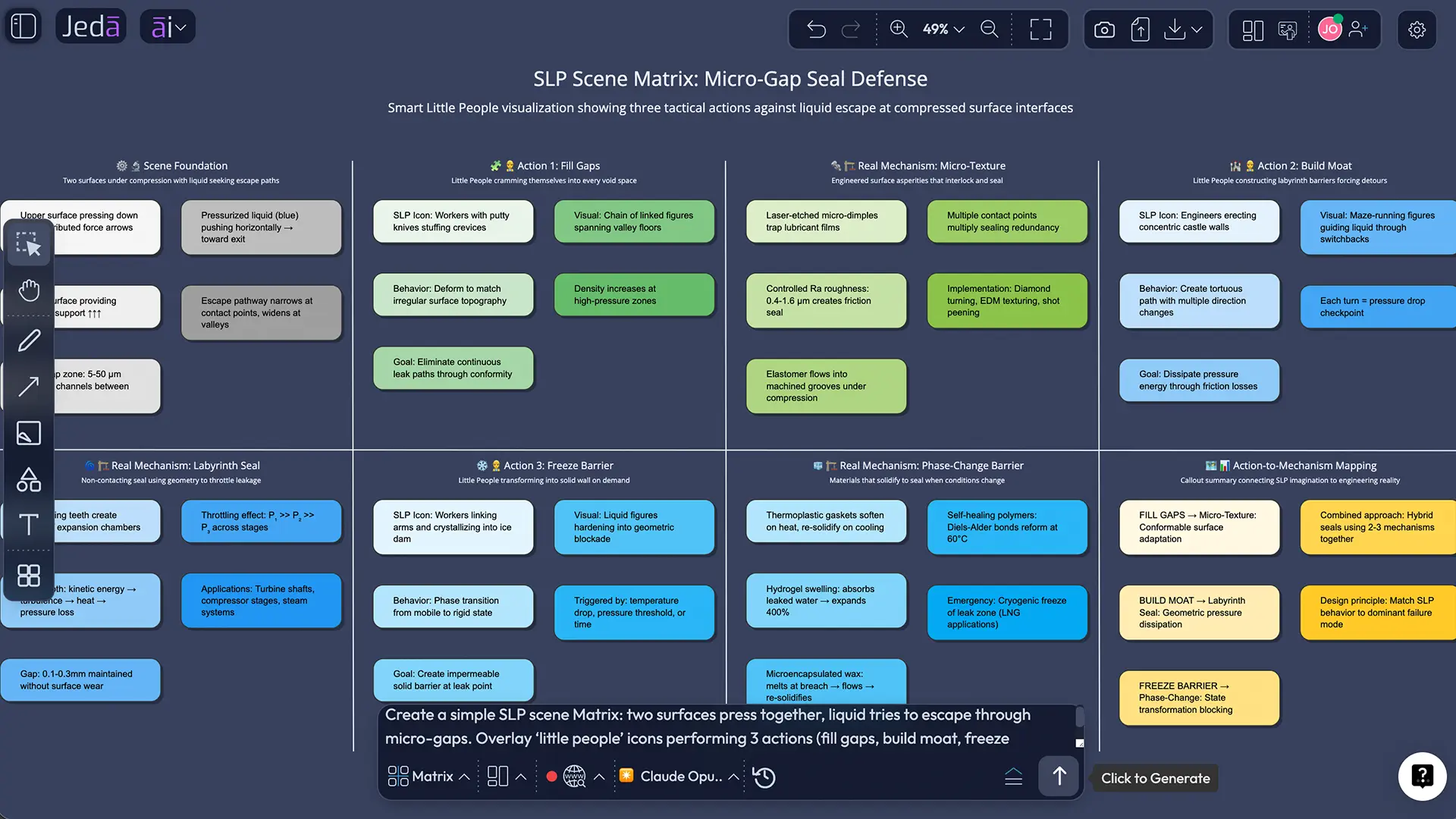
Example: liquid leakage at a seal interface
Scene:
- two surfaces press together,
- a liquid tries to escape through micro-gaps.
SLP actions (examples):
- “little people fill gaps with tiny wedges” → surface micro-texture or compliant microstructure
- “little people create a moat” → labyrinth seal geometry
- “little people freeze the liquid near gap” → local temperature control / phase change barrier
Notice what happens: you stop arguing about “better sealing” and start proposing concrete ways to manipulate the interface.
Thought‑leadership: SLP is ‘mechanism empathy’
SLP works because it forces empathy at the micro-level:
- If you were a molecule, where would you go?
- If you were a force vector, where would you concentrate?
- If you were heat, what path would you take?
That’s why SLP is still used in TRIZ training and creativity toolsets. AI doesn’t replace imagination here. It scales it.
FAQ
- What is the Smart Little People (SLP) method in TRIZ?
- Smart Little People (SLP) is a TRIZ creativity method where you imagine tiny agents inside the system performing actions to remove harmful interactions or strengthen useful functions, then translate those actions into real mechanisms.
- Is SLP the same as Moving Little Men or Miniature Dwarfs?
- Many TRIZ sources describe related variants such as Moving Little Men or Miniature Dwarfs. The core idea is the same: pictorial micro-agent modeling to trigger mechanism-level solutions.
- When should I use SLP?
- Use SLP when you need fast mechanism ideation, when the physics are hard to visualize, or when teams are stuck in abstract debate. It’s especially effective in workshops.
- How can AI help with SLP?
- AI can generate multiple SLP scene variants, propose micro-agent actions, and translate each into mechanism-level solution directions. Humans validate feasibility and constraints.
Citations
- [1]
Think Innovating (n.d.) . “Method of Smart Little People (MSLP)” ThinkInnovating.org.
View Source ↗ - [2]
T. Pheunghua (2024) . “TRIZ and Generative AI – Example of Prompt” TRIZ‑Consulting.de (PDF).
View Source ↗ - [3]
Wiley (Excerpt) (n.d.) . “TRIZ Tools for Creativity and Clever Solutions (SLP excerpt)” Wiley (PDF excerpt).
View Source ↗ - [4]
Benchmark Six Sigma (forum) (2020) . “Smart Little People (SLP) in TRIZ” BenchmarkSixSigma.com.
View Source ↗