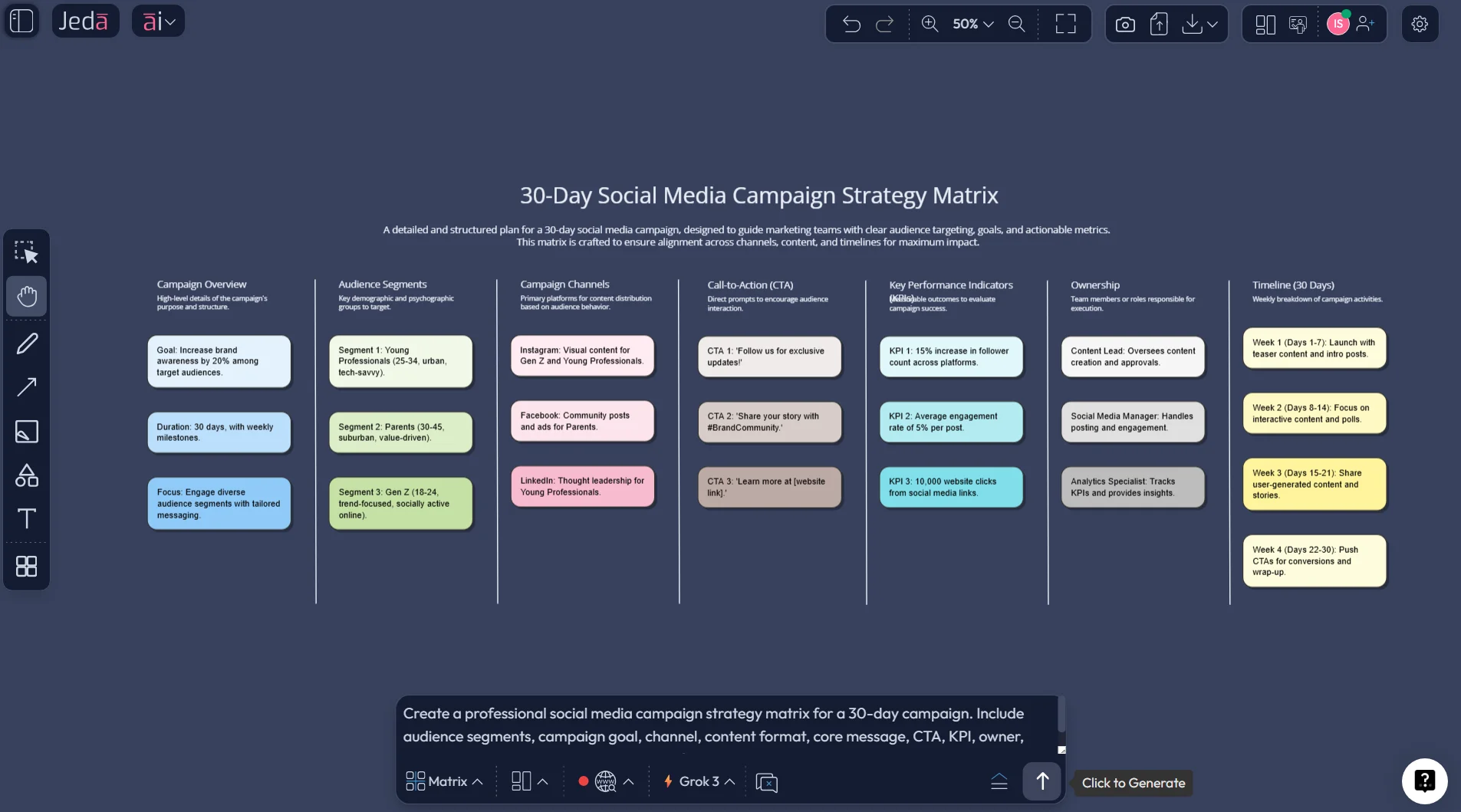
A social media campaign strategy should not live as scattered notes, three half-finished docs, and a calendar that nobody updates after week one. It should live in one editable system. That is exactly where Jeda.ai fits. Instead of treating campaign planning like a linear checklist, Jeda.ai turns it into a visual, collaborative artifact inside an AI Workspace and AI Whiteboard that your team can actually use. With 150,000+ users and 300+ strategic frameworks, Jeda.ai gives marketers a faster way to align goals, channels, content, paid support, and KPIs—without drowning in tabs.
If you’re building a launch plan, a seasonal push, or a lead-generation campaign, the problem is rarely “we have no ideas.” The real problem is fragmentation. Goals live in one place. audience notes live in another. platform logic lives in someone’s head. And then the campaign goes live with more optimism than structure. Not ideal.
A smarter fix is to use a matrix.
What is a social media campaign strategy?
A social media campaign strategy is the planning system that connects a campaign goal to the actual work people will see on social platforms. It defines the objective, target segments, core message, content angles, channel choices, cadence, calls to action, and the KPIs you will use to judge success.
That sounds obvious. But here’s the catch: a campaign strategy is not the same thing as your always-on social presence. Your ongoing social media marketing strategy sets the long-term brand direction. A campaign strategy is narrower, time-bound, and outcome-specific. It is built to move a defined metric, whether that is awareness, signups, waitlist joins, product trials, purchases, event registrations, or community participation.
Most current guides organize campaign planning around the same backbone—goals, audience, channel choice, timing, content, and measurement. They’re not wrong. They’re just static. A matrix-based approach is stronger because it forces trade-offs into view. You can see which audience segment is tied to which offer, which channel is carrying which message, and where your KPIs stop making sense.
Why build a social media campaign strategy with AI?
Because speed matters, but clarity matters more.
The average global social media user now visits 6.75 platforms per month and spends 18 hours and 36 minutes per week on social (DataReportal, 2026). That means campaign planning cannot be lazy channel-stuffing anymore. You need a way to decide where each message belongs and why. Marketers are also leaning harder into platform-native execution: HubSpot’s 2026 statistics say Instagram is used by 70% of marketers, TikTok is among the top ROI channels for many teams, and short-form video remains the top media format marketers plan to invest in (HubSpot, 2026). Meanwhile, Sprout Social reports that only 56% of social users think brands do a good job producing truly original content (Sprout Social, 2026). Translation: more posting is not the answer. Better strategy is.
Jeda.ai helps because it compresses the planning loop:
- you define the campaign objective,
- AI structures the first-pass matrix,
- your team edits the logic,
- you use AI+ to deepen weak rows,
- and you can convert the strategy into another visual when needed.
That’s useful in a normal planning meeting. It’s even more useful when your campaign includes paid and organic social, multiple stakeholders, or several audience segments with different value propositions.
And Jeda.ai does this inside one AI Workspace, not across a mess of isolated documents. That is the real edge.
- Faster alignment
Map goals, segments, channels, and KPIs in one board instead of across disconnected files.
- Visual campaign logic
A matrix makes trade-offs visible, so weak channel choices and vague CTAs stand out fast.
- AI-assisted expansion
Use Jeda.ai to generate first-pass ideas, then use AI+ to deepen offers, content hooks, or channel tactics.
- Collaborative planning
Let content, social, paid, leadership, and product teams review the same live campaign artifact.
- KPI-first structure
Tie each campaign stream to measurable outcomes like reach, CTR, engagement rate, leads, or conversions.
- Reusable system
Duplicate the matrix for launches, webinars, promos, or always-on campaign sprints without rebuilding from zero.
| Strategy Depth | Editable Visual | Collaboration | AI Expansion | Export | |
|---|---|---|---|---|---|
| Jeda.ai | High | ✓ | ✓ | ✓ | PNG / SVG / PDF |
| Static template | Medium | ✗ | Limited | ✗ | Varies |
| Basic scheduler | Low | ✗ | Operational only | Limited | Limited |
How to create a social media campaign strategy in Jeda.ai
Jeda.ai gives you two practical ways to build this. Since this topic is a matrix, the recommended path is the Recipe Matrix method first. Then use the Prompt Bar when you want more control over how the matrix is framed.
Method 1 — Recipe Matrix
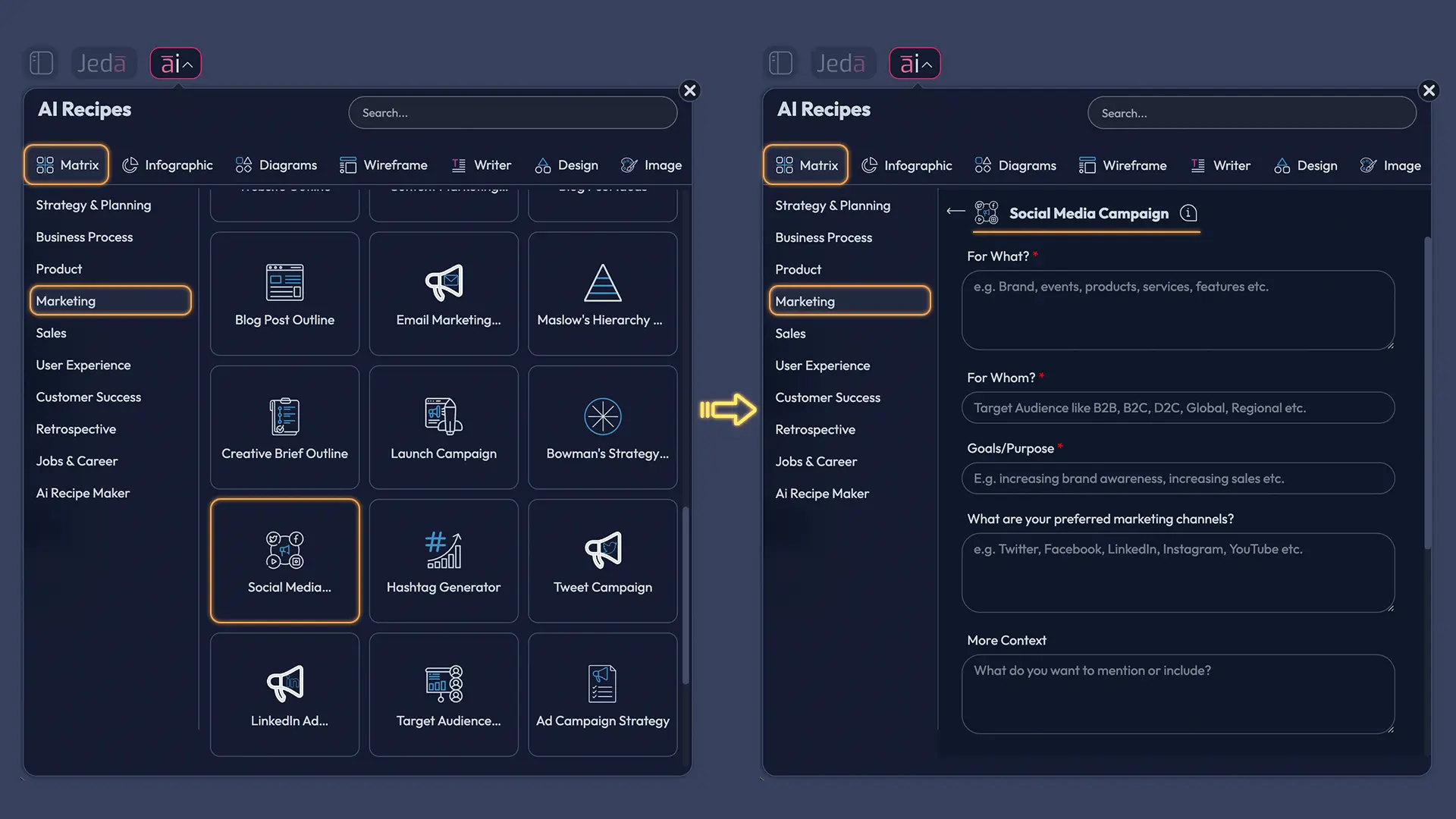
Open the AI Menu from the canvas and choose Matrix Recipes. Select the Social Media Campaign Strategy recipe, then fill in the inputs that actually matter: your campaign objective, the audience segment or segments, the offer, the timeframe, the channels you want to test, and the KPIs you care about.
Once Jeda.ai generates the first draft, do not treat it like gospel. Clean it up. Remove channels that are weak fits. Sharpen the message. Add owners. Add timing. Split paid and organic if that distinction matters. The point is not to “accept the AI answer.” The point is to turn the first draft into a decision-grade matrix.
Then use the AI+ button on any weak area. Maybe your Instagram plan looks bland. Maybe your LinkedIn CTA is vague. Maybe your TikTok content angles are all noise and no offer. Tap AI+ to extend that section and produce a deeper set of options.
Method 2 — Prompt Bar
If you want a more custom structure, open the Prompt Bar at the bottom of the canvas and select the Matrix command. Then ask Jeda.ai to generate a campaign matrix with the specific rows and columns you want.
This route is useful when your campaign needs a custom lens. Maybe you want one row for audience stage, one for creative format, one for paid support, and one for conversion friction. That is the kind of thing the Prompt Bar handles well.
After the matrix is on the board, you can also use Vision Transform to convert it into a different visual. A matrix is great for planning. A flowchart is better for approval flow. A mind map is better for idea expansion. Jeda.ai lets you move between those shapes without starting over. That is what makes an AI Whiteboard more useful than a plain planning doc.
- Open Matrix Recipes
Click AI Menu on the canvas, choose Matrix Recipes, and select the social media campaign planning template.
- Add campaign inputs
Enter the business goal, audience segments, offer, timeframe, channels, content themes, and target KPIs.
- Generate the first draft
Let Jeda.ai produce the initial campaign strategy matrix with rows, columns, and recommended planning logic.
- Edit the matrix
Refine channel choices, tighten the core message, separate paid and organic tactics, and assign owners or dates.
- Use AI+ for a deeper dive
Tap the AI+ button on any row or cell cluster to expand weak areas such as content hooks, CTA variations, or platform-specific tactics.
- Use the Prompt Bar when you need custom structure
Open the Prompt Bar, select Matrix, and prompt Jeda.ai to build a custom campaign matrix around your exact planning fields.
- Transform the visual if needed
Use Vision Transform to convert the matrix into a flowchart, mind map, or diagram for reviews, approvals, or presentation.
- Share or export the final board
Collaborate live, then export the finished strategy as PNG, SVG, or PDF for stakeholder review.
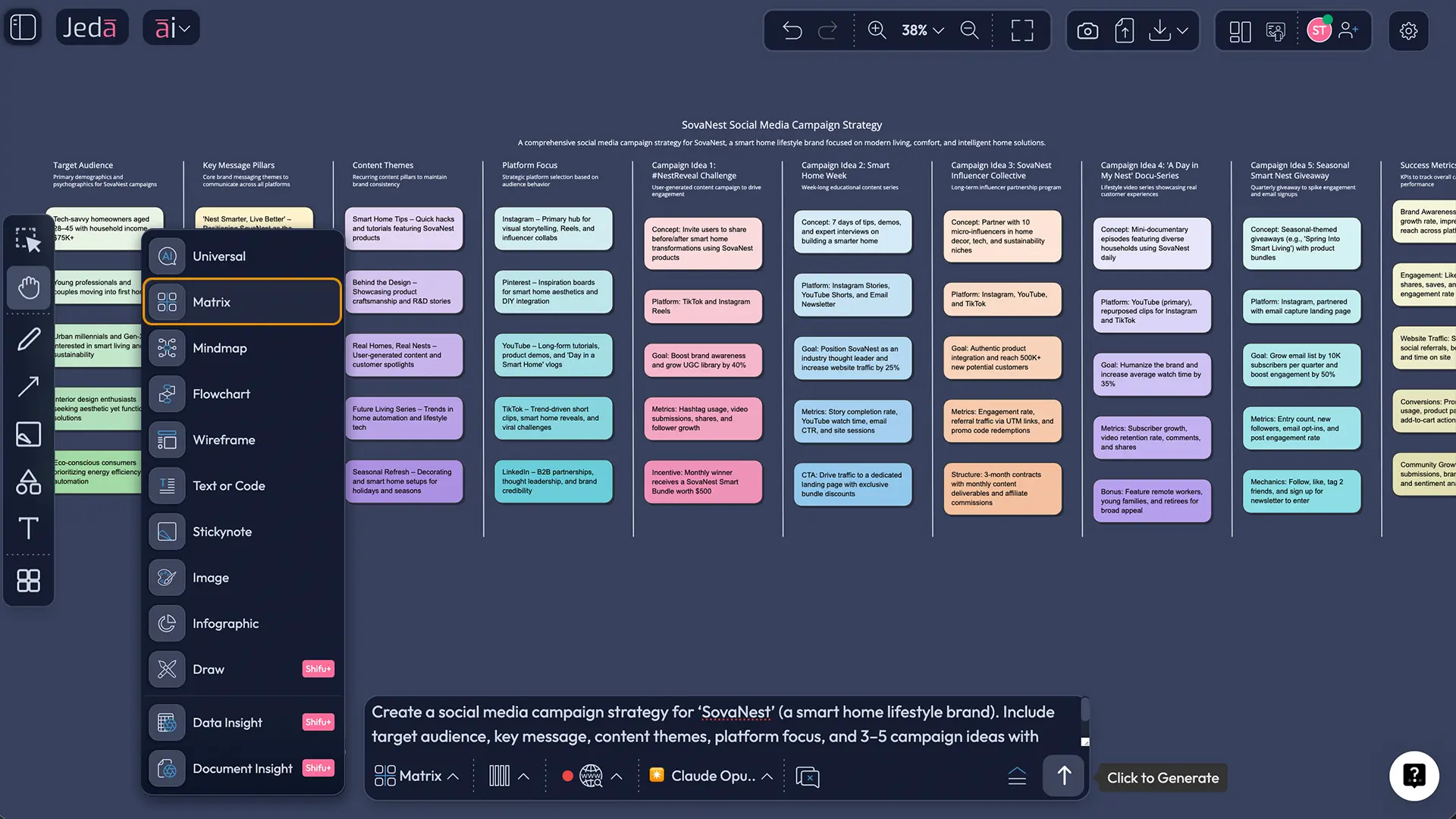
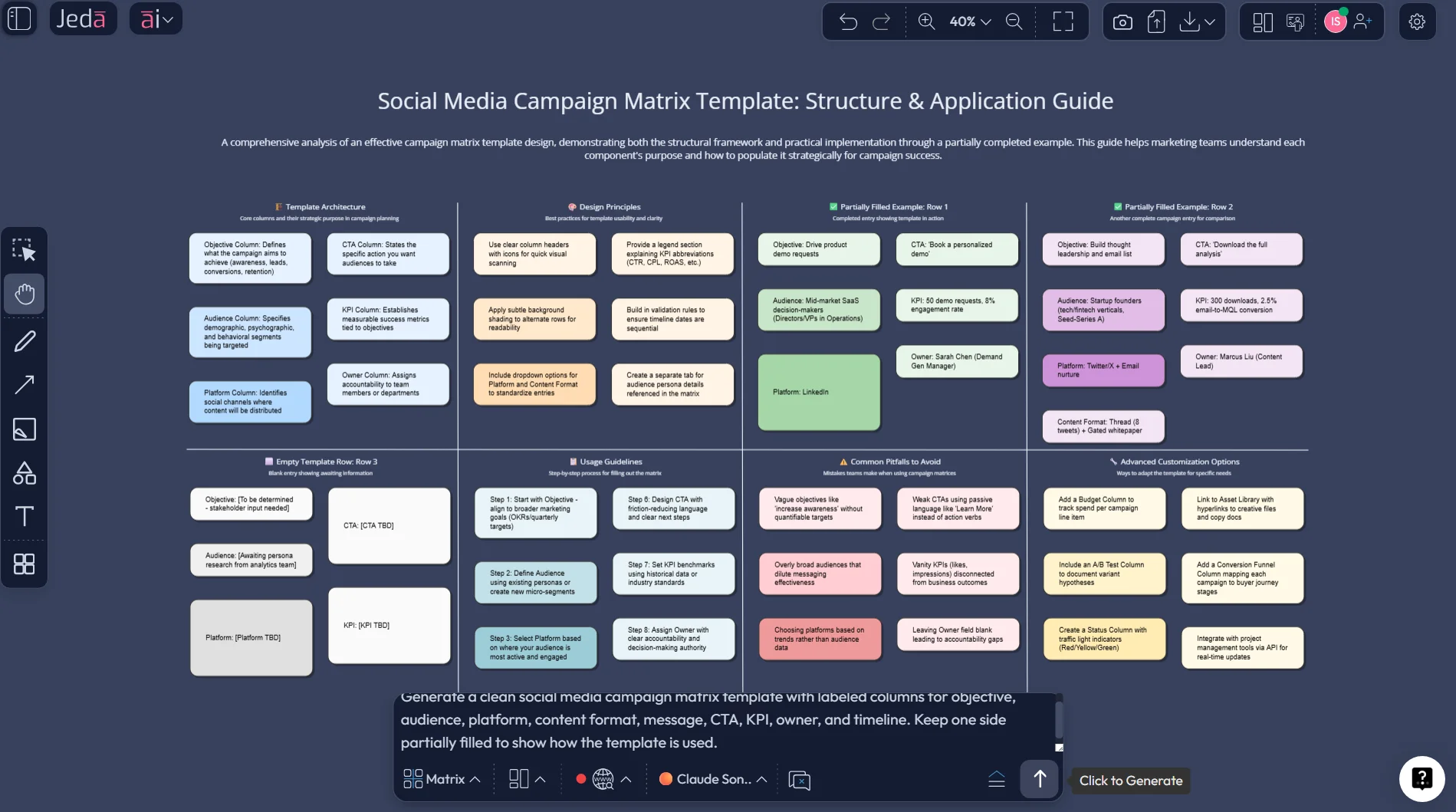
Social Media Campaign Strategy matrix template
A useful matrix does not try to hold everything. It holds the decisions that matter most.
For this topic, the strongest matrix usually includes these planning fields:
- campaign objective
- audience segment
- value proposition or core message
- channel or platform
- content format
- CTA
- KPI
- owner and timing
That sounds simple because it is. Simple is not the enemy. Vague is the enemy.
A strong social media campaign strategy matrix shows the relationship between these fields at a glance. It helps you answer questions like: Which message is LinkedIn carrying for decision-makers? Which CTA belongs on Instagram versus TikTok? Are we trying to generate demand and conversions from the same content stream? Did we assign a KPI that actually matches the objective? Those are the questions that save real campaigns.
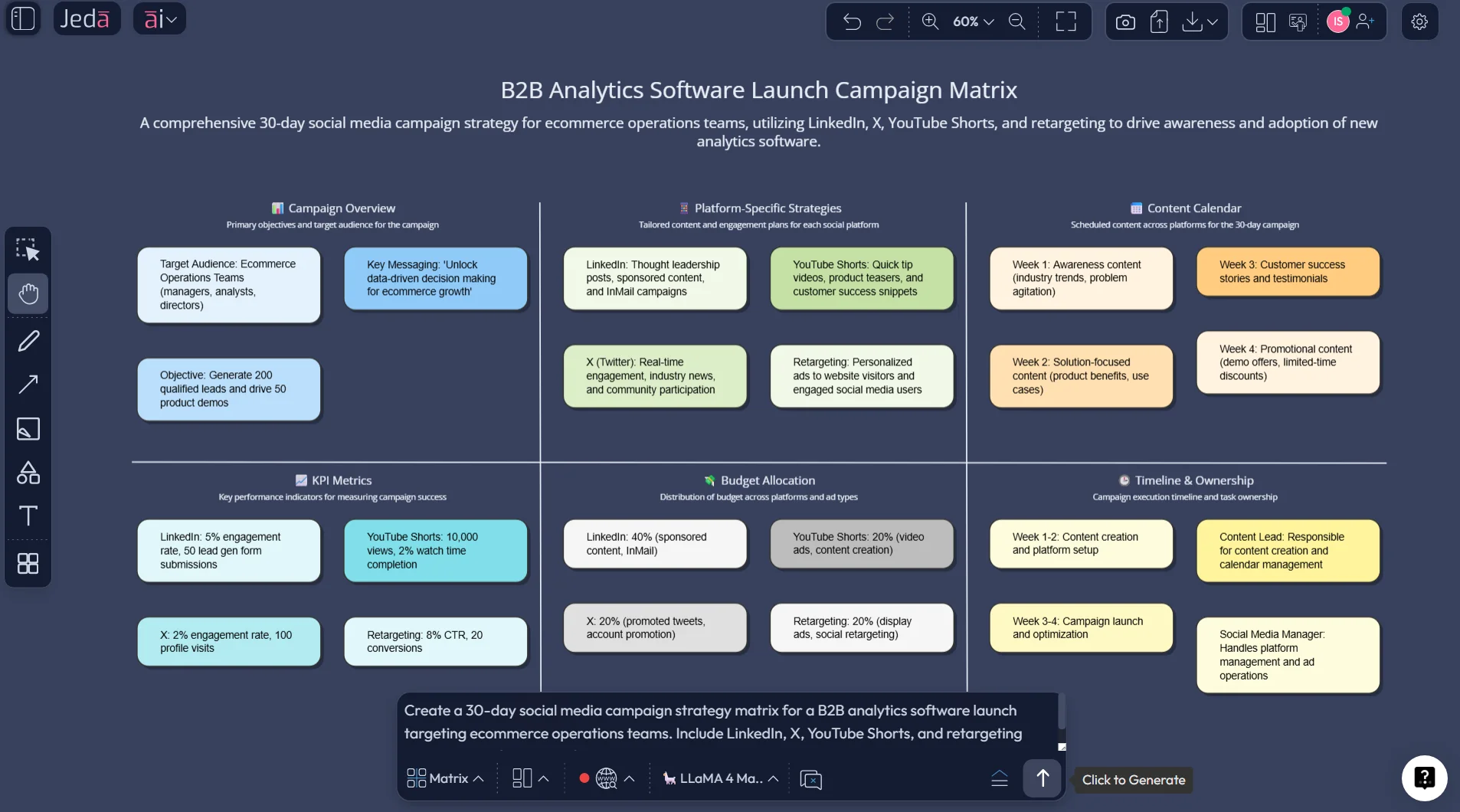
Worked example: a 30-day launch campaign
Imagine you are launching a new B2B analytics dashboard for ecommerce operators. The campaign goal is not “get attention.” Too vague. The real goal is book qualified demos.
Your matrix might look like this:
Audience 1: ecommerce operations managers
- Channel: LinkedIn
- Message: reduce stockout risk and reporting delays
- Content: before/after carousel, short thought-leadership post, customer quote
- CTA: book a demo
- KPI: CTR, demo form completion rate
Audience 2: performance marketers at mid-market brands
- Channel: X and YouTube Shorts
- Message: unify campaign and inventory data faster
- Content: punchy stat clips, problem-solution videos, teaser thread
- CTA: join webinar
- KPI: video completion rate, webinar registrations
Audience 3: existing email subscribers already in consideration
- Channel: Instagram retargeting plus LinkedIn remarketing
- Message: see the product in action
- Content: demo snippets, feature clips, social proof assets
- CTA: start free trial
- KPI: landing-page conversion rate, cost per trial
Now the benefit of Jeda.ai becomes obvious. You can build this visually, extend any weak section with AI+, convert the matrix into a presentation-ready diagram, and keep the whole campaign inside the same AI Workspace. No copy-paste circus. No “final_v7_really_final” deck nonsense.
Best practices for stronger campaign performance
A campaign plan is only useful if it helps you make better decisions under real constraints. Budgets change. timing shifts. channels underperform. And audience behavior gets weird without asking permission first.
That is why the strongest campaign strategies follow a few rules.
A few current signals matter here too. Community behavior and customer care should not sit outside your campaign strategy. Adobe cites Sprout Social research showing that 73% of social users say they’ll buy from a competitor if a brand doesn’t respond on social (Adobe Express, 2025). That is brutal, but useful. It means campaign planning should include response ownership, escalation, and moderation. Not just posting.
And originality matters more than the average content team wants to admit. If only 56% of social users think brands do a good job at producing original social content, then “do what’s trending, but with our logo on it” is not a strategy. It is decorative panic.
Common mistakes to avoid
The first mistake is confusing activity with strategy. A packed calendar is not proof of strategic thinking. It may just be evidence that your team is very busy.
The second mistake is treating every platform as identical. LinkedIn, Instagram, TikTok, X, YouTube Shorts, and Pinterest do not reward the same message shape. If your campaign matrix does not adapt the content format and CTA by channel, you are probably recycling too aggressively.
Third, teams often mix awareness, engagement, and conversion goals in one content stream and then wonder why the metrics look muddy. Separate those workstreams. Make the campaign honest.
Fourth, they leave measurement too late. KPIs should shape the plan before the first asset is built, not after the campaign underperforms.
And finally, some teams use AI to generate volume instead of clarity. Bad move. The point of AI here is to improve structure, sharpen angles, surface options, and save planning time. Not flood the calendar with generic filler.
Frequently Asked Questions
- What is a social media campaign strategy?
- A social media campaign strategy is the planning framework behind a time-bound campaign. It defines the campaign goal, audience, message, channels, content formats, CTAs, and KPIs so your social activity supports a measurable business outcome instead of becoming random posting.
- What is the difference between a social media strategy and a social media campaign?
- A social media strategy is the long-term system for how your brand uses social overall. A social media campaign is a focused, time-bound push inside that larger system. Strategy sets direction; campaigns are the structured plays you run to achieve specific outcomes.
- What should a social media campaign matrix include?
- A useful campaign matrix usually includes the objective, audience segment, core message, channel, content format, CTA, KPI, owner, and timeline. If you are mixing paid and organic social, separate those rows so the plan stays clear and the performance data stays meaningful.
- How do I choose the right social platforms for a campaign?
- Start with audience behavior, buying context, and past evidence. Choose the platforms where that audience already pays attention and where the content format fits the offer. A smaller, sharper channel mix usually beats a broad plan spread thin across every network.
- How does AI help with a social media campaign strategy?
- AI speeds up the first draft, surfaces content angles, suggests structural gaps, and helps you test alternatives faster. In Jeda.ai, AI is most useful when it helps you organize campaign logic visually, then extend weak sections with AI+ instead of replacing human judgment.
- How do I use AI without making my campaign sound generic?
- Use AI to structure, expand, compare, and refine. Do not publish the first generic output. Feed it real audience detail, brand voice, offer context, and channel constraints. Then edit aggressively. Originality still matters, especially when audiences can spot recycled content from a mile away.
- What KPIs matter most in a social media campaign?
- That depends on the goal. Awareness campaigns usually focus on reach, impressions, video views, and share of voice. Engagement campaigns emphasize saves, shares, comments, and click-through rate. Conversion campaigns care more about leads, trials, purchases, conversion rate, and cost per result.
- Can one campaign plan handle both paid and organic social?
- Yes, but only if you separate them clearly. Organic social often builds awareness, trust, and engagement, while paid social is often optimized for reach, retargeting, or direct conversion. Putting both into one matrix works well as long as the message, CTA, and KPI logic stay distinct.
- Can I build this in Jeda.ai on the free plan?
- Yes. Whitebelt is the free Jeda.ai plan and includes all 11 commands with limited daily usage. Blackbelt expands usage and collaboration, while Shifu adds Multi-LLM intelligence and the Aggregator for more advanced workflows. Start free, then upgrade if your team needs more depth.
- What can I do after the matrix is complete?
- After the matrix is done, use AI+ to deepen specific rows, then use Vision Transform if you want a different visual format such as a flowchart or mind map. You can collaborate live on the board and export the finished strategy as PNG, SVG, or PDF for stakeholder review.
Sources & Further Reading
- [1]
Felix, R.; Rauschnabel, P. A.; Hinsch, C. (2017) . “Elements of Strategic Social Media Marketing: A Holistic Framework” Journal of Business Research.
View Source ↗ - [2]
Li, F.; Larimo, J.; Leonidou, L. C. (2021) . “Social Media Marketing Strategy: Definition, Conceptualization, Taxonomy, Validation, and Future Agenda” Journal of the Academy of Marketing Science.
View Source ↗ - [3]
Hootsuite (2025) . “Social Media Marketing Strategy” Hootsuite Resources.
View Source ↗ - [4]
Sprout Social (2025) . “How to Build Your Social Media Marketing Strategy” Sprout Social Insights.
View Source ↗ - [5]
HubSpot (2026) . “2026 Marketing Statistics, Trends, & Data” HubSpot.
View Source ↗ - [6]
DataReportal (2026) . “Digital Around the World” DataReportal.
View Source ↗
Build Your Social Media Campaign Strategy in Jeda.ai
Join over 150,000 professionals using Jeda.ai to turn planning into editable visuals inside one AI Workspace.
Try Free Template