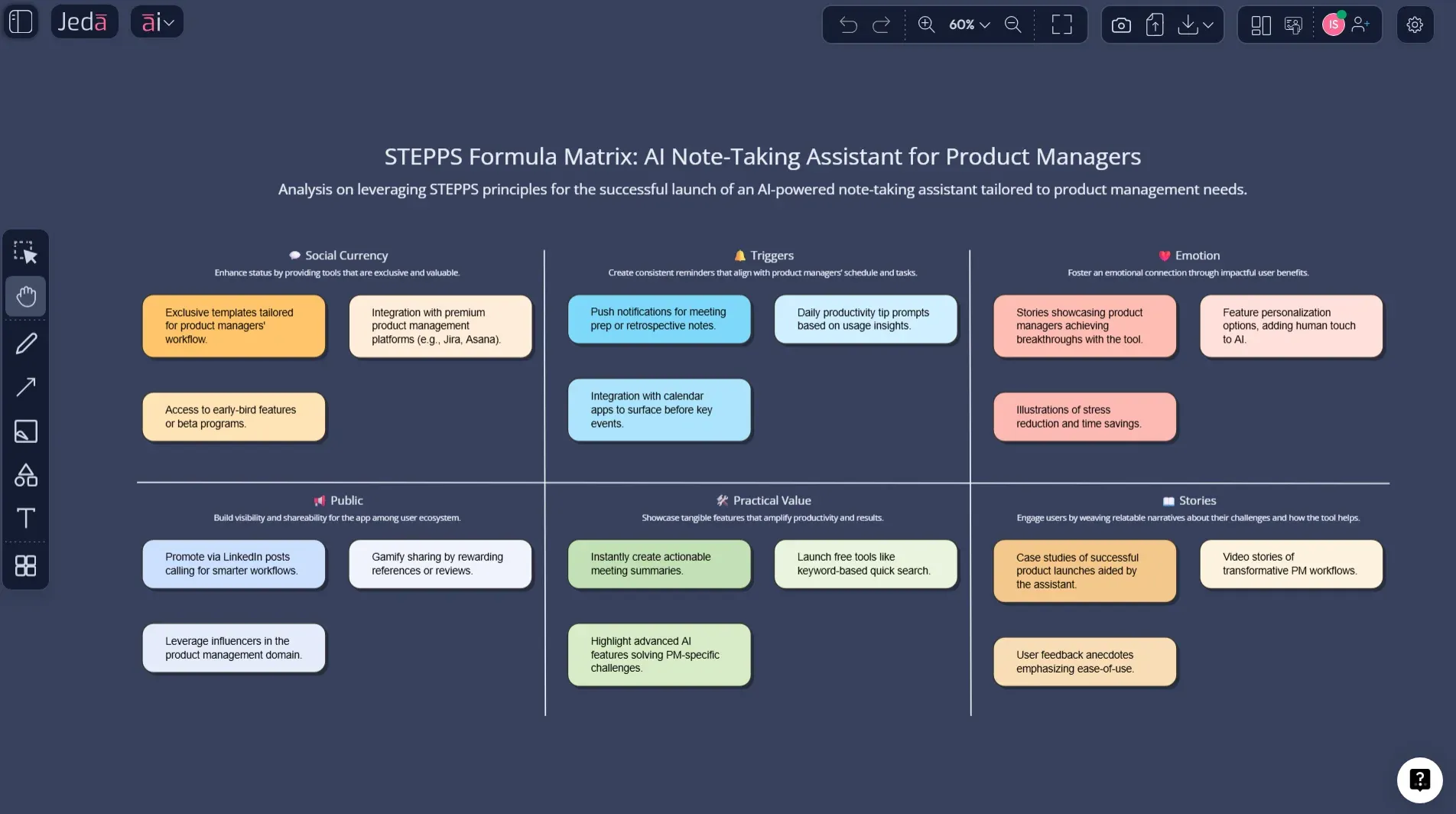
Most marketing content dies a quiet death. Not because the offer is bad. Not because the team is lazy. It dies because the message is clear enough to publish but weak enough to ignore. STEPPS Formula with AI gives you a cleaner way to diagnose that problem inside a visual, editable framework instead of another sad little doc. In Jeda.ai, you can build that framework inside an AI Workspace, pressure-test each sharing driver, and turn a rough campaign angle into something people actually pass along. That matters when your team needs sharper message design, faster reviews, and fewer “let’s revisit this next week” loops. And yes, it works beautifully on an AI Whiteboard too.
If you already use Jeda.ai’s AI Workspace or collaborate on an AI Whiteboard, this is one of the easiest marketing frameworks to operationalize. Not theoretical. Not fluffy. Actionable.
See also: AI Workspace, AI Whiteboard, and Strategic Frameworks.
What is STEPPS Formula?
The STEPPS Formula is Jonah Berger’s research-backed framework for understanding why people share ideas, products, and messages. The acronym stands for Social Currency, Triggers, Emotion, Public, Practical Value, and Stories. Berger popularized the framework in Contagious: Why Things Catch On, but the thinking behind it also connects to broader research on social transmission, emotional arousal, and word of mouth.
Here’s the practical translation.
A message gets stronger when it helps people look smart, gives them cues to remember it, makes them feel something active, is visible in public, offers immediate usefulness, and travels inside a narrative. Not every campaign needs to ace all six. But if you score badly across most of them, don’t expect organic sharing to rescue weak positioning.
In a Visual AI workflow, STEPPS becomes more useful because you can see all six forces side by side. That’s where Jeda.ai earns its keep. Instead of burying these judgments in comments and fragmented docs, you can structure them in a matrix, debate them live, and refine them with AI in one place.
Why use STEPPS Formula with AI?
The classic way to use STEPPS is annoyingly manual. Someone writes the campaign idea. Someone else says it needs “more emotion.” Another person wants a punchier hook. Then the team goes in circles because no one is evaluating the same message using the same criteria.
That is exactly why STEPPS Formula with AI works better inside a structured matrix.
- See the weak spots fast
A matrix forces your team to inspect all six STEPPS drivers at once, rather than over-fixating on the hook and ignoring the rest.
- Generate sharper variants
Jeda.ai can quickly produce alternate message angles, examples, and campaign directions when one STEPPS driver feels thin.
- Collaborate without chaos
Because everything lives on an editable AI Whiteboard, marketers, founders, and strategists can react to the same visual instead of scattered notes.
And there’s a second advantage. Most blog posts about STEPPS explain the framework, then stop. They don’t help you build a repeatable message workshop. Jeda.ai does. The platform gives you an AI Workspace, an AI Whiteboard, 300+ strategic frameworks, recipe-based generation, Prompt Bar creation, AI+ expansion, and visual conversion flows that keep the work usable after the first brainstorm.
The six parts of STEPPS, without the fake guru gloss
Social Currency
People share things that make them look informed, early, clever, or plugged in. If your message gives the audience a way to signal taste or expertise, sharing becomes identity work rather than unpaid labor.
Ask:
- Does sharing this make someone look smart or ahead of the curve?
- Is there a surprising angle, insider lens, or clever framing worth repeating?
- Would your audience feel proud to post this publicly?
Triggers
A message spreads longer when everyday cues bring it back to mind. The framework is not just about novelty. It is about recall. Berger’s work on word of mouth also shows that certain product characteristics and contexts can shape ongoing conversation, not just launch-week noise.
Ask:
- What recurring moment, habit, phrase, or setting reminds people of this idea?
- Is there a weekly, seasonal, or behavioral cue attached to the message?
- Will people remember this after the initial campaign burst fades?
Emotion
Emotion matters, but not all emotion works equally well. Berger and Milkman’s research on virality found that high-arousal emotions such as awe, anger, and anxiety were more associated with sharing than low-arousal states like sadness.
That does not mean “make everything outrageous.” It means the message should activate people.
Ask:
- Does this provoke awe, urgency, surprise, anger, relief, hope, or ambition?
- Is the emotional charge strong enough to move someone from passive agreement to action?
- Are you trying to sound touching when you actually need momentum?
Public
The more visible a behavior or idea is, the easier it becomes to imitate. Public cues help people notice what others are doing. If your message leaves visible traces — reposts, rituals, badges, templates, social proof — it is easier to spread.
Ask:
- Is the behavior observable?
- Can other people see the message in action?
- Does the output create visible proof people can copy?
Practical Value
Useful things travel. Berger’s work on viral content also notes that practical utility can support sharing because people pass along information that helps others save time, money, effort, or mistakes.
Ask:
- Does the message help someone do something better right now?
- Is the takeaway concrete enough to save, send, or screenshot?
- Would a friend thank someone for sharing it?
Stories
Stories carry information farther than isolated claims because people remember narratives better than slogans. The trick is not to tell any old story. The brand, idea, or lesson has to be baked into the story itself.
Ask:
- What is the story vehicle here?
- If the story gets retold, does the core idea travel with it?
- Is your brand central to the narrative or awkwardly taped onto the end?
How to create STEPPS Formula in Jeda.ai
The strongest setup is simple: build the first draft visually, then improve the weak sections in context. Jeda.ai gives you two clean ways to do that.
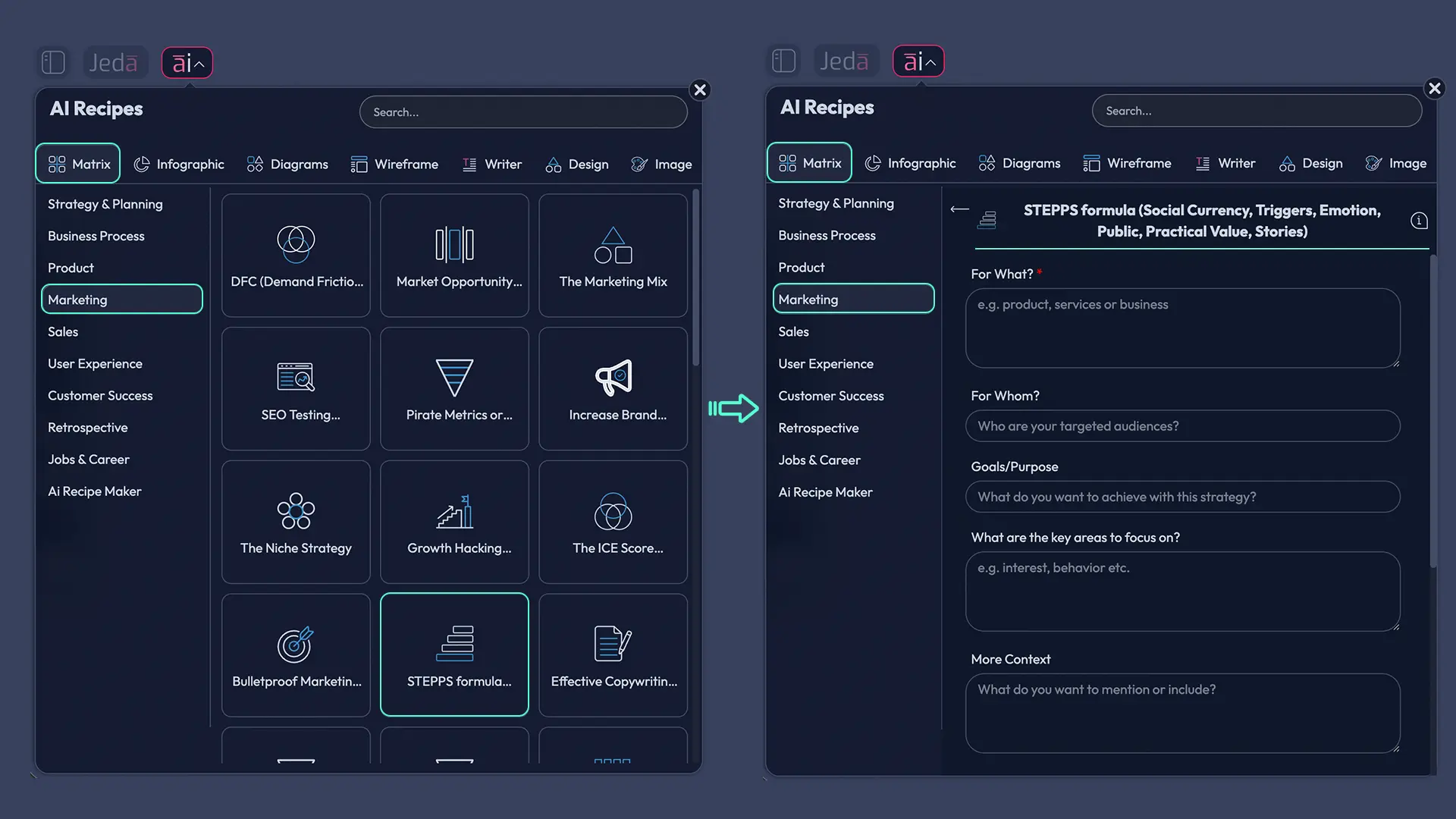
Method 1: Recipe Matrix
This is the recommended route because the AI Menu uses a prebuilt Matrix Recipe structure. The platform’s recipe flow is designed for guided framework generation, which is exactly what you want when the team needs speed without losing shape.
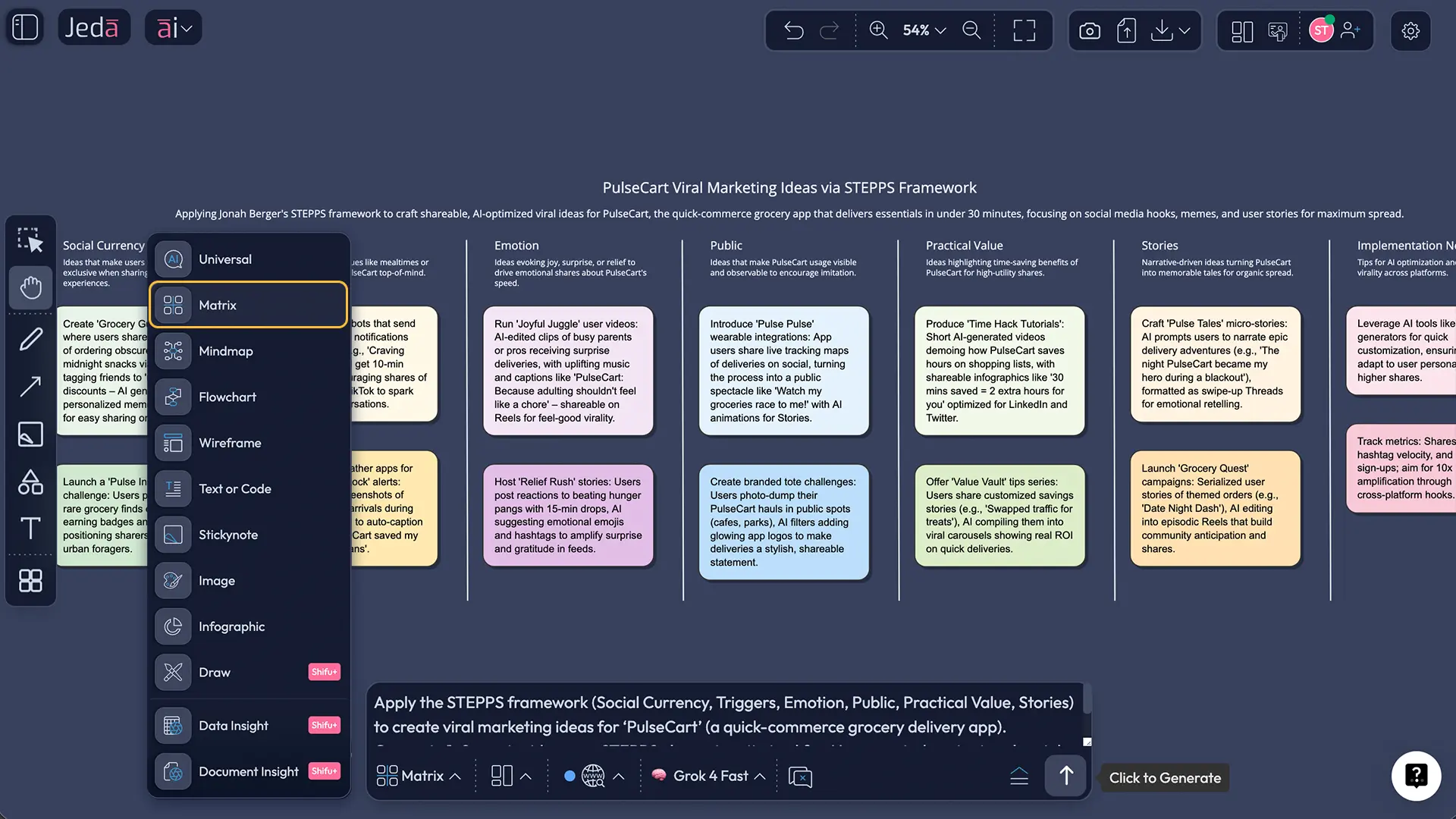
Method 2: Prompt Bar
This route is better when you already know the campaign context and want more control. Open the Prompt Bar at the bottom, choose the Matrix command, and describe the campaign, audience, offer, channel, and goal. Jeda.ai will generate the framework directly on the canvas.
- Open the STEPPS workspace
Start in Jeda.ai and create a fresh board inside the AI Workspace so your campaign team can review the framework in one shared place.
- Use the Recipe Matrix first
Click the AI Menu, open Matrix Recipes, go to the Marketing category, and select STEPPS Formula to generate a guided six-part matrix.
- Fill the guided fields with campaign context
Add the campaign topic, target audience, offer, desired audience reaction, and any message constraints so the matrix is grounded in a real use case.
- Generate and review the six boxes
Inspect Social Currency, Triggers, Emotion, Public, Practical Value, and Stories side by side. Tighten vague sections before moving on.
- Create a second version with the Prompt Bar
Open the Prompt Bar, choose the Matrix command, and ask Jeda.ai to generate a sharper or more niche STEPPS version for the same campaign.
- Use AI+ to deepen weak sections
Tap the AI+ button on any box that feels thin. Use it to extend ideas, generate sub-angles, or enrich examples without rebuilding the entire matrix.
- Convert or extend the output
If your team needs a different view, use Vision Transform to reshape the matrix into another visual format, then refine it on the same board.
A strong Prompt Bar example
Select the Matrix command and use a prompt like this:
Build a STEPPS Formula matrix for launching an AI note-taking assistant for product managers. Audience: PMs in SaaS teams. Goal: increase shares and demo signups. Make each section concrete, modern, and B2B-friendly. Include a bold core message, 2 trigger ideas, 2 emotional hooks, 2 public proof mechanisms, 3 practical-value assets, and 2 story angles.
And then do the smart thing: generate two or three variations instead of falling in love with version one. Version one is often the polite draft. Version three is where the interesting stuff shows up.
STEPPS Formula template and example
Let’s make this real. Imagine you are marketing a new AI note-taking assistant for product managers. Your original message is:
“An AI assistant that summarizes meetings faster.”
Fine. Functional. Also forgettable.
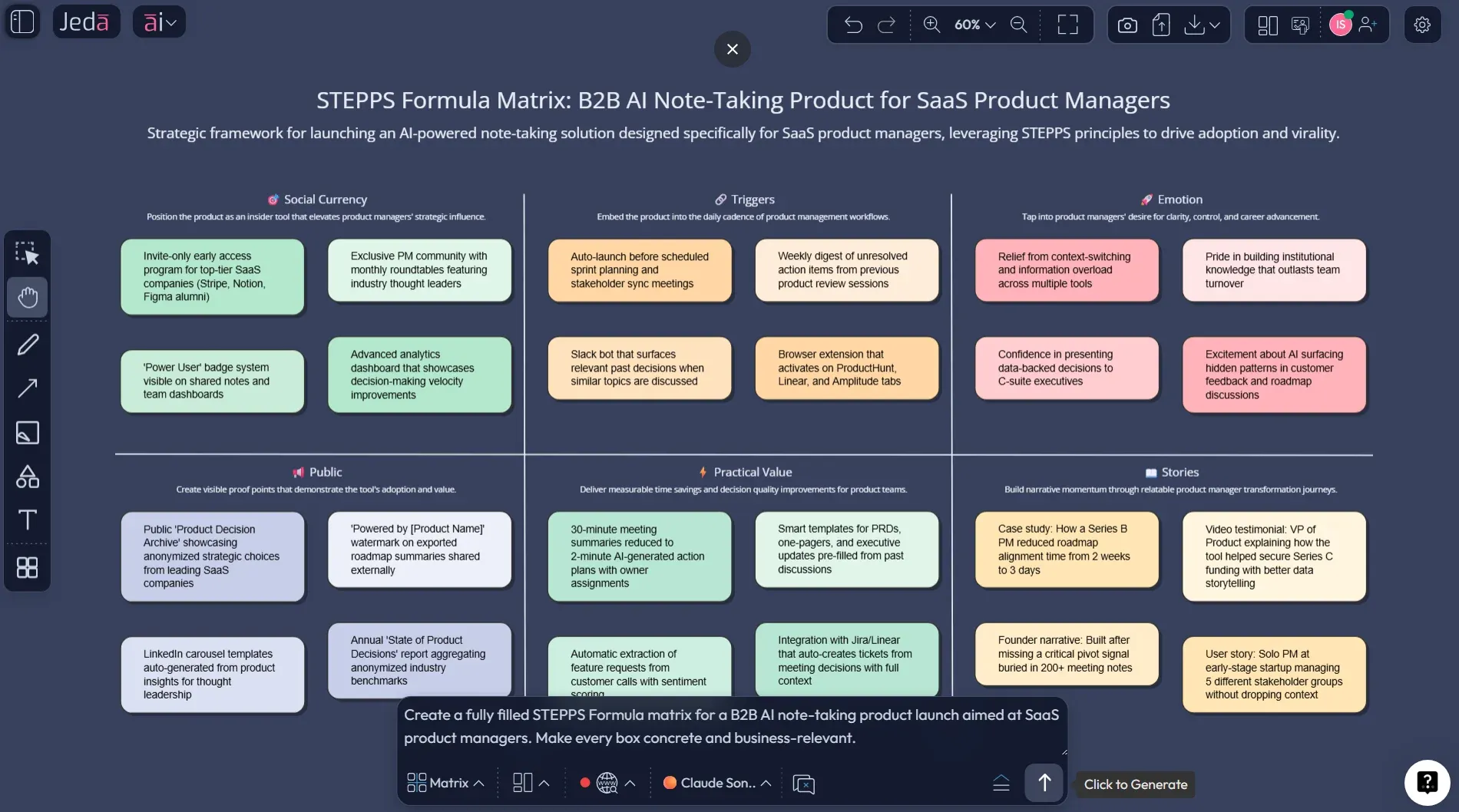
A stronger STEPPS Formula with AI matrix in Jeda.ai could look like this:
That version has teeth. It is not just describing the product. It is designing the reasons people would repeat it, recommend it, or remember it.
Best practices when using STEPPS Formula with AI
Common mistakes to avoid
The first mistake is treating STEPPS like a content decoration kit. It is not a set of random toppings you sprinkle onto weak positioning. If the product promise is muddy, the matrix will only expose that faster.
The second mistake is confusing emotion with melodrama. The goal is activation, not noise. You want people to feel something clear enough to react to, not manipulated enough to roll their eyes.
Third: teams often over-focus on Social Currency and ignore Practical Value. That creates flashy content people notice once and never use. Pretty bad trade.
And one more. A surprisingly common one. They generate the matrix, nod approvingly, and never turn it into campaigns, assets, or review workflows. The value is not the framework itself. The value is what the framework sharpens next.
Frequently asked questions
- What is STEPPS Formula in marketing?
- STEPPS Formula is Jonah Berger’s framework for designing messages people are more likely to share. It stands for Social Currency, Triggers, Emotion, Public, Practical Value, and Stories. Marketers use it to improve word of mouth, strengthen positioning, and make campaign ideas easier to remember and repeat.
- Who created the STEPPS framework?
- Jonah Berger, a Wharton marketing professor, popularized the STEPPS framework in his 2013 book Contagious: Why Things Catch On. The model is rooted in research on social transmission, emotional arousal, and word-of-mouth behavior rather than in generic viral-marketing folklore.
- Is STEPPS only useful for consumer brands?
- No. STEPPS works for B2B, SaaS, internal initiatives, nonprofits, and product launches as long as people need to talk about the idea for it to spread. In B2B, Practical Value, Triggers, and Stories often matter even more because the sharing context is more deliberate.
- What is the difference between STEPPS and AIDA?
- AIDA helps structure persuasion through attention, interest, desire, and action. STEPPS focuses on why people talk and share. One is mainly about moving an audience through a response sequence. The other is about building social transmission into the message itself.
- Why use AI for STEPPS Formula?
- AI speeds up iteration and comparison. Instead of debating one headline endlessly, you can generate multiple STEPPS angles, compare them side by side in a matrix, and improve the weak sections with AI+. That makes message development faster and much easier to review collaboratively.
- Does Jeda.ai support both recipe-based and prompt-based creation?
- Yes. In Jeda.ai you can use the AI Menu for a guided Matrix Recipe workflow or open the Prompt Bar and select the Matrix command for a freer build. That combination is useful when you want structure first and then more flexible iteration afterward.
- What should I do after generating the first STEPPS matrix?
- Review the weak boxes first, not the flashy ones. Then use the AI+ button to extend thin sections, generate stronger variations, and add examples. After that, convert or reshape the output only if the team needs another visual format for planning, presentation, or content production.
- Do I need all six STEPPS elements in every campaign?
- Not necessarily. Most strong campaigns rely heavily on two or three drivers, remain solid on a few others, and avoid obvious gaps. The real goal is not perfection. It is building a message people can remember, repeat, and find worth passing along.
- Can STEPPS Formula help with product launches?
- Yes. It is especially useful for launches because it forces the team to think beyond feature lists. A launch message becomes stronger when it gives the audience a reason to care, a reason to share, and a reason to remember the idea after the initial announcement.
- Is Jeda.ai just a blank brainstorming board?
- No. Jeda.ai is an AI Workspace and AI Whiteboard built for structured visual thinking. It combines editable matrices, recipe-driven generation, Prompt Bar workflows, AI+, and collaborative refinement so teams can turn raw ideas into decision-ready outputs much faster.
Sources & further reading
- [1]
Berger, Jonah (2013) . “Contagious: Why Things Catch On” Simon & Schuster / Official author page.
View Source ↗ - [2]
Berger, Jonah (2016) . “Framework (STEPPS)” JonahBerger.com.
View Source ↗ - [3]
Berger, Jonah and Milkman, Katherine L. (2012) . “What Makes Online Content Viral?” Journal of Marketing Research.
View Source ↗ - [4]
Berger, Jonah and Schwartz, Eric M. (2011) . “What Drives Immediate and Ongoing Word of Mouth?” Journal of Marketing Research.
View Source ↗ - [5]
Berger, Jonah (2014) . “Word of Mouth and Interpersonal Communication: A Review and Directions for Future Research” Journal of Consumer Psychology.
View Source ↗
Start Your STEPPS Formula with AI
Join over 150,000 professionals who use Jeda.ai to turn messy campaign thinking into structured, visual strategy.
Try Free Template