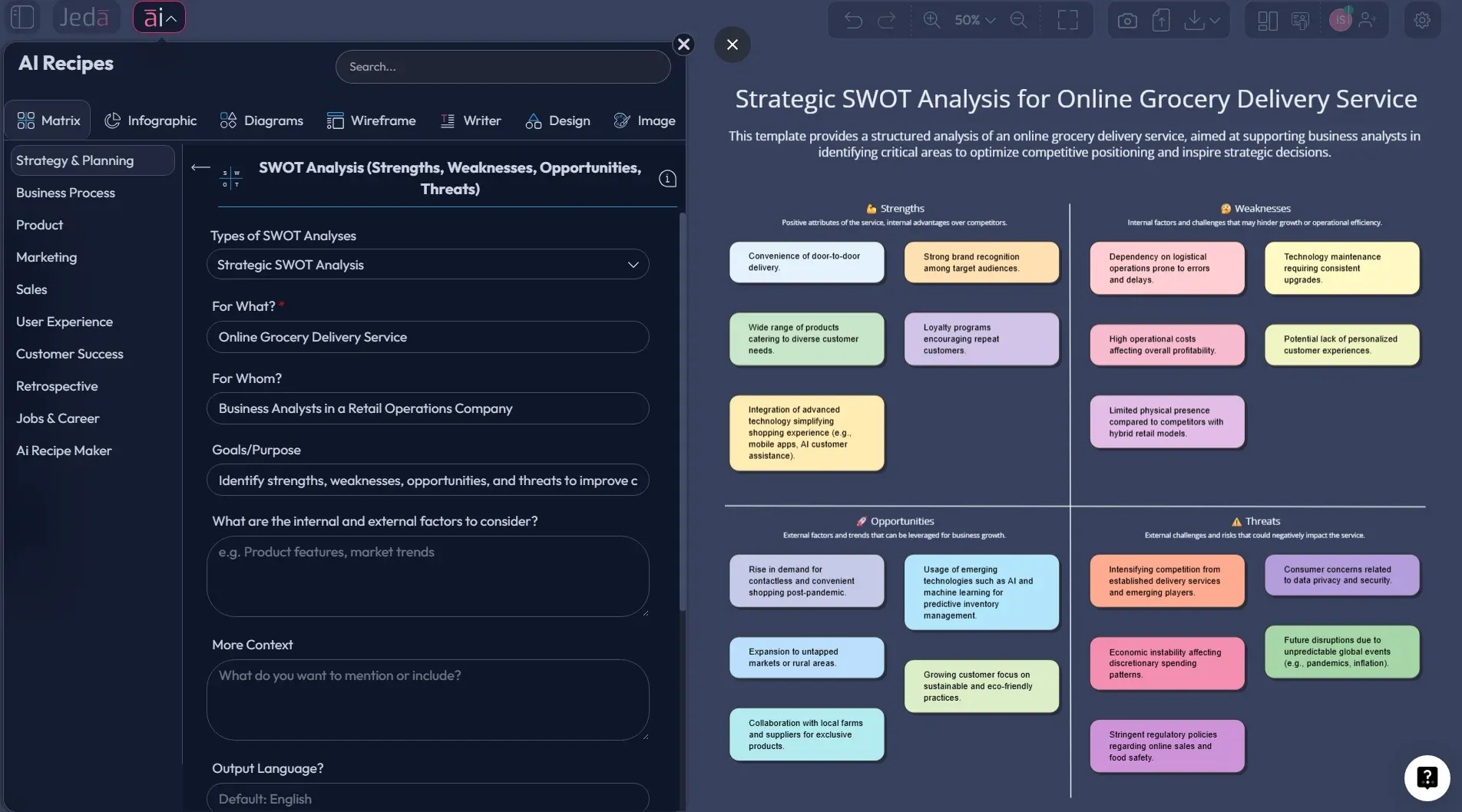
Strategic SWOT Analysis with AI sounds tidy. Neat, even. But most teams still use it like a workshop souvenir: fill four boxes, nod seriously, then move on. That is not strategy. That is stationery.
A real strategic SWOT needs evidence, trade-offs, and follow-through. It should help you decide where to play, what to protect, what to fix, and what to ignore. Done well, it gives leaders a shared view of internal capabilities and external pressure in one frame. Done badly, it becomes vague, flattering, and useless.
Jeda.ai fixes the part that usually slows teams down. Inside its AI Workspace, you can generate a structured SWOT in a visual matrix, ground it with uploaded documents or data, refine it collaboratively on an AI Whiteboard, and extend the strongest threads with the AI+ button. Jeda.ai supports 150,000+ users and gives teams access to 300+ strategic frameworks in one Visual AI environment. See the broader product context on the AI Workspace and AI Whiteboard pages.
What is Strategic SWOT Analysis with AI?
Strategic SWOT Analysis with AI is a more decision-oriented version of the classic SWOT framework. Instead of stopping at a descriptive list of strengths, weaknesses, opportunities, and threats, it uses AI to accelerate research, surface patterns, organize evidence, and push the matrix toward action. The logic is still familiar. The output is just sharper.
SWOT has been part of strategy work for decades, although its historical origin story is more tangled than most template pages admit. Recent archival work traces the original SOFT or SWOT approach to Robert Franklin Stewart and long-range planning practice, while later research showed both the framework's staying power and its limits when teams treat it as a static list rather than a strategic process. In other words, the framework survived because it is simple, but it works best when you connect it to actual choices and follow-up action.
That is where AI earns its keep. It can compress research time, scan uploaded reports, spot repeated patterns, and help teams move from "what is true" to "what should we do next." It still does not replace human judgment. Good.
Why use Strategic SWOT Analysis with AI instead of a manual SWOT?
Because manual SWOT sessions often suffer from three predictable problems: they are too slow, too generic, and too polite. People list strengths everyone already knows, avoid ugly weaknesses, confuse goals with opportunities, and leave without prioritizing anything. Research and practitioner guidance keep pointing to the same issue. SWOT is useful, but only when it stays evidence-based, focused, and tied to action.
AI helps by speeding up the ugly middle. It can draft an initial matrix, summarize source material, cluster repeated ideas, and surface external changes that deserve discussion. Then your team can do the part machines should not own: judgment, prioritization, and choice.
- Faster first draft
AI can turn raw context into a usable SWOT structure in minutes, which means the meeting starts with a board, not a blank stare.
- Better evidence
Use uploaded reports, spreadsheets, and real-time web context to reduce hand-wavy claims and force the matrix closer to reality.
- Easier strategy branching
Once the matrix exists, you can extend, compare, and convert it into adjacent visuals such as a mind map, flowchart, or action plan.
- Cleaner team alignment
A shared visual board keeps debate in one place, makes assumptions visible, and helps teams move from analysis into decision-making.
Jeda.ai is especially useful here because it is not just a text box with opinions. It is an AI Workspace built for structured visual thinking. The AI Whiteboard lets teams edit the result directly, not just admire it from a distance. And if your strategy work starts from evidence, Jeda.ai can also pull from uploaded PDFs, Word files, CSVs, or Excel sheets through Document Insight and Data Insight, then render the output back into a matrix.
How do you create Strategic SWOT Analysis with AI in Jeda.ai?
Jeda.ai supports both routes you asked for. Method 1 is the Recipe Matrix flow, which is the better choice when you want a structured start. Method 2 is the Prompt Bar flow, which is better when you already know the context and want more control over the framing.
Method 1: Recipe Matrix
Use this when you want the strategic structure pre-baked.
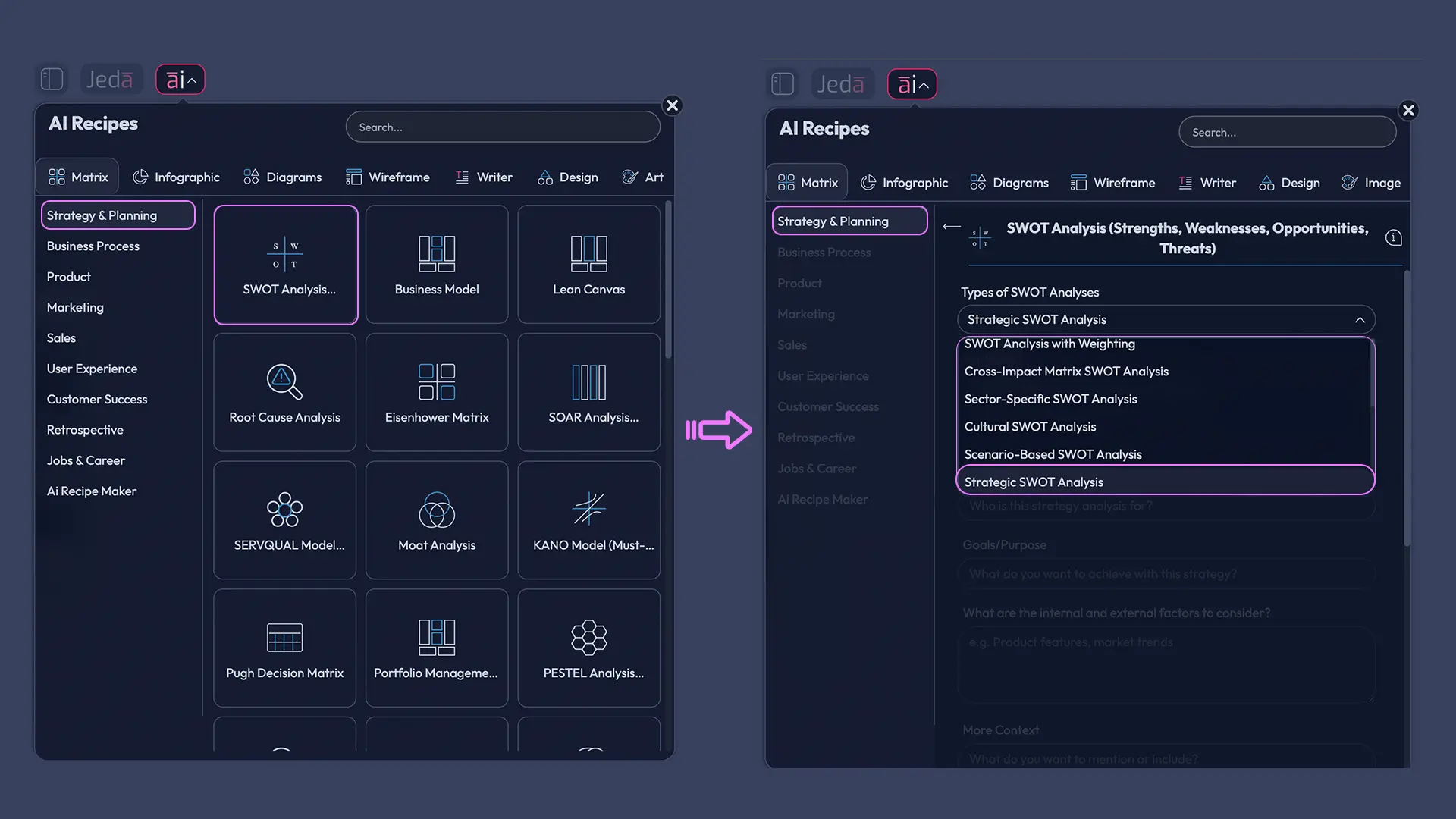
Open the AI Menu from the top-left corner, go to Matrix Recipes, then browse to Strategy & Planning and choose the SWOT recipe. The recipe form in Jeda.ai is built for structured input, with fields such as For What?, For Whom?, Goals or Purpose, internal and external factors, and More Context. That matters because garbage in still produces garbage out. AI is fast. It is not psychic.
The smart move is to fill the recipe with actual strategic context:
- the business or initiative you are evaluating
- the market or segment in scope
- the decision horizon, such as next 2 quarters or next 12 months
- the competitive pressure or industry shift that triggered the analysis
- the output you want, such as market entry options, risk prioritization, or capability investment
If you already have supporting material, use the advanced file analysis options to bring in a document or dataset. This is where Jeda.ai starts feeling less like a novelty and more like a strategy machine.
Method 2: Prompt Bar
Use this when you want a custom angle.
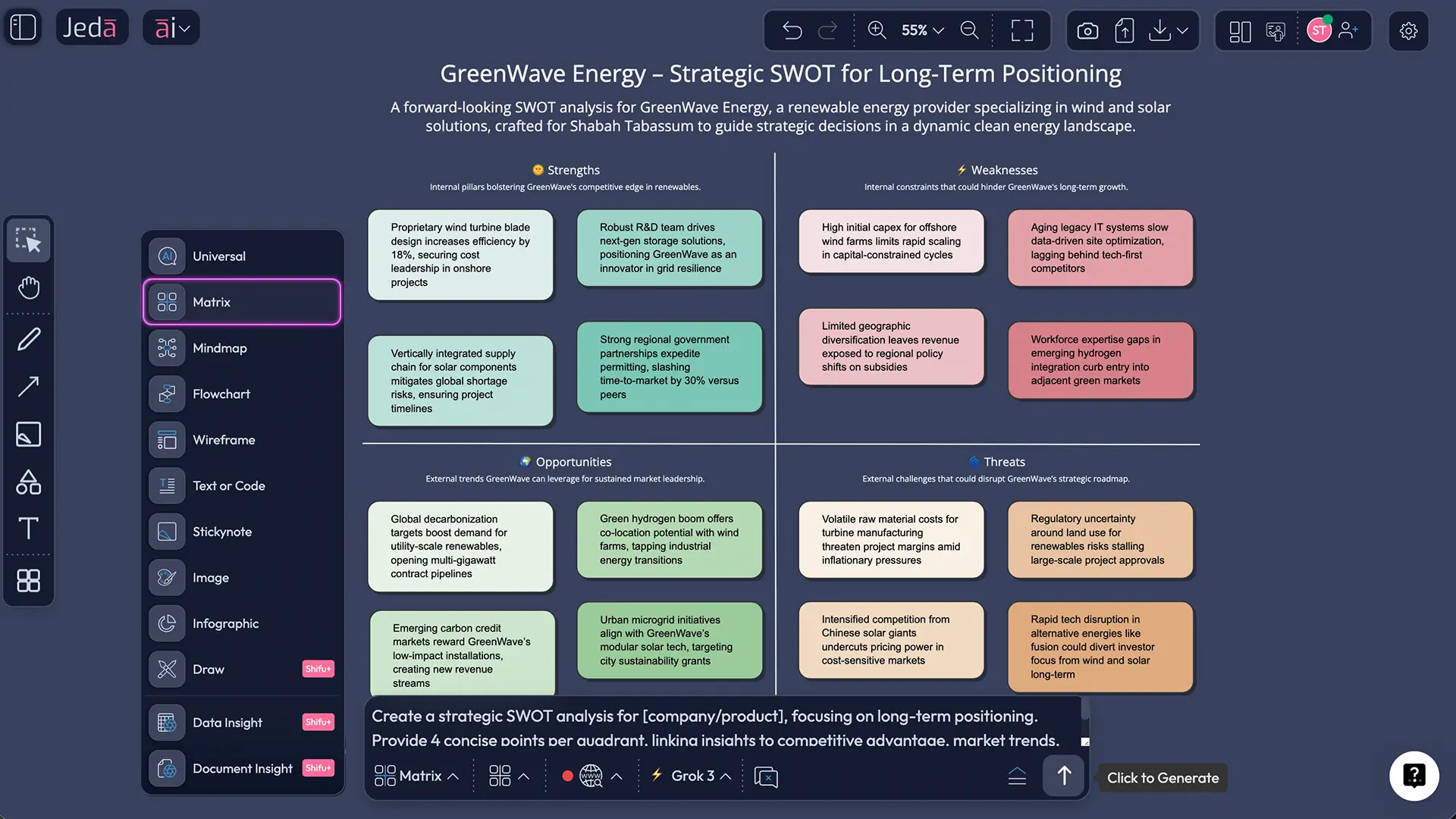
Open the Prompt Bar at the bottom of the canvas, select Matrix, and write a focused prompt. A good prompt tells the AI what is being analyzed, for whom, under what conditions, and toward which decision.
A solid example:
Create a strategic SWOT analysis for a B2B cybersecurity startup serving mid-market finance teams. Focus on competitive differentiation, pricing pressure, compliance trends, customer trust, channel expansion, and execution risk over the next 12 months.
That prompt works because it sets scope, audience, market, and timeframe. Too many prompts are basically "make me a SWOT" and then people wonder why they get a fortune cookie with four boxes.
AI+ button generated deep dive
After the matrix appears, select the quadrant, node, or section that deserves more depth and use the AI+ button to extend it. Treat AI+ as expansion, not as a place for tightly constrained sub-instructions. It is ideal for deepening a promising opportunity, stress-testing a threat, or expanding a weak area into sub-factors and implications.
Then, if the team needs a different perspective, use Vision Transform to convert the SWOT into a mind map, flowchart, or another visual structure. In Jeda.ai, that keeps the entire strategic conversation inside one AI Workspace, instead of forcing you to rebuild the same logic across separate tools.
- Method 1: Open the Recipe Matrix
Click the AI Menu, choose Matrix Recipes, go to Strategy and Planning, and select the SWOT recipe.
- Add strategic context
Fill in what you are analyzing, for whom, the goals or purpose, the internal and external factors, and any extra context that narrows the decision.
- Ground the recipe with evidence
Optionally attach a document or dataset so the SWOT pulls from real business material instead of generic assumptions.
- Generate the matrix
Choose the reasoning model, layout, and web search setting if needed, then generate the first SWOT board.
- Method 2: Use the Prompt Bar
Open the Prompt Bar, select Matrix, and write a focused strategic prompt with business scope, market, timeframe, and objective.
- Refine on the canvas
Edit text, merge duplicates, remove weak points, and use collaboration features to challenge vague claims and prioritize the strongest factors.
- Use AI+ to deepen the strongest sections
Select a quadrant or node and tap the AI+ button to extend it into a deeper layer of analysis.
- Convert the SWOT into next-step visuals
Use Vision Transform to turn the matrix into a mind map, flowchart, or another working visual when the team needs execution planning.
What does a good Strategic SWOT Analysis with AI look like?
A strategic SWOT is not just descriptive. It creates tension. It reveals where the company has an advantage worth pressing, where it is exposed, and where external change creates leverage or danger.
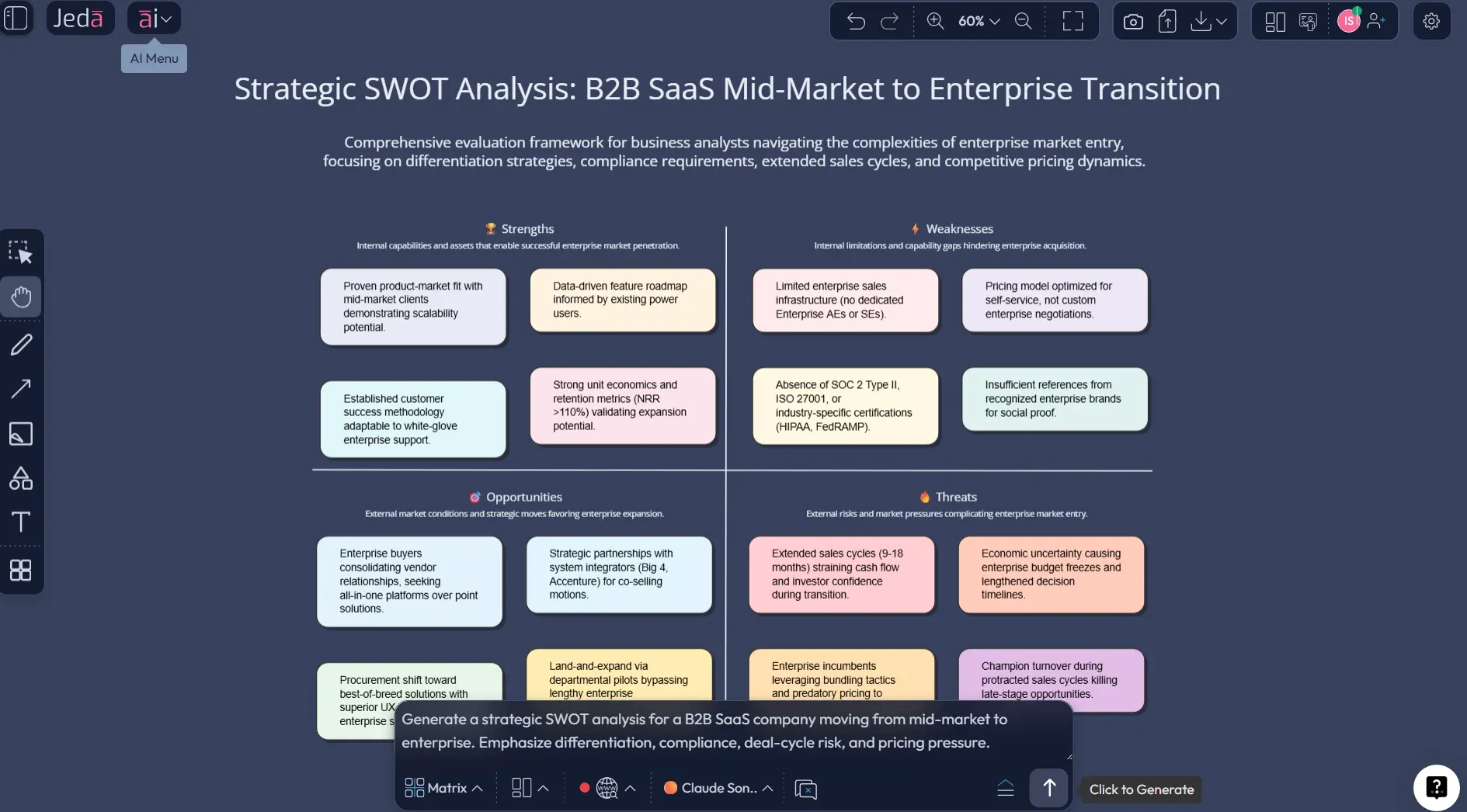
Here is a simple example for a fictional mid-market SaaS company that wants to move upmarket.
That matrix becomes strategic only when the team asks the harder follow-up questions:
- Which strengths actually matter in the target segment?
- Which weakness can kill the move fastest?
- Which opportunity is real this year, not theoretically nice?
- Which threat changes the investment sequence?
And then comes the missing bridge. You turn the matrix into action. This is where the TOWS logic is useful. Instead of merely listing factors, you connect strengths to opportunities, weaknesses to threats, and build concrete moves from those intersections.
So the strategy might become:
- use implementation speed plus customer proof to win a narrow upmarket wedge first
- delay broad vertical expansion until security credentials improve
- package analytics as the opening value story instead of selling the entire platform at once
- defend against bundling pressure by targeting buyers who care more about time-to-value than vendor consolidation
That is the difference between a board that looks smart and a board that can survive a leadership meeting.
What are the best practices for sharper strategic output?
Here is the blunt version: the quality of your SWOT is mostly decided before the matrix appears.
Jeda.ai helps because it keeps the whole loop on one AI Whiteboard. You can generate, edit, challenge, extend, and convert without losing the chain of reasoning.
What mistakes make a SWOT strategically useless?
The classics never die.
First, teams confuse aspirations with opportunities. "Launch in Europe" is not an opportunity. It is a proposed action. The opportunity is something like regulatory change, market fragmentation, or buyer dissatisfaction that could make expansion more viable.
Second, they overstate strengths. Everybody thinks customer service is a strength. Compared with what? Measured how? Against whom?
Third, they underplay weaknesses because politics enters the room wearing a nice blazer. That always ends well. Which is to say, not at all.
Fourth, they skip prioritization. A long SWOT often feels thorough, but it is usually just indecisive.
Fifth, they treat the workshop as the finish line. Research has been warning about this for years. SWOT becomes far more useful when it feeds strategic action rather than ending as a descriptive list.
Can Strategic SWOT Analysis with AI support different Jeda.ai workflows?
Yes, and this is one of the more underrated parts of the platform.
If you begin with a report, use Document Insight to pull the content into a matrix. If you begin with performance data, use Data Insight to ground the analysis in actual numbers. If the meeting shifts into process or execution, use Vision Transform to turn the board into a flowchart or mind map.
That combination makes Jeda.ai more than a template library. It makes it a working AI Workspace for strategic thinking, collaborative analysis, and visual strategy communication.
Frequently Asked Questions
- What is the difference between a basic SWOT and a strategic SWOT?
- A basic SWOT lists factors. A strategic SWOT pushes those factors toward decisions. It focuses on priority issues, competitive relevance, time horizon, and next-step action instead of stopping at descriptive brainstorming.
- Can AI replace human judgment in a SWOT analysis?
- No. AI can speed up research, drafting, clustering, and pattern-finding, but leadership judgment still decides what matters, what is credible, and what action follows. Treat AI as an accelerator, not the final strategist.
- How long should a strategic SWOT analysis take?
- A fast first draft can take minutes with AI, but a useful strategic SWOT still needs review, pruning, and prioritization. For most teams, one focused working session is enough to create a solid version.
- When should you use Strategic SWOT Analysis with AI?
- Use it before market entry, annual planning, product repositioning, competitive response, pricing review, or capability investment decisions. It is best when the team needs a clear strategic snapshot before committing resources.
- What makes a SWOT factor strong enough to keep?
- Keep factors that are specific, decision-relevant, and evidence-backed. If a point cannot change a choice, shape a priority, or be defended with data or observation, it probably does not belong in the final matrix.
- Can Jeda.ai generate a SWOT from documents or spreadsheets?
- Yes. Jeda.ai supports Document Insight and Data Insight, which let teams bring reports, PDFs, CSV files, and spreadsheets into the workflow and generate structured visual outputs grounded in those materials.
- How should I use the AI+ button in a SWOT workflow?
- Use the AI+ button after the first matrix exists. Select the most important quadrant or node, then extend it to surface deeper implications, related factors, or adjacent considerations. It works best for expansion, not micromanaged prompting.
- Should a SWOT always lead to a TOWS or action plan?
- Usually, yes. SWOT is strongest when it feeds strategy formulation. Turning the matrix into TOWS-style combinations, priorities, or execution visuals helps move the work from observation into action.
- Is Strategic SWOT Analysis with AI useful for consultants and leadership teams?
- Absolutely. Consultants can use it to structure client workshops faster, while leadership teams can use it to align on market pressures, internal capability gaps, and strategic choices without scattering context across multiple tools.
Sources & Further Reading
The strategic case for SWOT is strong, but the research is also honest about its limits. That is healthy. The most useful reading on SWOT does two things at once: it explains why the framework persists and warns against treating it as a lazy list.
- [1]
Puyt, Richard Willem, Finn Birger Lie, and others (2023) . “The origins of SWOT analysis” Long Range Planning.
View Source ↗ - [2]
Hill, Terry and Roy Westbrook (1997) . “SWOT analysis: It is time for a product recall” Long Range Planning.
View Source ↗ - [3]
Helms, Marilyn M. and Judy Nixon (2010) . “Exploring SWOT analysis, where are we now? A review of academic research from the last decade” Journal of Strategy and Management.
View Source ↗ - [4]
Weihrich, Heinz (1982) . “The TOWS matrix, a tool for situational analysis” Long Range Planning.
View Source ↗ - [5]
US Chamber of Commerce (2025) . “How to Use AI to Perform a SWOT Analysis” CO by U.S. Chamber of Commerce.
View Source ↗ - [6]
Asana (2026) . “SWOT Analysis: Examples and Templates” Asana Resources.
View Source ↗ - [7]
BDC (2020) . “SWOT analysis: An easy tool for strategic planning” Business Development Bank of Canada.
View Source ↗
Start Your Strategic SWOT Analysis with AI
Join over 150,000+ users who use Jeda.ai to turn frameworks into decision-ready visuals inside one AI Workspace.
Try Free Template