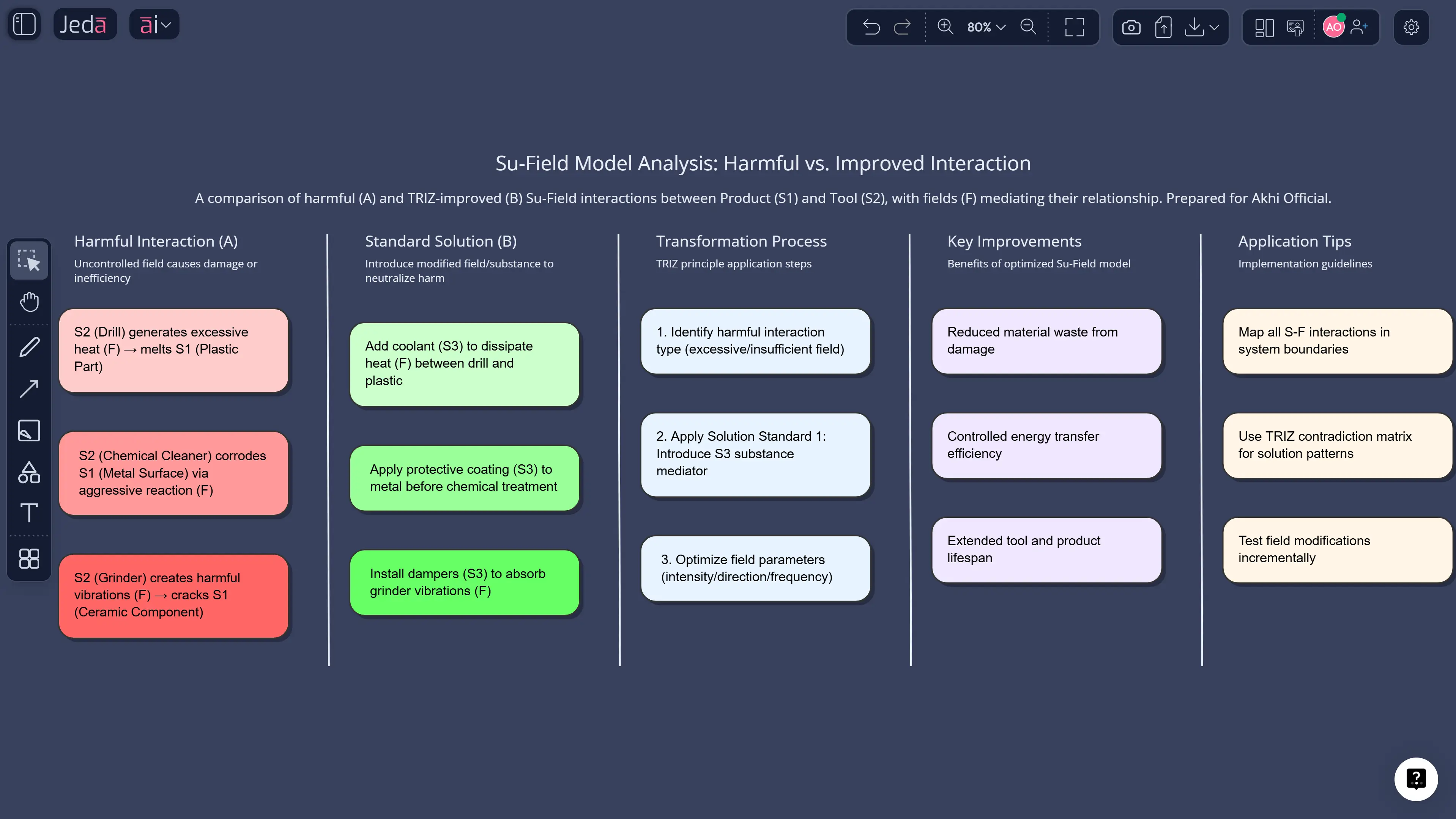
Brainstorming is fine until you need a solution that actually works in the real world—materials, physics, constraints, all of it. Su‑Field analysis is TRIZ’s way of forcing the conversation back to mechanisms.
Su‑Field (Substance‑Field) analysis models a technical situation using:
- Substances (components, materials, objects),
- Fields (mechanical, thermal, electrical, magnetic, chemical, etc.),
- and the interaction between them.
Then you use Standard Solution patterns (often referenced as “Standard Solutions” in TRIZ literature) to transform an ineffective or harmful interaction into a useful one.
An AI Workspace helps because Su‑Field work is highly structured and diagram-heavy. That’s perfect for a visual whiteboard.
What is Su‑Field analysis?
Su‑Field analysis is a TRIZ modeling technique for describing and improving technical systems by abstracting them into a minimal interaction model. Many descriptions define it as representing system behavior in terms of elements and interactions, and then applying a catalog of Standard Solutions to improve the model. In plain English:
- identify the objects that matter,
- identify the energy/action between them,
- classify the interaction (useful, insufficient, excessive, harmful),
- transform the model until the interaction becomes useful and controlled.
Why Su‑Field is underrated (and why teams love it once they try)
Most teams do one of two things:
- stay too abstract (“we need better reliability”), or
- jump too specific (“use material X”) without modeling why.
Su‑Field lives in the middle. It gives you just enough abstraction to generate options—but stays grounded in the physics of interaction.
That’s why it’s powerful for:
- manufacturing problems,
- failure modes,
- wear/friction/contamination,
- thermal issues,
- interaction design in hardware systems.
The minimal Su‑Field model
A “complete” Su‑Field model typically includes:
- S1: the object being acted upon,
- S2: the object/tool that acts,
- F: the field/energy that performs the action.
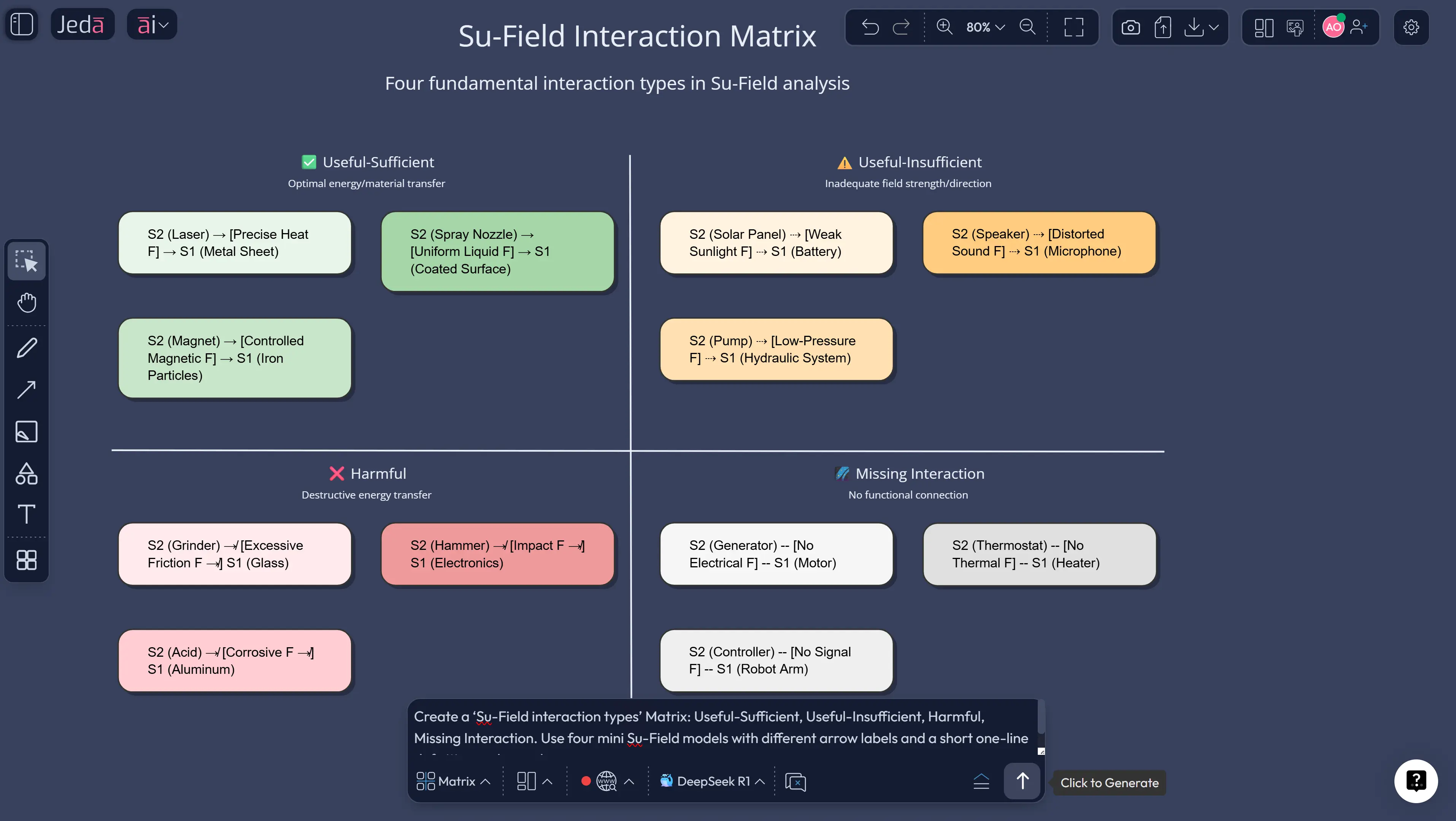
Then you label whether the action is:
- useful and sufficient,
- useful but insufficient,
- harmful,
- or missing.
The Standard Solutions idea (the punchline)
Once you’ve modeled the situation, TRIZ offers Standard Solution classes (often associated with “76 Standard Solutions” in many TRIZ references) to transform the Su‑Field model: add a substance, change the field, introduce a mediator, convert harm into benefit, and so on.
You don’t need to memorize 76 solutions. You need:
- the model,
- and a structured way to generate transformation candidates.
AI can do the “generate candidate transformations” part fast—then you validate feasibility.
How to run Su‑Field analysis with AI in Jeda.ai
1) Build the Su‑Field model as a diagram
In Jeda.ai:
- Create nodes for S1, S2, and Field.
- Draw the interaction arrow and label it (harmful/insufficient/etc.).
2) Add constraints and observation notes
Paste:
- failure description,
- operating conditions,
- constraints (materials, process, safety),
- measurable targets.
3) Generate Standard Solution directions with AI
Use the Prompt Bar with Matrix.
Prompt template:
- System: [what system/subsystem]
- S1 (acted object): [component/material]
- S2 (acting object/tool): [component/process]
- Field (F): [mechanical/thermal/electrical/etc.]
- Interaction type: [harmful/insufficient/excessive/missing]
- Constraints: [must-not-change]
- Deliverable: Propose 5 Standard Solution directions: (a) model transformation, (b) mechanism idea, (c) quick feasibility test.
4) Compare and select
Use a Matrix with columns:
- transformation type,
- expected benefit,
- new harm risk,
- implementation complexity,
- quick test.
5) Prototype the top 1–2 transformations
Su‑Field is not meant to end as a diagram. It ends as a mechanism concept you can test.
- Model the interaction
Define S1, S2, and the Field. Label whether the interaction is useful, insufficient, or harmful.
- Attach evidence
Add conditions, constraints, and failure observations from docs or tests.
- Generate transformations
Use AI to propose Standard Solution directions: add substance, change field, add mediator, control interaction.
- Evaluate risks
Score each direction for feasibility and new harm introduced.
- Prototype quickly
Test the top ideas with the simplest experiment that can falsify them.
Example: friction wear in a sliding interface
Problem: A sliding interface wears too fast. Lubrication helps but contaminates downstream.
Su‑Field model:
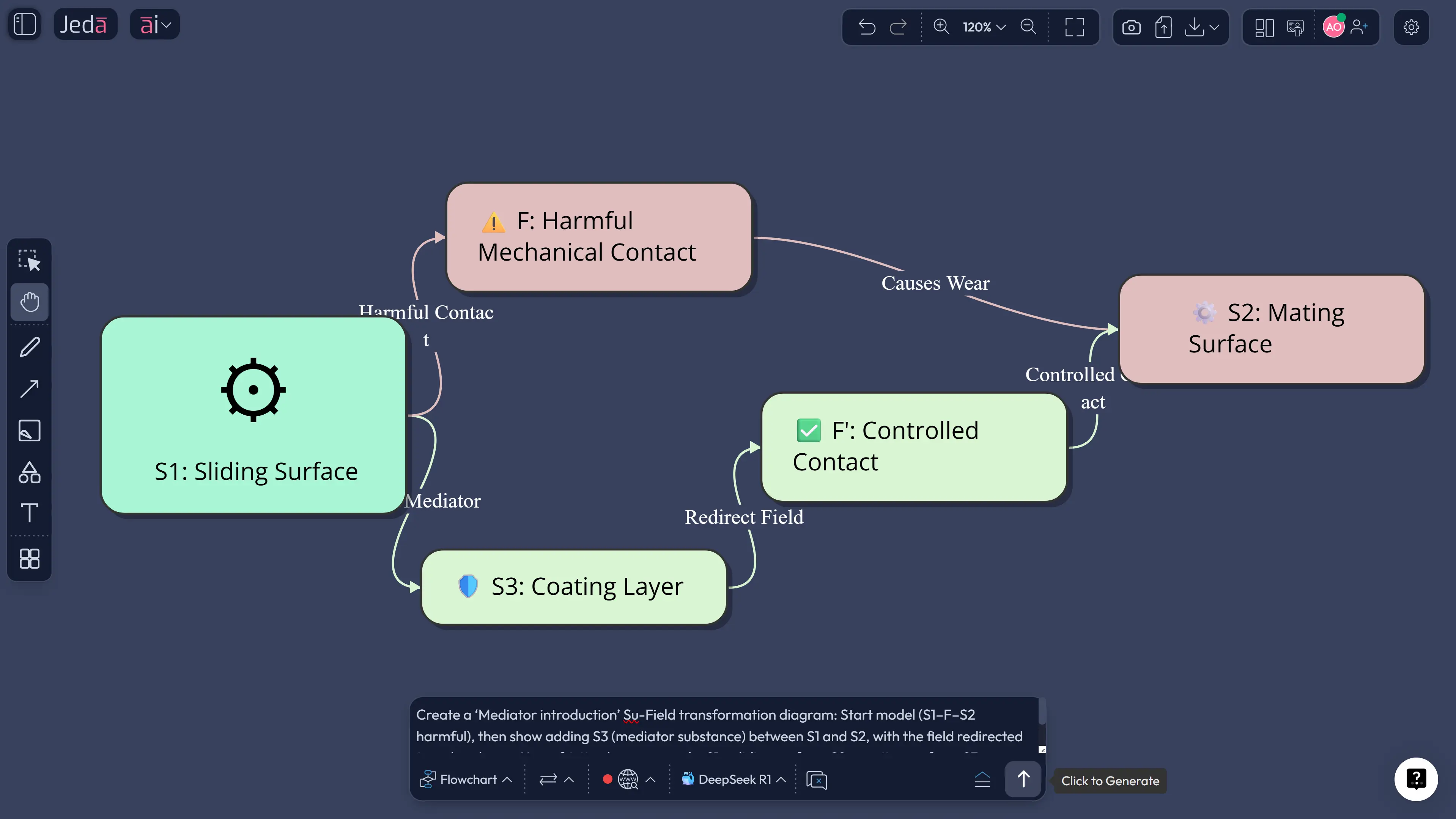
- S1: sliding surface (component A)
- S2: mating surface (component B)
- F: mechanical contact force
- Interaction: harmful (wear), plus side effect (contamination)
Standard-solution-style directions:
- Introduce a mediator substance: a sacrificial layer or coating that absorbs wear.
- Change the field: reduce mechanical contact via magnetic/air bearing (if feasible).
- Add a control field: use vibration/ultrasonic to reduce friction under certain conditions.
- Convert harm into benefit: capture wear particles as a sensing signal (predictive maintenance).
The point: Su‑Field forces you to identify the interaction that causes harm—and then transform it.
Thought-leadership angle: why Su‑Field is “AI-native”
Su‑Field analysis is basically:
- a small set of variables,
- strict structure,
- and a transformation library.
That’s exactly the type of workflow where AI shines—especially when the output is visual and editable. AI accelerates the drafting and option generation; humans validate physics and feasibility.
If you want a repeatable innovation system, Su‑Field is the tool that turns “ideas” into “mechanisms.”
FAQ
- What is Su‑Field analysis in TRIZ?
- Su‑Field (Substance‑Field) analysis is a TRIZ modeling method that represents a system as substances and the fields acting between them. It helps transform harmful or insufficient interactions using Standard Solution patterns.
- What are ‘Standard Solutions’ in Su‑Field analysis?
- Standard Solutions are TRIZ-prescribed transformation patterns used after you build a Su‑Field model. They suggest ways to add substances, change fields, introduce mediators, or control interactions to eliminate harm and improve function.
- Is Su‑Field only for mechanical engineering?
- Su‑Field is most common in physical systems because it models substances and energy fields, but the modeling mindset can also help in manufacturing, process engineering, and other domains where interactions can be formalized.
- How can AI help with Su‑Field analysis?
- AI can speed up model drafting, propose candidate transformation directions based on Standard Solutions, and structure evaluation matrices. Human judgment is required for physics validity and implementation feasibility.
Sources & further reading
- [1]
TRIZ Journal (n.d.) . “Su-Field Analysis” The TRIZ Journal.
View Source ↗ - [2]
INNOVAZIONE SISTEMATICA (Training PDF) (2020) . “Su-Field Analysis and Standard Solutions (EN_04)” InnovazioneSistematica.it.
View Source ↗ - [3]
Matriz TRIZ Wiki (2025) . “Standard inventive solutions (SIS)” Matriz TRIZ Wiki.
View Source ↗ - [4]
Matriz TRIZ Wiki (2025) . “Substance-field modeling” Matriz TRIZ Wiki.
View Source ↗ - [5]
D. Russo (2015) . “From Altshuller’s 76 Standard Solutions to a New Set of Standards” Procedia Engineering.
View Source ↗ - [6]
W. Yan et al. (2022) . “A Rule-Based Heuristic Methodology for Su-Field Analysis” Information (MDPI).
View Source ↗ - [7]
V. Petrov (2024) . “Concepts of Su-Field Analysis” Springer (Book Chapter).
View Source ↗