If you’re trying to build a defensible business, your supply chain is either a moat… or a liability wearing a safety vest.
A supply chain moat analysis is a structured assessment of whether your operations create a durable advantage that competitors can’t copy quickly—through cost position, speed, reliability, resilience, network access, and control over critical inputs. The “moat” language comes from the broader idea of an economic moat: a set of competitive advantages that protects long-run profits and market share.
This page shows how to run that analysis using an AI Workspace (Jeda.ai) so the output isn’t a 30-slide deck that nobody updates.
Jeda.ai is a Visual AI workspace with 300+ strategic frameworks in its AI Menu, so you can start from a structured template and keep everything editable. It becomes an editable, decision-grade board your team can extend with AI, debate live, and export as PNG, SVG, or PDF.
What is a supply chain moat?
A supply chain moat is a competitive advantage rooted in operations—where your end-to-end system (sourcing → manufacturing → fulfillment → returns) consistently delivers lower cost, faster cycle time, higher service levels, or greater resilience than peers, in ways that are hard to replicate.
In academic terms, this maps cleanly to the resource-based view (RBV): sustained advantage comes from resources and capabilities that are valuable, rare, difficult to imitate, and non-substitutable. Your supply chain becomes that capability when it is systemic (many interlocking parts), not just “we have a good warehouse.”
A second lens is the “Triple-A” view of supply chains—agility, adaptability, and alignment—which frames competitive supply chains as dynamic capabilities, not static infrastructure.
Why run supply chain moat analysis with AI?
Because moat work dies in spreadsheets.
AI helps when it’s used for structure, coverage, and stress-testing—then your team validates the claims with real ops data.
In Jeda.ai, you can turn SOPs, vendor terms, and KPI exports into an editable board with Document Insight or Data Insight, then refine it together in real time.
- Faster first draft
Generate a moat scorecard and hypotheses in minutes, then spend time validating—not formatting.
- Evidence-in workflow
Bring PDFs, notes, or data. Use Document Insight or Data Insight so your board reflects real operational facts.
- System-level thinking
AI helps connect cost, lead time, inventory, supplier power, and network constraints into one coherent model.
- Team alignment
Your supply chain moat is cross-functional. Build it on an AI Whiteboard where ops, finance, and product can argue productively.
- Editable outputs
Everything stays editable (except Art). Turn insights into a plan, not a static report.
- Resilience lens
Stress-test disruption scenarios (ports, demand shocks, supplier failures) and document trade-offs explicitly.
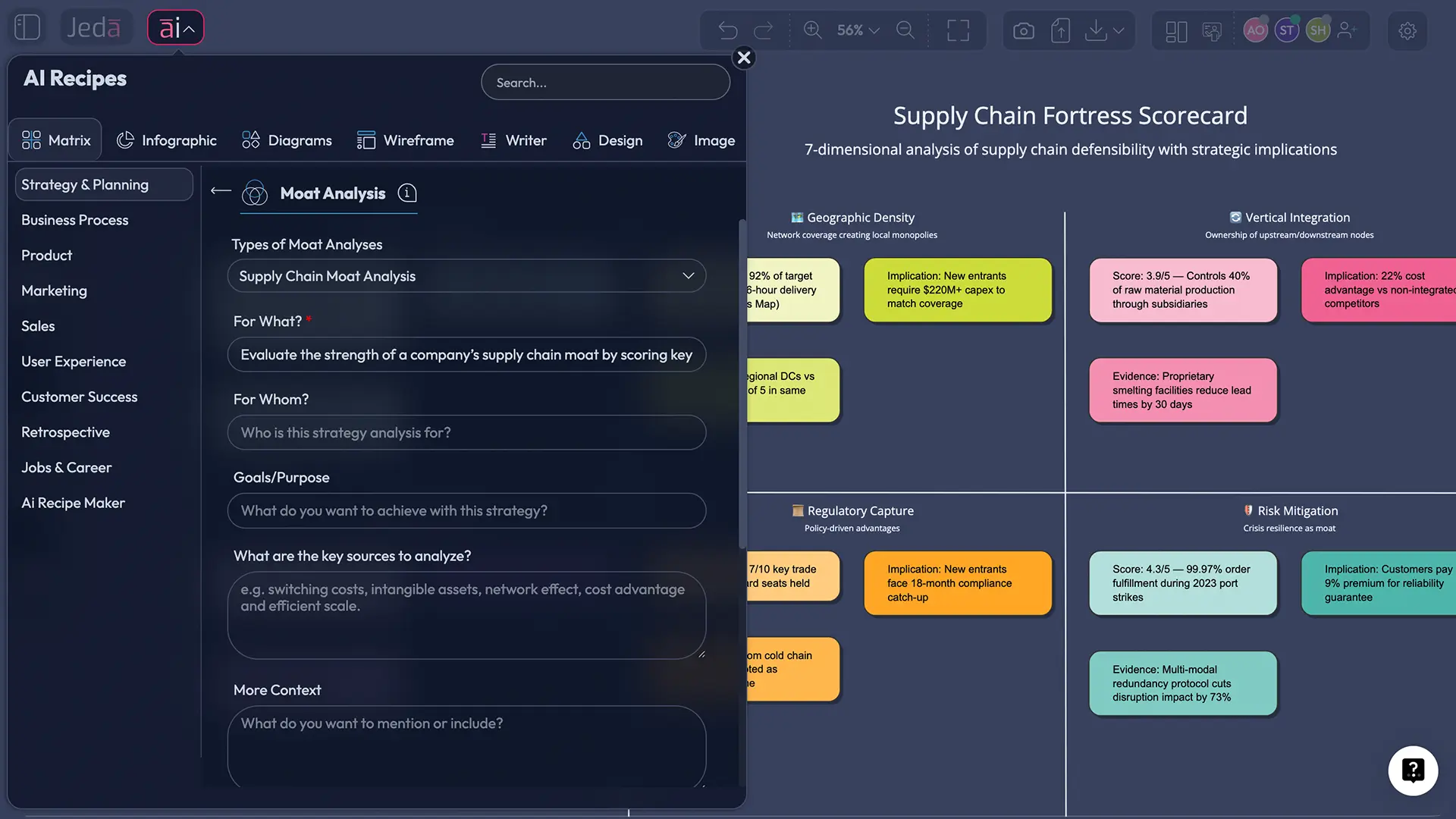
The Supply Chain Moat Scorecard (7 dimensions)
Here’s a practical scoring model you can use as a sub-recipe inside your broader Moat Analysis template.
Score each dimension 1–5. The trick is to score based on relative advantage versus close competitors—not internal comfort.
1) Cost position (structural, not “we negotiated hard”)
What to check:
- Unit logistics cost vs peers (inbound + outbound)
- Inventory carrying cost and obsolescence
- Manufacturing conversion cost and yield stability
- Process design advantages (automation, cross-dock, postponement)
Why it can be a moat: Cost advantage is durable when it’s baked into network design and routines, not one contract renewal away.
2) Speed and cycle-time advantage
What to check:
- Order-to-delivery lead time (and variance)
- Replenishment frequency and assortment refresh
- New product introduction (NPI) cycle time
A fast, repeatable loop can be hard to copy—especially when it depends on co-located capabilities and tuned processes.
3) Service reliability and quality
What to check:
- OTIF (on-time in-full) performance
- Stockout rate and backorder duration
- Returns processing speed and defect loops
Reliability becomes a moat when it changes buying behavior (repeat purchase, switching costs, willingness to pay).
4) Network control and asset advantage
What to check:
- Ownership/control of strategic nodes (DCs, sort centers, last-mile capacity)
- Access to constrained lanes or capacity during peak periods
- Geographic density advantages that competitors can’t match quickly
Hard to replicate without huge capital and time.
5) Supplier power and unique access
What to check:
- Exclusive/priority access to scarce inputs
- Supplier integration depth (shared planning, design-to-cost)
- Multi-sourcing strategy quality (risk vs switching cost)
Supplier relationships become strategic resources when they’re path-dependent and embedded in routines.
6) Visibility and decision-quality (data as a moat amplifier)
What to check:
- Real-time visibility to inventory and orders
- Forecasting maturity and feedback loops
- Exception management and root-cause learning
AI doesn’t replace good instrumentation, but it can translate signals into structured insights faster—especially when paired with Data Insight and Document Insight in Jeda.ai.
7) Resilience and recovery advantage
What to check:
- Time-to-recover (TTR) from disruptions
- Redundancy vs flexibility trade-offs documented
- Scenario playbooks and governance
Resilience can create competitive advantage when it improves recovery speed and reduces the financial impact of disruption.
How to create a Supply Chain Moat Analysis in Jeda.ai
Because this is a sub-recipe of the Moat Analysis templates, treat the AI Menu approach as the default.
Method 1: AI Menu recipe (recommended)
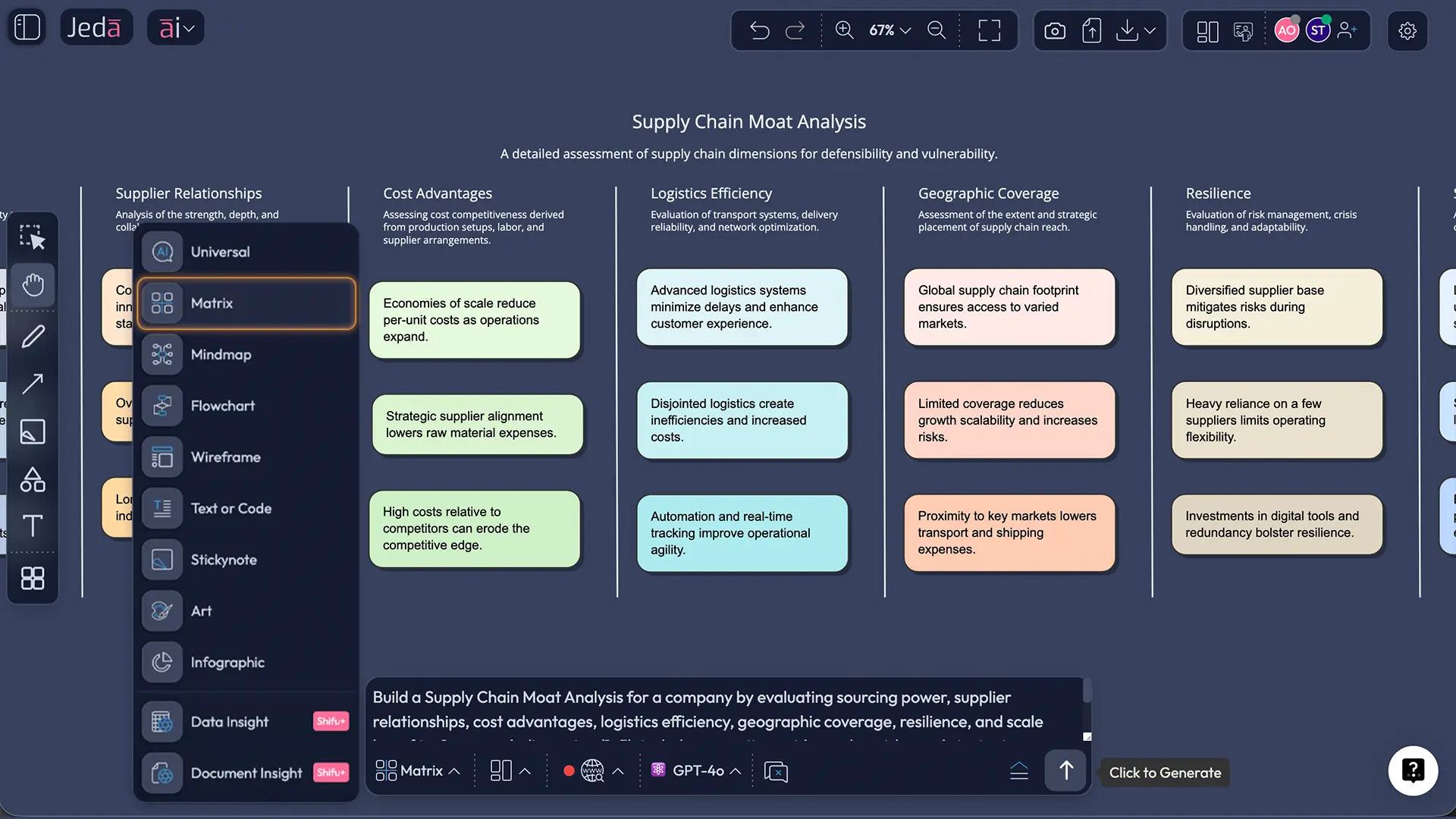
- Open the AI Menu (top-left).
- Navigate to the Matrix Recipes (or the Moat Analysis category, if your menu groups it that way).
- Choose Supply Chain Moat Analysis.
- Fill in your context (industry, product type, geography, operating model, key constraints).
- Click Generate to produce the scorecard on the canvas.
Method 2: Prompt Bar (fast, fully custom)
Open the Prompt Bar at the bottom, select the Matrix command, and paste a prompt like this:
Prompt (copy/paste):
Create a “Supply Chain Moat Scorecard” with 7 rows: Cost Position, Speed/Cycle Time, Service Reliability, Network Control, Supplier Power, Visibility/Decision Quality, Resilience/Recovery.
Use 5 columns: Definition, What to Measure, Evidence to Collect, Score (1–5), Notes/Implications.
Context: [industry], [product category], [geography], [B2B/B2C], [lead-time target], [service level target], [fulfillment model], [top 3 constraints].
After the scorecard, add a summary: “Current Moat Thesis”, “Weak Links”, and “Top 5 initiatives to widen the moat.”
After it generates:
- Tap the AI+ button to extend any row (e.g., resilience) into deeper sub-questions.
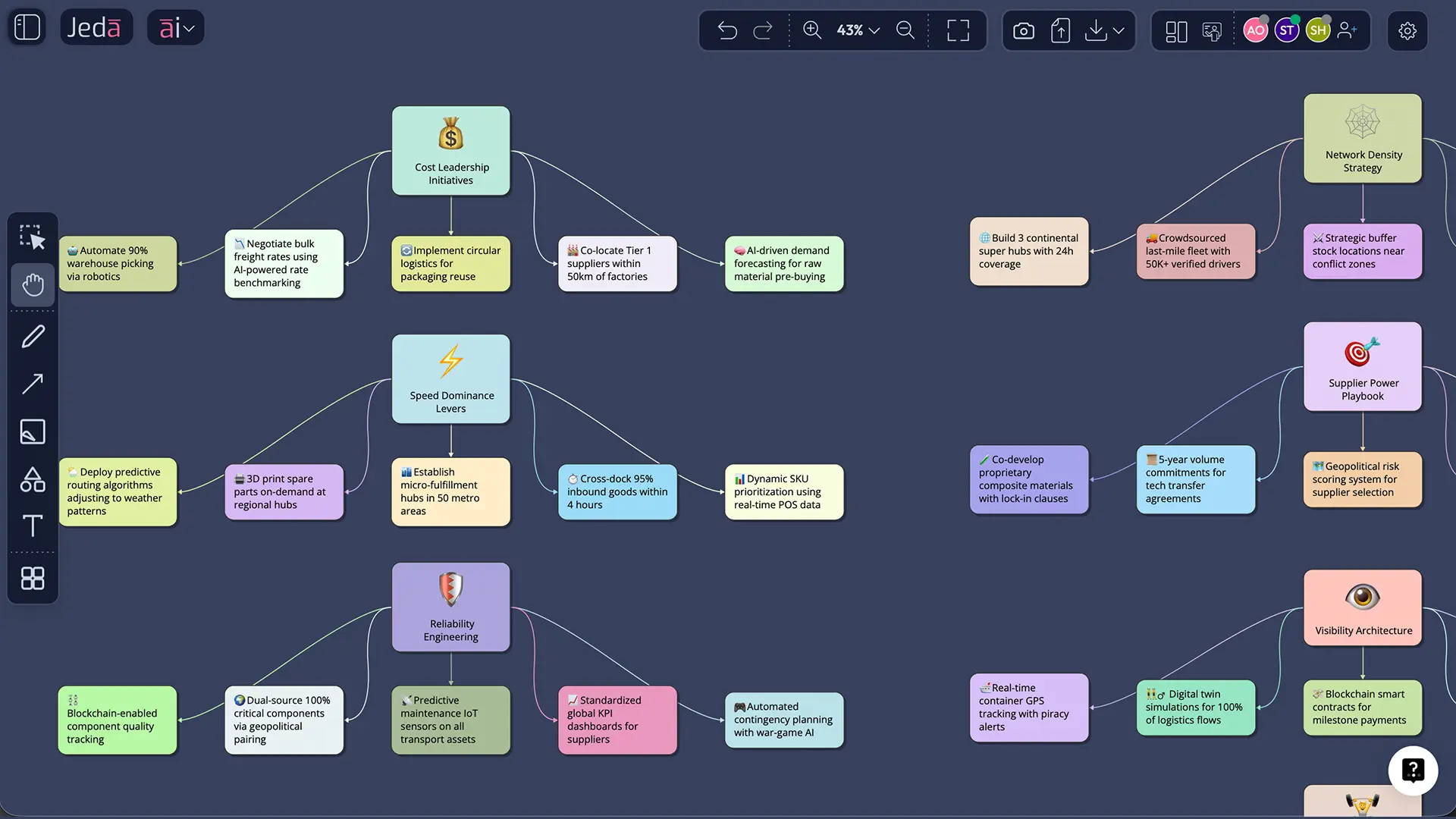
- Use Vision Transform if you want to convert the matrix into a Diagram (causal map) or Mindmap (capabilities tree).
- Define the competitive set
List 3–5 direct rivals you actually lose deals to. A moat is relative.
- Gather evidence inputs
Bring SOPs, KPIs, vendor terms, and shipping/returns data. Use Document Insight or Data Insight when you have files.
- Generate the scorecard
Use the AI Menu recipe or Prompt Bar with the Matrix command to create a 7-dimension scorecard.
- Stress-test the scores
Run 2 disruption scenarios (demand spike, supplier outage). Adjust scores based on recovery behavior, not confidence.
- Turn insights into a plan
Convert the scorecard into a Diagram of causes and initiatives. Assign owners, sequence, and risks on the board.
Worked example: Zara’s speed moat (what “hard to copy” looks like)
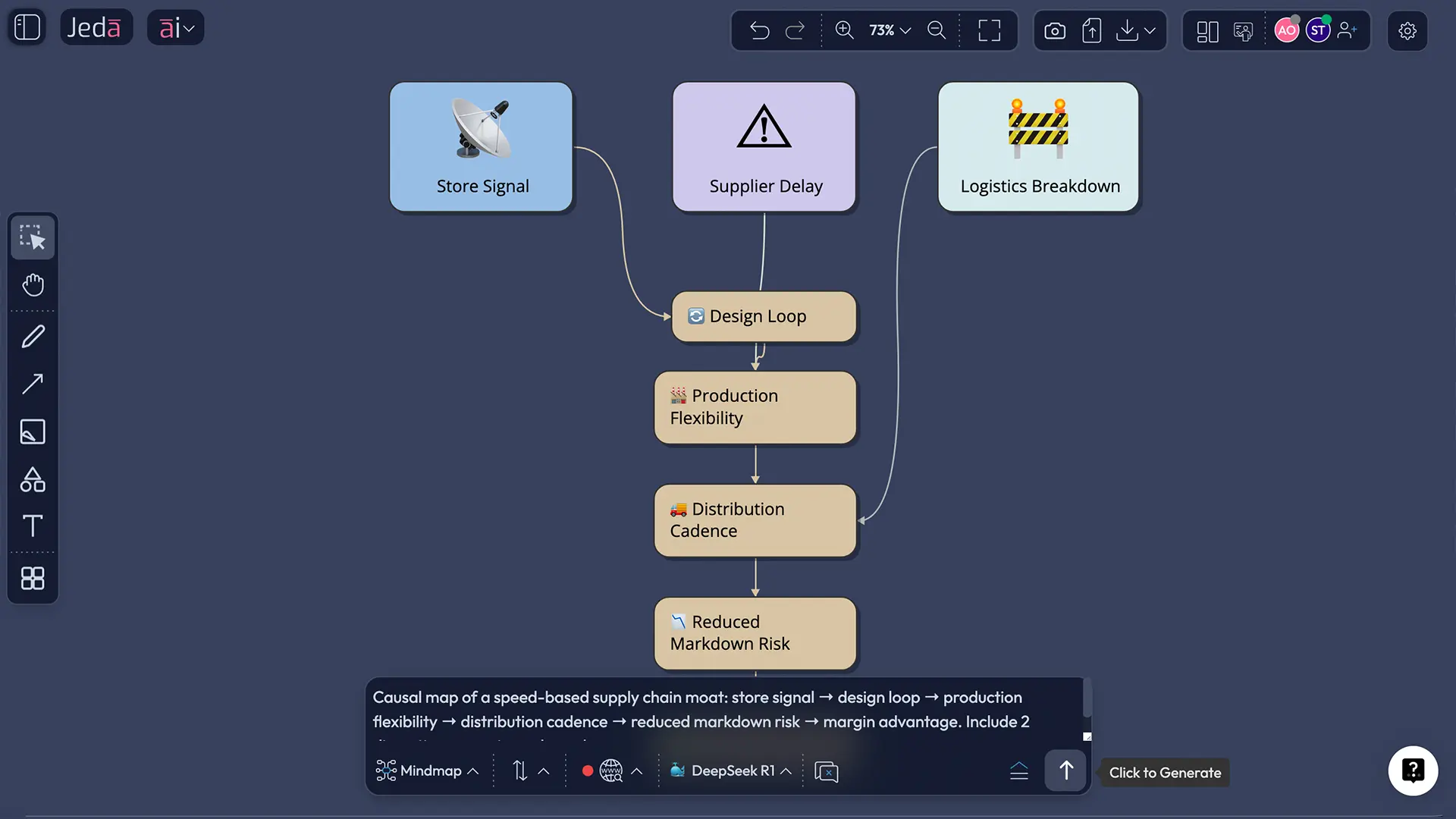
Zara (Inditex) is a classic illustration of a supply chain moat built around speed and assortment refresh. It’s the operational system: frequent replenishment and rapid response to demand signals.
A documented case discussion reports order-to-delivery lead times measured in days, supported by tight coordination across design, production, and distribution.
How to translate that into the scorecard:
- Speed: high score (rapid replenishment loop)
- Network control: elevated (coordination across critical nodes)
- Visibility: strong (store-level signals feed decisions)
- Cost: not necessarily lowest, but the system converts speed into margin by reducing markdown risk
What’s the moat claim? Competitors can copy a tactic (faster shipping). Copying the system—process, governance, supplier structure, and incentives—takes years.
Best practices for a credible supply chain moat thesis
A few practices that keep the analysis honest:
- Confusing “busy” with “better.” High activity isn’t a moat. Measurable advantage is.
- Over-indexing on one dimension. A low-cost supply chain with poor reliability often loses on total customer value.
- Ignoring variance. Average lead time matters, but variance often hurts more.
- Assuming resilience is just redundancy. Flexibility can create advantage even when redundancy is expensive.
Frequently Asked Questions
- What is supply chain moat analysis?
- Supply chain moat analysis is a structured evaluation of whether your operations create a durable competitive advantage through cost, speed, reliability, network control, supplier access, visibility, and resilience. The goal is to identify which advantages are hard for competitors to replicate within 12–24 months.
- How is a supply chain moat different from a general economic moat?
- An economic moat is the umbrella concept of durable competitive advantage. A supply chain moat is a specific subset where the advantage is driven by operational capabilities—network design, logistics execution, supplier integration, and recovery ability—rather than branding or patents.
- Which frameworks support supply chain moat analysis?
- Common foundations include Porter’s value chain (to locate cost/value drivers), the resource-based view (to test whether capabilities are hard to imitate), and Triple-A supply chain thinking (agility, adaptability, alignment) to assess dynamic performance under change.
- What KPIs should I use for a supply chain moat scorecard?
- Start with OTIF, stockout rate, order-to-delivery lead time and variance, inventory turns and obsolescence, logistics cost per unit, forecast error, and time-to-recover from disruptions. Then add category-specific metrics like cold-chain integrity or return cycle time.
- Can resilience really be a competitive advantage, not just risk management?
- Yes. Faster recovery can protect revenue during disruptions and capture demand when competitors cannot deliver. Research on resilient enterprises argues that flexibility investments can produce day-to-day operational benefits alongside disruption recovery advantages.
- How do I stress-test a supply chain moat?
- Run two scenarios: a demand spike (volume + mix change) and a supply disruption (supplier outage or transport shock). Compare response time, service level degradation, and recovery cost. Update the moat scorecard based on observed weak links and decision latency.
- How do I use AI in supply chain moat analysis without hallucinations?
- Use AI for structure, summarization, and scenario generation, but ground every claim in evidence: KPIs, contracts, SOPs, and incident logs. In Jeda.ai, Document Insight and Data Insight let you bring source material into the workflow so the board reflects real inputs.
- Does Jeda.ai export the moat analysis to PowerPoint?
- No. Jeda.ai exports boards as PNG, SVG, or PDF. If you need slides, export an image/PDF and place it into your deck workflow.
- Which Jeda.ai plan do teams typically use for this analysis?
- You can run the workflow on the free Whitebelt plan with limited daily usage. Teams that need expanded usage and collaboration often use Blackbelt, while Shifu adds multi-model intelligence and an aggregator model for deeper analysis workflows.
- How often should I redo the moat analysis?
- Quarterly is a practical cadence for most teams, because capacity constraints, supplier relationships, and service performance change with seasons, product launches, and disruptions. Re-run sooner after a major network change or a significant disruption event.
Sources & further reading
- [1]
Hau L. Lee (2004) . “The Triple-A Supply Chain” Harvard Business Review.
View Source ↗ - [2]
Jay B. Barney (1991) . “Firm Resources and Sustained Competitive Advantage” Journal of Management.
View Source ↗ - [3]
Michael E. Porter (1985) . “Competitive Advantage: Creating and Sustaining Superior Performance” Free Press / Harvard Business School reference page.
View Source ↗ - [4]
Rameshwar Dubey et al. (2018) . “Supply chain agility, adaptability and alignment” International Journal of Operations & Production Management.
View Source ↗ - [5]
Yossi Sheffi & James B. Rice Jr. (2005) . “A Supply Chain View of the Resilient Enterprise” MIT Sloan Management Review (PDF).
View Source ↗ - [6]
Michigan State University Online (2024) . “How to Use Your Supply Chain to Gain Competitive Advantage” MSU Online.
View Source ↗
Start Your Supply Chain Moat Analysis Today
Join over 150,000+ users who use Jeda.ai as their AI Workspace for decision-ready strategy boards.
Try Free Template