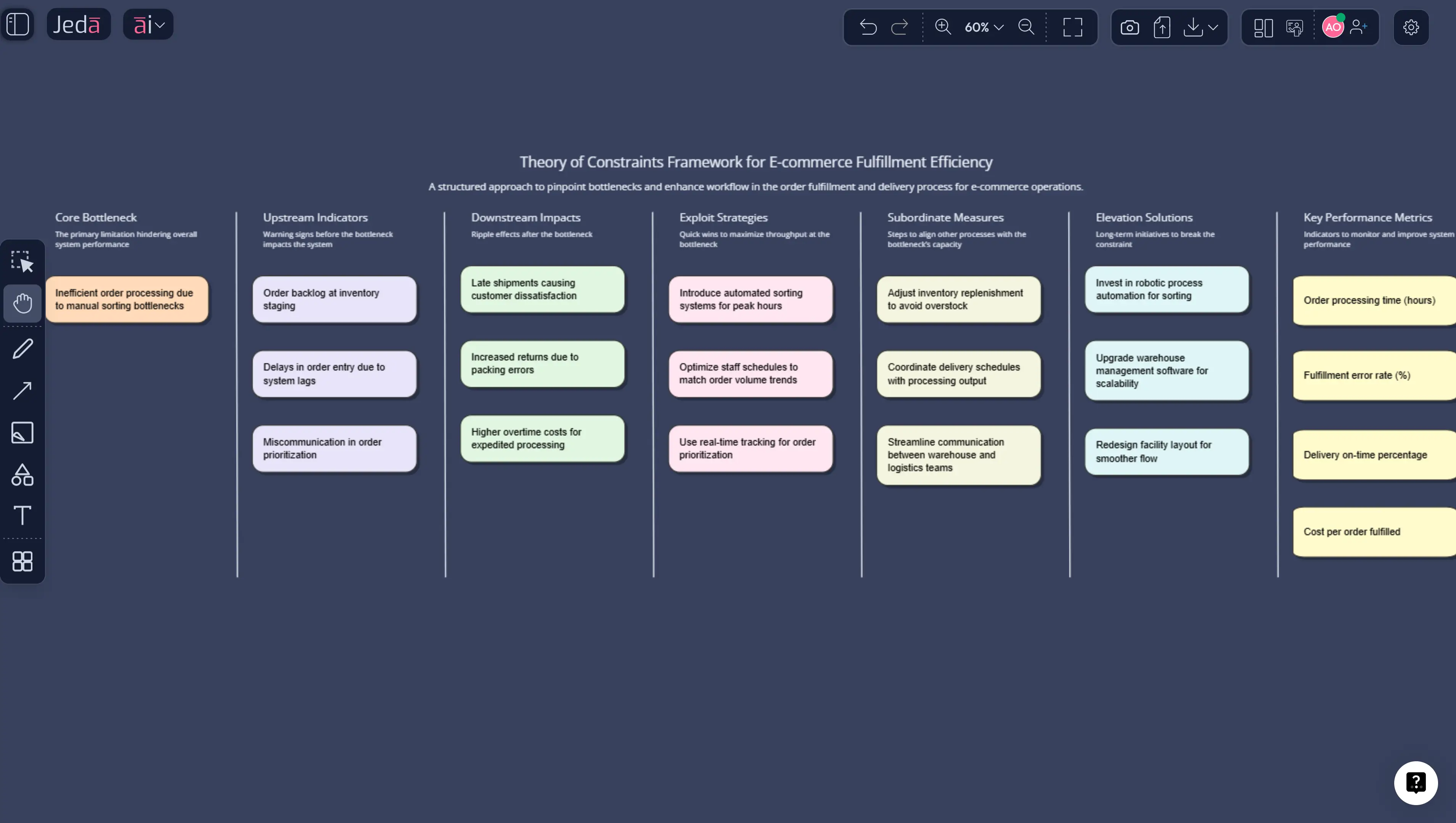
Theory of Constraints with AI helps you stop “optimizing everything” and start fixing the one thing that is actually throttling output. That is the whole point. Instead of spreading effort across twenty process issues, you identify the limiting constraint, improve it, and then move to the next one. In a modern AI Workspace, that work gets faster because your team can see the bottleneck, the evidence, the trade-offs, and the action path in one place.
A lot of operations reviews still drown in local fixes, long slide decks, and debates that go nowhere. Jeda.ai turns that mess into an editable AI Whiteboard and matrix-based decision flow, so the discussion stays focused on throughput, flow, and system impact. More than 150,000+ users already use Jeda.ai to turn complex work into visual, collaborative decisions. And yes, Jeda.ai has a pre-built Theory of Constraints recipe in its AI Menu under Business Process, so you do not have to build the structure from scratch.
What Is Theory of Constraints with AI?
Theory of Constraints, usually shortened to TOC, is a management philosophy developed by Eliyahu M. Goldratt. The core idea is brutally simple: every system is limited by at least one constraint, and improving non-constraints before fixing that limiting point mostly creates motion, not progress. Goldratt popularized the approach in The Goal in 1984, and the framework later expanded into the five focusing steps, throughput accounting, and thinking processes used across operations, supply chains, and project work.
Here is the clean version. You identify the current constraint, exploit it, subordinate the rest of the system to it, elevate it if needed, and then repeat the cycle once the bottleneck moves. That sequence is why TOC still holds up. It is practical. It cuts noise. It forces prioritization.
Using Theory of Constraints with AI does not replace the framework. It sharpens it. In Jeda.ai, your team can feed in the goal, the symptoms, the suspected bottleneck, and the surrounding process context, then generate an editable matrix in an AI Whiteboard. From there, you can reorganize notes, add evidence, collaborate live, and extend any section with the AI+ button. That is a better workflow than passing around static documents and hoping everyone interprets the bottleneck the same way.
Why Use Theory of Constraints with AI in an AI Workspace?
Most teams do not fail because they lack ideas. They fail because they attack the wrong choke point. That is why TOC works so well inside an AI Workspace. It gives the team one shared logic: fix the rate-limiting step first.
With Jeda.ai, you are not just writing about a bottleneck. You are building it visually in a Visual AI environment that your team can edit together. That means fewer disconnected notes, fewer “version 9 final final” decks, and a much clearer path from diagnosis to action.
- Constraint-first focus
Center the team on the one limiting factor instead of scattering effort across every visible problem.
- Faster bottleneck detection
Use AI to organize symptoms, queues, delays, and dependencies into a structured Theory of Constraints view.
- System-level thinking
Map how one weak link affects upstream and downstream flow, not just one team’s local workload.
- Shared alignment
Review, edit, and debate the same board in real time inside Jeda.ai’s AI Whiteboard.
- AI+ deep dives
Extend a generated section to surface likely root causes, mitigation ideas, and second-order effects.
- Slide-ready structure
Turn bottleneck analysis into a clean matrix your team can refine, present, and export as PNG, SVG, or PDF.
When Should You Use Theory of Constraints?
Use TOC when one bottleneck is clearly choking a larger system. Manufacturing teams use it for line throughput. Service teams use it for ticket backlogs. Project leaders use it when shared resources keep delaying delivery. It is a strong fit when work piles up before one stage, local optimization changes nothing, or recurring delays keep appearing in different forms.
A quick rule of thumb:
| Framework | Best use case | What it tells you |
|---|---|---|
| Theory of Constraints | One bottleneck is limiting system output | Where to focus first and how to relieve the choke point |
| Five Whys | One problem needs root-cause drilling | Why a specific failure keeps happening |
| Business Process Management | You need a full workflow redesign | How the end-to-end process runs today and should run tomorrow |
That is why TOC works so well alongside related pages like Five Whys with AI and Business Process Management with AI. One finds the critical constraint. The others help unpack the wider system or the root cause beneath it.
How to Create Theory of Constraints in Jeda.ai
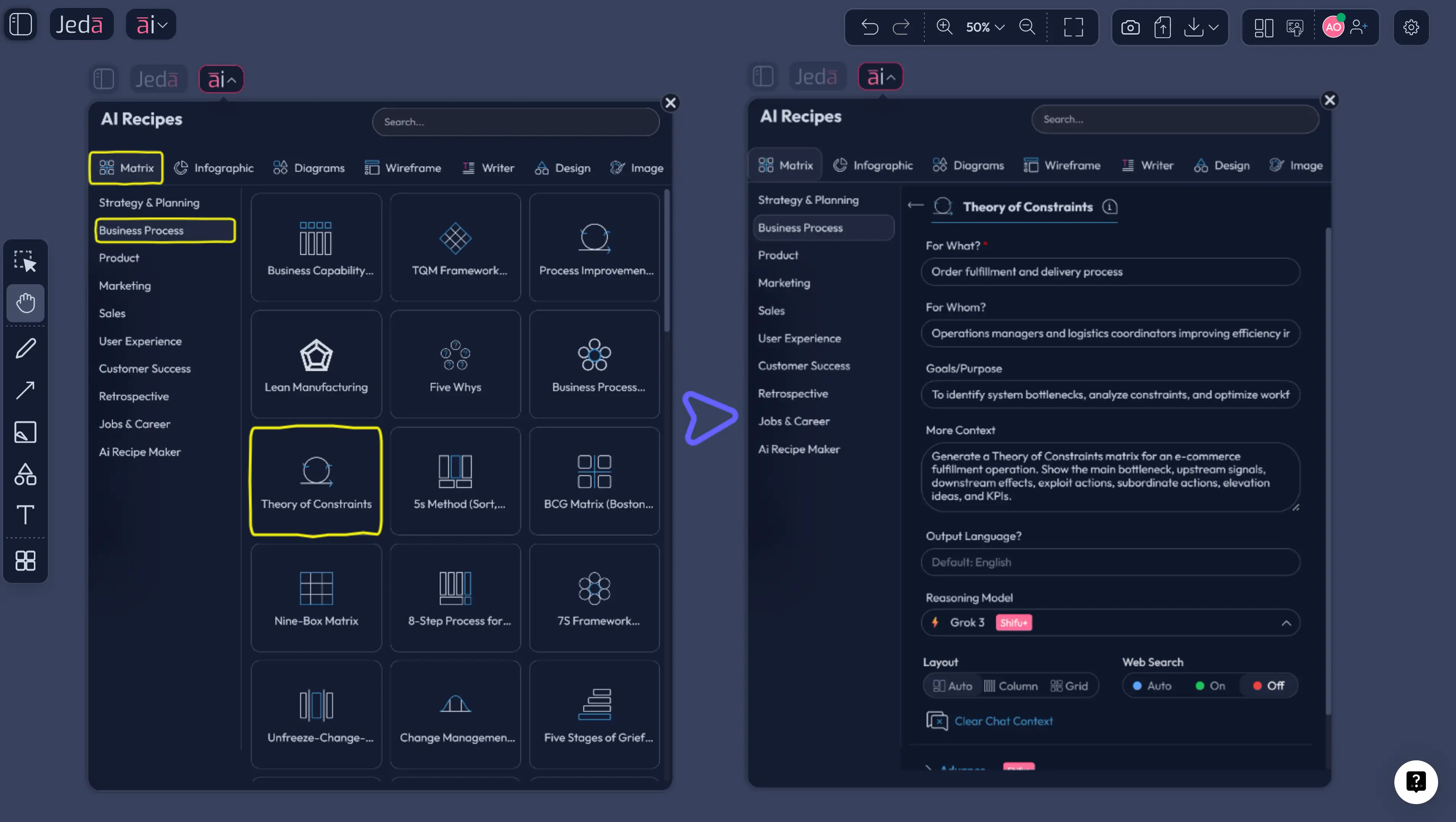
You have two clean ways to build a Theory of Constraints with AI board in Jeda.ai. Since this topic already has a recipe in the AI Menu, the better starting point is the Recipe Matrix method.
Method 1: Recipe Matrix in Jeda.ai
Start here when you want the fastest structured output. This uses the built-in Theory of Constraints recipe from the AI Menu.
- Open an AI Workspace
Log in to Jeda.ai and enter the AI Workspace where you want to build your Theory of Constraints board.
- Go to the AI Menu
Open the AI Menu and navigate to the Business Process recipe category.
- Choose Theory of Constraints
Select the Theory of Constraints recipe so the matrix structure is pre-configured for bottleneck analysis.
- Define the goal
Enter the business outcome you are trying to improve, such as throughput, lead time, service level, or project delivery speed.
- Describe the suspected constraint
Add the bottleneck, symptoms, queues, delays, blocked stages, policy issues, or shared-resource conflicts that are limiting performance.
- Add operating context
Include affected teams, inputs, outputs, metrics, and any available evidence so the matrix reflects the real system rather than a vague complaint.
- Pick layout and AI model
Choose the matrix layout that best fits your review style and select your preferred AI model or multi-LLM setup.
- Generate the matrix
Click Generate to create the first Theory of Constraints board with editable sections, sticky notes, and improvement logic.
- Refine and collaborate
Edit the board with your team, validate the actual constraint, and prioritize actions before moving to execution.
Method 2: Prompt Bar
Use this when you want more freedom or want to create a TOC board from a messy situation without starting from the recipe.
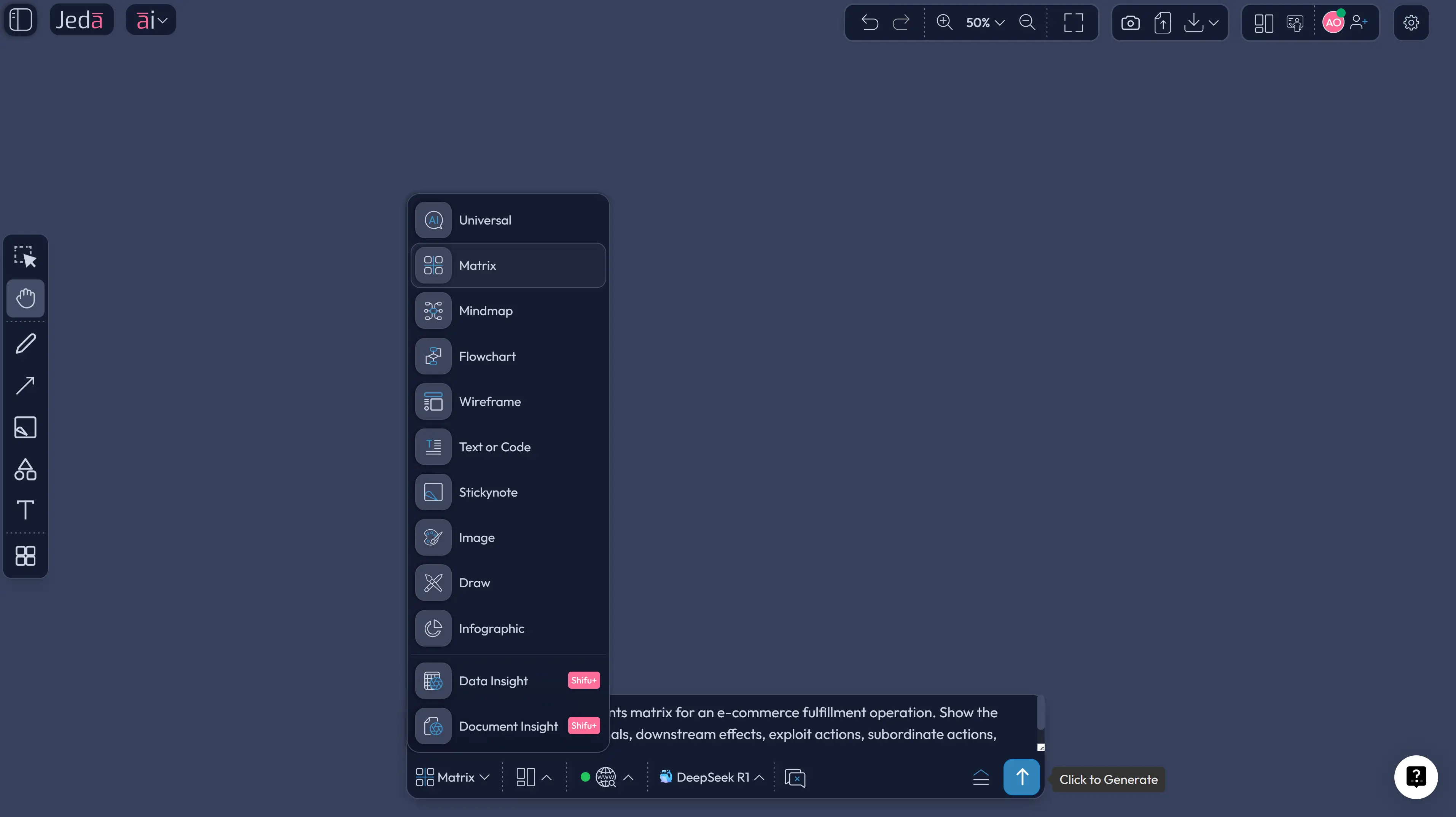
- Open the Prompt Bar at the bottom of the canvas.
- Select the Matrix command.
- Type a prompt that states the goal, the system, the suspected bottleneck, and the desired output.
- Press Enter and review the generated matrix.
A strong prompt looks like this:
Create a Theory of Constraints matrix for a regional coffee chain. Goal: increase daily order throughput without adding headcount. Suspected constraints: grinder capacity, morning rush staffing, and delayed mobile-order batching. Show the current bottleneck, symptoms, downstream effects, quick exploitation ideas, subordination actions, elevation options, and KPIs.
After generation, select any section and use the AI+ button to extend it. This is where the deep dive happens. Use AI+ to expand the current bottleneck, uncover likely knock-on effects, or continue the action logic. Keep it as an extension tool. Build first, deepen second.
And if the team wants a different visual format, use Vision Transform to convert the matrix into a flow-oriented view. That is useful when the group needs to see cause-and-effect movement, not just the structured grid.
Theory of Constraints Template & Example
Let’s make this real. Imagine a fast-growing specialty coffee chain. Demand is strong. Revenue looks healthy. But mobile orders are late, baristas feel swamped, and customers keep abandoning pickup during the morning rush. Leadership’s instinct is predictable: hire more people, add more menu promotions, maybe expand prep space.
But TOC asks a nastier question: what is the one point limiting total flow right now?
In this example, the real constraint is not “the team is busy.” It is grinder capacity plus how orders are batched ahead of drink assembly. Once the board is generated in Jeda.ai, the team can separate symptoms from the actual bottleneck:
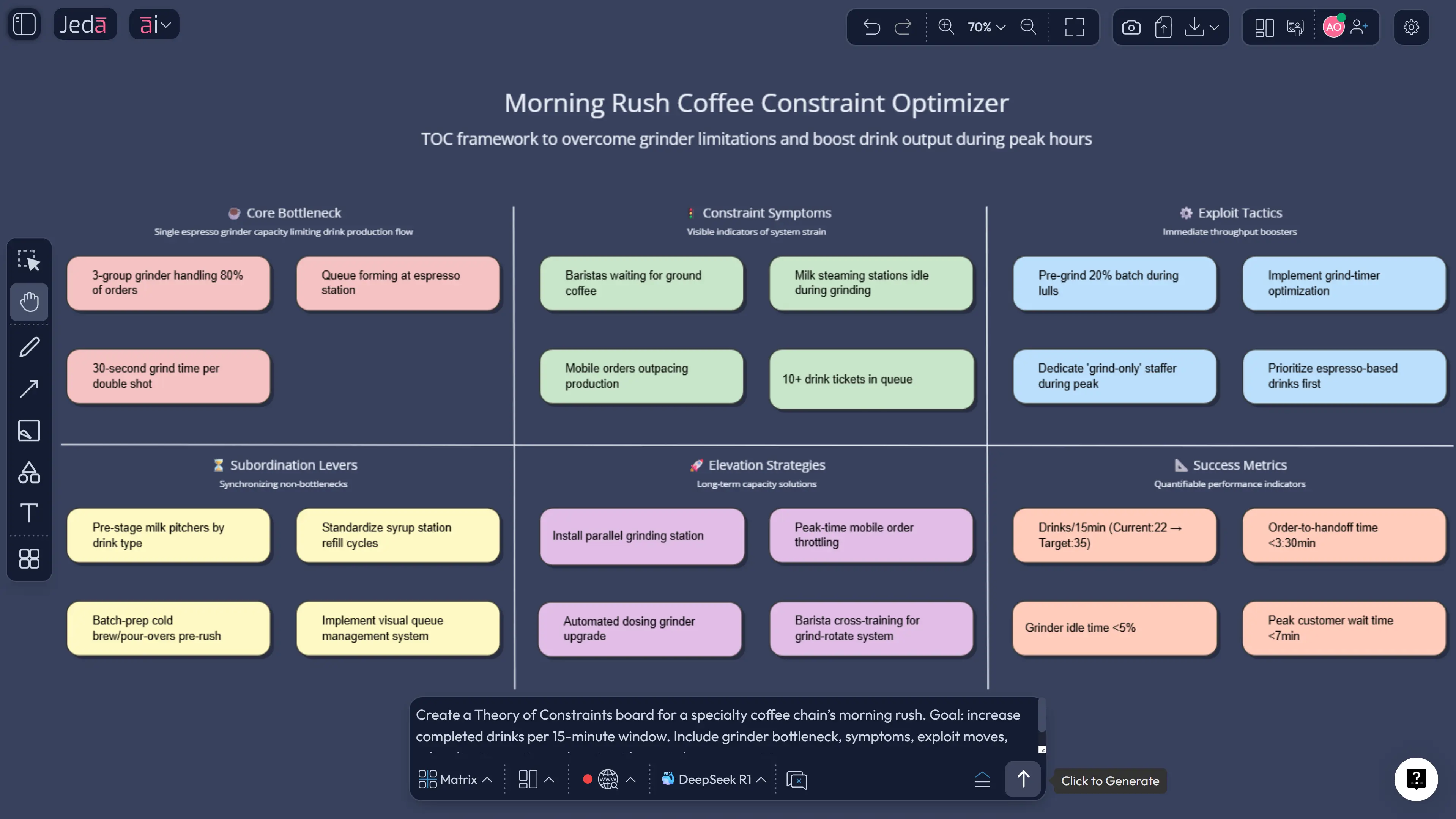
If your team works in operations, product delivery, or service design, that same pattern applies. The constraint may be QA review, one shared engineer, a policy approval queue, or a replenishment delay. Different system. Same logic.
Best Practices for Better Theory of Constraints Boards
For adjacent strategy work, it also helps to connect your TOC page to Lean Manufacturing with AI or even the broader AI Whiteboard and AI Workspace hubs. The framework is powerful on its own. It becomes far more useful when it lives inside a repeatable visual system.
Common Mistakes to Avoid
Teams often confuse the loudest pain point with the real constraint. They also waste time optimizing non-constraints because it feels productive. Another common error is skipping the system view: if you improve one area while starving or blocking the actual bottleneck, the whole system can get worse. And many teams invest too early. TOC tells you to exploit and subordinate before you elevate. Then repeat, because once one constraint moves, another becomes the new limiter.
Theory of Constraints with AI FAQs
- What is Theory of Constraints with AI?
- Theory of Constraints with AI combines Goldratt’s bottleneck-focused framework with AI-assisted structuring, analysis, and visualization. The AI does not replace the method. It helps you organize symptoms, surface likely choke points, and build an editable board faster so your team can validate the real constraint.
- What are the five focusing steps in Theory of Constraints?
- The five focusing steps are identify the constraint, exploit it, subordinate the rest of the system to it, elevate it if needed, and repeat when the constraint moves. The sequence matters because TOC is designed to improve total system throughput, not local efficiency alone.
- When should you use a Theory of Constraints template?
- Use a Theory of Constraints template when one bottleneck appears to be limiting flow across a wider system. It is especially useful for recurring delays, overloaded queues, resource conflicts, stock issues, and delivery problems where improving the whole system matters more than optimizing individual departments.
- Is Theory of Constraints only for manufacturing?
- No. TOC started in production settings, but it is widely applied in project management, supply chain, service operations, and business process improvement. Any system with interdependent steps and one limiting factor can benefit from a TOC analysis.
- How do you create Theory of Constraints in Jeda.ai?
- You can create it in two ways inside Jeda.ai. Method one uses the AI Menu recipe under Business Process for a ready-made matrix. Method two uses the Prompt Bar with the Matrix command. After generation, you can refine the board, collaborate live, and use AI+ to extend the analysis.
- What kinds of constraints can AI help identify?
- AI can help organize signals around physical, resource, policy, market, and process constraints. It is especially useful when the system is messy and the symptoms are spread across teams, queues, notes, and performance observations. Your team still needs to verify the actual bottleneck.
- What should be included in a Theory of Constraints board?
- A strong Theory of Constraints board should include the system goal, the current constraint, supporting symptoms, upstream and downstream effects, exploit actions, subordination actions, elevation options, owners, and a short set of throughput-focused KPIs. Without those, the analysis stays vague.
- How is Theory of Constraints different from Five Whys?
- Theory of Constraints identifies the limiting factor in a system and prioritizes how to improve flow around it. Five Whys drills down into the cause of one specific problem. They work well together, but they answer different management questions.
- Can teams collaborate on a TOC board in Jeda.ai?
- Yes. Jeda.ai is built as an AI Whiteboard and AI Workspace, so teams can review the same Theory of Constraints board together, edit sections, challenge assumptions, and align on actions in real time instead of passing around disconnected files.
- Can I export a Theory of Constraints board from Jeda.ai?
- Yes. Once your Theory of Constraints board is ready, you can export it from Jeda.ai as PNG, SVG, or PDF. That makes it easier to circulate the visual, present the logic, or attach it to an operating review without rebuilding the framework elsewhere.
Sources & Further Reading
- [1]
Goldratt, Eliyahu M.; Cox, Jeff (1984) . “The Goal: A Process of Ongoing Improvement” North River Press / Google Books.
View Source ↗ - [2]
Goldratt, Eliyahu M. (1990) . “What Is This Thing Called Theory of Constraints and How Should It Be Implemented?” North River Press / Google Books.
View Source ↗ - [3]
Şimşit, Zeynep Tuğçe; Günay, Noyan Sebla; Vayvay, Özalp (2014) . “Theory of Constraints: A Literature Review” Procedia - Social and Behavioral Sciences.
View Source ↗ - [4]
Watson, Kevin J.; Blackstone, John H.; Gardiner, Stanley C. (2007) . “The Evolution of a Management Philosophy: The Theory of Constraints” Journal of Operations Management.
View Source ↗ - [5]
Steyn, Herman (2002) . “Project Management Applications of the Theory of Constraints Beyond Critical Chain Scheduling” International Journal of Project Management.
View Source ↗ - [6]
da Silva Stefano, G.; Lacerda, D. P.; Silva, V. L.; Silva, F. N.; Piran, F. S. (2024) . “How Important Is the Theory of Constraints to Supply Chain Management? An Assessment of Its Application and Impacts” Computers & Industrial Engineering.
View Source ↗
Start Your Theory of Constraints with AI Board Today
Join over 150,000+ professionals who use Jeda.ai’s AI Workspace and AI Whiteboard to turn bottlenecks into visible, decision-ready action.
Try Free Template