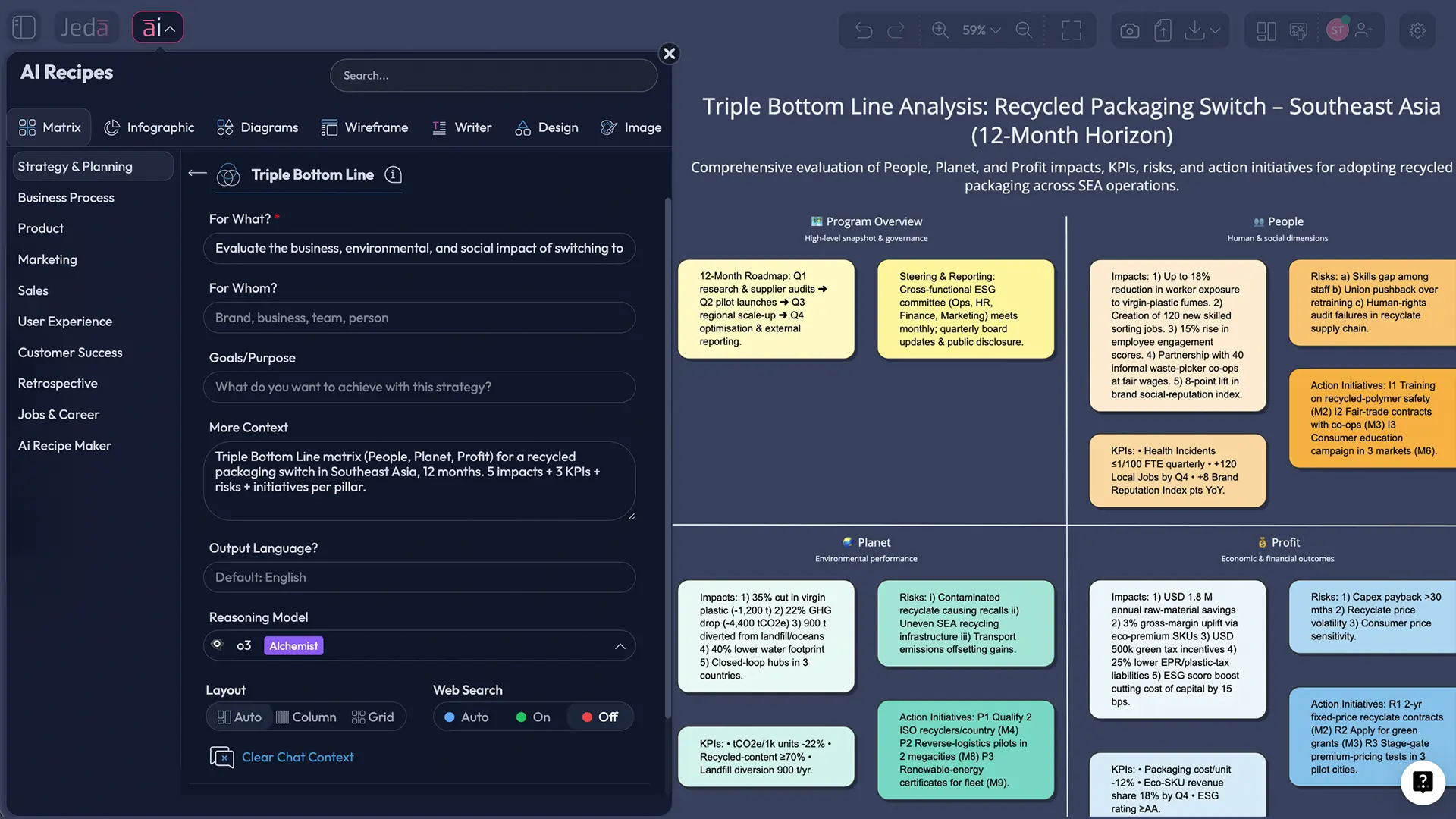
Triple Bottom Line with AI (People, Planet, Profit)
If you’ve ever tried to balance “we need growth” with “we should do the right thing,” you’ve already been doing Triple Bottom Line thinking — just without a clean scoreboard. The Triple Bottom Line (TBL) says performance isn’t only financial. It’s also social (People) and environmental (Planet) — alongside Profit. John Elkington popularized the idea in the mid‑1990s, and later argued we should treat it as a sharper lens for change, not a feel‑good badge.
This guide shows how to generate a Triple Bottom Line matrix in Jeda.ai, a Visual AI workspace used by 150,000+ users, inside one AI Workspace, using either:
- Method 1: Recipe Matrix (AI Menu → Matrix Recipes), or
- Method 2: Prompt Bar (Matrix command)
And when you want more depth? You’ll use the AI+ button to extend the analysis — without turning it into a 60‑page sustainability novella.
What is the Triple Bottom Line?
Triple Bottom Line (TBL) is a sustainability framework that measures performance across three outcomes: People, Planet, and Profit. Instead of optimizing for one “bottom line,” you evaluate trade‑offs and decisions across all three.
Where it helps most:
- Strategy choices (new market, new product, new supplier)
- Budget trade-offs (cost reduction vs safety vs emissions)
- Operations decisions (packaging, logistics, energy use)
- Reporting clarity (what you measure shapes what you do)
Why use Triple Bottom Line with AI?
A TBL matrix is simple… until you try to make it specific. Most teams get stuck in one of two traps:
- Vague statements (“support the community”)
- Metric chaos (50 indicators nobody owns)
AI helps because it’s fast at:
- Turning messy context into structured categories
- Suggesting measurable indicators (not just slogans)
- Surfacing trade-offs (the part humans avoid until it’s too late)
In Jeda.ai, you do this on an AI Whiteboard where the matrix stays visible while your team edits, debates, and iterates in real time.
- One matrix, one truth
Your People–Planet–Profit trade-offs stay on one canvas, so decisions don’t get lost across docs, chats, and slides.
- Multi‑model thinking
Run 1–3 AI models plus an aggregator for stronger coverage: compliance angle, strategy angle, and practical measurement ideas — backed by 300+ strategic frameworks in the AI Menu.
- Editable visuals-out
Unlike chat-only tools, you get a board your team can edit, annotate, and export as PNG, SVG, or PDF.
Triple Bottom Line vs ESG vs CSR (quick reality check)
People mix these terms like they’re synonyms. They’re not.
- Triple Bottom Line is a decision framework (a way to evaluate choices).
- ESG is a reporting / investor lens (often tied to disclosures and ratings).
- CSR is usually a program lens (initiatives, philanthropy, community work).
TBL is useful because it forces you to make the trade-offs visible.
How to create a Triple Bottom Line matrix in Jeda.ai
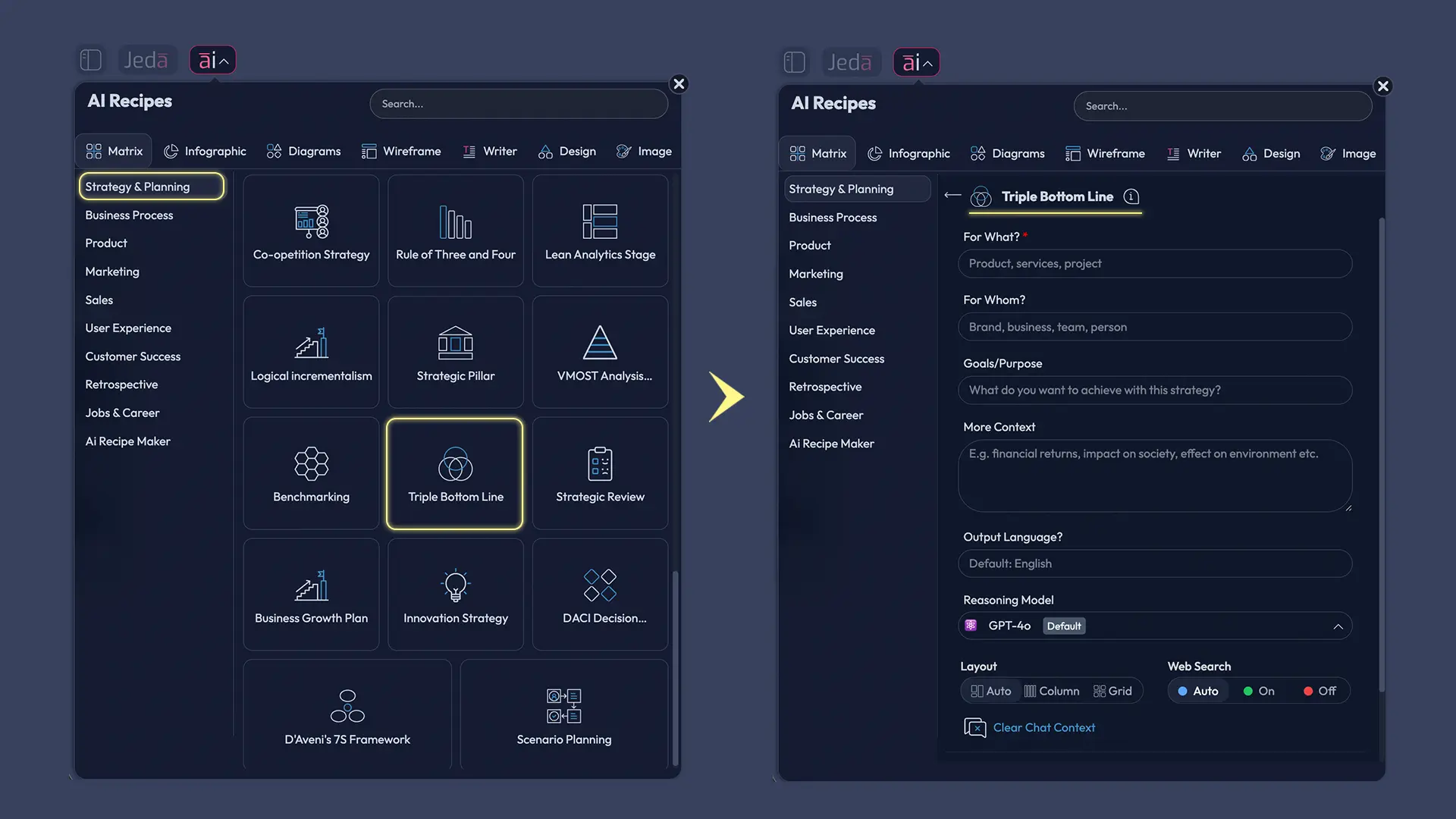
Method 1: Recipe Matrix (AI Menu → Matrix Recipes)
Use this method if your workspace already has a Triple Bottom Line recipe in the AI Menu.
- Open your board in Jeda.ai (your AI Workspace).
- Click AI Menu (top-left).
- Go to Matrix Recipes.
- Choose Triple Bottom Line.
- Enter your context:
- decision / project name
- scope (market, region, time horizon)
- constraints (budget, policy, targets)
- Click Generate.
Method 2: Prompt Bar (Matrix command)
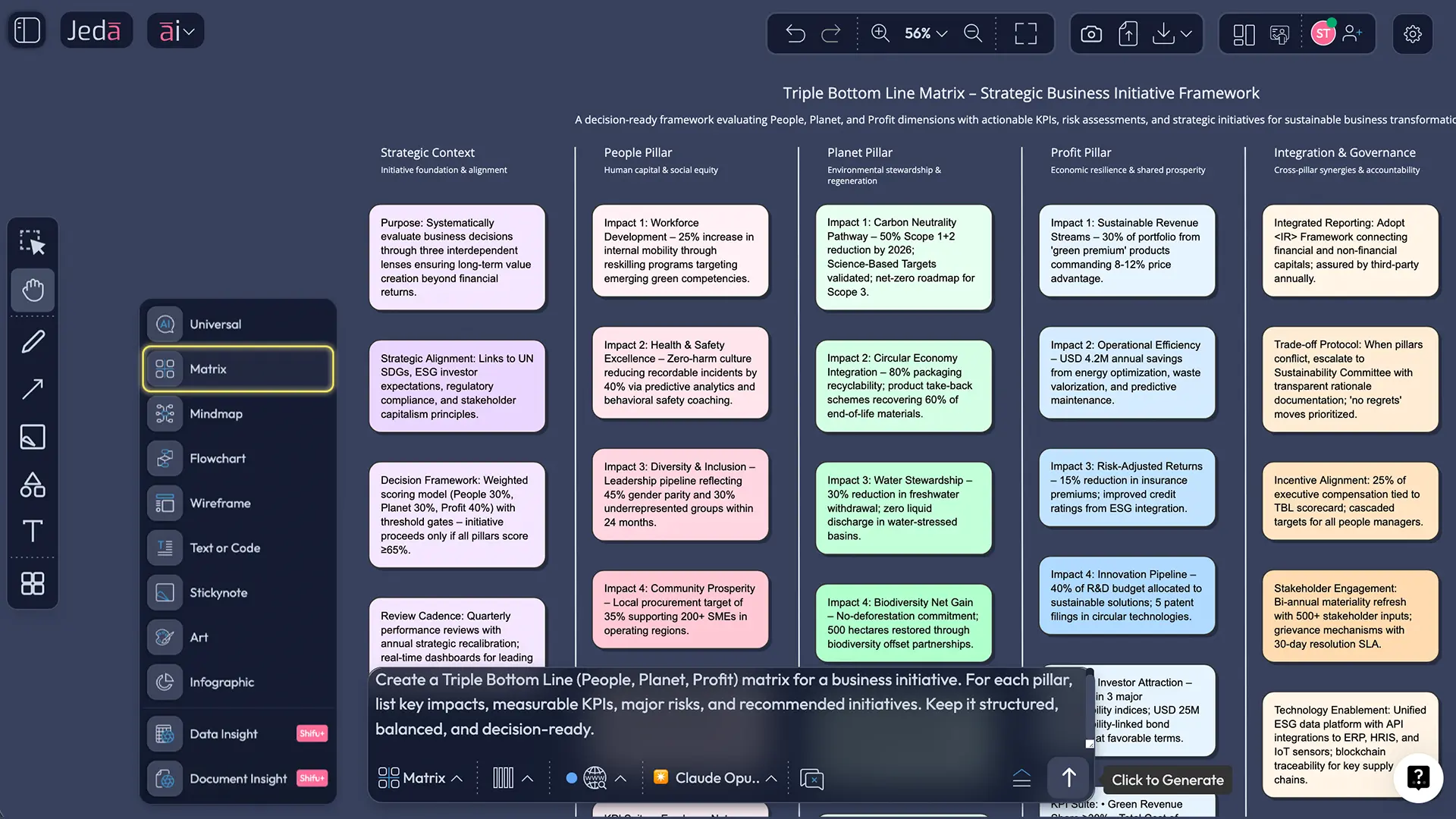
Use this method when you want full control, or you don’t see a dedicated recipe.
- Open the Prompt Bar at the bottom.
- Select the Matrix command.
- Paste a tight prompt like this:
Prompt (copy-paste):
“Create a Triple Bottom Line matrix (People, Planet, Profit) for [decision] in [industry] in [region] over [time horizon].
For each pillar: list 5–7 impacts, 3 measurable KPIs, key risks, and 2 practical initiatives. Keep items specific and decision-linked.”
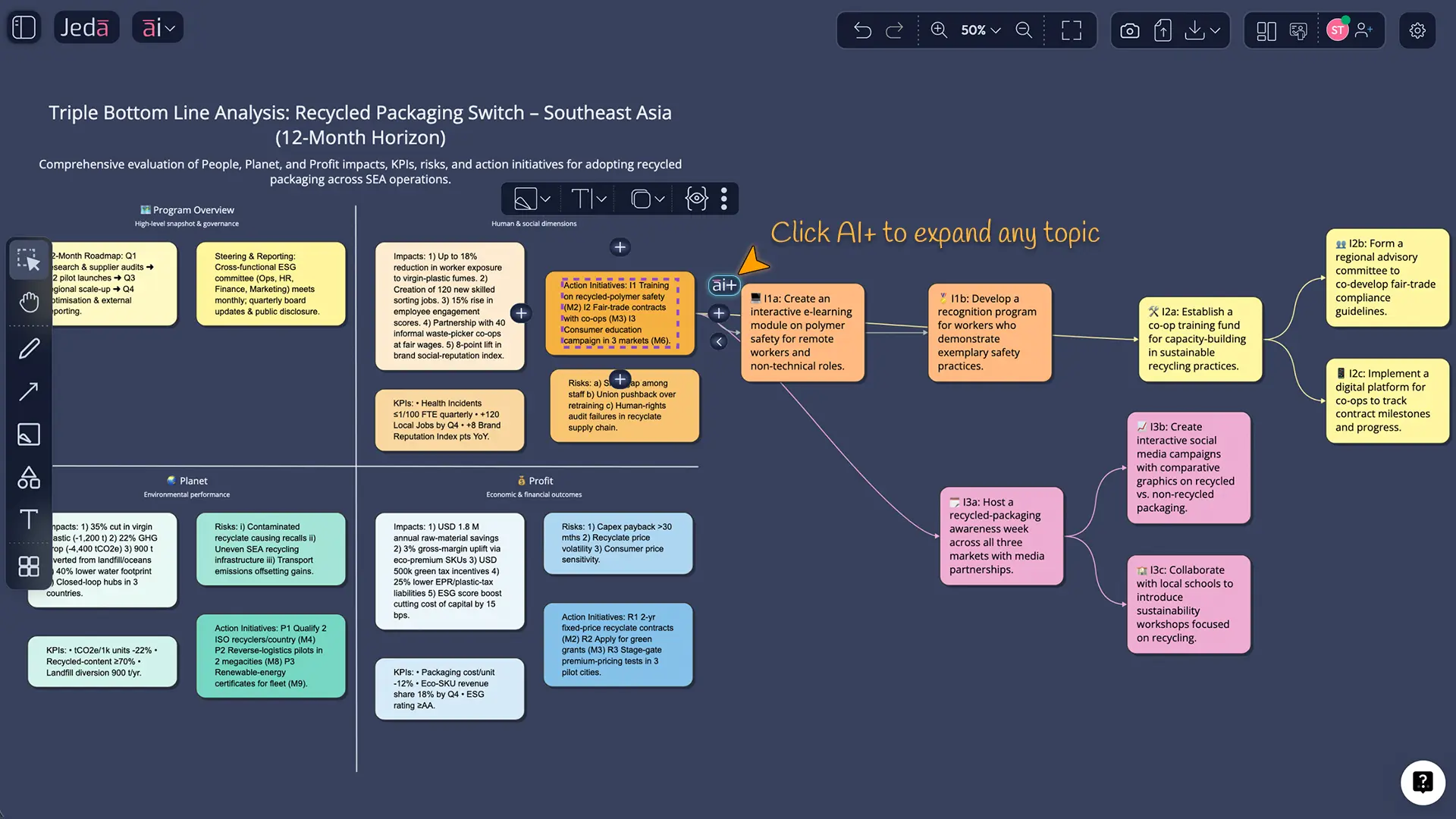
Use AI+ to go deeper (without micromanaging)
After the matrix appears:
- Click a quadrant (e.g., Planet) or a single sticky cluster.
- Tap the AI+ button to extend it with more impacts, KPIs, risks, or mitigation ideas.
- Repeat per quadrant until the matrix feels decision-ready.
ProcessSteps (HowTo schema)
- Choose Recipe Matrix or Prompt Bar
If your workspace includes a Triple Bottom Line recipe, use AI Menu → Matrix Recipes. Otherwise, generate it from the Prompt Bar using the Matrix command.
- Lock the decision scope
Write the decision, geography, and time horizon. A ‘global TBL’ turns into motivational posters. A scoped TBL turns into action.
- Generate the 3-pillar matrix
Create People, Planet, and Profit columns (or a 3-box grid). Keep everything on one canvas so trade-offs stay visible.
- Populate impacts first, then add KPIs
Start with 5–7 specific impacts per pillar. Then add 3 measurable KPIs that you can track monthly or quarterly.
- Make trade-offs explicit
Connect conflicts across pillars (e.g., lower cost vs higher emissions). Add a short ‘trade-off note’ so the team doesn’t pretend it doesn’t exist.
- Extend with AI+ where it’s thin
Select a weak quadrant and tap the AI+ button to expand impacts, risks, and mitigation options. Keep what fits your context. Delete the rest.
- Turn the matrix into decisions and owners
Convert the best initiatives into owners, deadlines, and success criteria. Then export the board as PNG, SVG, or PDF for stakeholders.
Triple Bottom Line template + example (worked-through)
Let’s do a real-ish scenario:
Decision: A mid-size consumer brand wants to switch to recycled packaging across its top 20 SKUs in Southeast Asia within 12 months.
People (social)
Possible impacts:
- safer handling in the supply chain (if material is lighter)
- improved worker training requirements
- customer trust and brand loyalty
- supplier labor standards risk (new sourcing)
- local community waste reduction
KPIs (examples):
- worker incidents per 200,000 hours
- supplier audit pass rate (%)
- customer complaints rate tied to packaging
Planet (environment)
Possible impacts:
- lower virgin plastic use
- changes in emissions from shipping (weight/volume)
- recyclability rate by local infrastructure
- waste leakage risk (if “recyclable” isn’t actually recycled locally)
KPIs:
- kg packaging per unit shipped
- CO₂e per shipped unit (scope 3 estimate)
- % SKUs with locally recyclable packaging
Profit (financial)
Possible impacts:
- packaging unit cost change
- shipping cost change
- returns/damage rate change
- pricing power / demand lift (maybe)
- brand risk reduction (hard to price, still real)
KPIs:
- gross margin impact (% points)
- damage/returns rate
- cost per unit shipped
Best practices (so your matrix doesn’t become corporate theater)
Common mistakes to avoid
- Copying generic ESG lists instead of decision-linked impacts.
- Treating People and Planet as “nice to have” while Profit gets real numbers.
- Ignoring local context (e.g., “recyclable” means different things across regions).
- No ownership (a matrix with no owners is just a mood board).
- Forgetting the trade-offs (the lie that makes every plan fragile).
Frequently Asked Questions
- What is the Triple Bottom Line?
- The Triple Bottom Line is a sustainability framework that evaluates performance across People (social impact), Planet (environmental impact), and Profit (financial results). It’s used to make trade-offs visible so teams can make decisions that balance outcomes rather than chasing profit alone.
- Is Triple Bottom Line the same as ESG?
- No. Triple Bottom Line is a decision framework for evaluating choices across People, Planet, and Profit. ESG is more often used as a reporting and investor lens tied to disclosures and ratings. Many teams use TBL to shape decisions and ESG to report results.
- How do you measure the Triple Bottom Line?
- You measure it by choosing a small set of KPIs for each pillar. People KPIs often track safety, labor, and community outcomes; Planet KPIs often track emissions, energy, waste, and water; Profit KPIs track margin, cash flow, and risk-adjusted returns.
- What’s a good number of KPIs per pillar?
- Three KPIs per pillar is usually enough for most decisions. If you can’t explain why a KPI changes the decision, delete it. A shorter list increases ownership and follow-through.
- Can AI generate a Triple Bottom Line analysis?
- Yes. AI can draft impacts, KPIs, and risks quickly, then you refine the outputs with real constraints and local context. In Jeda.ai, you generate the TBL matrix with the Matrix command and extend each section using the AI+ button.
- How long does a Triple Bottom Line workshop take?
- For a single scoped decision, most teams can produce a useful first draft in 30–60 minutes, then tighten it in a second pass. The time savings come from starting with a structured matrix instead of building the framework from scratch.
- When should a company use the Triple Bottom Line?
- Use it when you’re making decisions with social and environmental consequences: supply chain changes, new product launches, facility moves, energy sourcing, packaging decisions, or major cost cuts. It’s most valuable when trade-offs are real and visible.
- What does Jeda.ai export for a TBL matrix?
- You can export your TBL board as PNG, SVG, or PDF. This makes it easy to share with stakeholders or include in reports without recreating the matrix elsewhere.
- How is the Triple Bottom Line criticized?
- A common critique is that TBL can become a reporting exercise without accountability. Even John Elkington has argued that the idea was sometimes used as a light-touch label instead of driving real system change. The fix is to link the matrix to decisions, owners, and measurable outcomes.
- How do I connect Triple Bottom Line to other strategy frameworks?
- You can pair TBL with frameworks like PESTEL (external forces), SWOT (internal/external positioning), or a Business Model Canvas (how value is created and captured). In practice, teams often run PESTEL first, then use TBL to test decision options.
Sources & further reading
- [1]
Elkington, John (n.d.) . “Enter the Triple Bottom Line (chapter excerpt)” johnelkington.com (PDF).
View Source ↗ - [2]
Elkington, John (2018) . “25 Years Ago I Coined the Phrase ‘Triple Bottom Line.’ Here’s Why I’m Giving Up on It.” Harvard Business Review.
View Source ↗ - [3]
Slaper, Timothy F. & Hall, Tanya J. (2011) . “The Triple Bottom Line: What Is It and How Does It Work?” Indiana Business Review.
View Source ↗ - [4]
Harvard Business School Online (2020) . “The Triple Bottom Line: What It Is & Why It’s Important” HBS Online Blog.
View Source ↗ - [5]
Investopedia Editors (n.d.) . “Triple Bottom Line (TBL): What It Is and How to Measure” Investopedia.
View Source ↗ - [6]
IBM (n.d.) . “What Is the Triple Bottom Line (TBL)?” IBM Think.
View Source ↗ - [7]
Deng, Q. et al. (2024) . “Balancing core enterprises’ triple bottom line challenge” ScienceDirect.
View Source ↗
Build a Triple Bottom Line Board in Minutes
Join over 150,000+ users who use Jeda.ai as an AI Workspace to turn sustainability trade-offs into editable, decision-ready visuals.
Try Free Template