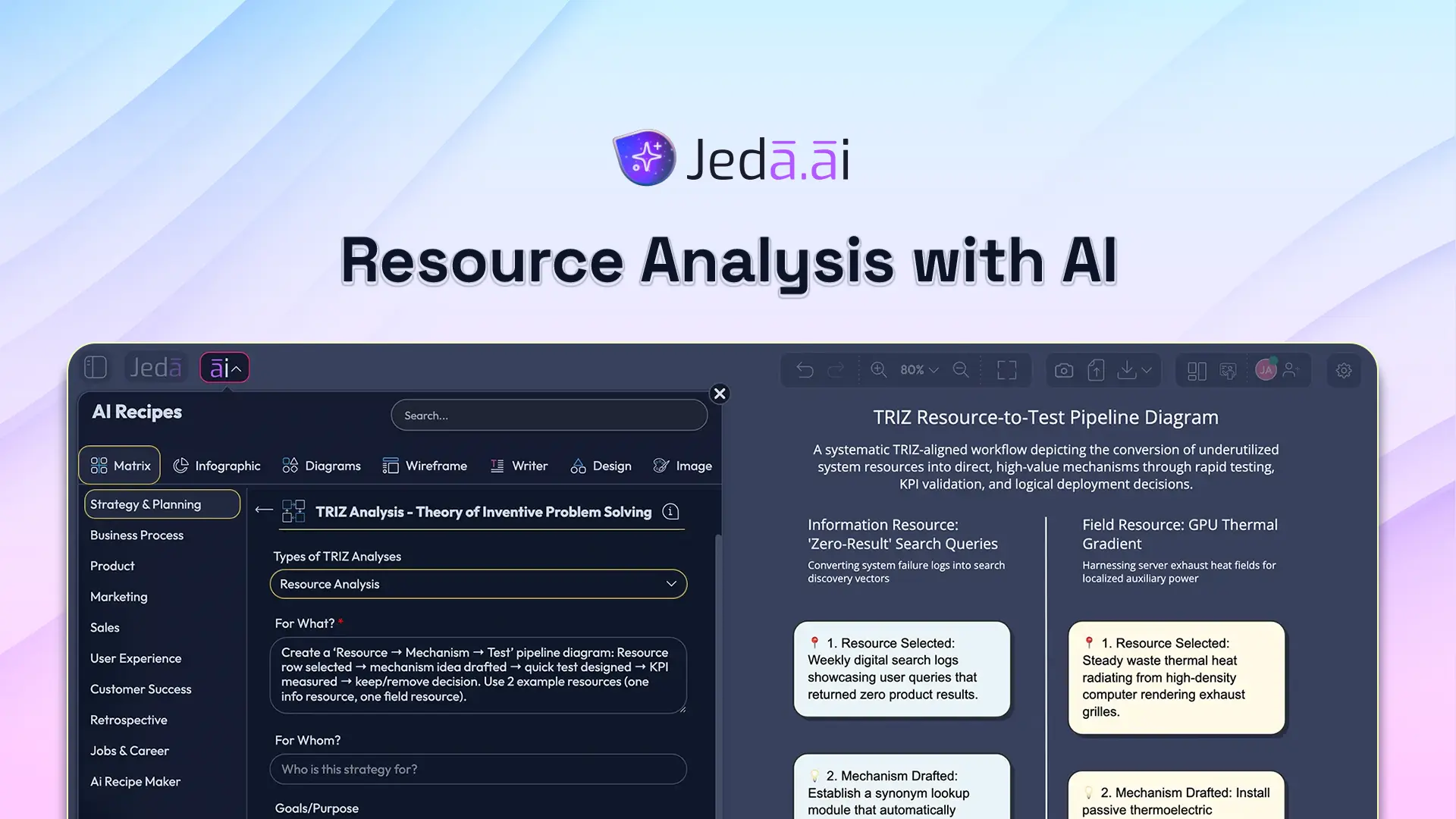
TRIZ has a slightly ruthless philosophy: before you add new parts, ask what the system is already wasting.
In TRIZ, “resources” can include substances, fields, capabilities, space, time, information, and even harmful byproducts that can be redirected. A research paper summarizing TRIZ resources describes resources broadly, including tangible and intangible types, and notes that they may be useful, harmful, or neutral.
This guide shows how to run TRIZ resource analysis with AI in Jeda.ai so you can generate solution directions that move toward IFR without bolting on complexity.
What is TRIZ resource analysis?
TRIZ resource analysis is the process of identifying and exploiting resources in:
- the system,
- the super-system (environment, user, adjacent systems),
- and the operating space/time context
…to solve an inventive problem with minimal added cost and harm.
Some TRIZ references explicitly categorize resources into types such as material, field-like, spatial, temporal, informational, and functional resources.
Why resource analysis works (and why teams skip it)
Resource analysis works because many “hard problems” are not missing technology. They are missing attention.
Teams skip it because:
- it sounds vague (“use your environment”),
- it’s hard to systematically inventory,
- and it’s tedious to document.
That’s exactly where AI helps: fast inventory, structured tables, and idea prompts tied to each resource.
TRIZ resource categories (practical list)
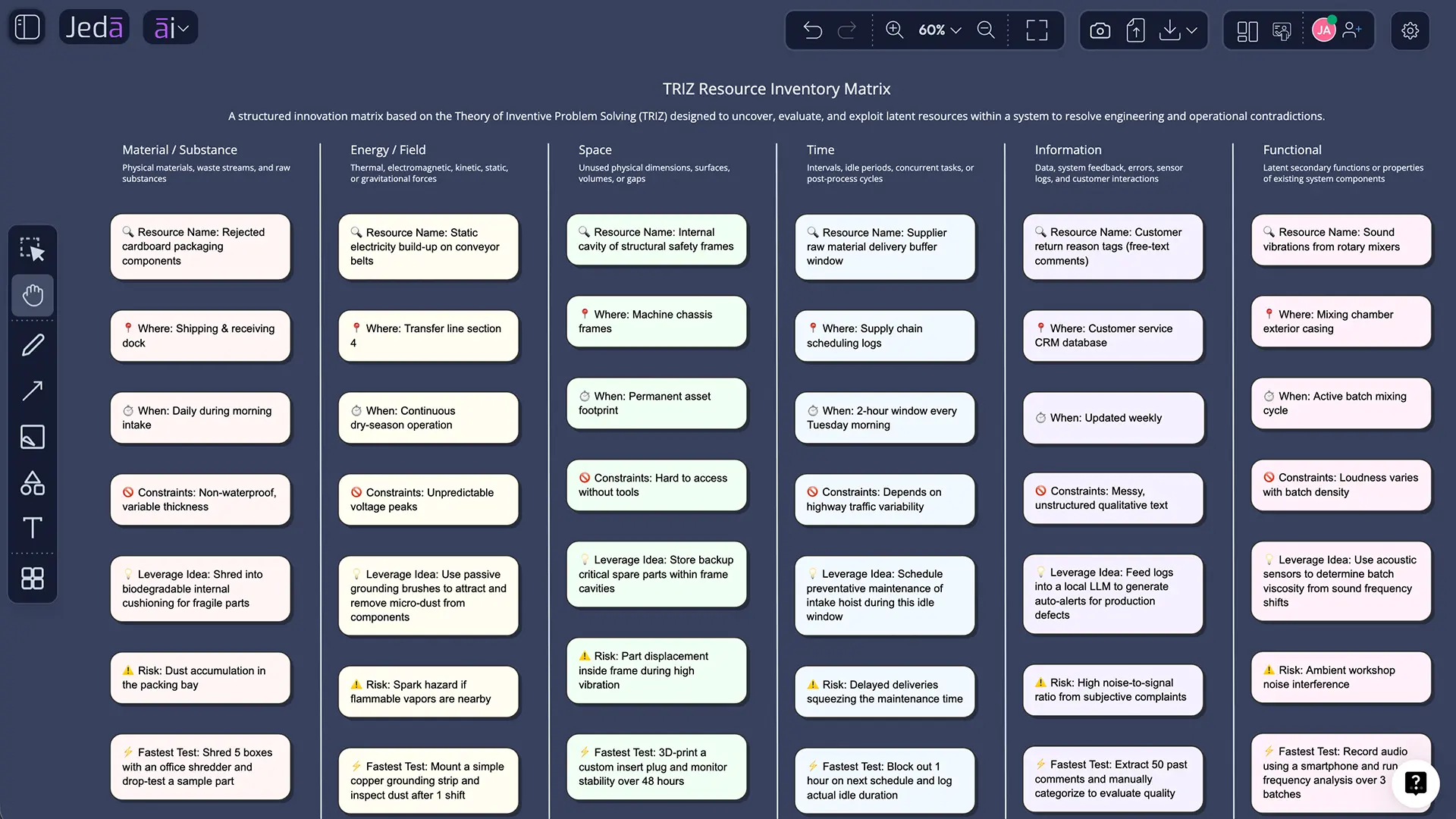
A useful working set (aligned to common TRIZ teaching) includes:
Material resources
Existing parts, materials, waste material, coatings, fluids, dust, wear particles.Field resources
Mechanical, thermal, electrical, magnetic, acoustic, chemical fields already present.Spatial resources
Empty volume, surface area, unused geometry, “dead zones” in layout.Temporal resources
Idle time, transient states, startup/shutdown phases, duty cycles.Information resources
Sensor signals, logs, operator knowledge, error codes, process variability signatures.Functional/capability resources
Motions, heat generation, vibration, pressure, existing control loops.
Bonus: harmful resources
A TRIZ-oriented research paper discusses “harmful resources” as things that appear negative but can be systematically analyzed and utilized.
Example: waste heat, vibration, noise, friction, “unused” byproducts.
How to run Resource Analysis with AI (Matrix) in Jeda.ai (2 ways)
Method 1 — AI Recipe Templates (AI Menu)
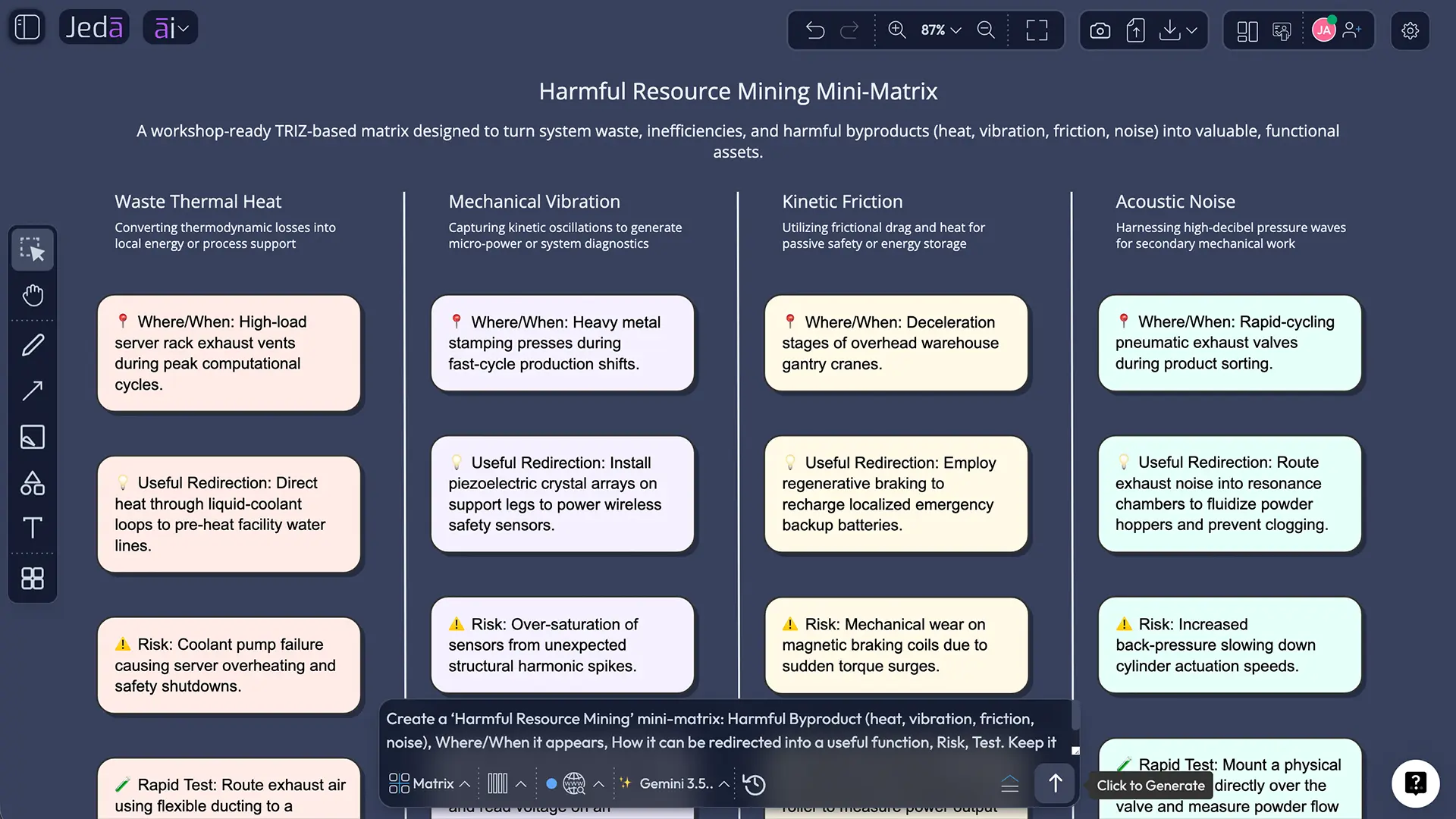
Open your board → open AI Menu / AI Recipes.
Go to the relevant category (e.g., TRIZ / Problem Solving / System Analysis) → pick Resource Analysis.
Fill the recipe fields
Click Generate → you’ll get an editable Resource Inventory Matrix on-canvas.
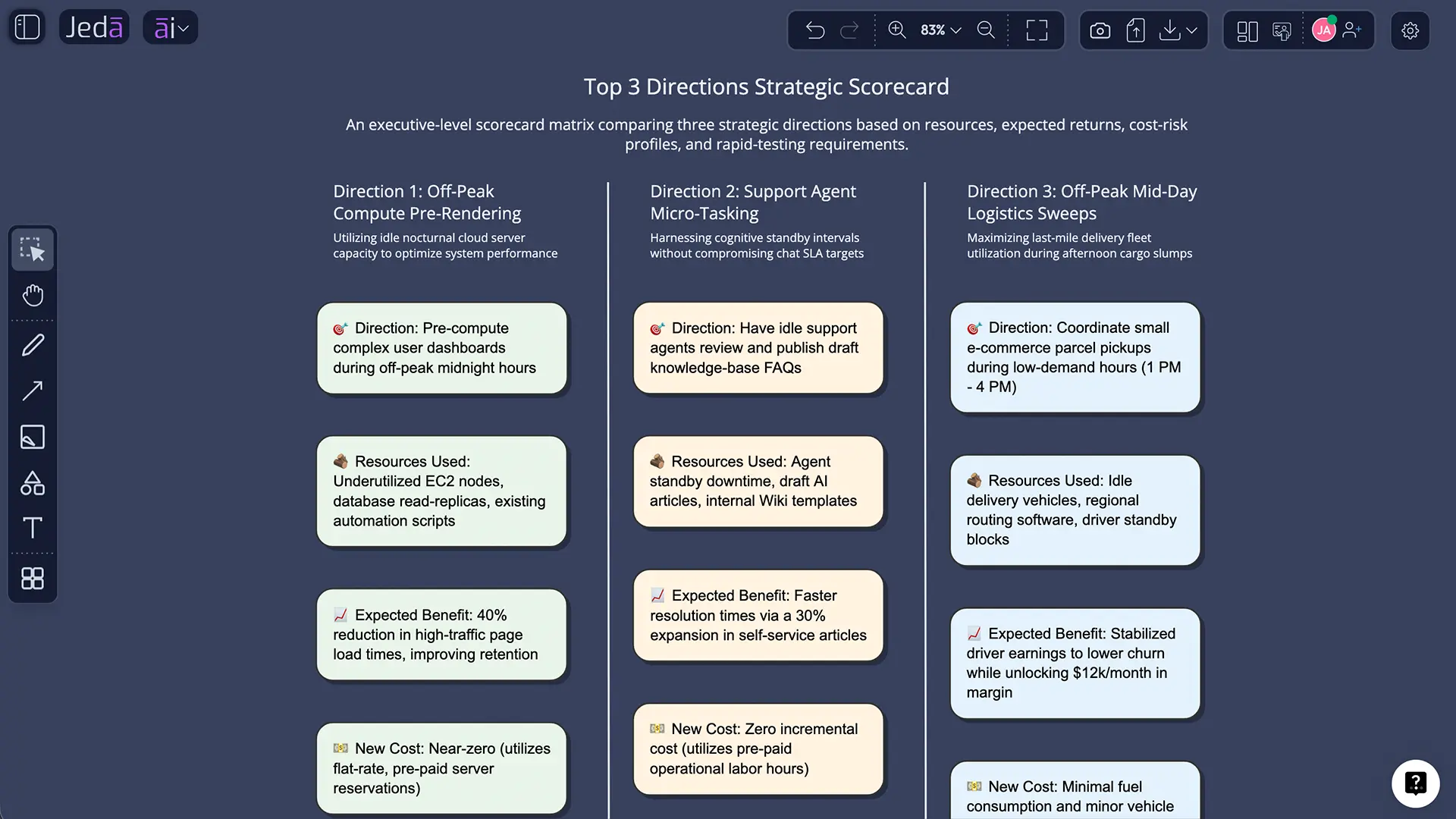
Expand the best rows into solution directions (mechanism + risk + fastest test).
Method 2 — Prompt Bar (Matrix command)
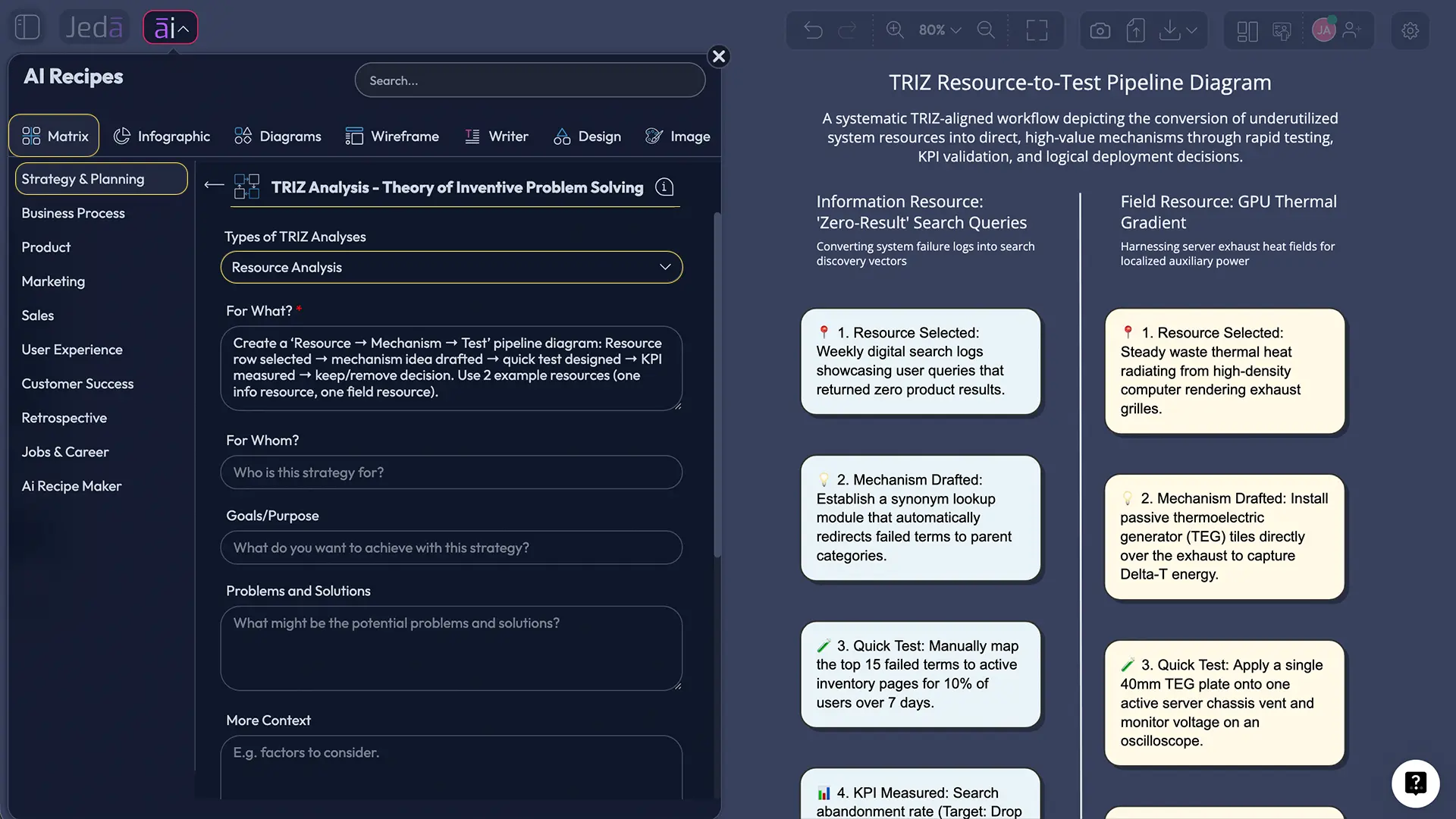
Open the AI Prompt / Command Bar at the bottom.
Select Matrix.
Paste a structured prompt (recommended fields):
Deliverable: “Create a TRIZ resource analysis matrix with categories: material/substance, energy/field, space, time, information, functional. For each resource: where/when it exists, leverage idea, risk, fastest validation test. Highlight top 3.” (These categories are commonly used in TRIZ resource classifications.)
Generate → edit rows for accuracy (kill duplicates, rename resources, tighten “where/when”).
Rank rows by ideality (more benefit, less cost/harm) and pick 1–2 directions to prototype.
- Define the IFR-style goal
State the outcome + constraints (no new parts, no size increase, cost cap). Keep it measurable.
- Inventory resources
List resources by type: substance/material, energy/field, space, time, information, functional capabilities (system + super-system).
- Mine evidence
Extract candidate resources from specs, logs, test reports, and observed byproducts (including ‘harmful resources’ like heat/vibration).
- Turn each resource into options
For every resource row, generate: 1 leverage mechanism, 1 risk, 1 fastest falsifiable test.
- Rank and select
Prioritize highest-ideality directions: biggest benefit with lowest added cost and harm. Choose 1–2 for quick experiments.
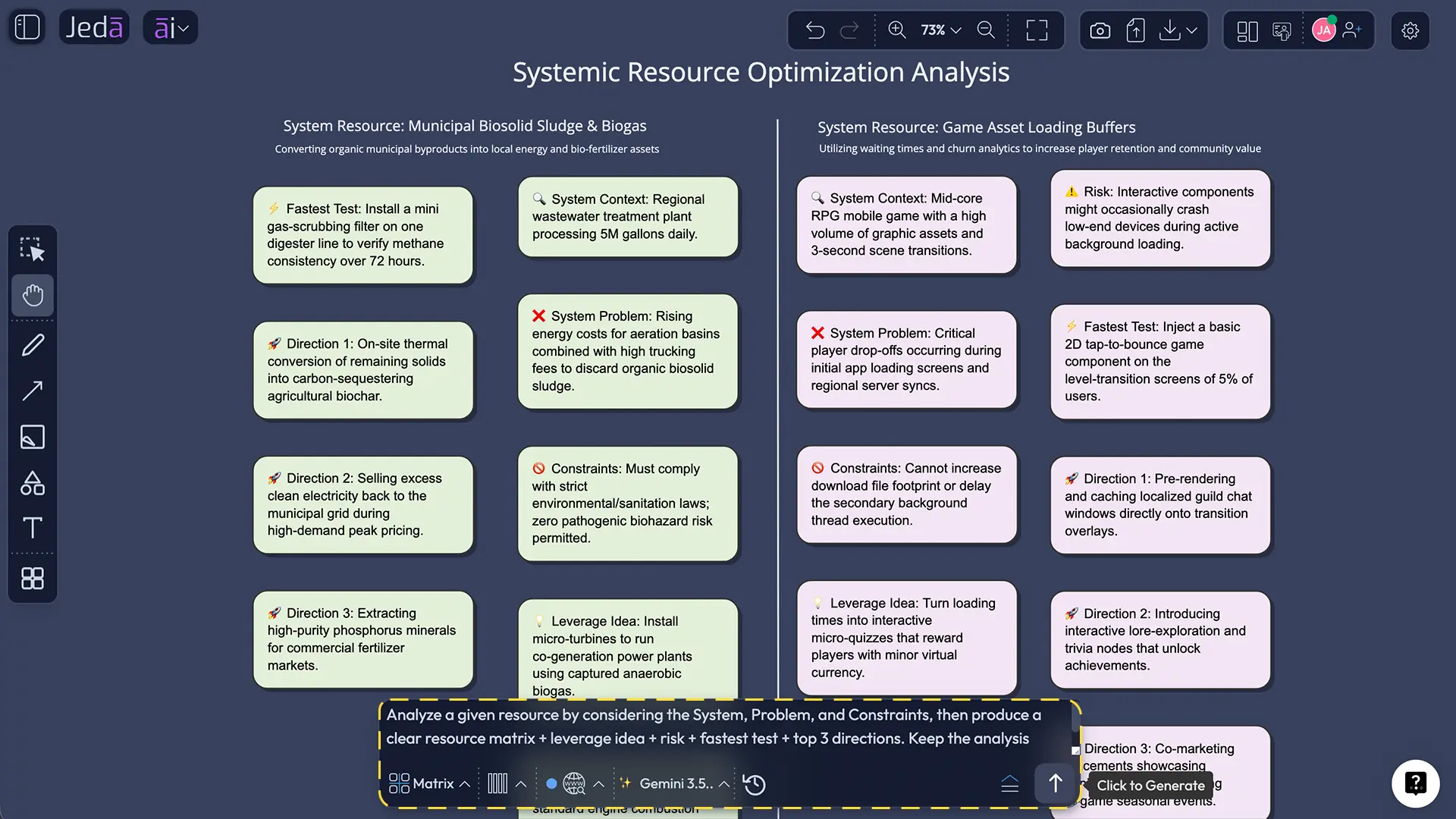
Copy-paste prompt template (Matrix)
- System: [what you’re improving]
- Problem: [undesired effect + conditions]
- Constraints: [what cannot change]
- Deliverable: Create a TRIZ resource analysis matrix with categories: material, field, space, time, information, functional. For each resource, propose 1 leverage idea, 1 risk, and 1 quick validation test. Highlight the top 3 highest-ideality directions.
Example: reducing noise without adding insulation
Problem: a device is too loud, but you can’t add insulation (cost/size).
Resource analysis might surface:
- harmful resource: vibration (source of noise)
- field resource: existing motor control signal
- spatial resource: unused cavity volume as resonator trap
- information resource: frequency signature from internal sensor
Solution directions:
- shift excitation frequency away from resonance using control (field + information),
- add structural rib pattern using existing geometry (spatial),
- use damping through existing material interface (material).
No “new tech.” Just smarter use of what’s already there.
FAQ
- What counts as a ‘resource’ in TRIZ?
- In TRIZ, a resource can be anything that can be used to achieve the desired function: substances, fields, space, time, information, capabilities, and even harmful byproducts that can be redirected.
- What are the common TRIZ resource categories?
- Many TRIZ references describe resource types such as material, field-like, spatial, temporal, informational, and functional resources. Teams use these categories to systematically inventory what is already available.
- What are harmful resources in TRIZ?
- Harmful resources are negative effects or byproducts—like heat, vibration, friction, or waste—that can sometimes be repurposed toward useful functionality instead of being only suppressed.
- How can AI help with resource analysis?
- AI can extract candidate resources from documents, build structured resource inventories, and generate mechanism ideas tied to specific resources. Humans validate constraints and feasibility.
Citations
- [1]
D. D. Sheu & W. J. Chen (2020) . “Systematic analysis and usage of harmful resources” Technological Forecasting and Social Change (ScienceDirect).
View Source ↗ - [2]
H. G. Gräbe (2022) . “Systems, Resources, and Systemic Development in TRIZ” TRIZ Future Conference (PDF).
View Source ↗ - [3]
Springer (Book Chapter) (2019) . “Resources” Springer Link.
View Source ↗ - [4]
S. D. Savransky et al. (2005) . “The TRIZ Resource Analysis Tool for Solving Management Tasks” ResearchGate (paper).
View Source ↗ - [5]
Z. Bai et al. (2024) . “Component and resource expressions for trimming method (resource mining)” ScienceDirect.
View Source ↗