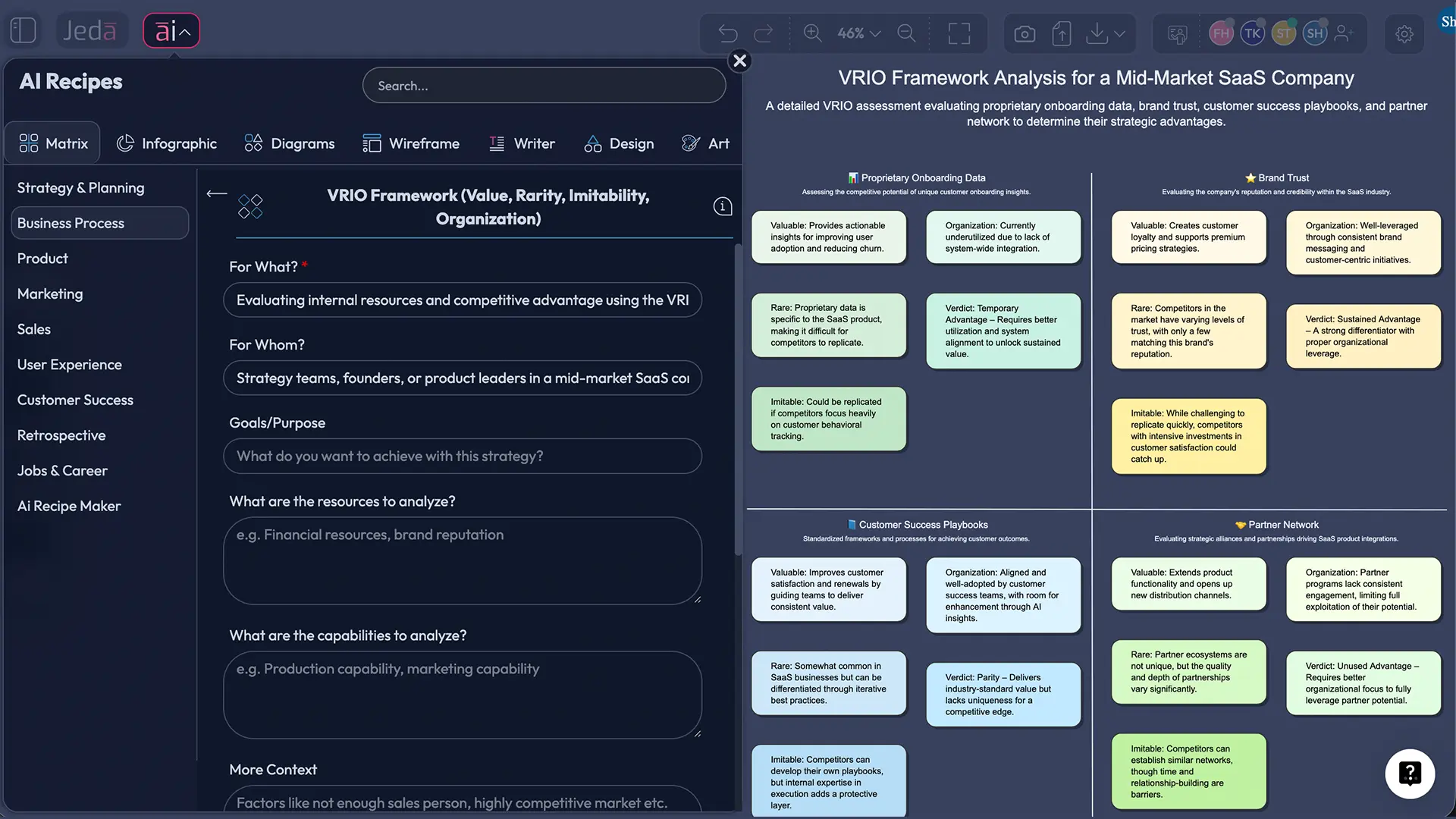
VRIO Framework with AI gives you a faster, clearer way to answer a question most teams avoid until it hurts: what do we actually have that competitors cannot easily copy? In a strong AI Workspace, that answer should not live in a forgotten slide, a messy spreadsheet, and three contradictory meeting notes. It should live on one editable board. That is where Jeda.ai fits. Inside an AI Whiteboard and AI Workspace, your team can map Value, Rarity, Imitability, and Organization in one place, build evidence around each resource, and turn the output into a sharper strategic call. That matters when you are moving fast, and it matters even more when you are wrong.
And yes, this is why 150,000+ users come to Jeda.ai for structured thinking instead of blank-canvas wandering. With 300+ strategic frameworks, Visual AI support, collaborative editing, and editable outputs, Jeda.ai helps teams move from “we think this is a strength” to “here is the proof, the risk, and the next move.”
What is VRIO Framework with AI?
The VRIO framework is a strategic analysis model used to test whether a resource or capability can create a real competitive advantage. The four checks are simple on paper and brutally useful in practice:
- Value: does the resource help you exploit opportunities or reduce threats?
- Rarity: do few competitors have it?
- Imitability: is it hard or costly to copy?
- Organization: is the company set up to capture the benefit?
The logic comes out of the resource-based view of the firm. Wernerfelt helped establish the resource-based perspective in 1984, Barney formalized the sustained-advantage logic in 1991, and later strategy teaching materials framed the practical decision tool as VRIO. In plain English: not every strength matters, and not every advantage lasts.
Using VRIO Framework with AI changes the speed and depth of the exercise. A manual workshop often stalls because the team spends too much time listing resources and too little time pressure-testing them. Jeda.ai helps compress that cycle. In one AI Workspace, you can generate the first matrix, edit each cell, add notes from documents or prior research, and push the conversation from vague confidence to specific reasoning.
Why use VRIO Framework with AI instead of doing it manually?
A manual VRIO session usually breaks in one of three places. First, teams confuse “good” with “strategically decisive.” Second, they overrate rarity because they are too close to their own story. Third, they forget the last letter. Organization. A resource can be brilliant and still underperform because the company is not built to use it.
That is where Jeda.ai earns its keep. In an AI Whiteboard, VRIO becomes less of a classroom diagram and more of a decision system.
- Structured matrix generation
Start with an editable VRIO matrix instead of drawing boxes by hand and hoping the session stays coherent.
- Faster strategic reasoning
Use AI to draft first-pass judgments on Value, Rarity, Imitability, and Organization, then tighten them with human review.
- Evidence-backed evaluation
Pull in documents, notes, screenshots, or prior research so the analysis has receipts, not just opinions.
- Real-time collaboration
Cross-functional teams can edit the same board together inside Jeda.ai instead of emailing around competing versions.
- AI+ deep dive
After the first matrix is generated, use the AI+ button to extend the analysis and surface blind spots or stronger next steps.
- Easy visual conversion
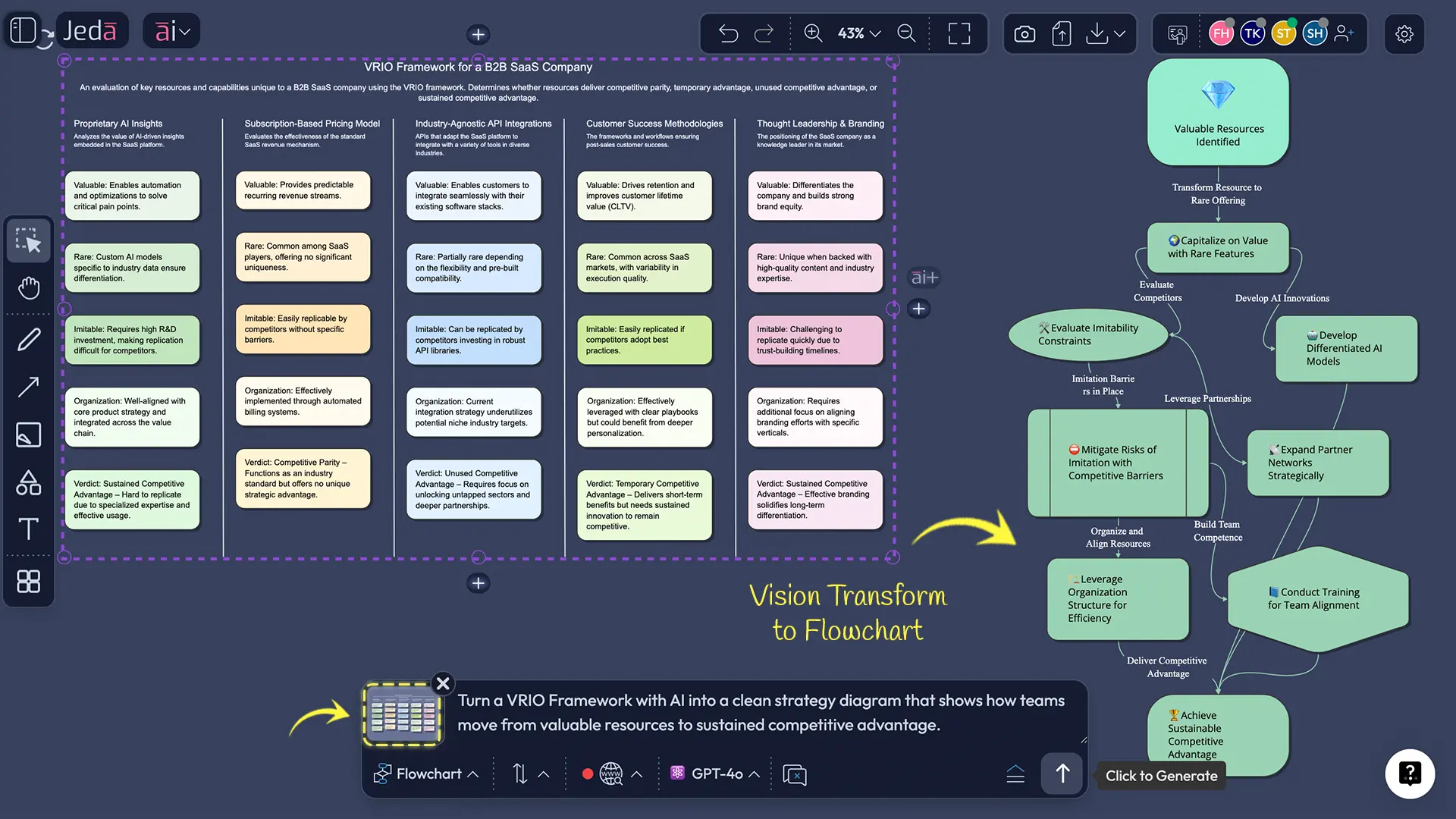
Use Vision Transform to turn a matrix into a diagram or mind map when you need a different lens for the same strategy story.
How to create a VRIO Framework with AI in Jeda.ai
The cleanest path is the recipe-first route. Since VRIO is a matrix, start with the matrix recipe rather than improvising from scratch.
Method 1: Recipe Matrix
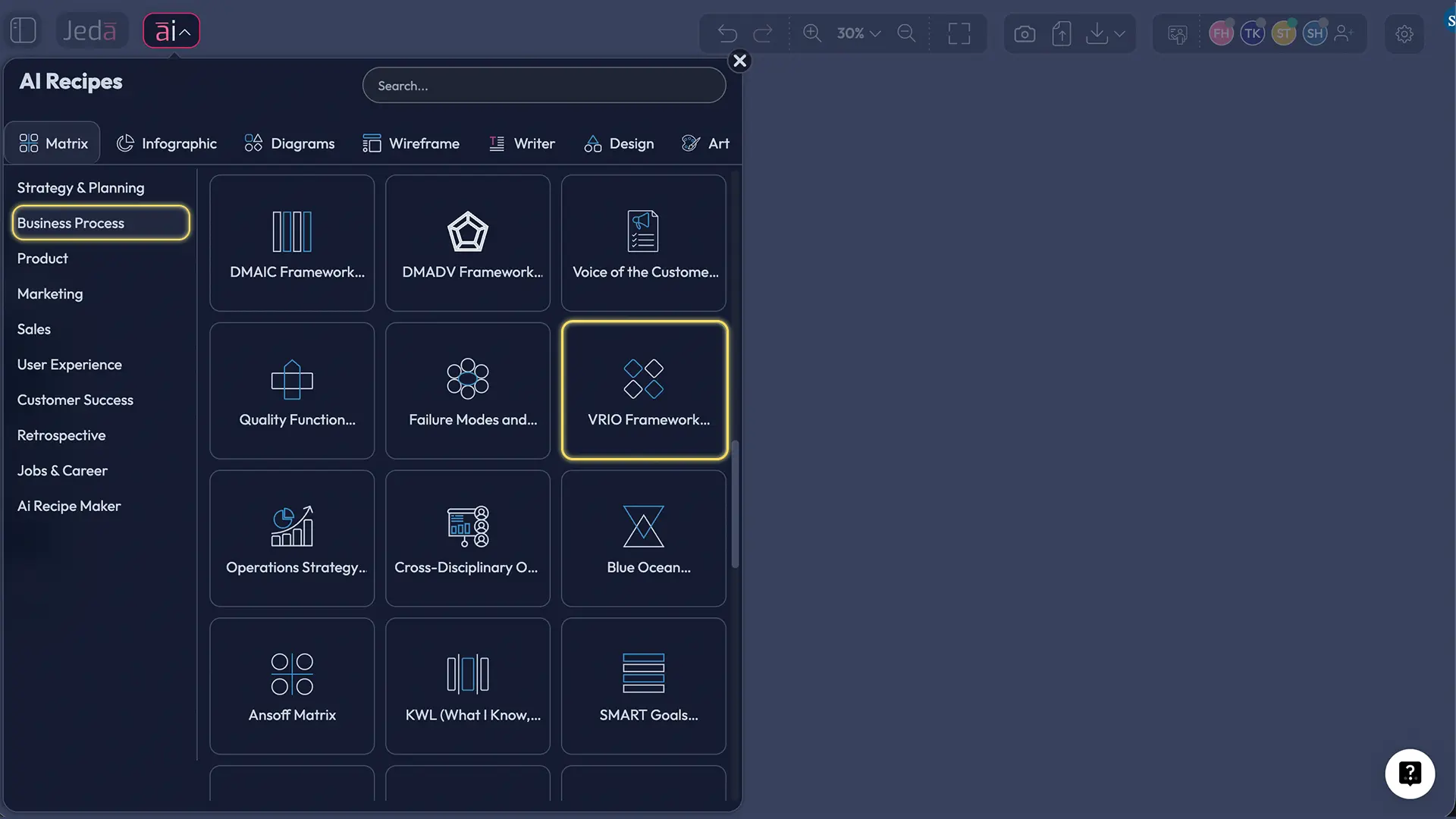
- Open the AI Menu
Inside Jeda.ai, open the AI Menu from the canvas and go to the Matrix recipe area.
- Choose the VRIO Framework recipe
Select the VRIO Framework matrix template so the board starts with the right strategic structure.
- Add your business context
Enter the company, market, business model, and the main resources or capabilities you want to test.
- Generate the first matrix
Let Jeda.ai build the initial Value, Rarity, Imitability, and Organization assessment in an editable matrix.
- Refine and prioritize
Edit weak assumptions, add evidence, and rank which resources produce parity, temporary advantage, unused advantage, or sustained advantage.
- Extend with AI+
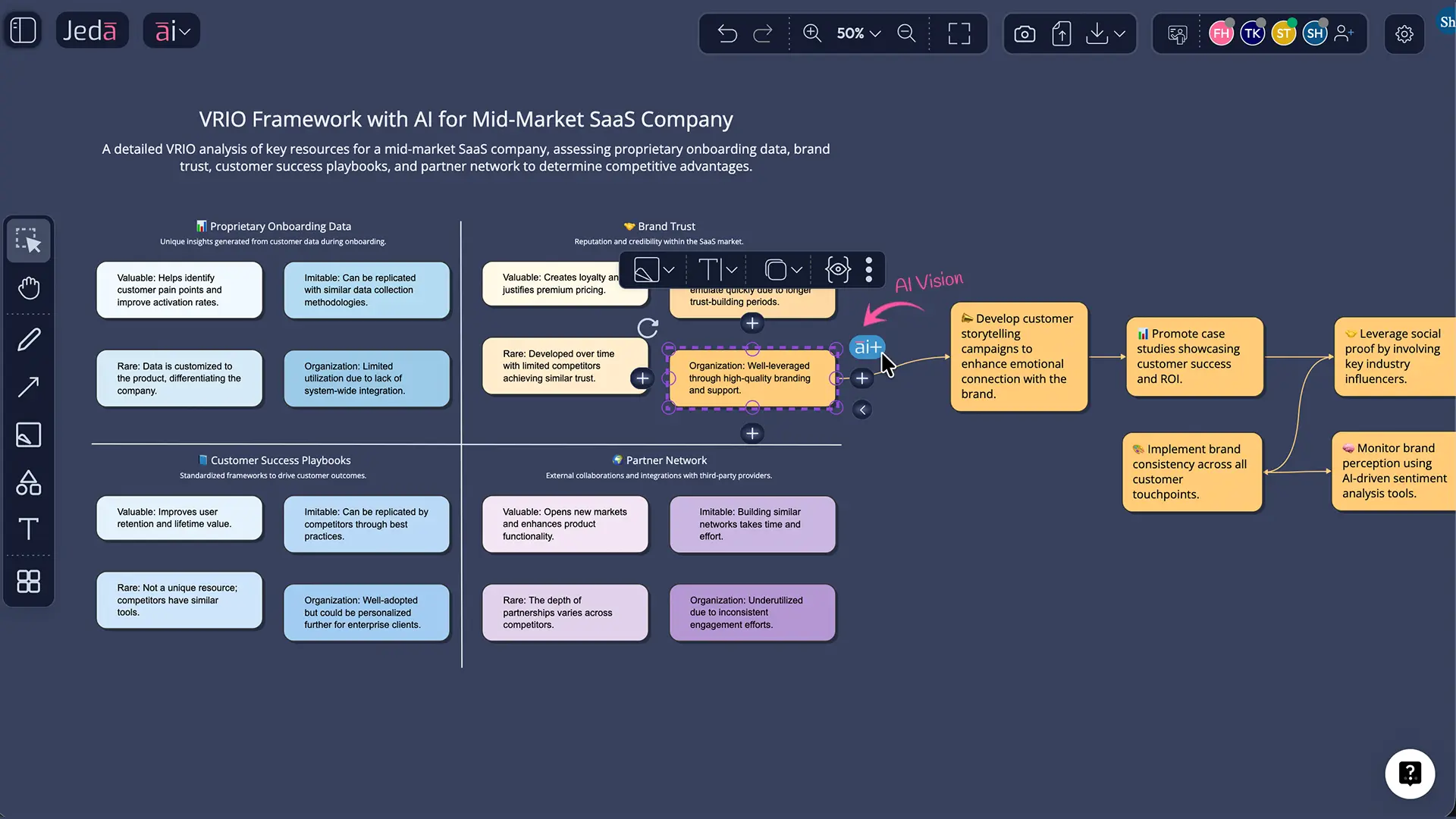
Select the generated matrix and tap the AI+ button to expand the reasoning, surface caveats, and deepen the analysis.
Method 2: Prompt Bar
Sometimes you do not want the guided recipe. Fair. Use the Prompt Bar.
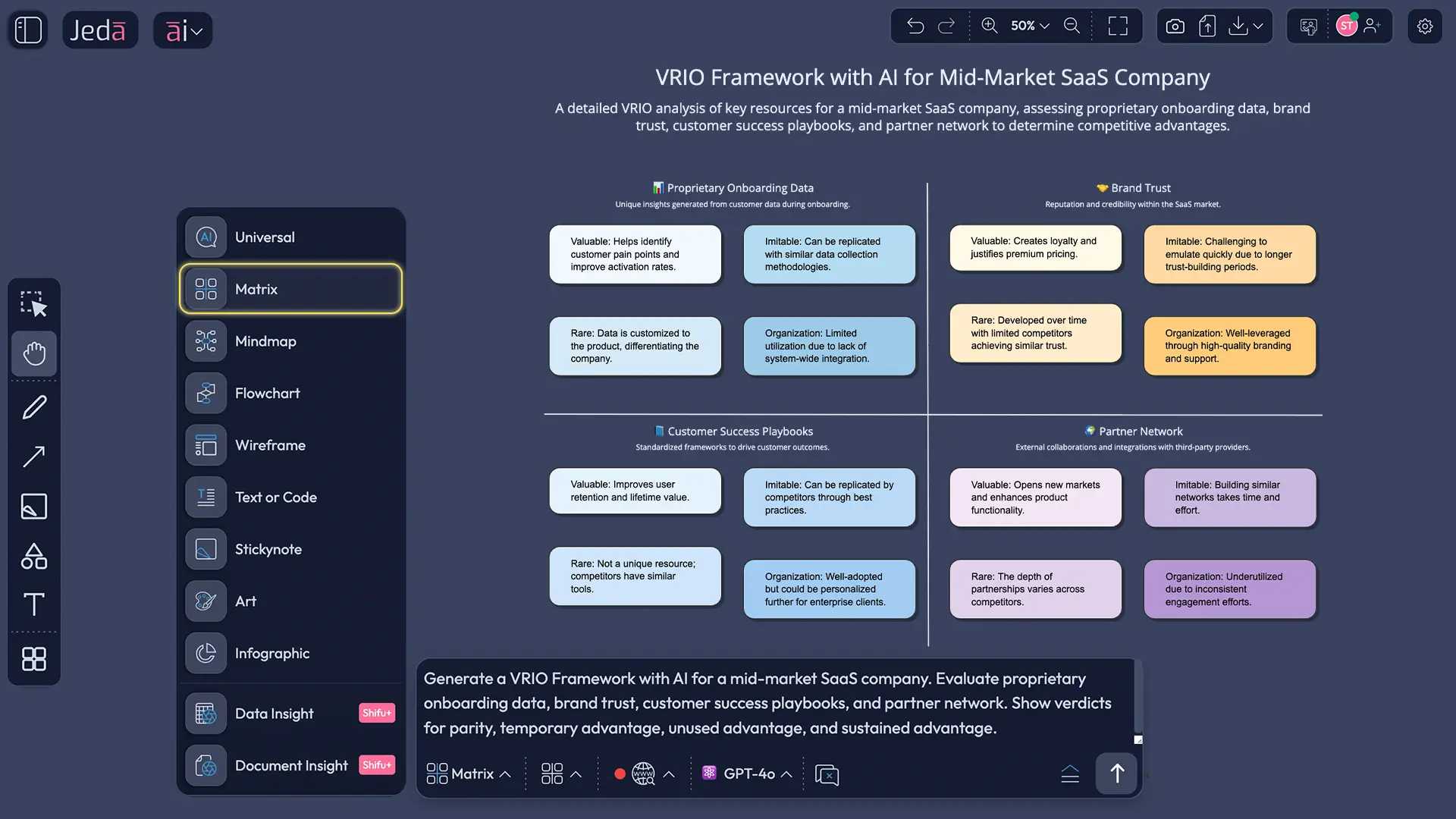
Open the Prompt Bar at the bottom of the canvas, select the Matrix command, and describe the business plus the resources you want evaluated. A strong prompt is specific about the company, industry, and what counts as a resource.
Example:
“Create a VRIO Framework with AI for a B2B SaaS company. Evaluate proprietary onboarding data, customer success playbooks, founder-led brand reputation, and enterprise partner ecosystem. Show which resources create competitive parity, temporary advantage, unused advantage, or sustained advantage.”
Once Jeda.ai generates the first pass, tighten the language, add evidence, and use the AI+ button to extend the board. Then use Vision Transform if you want to convert the matrix into a supporting diagram for presentation.
What the AI+ button should do here
This part matters. You are not using AI+ to issue a brand-new custom instruction. You are using it to deepen what already exists.
In a good workflow, you generate the VRIO matrix first, review it, select it, and then use AI+ to expand the reasoning around the current board. That extension can surface missing supporting capabilities, weak organizational alignment, or contradictions between what looks rare and what is actually easy to imitate.
VRIO Framework with AI example
Let’s make this concrete.
Imagine a mid-market SaaS company with four candidate resources:
- Proprietary onboarding behavior data
- Strong brand trust in one niche market
- A polished customer success playbook
- An enterprise channel partner network
Now run the logic.
Proprietary onboarding behavior data
If the data improves retention or reduces time-to-value, it is valuable. If competitors do not have a comparable dataset, it may be rare. If it took years of product usage and customer volume to build, imitation is hard. But if the company lacks the analytics workflow, team incentives, or product process to use it well, the advantage leaks. That is the “O” problem. And it is more common than most teams admit.
Brand trust in a niche market
A niche brand can be valuable and rare. It can also be somewhat hard to imitate because trust has social and historical weight. But if brand trust is not backed by repeatable delivery, documentation, and positioning discipline, it may create only temporary advantage. Brand without operational follow-through is just expensive optimism.
Customer success playbook
Playbooks are often valuable. They are less often rare. And unless they are tied to hard-won tacit knowledge, they can usually be copied over time. That means this resource may support competitive parity or temporary advantage, not a long-haul moat.
Enterprise partner network
This can become a strong VRIO resource when it creates distribution leverage competitors cannot quickly replicate. But the organization question is decisive. Without partner enablement, governance, and shared execution, the network is just a logo slide.
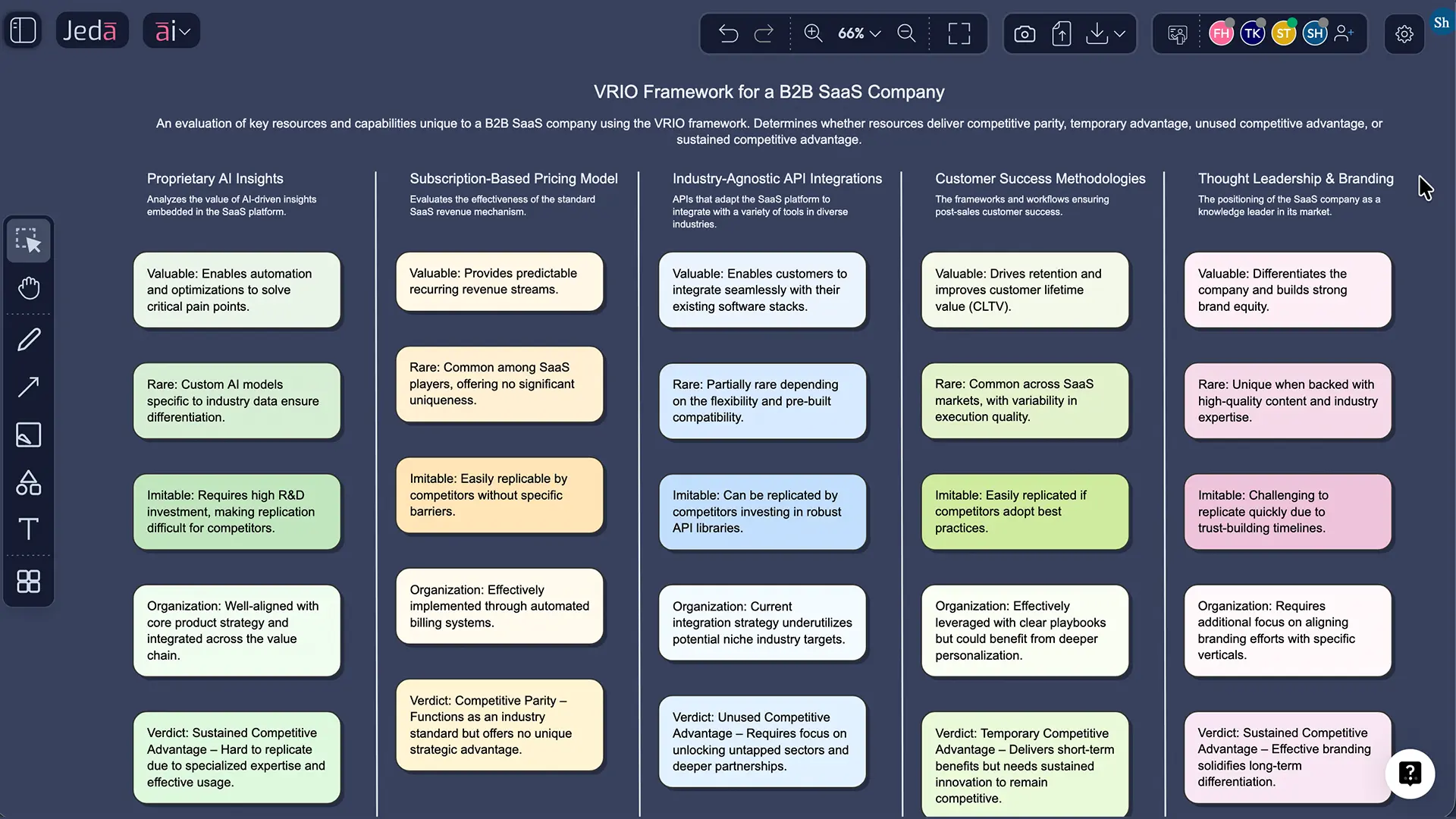
What each letter really means in practice
V = Value
Do not ask whether the resource is nice to have. Ask whether it changes outcomes. Better margins. Lower churn. Faster execution. Reduced risk. More pricing power. If the answer is fuzzy, the resource probably is not as strategic as the room wants it to be.
R = Rarity
Rarity is relative, not emotional. Your team may love a capability that half the market already has. If competitors can access it through vendors, hiring, or capital, rarity drops fast.
I = Imitability
This is where sustainable advantage either gets interesting or falls apart. Can rivals buy it, copy it, hire it away, reverse-engineer it, or substitute around it? If yes, your edge may still matter, but it probably will not last long.
O = Organization
This is the letter people rush past, and it is often the most revealing. Organization means structure, process, incentives, ownership, workflows, and management support. A company can own something rare and hard to copy yet still fail to turn it into advantage because the organization is not ready.
Best practices for a stronger VRIO analysis
Common mistakes to avoid
The first mistake is treating every internal strength as strategically important. It is not.
The second is ignoring substitutes. A capability can look unique until you realize competitors can achieve the same outcome through a different route.
Third, teams often score rarity too generously. Internal pride is not market proof.
Fourth, they treat the matrix as a one-time artifact. Markets move. Capabilities decay. Competitors learn.
And fifth, they forget organization. Honestly, this is the one that quietly wrecks the analysis. If your systems, leadership, incentives, and workflows do not support the resource, you are not looking at sustained advantage. You are looking at wasted potential.
VRIO vs SWOT vs Value Chain
Use VRIO when the main question is which internal resources can produce durable advantage. Use SWOT when you need a broader picture of internal and external factors. Use Value Chain when you want to diagnose where value is created, strengthened, or lost across operations.
| Best For | Primary Lens | Typical Output | |
|---|---|---|---|
| VRIO | Testing strategic resources | Internal advantage | Parity, temporary, unused, or sustained advantage |
| SWOT | Broad strategic diagnosis | Internal + external | Strengths, weaknesses, opportunities, threats |
| Value Chain | Operational value creation | Activities and cost/value flow | Where advantage is built or leaking |
If you already work in Jeda.ai, you do not have to choose only one forever. Build the VRIO matrix in the same AI Workspace, then branch into a SWOT or a Value Chain view when the strategy discussion needs a wider frame.
Frequently asked questions
- What is VRIO Framework with AI?
- VRIO Framework with AI is an AI-assisted version of the classic VRIO model that evaluates resources through Value, Rarity, Imitability, and Organization. The AI speeds up first-pass analysis, but the board stays editable so your team can challenge, refine, and validate each conclusion in Jeda.ai.
- Who should use a VRIO Framework with AI?
- Strategy consultants, business leaders, product managers, founders, and analysts get the most value from VRIO when they need to assess whether a capability is a real source of competitive advantage. It is especially useful before planning cycles, market moves, or major investment decisions.
- How is VRIO different from SWOT?
- VRIO is narrower and more surgical. It focuses on internal resources and whether they can support a lasting advantage. SWOT is broader because it covers both internal and external factors. Teams often use VRIO to pressure-test strengths that appear inside a SWOT exercise.
- Can AI do the full VRIO analysis for me?
- AI can generate a strong first draft, speed up categorization, and surface likely strategic patterns. It should not be the final judge. The best VRIO work happens when AI drafts the structure and humans test the assumptions with evidence, context, and market knowledge.
- What makes the Organization part of VRIO so important?
- Organization determines whether a company can actually capture the upside of a valuable, rare, and hard-to-copy resource. Without the right processes, incentives, ownership, workflows, and leadership support, even a powerful resource may never become a real advantage.
- Can I create VRIO Framework with AI in Jeda.ai without a recipe?
- Yes. You can use the Prompt Bar by selecting the Matrix command and describing the business, market, and resources you want evaluated. The recipe method is usually faster for structure, while the Prompt Bar gives you more flexibility when the context is unusual or highly specific.
- What should I bring into a VRIO workshop?
- Bring a list of candidate resources, recent performance data, market context, product or operational notes, and evidence that supports or weakens each claim. VRIO gets sharper when the room can point to facts instead of relying on instinct, hierarchy, or memory.
- Can I turn the VRIO matrix into another visual?
- Yes. In Jeda.ai, you can use Vision Transform to convert the matrix into another visual format when you want a different storytelling angle. That is useful for leadership reviews, workshop readouts, or follow-up sessions that need a diagram instead of a grid.
- How can I export my VRIO Framework with AI board?
- After refining the board in Jeda.ai, you can export the result as PNG, SVG, or PDF. That makes it easy to share with stakeholders, include in planning decks, or archive the final version after the team reaches a decision.
Sources & Further Reading
- [1]
Wernerfelt, Birger (1984) . “A Resource-Based View of the Firm” Strategic Management Journal.
View Source ↗ - [2]
Barney, Jay B. (1991) . “Firm Resources and Sustained Competitive Advantage” Journal of Management.
View Source ↗ - [3]
Barney, Jay B. and Hesterly, William S. (2008) . “Strategic Management and Competitive Advantage, Chapter 3: Internal Analysis Using VRIO” Teaching resource PDF.
View Source ↗ - [4]
Helfat, Constance E.; Kaul, Aseem; Ketchen Jr., David J.; Barney, Jay B.; Chatain, Olivier; Singh, Harbir (2023) . “Renewing the Resource-Based View: New Contexts, New Concepts, and New Methods” Strategic Management Journal.
View Source ↗ - [5]
Oregon State University (2019) . “VRIO Analysis” Strategic Management Open Textbook.
View Source ↗
Start Your VRIO Framework with AI Today
Join over 150,000+ professionals who use Jeda.ai to turn strategy ideas, documents, and business context into editable visual decisions inside one AI Workspace.
Try Free Template