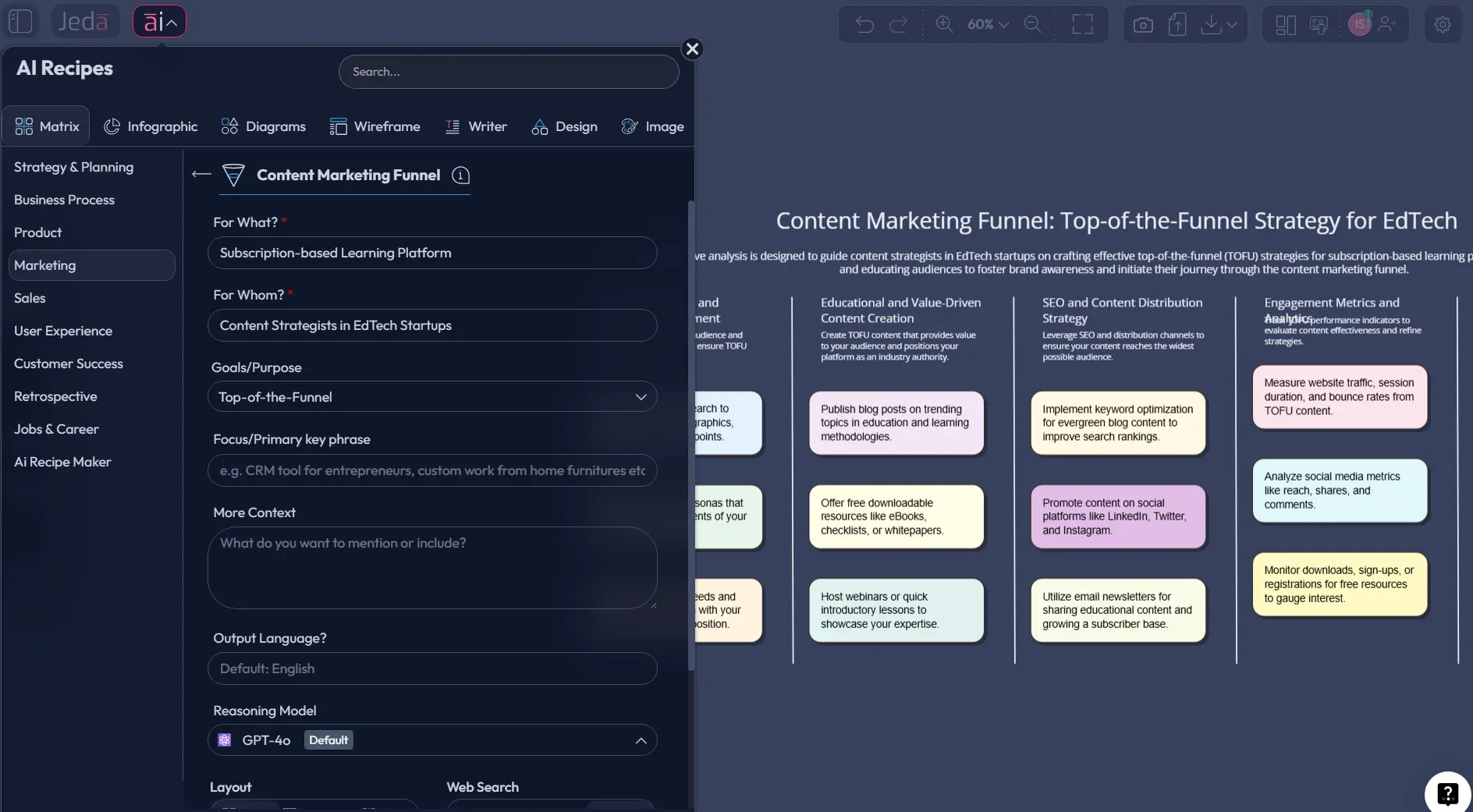
Content Marketing Funnel with AI is not just a prettier way to organize TOFU, MOFU, and BOFU assets. Done well, it becomes a working decision system: one board for awareness, one logic for consideration, one path to conversion, and a clean way to spot where buyers stall.
Most teams don’t have a content problem. They have a sequencing problem. They publish a pile of blog posts, a few case studies, maybe a webinar or two, and then wonder why traffic doesn’t become pipeline. The funnel itself is still useful because it maps content to buyer intent: TOFU builds awareness, MOFU builds confidence, and BOFU helps a buyer say yes.
But here’s the twist. Buyer journeys are messier than the neat funnel slide in your deck, and AI is compressing research behavior fast. McKinsey notes that more than 70% of AI-powered search users ask top-of-funnel questions, yet AI is also used across the full decision journey; in some sectors, 40% to 55% of consumers already use AI-based search to help make purchase decisions. So the old “publish more TOFU and hope” approach? Not dead, but definitely limping.
Jeda.ai gives you a more useful way to run the system: map the Content Marketing Funnel with AI in an editable AI Workspace, build it visually on an AI Whiteboard, use the guided recipe when you want speed, then switch to the Prompt Bar when you want tighter control. That matters because a funnel is not a static diagram. It changes with audience, offer, market, and proof. Jeda.ai positions this kind of work inside a Visual AI environment built for collaborative, editable thinking rather than static output.
And there’s a scale angle too. Jeda.ai’s internal platform reference for this workflow highlights 150,000+ users and 300+ strategic frameworks, which is exactly why the product fit here is stronger than a blank-canvas tool with a chatbot bolted on.
What is a content marketing funnel?
A content marketing funnel is a stage-based framework for aligning content to the buyer journey so prospects receive the right information at the right moment. In plain English: you stop treating all content as equal.
At the top, you help people name a problem. In the middle, you help them evaluate approaches and trust your point of view. At the bottom, you remove friction, reduce risk, and make the next step obvious.
Semrush defines the core stages clearly: Top of Funnel (ToFu) for awareness, Middle of Funnel (MoFu) for interest and evaluation, and Bottom of Funnel (BoFu) for conversion. Mailchimp and INFUSE describe the same basic logic in less acronym-happy language: deliver relevant content based on behavior and stage, then guide prospects toward action.
The trouble is that many teams build funnel content like isolated assets. A TOFU blog exists. A MOFU webinar exists. A BOFU case study exists. But they aren’t connected. No progression. No visual logic. No shared map.
That is exactly why a matrix recipe works here.
Why use a Content Marketing Funnel with AI instead of doing it manually?
Because manual funnel planning usually breaks in four places.
First, teams mislabel intent. They call something TOFU because it’s a blog post, even when it’s actually a comparison piece doing MOFU work.
Second, content calendars drift away from the actual buyer journey. You get volume without progression.
Third, personalization stays shallow. McKinsey argues that AI and generative AI can help brands scale tailored interactions as consumers increasingly expect more relevant experiences.
Fourth, the measurement story gets muddy. You can measure traffic, sure. But traffic is not movement.
Jeda.ai helps because you can turn the funnel into a visible operating model. You can structure stages in a Matrix, expand message paths in a Mindmap, convert the plan into a Flowchart, and use AI+ to deepen the weak sections after the first pass. The platform reference supplied for this workflow specifies that Matrix outputs are editable, AI+ extends existing visuals, Vision Transform converts one visual format to another, and exports are PNG, SVG, or PDF only.
- Map the whole funnel fast
Use a matrix to lay out stage, buyer intent, content type, CTA, channel, and KPI in one place.
- Generate better stage logic
Use the recipe for structure, then refine with the Prompt Bar when your funnel needs sharper segmentation.
- Make AI useful, not random
AI helps spot gaps, repurpose assets, and suggest stage-appropriate content instead of generic blog ideas.
- Bring evidence into the board
Use Document Insight or Data Insight to pull campaign learnings, call notes, and performance trends into the funnel.
- Turn one plan into many views
Start in Matrix, convert to Flowchart or Diagram, and keep the same strategy readable for different teams.
- Align marketing and revenue teams
Review content progression together on one AI Whiteboard instead of splitting the truth across docs and slides.
The four sub-recipes inside the Content Marketing Funnel recipe
This matrix recipe under the Marketing category works best when you think of it as four decision modes rather than one generic template.
Top-of-the-Funnel
Use this when your main job is reach, discovery, and problem framing. TOFU content should be useful before it is persuasive. Semrush recommends educational, non-overtly promotional assets at this stage, including blog posts, infographics, and ebooks.
Good TOFU questions:
- What problem is the audience trying to name?
- What category questions are they asking?
- What content builds trust before a product pitch?
Typical assets: SEO blog posts, explainers, templates, social snippets, trend reports, infographics, and educational videos.
Middle-of-the-Funnel
This is where buyers compare approaches, narrow the field, and look for confidence. MOFU content should help people evaluate, not just consume. Targeted email, workshops, webinars, comparison guides, and case-backed education fit here.
Good MOFU questions:
- What objections show up once buyers understand the problem?
- What criteria do they use to compare options?
- Which proof points move them from curiosity to consideration?
Typical assets: webinars, buyer guides, comparisons, use-case pages, calculators, mini case studies, email nurture sequences.
Bottom-of-the-Funnel
BOFU is where clarity beats cleverness. Buyers want answers on fit, pricing logic, implementation, proof, and risk. Semrush highlights demos, customer success stories, onboarding resources, and pricing support as BOFU tactics.
Good BOFU questions:
- What final risk needs to be reduced?
- What proof closes the deal?
- What CTA is actually appropriate here: demo, trial, consult, or proposal?
Typical assets: demos, full case studies, ROI narratives, implementation pages, FAQs, objection handling, pricing support, customer proof.
Full Funnel Strategy
This is the grown-up version. Not a pile of stages. A system.
Use it when you need to connect audience intent, content inventory, distribution, offers, and next-step movement in one board. This mode is the difference between “we make content” and “we build buyer momentum.”
How to create a Content Marketing Funnel with AI in Jeda.ai
The workflow file for this project requires two methods here: Method 1: Recipe Matrix and Method 2: Prompt Bar. It also requires an AI+ button generated deep dive after the initial output.
This recipe is best treated as a Matrix-first workflow. The platform guidance says AI Recipes live in the AI Menu at the top-left, while manual generation uses the Prompt Bar at the bottom of the workspace.
- Open a workspace in Jeda.ai
Create or open a board in your AI Workspace. This becomes the shared funnel planning canvas for strategy, content, and revenue teams.
- Method 1: Use the Recipe Matrix
Open the AI Menu at the top-left, go to Matrix Recipes → Marketing, select Content Marketing Funnel, then choose the sub-recipe you need: Top-of-the-Funnel, Middle-of-the-Funnel, Bottom-of-the-Funnel, or Full Funnel Strategy.
- Fill the recipe context fields
Add audience, offer, buying stage, goals, channels, constraints, and any must-win messages. Generate the matrix.
- Method 2: Use the Prompt Bar
Open the Prompt Bar, select the Matrix command, write your funnel prompt in plain language, and generate the visual manually when you want more control than the recipe gives you.
- Use AI+ for a deeper pass
Select a weak stage, message lane, or CTA block and tap the AI+ button to extend the analysis. Use it to deepen segmentation, add missing proof, or expand the handoff logic between stages.
- Convert and share
Use Vision Transform to convert the matrix into a flowchart or diagram for execution. Then export the board as PNG, SVG, or PDF, or keep collaborating live on the AI Whiteboard.
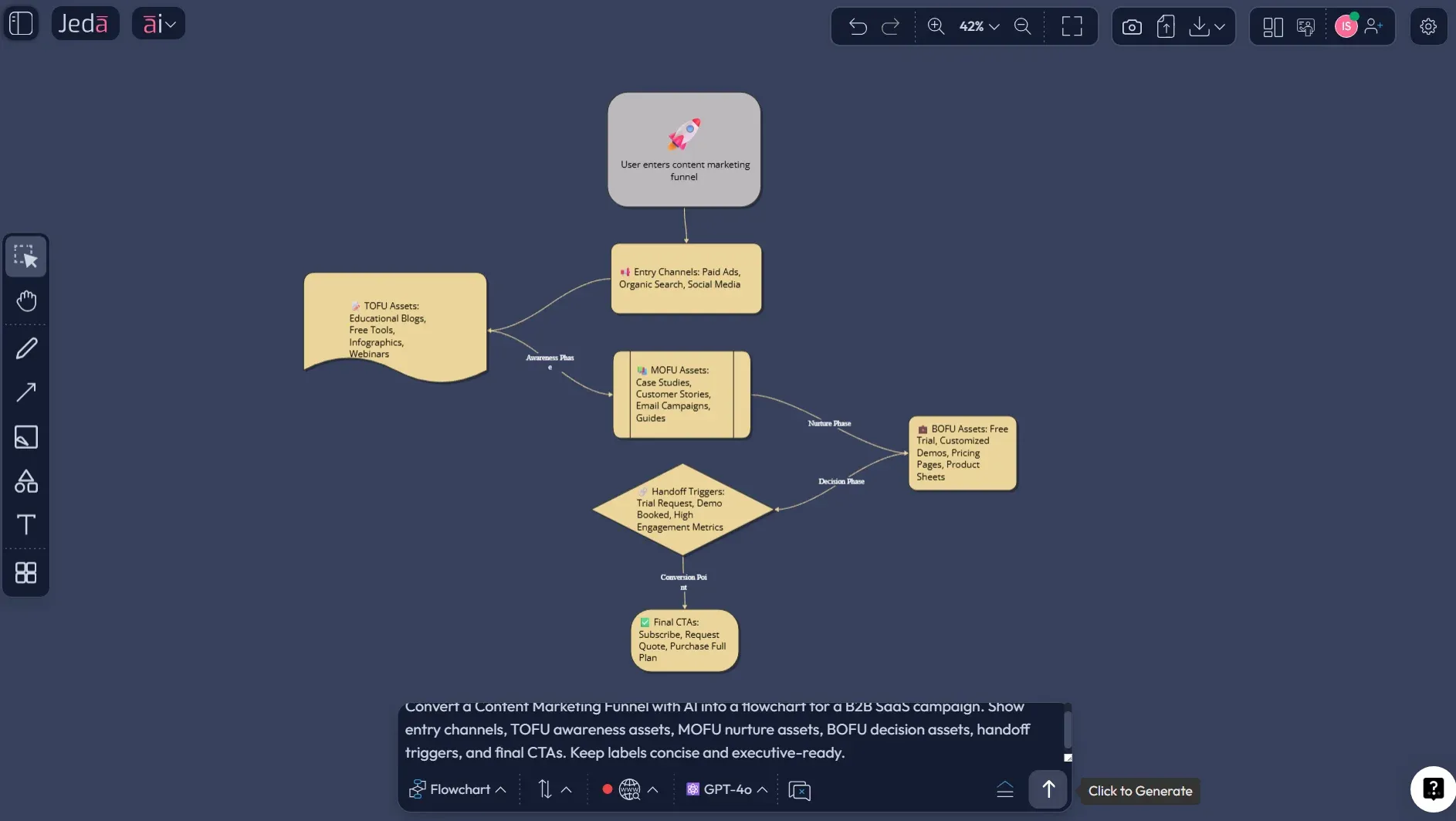
Copy-paste prompt for the Prompt Bar
Prompt:
Create a Content Marketing Funnel with AI for [company / product / offer].
Audience: [ICP or persona].
Goal: [pipeline, demos, trials, signups, deals].
Build a matrix with four sections: Top-of-the-Funnel, Middle-of-the-Funnel, Bottom-of-the-Funnel, Full Funnel Strategy.
For each section, include: buyer intent, core questions, best content types, primary CTA, distribution channels, proof needed, and KPIs.
Keep the recommendations specific, practical, and stage-appropriate.
End with: 3 biggest funnel gaps, 3 repurposing opportunities, and 3 next actions for the team this month.
AI+ button generated deep dive
Nothing specific should be instructed through AI+ here, so use it the way the workflow intends: as a second-layer expansion tool, not as a brand-new prompt engine. A good move is to select one matrix block — say MOFU — and use AI+ to expand hidden objections, missing proof assets, or weak CTAs. Then do the same for BOFU if conversion friction is still fuzzy.
That gives you the practical version of “deep dive” without turning the board into prompt soup. Which, let’s be honest, happens fast.
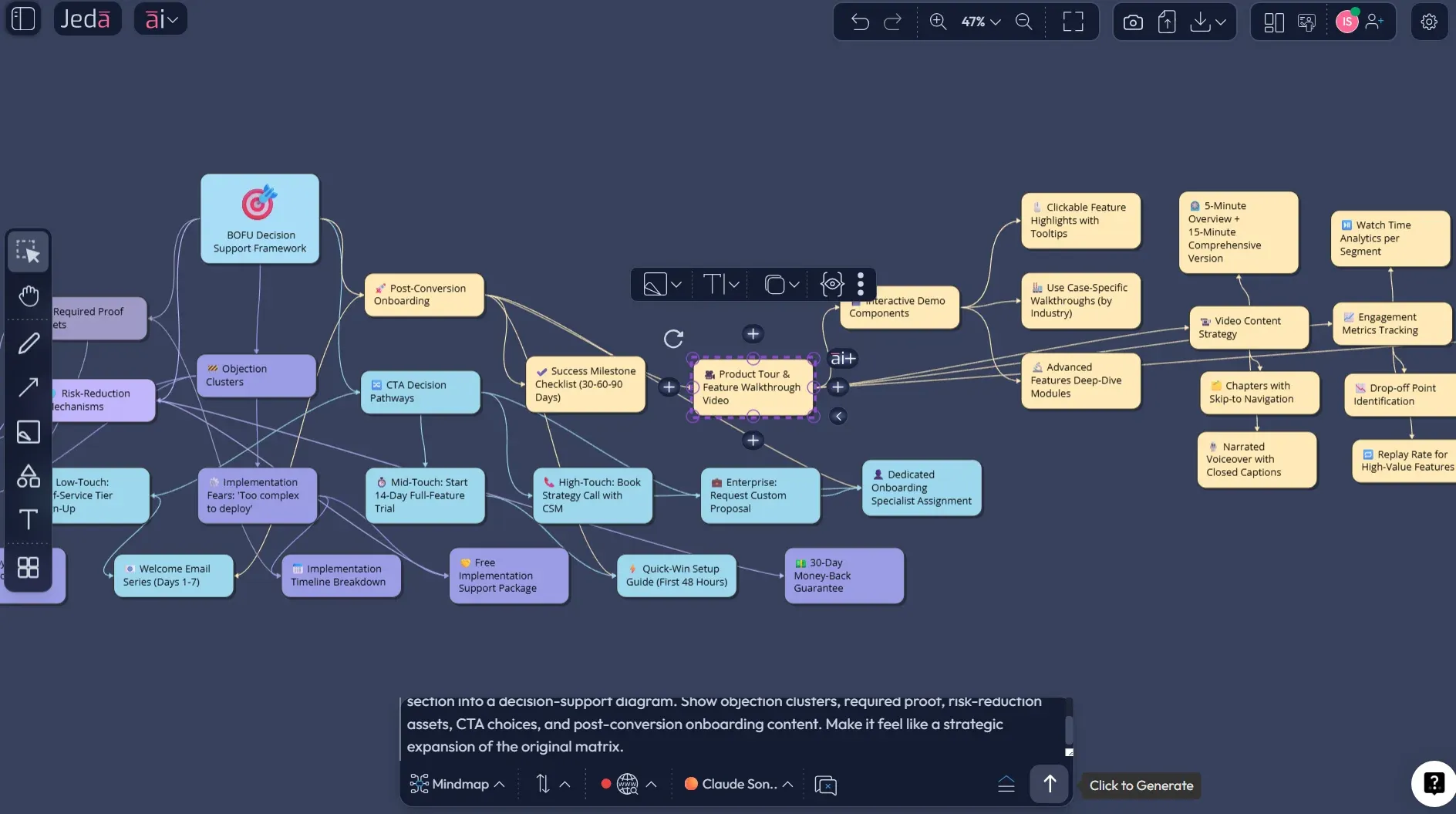
A practical full-funnel example
Say you’re marketing an AI workspace for strategy teams.
Your TOFU content might target category questions such as “what is an AI workspace,” “how to plan content across funnel stages,” or “TOFU MOFU BOFU examples.” Its job is reach and problem definition.
Your MOFU layer would shift into comparison and framework content: buyer journey maps, content planning templates, “how to build a marketing funnel with AI,” or use-case pages for consultants, marketers, and business leaders. This is where self-service content has to work harder. HubSpot cites G2 research showing 69% of B2B buyers typically engage sales only after they’ve already made their decision.
Your BOFU layer would tighten around demos, implementation clarity, outcomes, customer proof, and decision support. Fewer assets. More consequence.
And your Full Funnel Strategy view would connect all of it: audience segment, content lane, offer, handoff trigger, KPI, and owner.
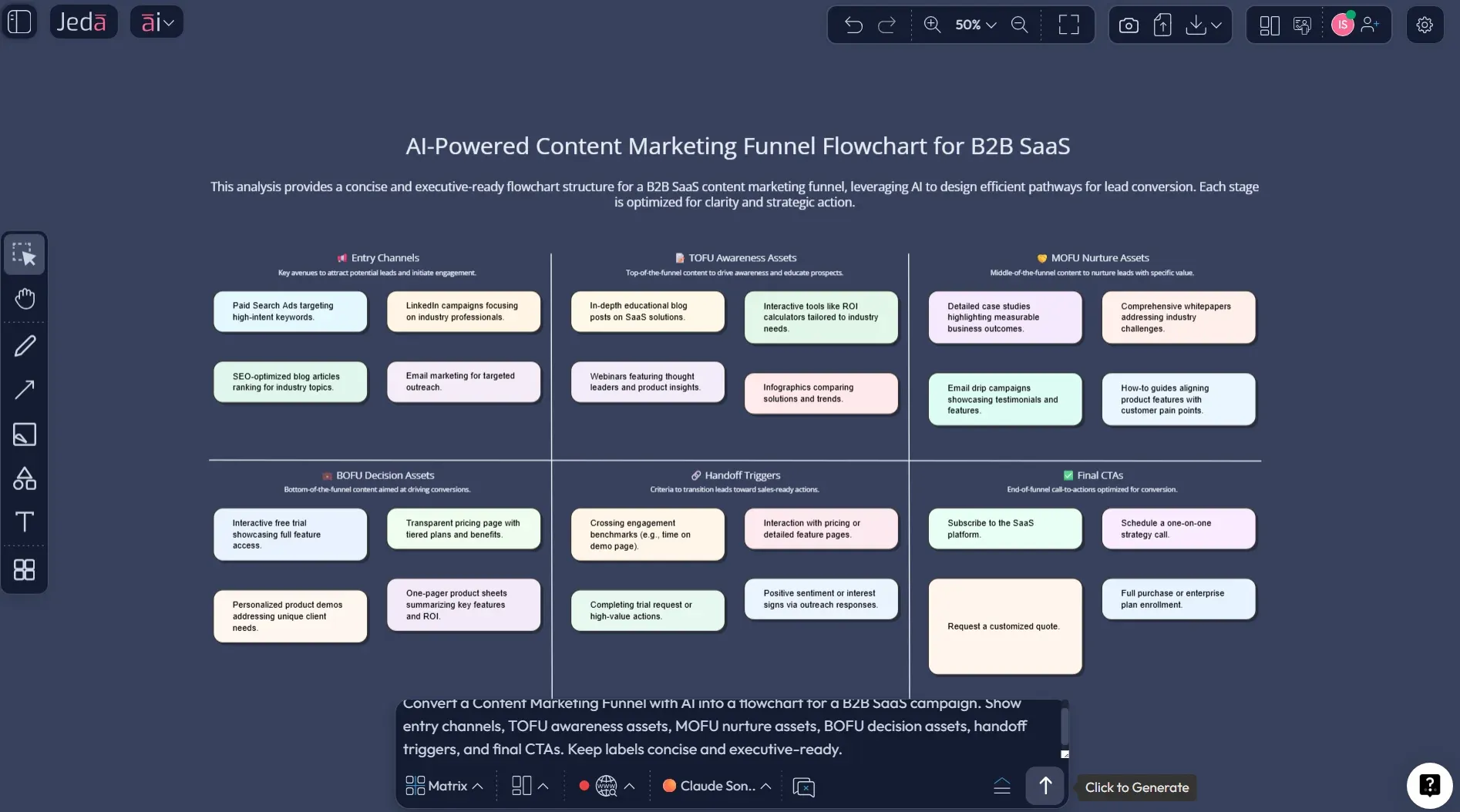
Best practices for building a smarter funnel
A few rules help keep the funnel useful instead of decorative.
1. Start with buyer questions, not formats
Blog post is not a strategy. Webinar is not a strategy. A buyer question is the real starting point.
2. Measure movement, not just traffic
TOFU can win on reach, but a funnel needs stage progression too. Track whether people move from awareness assets to evaluation assets, not just whether they liked a headline.
3. Match proof to stage
Awareness needs relevance. Consideration needs confidence. Decision needs risk reduction.
4. Refresh for AI search reality
McKinsey’s 2025 research argues brands must rethink how they structure, produce, and amplify content because AI-powered search now shapes decisions across the journey. So your funnel content should answer questions clearly, cite proof, and remain easy to extract.
5. Keep timeliness visible
A 2024 Industrial Marketing Management study found that timely, stage-relevant content increases engagement in B2B markets. Old assets can still rank, but stale funnel logic quietly kills progression.
Common mistakes to avoid
The classics show up again and again.
Mistake 1: Treating TOFU as random traffic bait.
TOFU should educate around real pains, not chase clicks that never relate to your offer.
Mistake 2: Making MOFU too generic.
This is the stage where nuance matters. Comparison criteria, objection handling, and proof do the heavy lifting.
Mistake 3: Hiding the BOFU CTA.
If a buyer is ready, don’t make them solve a puzzle to find the next step.
Mistake 4: Using one message for every persona.
Different audiences research differently. Your funnel should reflect that, visually and strategically.
Mistake 5: Forgetting retention and advocacy.
Strictly speaking, the classic funnel ends at conversion. Real growth usually doesn’t.
Frequently Asked Questions
- What is a content marketing funnel with AI?
- A content marketing funnel with AI is a stage-based content system that uses AI to map buyer intent, suggest stage-fit content, identify gaps, and improve progression from awareness to conversion. It should help structure decisions, not just generate more assets.
- What are TOFU, MOFU, and BOFU in content marketing?
- TOFU is top-of-funnel awareness content, MOFU is middle-of-funnel consideration content, and BOFU is bottom-of-funnel conversion content. The goal is to match content to the buyer’s questions and decision readiness at each stage.
- Why use AI for funnel planning instead of doing it manually?
- AI helps teams classify intent faster, propose content ideas by stage, surface missing proof, and connect scattered assets into one visual plan. The real gain is clarity and speed, especially when teams need to revise the funnel often.
- What content works best at the top of the funnel?
- TOFU works best with educational, non-promotional content such as blog posts, explainer guides, templates, infographics, and short videos. The job is to help buyers understand a problem before pushing them toward a product decision.
- What should be included in a MOFU content plan?
- A strong MOFU plan usually includes comparison content, webinars, buyer guides, segmented email nurture, use-case pages, and proof-backed education. At this stage, buyers want confidence, criteria, and a reason to keep evaluating your solution.
- What belongs in the bottom of the funnel?
- BOFU content should remove friction and reduce risk. Typical assets include demos, case studies, pricing support, implementation FAQs, onboarding clarity, and customer proof. Buyers at this stage want evidence and a clean next step.
- How does Jeda.ai help build a content marketing funnel?
- Jeda.ai lets teams generate the funnel as an editable matrix, expand sections with AI+ on an AI Whiteboard, convert the plan into flowcharts or diagrams with Vision Transform, and collaborate live in one AI Workspace instead of spreading logic across multiple tools.
- Is there a recipe for Content Marketing Funnel in Jeda.ai?
- For this workflow, yes—the Content Marketing Funnel is treated as a Matrix recipe under the Marketing category with four sub-recipes: Top-of-the-Funnel, Middle-of-the-Funnel, Bottom-of-the-Funnel, and Full Funnel Strategy. The Prompt Bar method also works when you want more control.
- Can I use web context and internal files to improve the funnel?
- Yes. Jeda.ai includes web search as a platform feature, and you can also use uploaded documents or datasets through Document Insight and Data Insight to feed evidence into the planning board. That helps keep the funnel grounded in real inputs.
- Can I export the finished funnel board?
- Yes. Export options referenced in the platform guidance include PNG, SVG, and PDF. Those formats work well for playbooks, stakeholder reviews, and campaign planning archives.
Sources and further reading
- [1]
Rachel Handley (2024) . “How to Build an Effective Content Marketing Funnel [Data + Guide]” Semrush.
View Source ↗ - [2]
Mailchimp (n.d.) . “Content Marketing Funnel: Content Guide for Each Stage” Mailchimp.
View Source ↗ - [3]
INFUSE (n.d.) . “Content Marketing Funnel” INFUSE Glossary.
View Source ↗ - [4]
David Court, Dave Elzinga, Susan Mulder, Ole Jørgen Vetvik (2009) . “The consumer decision journey” McKinsey Quarterly.
View Source ↗ - [5]
McKinsey & Company (2025) . “Winning in the age of AI search” McKinsey.
View Source ↗ - [6]
McKinsey & Company (2025) . “Unlocking the next frontier of personalized marketing” McKinsey.
View Source ↗ - [7]
Hollebeek, Linda D. and Macky, Keith (2019) . “Digital Content Marketing's Role in Fostering Consumer Engagement, Trust, and Value” Journal of Interactive Marketing.
View Source ↗ - [8]
du Plessis, Charmaine (2022) . “A Scoping Review of the Effect of Content Marketing on Online Consumer Behavior” SAGE Open.
View Source ↗ - [9]
Salonen, Anna et al. (2024) . “Digital content marketing on social media along the B2B buyer journey” Industrial Marketing Management.
View Source ↗
Build your Content Marketing Funnel with AI in one board
Join over 150,000+ users using Jeda.ai’s AI Workspace to plan, visualize, and refine funnel strategy faster on one board.
Try Free Template